
Quantum Rotational Dynamics of CH 3 I Group
- Slides: 11
Quantum Rotational Dynamics of CH 3 I Group D Y Liu, S Jonas, V Atakan, H Wu, S Omar-Diallo, I-K. Jeong D. Phelan
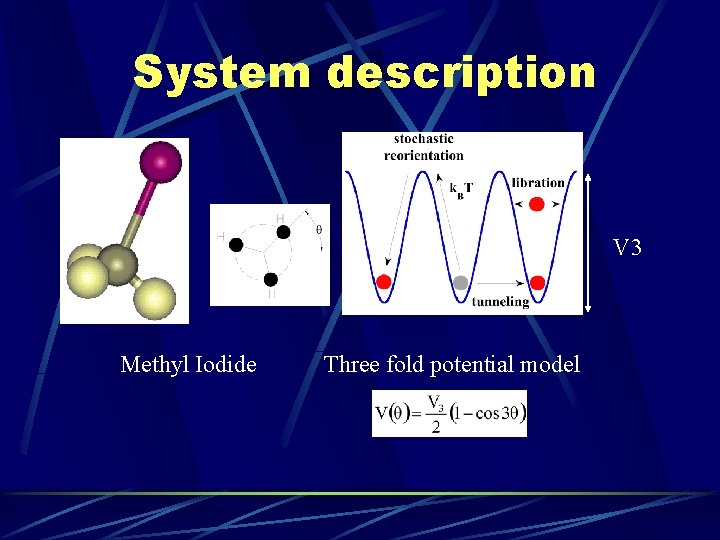
System description V 3 Methyl Iodide Three fold potential model
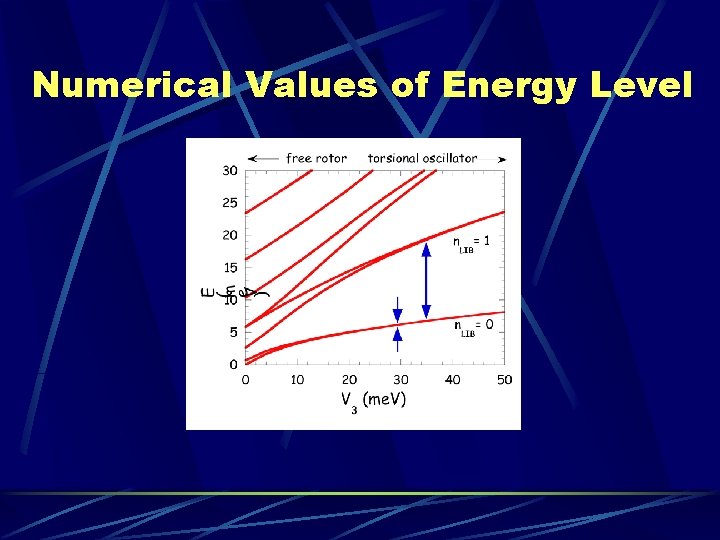
Numerical Values of Energy Level
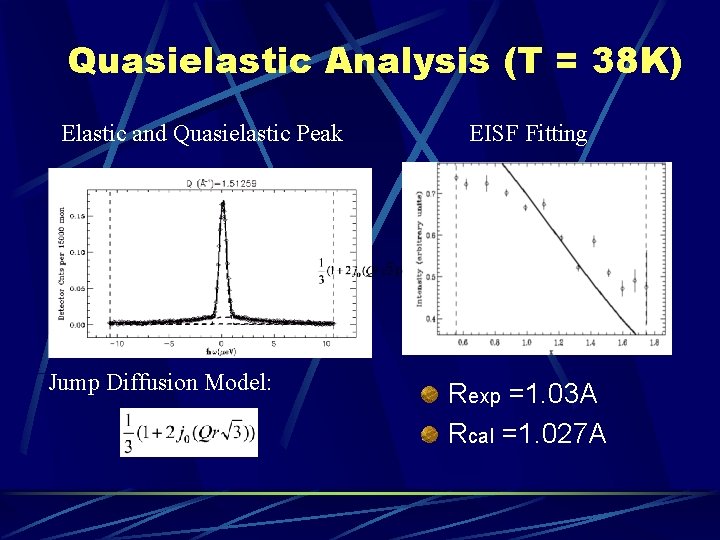
Experimental Goals What we are looking for: 1. 2. 3. The “height”of the V 3 well The librational energy The projected radius of Hydrogen from Carbon
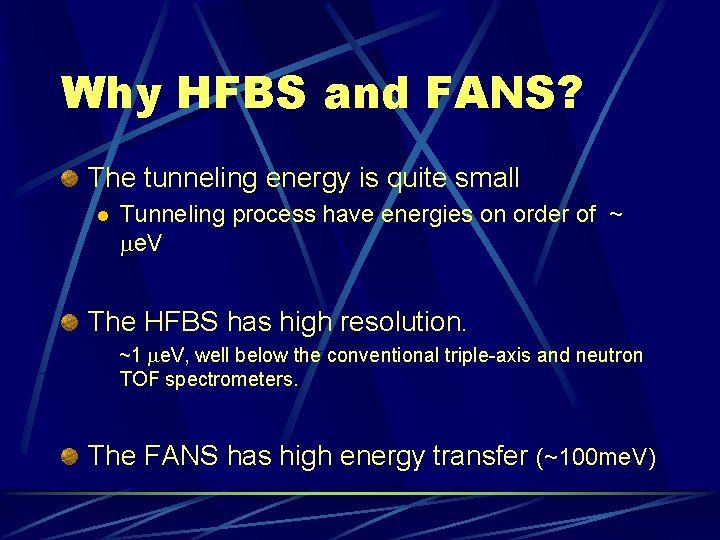
Why HFBS and FANS? The tunneling energy is quite small l Tunneling process have energies on order of ~ me. V The HFBS has high resolution. ~1 me. V, well below the conventional triple-axis and neutron TOF spectrometers. The FANS has high energy transfer (~100 me. V)
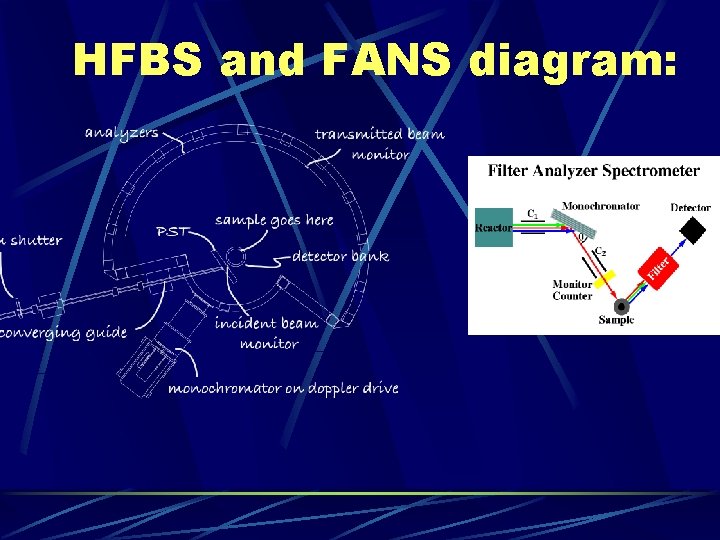
HFBS and FANS diagram:
How HFBS works The HFBS varies incident energy by using a cam-based Doppler-driven monochromator. Phase Space Transformer increase flux 4 x. Very large analyzer array, 20% of 4 p. The scattering chamber is operated under vacuum l instead of Ar or He improving the signal-tobackground ratio.
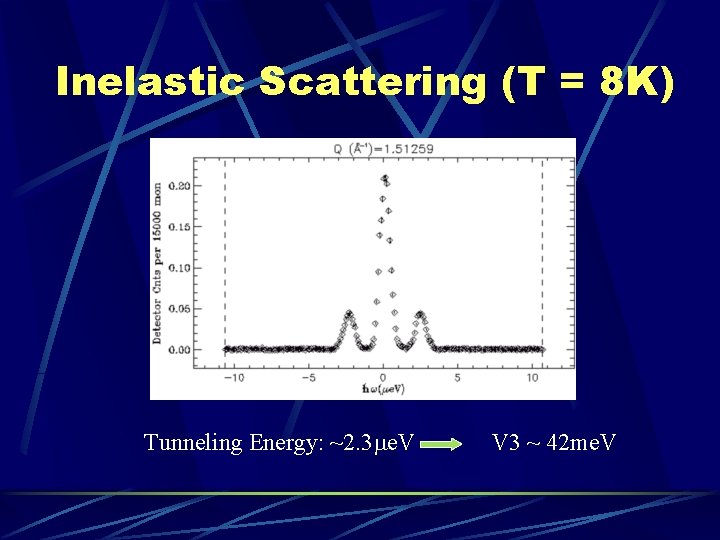
Inelastic Scattering (T = 8 K) Tunneling Energy: ~2. 3 me. V V 3 ~ 42 me. V
Quasielastic Analysis (T = 38 K) Elastic and Quasielastic Peak Jump Diffusion Model: EISF Fitting Rexp =1. 03 A Rcal =1. 027 A
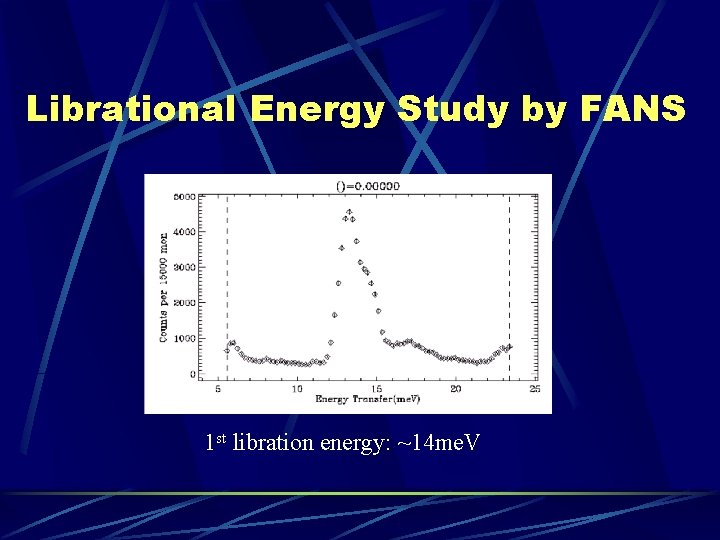
Librational Energy Study by FANS 1 st libration energy: ~14 me. V
Acknowledgement NIST Zema Chowdhuri, Robert Dimeo (HFBS) Craig Brown (FANS) Members of Group D, summer school 2003