
QUANTUM QUENCH DYNAMICS IN THE EXTENDED DICKE MODEL

![Forward quench protocol S. Lerma-Hernández et al. , ar. Xiv: 1710. 05937 [quant-ph] (2017)](https://slidetodoc.com/presentation_image_h/145f9eedfc9859841e45b30ec0ab76b5/image-17.jpg "Forward quench protocol S. Lerma-Hernández et al. , ar. Xiv: 1710. 05937 [quant-ph] (2017)")

- Slides: 27
QUANTUM QUENCH DYNAMICS IN THE EXTENDED DICKE MODEL Michal Kloc, Pavel Stránský, Pavel Cejnar Institute of Particle and Nuclear Physics Charles University, Prague Czech Republic ar. Xiv: 1805. 06285 [quant. ph] (2018) Sumbmitted to: Physical Review A CSIC, Madrid 2018
Outline • Excited-State Quantum Phase Transitions (ESQPT) • Extended Dicke Model • Quantum quenches: backward and forward protocols
Brief introduction to the ESQPTs
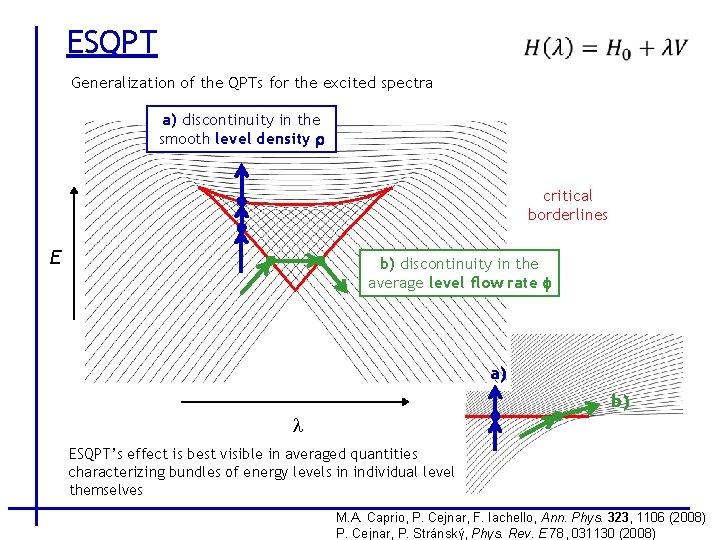
ESQPT Generalization of the QPTs for the excited spectra a) discontinuity in the smooth level density r critical borderlines E b) discontinuity in the average level flow rate f a) b) l ESQPT’s effect is best visible in averaged quantities characterizing bundles of energy levels in individual level themselves M. A. Caprio, P. Cejnar, F. Iachello, Ann. Phys. 323, 1106 (2008) P. Cejnar, P. Stránský, Phys. Rev. E 78, 031130 (2008)
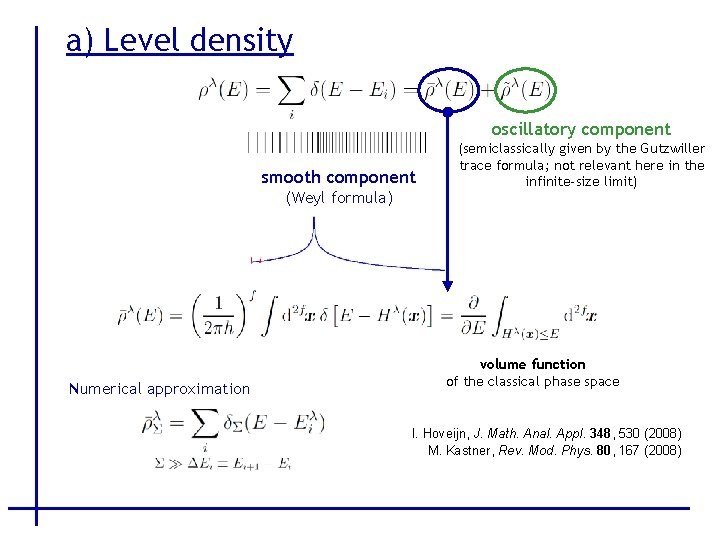
a) Level density oscillatory component smooth component (Weyl formula) Numerical approximation (semiclassically given by the Gutzwiller trace formula; not relevant here in the infinite-size limit) volume function of the classical phase space I. Hoveijn, J. Math. Anal. Appl. 348, 530 (2008) M. Kastner, Rev. Mod. Phys. 80, 167 (2008)
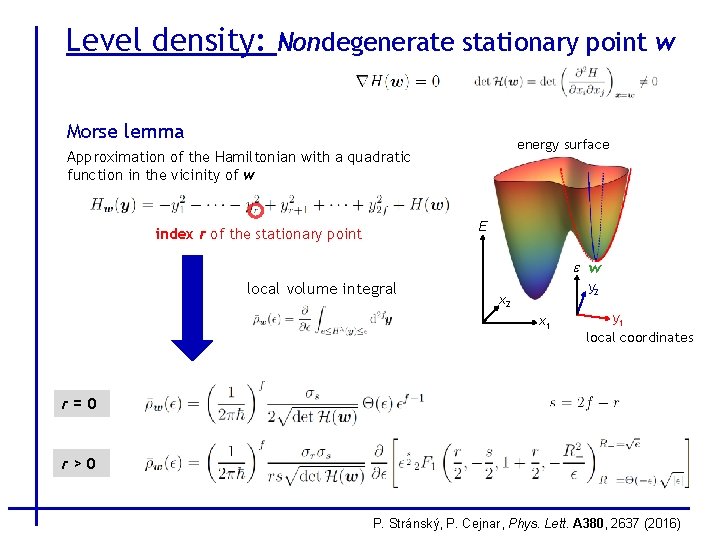
Level density: Nondegenerate stationary point w Morse lemma energy surface Approximation of the Hamiltonian with a quadratic function in the vicinity of w E index r of the stationary point e w local volume integral y 2 x 1 y 1 local coordinates r=0 r>0 P. Stránský, P. Cejnar, Phys. Lett. A 380, 2637 (2016)
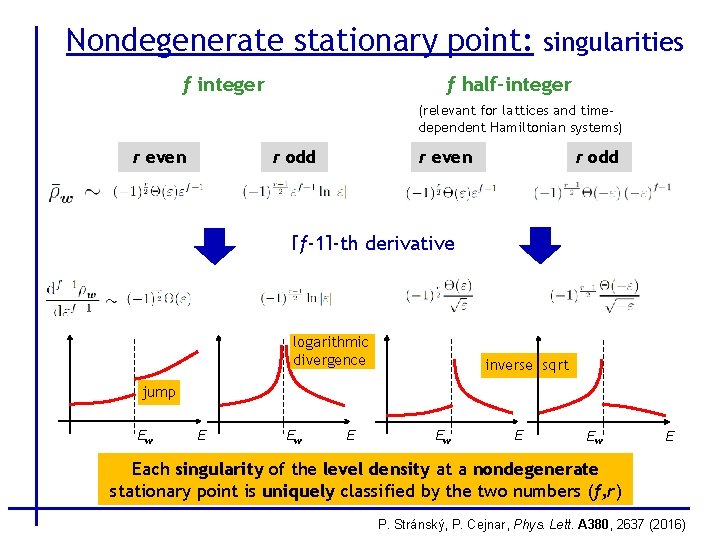
Nondegenerate stationary point: singularities f integer f half-integer (relevant for lattices and timedependent Hamiltonian systems) r even r odd [f-1]-th derivative logarithmic divergence inverse sqrt jump Ew E Each singularity of the level density at a nondegenerate stationary point is uniquely classified by the two numbers (f, r) P. Stránský, P. Cejnar, Phys. Lett. A 380, 2637 (2016)
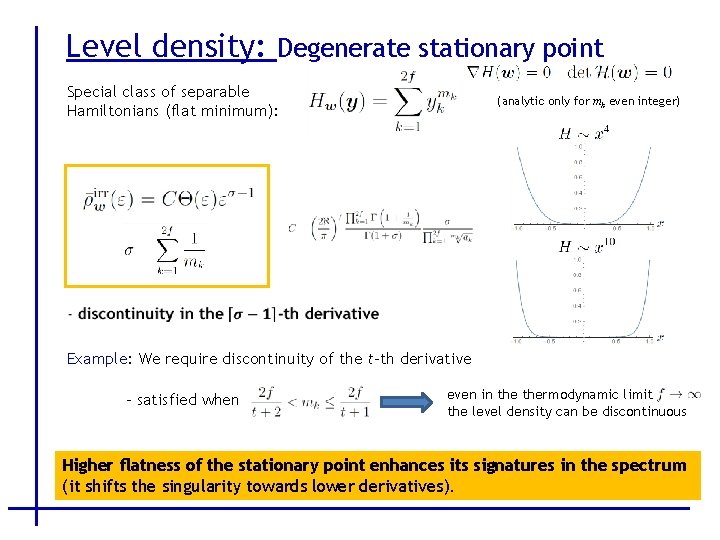
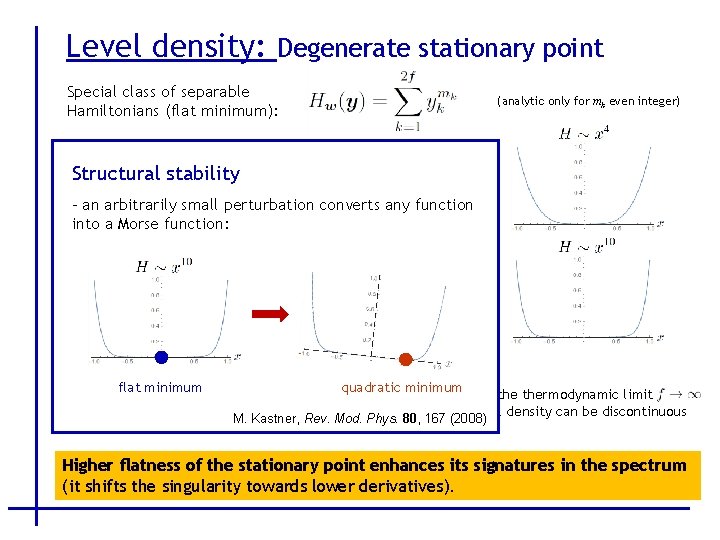
Level density: Degenerate stationary point Special class of separable Hamiltonians (flat minimum): (analytic only for mk even integer) Example: We require discontinuity of the t-th derivative - satisfied when even in thermodynamic limit the level density can be discontinuous Higher flatness of the stationary point enhances its signatures in the spectrum (it shifts the singularity towards lower derivatives).
Level density: Degenerate stationary point Special class of separable Hamiltonians (flat minimum): (analytic only for mk even integer) Structural stability - an arbitrarily small perturbation converts any function into a Morse function: - discontinuity of the -th derivative Example 1: We require discontinuity of the t-th derivative flat minimum quadratic minimum even in thermodynamic limit - satisfied when the level density can be discontinuous M. Kastner, Rev. Mod. Phys. 80, 167 (2008) Higher flatness of the stationary point enhances its signatures in the spectrum (it shifts the singularity towards lower derivatives).
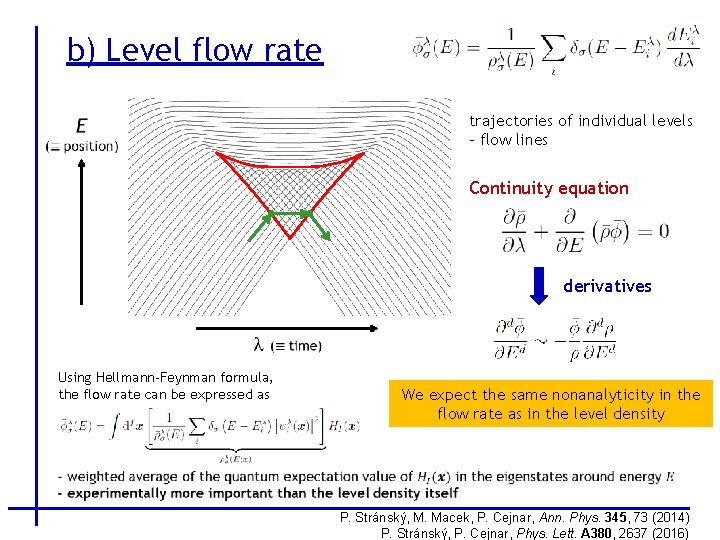
b) Level flow rate trajectories of individual levels – flow lines Continuity equation derivatives Using Hellmann-Feynman formula, the flow rate can be expressed as We expect the same nonanalyticity in the flow rate as in the level density P. Stránský, M. Macek, P. Cejnar, Ann. Phys. 345, 73 (2014) P. Stránský, P. Cejnar, Phys. Lett. A 380, 2637 (2016)
Extended Dicke Model
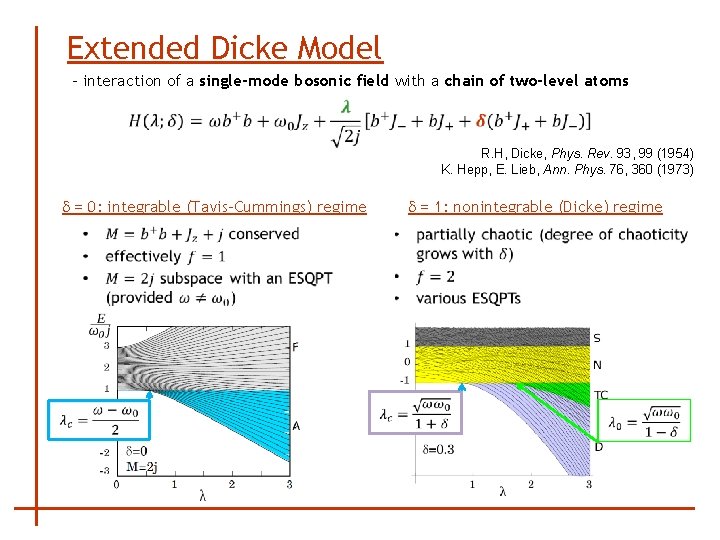
Extended Dicke Model - interaction of a single-mode bosonic field with a chain of two-level atoms R. H, Dicke, Phys. Rev. 93, 99 (1954) K. Hepp, E. Lieb, Ann. Phys. 76, 360 (1973) d = 1: nonintegrable (Dicke) regime d = 0: integrable (Tavis-Cummings) regime
Quantum quenches in the Extended Dicke Model
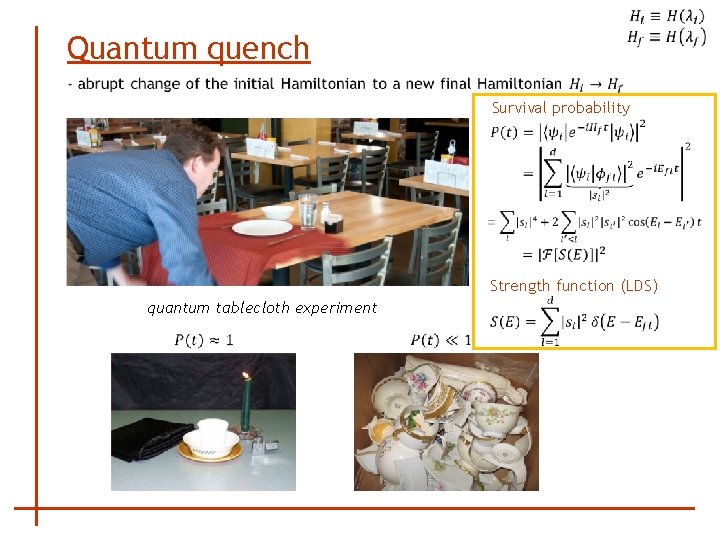
Quantum quench Survival probability Strength function (LDS) quantum tablecloth experiment
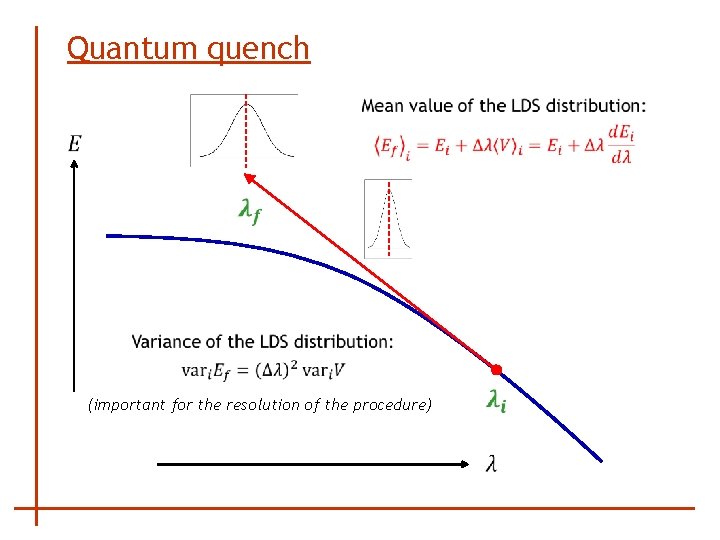
Quantum quench (important for the resolution of the procedure)
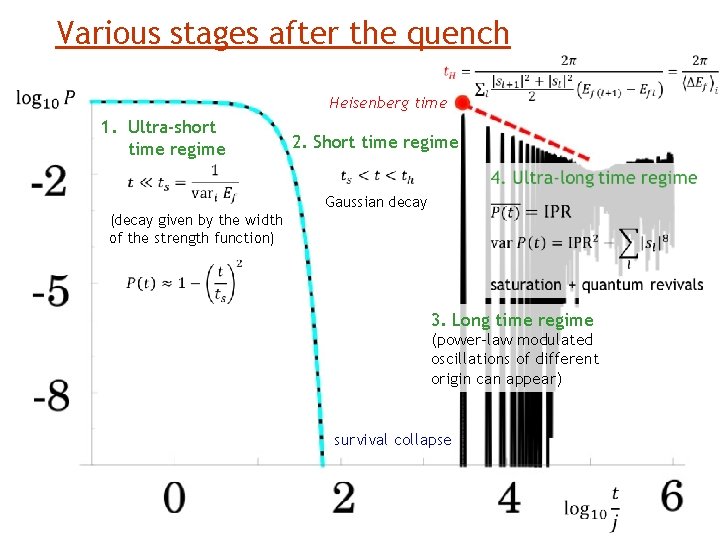
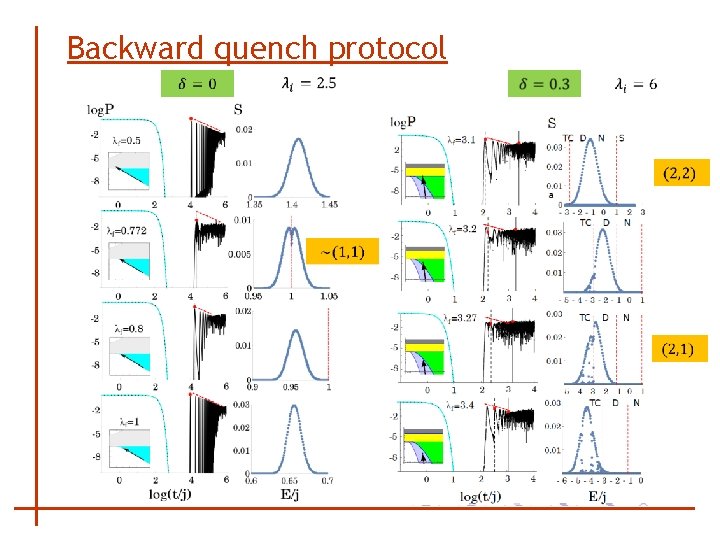
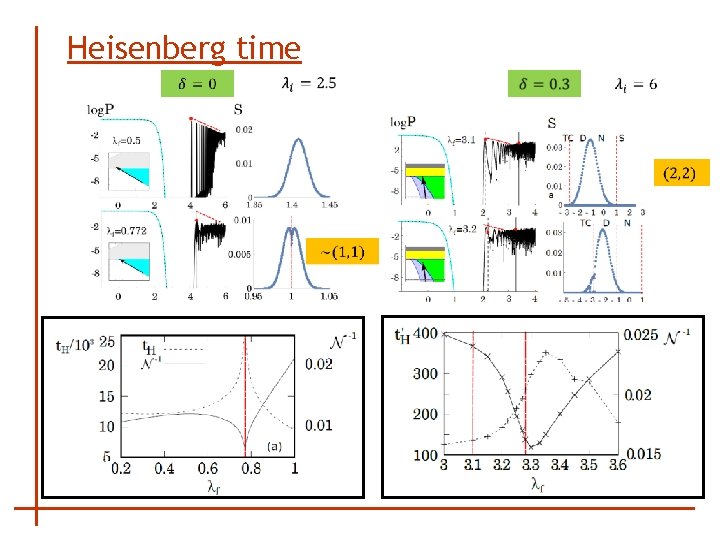
Various stages after the quench Heisenberg time 1. Ultra-short time regime 2. Short time regime Gaussian decay (decay given by the width of the strength function) 3. Long time regime (power-law modulated oscillations of different origin can appear) survival collapse
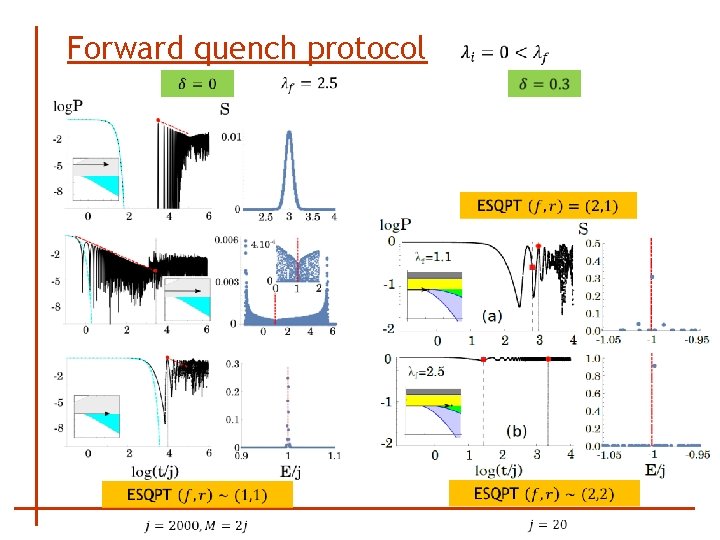
Forward quench protocol S. Lerma-Hernández et al. , ar. Xiv: 1710. 05937 [quant-ph] (2017)
Forward quench protocol
Backward quench protocol
Heisenberg time
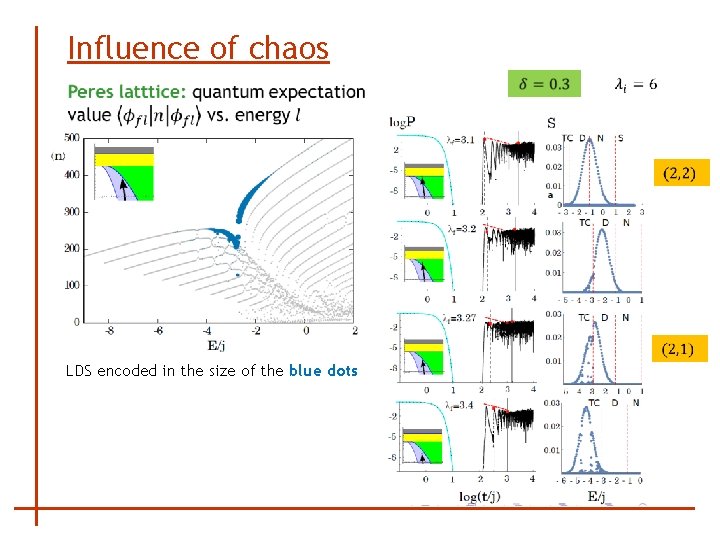
Influence of chaos LDS encoded in the size of the blue dots
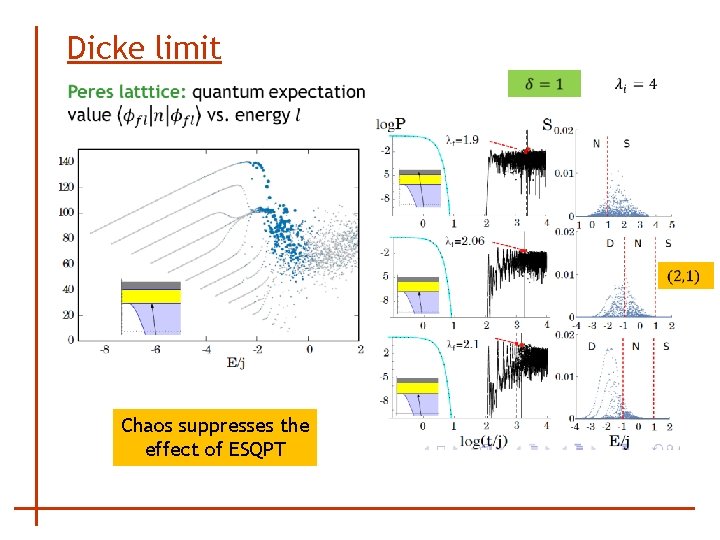
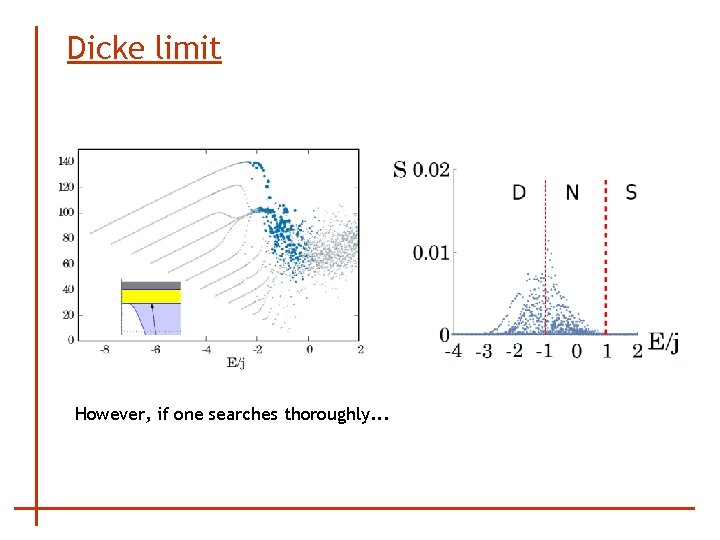
Dicke limit Chaos suppresses the effect of ESQPT
Dicke limit However, if one searches thoroughly. . .
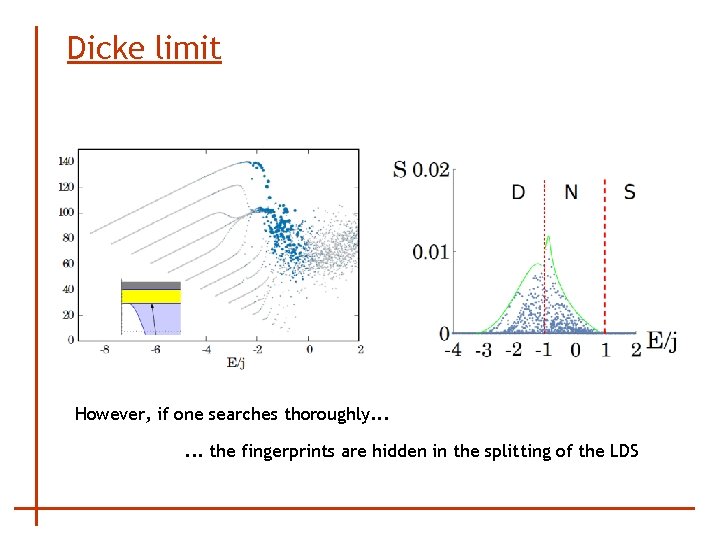
Dicke limit However, if one searches thoroughly. . . the fingerprints are hidden in the splitting of the LDS
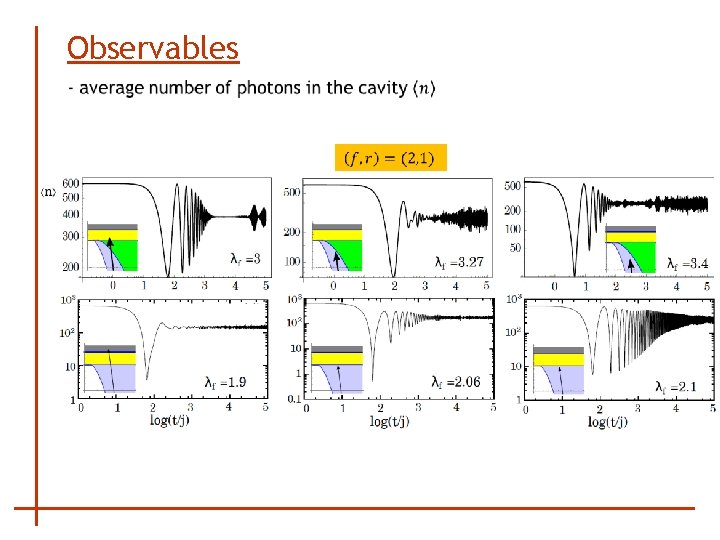
Observables
Summary THANKS FOR YOUR ATTENTION 1. ESQPT stabilizes the initial state - forward quenches across the QPT to the ESQPT regions - in the non-integrable case the stabilization is stronger for longer quenches to the ESQPT between TC and N phase 2. ESQPT speeds up the onset of the saturation - backward quenches from the ground state to the ESQPT regions - in non-integrable systems strongly disturbed by chaos Selected bibliography http: //pavelstransky. cz/quench_dicke. php Extended Dicke Model • R. H. Dicke, Phys. Rev. 93, 99 (1954) • T. Brandes, Phys. Rev. E 88, 032133 (2013) • M. Kloc, P. Stránský, P. Cejnar, Ann. Phys. 382, 85 (2017) Quantum quenches and ESQPT • P. Pérez-Fernández et al. , Phys. Rev. A 83, 033802 (2011) • L. F. Santos, F. Pérez-Bernal, Phys. Rev. A 92, 050101(R) (2015) • L. F. Santos, M. Távora, F. Pérez-Bernal, Phys. Rev. A 94, 012113 (2016) Experimental relevance • K. Baumann et al. , Phys. Rev. Lett. 107, 140402 (2011) • Z. Zhiqiang et al. , Optica 4, 424 (2017)