
QUANTUM PHYSICS 2017 11 18 Double slit experiment

QUANTUM PHYSICS 2017. 11. 18

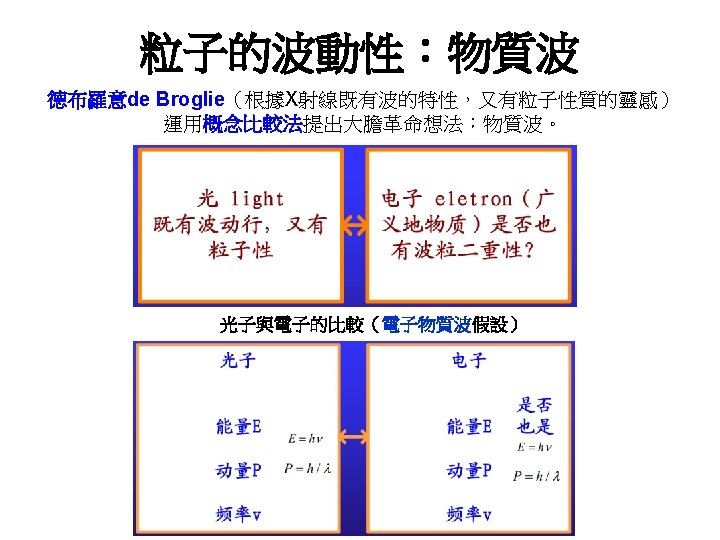
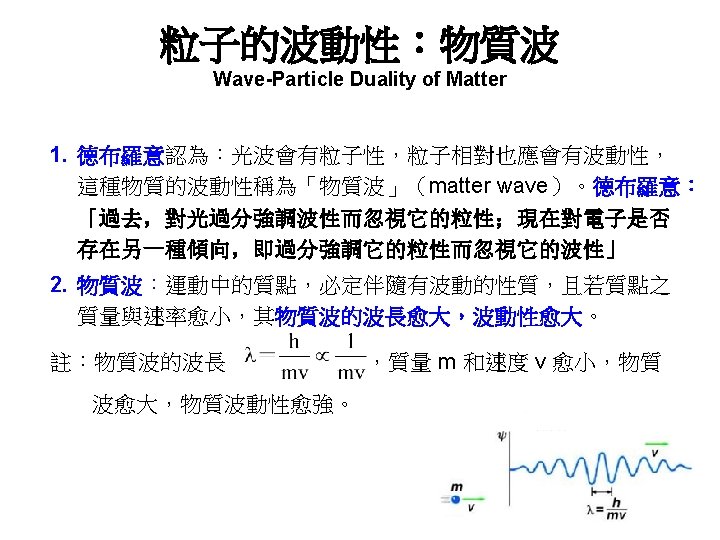
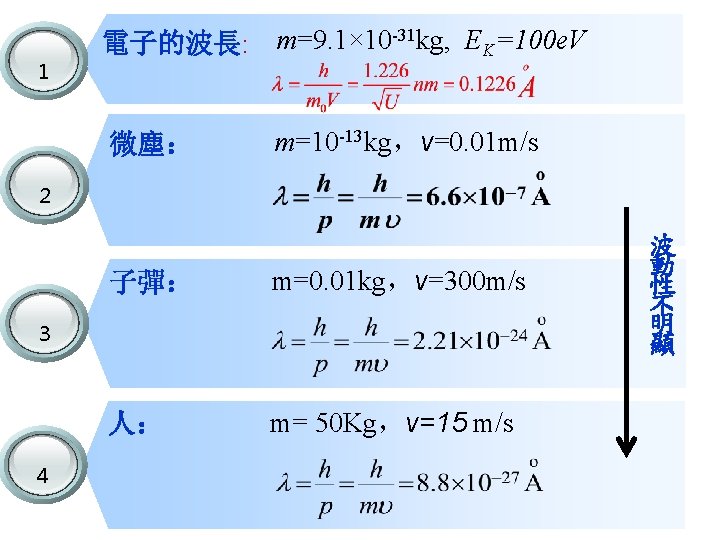
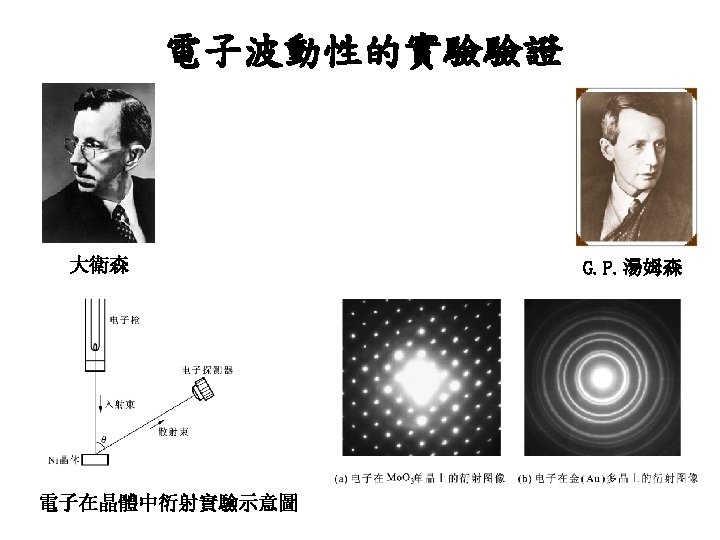


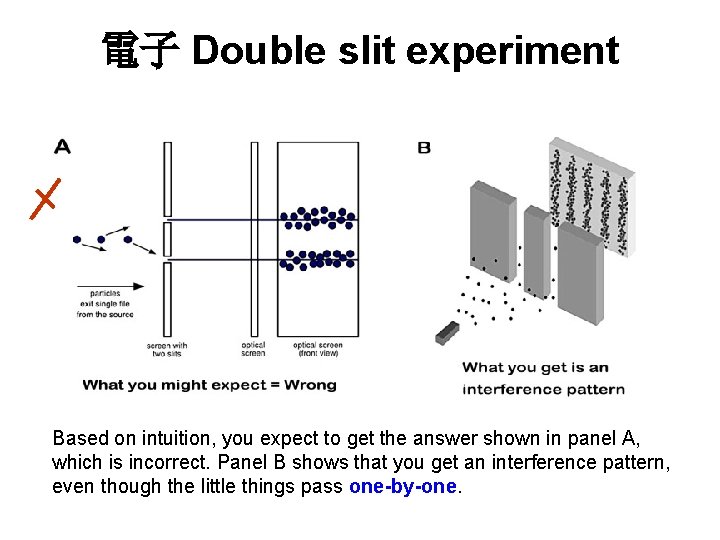
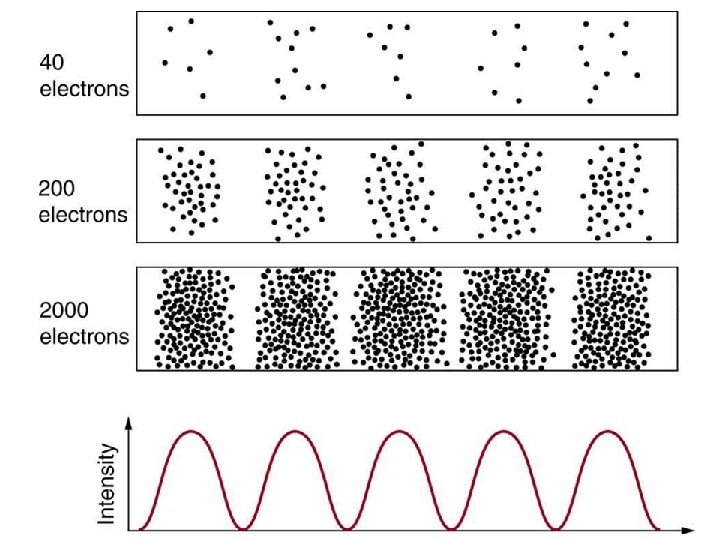
電子 Double slit experiment Based on intuition, you expect to get the answer shown in panel A, which is incorrect. Panel B shows that you get an interference pattern, even though the little things pass one-by-one.


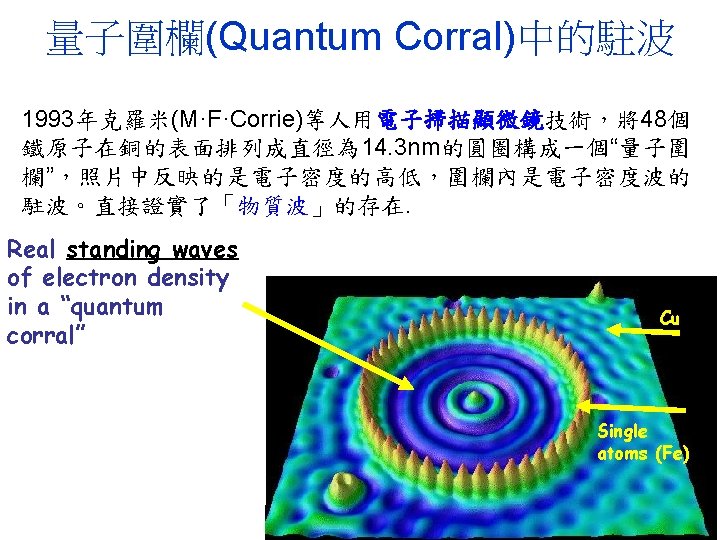

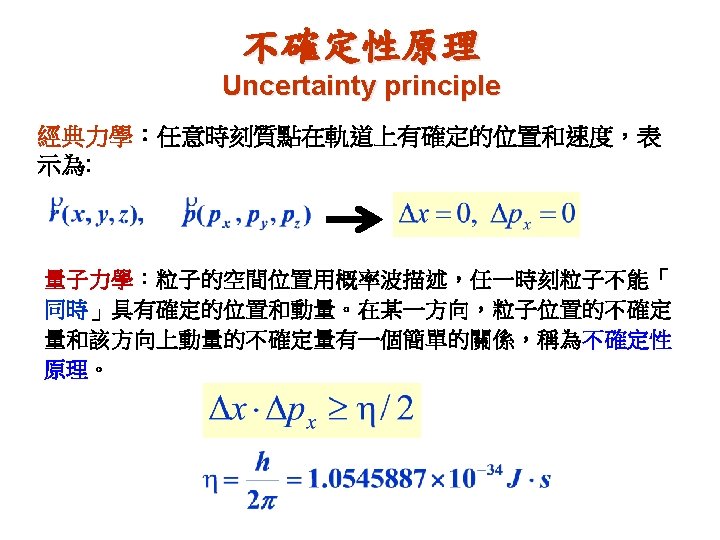


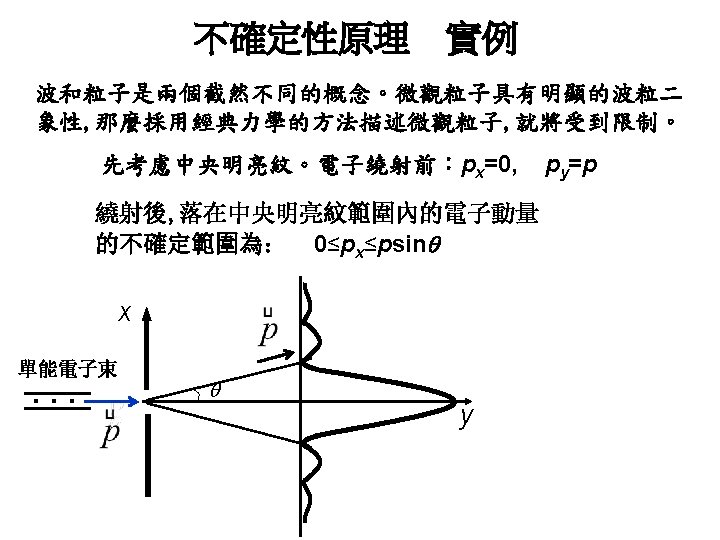
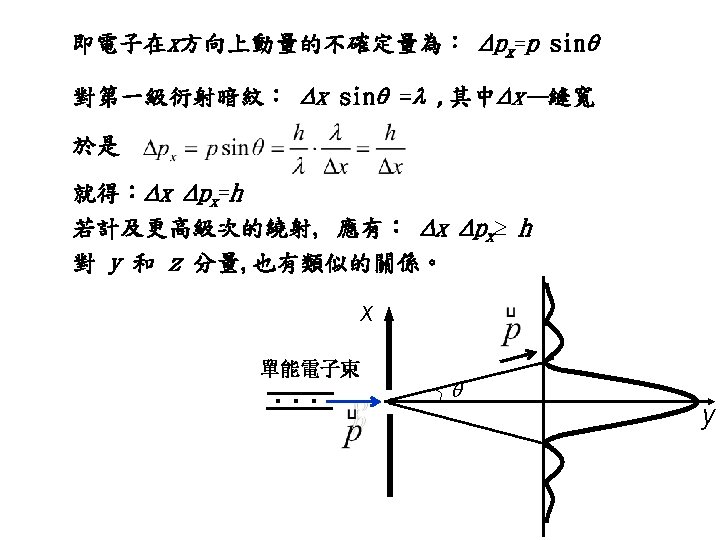



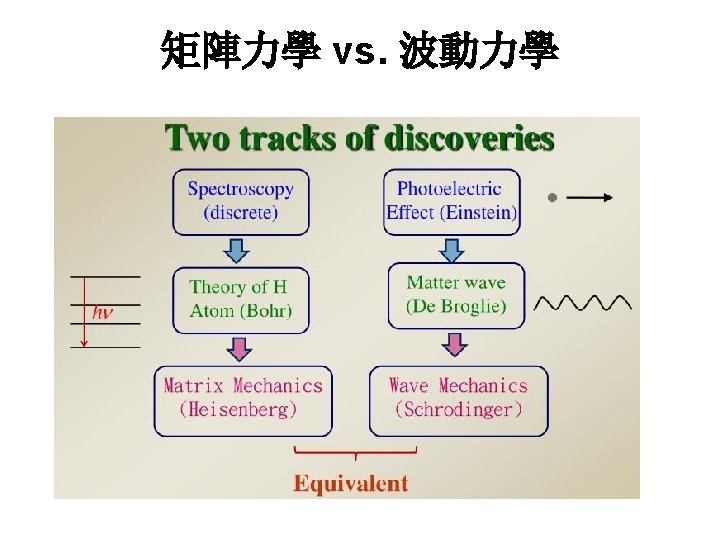
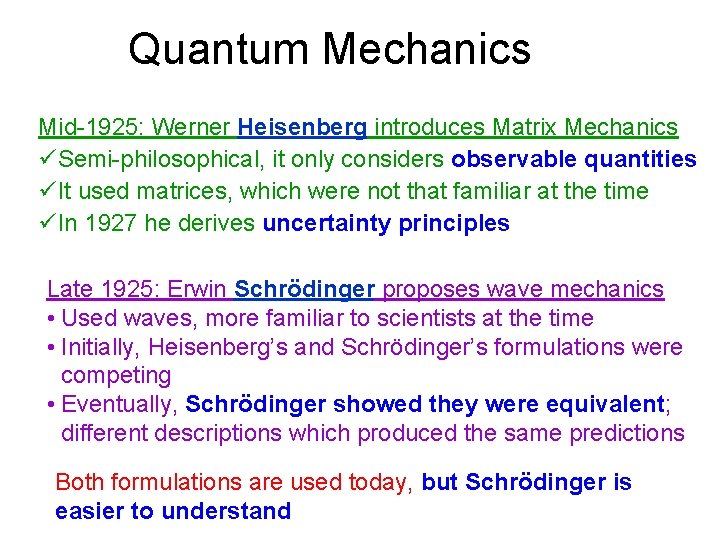
Quantum Mechanics Mid-1925: Werner Heisenberg introduces Matrix Mechanics üSemi-philosophical, it only considers observable quantities üIt used matrices, which were not that familiar at the time üIn 1927 he derives uncertainty principles Late 1925: Erwin Schrödinger proposes wave mechanics • Used waves, more familiar to scientists at the time • Initially, Heisenberg’s and Schrödinger’s formulations were competing • Eventually, Schrödinger showed they were equivalent; different descriptions which produced the same predictions Both formulations are used today, but Schrödinger is easier to understand

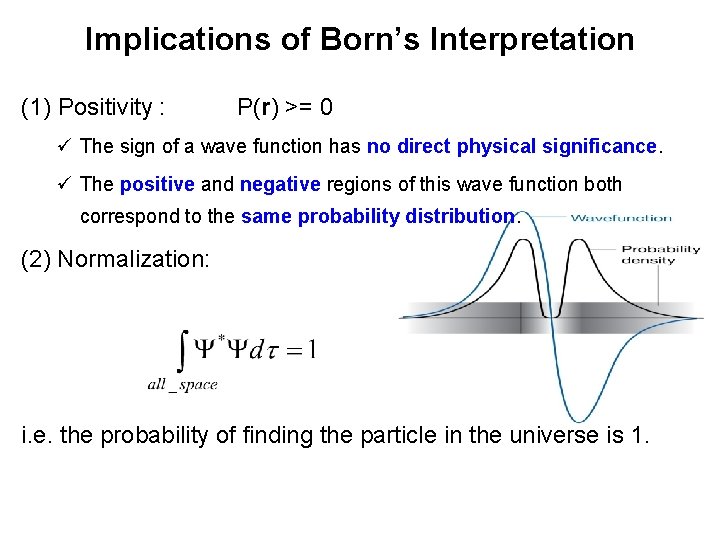
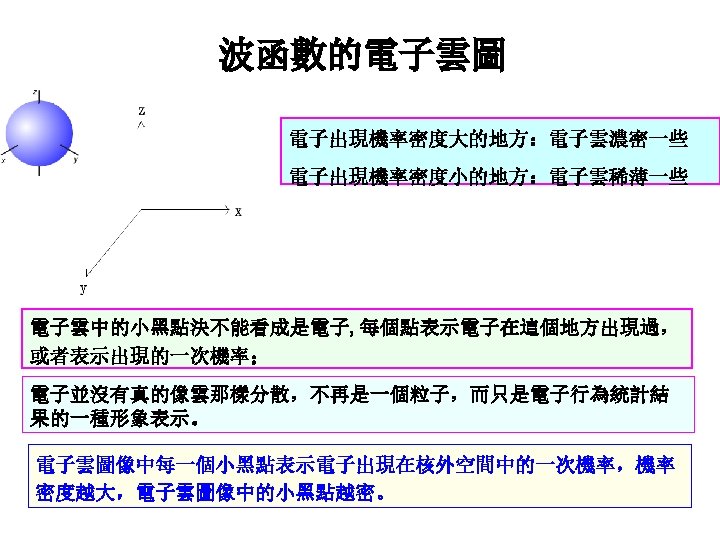
Implications of Born’s Interpretation (1) Positivity : P(r) >= 0 ü The sign of a wave function has no direct physical significance. ü The positive and negative regions of this wave function both correspond to the same probability distribution. (2) Normalization: i. e. the probability of finding the particle in the universe is 1.


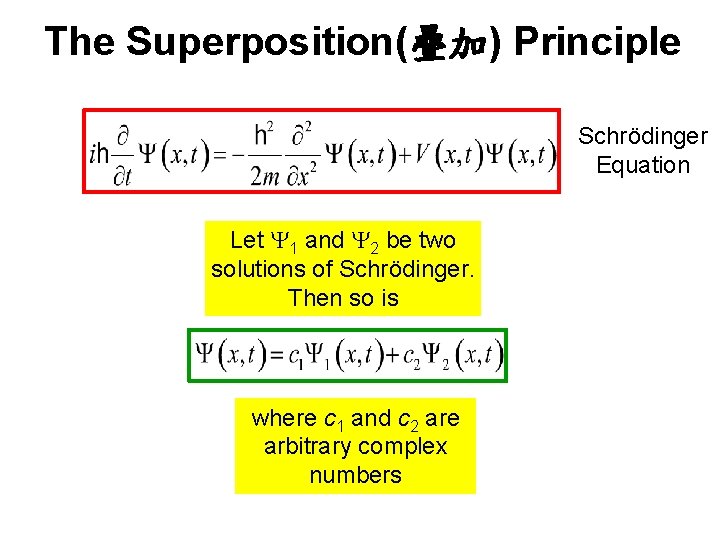
The Superposition(疊加) Principle Schrödinger Equation Let 1 and 2 be two solutions of Schrödinger. Then so is where c 1 and c 2 are arbitrary complex numbers
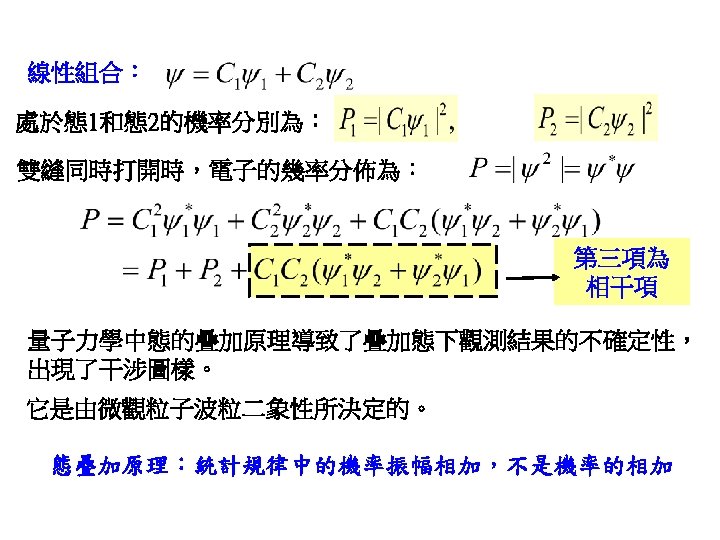
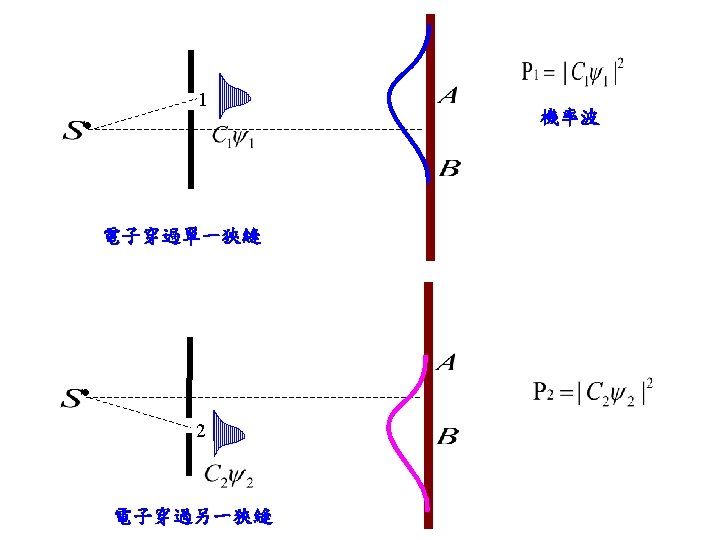
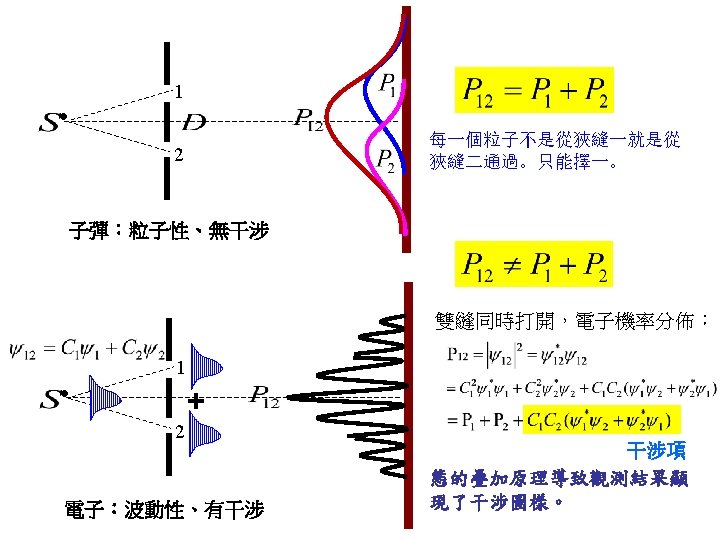
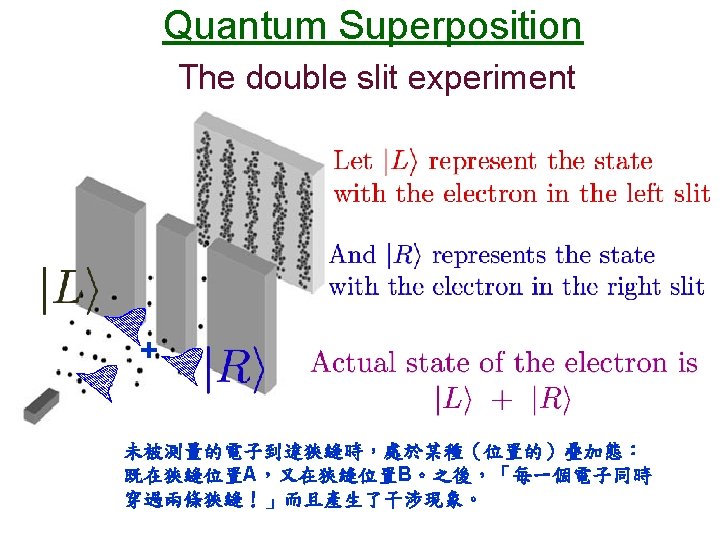
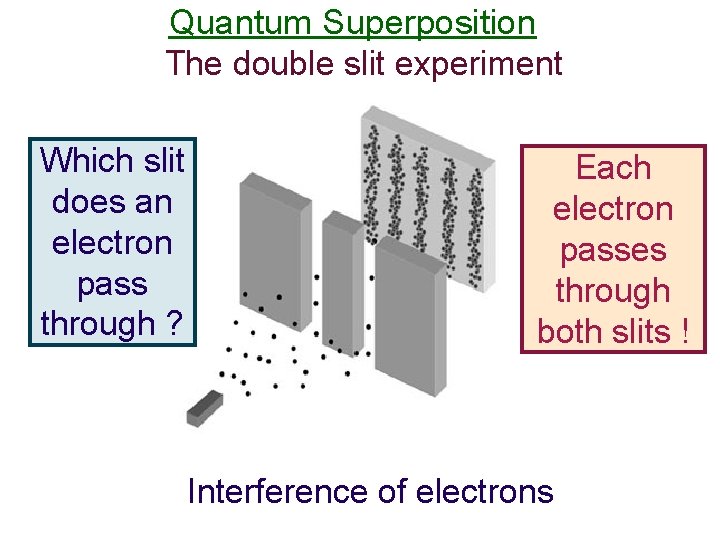
Quantum Superposition The double slit experiment Which slit does an electron pass through ? Each electron passes through both slits ! Interference of electrons
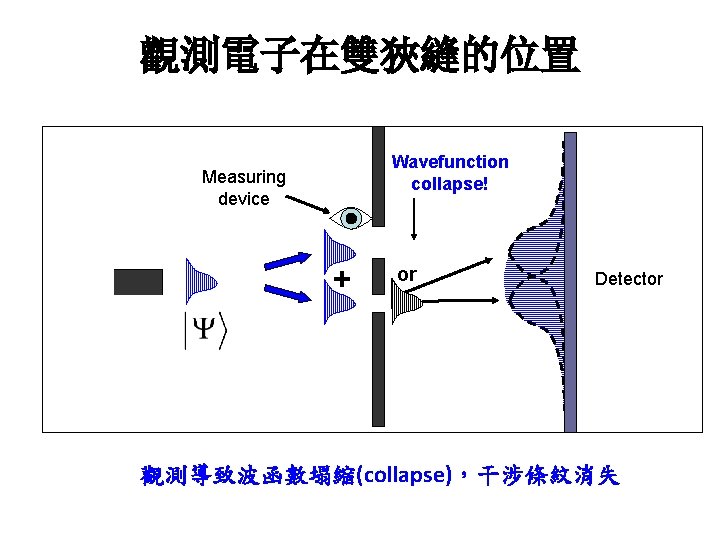
觀測電子在雙狹縫的位置 Wavefunction collapse! Measuring device + or Detector 觀測導致波函數塌縮(collapse),干涉條紋消失
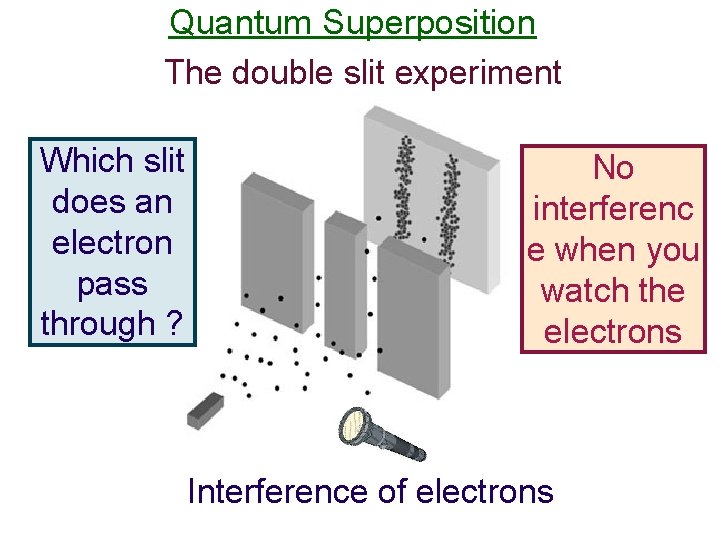
Quantum Superposition The double slit experiment Which slit does an electron pass through ? No interferenc e when you watch the electrons Interference of electrons
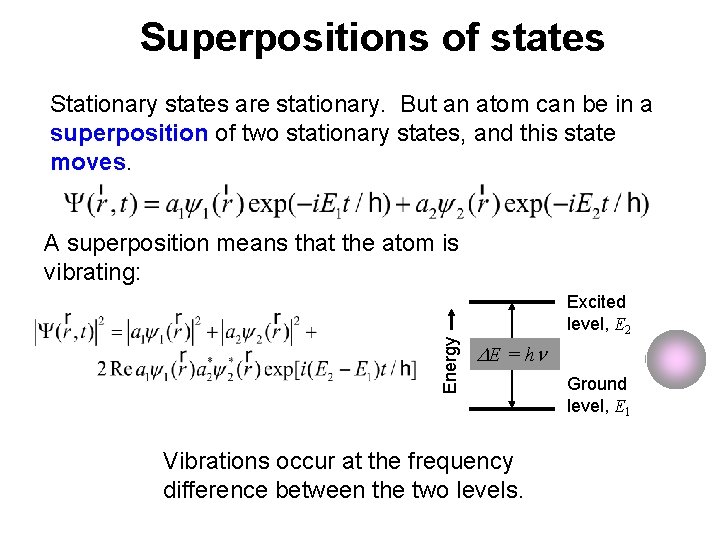
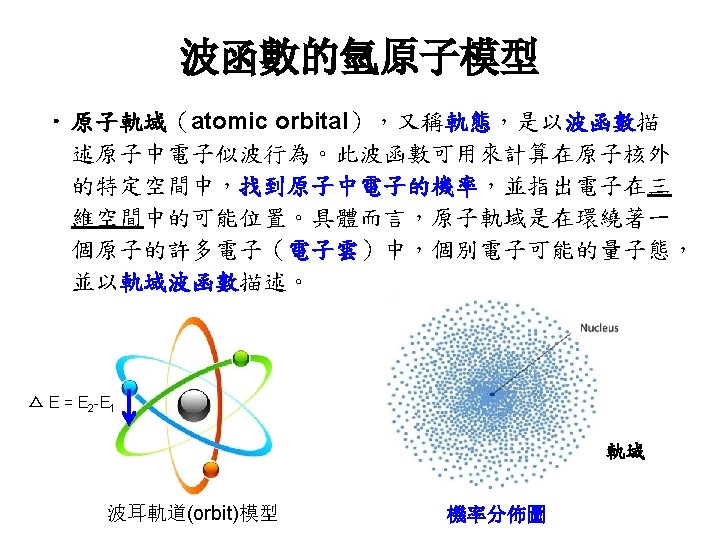
Superpositions of states Stationary states are stationary. But an atom can be in a superposition of two stationary states, and this state moves. A superposition means that the atom is vibrating: Energy Excited level, E 2 DE = h n Vibrations occur at the frequency difference between the two levels. Ground level, E 1
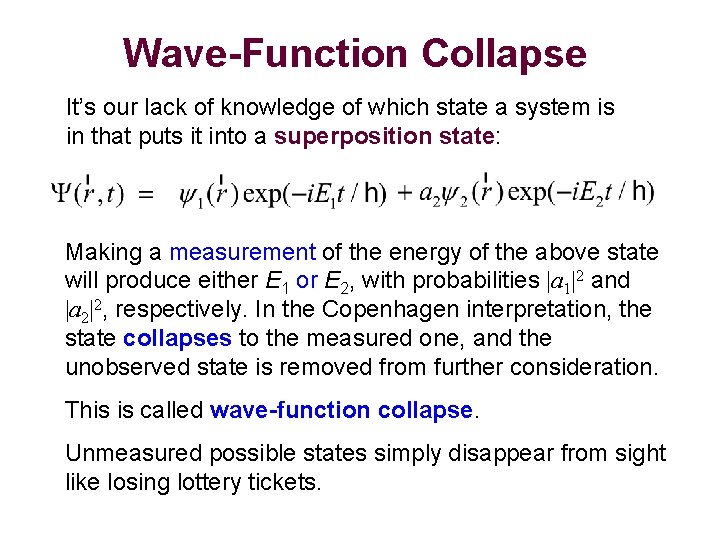
Wave-Function Collapse It’s our lack of knowledge of which state a system is in that puts it into a superposition state: Making a measurement of the energy of the above state will produce either E 1 or E 2, with probabilities |a 1|2 and |a 2|2, respectively. In the Copenhagen interpretation, the state collapses to the measured one, and the unobserved state is removed from further consideration. This is called wave-function collapse. Unmeasured possible states simply disappear from sight like losing lottery tickets.
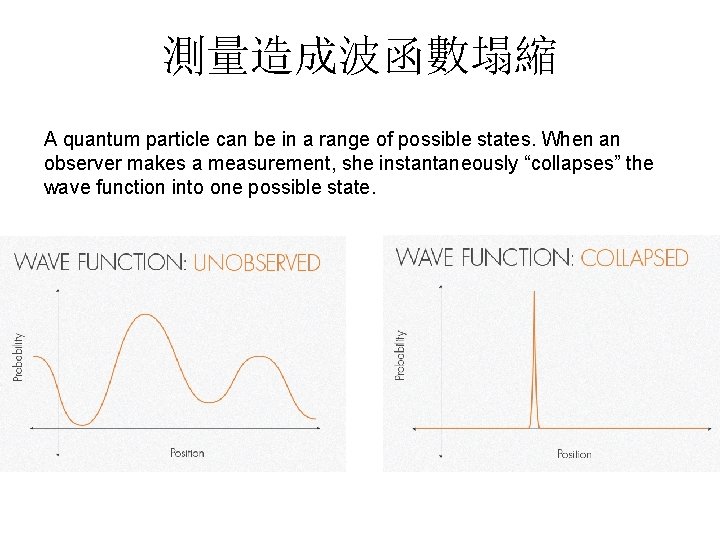
測量造成波函數塌縮 A quantum particle can be in a range of possible states. When an observer makes a measurement, she instantaneously “collapses” the wave function into one possible state.
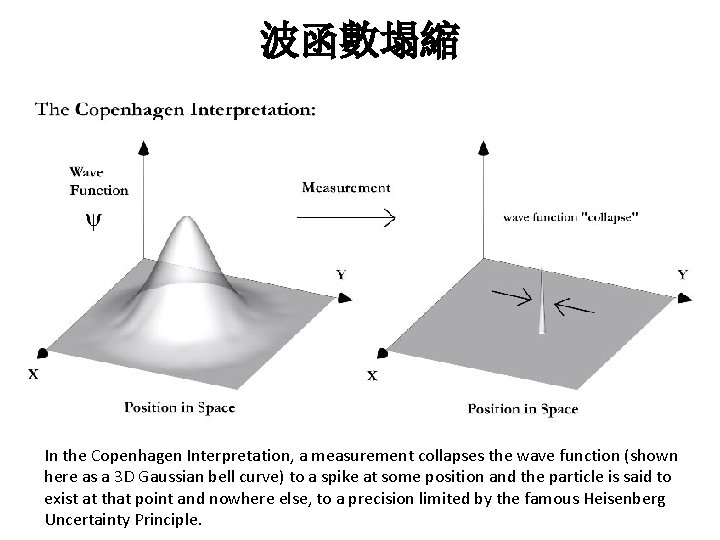
波函數塌縮 In the Copenhagen Interpretation, a measurement collapses the wave function (shown here as a 3 D Gaussian bell curve) to a spike at some position and the particle is said to exist at that point and nowhere else, to a precision limited by the famous Heisenberg Uncertainty Principle.
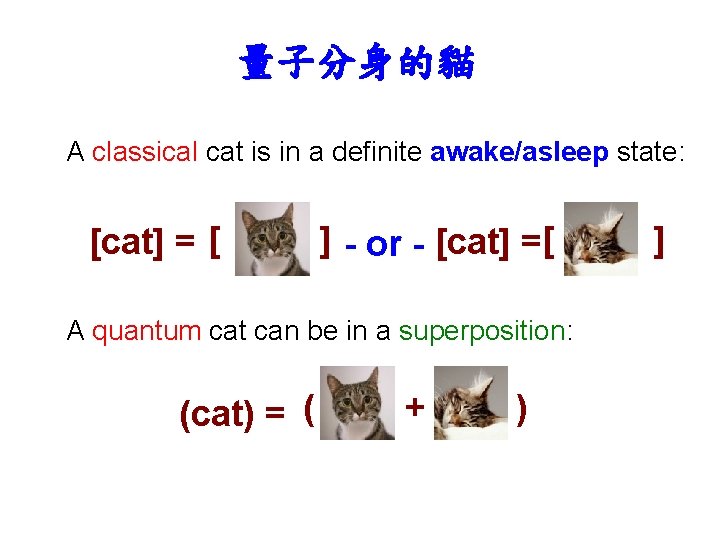
量子分身的貓 A classical cat is in a definite awake/asleep state: [cat] = [ ] - or - [cat] =[ A quantum cat can be in a superposition: (cat) = ( + ) ]
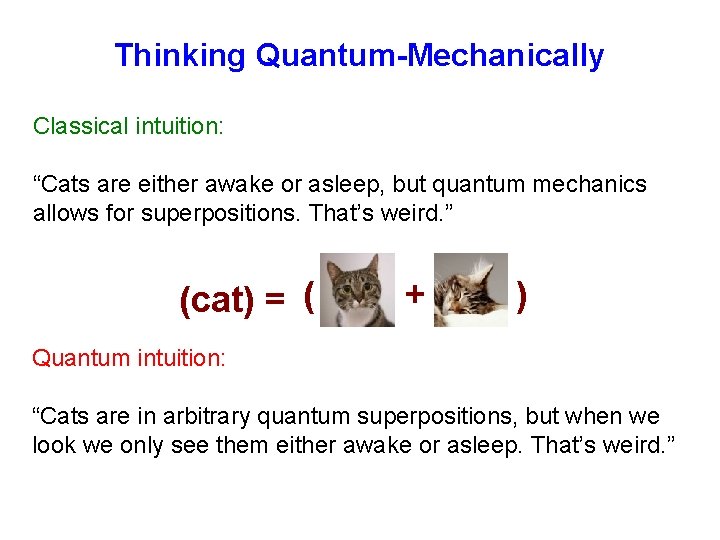
Thinking Quantum-Mechanically Classical intuition: “Cats are either awake or asleep, but quantum mechanics allows for superpositions. That’s weird. ” (cat) = ( + ) Quantum intuition: “Cats are in arbitrary quantum superpositions, but when we look we only see them either awake or asleep. That’s weird. ”
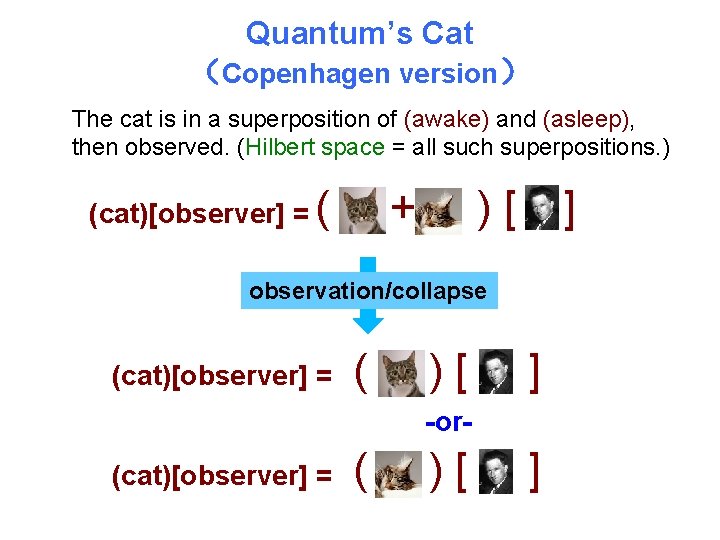
Quantum’s Cat (Copenhagen version) The cat is in a superposition of (awake) and (asleep), then observed. (Hilbert space = all such superpositions. ) (cat)[observer] = ( + ) [ ] observation/collapse (cat)[observer] = ( ) [ ] -or- (cat)[observer] = ( ) [ ]



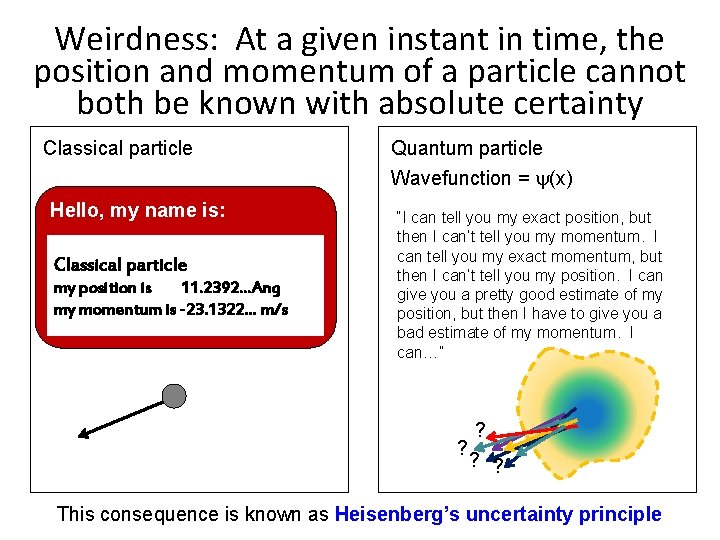
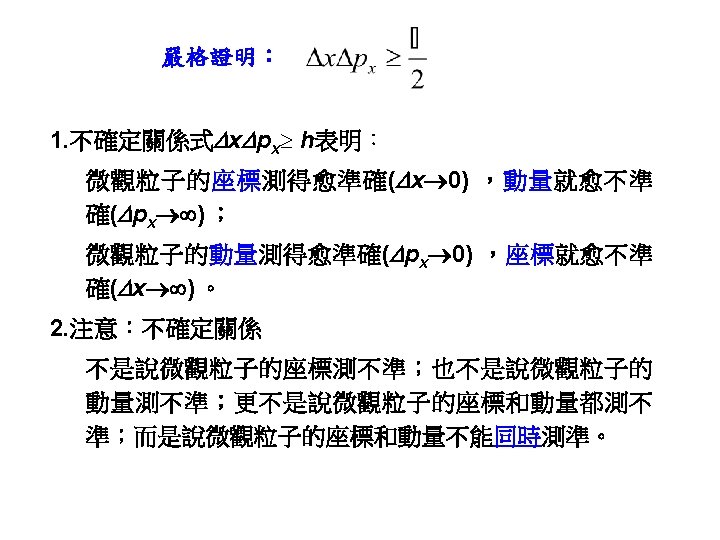
Weirdness: At a given instant in time, the position and momentum of a particle cannot both be known with absolute certainty Classical particle Hello, my name is: Classical particle my position is 11. 2392…Ang my momentum is -23. 1322… m/s Quantum particle Wavefunction = (x) “I can tell you my exact position, but then I can’t tell you my momentum. I can tell you my exact momentum, but then I can’t tell you my position. I can give you a pretty good estimate of my position, but then I have to give you a bad estimate of my momentum. I can…” ? ? This consequence is known as Heisenberg’s uncertainty principle
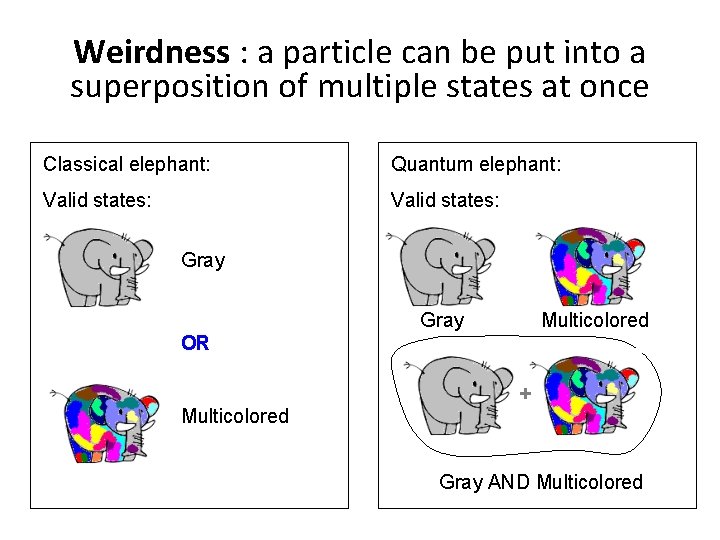
Weirdness : a particle can be put into a superposition of multiple states at once Classical elephant: Quantum elephant: Valid states: Gray Multicolored OR Multicolored + Gray AND Multicolored
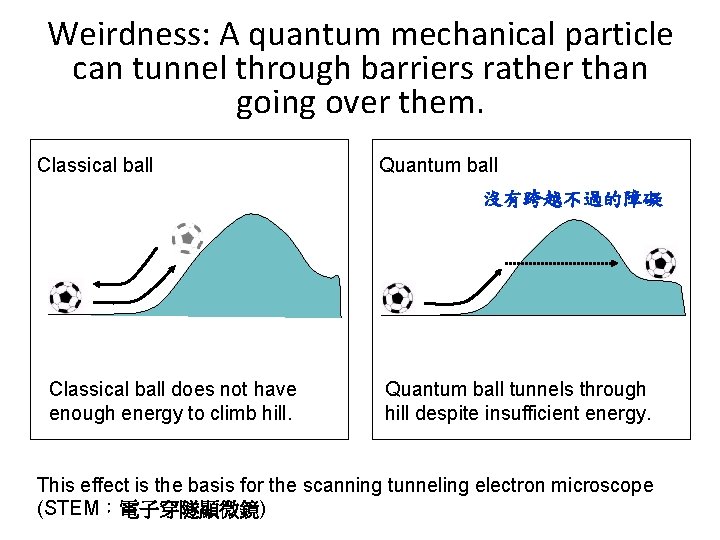
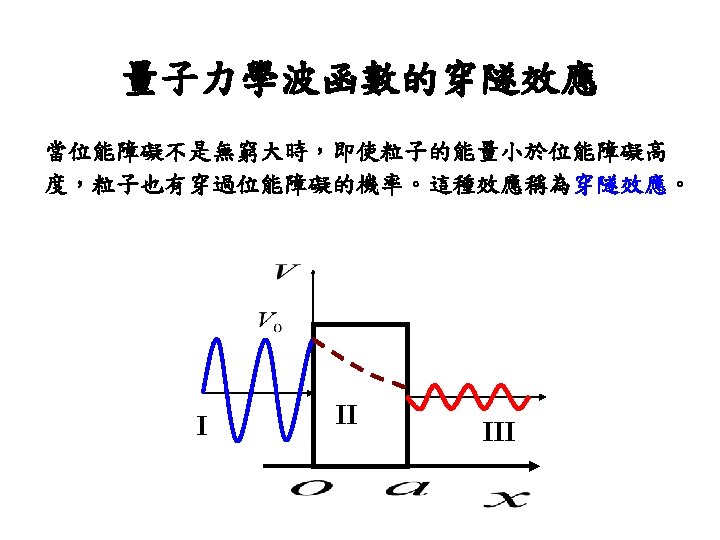
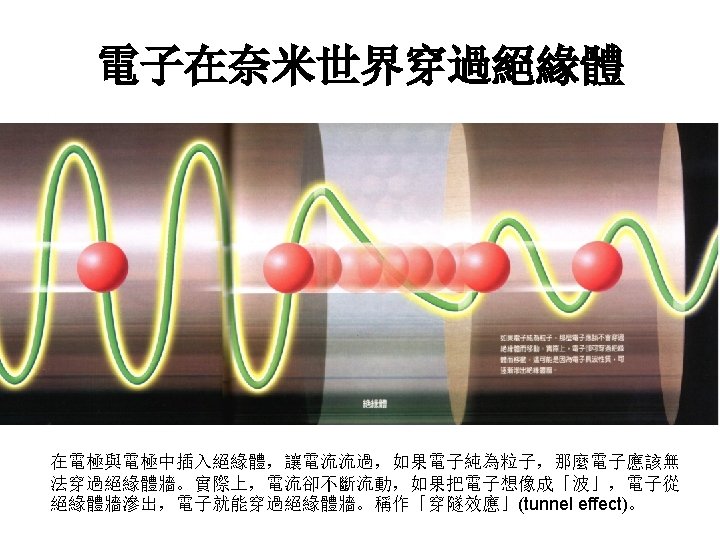
Weirdness: A quantum mechanical particle can tunnel through barriers rather than going over them. Classical ball Quantum ball 沒有跨越不過的障礙 Classical ball does not have enough energy to climb hill. Quantum ball tunnels through hill despite insufficient energy. This effect is the basis for the scanning tunneling electron microscope (STEM:電子穿隧顯微鏡)
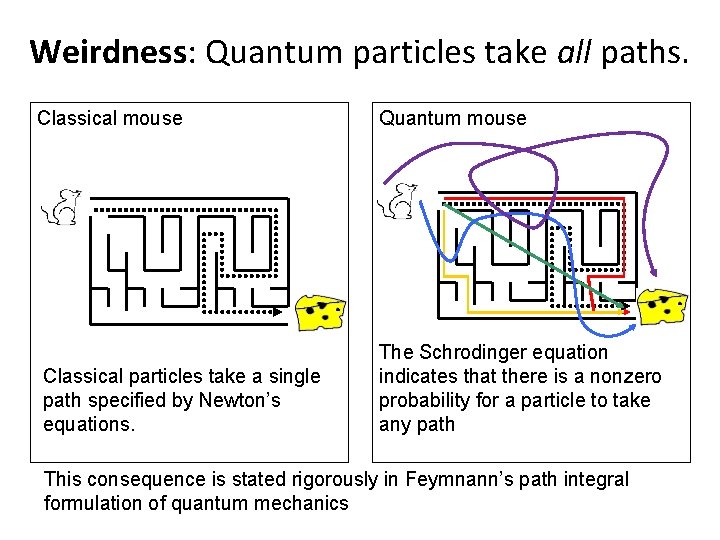
Weirdness: Quantum particles take all paths. Classical mouse Quantum mouse Classical particles take a single path specified by Newton’s equations. The Schrodinger equation indicates that there is a nonzero probability for a particle to take any path This consequence is stated rigorously in Feymnann’s path integral formulation of quantum mechanics
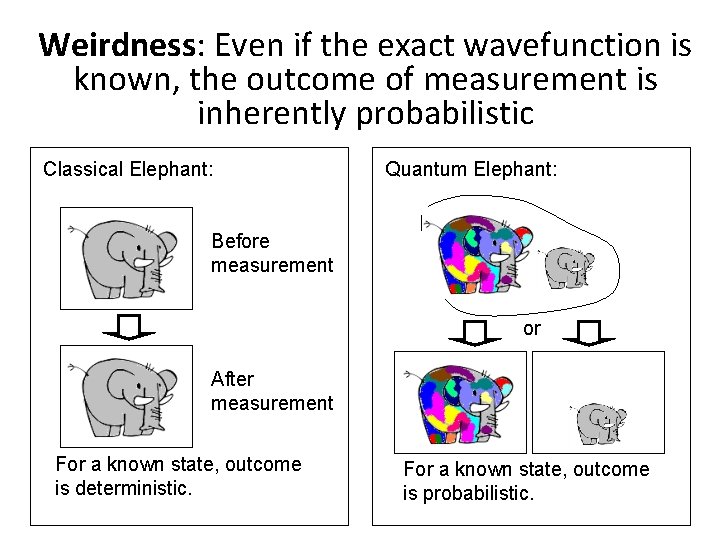
Weirdness: Even if the exact wavefunction is known, the outcome of measurement is inherently probabilistic Classical Elephant: Quantum Elephant: Before measurement or After measurement For a known state, outcome is deterministic. For a known state, outcome is probabilistic.
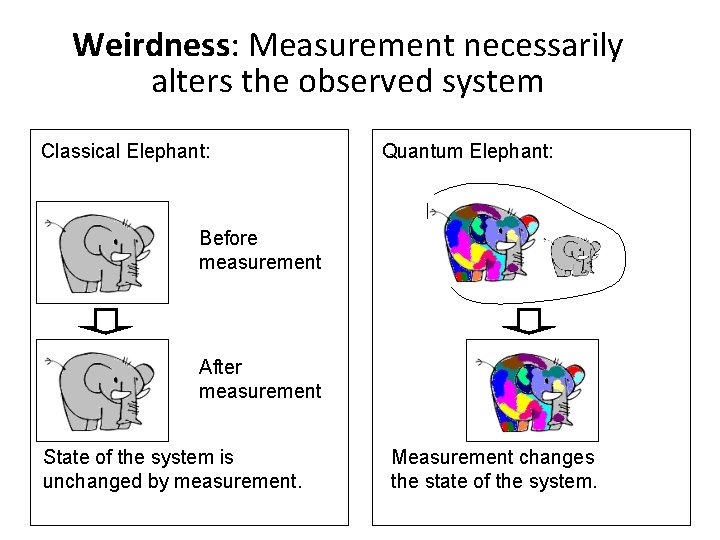
Weirdness: Measurement necessarily alters the observed system Classical Elephant: Quantum Elephant: Before measurement After measurement State of the system is unchanged by measurement. Measurement changes the state of the system.




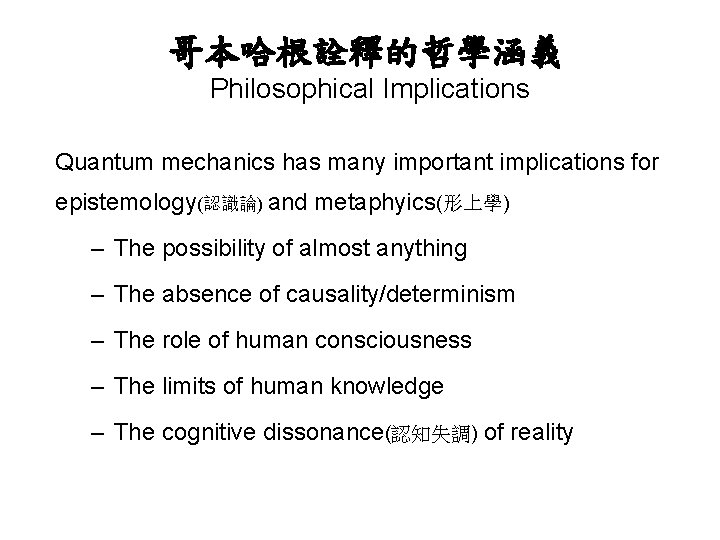
哥本哈根詮釋的哲學涵義 Philosophical Implications Quantum mechanics has many important implications for epistemology(認識論) and metaphyics(形上學) – The possibility of almost anything – The absence of causality/determinism – The role of human consciousness – The limits of human knowledge – The cognitive dissonance(認知失調) of reality
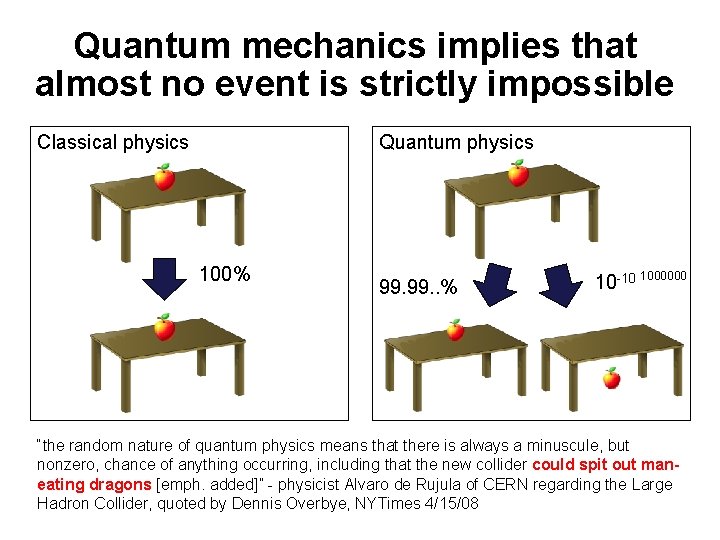
Quantum mechanics implies that almost no event is strictly impossible Classical physics Quantum physics 100% 99. . % 10 -10 1000000 “the random nature of quantum physics means that there is always a minuscule, but nonzero, chance of anything occurring, including that the new collider could spit out maneating dragons [emph. added]” - physicist Alvaro de Rujula of CERN regarding the Large Hadron Collider, quoted by Dennis Overbye, NYTimes 4/15/08
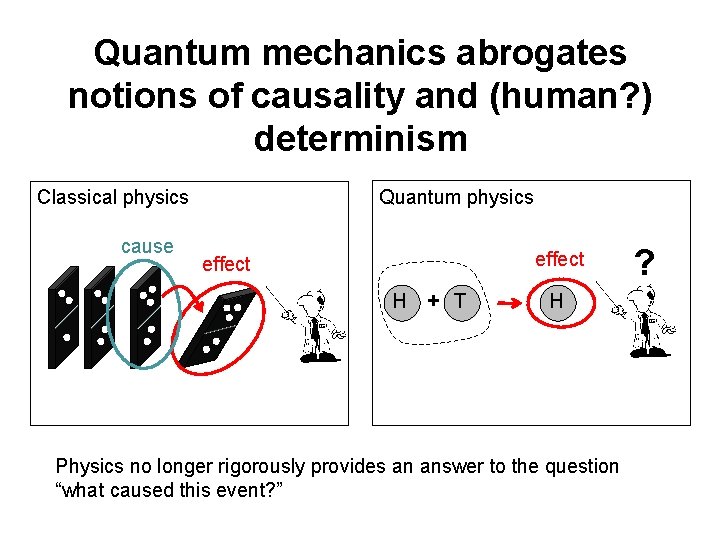
Quantum mechanics abrogates notions of causality and (human? ) determinism Classical physics cause Quantum physics effect H + T H Physics no longer rigorously provides an answer to the question “what caused this event? ” ?
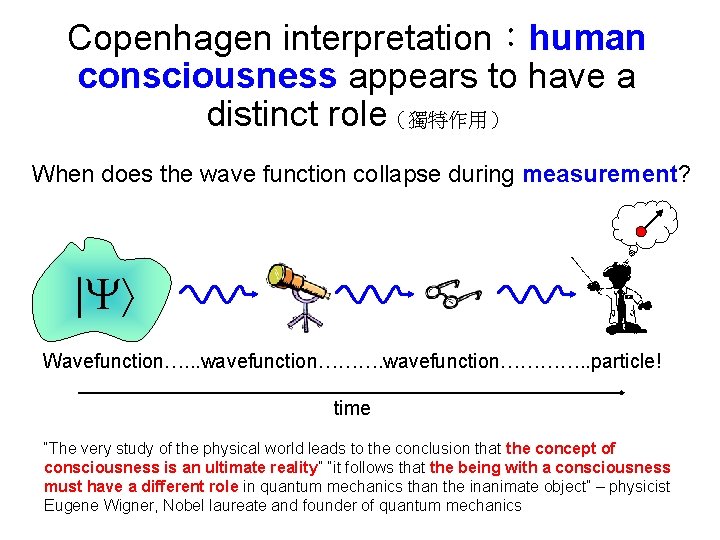
Copenhagen interpretation:human consciousness appears to have a distinct role(獨特作用) When does the wave function collapse during measurement? | Wavefunction…. . . wavefunction…………. . particle! time “The very study of the physical world leads to the conclusion that the concept of consciousness is an ultimate reality” “it follows that the being with a consciousness must have a different role in quantum mechanics than the inanimate object” – physicist Eugene Wigner, Nobel laureate and founder of quantum mechanics
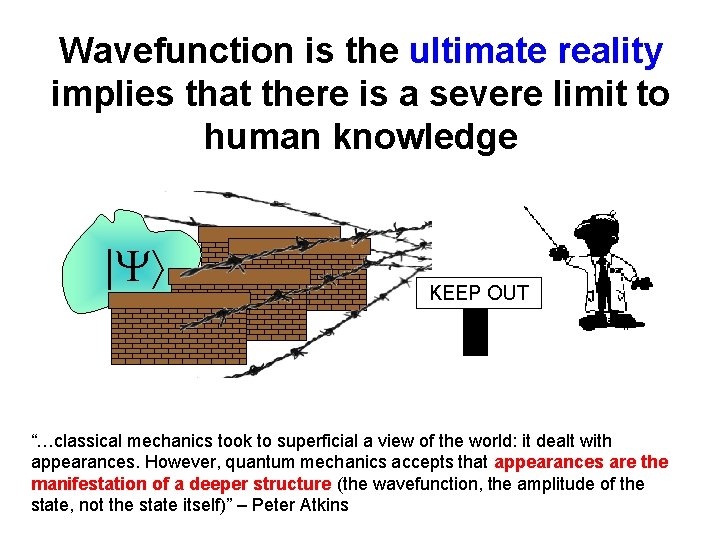
Wavefunction is the ultimate reality implies that there is a severe limit to human knowledge | KEEP OUT “…classical mechanics took to superficial a view of the world: it dealt with appearances. However, quantum mechanics accepts that appearances are the manifestation of a deeper structure (the wavefunction, the amplitude of the state, not the state itself)” – Peter Atkins
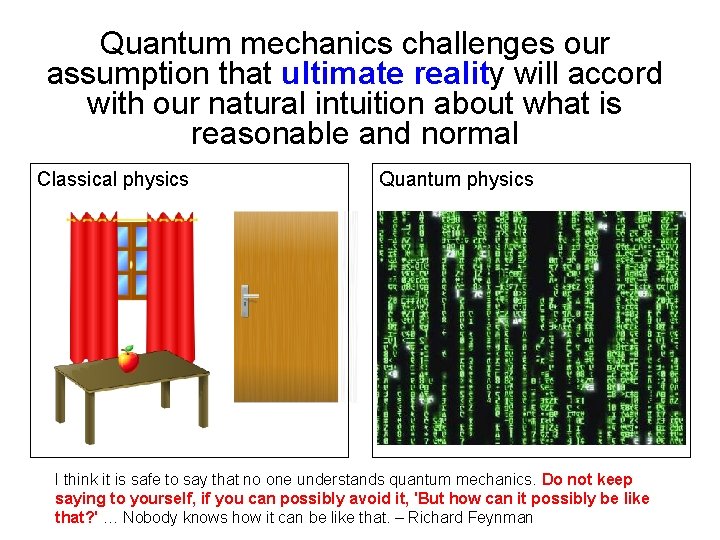
Quantum mechanics challenges our assumption that ultimate reality will accord with our natural intuition about what is reasonable and normal Classical physics Quantum physics I think it is safe to say that no one understands quantum mechanics. Do not keep saying to yourself, if you can possibly avoid it, 'But how can it possibly be like that? ' … Nobody knows how it can be like that. – Richard Feynman


- Slides: 77