
Quantum Photosynthesis FIGURE 10 2 Journey into a

- Slides: 25
Quantum Photosynthesis
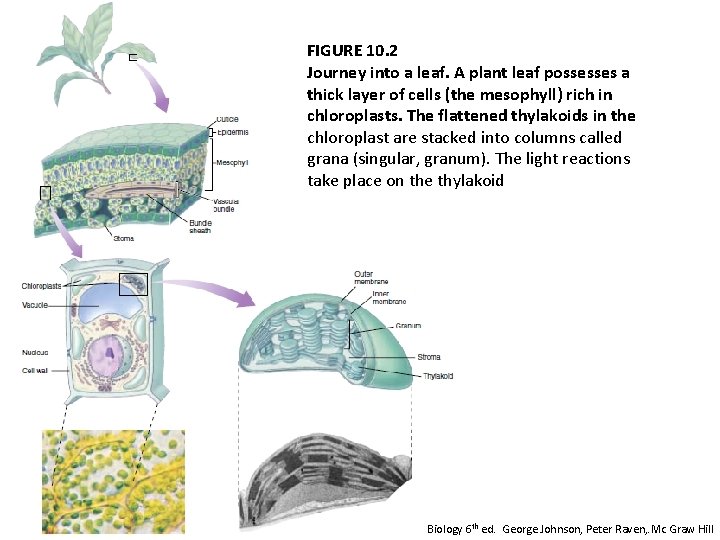
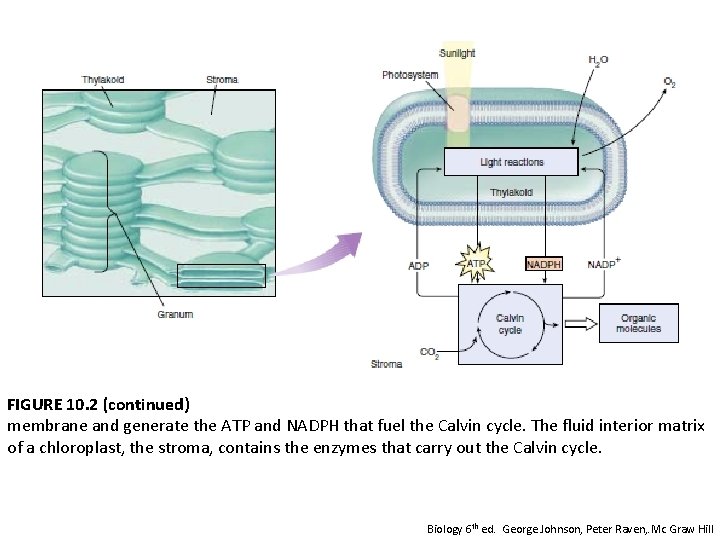
FIGURE 10. 2 Journey into a leaf. A plant leaf possesses a thick layer of cells (the mesophyll) rich in chloroplasts. The flattened thylakoids in the chloroplast are stacked into columns called grana (singular, granum). The light reactions take place on the thylakoid Biology 6 th ed. George Johnson, Peter Raven, . Mc Graw Hill
FIGURE 10. 2 (continued) membrane and generate the ATP and NADPH that fuel the Calvin cycle. The fluid interior matrix of a chloroplast, the stroma, contains the enzymes that carry out the Calvin cycle. Biology 6 th ed. George Johnson, Peter Raven, . Mc Graw Hill
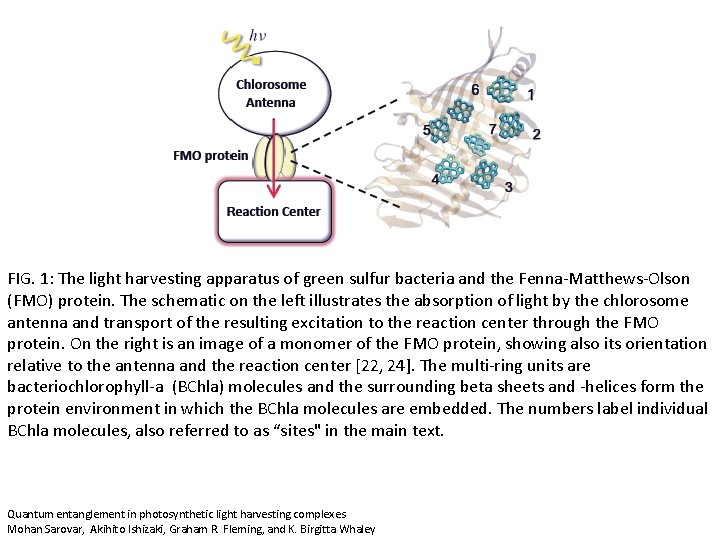
FIG. 1: The light harvesting apparatus of green sulfur bacteria and the Fenna-Matthews-Olson (FMO) protein. The schematic on the left illustrates the absorption of light by the chlorosome antenna and transport of the resulting excitation to the reaction center through the FMO protein. On the right is an image of a monomer of the FMO protein, showing also its orientation relative to the antenna and the reaction center [22, 24]. The multi-ring units are bacteriochlorophyll-a (BChla) molecules and the surrounding beta sheets and -helices form the protein environment in which the BChla molecules are embedded. The numbers label individual BChla molecules, also referred to as “sites" in the main text. Quantum entanglement in photosynthetic light harvesting complexes Mohan Sarovar, Akihito Ishizaki, Graham R. Fleming, and K. Birgitta Whaley
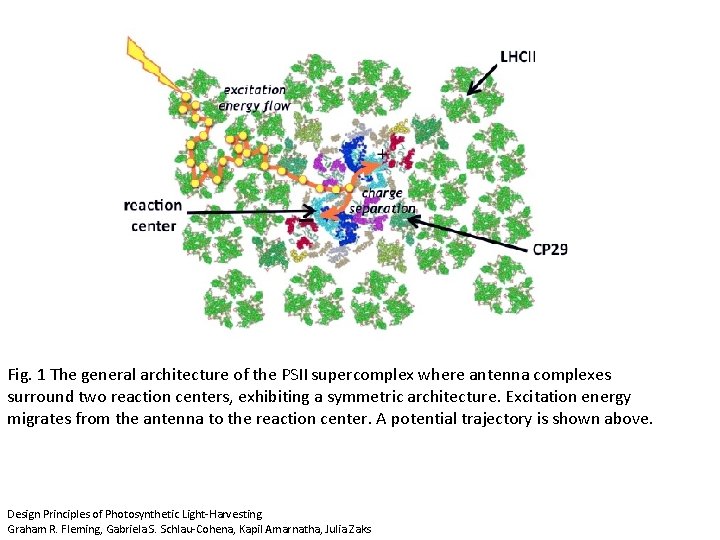
Fig. 1 The general architecture of the PSII supercomplex where antenna complexes surround two reaction centers, exhibiting a symmetric architecture. Excitation energy migrates from the antenna to the reaction center. A potential trajectory is shown above. Design Principles of Photosynthetic Light-Harvesting Graham R. Fleming, Gabriela S. Schlau-Cohena, Kapil Amarnatha, Julia Zaks
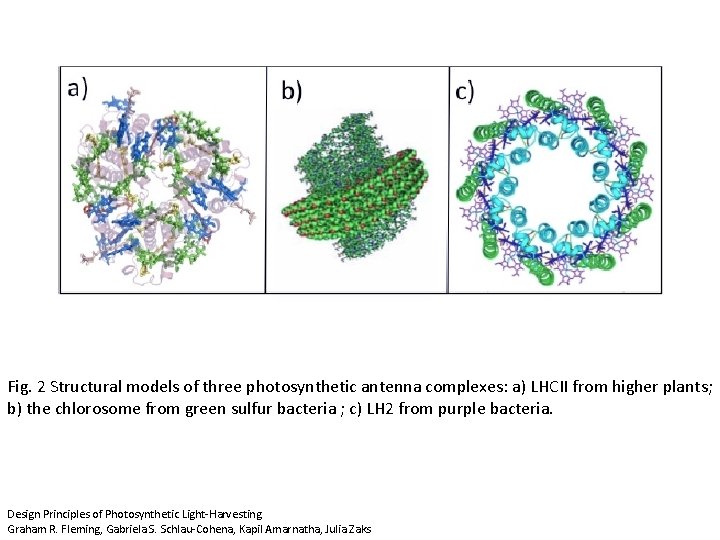
Fig. 2 Structural models of three photosynthetic antenna complexes: a) LHCII from higher plants; b) the chlorosome from green sulfur bacteria ; c) LH 2 from purple bacteria. Design Principles of Photosynthetic Light-Harvesting Graham R. Fleming, Gabriela S. Schlau-Cohena, Kapil Amarnatha, Julia Zaks
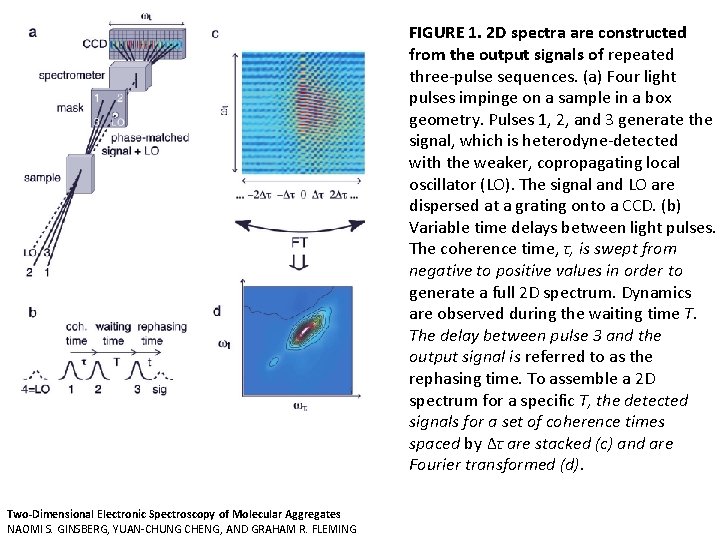
FIGURE 1. 2 D spectra are constructed from the output signals of repeated three-pulse sequences. (a) Four light pulses impinge on a sample in a box geometry. Pulses 1, 2, and 3 generate the signal, which is heterodyne-detected with the weaker, copropagating local oscillator (LO). The signal and LO are dispersed at a grating onto a CCD. (b) Variable time delays between light pulses. The coherence time, τ, is swept from negative to positive values in order to generate a full 2 D spectrum. Dynamics are observed during the waiting time T. The delay between pulse 3 and the output signal is referred to as the rephasing time. To assemble a 2 D spectrum for a specific T, the detected signals for a set of coherence times spaced by Δτ are stacked (c) and are Fourier transformed (d). Two-Dimensional Electronic Spectroscopy of Molecular Aggregates NAOMI S. GINSBERG, YUAN-CHUNG CHENG, AND GRAHAM R. FLEMING
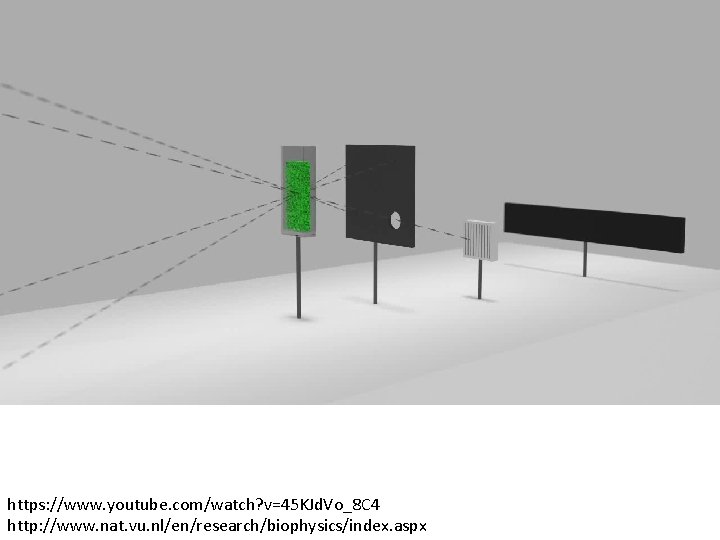
https: //www. youtube. com/watch? v=45 KJd. Vo_8 C 4 http: //www. nat. vu. nl/en/research/biophysics/index. aspx
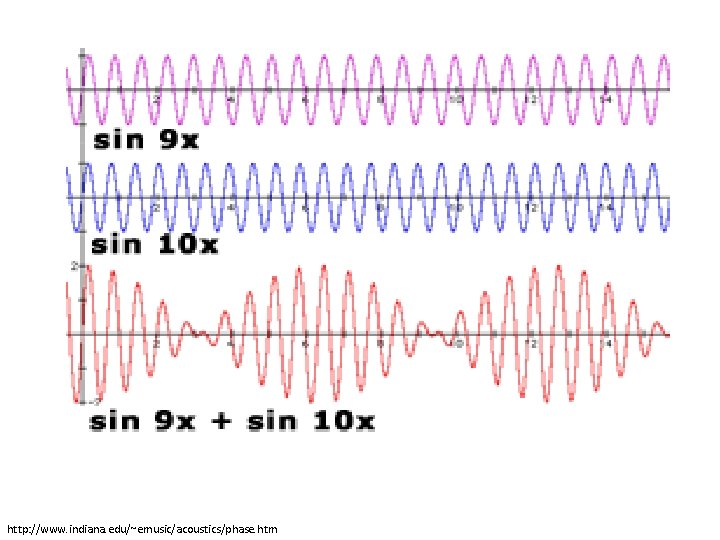
http: //www. indiana. edu/~emusic/acoustics/phase. htm
https: //www. youtube. com/watch? v=YTj 4 Hi 1 Hd. JQ http: //www. quantummadesimple. com
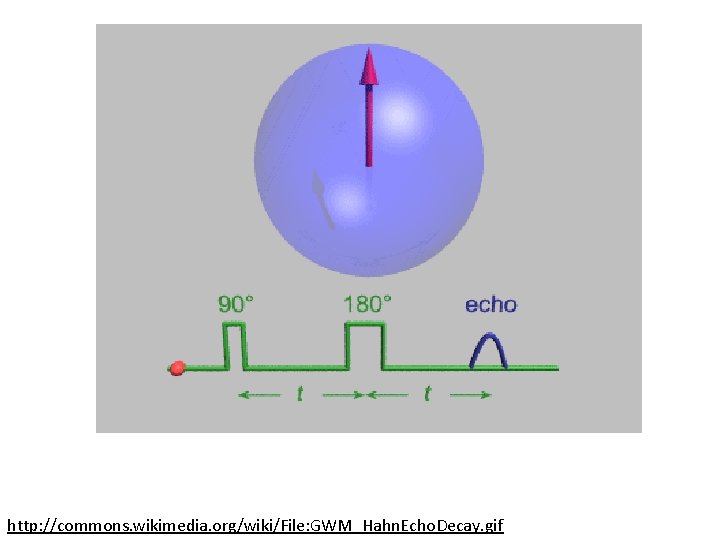
http: //commons. wikimedia. org/wiki/File: GWM_Hahn. Echo. Decay. gif
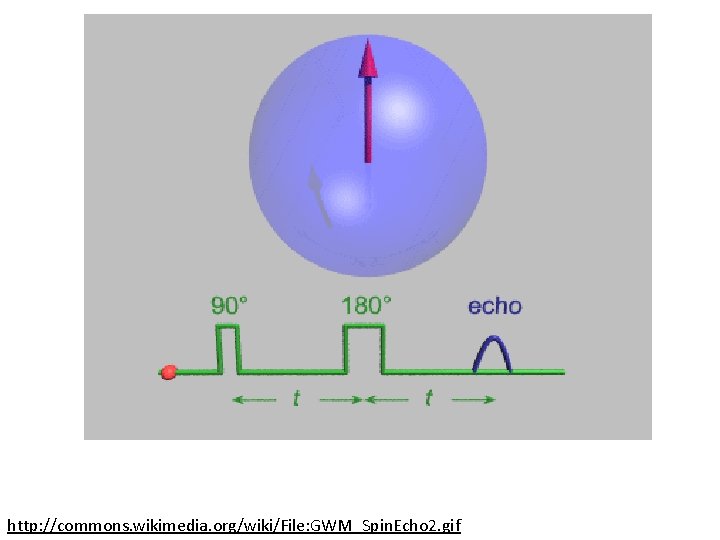
http: //commons. wikimedia. org/wiki/File: GWM_Spin. Echo 2. gif
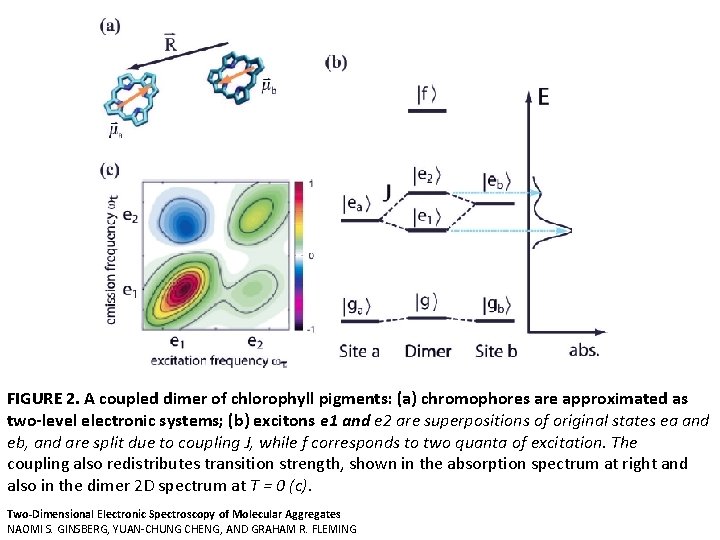
FIGURE 2. A coupled dimer of chlorophyll pigments: (a) chromophores are approximated as two-level electronic systems; (b) excitons e 1 and e 2 are superpositions of original states ea and eb, and are split due to coupling J, while f corresponds to two quanta of excitation. The coupling also redistributes transition strength, shown in the absorption spectrum at right and also in the dimer 2 D spectrum at T = 0 (c). Two-Dimensional Electronic Spectroscopy of Molecular Aggregates NAOMI S. GINSBERG, YUAN-CHUNG CHENG, AND GRAHAM R. FLEMING
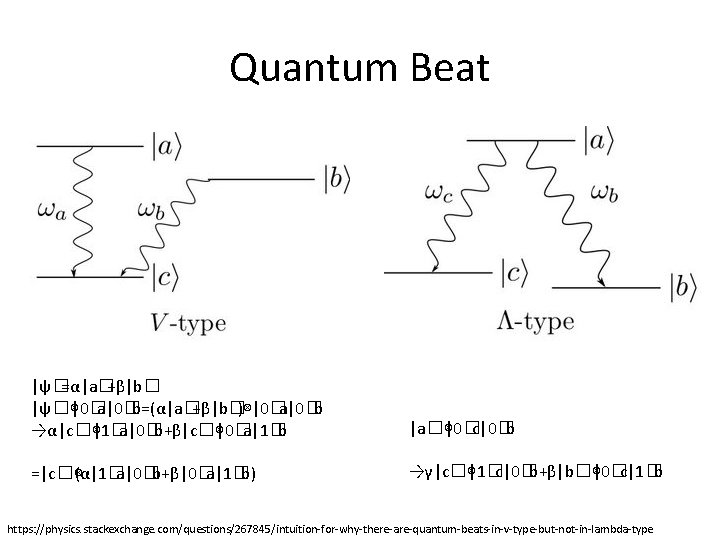
Quantum Beat |ψ�=α|a�+β|b� |ψ�⊗|0� a|0�b=(α|a�+β|b�)⊗|0�a|0�b →α|c�⊗|1�a|0�b+β|c�⊗|0�a|1�b |a�⊗|0�c|0�b =|c�⊗(α|1�a|0�b+β|0�a|1�b) →γ|c�⊗|1�c|0�b+β|b�⊗|0�c|1�b https: //physics. stackexchange. com/questions/267845/intuition-for-why-there-are-quantum-beats-in-v-type-but-not-in-lambda-type
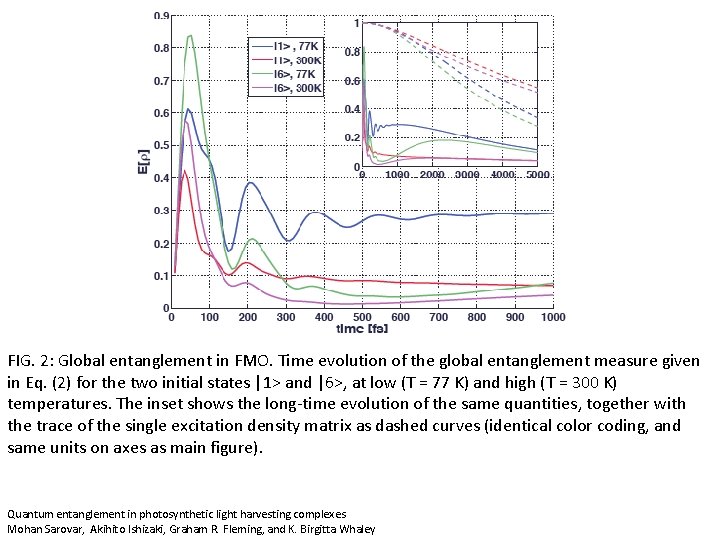
FIG. 2: Global entanglement in FMO. Time evolution of the global entanglement measure given in Eq. (2) for the two initial states |1> and |6>, at low (T = 77 K) and high (T = 300 K) temperatures. The inset shows the long-time evolution of the same quantities, together with the trace of the single excitation density matrix as dashed curves (identical color coding, and same units on axes as main figure). Quantum entanglement in photosynthetic light harvesting complexes Mohan Sarovar, Akihito Ishizaki, Graham R. Fleming, and K. Birgitta Whaley
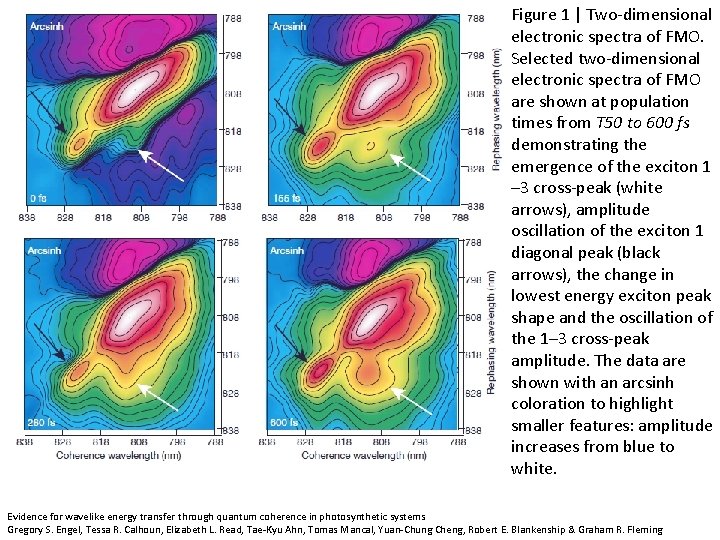
Figure 1 | Two-dimensional electronic spectra of FMO. Selected two-dimensional electronic spectra of FMO are shown at population times from T 50 to 600 fs demonstrating the emergence of the exciton 1 – 3 cross-peak (white arrows), amplitude oscillation of the exciton 1 diagonal peak (black arrows), the change in lowest energy exciton peak shape and the oscillation of the 1– 3 cross-peak amplitude. The data are shown with an arcsinh coloration to highlight smaller features: amplitude increases from blue to white. Evidence for wavelike energy transfer through quantum coherence in photosynthetic systems Gregory S. Engel, Tessa R. Calhoun, Elizabeth L. Read, Tae-Kyu Ahn, Tomas Mancal, Yuan-Chung Cheng, Robert E. Blankenship & Graham R. Fleming
Evidence for wavelike energy transfer through quantum coherence in photosynthetic systems Gregory S. Engel, Tessa R. Calhoun, Elizabeth L. Read, Tae-Kyu Ahn, Tomas Mancal, Yuan-Chung Cheng, Robert E. Blankenship & Graham R. Fleming
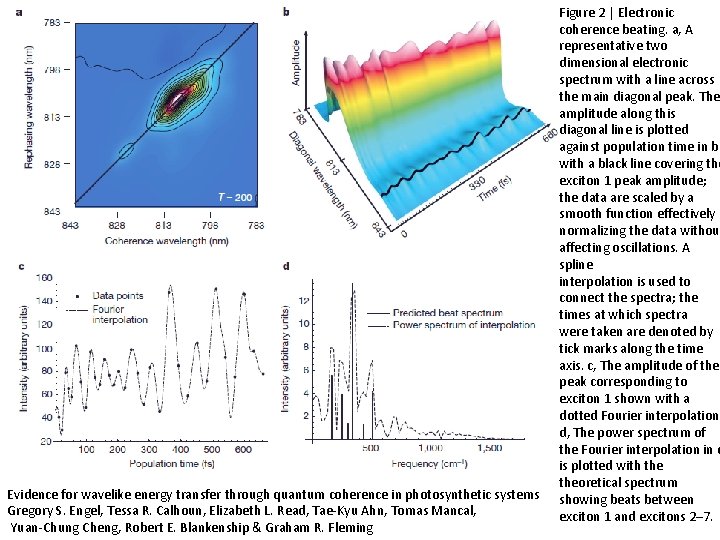
Evidence for wavelike energy transfer through quantum coherence in photosynthetic systems Gregory S. Engel, Tessa R. Calhoun, Elizabeth L. Read, Tae-Kyu Ahn, Tomas Mancal, Yuan-Chung Cheng, Robert E. Blankenship & Graham R. Fleming Figure 2 | Electronic coherence beating. a, A representative two dimensional electronic spectrum with a line across the main diagonal peak. The amplitude along this diagonal line is plotted against population time in b with a black line covering the exciton 1 peak amplitude; the data are scaled by a smooth function effectively normalizing the data without affecting oscillations. A spline interpolation is used to connect the spectra; the times at which spectra were taken are denoted by tick marks along the time axis. c, The amplitude of the peak corresponding to exciton 1 shown with a dotted Fourier interpolation. d, The power spectrum of the Fourier interpolation in c is plotted with theoretical spectrum showing beats between exciton 1 and excitons 2– 7.
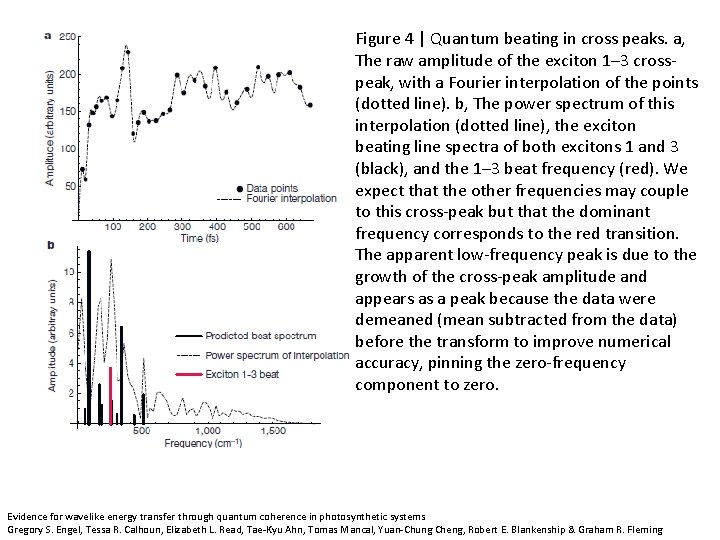
Figure 4 | Quantum beating in cross peaks. a, The raw amplitude of the exciton 1– 3 crosspeak, with a Fourier interpolation of the points (dotted line). b, The power spectrum of this interpolation (dotted line), the exciton beating line spectra of both excitons 1 and 3 (black), and the 1– 3 beat frequency (red). We expect that the other frequencies may couple to this cross-peak but that the dominant frequency corresponds to the red transition. The apparent low-frequency peak is due to the growth of the cross-peak amplitude and appears as a peak because the data were demeaned (mean subtracted from the data) before the transform to improve numerical accuracy, pinning the zero-frequency component to zero. Evidence for wavelike energy transfer through quantum coherence in photosynthetic systems Gregory S. Engel, Tessa R. Calhoun, Elizabeth L. Read, Tae-Kyu Ahn, Tomas Mancal, Yuan-Chung Cheng, Robert E. Blankenship & Graham R. Fleming
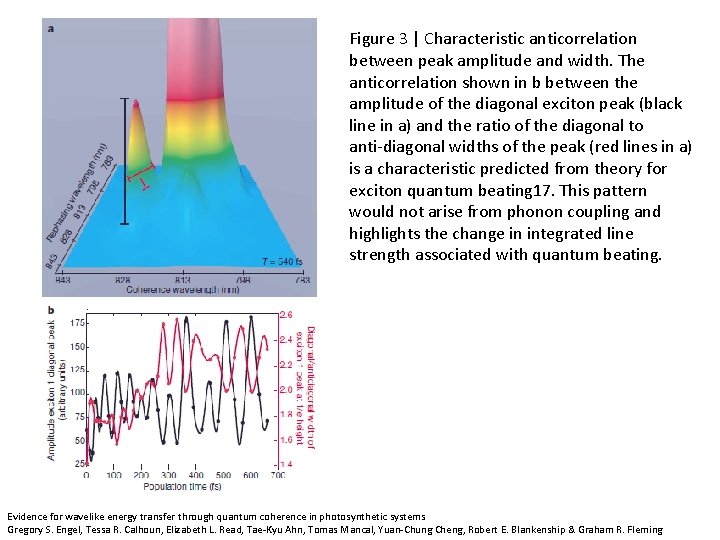
Figure 3 | Characteristic anticorrelation between peak amplitude and width. The anticorrelation shown in b between the amplitude of the diagonal exciton peak (black line in a) and the ratio of the diagonal to anti-diagonal widths of the peak (red lines in a) is a characteristic predicted from theory for exciton quantum beating 17. This pattern would not arise from phonon coupling and highlights the change in integrated line strength associated with quantum beating. Evidence for wavelike energy transfer through quantum coherence in photosynthetic systems Gregory S. Engel, Tessa R. Calhoun, Elizabeth L. Read, Tae-Kyu Ahn, Tomas Mancal, Yuan-Chung Cheng, Robert E. Blankenship & Graham R. Fleming
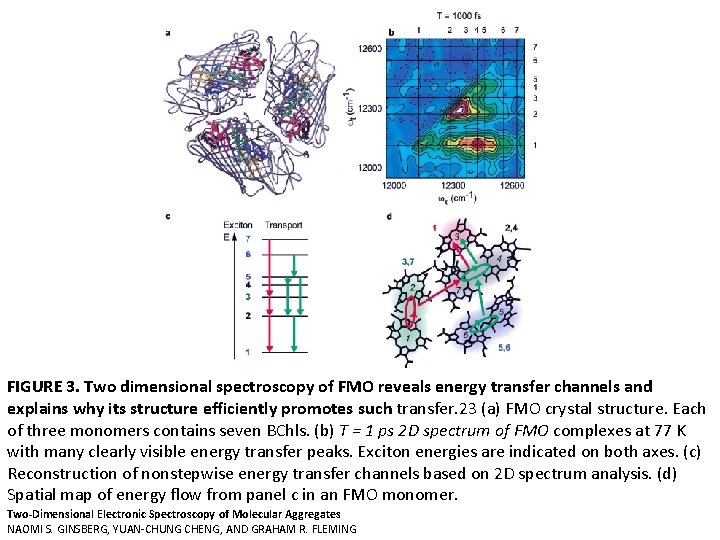
FIGURE 3. Two dimensional spectroscopy of FMO reveals energy transfer channels and explains why its structure efficiently promotes such transfer. 23 (a) FMO crystal structure. Each of three monomers contains seven BChls. (b) T = 1 ps 2 D spectrum of FMO complexes at 77 K with many clearly visible energy transfer peaks. Exciton energies are indicated on both axes. (c) Reconstruction of nonstepwise energy transfer channels based on 2 D spectrum analysis. (d) Spatial map of energy flow from panel c in an FMO monomer. Two-Dimensional Electronic Spectroscopy of Molecular Aggregates NAOMI S. GINSBERG, YUAN-CHUNG CHENG, AND GRAHAM R. FLEMING
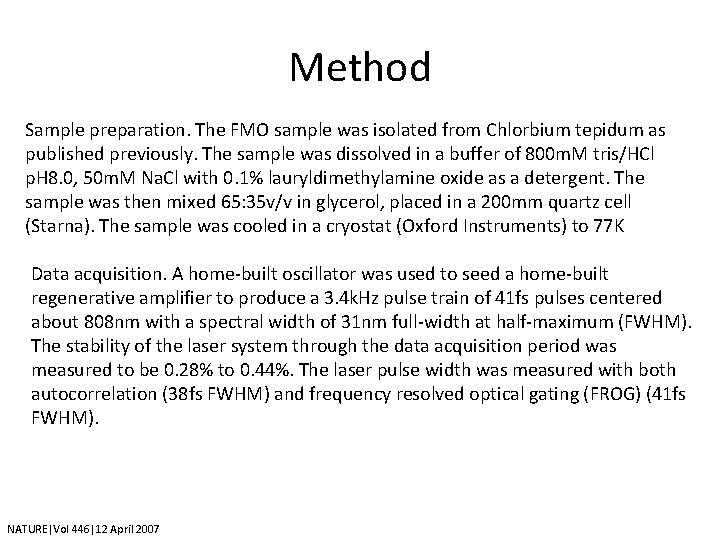
Method Sample preparation. The FMO sample was isolated from Chlorbium tepidum as published previously. The sample was dissolved in a buffer of 800 m. M tris/HCl p. H 8. 0, 50 m. M Na. Cl with 0. 1% lauryldimethylamine oxide as a detergent. The sample was then mixed 65: 35 v/v in glycerol, placed in a 200 mm quartz cell (Starna). The sample was cooled in a cryostat (Oxford Instruments) to 77 K Data acquisition. A home-built oscillator was used to seed a home-built regenerative amplifier to produce a 3. 4 k. Hz pulse train of 41 fs pulses centered about 808 nm with a spectral width of 31 nm full-width at half-maximum (FWHM). The stability of the laser system through the data acquisition period was measured to be 0. 28% to 0. 44%. The laser pulse width was measured with both autocorrelation (38 fs FWHM) and frequency resolved optical gating (FROG) (41 fs FWHM). NATURE|Vol 446|12 April 2007
Additional Resources Quantum Mechanics of Photosynthetic Light Harvesting Machinery https: //www. youtube. com/watch? v=Cn. HM-Py. N 0 gg ICAM, the Institute for Complex Adaptive Matter is a global network of research institutions with an interest in emergent phenomena in quantum matter. http: //icam-i 2 cam. org/ Quantum Coherence & Entanglement in Photosynthetic Light-Harvesting Complexes - P. Nalbach https: //www. youtube. com/watch? v=l. XS 2 h. Mkwt. LI&list=PLd. V 511 Az. T 3 Mr. UTHTWc 3 Oaf. FZu. E 7 trz_-&index=2 Coherent Oscillations in 2 D Photon-Echo Signals of Photosynthetic Complexes D. Egorova - https: //www. youtube. com/watch? v=1 wa. Hd 7 D 8 g 40&list=PLd. V 511 Az. T 3 Mr. UTHTWc 3 Oaf. FZu. E 7 trz_-&index=11 Quantum Mechanics of Photosynthetic Light Harvesting - D. Coker https: //www. youtube. com/watch? v=yt 10 n_5 do. Fk&list=PLd. V 511 Az. T 3 Mr. UTHTWc 3 Oaf. FZu. E 7 trz_-&index=7 Quantum-mechanical Optimization of Light-Harvesting in Photosynthesis - G. Scholes - https: //www. youtube. com/watch? v=Nu-t. Do. Cz 2 G 8&list=PLd. V 511 Az. T 3 Mr. UTHTWc 3 Oaf. FZu. E 7 trz_-&index=5
Additional Resources Evidence for wavelike energy transfer through quantum coherence in photosynthetic systems Gregory S. Engel, Tessa R. Calhoun, Elizabeth L. Read, Tae-Kyu Ahn, Toma´sˇ Mancˇal, Yuan. Chung Cheng, Robert E. Blankenship & Graham R. Fleming Vol 446| 12 April 2007| doi: 10. 1038/nature 05678 Direct evidence of quantum transport in photosynthetic light-harvesting complexes Gitt Panitchayangkoon, Dmitri V. Voronine, Darius Abramavicius, Justin R. Caram, Nicholas H. C. Lewis, Shaul Mukamel, and Gregory S. Engel 20908– 20912 ∣ PNAS ∣ December 27, 2011 ∣ vol. 108 ∣ no. 52 Functional quantum biology in photosynthesis and magnetoreception Neill Lambert, Yueh-Nan Chen, Yuan-Chung Cheng, Che-Ming Li, Guang-Yin Chen, Franco Noria ar. Xiv: 1205. 0883 v 1 [physics. bio-ph] 4 May 2012