
Quantum Parallelism and the Exact Simulation of Physical
- Slides: 68
Quantum Parallelism and the Exact Simulation of Physical Systems Dan Cristian Marinescu School of Computer Science University of Central Florida Orlando, Florida 32816, USA Computing Frontiers, Ischia, April 14, 2004
Frontier(s)…from Webster’s unabridged n n dictionary. The part of a settled or civilized country nearest to an unsettled or uncivilized region. Any new or incompletely investigated field of learning or thought. Computing Frontiers, Ischia, April 14, 2004 2
What is a Quantum computer? n n n A device that harnesses quantum physical phenomena such as entanglement and superposition. The laws of quantum mechanics differ radically from the laws of classical physics. The unit of information, the qubit can exist as a 0, or 1, or, simultaneously, as both 0 and 1. Computing Frontiers, Ischia, April 14, 2004 3
Does quantum computing represent the frontiers of computing? n n Is it for real? Can we actually build quantum computers? - Very likely, but it will take some time…. If so, what would a quantum computer allow us to do that is either unfeasible or impractical with today’s most advanced systems? – Exact simulation of physical systems, among other things. Once we have quantum computers do we need new algorithms? – Yes, we need quantum algorithms. Is it so different from our current thinking that it requires a substantial change in the way we educate our students? – Yes, it does. Computing Frontiers, Ischia, April 14, 2004 4
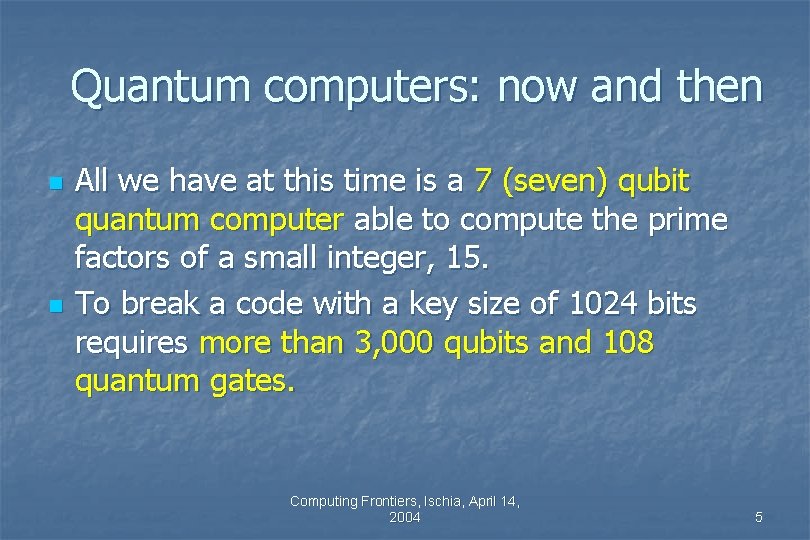
Quantum computers: now and then n n All we have at this time is a 7 (seven) qubit quantum computer able to compute the prime factors of a small integer, 15. To break a code with a key size of 1024 bits requires more than 3, 000 qubits and 108 quantum gates. Computing Frontiers, Ischia, April 14, 2004 5
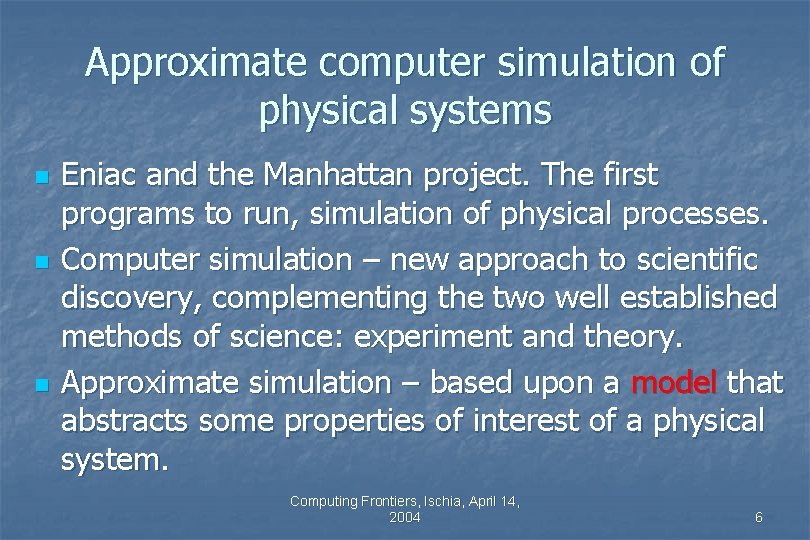
Approximate computer simulation of physical systems n n n Eniac and the Manhattan project. The first programs to run, simulation of physical processes. Computer simulation – new approach to scientific discovery, complementing the two well established methods of science: experiment and theory. Approximate simulation – based upon a model that abstracts some properties of interest of a physical system. Computing Frontiers, Ischia, April 14, 2004 6
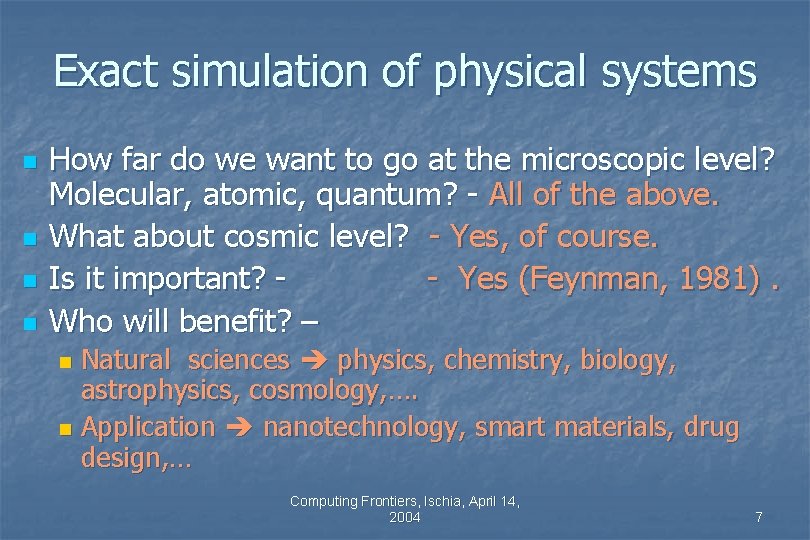
Exact simulation of physical systems n n How far do we want to go at the microscopic level? Molecular, atomic, quantum? - All of the above. What about cosmic level? - Yes, of course. Is it important? - Yes (Feynman, 1981). Who will benefit? – Natural sciences physics, chemistry, biology, astrophysics, cosmology, …. n Application nanotechnology, smart materials, drug design, … n Computing Frontiers, Ischia, April 14, 2004 7
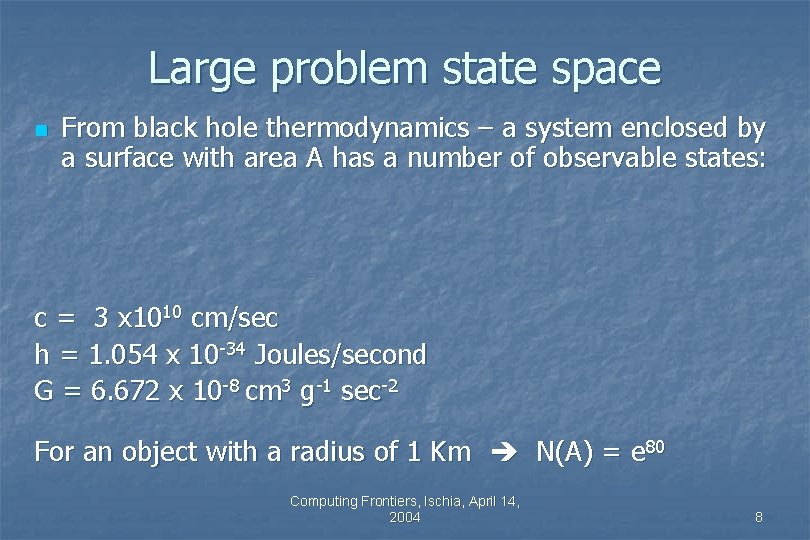
Large problem state space n From black hole thermodynamics – a system enclosed by a surface with area A has a number of observable states: c = 3 x 1010 cm/sec h = 1. 054 x 10 -34 Joules/second G = 6. 672 x 10 -8 cm 3 g-1 sec-2 For an object with a radius of 1 Km N(A) = e 80 Computing Frontiers, Ischia, April 14, 2004 8
Acknowledgments n Some of the material presented is from the book Approaching Quantum Computing by Dan C. Marinescu and Gabriela M. Marinescu to be published by Prentice Hall in June 2004 n Work supported by National Science Foundation grants MCB 9527131, DBI 0296107, ACI 0296035, and EIA 0296179. Computing Frontiers, Ischia, April 14, 2004 9
Contents n n n n Computing and the Laws of Physics Quantum Mechanics & Computers Qubits and Quantum Gates Quantum Parallelism Deutsch’s Algorithm Virus Structure Determination and Drug Design Summary Computing Frontiers, Ischia, April 14, 2004 10
The limits of solid-state technologies n n For the past two decades we have enjoyed Gordon Moore’s law. But all good things may come to an end… We are limited in our ability to increase n n n the density and the speed of a computing engine. Reliability will also be affected n n to increase the speed we need increasingly smaller circuits (light needs 1 ns to travel 30 cm in vacuum) smaller circuits systems consisting only of a few particles are subject to Heissenberg uncertainty Computing Frontiers, Ischia, April 14, 2004 11
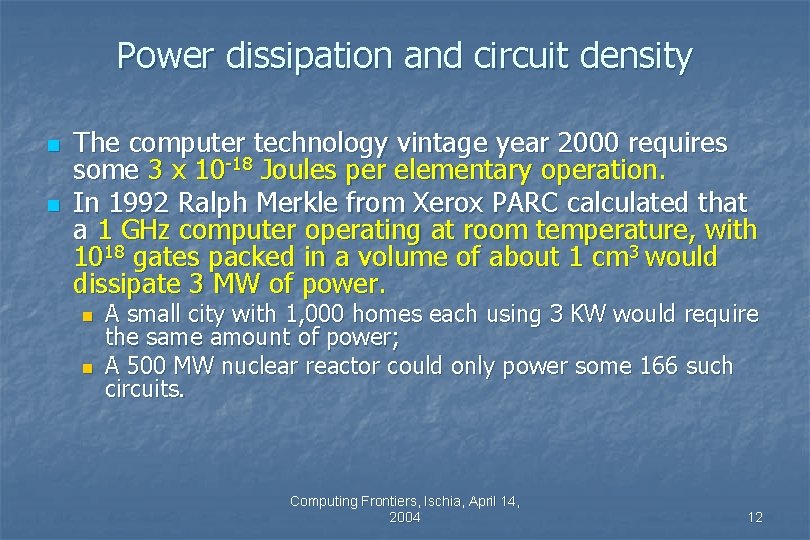
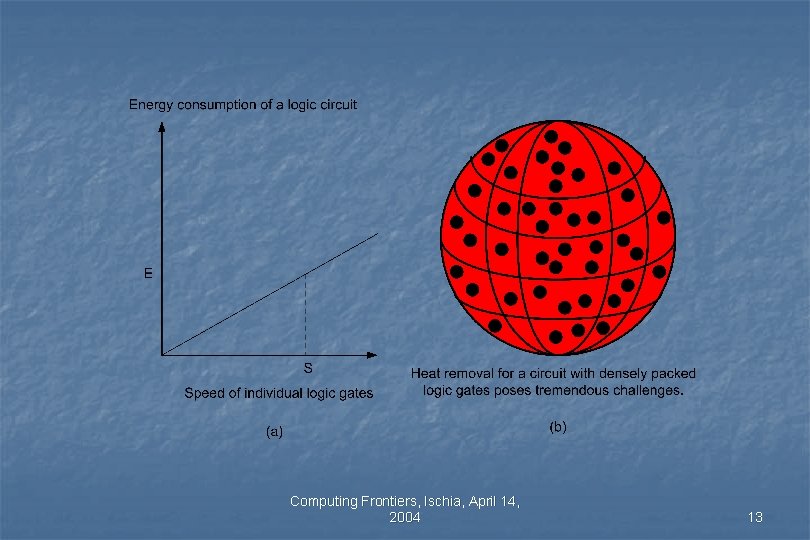
Power dissipation and circuit density n n The computer technology vintage year 2000 requires some 3 x 10 -18 Joules per elementary operation. In 1992 Ralph Merkle from Xerox PARC calculated that a 1 GHz computer operating at room temperature, with 1018 gates packed in a volume of about 1 cm 3 would dissipate 3 MW of power. n n A small city with 1, 000 homes each using 3 KW would require the same amount of power; A 500 MW nuclear reactor could only power some 166 such circuits. Computing Frontiers, Ischia, April 14, 2004 12
Computing Frontiers, Ischia, April 14, 2004 13
Contents n n n n Computing and the Laws of Physics Quantum Mechanics & Computers Qubits and Quantum Gates Quantum Parallelism Deutsch’s Algorithm Virus Structure Determination and Drug Design Summary Computing Frontiers, Ischia, April 14, 2004 14
A happy marriage… n The two greatest discoveries of the 20 -th century n n quantum mechanics stored program computers led to the idea of quantum computing and quantum information theory Computing Frontiers, Ischia, April 14, 2004 15
Quantum; Quantum mechanics n n Quantum Latin word meaning some quantity. In physics it is used with the same meaning as the word discrete in mathematics. Quantum mechanics a mathematical model of the physical world. Computing Frontiers, Ischia, April 14, 2004 16
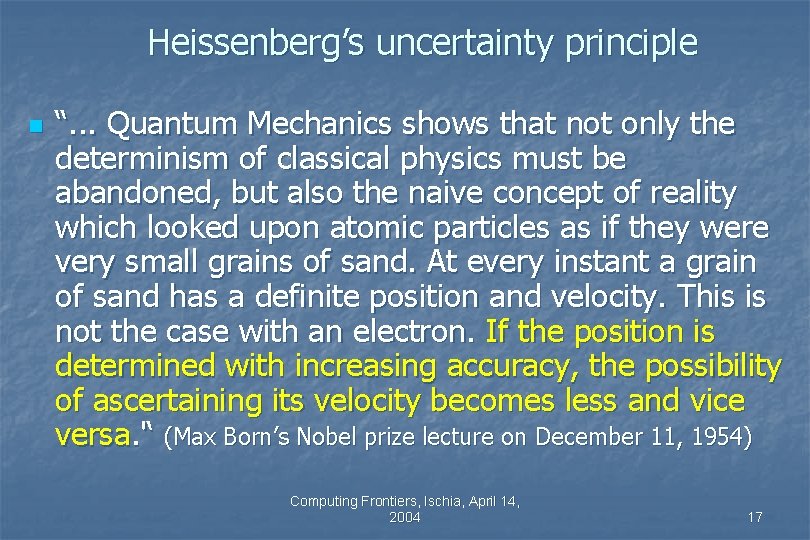
Heissenberg’s uncertainty principle n “. . . Quantum Mechanics shows that not only the determinism of classical physics must be abandoned, but also the naive concept of reality which looked upon atomic particles as if they were very small grains of sand. At every instant a grain of sand has a definite position and velocity. This is not the case with an electron. If the position is determined with increasing accuracy, the possibility of ascertaining its velocity becomes less and vice versa. '‘ (Max Born’s Nobel prize lecture on December 11, 1954) Computing Frontiers, Ischia, April 14, 2004 17
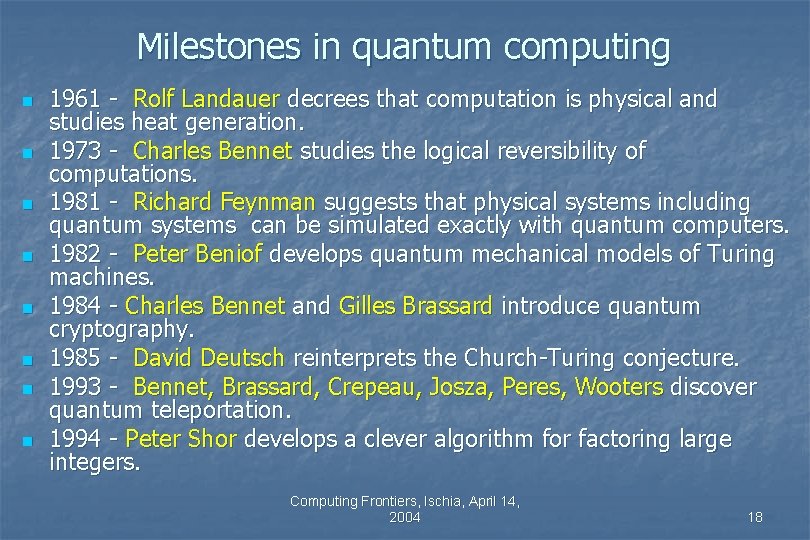
Milestones in quantum computing n n n n 1961 - Rolf Landauer decrees that computation is physical and studies heat generation. 1973 - Charles Bennet studies the logical reversibility of computations. 1981 - Richard Feynman suggests that physical systems including quantum systems can be simulated exactly with quantum computers. 1982 - Peter Beniof develops quantum mechanical models of Turing machines. 1984 - Charles Bennet and Gilles Brassard introduce quantum cryptography. 1985 - David Deutsch reinterprets the Church-Turing conjecture. 1993 - Bennet, Brassard, Crepeau, Josza, Peres, Wooters discover quantum teleportation. 1994 - Peter Shor develops a clever algorithm for factoring large integers. Computing Frontiers, Ischia, April 14, 2004 18
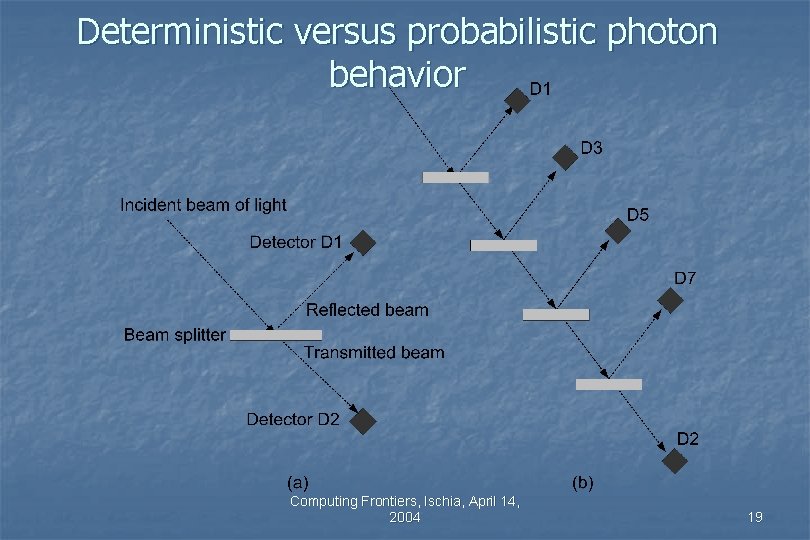
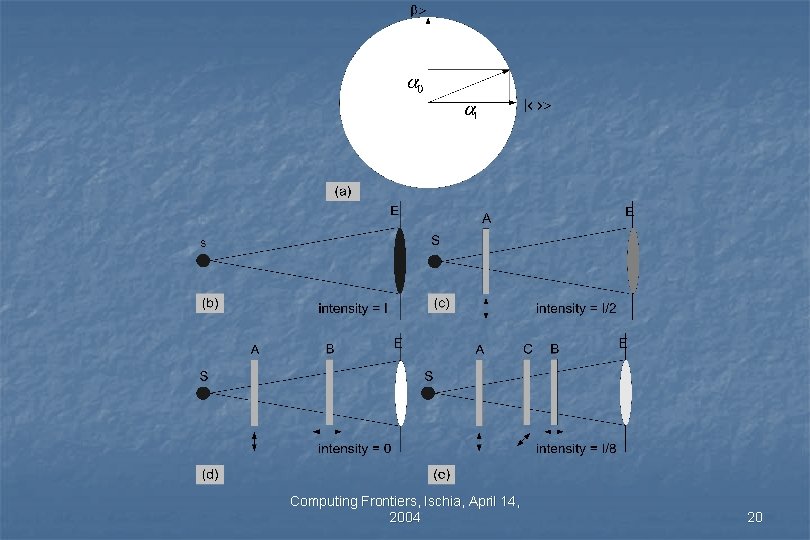
Deterministic versus probabilistic photon behavior Computing Frontiers, Ischia, April 14, 2004 19
Computing Frontiers, Ischia, April 14, 2004 20
Contents n n n Computing and the Laws of Physics Quantum Mechanics & Computers Qubits and Quantum Gates Quantum Parallelism Virus Structure Determination and Drug Design Summary Computing Frontiers, Ischia, April 14, 2004 21
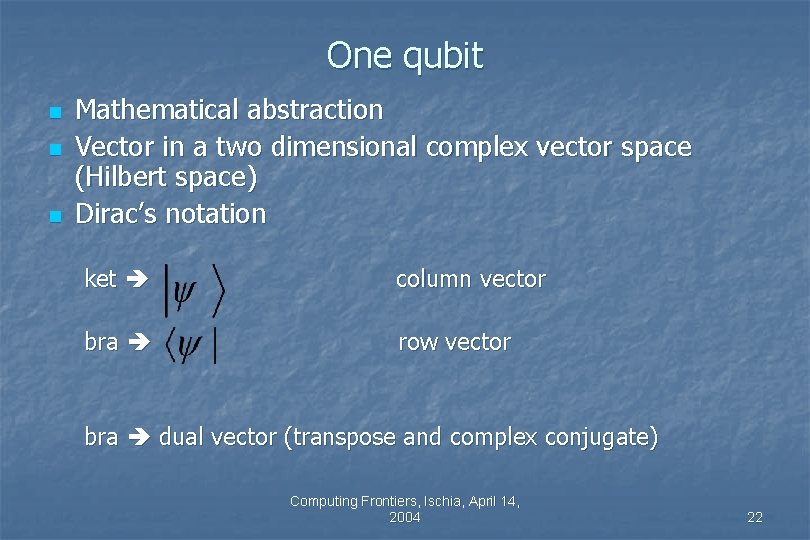
One qubit n n n Mathematical abstraction Vector in a two dimensional complex vector space (Hilbert space) Dirac’s notation ket column vector bra row vector bra dual vector (transpose and complex conjugate) Computing Frontiers, Ischia, April 14, 2004 22
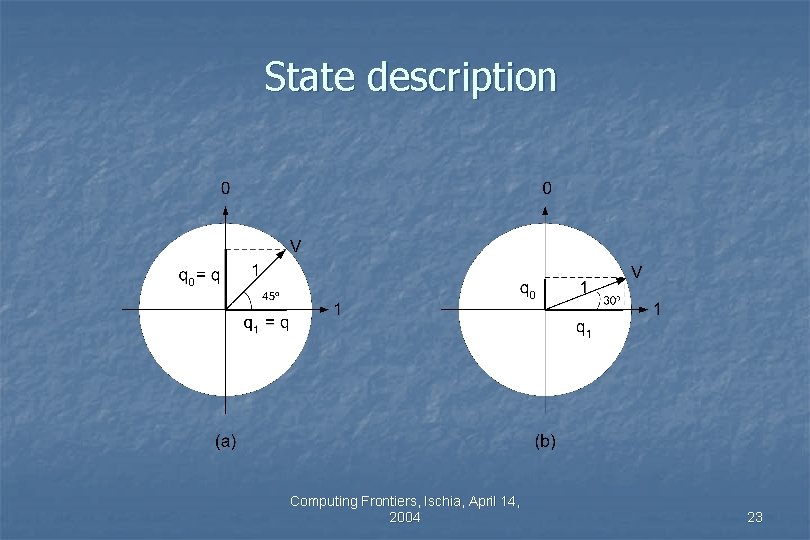
State description Computing Frontiers, Ischia, April 14, 2004 23
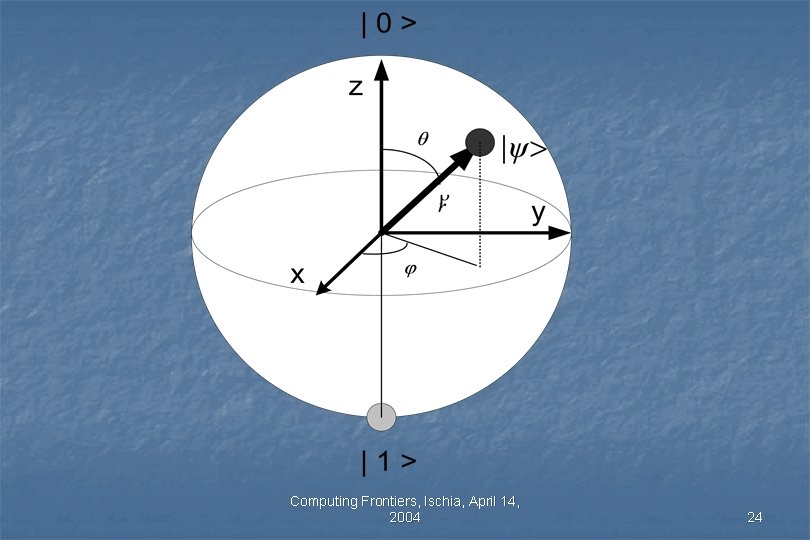
Computing Frontiers, Ischia, April 14, 2004 24
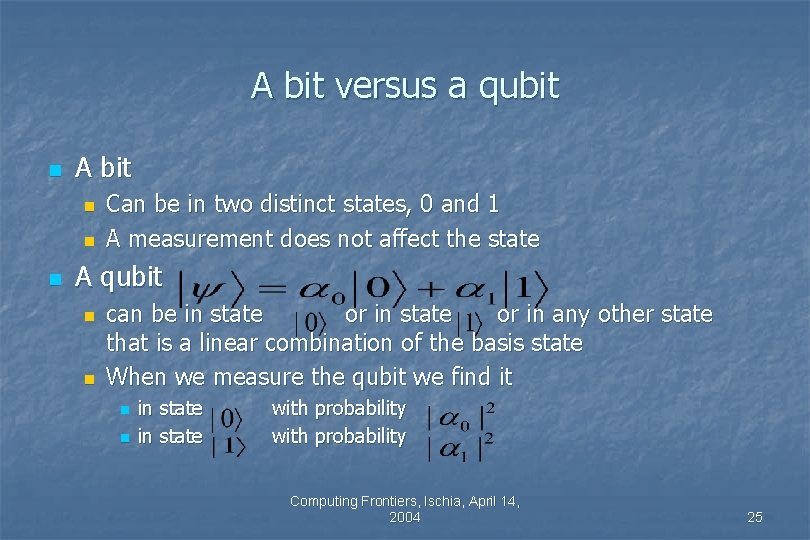
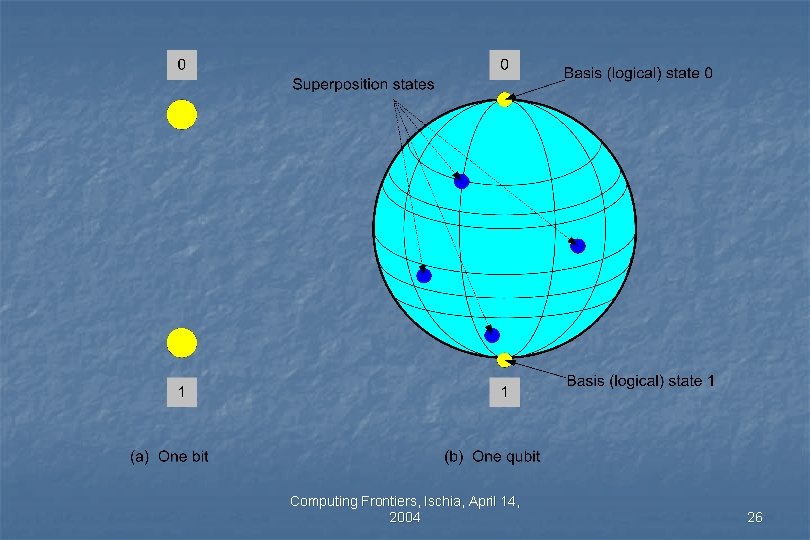
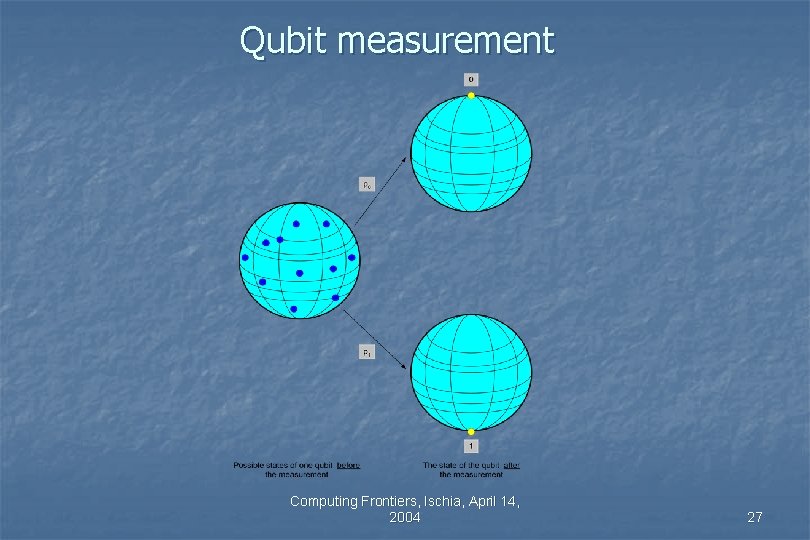
A bit versus a qubit n A bit n n n Can be in two distinct states, 0 and 1 A measurement does not affect the state A qubit n n can be in state or in any other state that is a linear combination of the basis state When we measure the qubit we find it n n in state with probability Computing Frontiers, Ischia, April 14, 2004 25
Computing Frontiers, Ischia, April 14, 2004 26
Qubit measurement Computing Frontiers, Ischia, April 14, 2004 27
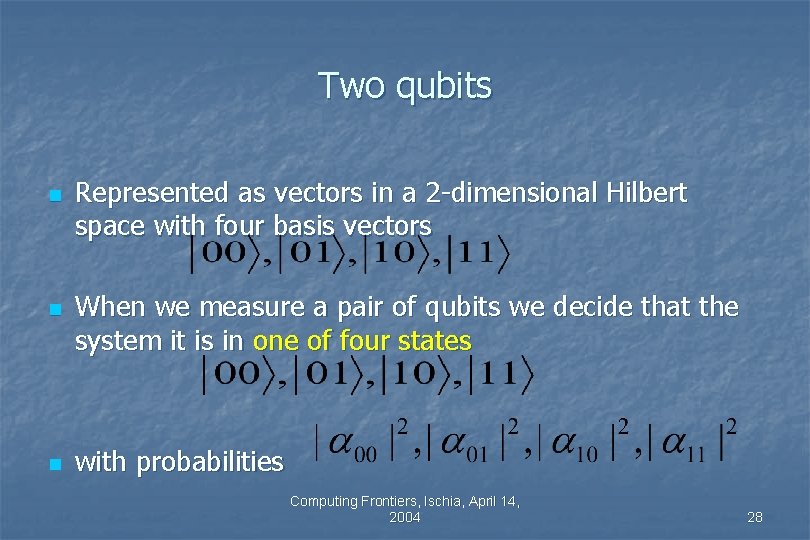
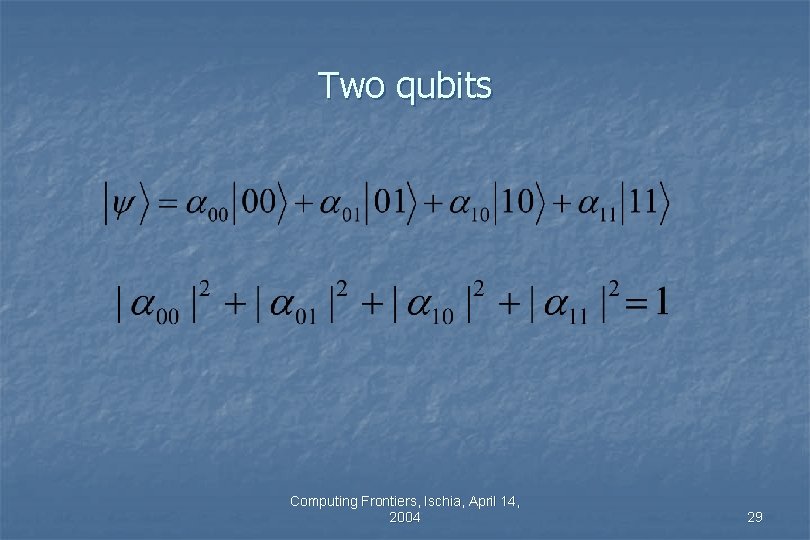
Two qubits n n n Represented as vectors in a 2 -dimensional Hilbert space with four basis vectors When we measure a pair of qubits we decide that the system it is in one of four states with probabilities Computing Frontiers, Ischia, April 14, 2004 28
Two qubits Computing Frontiers, Ischia, April 14, 2004 29
Measuring two qubits n n Before a measurement the state of the system consisting of two qubits is uncertain (it is given by the previous equation and the corresponding probabilities). After the measurement the state is certain, it is 00, 01, 10, or 11 like in the case of a classical two bit system. Computing Frontiers, Ischia, April 14, 2004 30
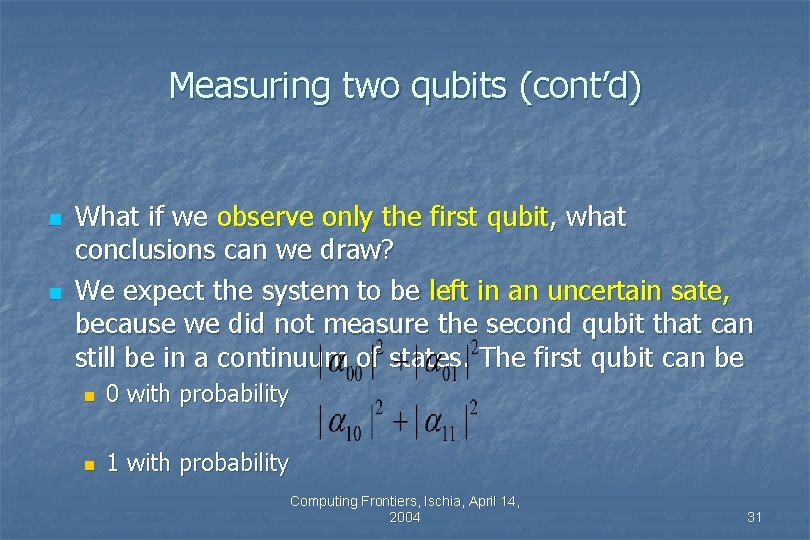
Measuring two qubits (cont’d) n n What if we observe only the first qubit, what conclusions can we draw? We expect the system to be left in an uncertain sate, because we did not measure the second qubit that can still be in a continuum of states. The first qubit can be n 0 with probability n 1 with probability Computing Frontiers, Ischia, April 14, 2004 31
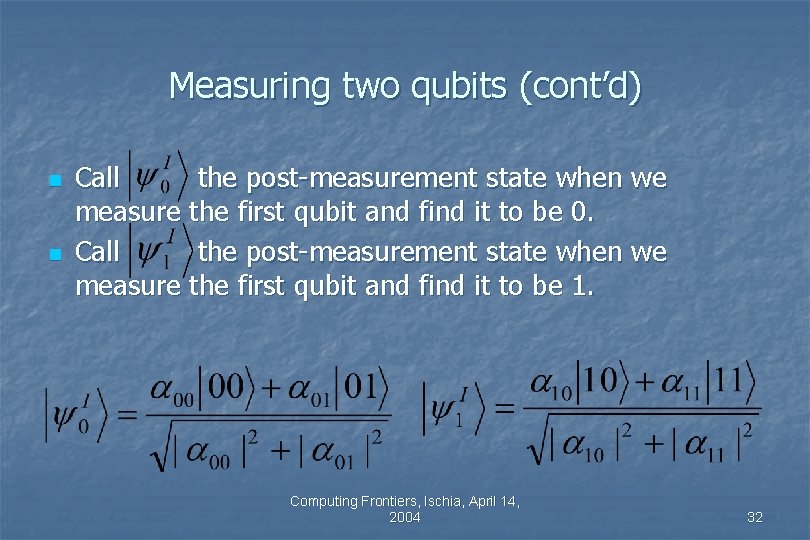
Measuring two qubits (cont’d) n n Call the post-measurement state when we measure the first qubit and find it to be 0. Call the post-measurement state when we measure the first qubit and find it to be 1. Computing Frontiers, Ischia, April 14, 2004 32
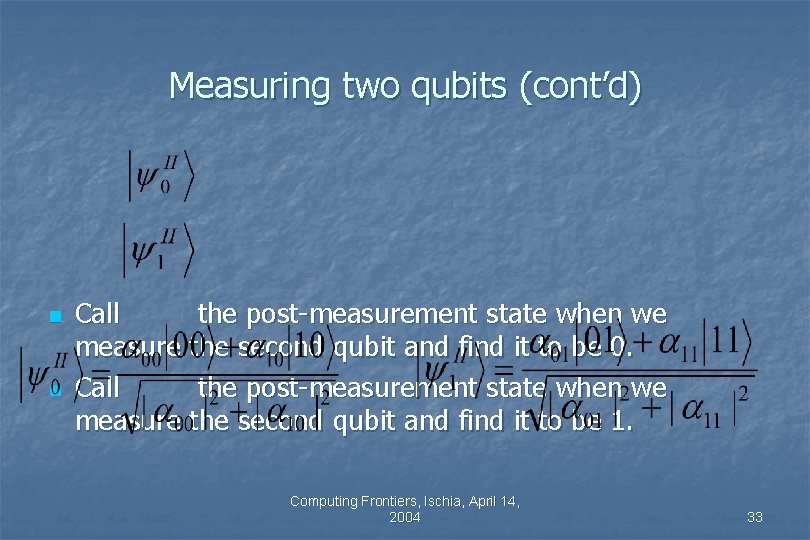
Measuring two qubits (cont’d) n n Call the post-measurement state when we measure the second qubit and find it to be 0. Call the post-measurement state when we measure the second qubit and find it to be 1. Computing Frontiers, Ischia, April 14, 2004 33
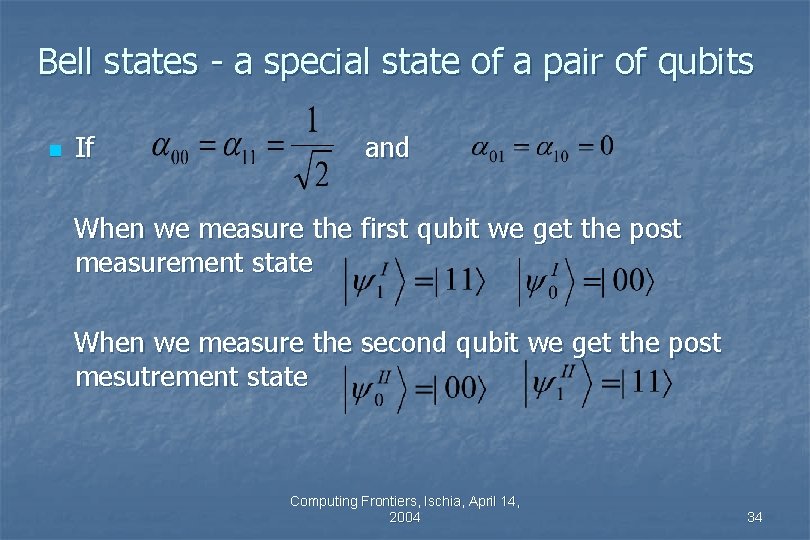
Bell states - a special state of a pair of qubits n If and When we measure the first qubit we get the post measurement state When we measure the second qubit we get the post mesutrement state Computing Frontiers, Ischia, April 14, 2004 34
This is an amazing result! n n The two measurements are correlated, once we measure the first qubit we get exactly the same result as when we measure the second one. The two qubits need not be physically constrained to be at the same location and yet, because of the strong coupling between them, measurements performed on the second one allow us to determine the state of the first. Computing Frontiers, Ischia, April 14, 2004 35
Entanglement (Verschrankung) n n n Discovered by Schrodinger. An entangled pair is a single quantum system in a superposition of equally possible states. The entangled state contains no information about the individual particles, only that they are in opposite states. Einstein called entanglement “Spooky action at a distance". Computing Frontiers, Ischia, April 14, 2004 36
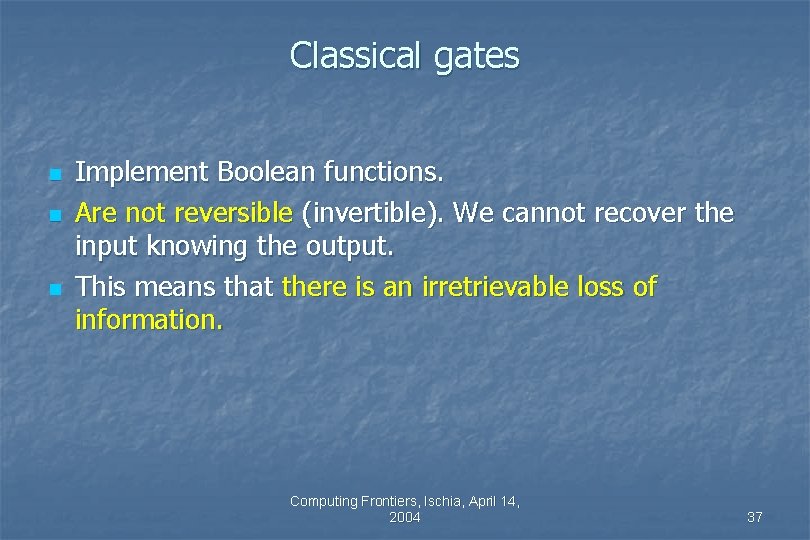
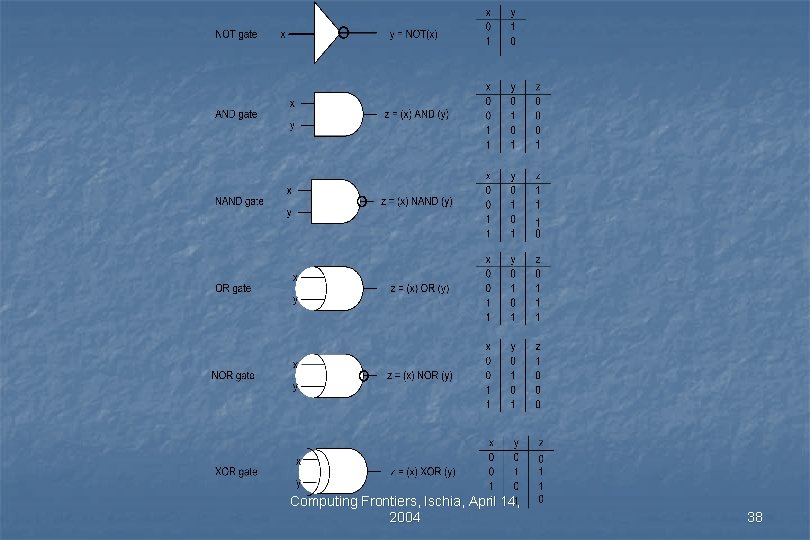
Classical gates n n n Implement Boolean functions. Are not reversible (invertible). We cannot recover the input knowing the output. This means that there is an irretrievable loss of information. Computing Frontiers, Ischia, April 14, 2004 37
Computing Frontiers, Ischia, April 14, 2004 38
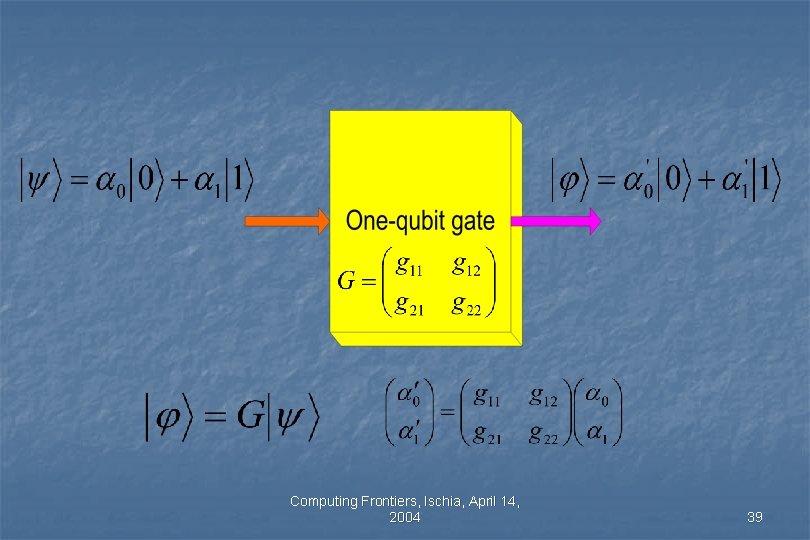
Computing Frontiers, Ischia, April 14, 2004 39
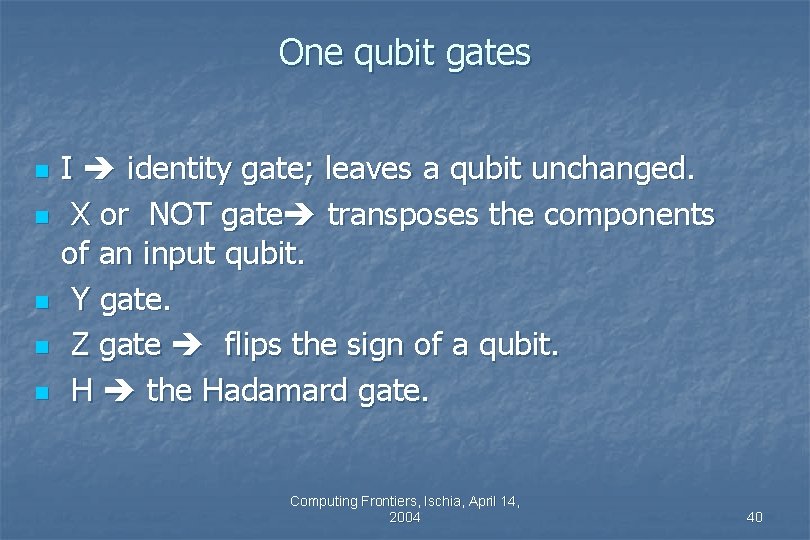
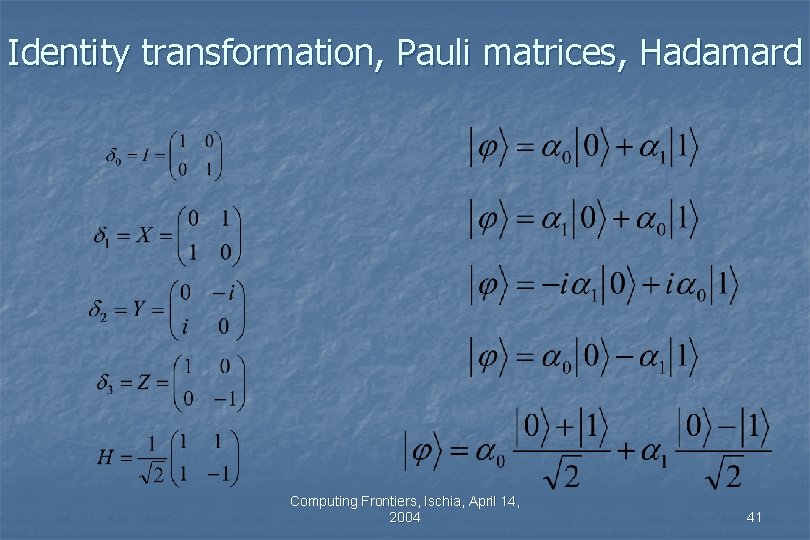
One qubit gates n n n I identity gate; leaves a qubit unchanged. X or NOT gate transposes the components of an input qubit. Y gate. Z gate flips the sign of a qubit. H the Hadamard gate. Computing Frontiers, Ischia, April 14, 2004 40
Identity transformation, Pauli matrices, Hadamard Computing Frontiers, Ischia, April 14, 2004 41
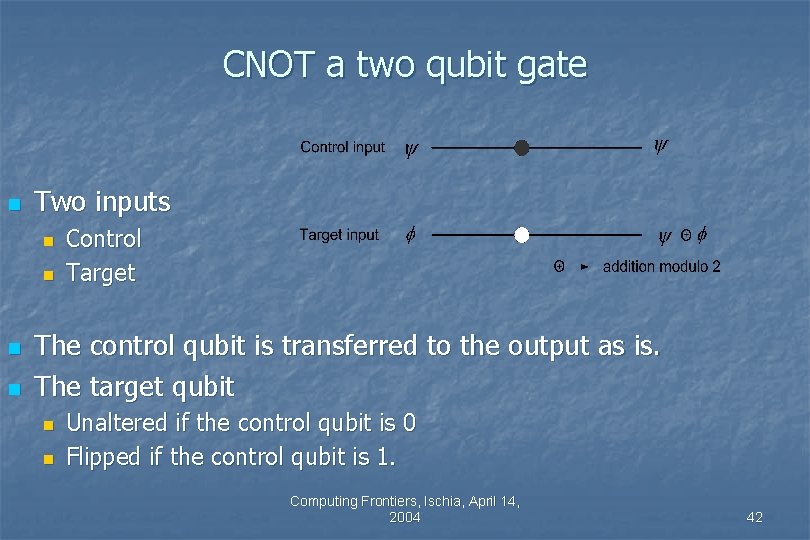
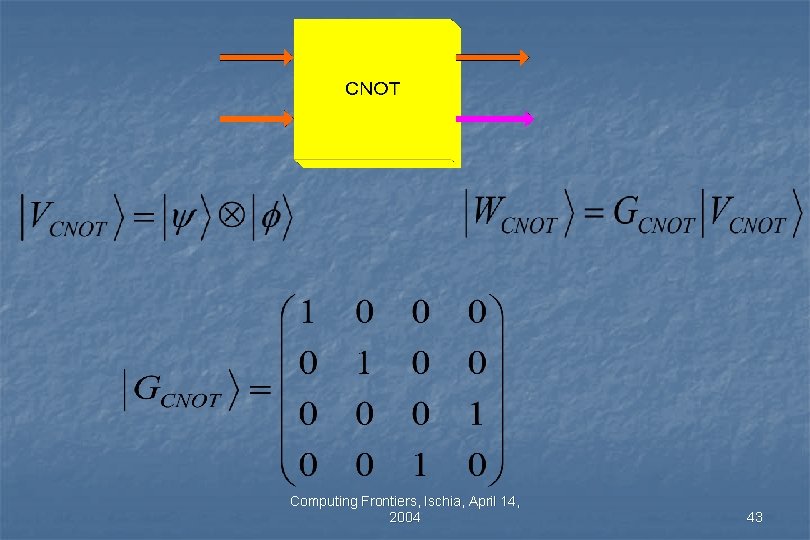
CNOT a two qubit gate n Two inputs n n Control Target The control qubit is transferred to the output as is. The target qubit n n Unaltered if the control qubit is 0 Flipped if the control qubit is 1. Computing Frontiers, Ischia, April 14, 2004 42
Computing Frontiers, Ischia, April 14, 2004 43
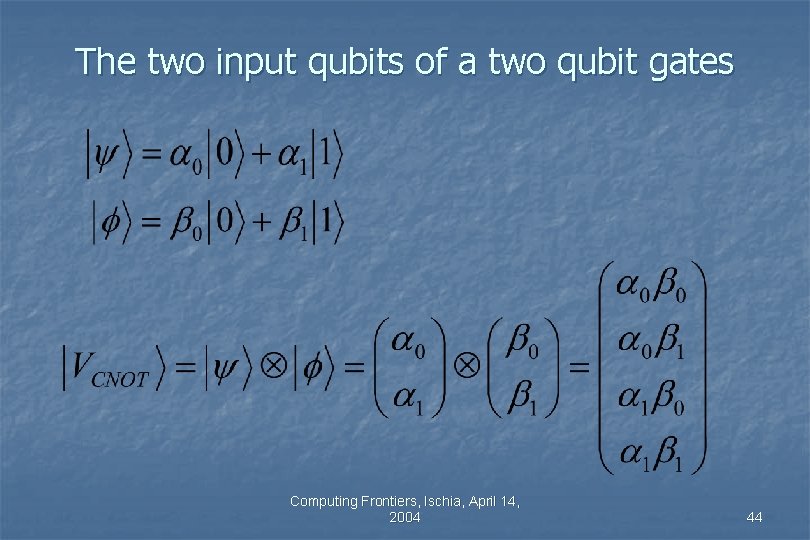
The two input qubits of a two qubit gates Computing Frontiers, Ischia, April 14, 2004 44
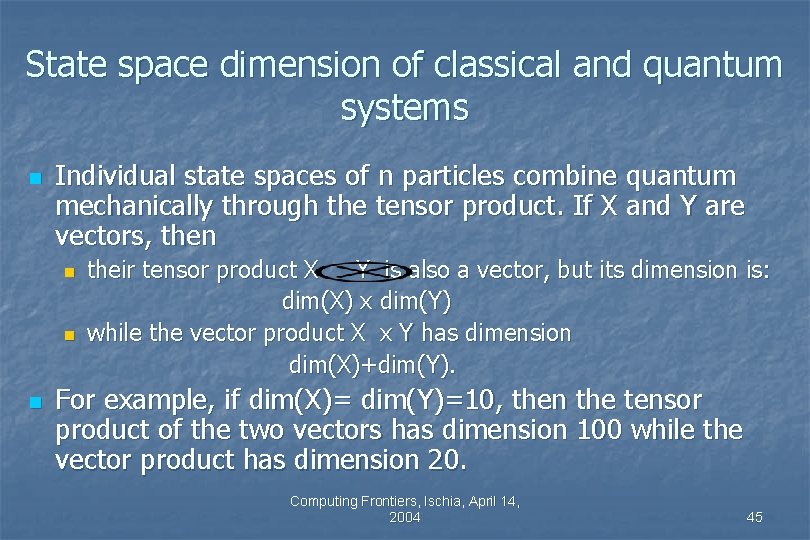
State space dimension of classical and quantum systems n Individual state spaces of n particles combine quantum mechanically through the tensor product. If X and Y are vectors, then n their tensor product X Y is also a vector, but its dimension is: dim(X) x dim(Y) while the vector product X x Y has dimension dim(X)+dim(Y). For example, if dim(X)= dim(Y)=10, then the tensor product of the two vectors has dimension 100 while the vector product has dimension 20. Computing Frontiers, Ischia, April 14, 2004 45
Parallelism and Quantum computers n n In quantum systems the amount of parallelism increases exponentially with the size of the system, thus with the number of qubits (e. g. a 21 qubit quantum computer is twice as powerful as a 20 qubit quantum computer). A quantum computer will enable us to solve problems with a very large state space. Computing Frontiers, Ischia, April 14, 2004 46
Contents n n n n Computing and the Laws of Physics Quantum Mechanics & Quantum Computers Qubits and Quantum Gates Quantum Parallelism Deutsch’s Algorithm Virus Structure Determination and Drug Design Summary Computing Frontiers, Ischia, April 14, 2004 47
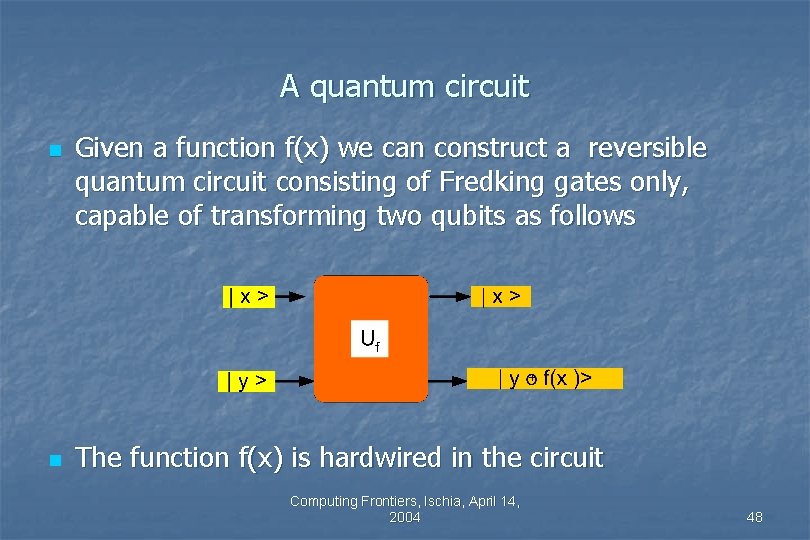
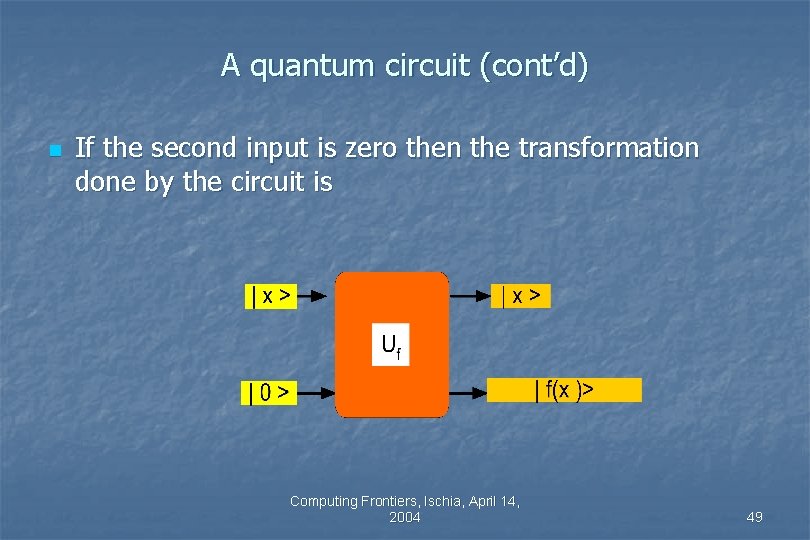
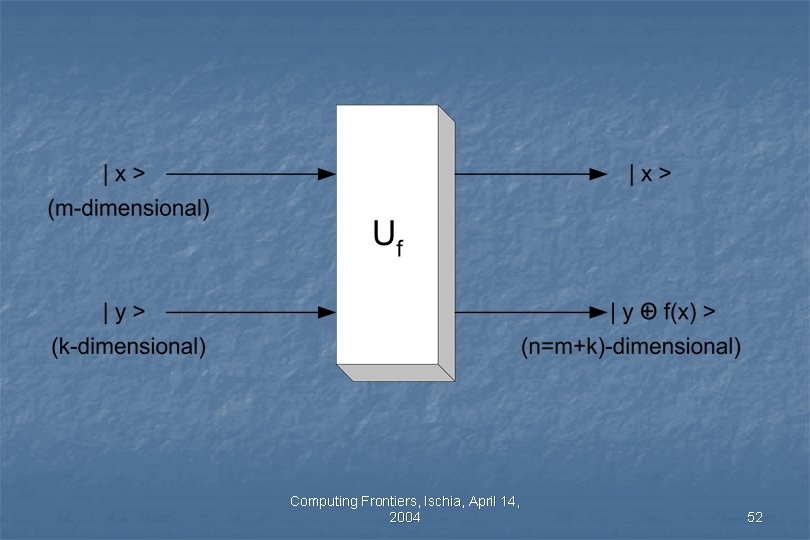
A quantum circuit n n Given a function f(x) we can construct a reversible quantum circuit consisting of Fredking gates only, capable of transforming two qubits as follows The function f(x) is hardwired in the circuit Computing Frontiers, Ischia, April 14, 2004 48
A quantum circuit (cont’d) n If the second input is zero then the transformation done by the circuit is Computing Frontiers, Ischia, April 14, 2004 49
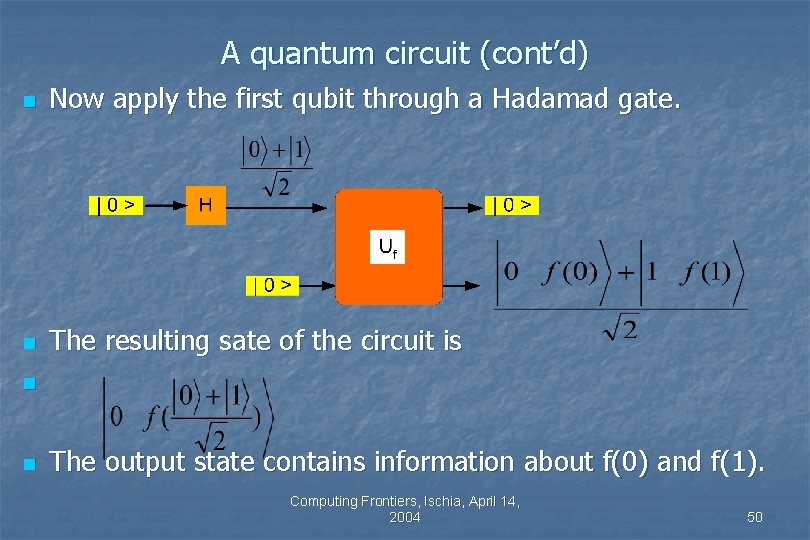
A quantum circuit (cont’d) n Now apply the first qubit through a Hadamad gate. n The resulting sate of the circuit is n n The output state contains information about f(0) and f(1). Computing Frontiers, Ischia, April 14, 2004 50
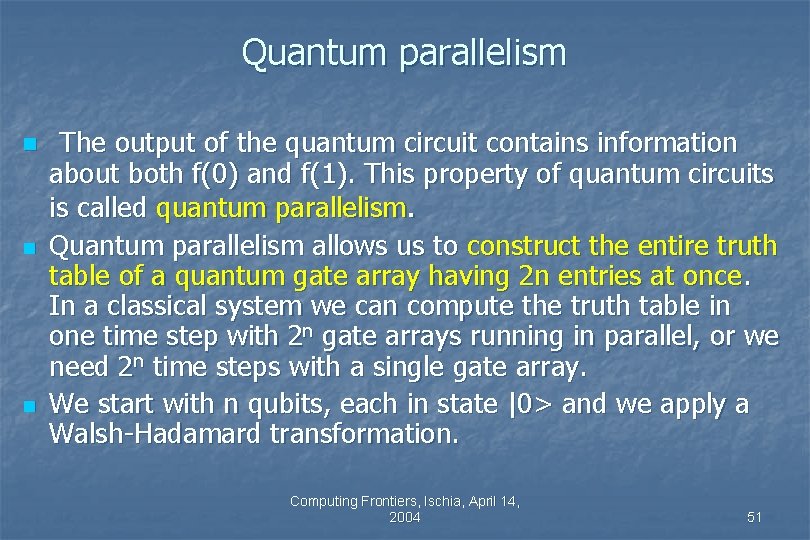
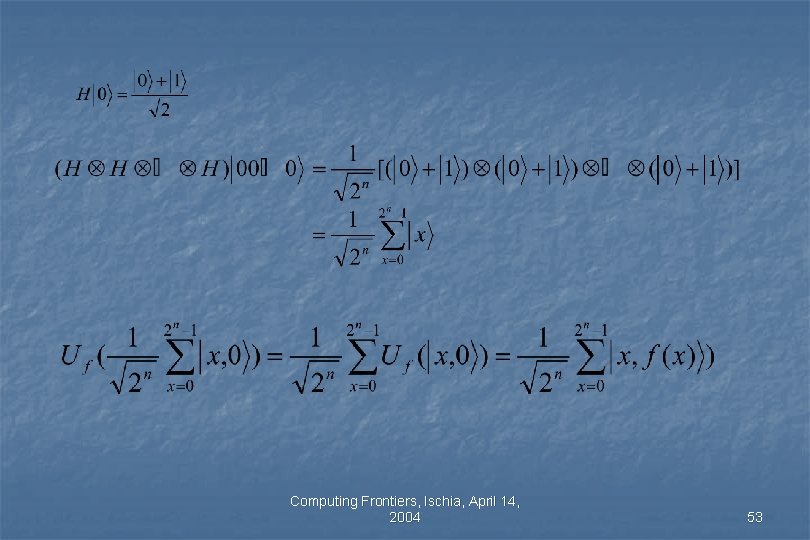
Quantum parallelism n n n The output of the quantum circuit contains information about both f(0) and f(1). This property of quantum circuits is called quantum parallelism. Quantum parallelism allows us to construct the entire truth table of a quantum gate array having 2 n entries at once. In a classical system we can compute the truth table in one time step with 2 n gate arrays running in parallel, or we need 2 n time steps with a single gate array. We start with n qubits, each in state |0> and we apply a Walsh-Hadamard transformation. Computing Frontiers, Ischia, April 14, 2004 51
Computing Frontiers, Ischia, April 14, 2004 52
Computing Frontiers, Ischia, April 14, 2004 53
Contents n n n n Computing and the Laws of Physics Quantum Mechanics and Computers Qubits and Quantum Gates Quantum Parallelism Deutsch’s Algorithm Virus Structure Determination and Drug Design Summary Computing Frontiers, Ischia, April 14, 2004 54
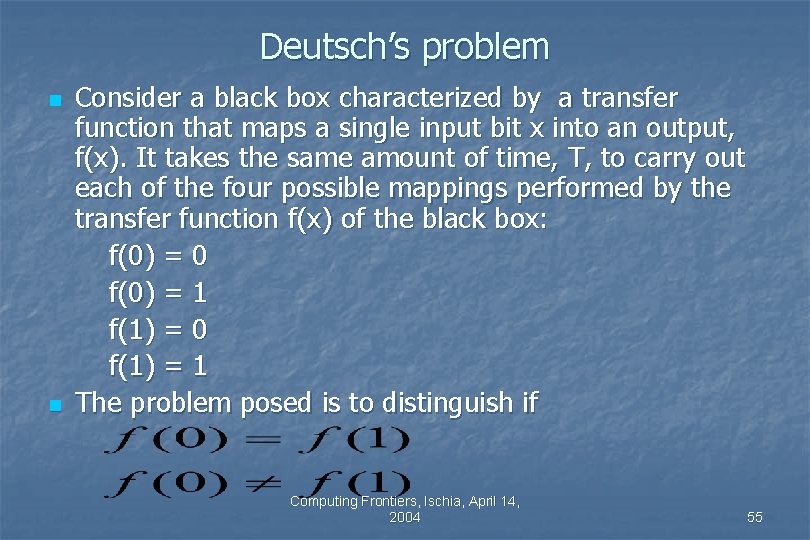
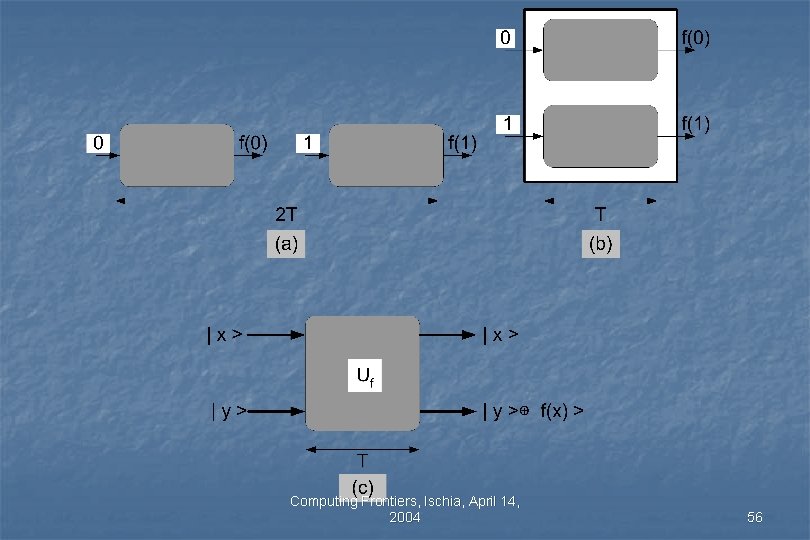
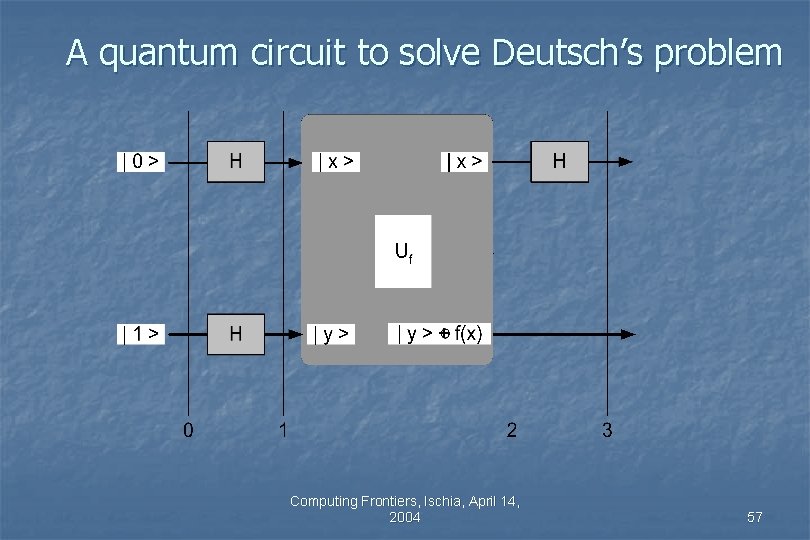
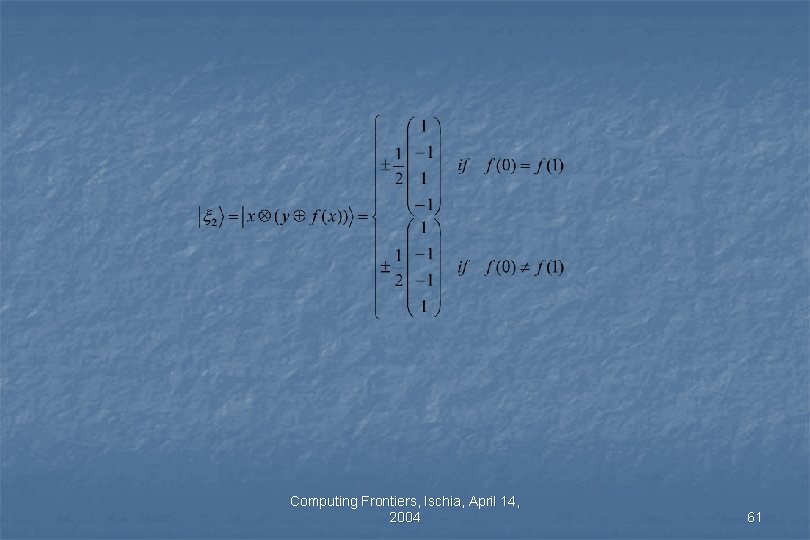
Deutsch’s problem n n Consider a black box characterized by a transfer function that maps a single input bit x into an output, f(x). It takes the same amount of time, T, to carry out each of the four possible mappings performed by the transfer function f(x) of the black box: f(0) = 0 f(0) = 1 f(1) = 0 f(1) = 1 The problem posed is to distinguish if Computing Frontiers, Ischia, April 14, 2004 55
Computing Frontiers, Ischia, April 14, 2004 56
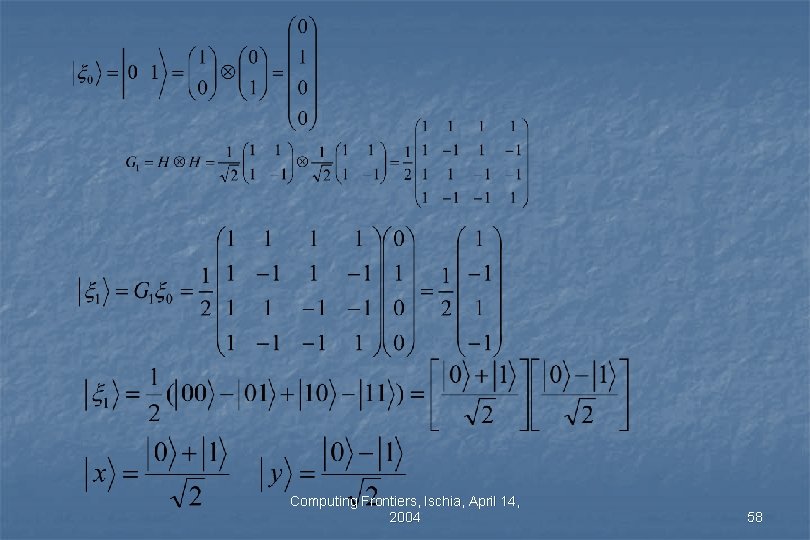
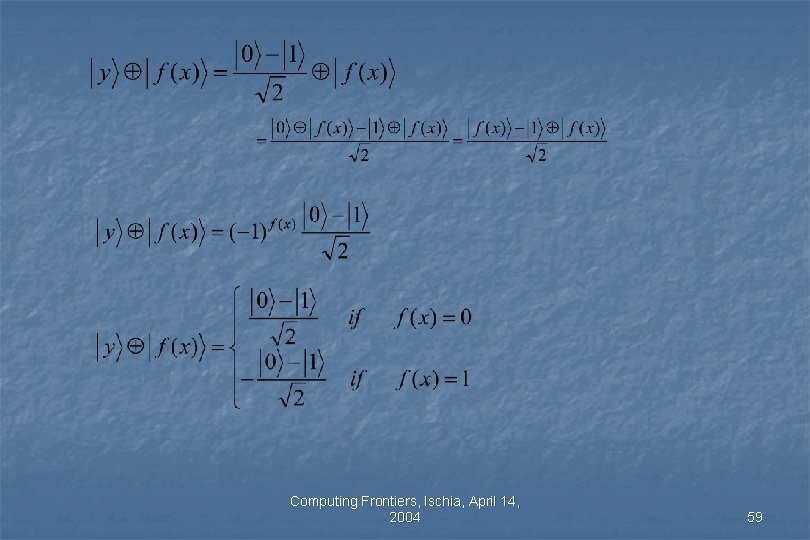
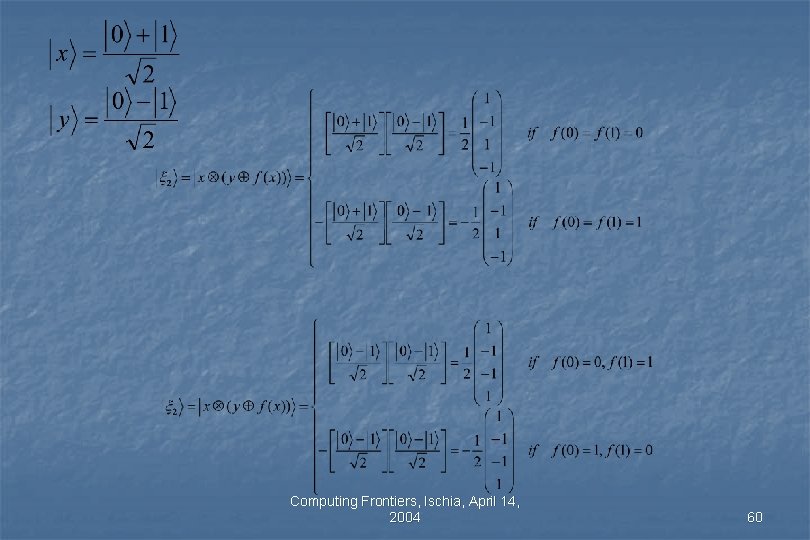
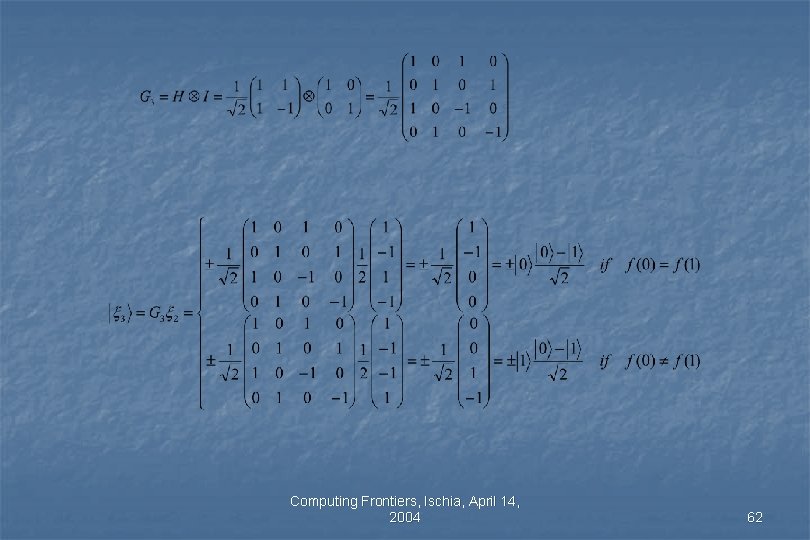
A quantum circuit to solve Deutsch’s problem Computing Frontiers, Ischia, April 14, 2004 57
Computing Frontiers, Ischia, April 14, 2004 58
Computing Frontiers, Ischia, April 14, 2004 59
Computing Frontiers, Ischia, April 14, 2004 60
Computing Frontiers, Ischia, April 14, 2004 61
Computing Frontiers, Ischia, April 14, 2004 62
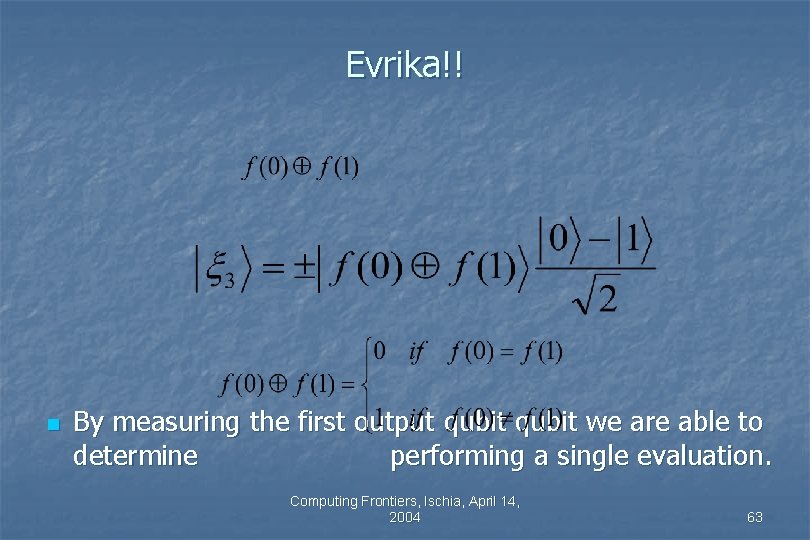
Evrika!! n By measuring the first output qubit we are able to determine performing a single evaluation. Computing Frontiers, Ischia, April 14, 2004 63
Contents n n n n Computing and the Laws of Physics Quantum Mechanics and Computers Qubits and Quantum Gates Quantum Parallelism Deutsch’s Algorithm Virus Structure Determination and Drug Design Summary Computing Frontiers, Ischia, April 14, 2004 64
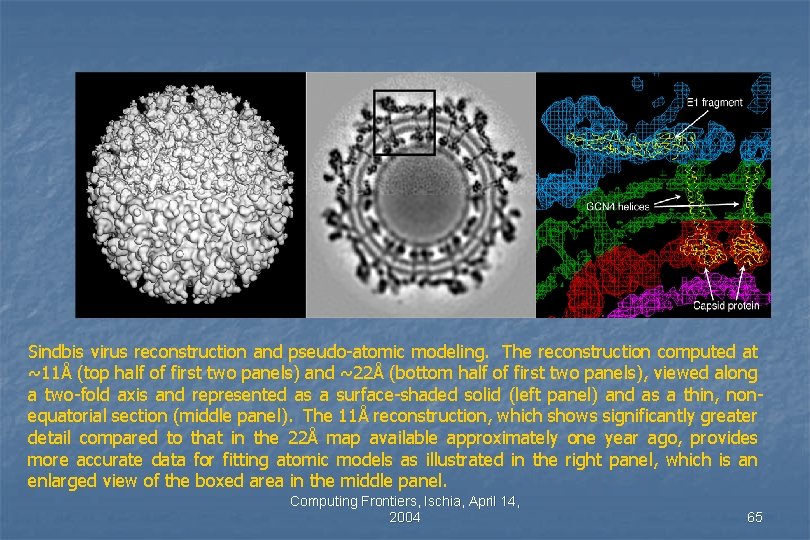
Sindbis virus reconstruction and pseudo-atomic modeling. The reconstruction computed at ~11Å (top half of first two panels) and ~22Å (bottom half of first two panels), viewed along a two-fold axis and represented as a surface-shaded solid (left panel) and as a thin, nonequatorial section (middle panel). The 11Å reconstruction, which shows significantly greater detail compared to that in the 22Å map available approximately one year ago, provides more accurate data for fitting atomic models as illustrated in the right panel, which is an enlarged view of the boxed area in the middle panel. Computing Frontiers, Ischia, April 14, 2004 65
Final remarks n n A tremendous progress has been made in quantum computing and quantum information theory during the past decade. Motivation the incredible impact this discipline could have on how we store, process, and transmit data and knowledge in this information age. Computing Frontiers, Ischia, April 14, 2004 66
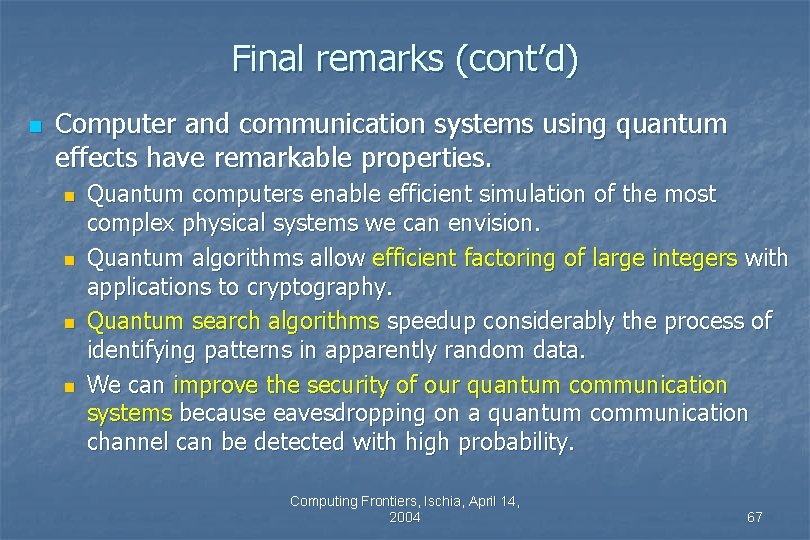
Final remarks (cont’d) n Computer and communication systems using quantum effects have remarkable properties. n n Quantum computers enable efficient simulation of the most complex physical systems we can envision. Quantum algorithms allow efficient factoring of large integers with applications to cryptography. Quantum search algorithms speedup considerably the process of identifying patterns in apparently random data. We can improve the security of our quantum communication systems because eavesdropping on a quantum communication channel can be detected with high probability. Computing Frontiers, Ischia, April 14, 2004 67
Summary n n Quantum computing and quantum information theory is truly an exciting field. It is too important to be left to the physicists alone…. Computing Frontiers, Ischia, April 14, 2004 68