
Quantum numbers and Periodic table II What is
Quantum numbers and Periodic table II/
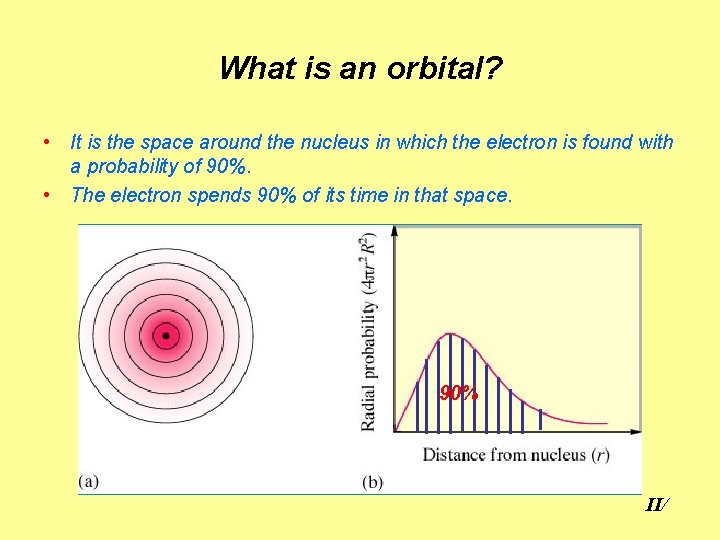
What is an orbital? • It is the space around the nucleus in which the electron is found with a probability of 90%. • The electron spends 90% of its time in that space. 90% II/

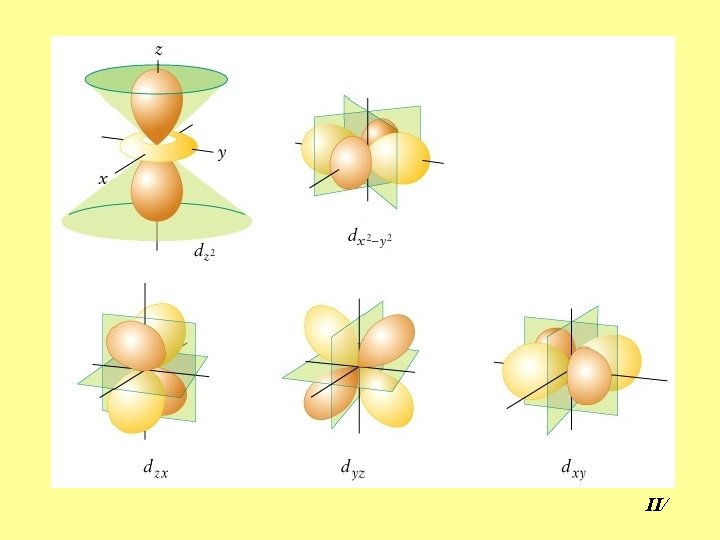
Different shapes of orbitals s p d f II/
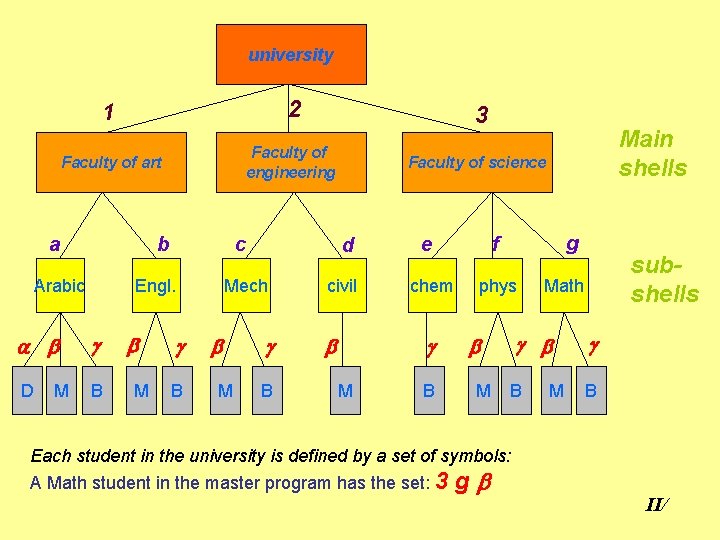
university 1 2 Faculty of art Faculty of engineering a b Arabic g D B M c Engl. a b b M 3 g B b M Faculty of science d Mech g B Main shells civil b f chem phys g M g e B Math g b g B B b M subshells M Each student in the university is defined by a set of symbols: A Math student in the master program has the set: 3 gb II/
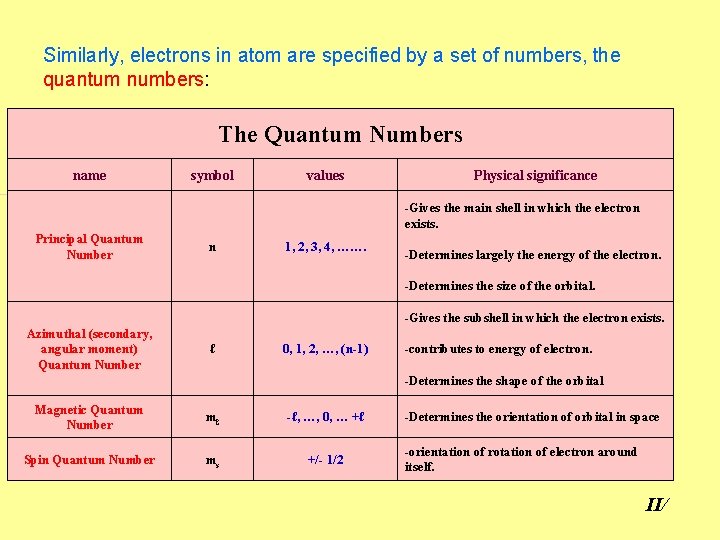
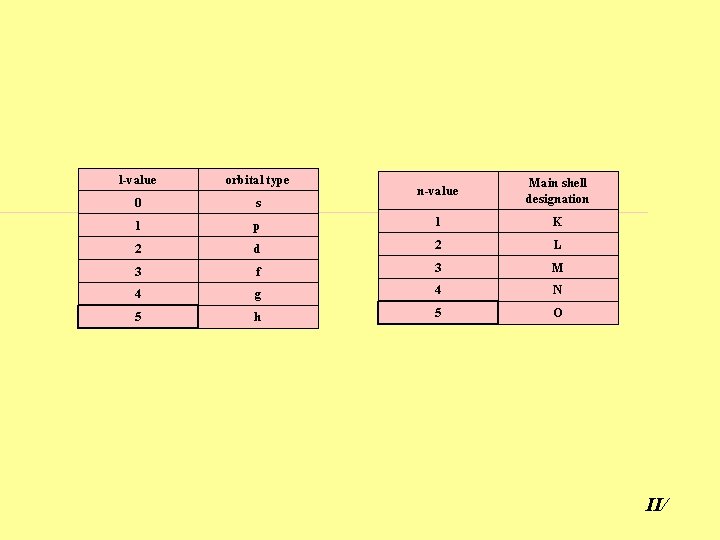
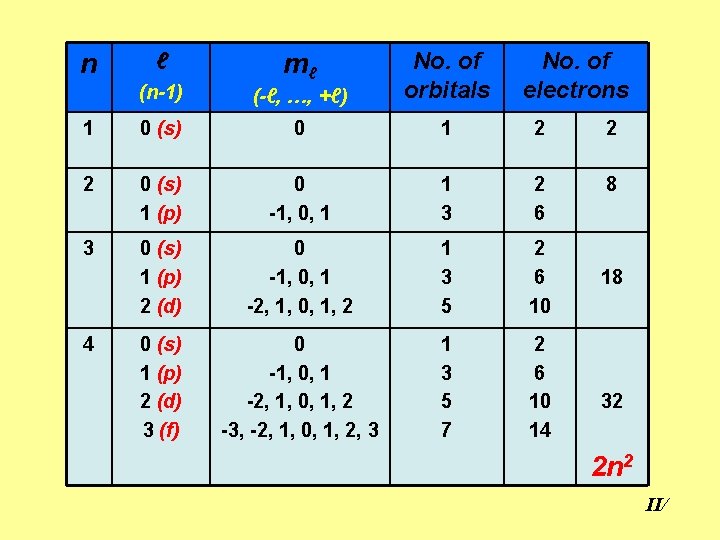
Similarly, electrons in atom are specified by a set of numbers, the quantum numbers: The Quantum Numbers name symbol values Physical significance -Gives the main shell in which the electron exists. Principal Quantum Number n 1, 2, 3, 4, ……. -Determines largely the energy of the electron. -Determines the size of the orbital. -Gives the subshell in which the electron exists. Azimuthal (secondary, angular moment) Quantum Number ℓ 0, 1, 2, …, (n-1) -contributes to energy of electron. -Determines the shape of the orbital Magnetic Quantum Number mℓ -ℓ, …, 0, … +ℓ Spin Quantum Number ms +/- 1/2 -Determines the orientation of orbital in space -orientation of rotation of electron around itself. II/
l-value orbital type 0 s 1 n-value Main shell designation p 1 K 2 d 2 L 3 f 3 M 4 g 4 N 5 h 5 O II/
(n-1) (-ℓ, …, +ℓ) No. of orbitals 1 0 (s) 0 1 2 2 2 0 (s) 1 (p) 0 -1, 0, 1 1 3 2 6 8 3 0 (s) 1 (p) 2 (d) 0 -1, 0, 1 -2, 1, 0, 1, 2 1 3 5 2 6 10 0 (s) 1 (p) 2 (d) 3 (f) 0 -1, 0, 1 -2, 1, 0, 1, 2 -3, -2, 1, 0, 1, 2, 3 1 3 5 7 2 6 10 14 n 4 ℓ mℓ No. of electrons 18 32 2 n 2 II/
II/8
II/

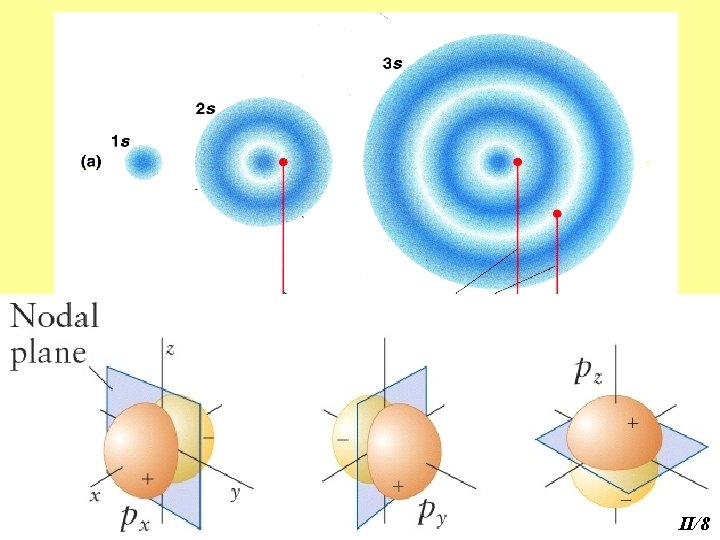
Nodes: Regions where electrons are not allowed to be present in. Electron Probability of being there is zero. II/
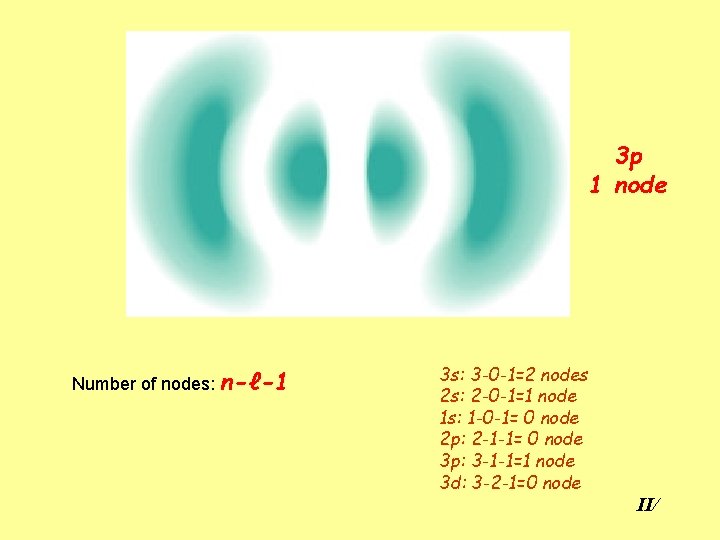
3 p 1 node Number of nodes: n-ℓ-1 3 s: 3 -0 -1=2 nodes 2 s: 2 -0 -1=1 node 1 s: 1 -0 -1= 0 node 2 p: 2 -1 -1= 0 node 3 p: 3 -1 -1=1 node 3 d: 3 -2 -1=0 node II/
- Slides: 11