
Quantum Numbers Activity WarmUp Write the electron configuration
Quantum Numbers Activity

Warm-Up • Write the electron configuration for Uranium • Now, write the abbreviated electron configuration for Europium
Quantum Numbers Helping Us Understand Electron Configurations
Electron Configurations • The distribution of electrons into the various energy shells and subshells in an atom in its ground state is called its electron configuration. • Each energy shell and subshell has a maximum number of electrons it can hold. – s = 2, p = 6, d = 10, f = 14. – Based on the number of orbitals in the subshell. • We place electrons in the energy shells and subshells in order of energy, from low energy up. – Aufbau principle. 4 Tro's "Introductory Chemistry", Chapter 9
Quantum Numbers • Quantum numbers tell us properties of the atomic orbitals, and electrons, in an atom • Like giving each electron its own address – We understand this idea from electron configurations • An orbital is a 3 -D region of an atom where there is a high probability of finding electrons (NOT an actual ring & NOT like the planetary orbitals)
Principal Quantum Number Angular Momentum Quantum Number Magnetic Quantum Number Spin Quantum Number
Textbook • You will need a textbook to look up information about the quantum numbers.
Know for each Quantum # • • • Definition Symbol The allowed values An example A visual representation of the quantum number
Review Quantum Numbers as a Class Discussion of the 4 types of quantum numbers and there properties
Quantum Number Review Notes
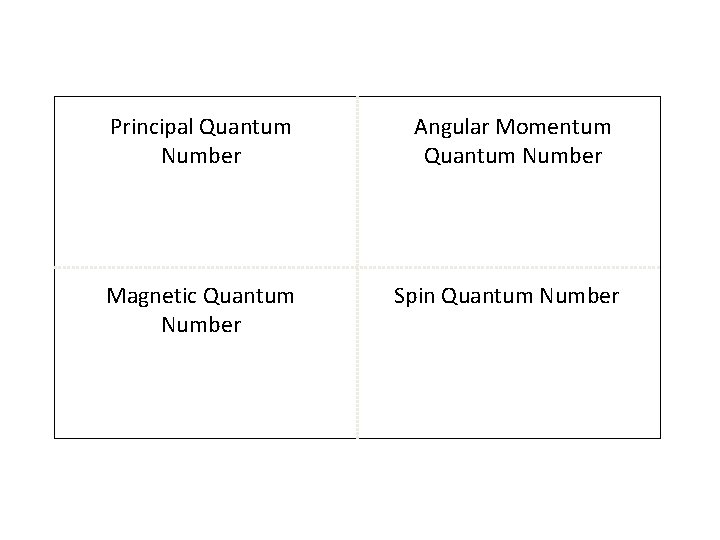
Quantum Numbers • Used to describe various properties of the orbitals in an electron configuration • Each electron is assigned a set of four quantum numbers which, in order, are n, l, ml , and ms • Like giving each electron its own address

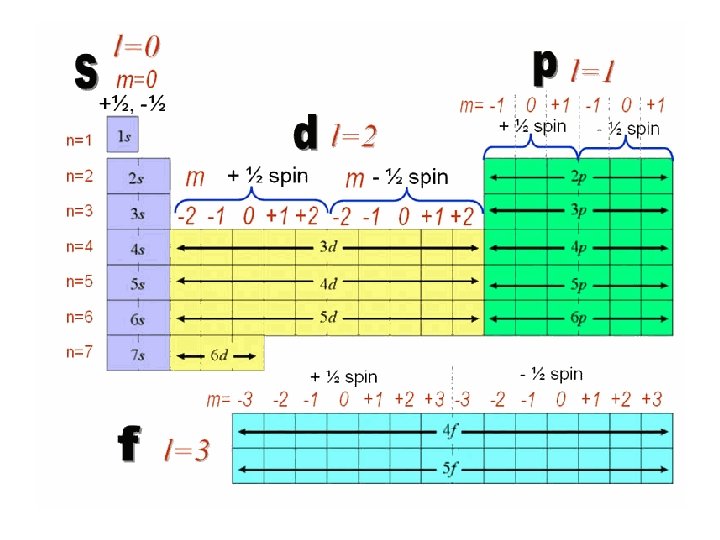
Principle quantum number • Definition: indicates the main energy level occupied by the electron • Symbol: n • Values: (written as integers) 1, 2, 3, 4, 5, 6, 7
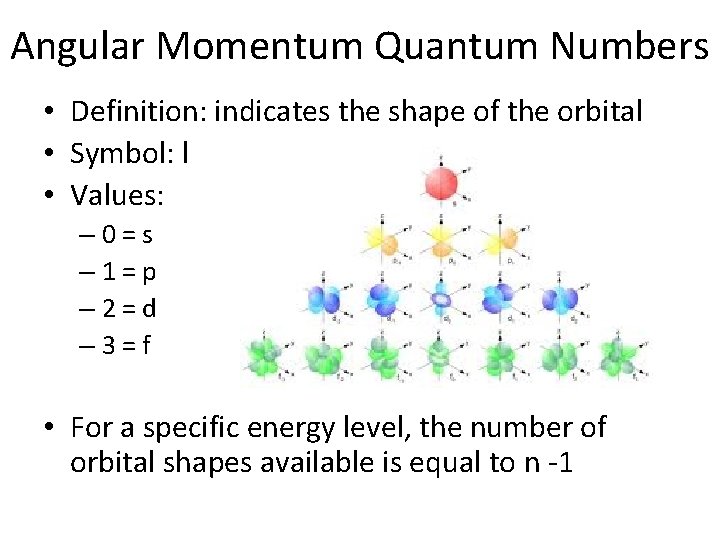
Angular Momentum Quantum Numbers • Definition: indicates the shape of the orbital • Symbol: l • Values: – 0=s – 1=p – 2=d – 3=f • For a specific energy level, the number of orbital shapes available is equal to n -1
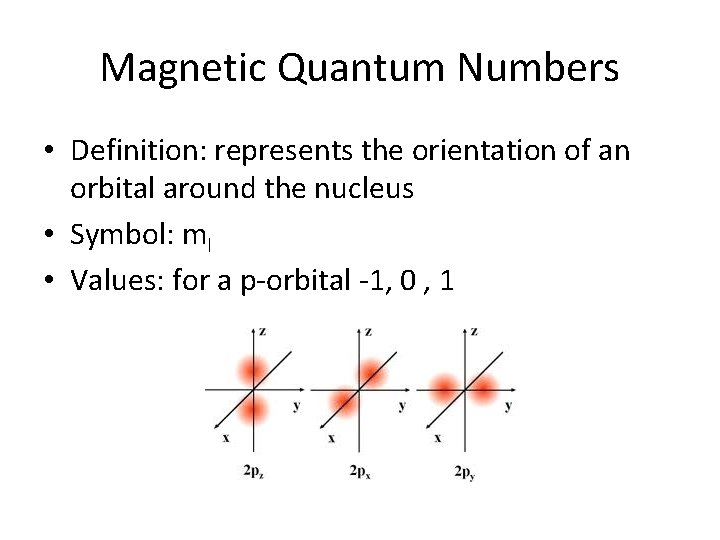
Magnetic Quantum Numbers • Definition: represents the orientation of an orbital around the nucleus • Symbol: ml • Values: for a p-orbital -1, 0 , 1
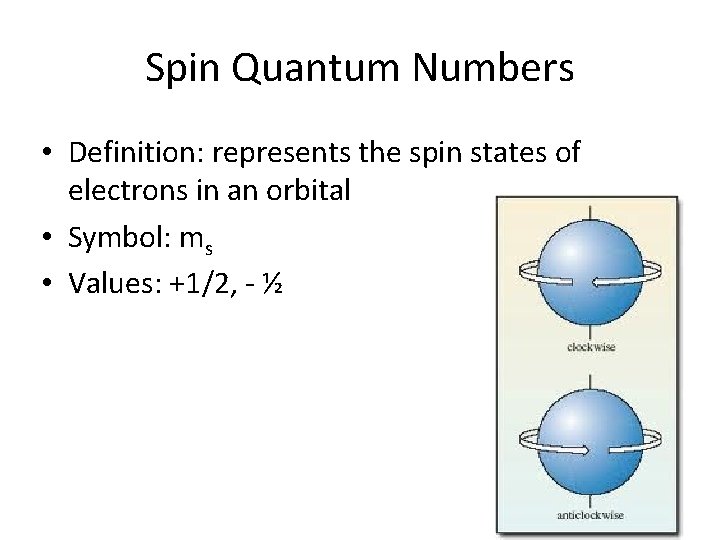
Spin Quantum Numbers • Definition: represents the spin states of electrons in an orbital • Symbol: ms • Values: +1/2, - ½
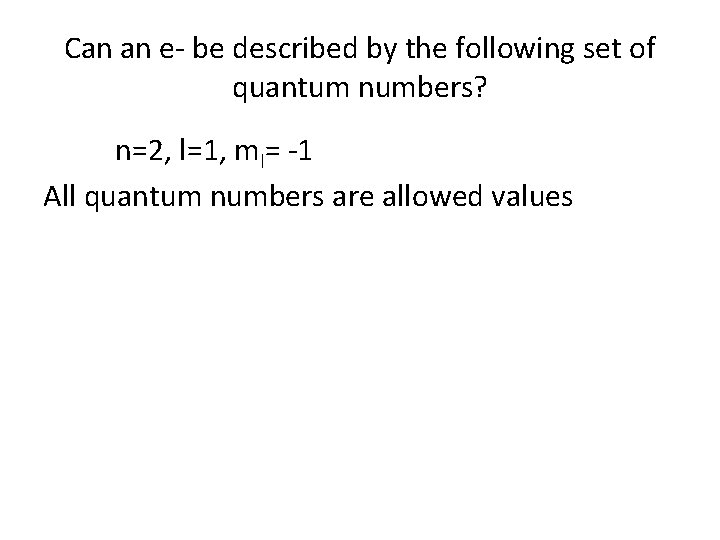
Can an e- be described by the following set of quantum numbers? n=2, l=1, ml= -1 All quantum numbers are allowed values
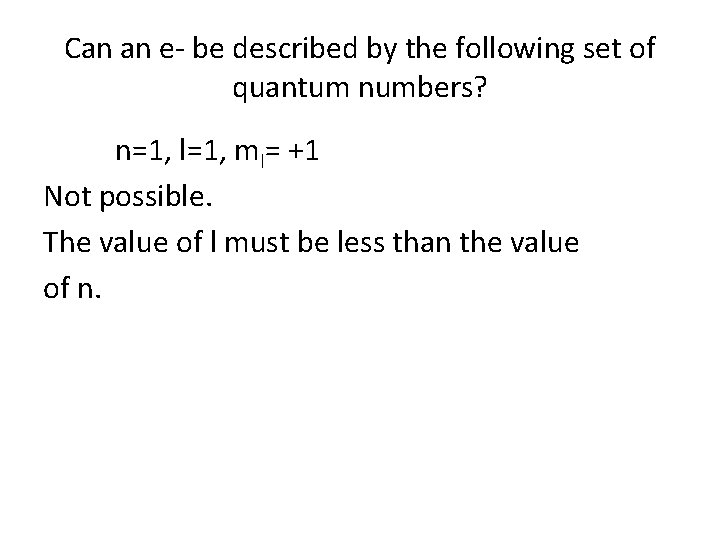
Can an e- be described by the following set of quantum numbers? n=1, l=1, ml= +1 Not possible. The value of l must be less than the value of n.
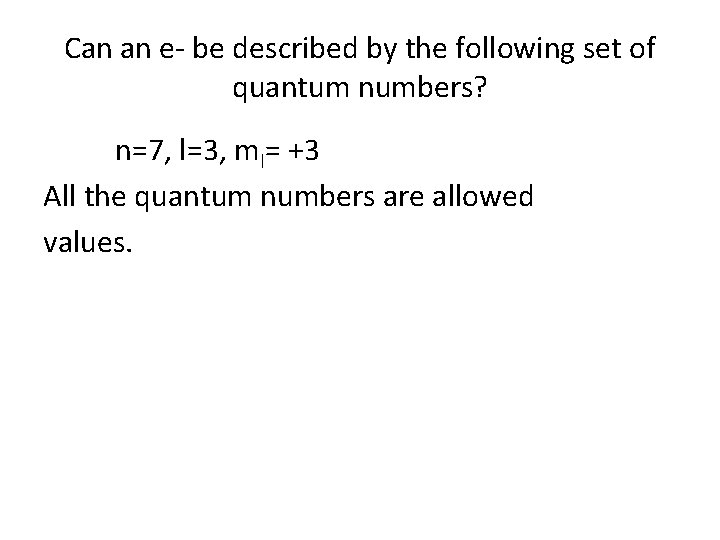
Can an e- be described by the following set of quantum numbers? n=7, l=3, ml= +3 All the quantum numbers are allowed values.
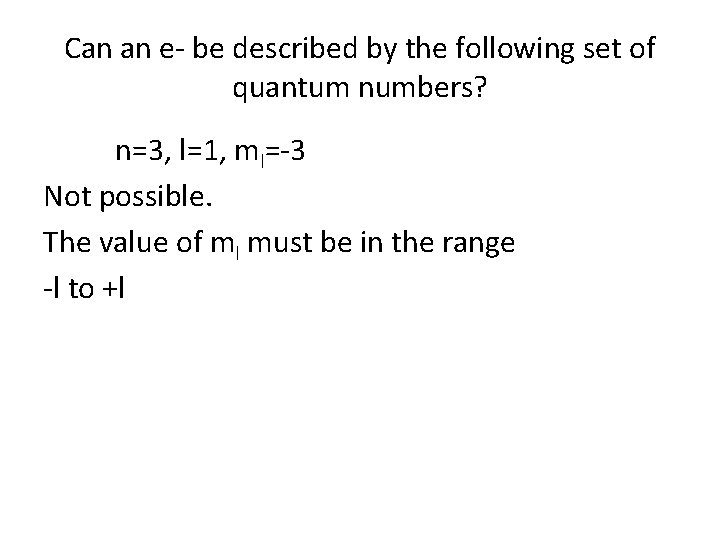
Can an e- be described by the following set of quantum numbers? n=3, l=1, ml=-3 Not possible. The value of ml must be in the range -l to +l

Replace the ? Mark with an appropriate quantum number. n=3, l=1, ml=? n=4, l=? , ml=-2 n=? , l=3, ml=?
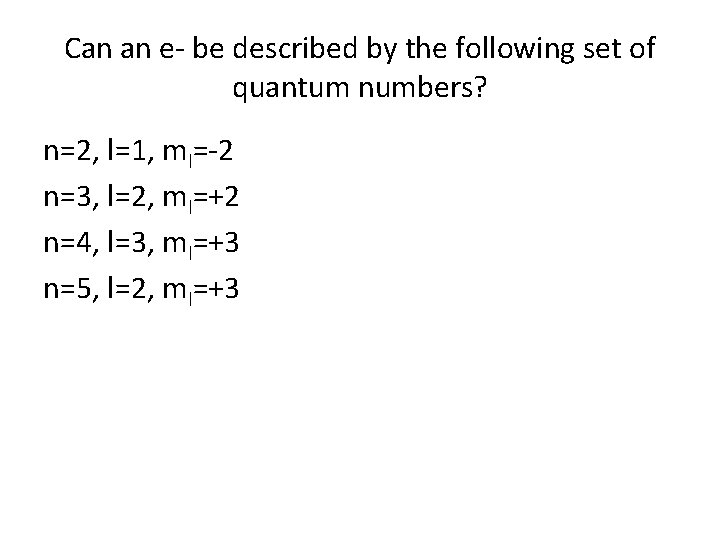
Can an e- be described by the following set of quantum numbers? n=2, l=1, ml=-2 n=3, l=2, ml=+2 n=4, l=3, ml=+3 n=5, l=2, ml=+3
Orbital Diagrams An easier yet longer way to write electron configurations
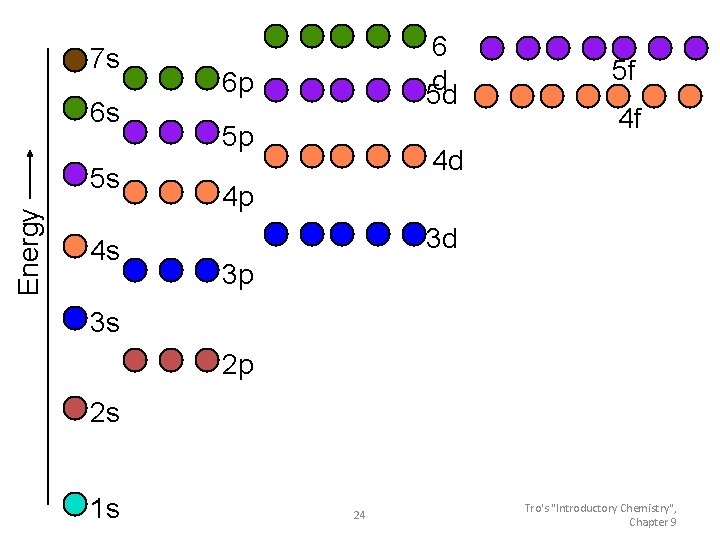
7 s 6 s Energy 5 s 4 s 6 d 5 d 6 p 5 p 5 f 4 f 4 d 4 p 3 d 3 p 3 s 2 p 2 s 1 s 24 Tro's "Introductory Chemistry", Chapter 9
Filling an Orbital with Electrons • Each orbital may have a maximum of 2 electrons. – Pauli Exclusion principle. • Electrons spin on an axis. – Generating their own magnetic field. • When two electrons are in the same orbital, they must have opposite spins. – So their magnetic fields will cancel. 25 Tro's "Introductory Chemistry", Chapter 9
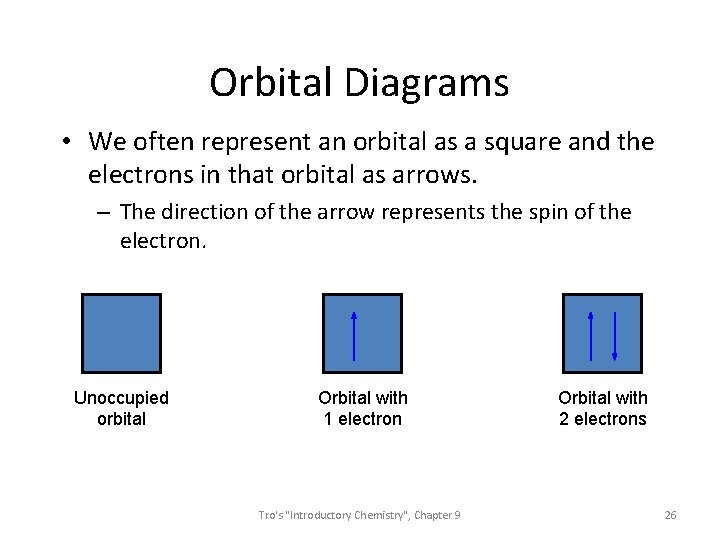
Orbital Diagrams • We often represent an orbital as a square and the electrons in that orbital as arrows. – The direction of the arrow represents the spin of the electron. Unoccupied orbital Orbital with 1 electron Tro's "Introductory Chemistry", Chapter 9 Orbital with 2 electrons 26
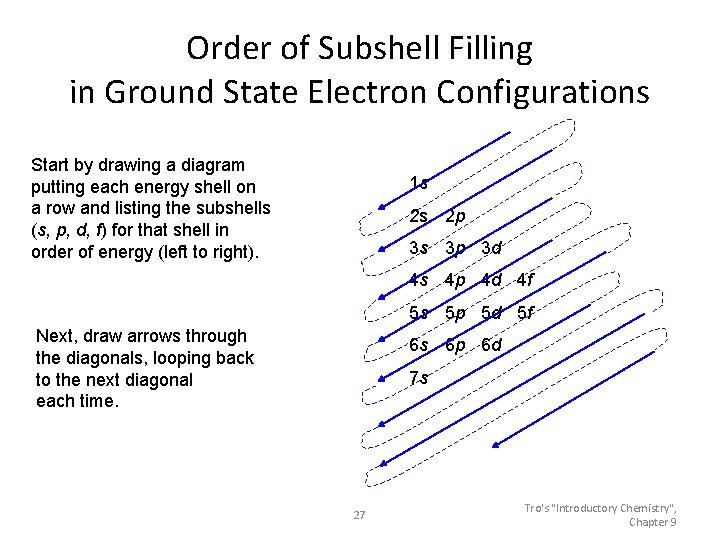
Order of Subshell Filling in Ground State Electron Configurations Start by drawing a diagram putting each energy shell on a row and listing the subshells (s, p, d, f) for that shell in order of energy (left to right). 1 s 2 s 2 p 3 s 3 p 3 d 4 s 4 p 4 d 4 f 5 s 5 p 5 d 5 f Next, draw arrows through the diagonals, looping back to the next diagonal each time. 6 s 6 p 6 d 7 s 27 Tro's "Introductory Chemistry", Chapter 9
Filling the Orbitals in a Subshell with Electrons • Energy shells fill from lowest energy to highest. • Subshells fill from lowest energy to highest. – s→p→d→f • Orbitals that are in the same subshell have the same energy. • When filling orbitals that have the same energy, place one electron in each before completing pairs. – Hund’s rule. 28 Tro's "Introductory Chemistry", Chapter 9
Electron Configuration of Atoms in their Ground State • The electron configuration is a listing of the subshells in order of filling with the number of electrons in that subshell written as a superscript. Kr = 36 electrons = 1 s 22 p 63 s 23 p 64 s 23 d 104 p 6 • A short-hand way of writing an electron configuration is to use the symbol of the previous noble gas in [] to represent all the inner electrons, then just write the last set. Rb = 37 electrons = 1 s 22 p 63 s 23 p 64 s 23 d 104 p 65 s 1 = [Kr]5 s 1 29 Tro's "Introductory Chemistry", Chapter 9
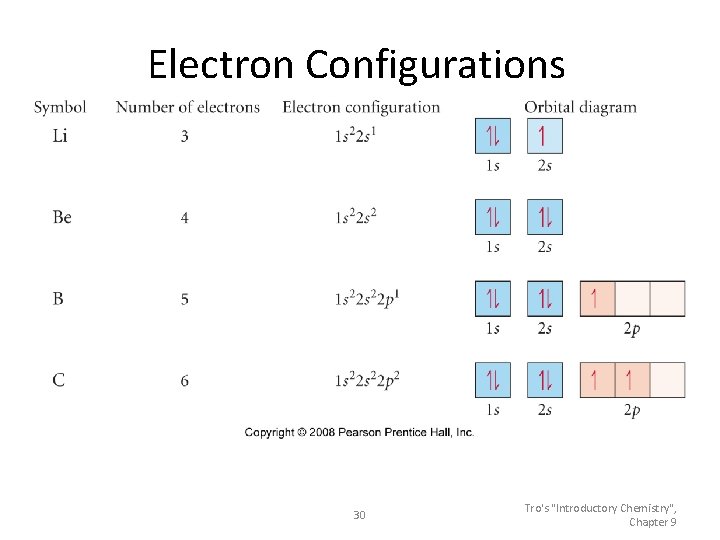
Electron Configurations 30 Tro's "Introductory Chemistry", Chapter 9
- Slides: 30