
Quantum Monte Carlo simulations of helium clusters doped
![4 He nanodroplets are superfluid Experiment: (Toennies et al. Science, 1998) Relative Depletion [%]](https://slidetodoc.com/presentation_image_h2/d5c399ad83bb928759bcdc78897286d9/image-6.jpg "4 He nanodroplets are superfluid Experiment: (Toennies et al. Science, 1998) Relative Depletion [%]")


- Slides: 47
Quantum Monte Carlo simulations of helium clusters doped with molecular and ionic impurities Stefano Paolini CNR-INFM-Democritos National Simulation Center and Physics Department “G. Galilei” University of Padova Quantum Monte Carlo in the Apuan Alps III The Towler Institute, Vallico Sotto, July 27 th, 2007
Part 1: Rotational dynamics of helium solvated molecules: from small clusters toward the nanodroplet regime
Acknoledgements: • Stefano Baroni (SISSA & INFM-DEMOCRITOS) • Paolo Cazzato (INFM-DEMOCRITOS) • Stefano Fantoni (SISSA) • Saverio Moroni (SISSA & INFM-DEMOCRITOS) • • Giacinto Scoles (SISSA)
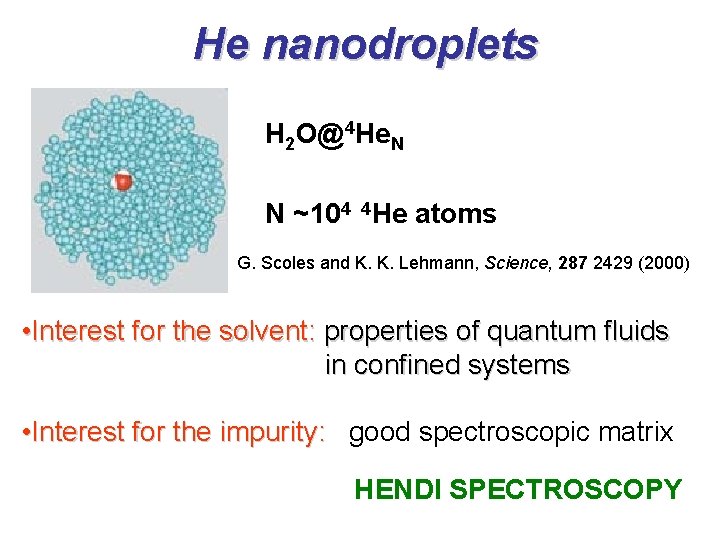
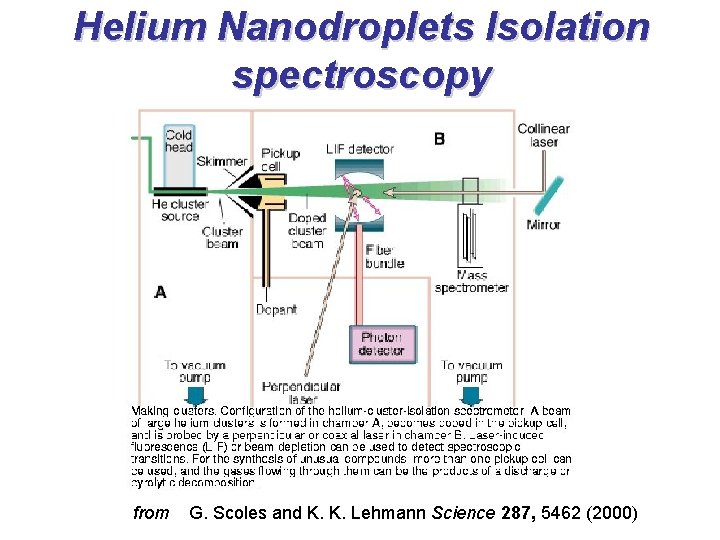
He nanodroplets H 2 O@4 He. N N ~104 4 He atoms G. Scoles and K. K. Lehmann, Science, 287 2429 (2000) • Interest for the solvent: properties of quantum fluids in confined systems • Interest for the impurity: good spectroscopic matrix HENDI SPECTROSCOPY
Helium Nanodroplets Isolation spectroscopy from G. Scoles and K. K. Lehmann Science 287, 5462 (2000)
4 He nanodroplets are superfluid Experiment: (Toennies et al. Science, 1998) Relative Depletion [%] • Pure 3 He droplets • T=0. 15 K Relative Depletion [%] • Broad peak • Pure 4 He droplets • T=0. 38 K • free rotor spectrum with increased inertia Wave Number Change [ cm -1] • Superfluidity: response to an imposed rotation How small can a superfluid droplet be?
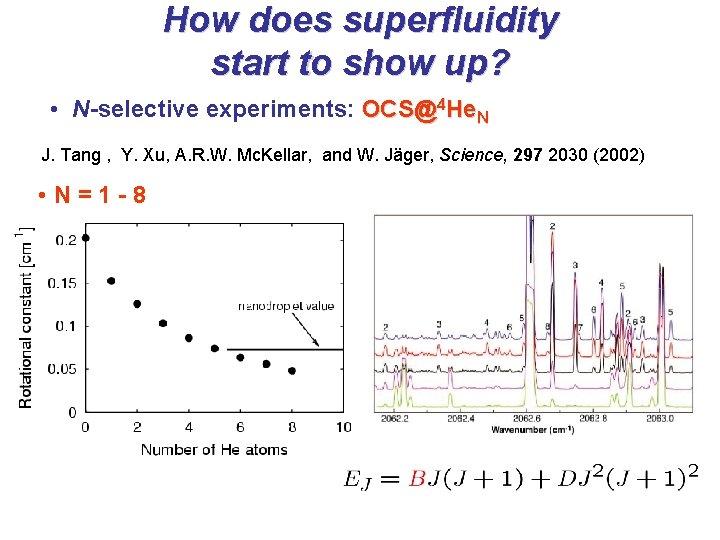
How does superfluidity start to show up? • N-selective experiments: OCS@4 He. N J. Tang , Y. Xu, A. R. W. Mc. Kellar, and W. Jäger, Science, 297 2030 (2002) • N=1 -8
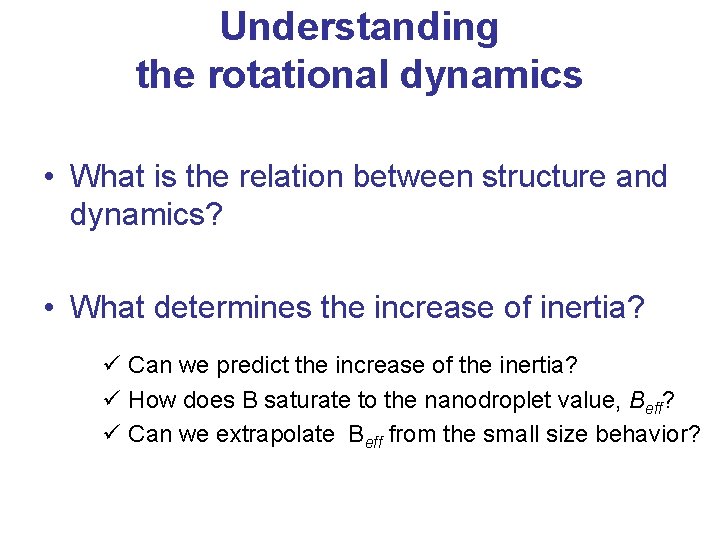
Understanding the rotational dynamics • What is the relation between structure and dynamics? • What determines the increase of inertia? ü Can we predict the increase of the inertia? ü How does B saturate to the nanodroplet value, Beff? ü Can we extrapolate Beff from the small size behavior?
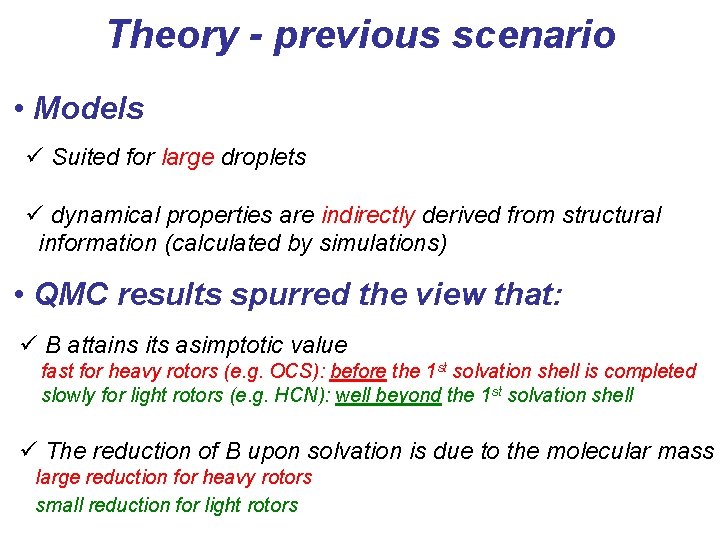
Theory - previous scenario • Models ü Suited for large droplets ü dynamical properties are indirectly derived from structural information (calculated by simulations) • QMC results spurred the view that: ü B attains its asimptotic value fast for heavy rotors (e. g. OCS): before the 1 st solvation shell is completed slowly for light rotors (e. g. HCN): well beyond the 1 st solvation shell ü The reduction of B upon solvation is due to the molecular mass large reduction for heavy rotors small reduction for light rotors
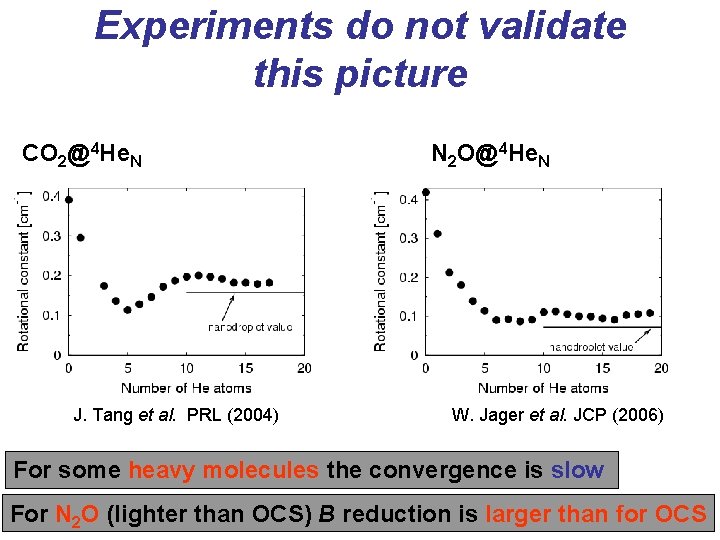
Experiments do not validate this picture CO 2@4 He. N J. Tang et al. PRL (2004) N 2 O@4 He. N W. Jager et al. JCP (2006) For some heavy molecules the convergence is slow For N 2 O (lighter than OCS) B reduction is larger than for OCS
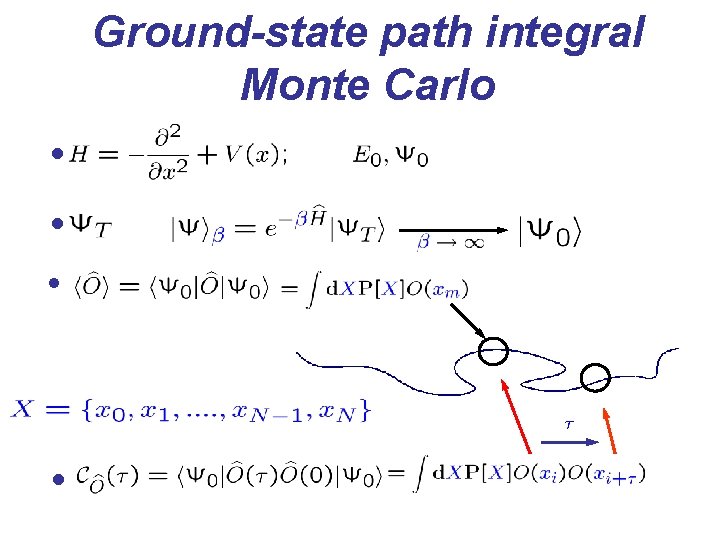
Ground-state path integral Monte Carlo • •
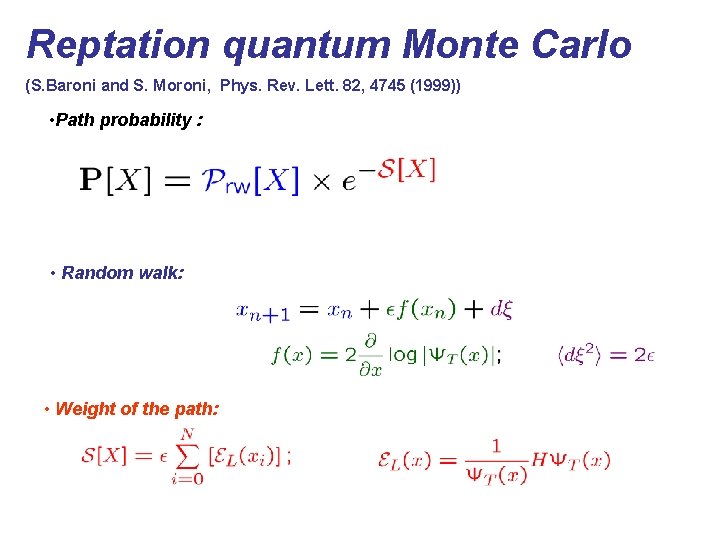
Reptation quantum Monte Carlo (S. Baroni and S. Moroni, Phys. Rev. Lett. 82, 4745 (1999)) • Path probability : • Random walk: • Weight of the path:
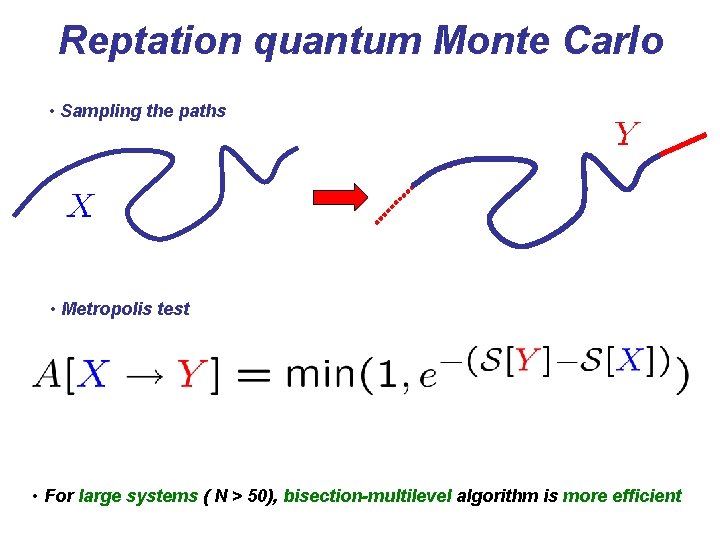
Reptation quantum Monte Carlo • Sampling the paths • Metropolis test • For large systems ( N > 50), bisection-multilevel algorithm is more efficient
Hamiltonian Trial function
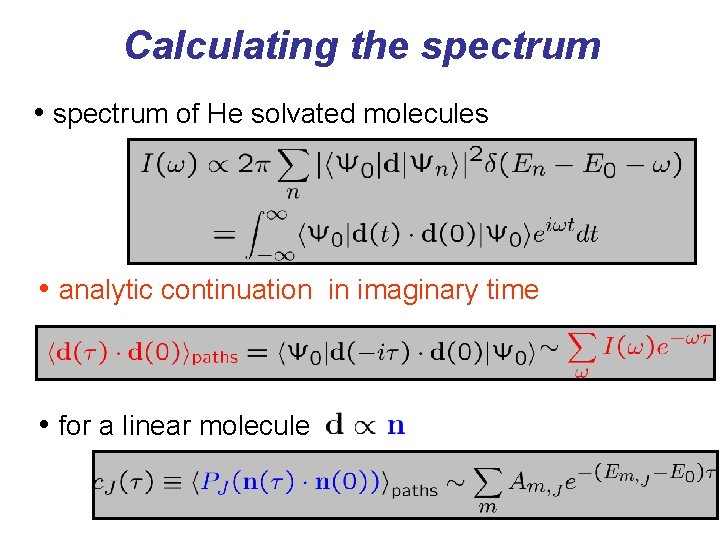
Calculating the spectrum • spectrum of He solvated molecules • analytic continuation in imaginary time • for a linear molecule
Elucidating the relation between the structure and the dynamics RQMC simulations: • CO@He. N: double-lined spectra
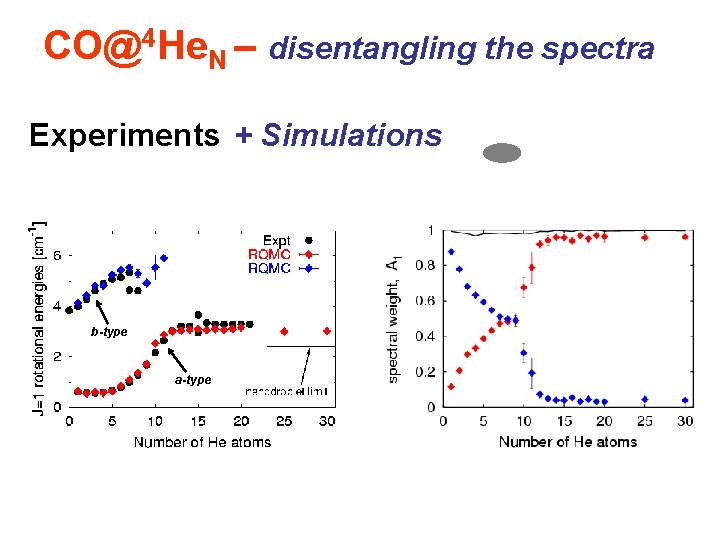
CO@4 He. N – disentangling the spectra Experiments + Simulations O b-type C a-type He density accumulation
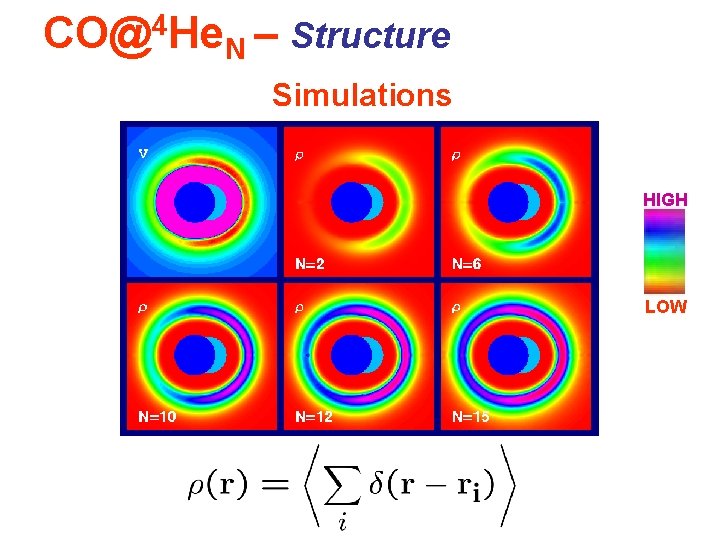
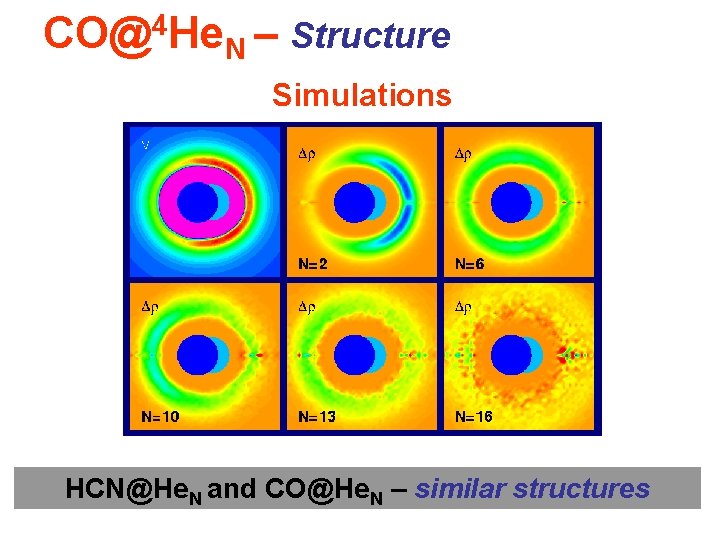
CO@4 He. N – Structure Simulations HIGH LOW
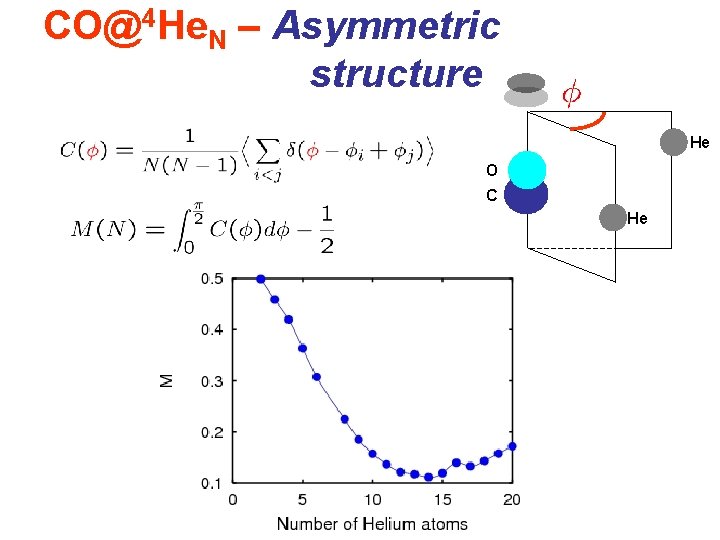
CO@4 He. N – Asymmetric structure He O C He
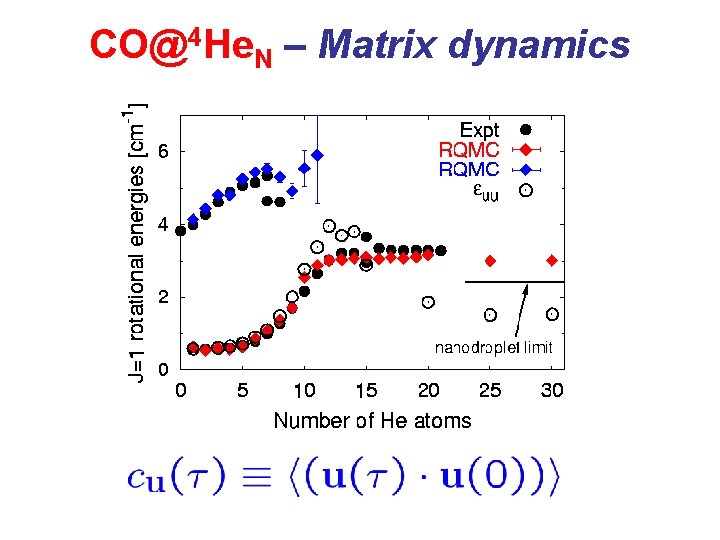
CO@4 He. N – Matrix dynamics
Convergence of B to the nanodroplet limit RQMC simulations: • OCS@He. N: a prototype of HEAVY ROTORS
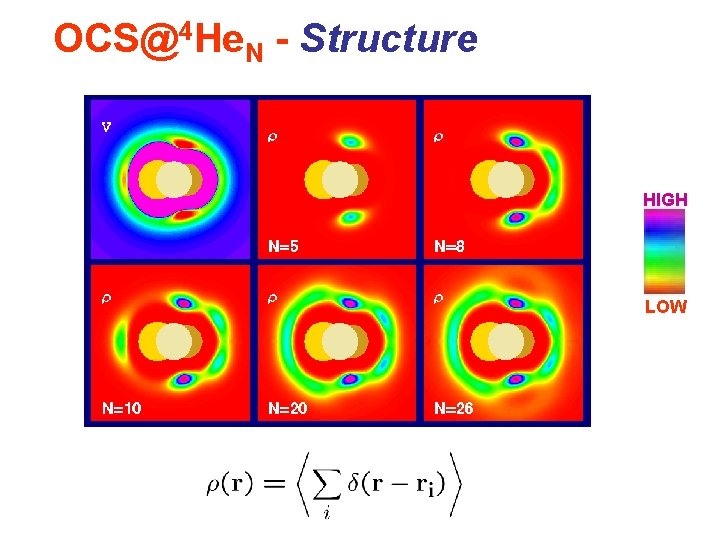
OCS@4 He. N - Structure HIGH LOW
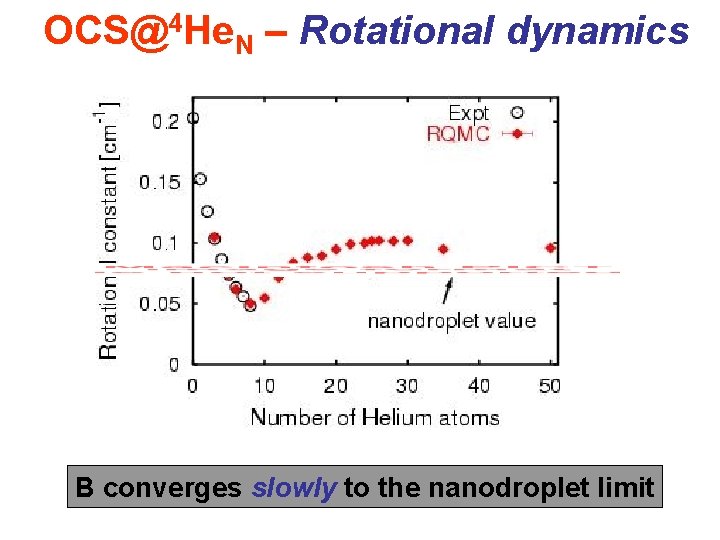
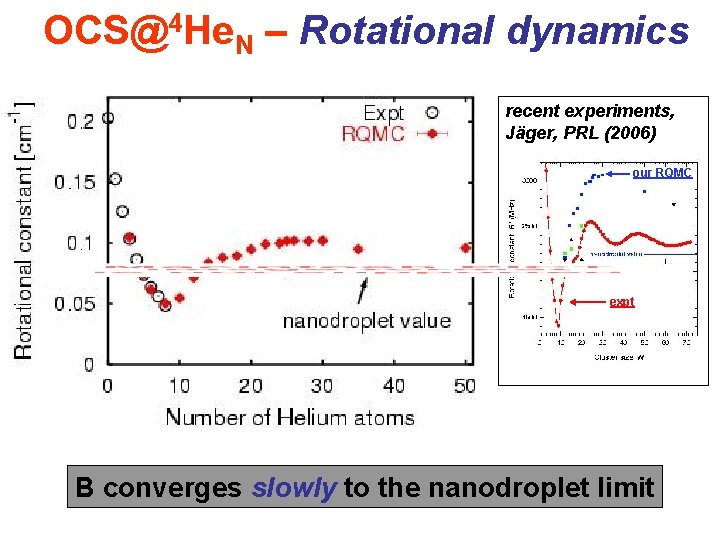
OCS@4 He. N – Rotational dynamics B converges slowly to the nanodroplet limit
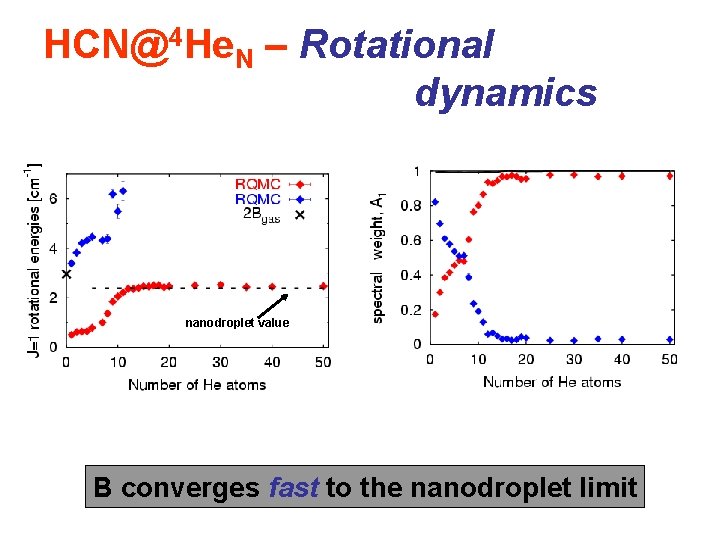
Convergence of B to the nanodroplet limit RQMC simulations: • HCN@He. N: a prototype of LIGHT ROTORS
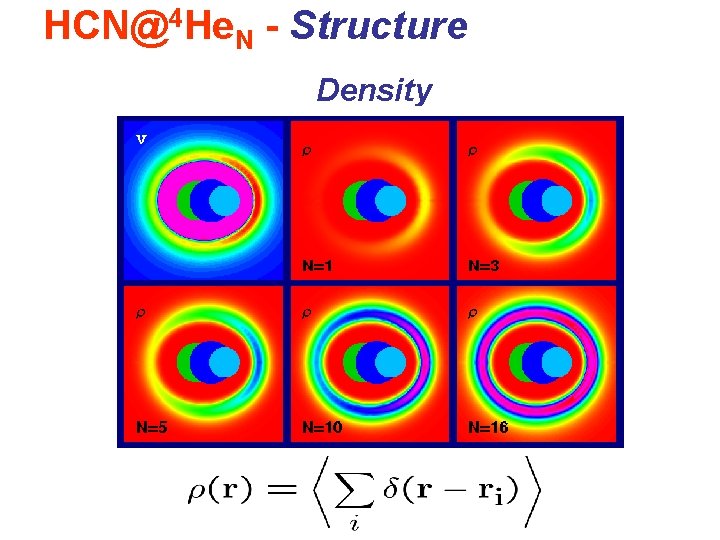
HCN@4 He. N - Structure Density
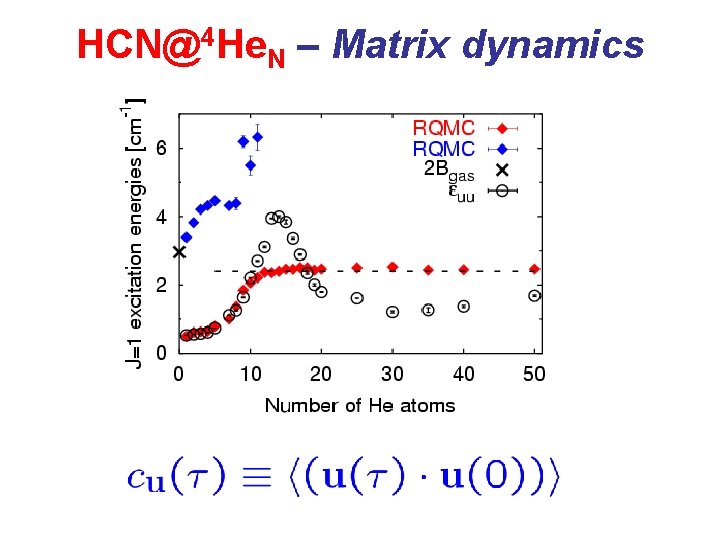
HCN@4 He. N – Rotational dynamics nanodroplet value B converges fast to the nanodroplet limit
HCN@4 He. N – Matrix dynamics
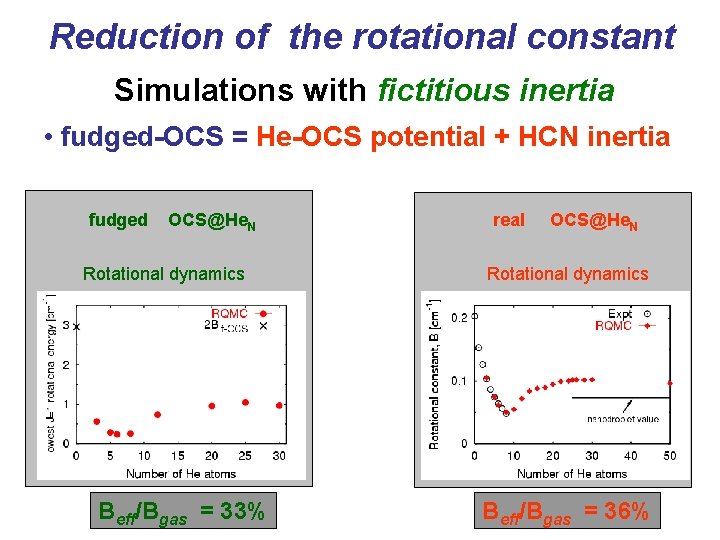
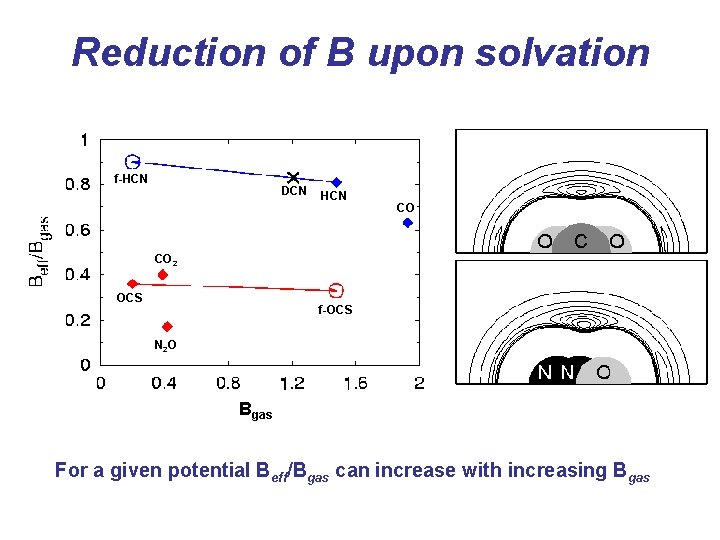
Reduction of the rotational constant Simulations with fictitious inertia • fudged-OCS = He-OCS potential + HCN inertia fudged OCS@He. N Rotational dynamics Beff/Bgas = 33% real OCS@He. N Rotational dynamics Beff/Bgas = 36%
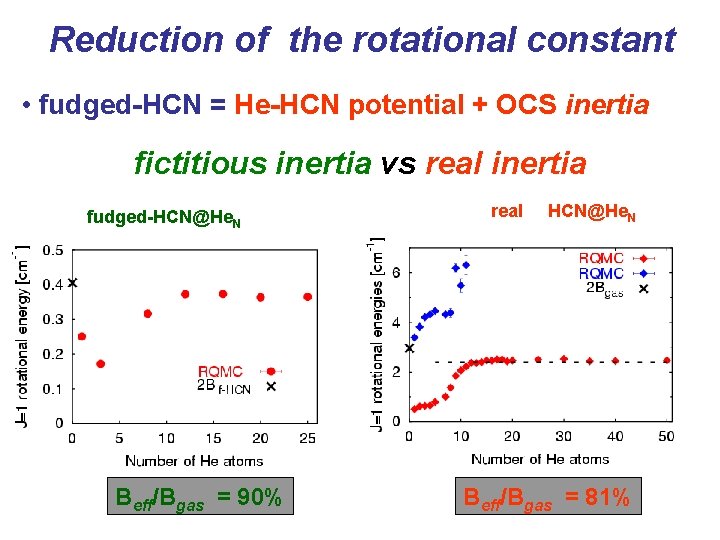
Reduction of the rotational constant • fudged-HCN = He-HCN potential + OCS inertia fictitious inertia vs real inertia fudged-HCN@He. N Beff/Bgas = 90% real HCN@He. N Beff/Bgas = 81%
Reduction of B upon solvation f-HCN DCN HCN CO CO 2 OCS f-OCS N 2 O Bgas For a given potential Beff/Bgas can increase with increasing Bgas
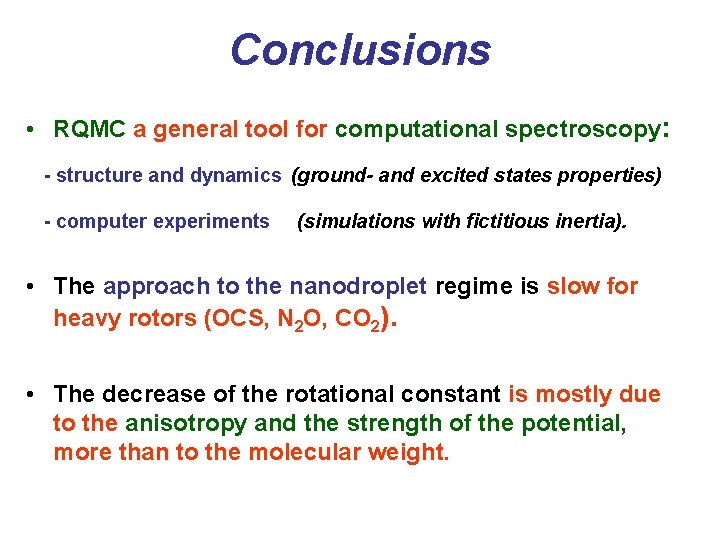
Conclusions • RQMC a general tool for computational spectroscopy: - structure and dynamics (ground- and excited states properties) - computer experiments (simulations with fictitious inertia). • The approach to the nanodroplet regime is slow for heavy rotors (OCS, N 2 O, CO 2). • The decrease of the rotational constant is mostly due to the anisotropy and the strength of the potential, more than to the molecular weight.
Part 2: Solid-like vs liquid-like behavior in 4 He clusters doped with alkali and alkaline-earth ions
Work done with: • Flavio Toigo and Francesco Ancilotto (Physics Department “G. Galilei”, University of Padova and INFM-Democritos NSC, Trieste, Italy). I also want to thank • Stefano Baroni and Saverio Moroni (International School for Advanced Studies and INFM-Democritos NSC, Trieste, Italy).
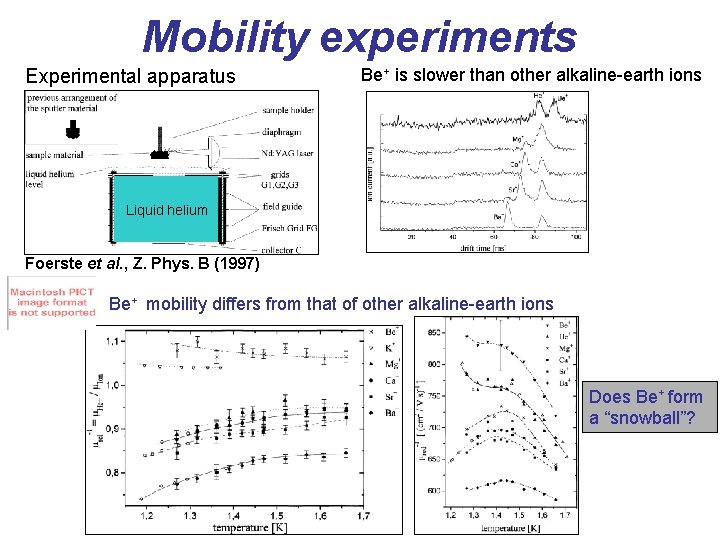
Mobility experiments Experimental apparatus Be+ is slower than other alkaline-earth ions Liquid helium Foerste et al. , Z. Phys. B (1997) Be+ mobility differs from that of other alkaline-earth ions Does Be+ form a “snowball”?
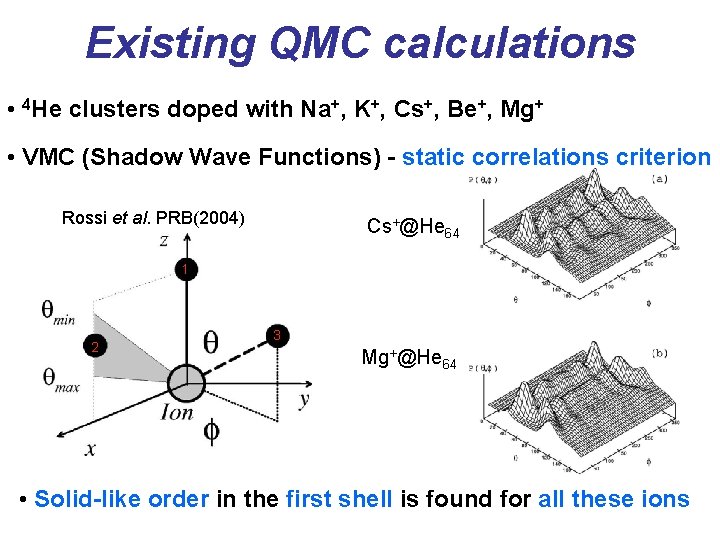
Existing QMC calculations • 4 He clusters doped with Na+, K+, Cs+, Be+, Mg+ • VMC (Shadow Wave Functions) - static correlations criterion Rossi et al. PRB(2004) Cs+@He 64 1 2 3 Mg+@He 64 • Solid-like order in the first shell is found for all these ions
Dynamical correlations criterion • Multipole moments imaginary-time correlations: Baroni and Moroni Chem. Phys. Chem (2005) • A slow decaying indicates solid-like behavior • Used for clusters of para-hydrogen made of just one shell
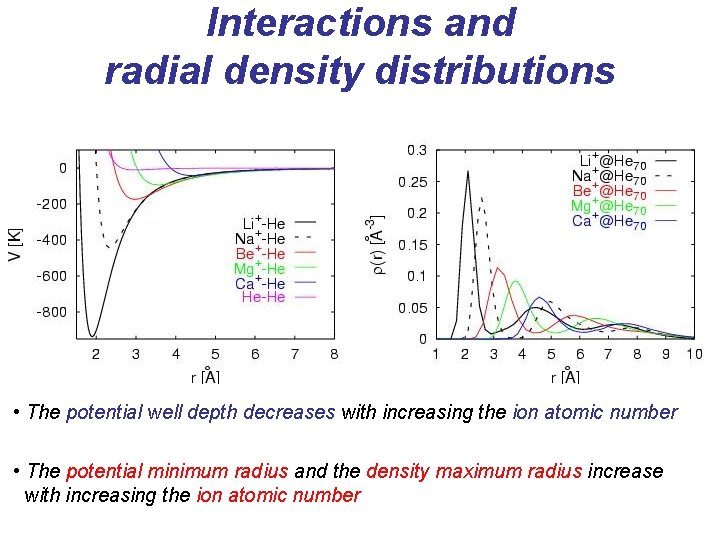
Interactions and radial density distributions • The potential well depth decreases with increasing the ion atomic number • The potential minimum radius and the density maximum radius increase with increasing the ion atomic number
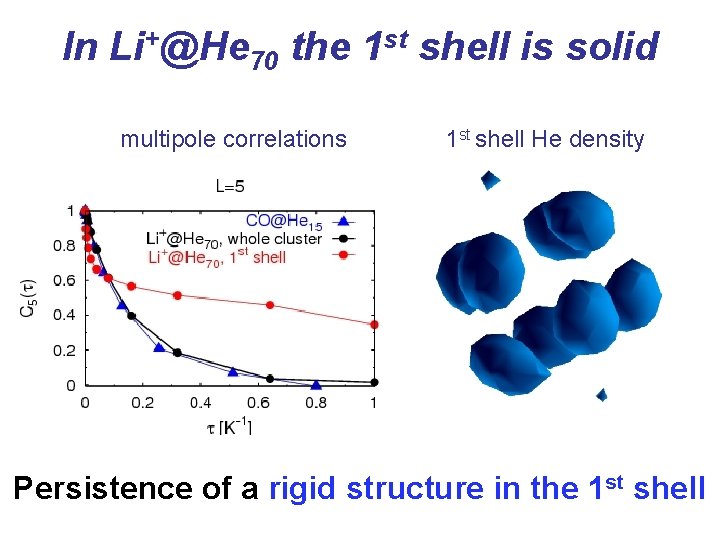
In Li+@He 70 the 1 st shell is solid multipole correlations 1 st shell He density Persistence of a rigid structure in the 1 st shell
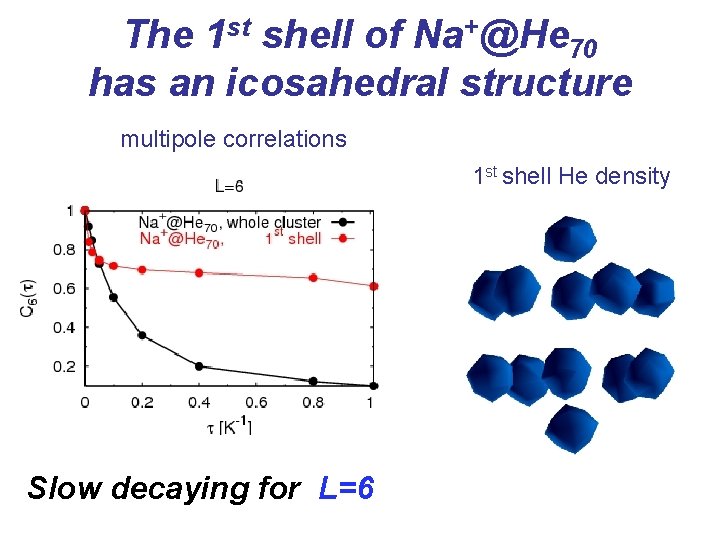
The 1 st shell of Na+@He 70 has an icosahedral structure multipole correlations 1 st shell He density Slow decaying for L=6
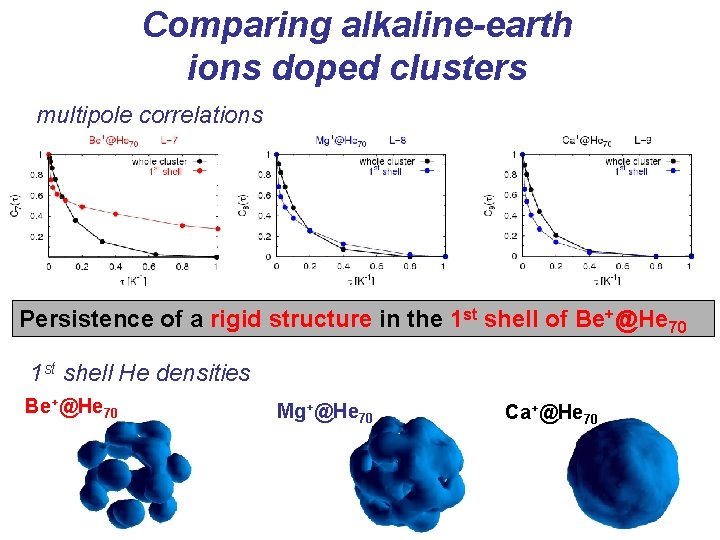
Comparing alkaline-earth ions doped clusters multipole correlations Persistence of a rigid structure in the 1 st shell of Be+@He 70 1 st shell He densities Be+@He 70 Mg+@He 70 Ca+@He 70
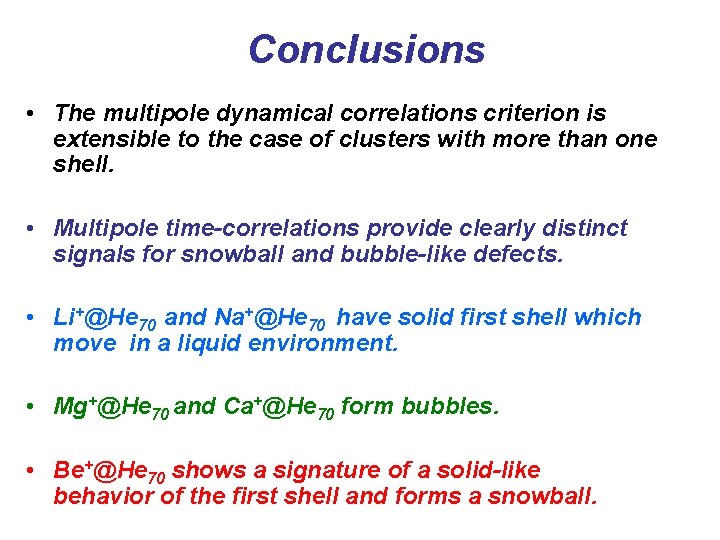
Conclusions • The multipole dynamical correlations criterion is extensible to the case of clusters with more than one shell. • Multipole time-correlations provide clearly distinct signals for snowball and bubble-like defects. • Li+@He 70 and Na+@He 70 have solid first shell which move in a liquid environment. • Mg+@He 70 and Ca+@He 70 form bubbles. • Be+@He 70 shows a signature of a solid-like behavior of the first shell and forms a snowball.
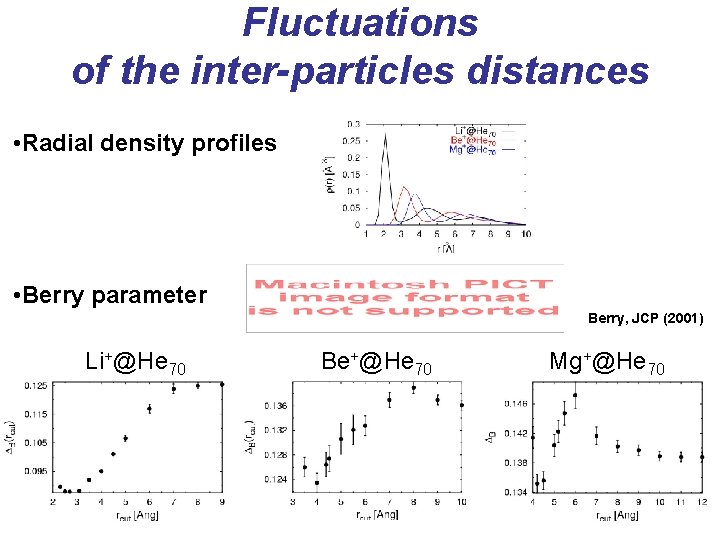
Fluctuations of the inter-particles distances • Radial density profiles • Berry parameter Berry, JCP (2001) Li+@He 70 Be+@He 70 Mg+@He 70
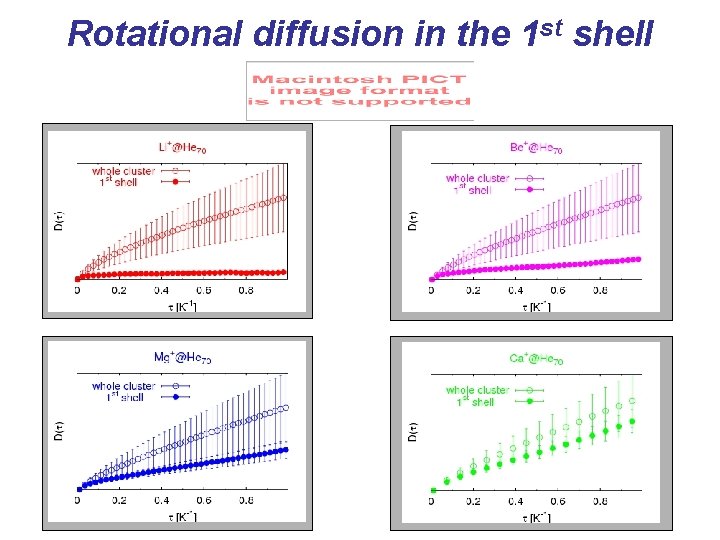
Rotational diffusion in the 1 st shell
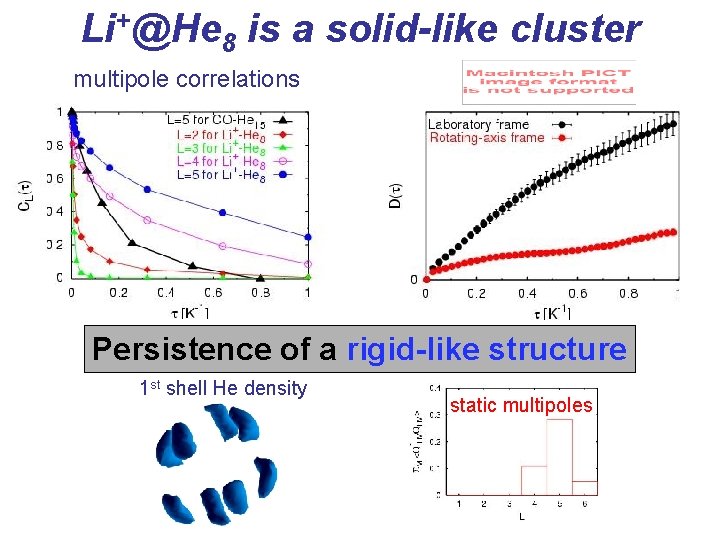
Li+@He 8 is a solid-like cluster multipole correlations Persistence of a rigid-like structure 1 st shell He density static multipoles
CO@4 He. N – Structure Simulations HCN@He. N and CO@He. N – similar structures
OCS@4 He. N – Rotational dynamics recent experiments, Jäger, PRL (2006) our RQMC expt B converges slowly to the nanodroplet limit
Ground-state path integral Monte Carlo • Optimized trial function • approaches exact ground state as • Compute expectation values: • • Use discretized path integral to represent R 0 RM time step exact results for Metropolis (reptation or bisection-multilevel) algorithm to sample paths