
Quantum Mechanics in Your Face Sidney Coleman 1994
![Behind the Scenes |ψ> = [ |⇑⇑⇑> - |⇓⇓⇓> ]/√ 2 A 1 =](https://slidetodoc.com/presentation_image/1558469ff57971368170733a60f624ab/image-11.jpg "Behind the Scenes |ψ> = [ |⇑⇑⇑> - |⇓⇓⇓> ]/√ 2 A 1 =")
- Slides: 20
Quantum Mechanics in Your Face Sidney Coleman 1994
Outline ①A quick review of (vernacular) quantum mechanics ②Better than Bell: The GHZM effect ③The return of Schrödinger’s cat There is no representation, express or implied, that any part of this lecture is original. * * Or that any account is taken of classical or quantum gravity
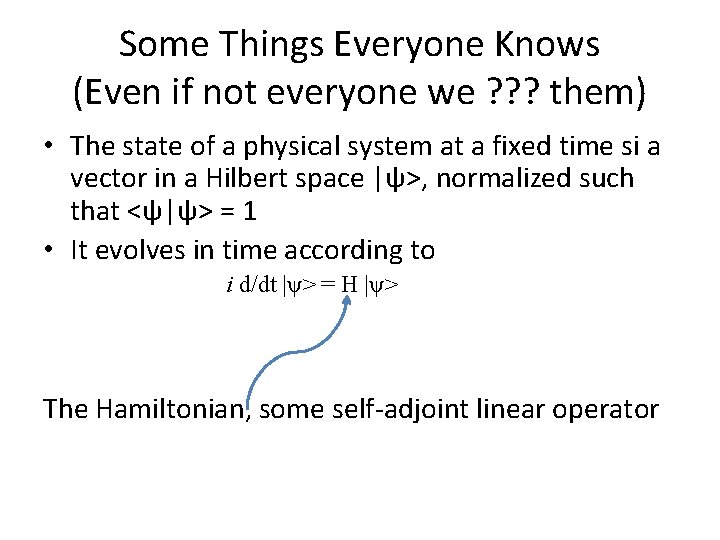
Some Things Everyone Knows (Even if not everyone we ? ? ? them) • The state of a physical system at a fixed time si a vector in a Hilbert space |ψ>, normalized such that <ψ|ψ> = 1 • It evolves in time according to i d/dt |ψ> = H |ψ> The Hamiltonian, some self-adjoint linear operator
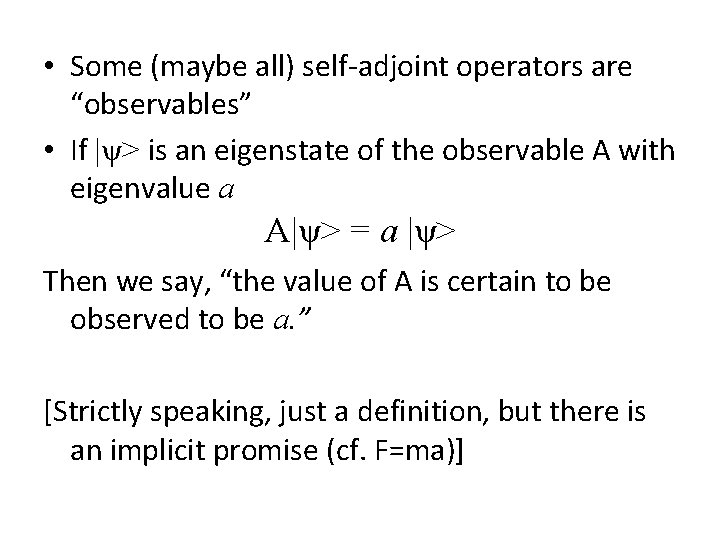
• Some (maybe all) self-adjoint operators are “observables” • If |ψ> is an eigenstate of the observable A with eigenvalue a A|ψ> = a |ψ> Then we say, “the value of A is certain to be observed to be a. ” [Strictly speaking, just a definition, but there is an implicit promise (cf. F=ma)]
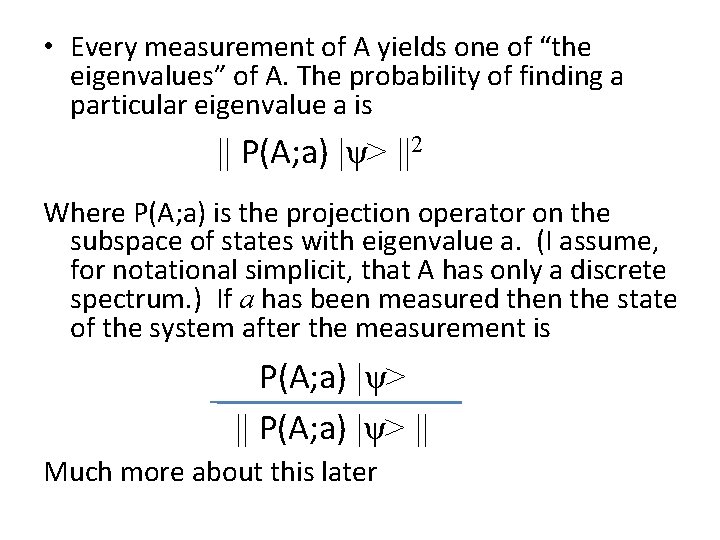
• Every measurement of A yields one of “the eigenvalues” of A. The probability of finding a particular eigenvalue a is || P(A; a) |ψ> ||2 Where P(A; a) is the projection operator on the subspace of states with eigenvalue a. (I assume, for notational simplicit, that A has only a discrete spectrum. ) If a has been measured then the state of the system after the measurement is P(A; a) |ψ> || Much more about this later
Credits for the next part • A. Einstein, B. Podolsky, N Rosen, Phys. Rev. 47 (1935) 777. • J. S. Bell, Rev. Mod. Phys. 38 (1964) 403 • – Physics 1 (1964), 195. • N. D. Mermin, Physics Today, April 1985, p. 38 • D Greenberger, M. Horne, A. Shimony, A. Zeilinger Am. J Phys 58, (1990) 1131 • N. D. Mermin, Am. J. Phys. 58 (1990), 731. • – Physics Today, June 1990, p. 9
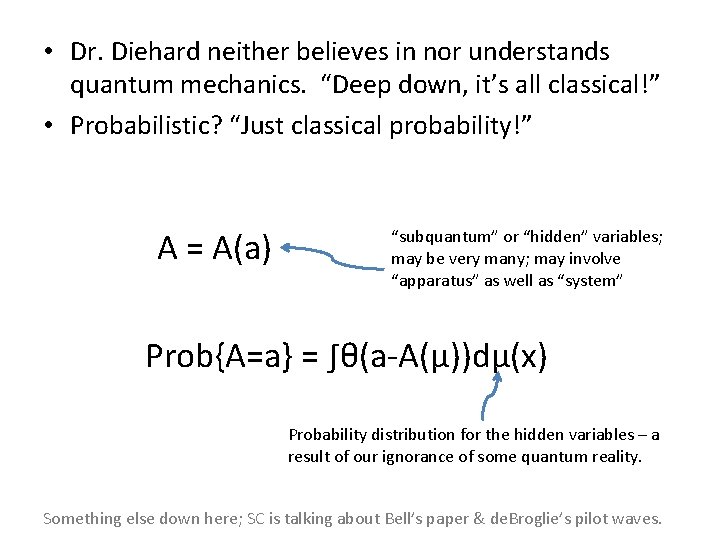
• Dr. Diehard neither believes in nor understands quantum mechanics. “Deep down, it’s all classical!” • Probabilistic? “Just classical probability!” A = A(a) “subquantum” or “hidden” variables; may be very many; may involve “apparatus” as well as “system” Prob{A=a} = ∫θ(a-A(μ))dμ(x) Probability distribution for the hidden variables – a result of our ignorance of some quantum reality. Something else down here; SC is talking about Bell’s paper & de. Broglie’s pilot waves.
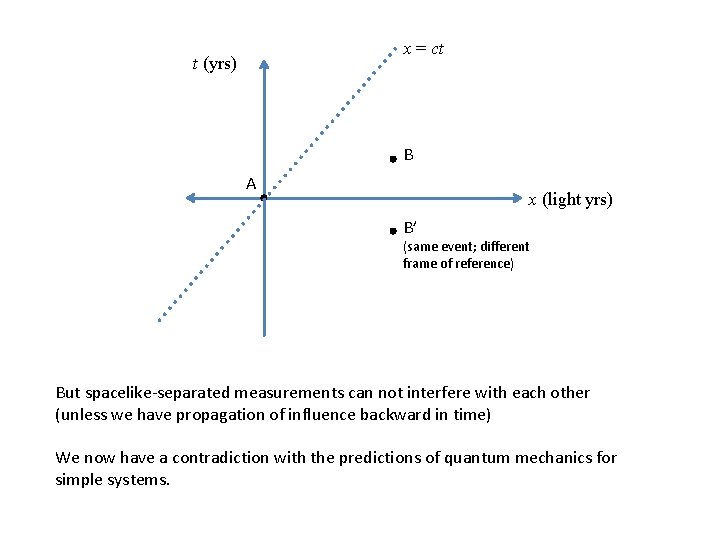
x = ct t (yrs) B A x (light yrs) B’ (same event; different frame of reference) But spacelike-separated measurements can not interfere with each other (unless we have propagation of influence backward in time) We now have a contradiction with the predictions of quantum mechanics for simple systems.
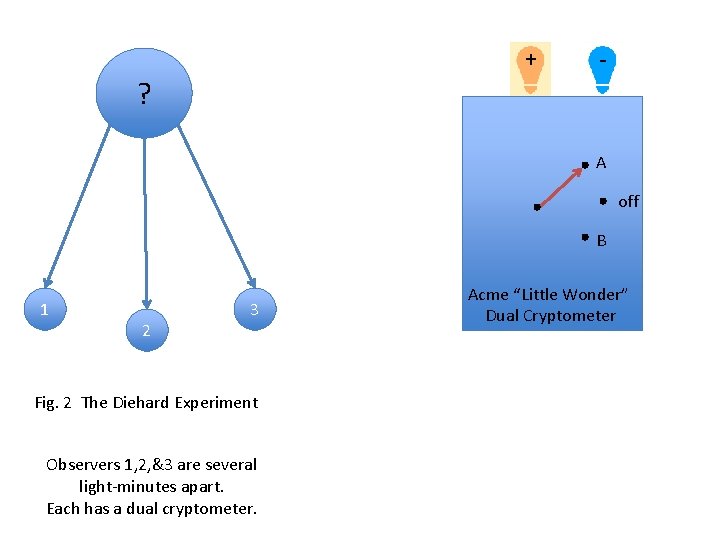
+ - ? A off B 1 2 3 Fig. 2 The Diehard Experiment Observers 1, 2, &3 are several light-minutes apart. Each has a dual cryptometer. Acme “Little Wonder” Dual Cryptometer
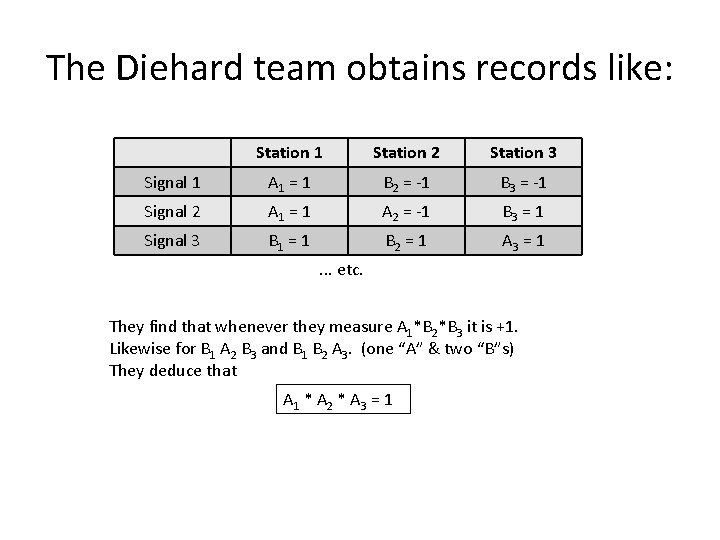
The Diehard team obtains records like: Station 1 Station 2 Station 3 Signal 1 A 1 = 1 B 2 = -1 B 3 = -1 Signal 2 A 1 = 1 A 2 = -1 B 3 = 1 Signal 3 B 1 = 1 B 2 = 1 A 3 = 1 . . . etc. They find that whenever they measure A 1*B 2*B 3 it is +1. Likewise for B 1 A 2 B 3 and B 1 B 2 A 3. (one “A” & two “B”s) They deduce that A 1 * A 2 * A 3 = 1
Behind the Scenes |ψ> = [ |⇑⇑⇑> - |⇓⇓⇓> ]/√ 2 A 1 = σx 1 ; B 1 = σy 1 ; etc. A 1 B 2 B 3 |ψ> = σx 1 σy 2 σy 3 |ψ> = (-1)(i)(i)|ψ> = |ψ> etc. for B 1 A 2 B 3 & B 1 B 2 A 3. but. . . A 1 A 2 A 3 |ψ>=σx 1 σx 2 σx 3 |ψ>=(-1)(-1)|ψ>= −|ψ> “spooky action at a distance”?
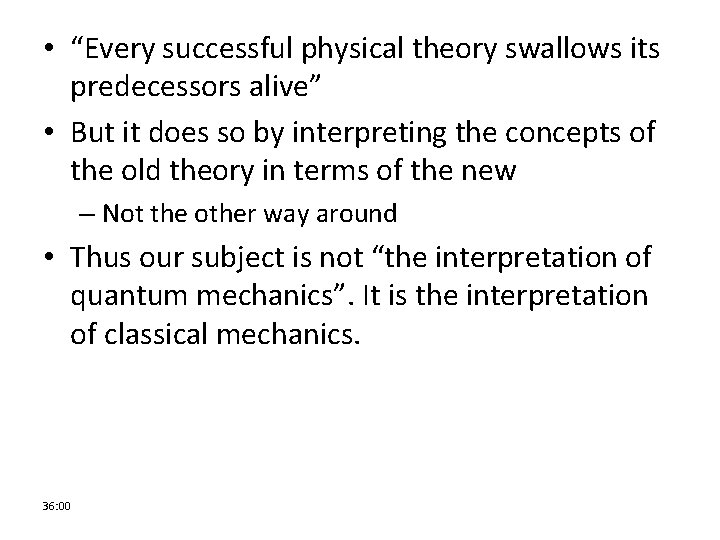
• “Every successful physical theory swallows its predecessors alive” • But it does so by interpreting the concepts of the old theory in terms of the new – Not the other way around • Thus our subject is not “the interpretation of quantum mechanics”. It is the interpretation of classical mechanics. 36: 00
3. Credits for the Next Part • J. von Neumann, Mathematsche Grundlagen der Quantenmechanik (1932) • H. Everett III, Rev. Mod. Phys. 29 (1957), 454. • J Hartle, Am. J. Phys. 36 (1968) 204 • E Farhi, J Goldstone, S Gutmann, Ann. Phys. 192 (1989), 368.
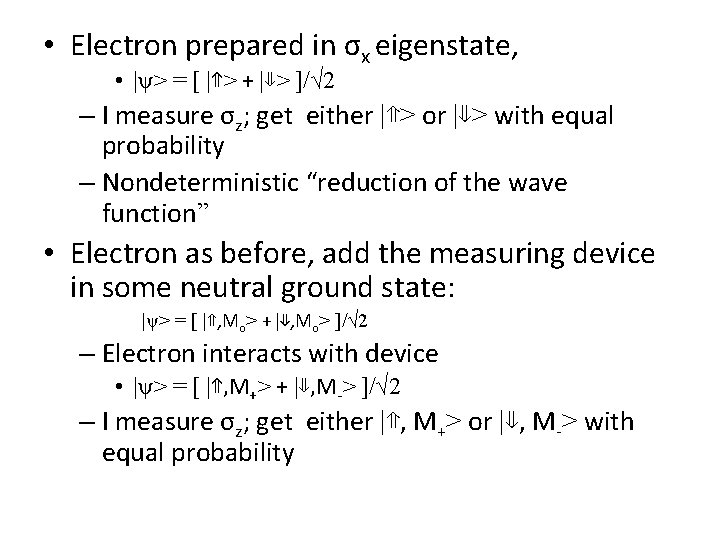
• Electron prepared in σx eigenstate, • |ψ> = [ |⇑> + |⇓> ]/√ 2 – I measure σz; get either |⇑> or |⇓> with equal probability – Nondeterministic “reduction of the wave function” • Electron as before, add the measuring device in some neutral ground state: |ψ> = [ |⇑, Mo> + |⇓, Mo> ]/√ 2 – Electron interacts with device • |ψ> = [ |⇑, M+> + |⇓, M-> ]/√ 2 – I measure σz; get either |⇑, M+> or |⇓, M-> with equal probability
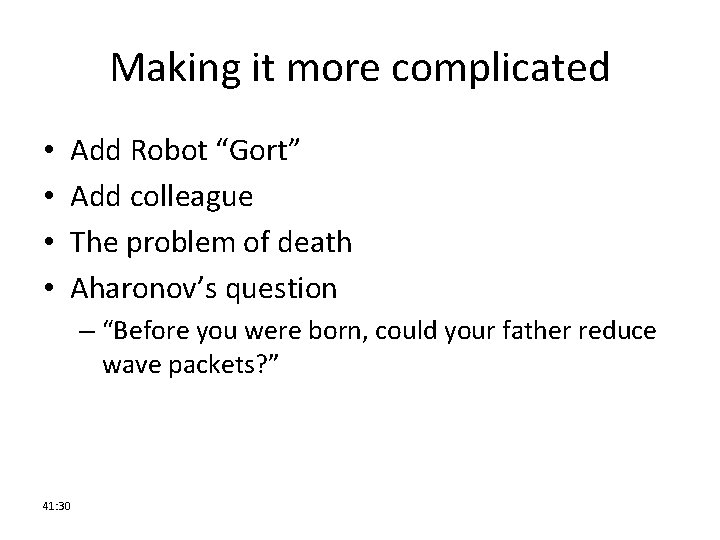
Making it more complicated • • Add Robot “Gort” Add colleague The problem of death Aharonov’s question – “Before you were born, could your father reduce wave packets? ” 41: 30
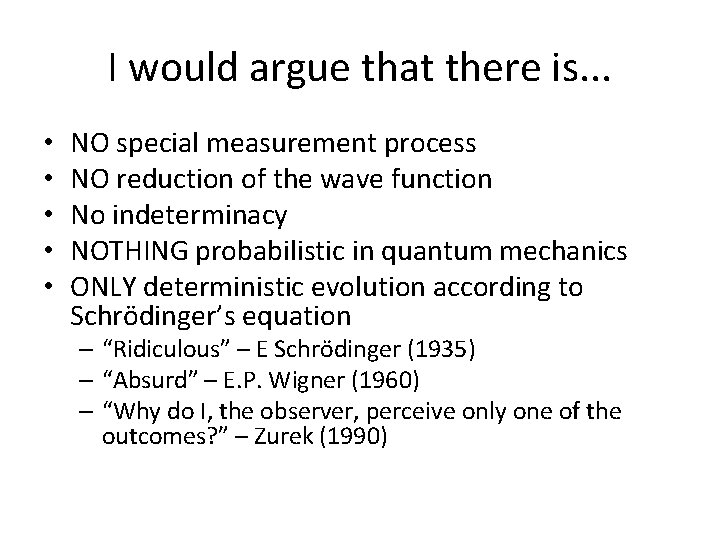
I would argue that there is. . . • • • NO special measurement process NO reduction of the wave function No indeterminacy NOTHING probabilistic in quantum mechanics ONLY deterministic evolution according to Schrödinger’s equation – “Ridiculous” – E Schrödinger (1935) – “Absurd” – E. P. Wigner (1960) – “Why do I, the observer, perceive only one of the outcomes? ” – Zurek (1990)
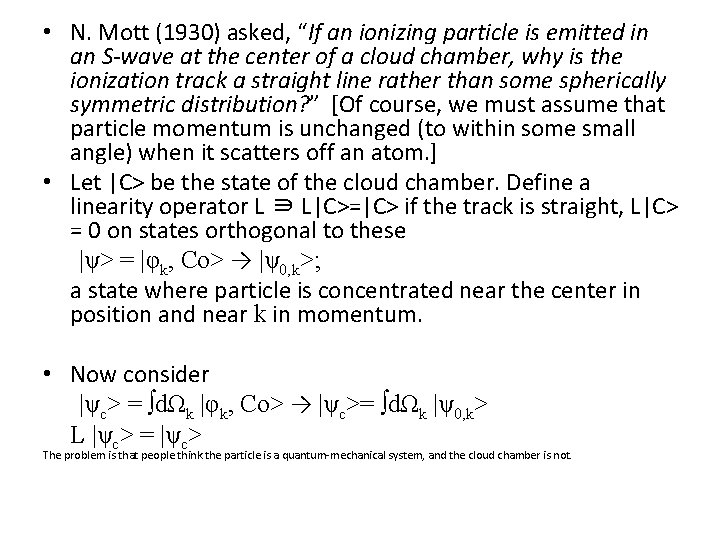
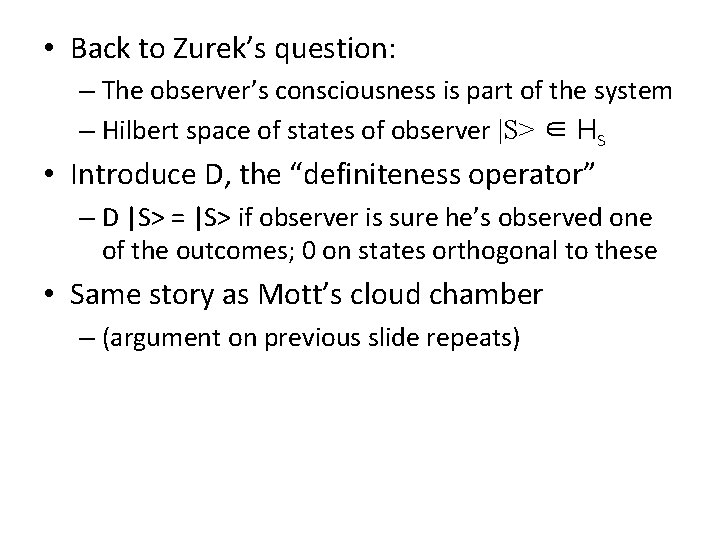
• N. Mott (1930) asked, “If an ionizing particle is emitted in an S-wave at the center of a cloud chamber, why is the ionization track a straight line rather than some spherically symmetric distribution? ” [Of course, we must assume that particle momentum is unchanged (to within some small angle) when it scatters off an atom. ] • Let |C> be the state of the cloud chamber. Define a linearity operator L ∋ L|C>=|C> if the track is straight, L|C> = 0 on states orthogonal to these |ψ> = |φk, Co> → |ψ0, k>; a state where particle is concentrated near the center in position and near k in momentum. • Now consider |ψc> = ∫dΩk |φk, Co> → |ψc>= ∫dΩk |ψ0, k> L |ψc> = |ψc> The problem is that people think the particle is a quantum-mechanical system, and the cloud chamber is not.
• Back to Zurek’s question: – The observer’s consciousness is part of the system – Hilbert space of states of observer |S> ∈ HS • Introduce D, the “definiteness operator” – D |S> = |S> if observer is sure he’s observed one of the outcomes; 0 on states orthogonal to these • Same story as Mott’s cloud chamber – (argument on previous slide repeats)
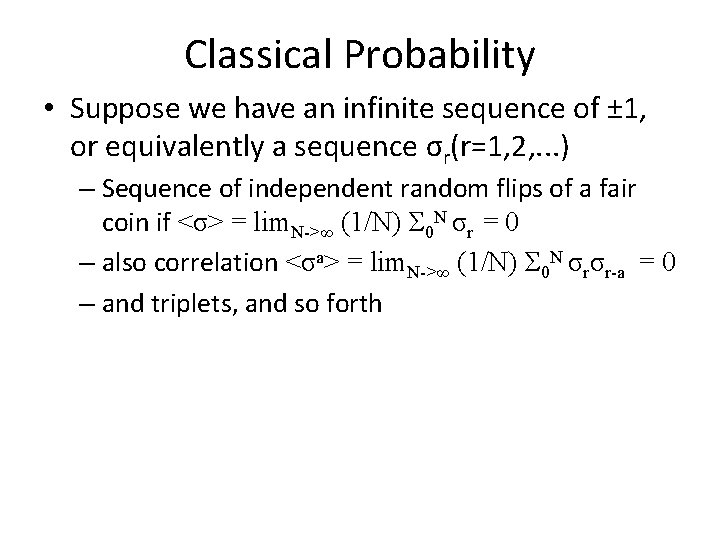
Classical Probability • Suppose we have an infinite sequence of ± 1, or equivalently a sequence σr(r=1, 2, . . . ) – Sequence of independent random flips of a fair coin if <σ> = lim. N->∞ (1/N) Σ 0 N σr = 0 – also correlation <σa> = lim. N->∞ (1/N) Σ 0 N σrσr-a = 0 – and triplets, and so forth
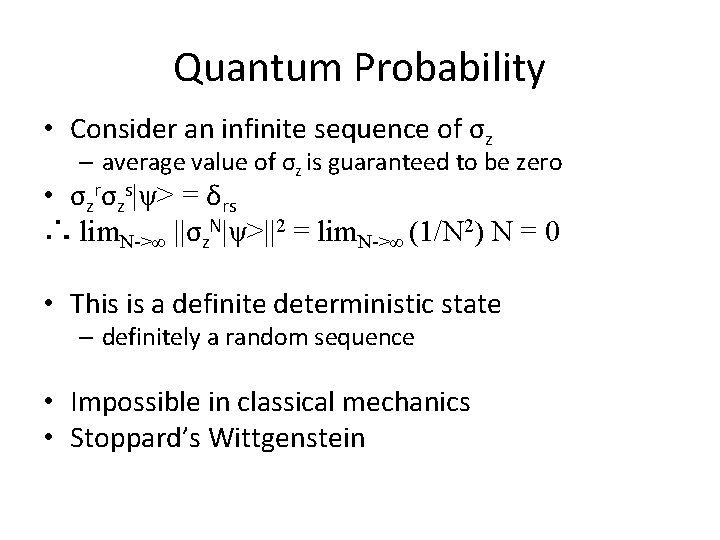
Quantum Probability • Consider an infinite sequence of σz – average value of σz is guaranteed to be zero • σzrσzs|ψ> = δrs ∴ lim. N->∞ ||σz. N|ψ>||2 = lim. N->∞ (1/N 2) N = 0 • This is a definite deterministic state – definitely a random sequence • Impossible in classical mechanics • Stoppard’s Wittgenstein