
Quantum Mechanics II Examples Michael A Nielsen University
- Slides: 35
Quantum Mechanics II: Examples Michael A. Nielsen University of Queensland Goals: 1. To apply the principles introduced in the last lecture to some illustrative examples: superdense coding, and quantum teleportation. 2. Revised form of postulates 2 (dynamics) and 3 (measurement). 3. Introduce more elements of the Dirac notation. 4. Discuss the philosophy underlying quantum information science.
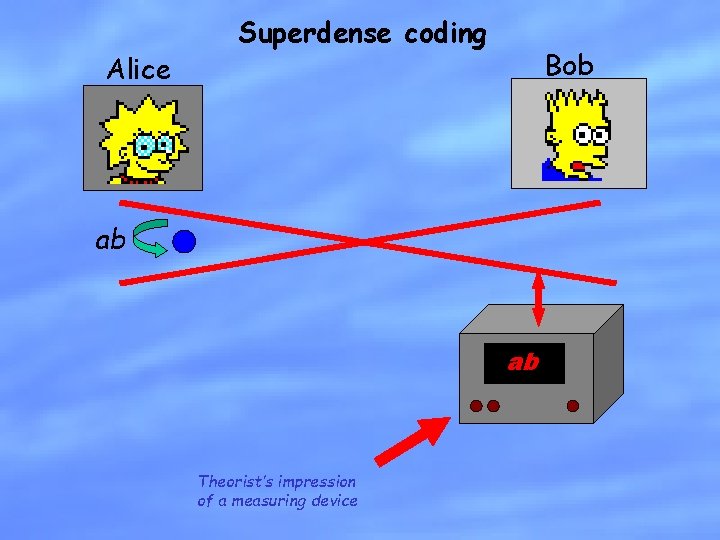
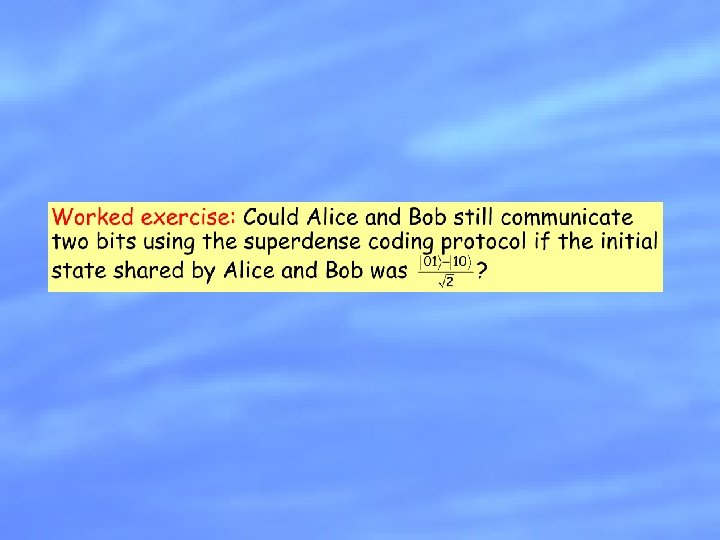
Alice Superdense coding Bob ab ab Theorist’s impression of a measuring device
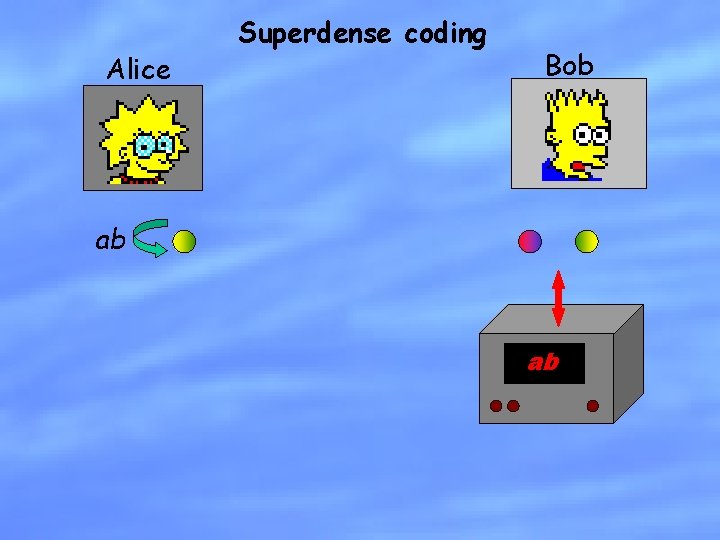
Alice Superdense coding Bob ab ab
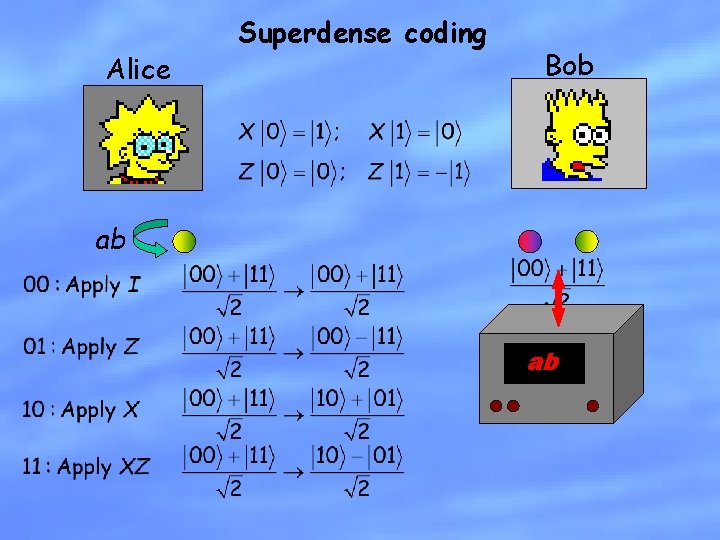
Alice Superdense coding Bob ab ab
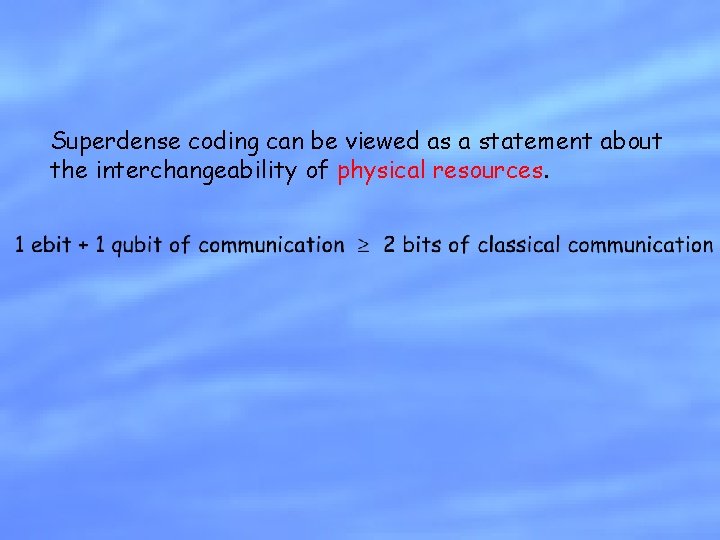
Superdense coding can be viewed as a statement about the interchangeability of physical resources.
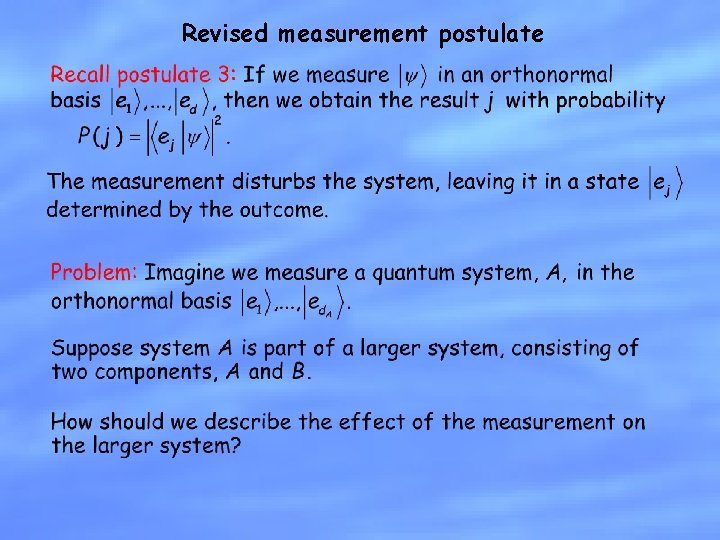
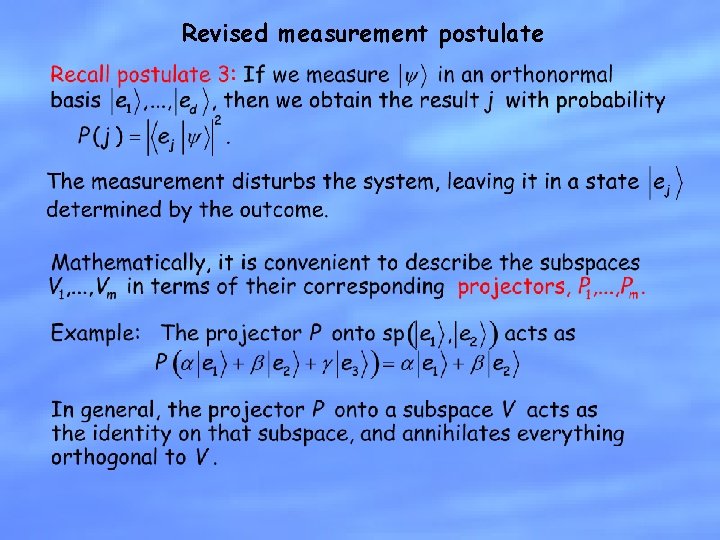
Revised measurement postulate
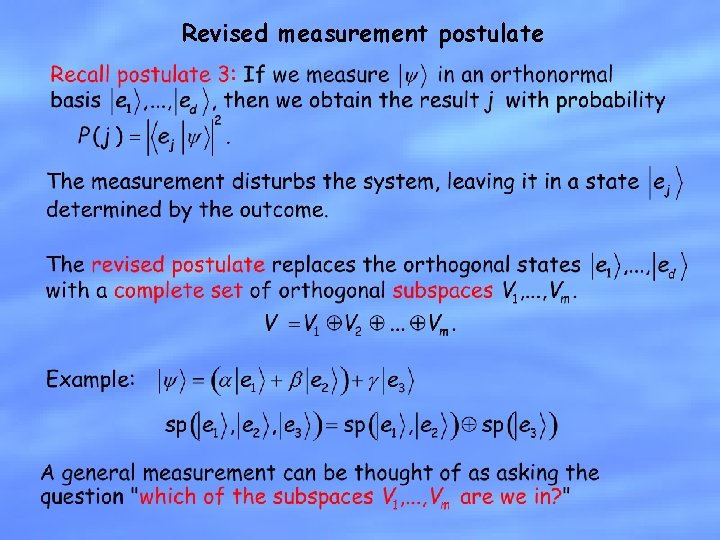
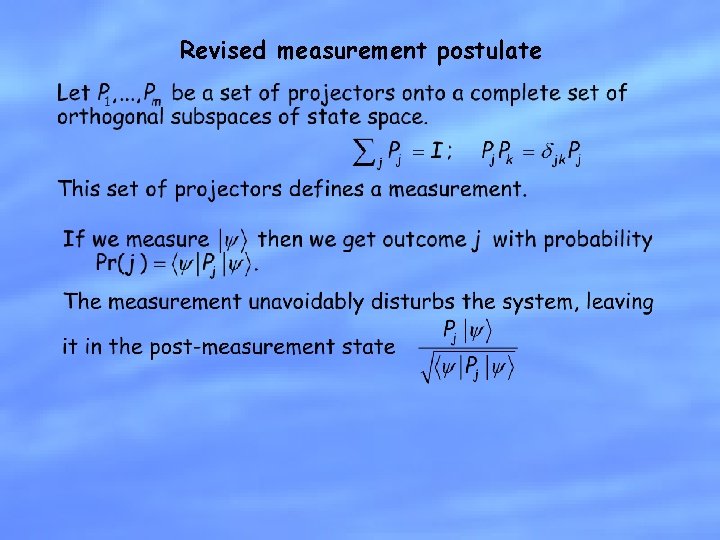
Revised measurement postulate
Revised measurement postulate
Revised measurement postulate
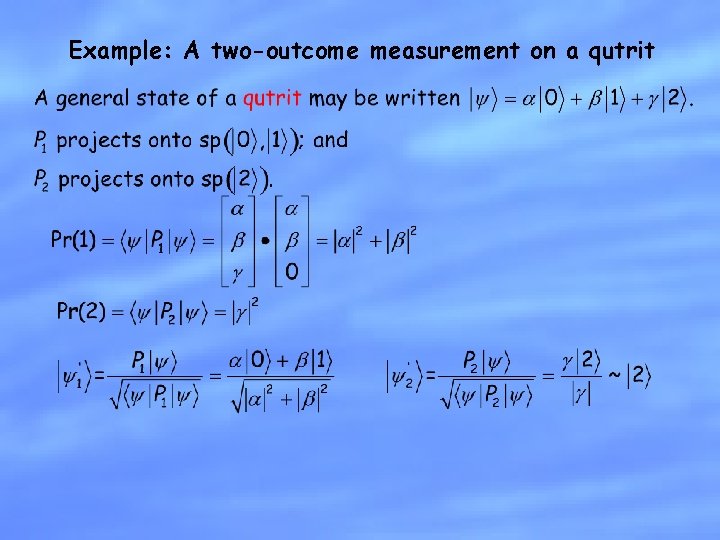
Example: A two-outcome measurement on a qutrit
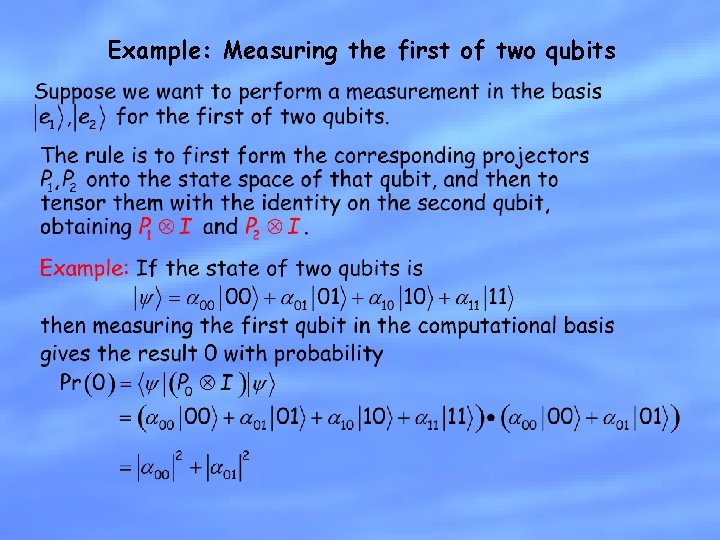
Example: Measuring the first of two qubits
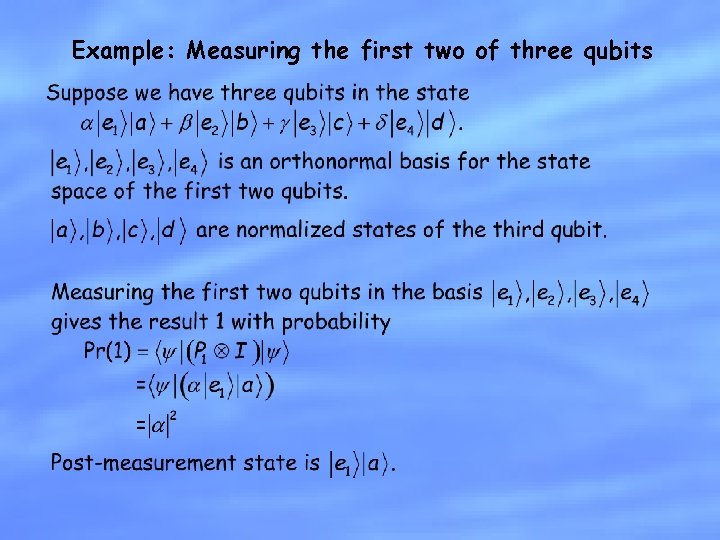
Example: Measuring the first two of three qubits
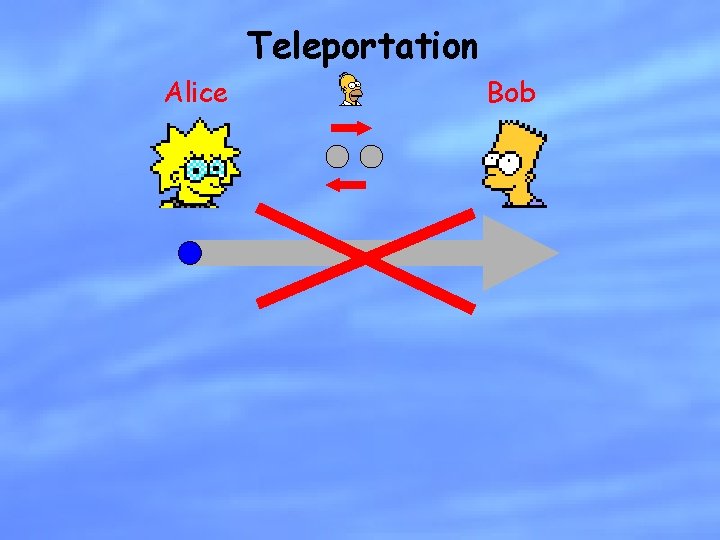
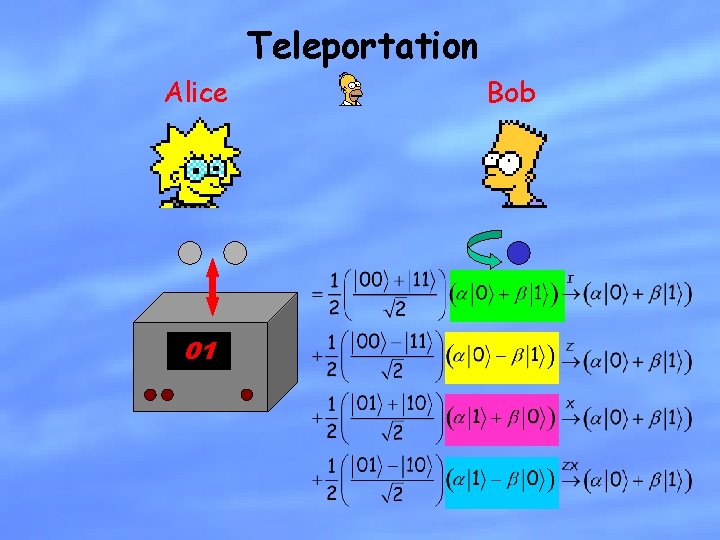
Teleportation Alice Bob
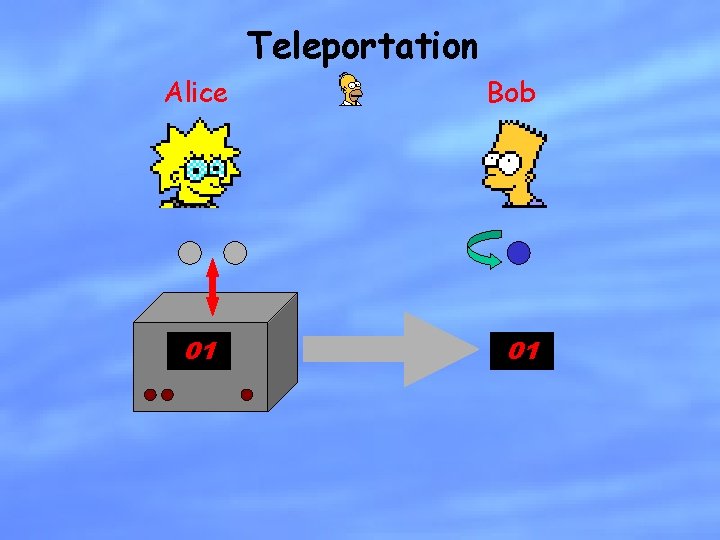
Teleportation Alice 01 Bob 01
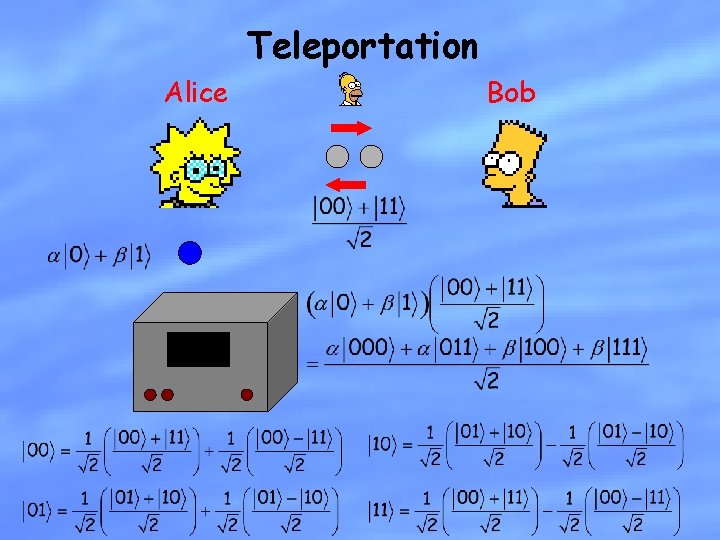
Teleportation Alice Bob
Teleportation Alice 01 Bob
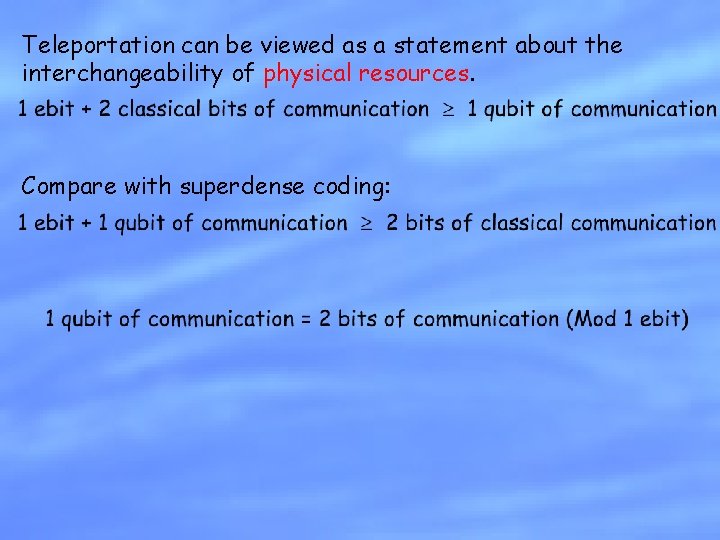
Teleportation can be viewed as a statement about the interchangeability of physical resources. Compare with superdense coding:
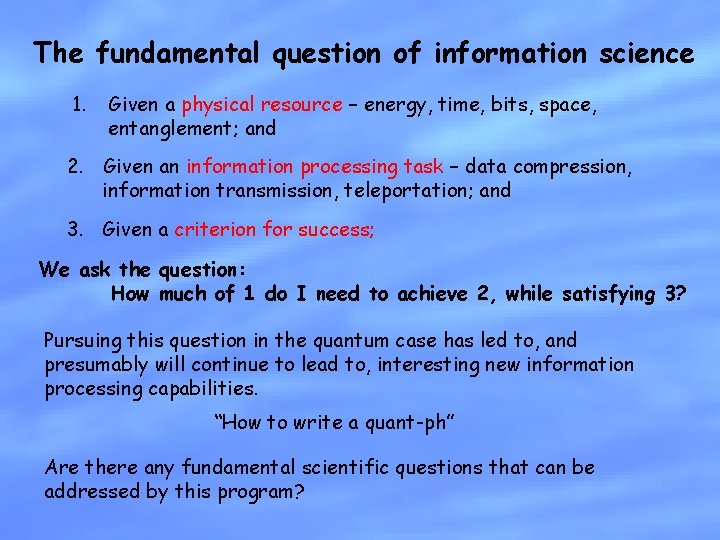
The fundamental question of information science 1. Given a physical resource – energy, time, bits, space, entanglement; and 2. Given an information processing task – data compression, information transmission, teleportation; and 3. Given a criterion for success; We ask the question: How much of 1 do I need to achieve 2, while satisfying 3? Pursuing this question in the quantum case has led to, and presumably will continue to lead to, interesting new information processing capabilities. “How to write a quant-ph” Are there any fundamental scientific questions that can be addressed by this program?
What fundamental problems are addressed by quantum information science? Your challenger
What high-level principles are implied by quantum mechanics?
Robert B. Laughlin, 1998 Nobel Lecture “I give my class of extremely bright graduate students, who have mastered quantum mechanics but are otherwise unsuspecting and innocent, a take-home exam in which they are asked to deduce superfluidity from first principles. There is no doubt a special place in hell being reserved for me at this very moment for this mean trick, for the task is impossible. Superfluidity, like the fractional quantum Hall effect, is an emergent phenomenon – a low-energy collective effect of huge numbers of particles that cannot be deduced from the microscopic equations of motion in a rigorous way and that disappears completely when the system is taken apart (Anderson, 1972)”
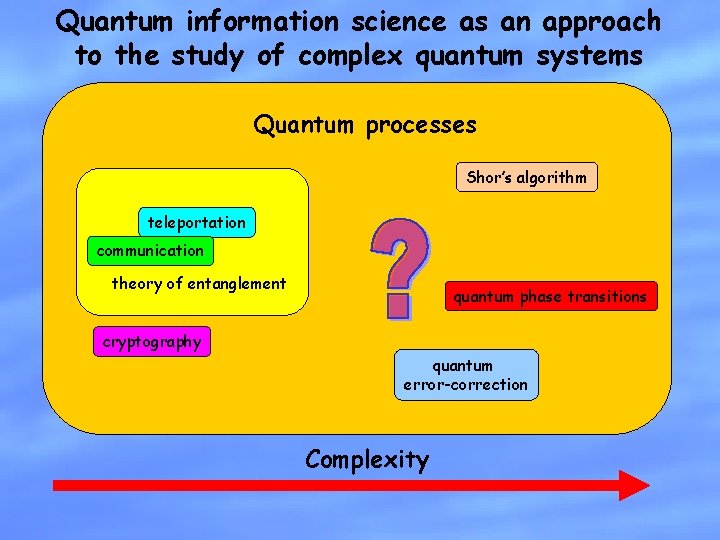
Quantum information science as an approach to the study of complex quantum systems Quantum processes Shor’s algorithm teleportation communication theory of entanglement quantum phase transitions cryptography quantum error-correction Complexity
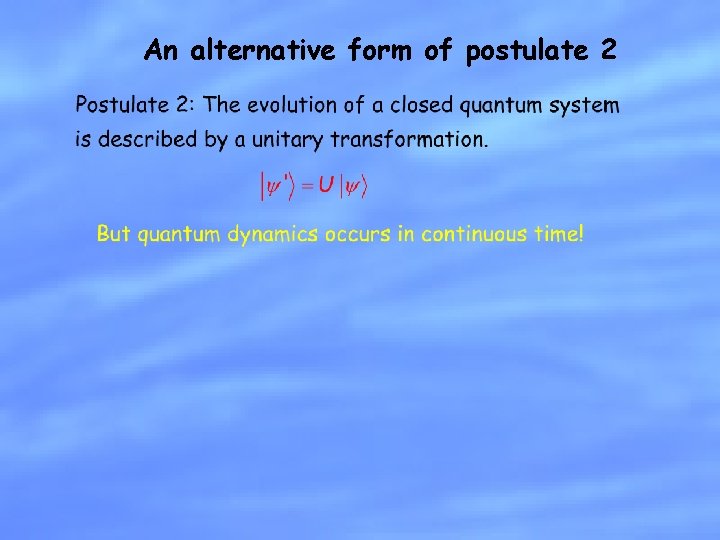
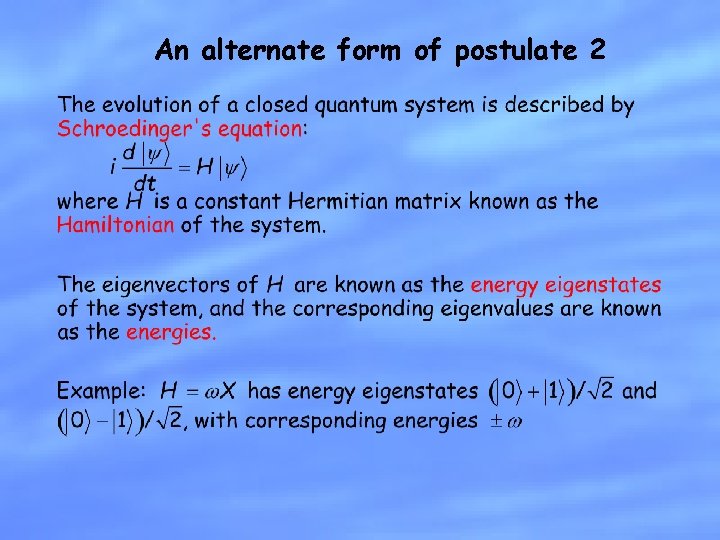
A few quanta of miscellanea The “outer product” notation The spectral theorem – diagonalizing Hermitian matrices Historical digression on measurement The trace operation Quantum dynamics in continuous time: an alternative form of the second postulate
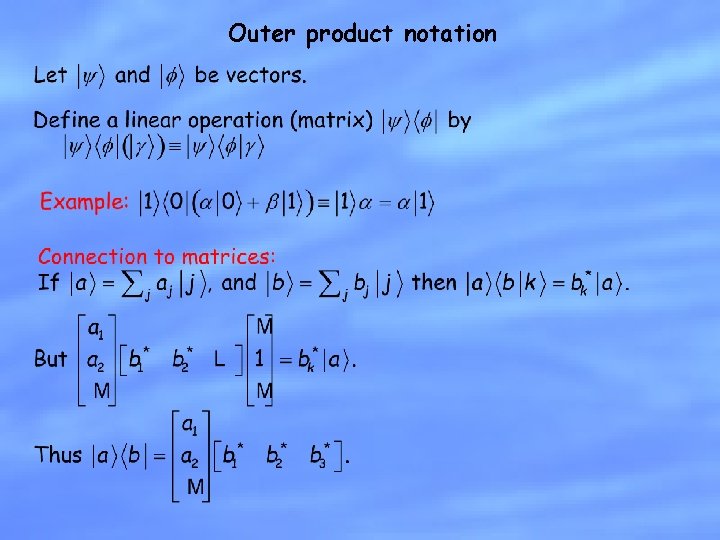
Outer product notation
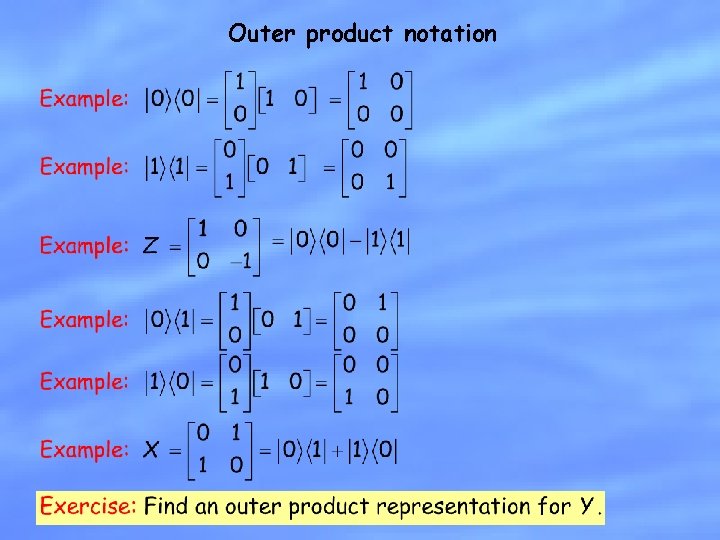
Outer product notation
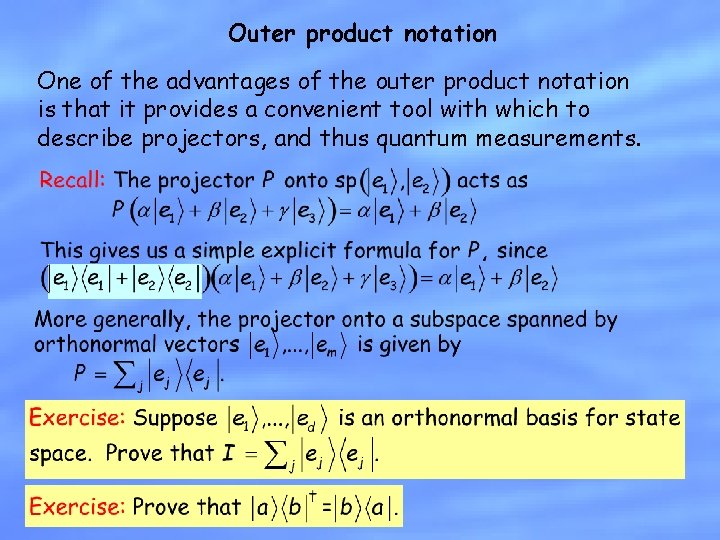
Outer product notation One of the advantages of the outer product notation is that it provides a convenient tool with which to describe projectors, and thus quantum measurements.
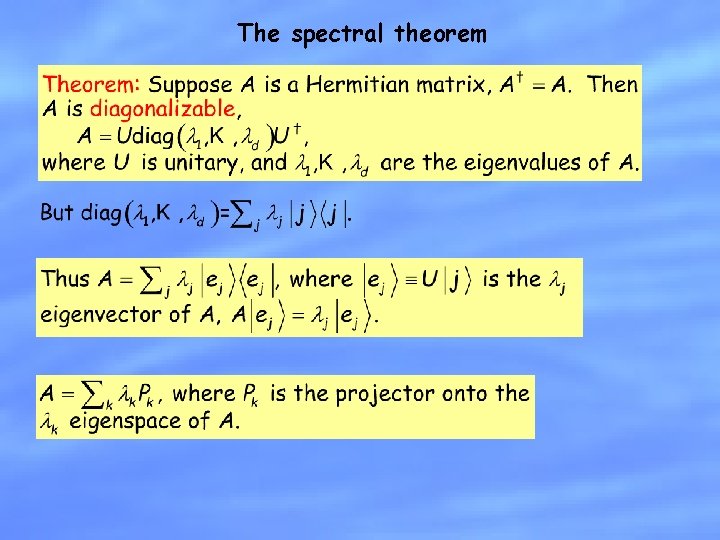
The spectral theorem
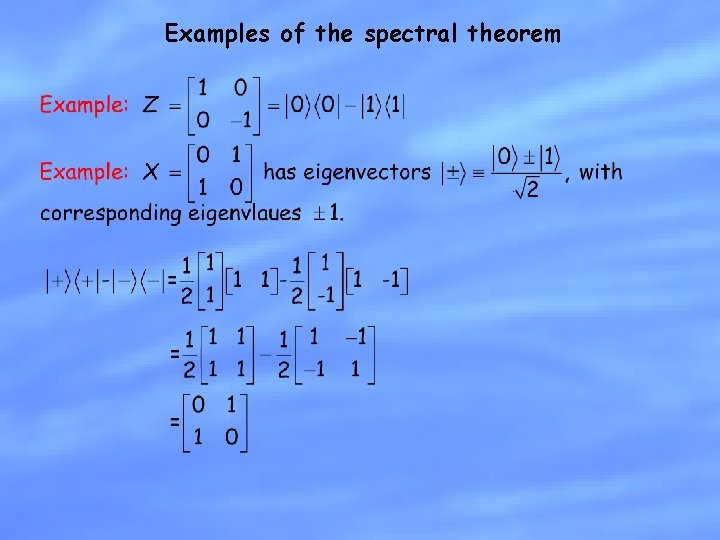
Examples of the spectral theorem
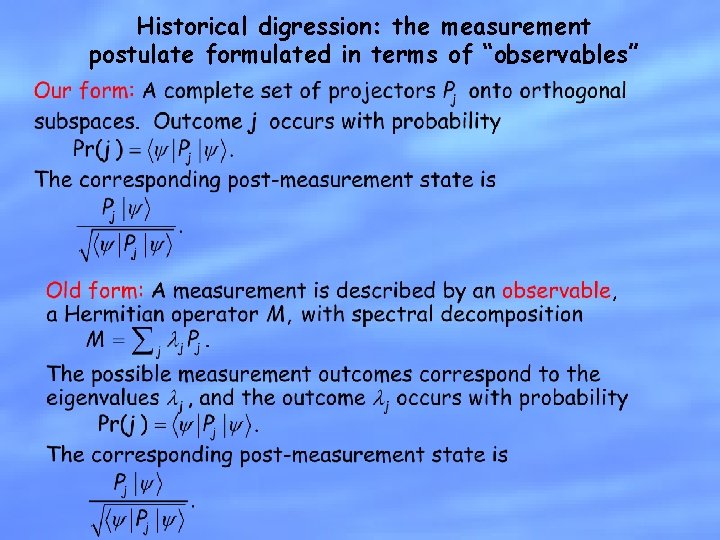
Historical digression: the measurement postulate formulated in terms of “observables”
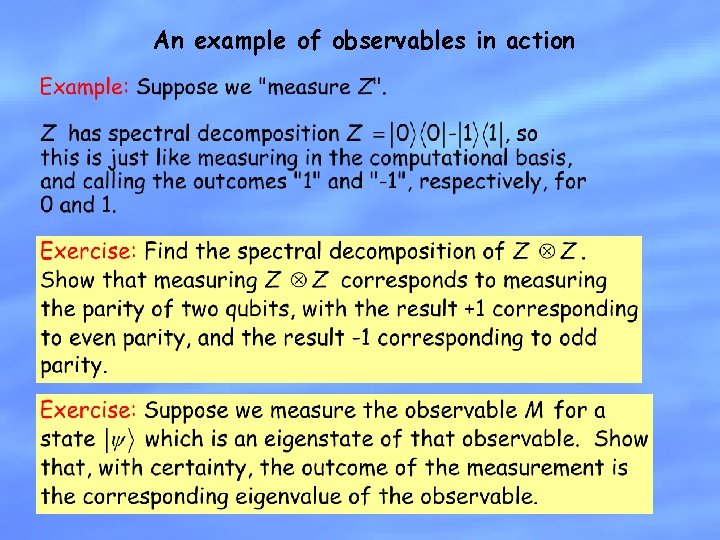
An example of observables in action
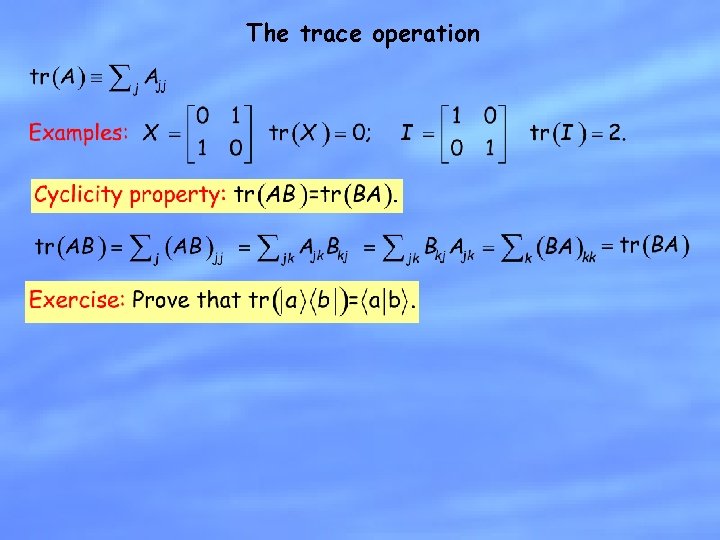
The trace operation
An alternative form of postulate 2
An alternate form of postulate 2
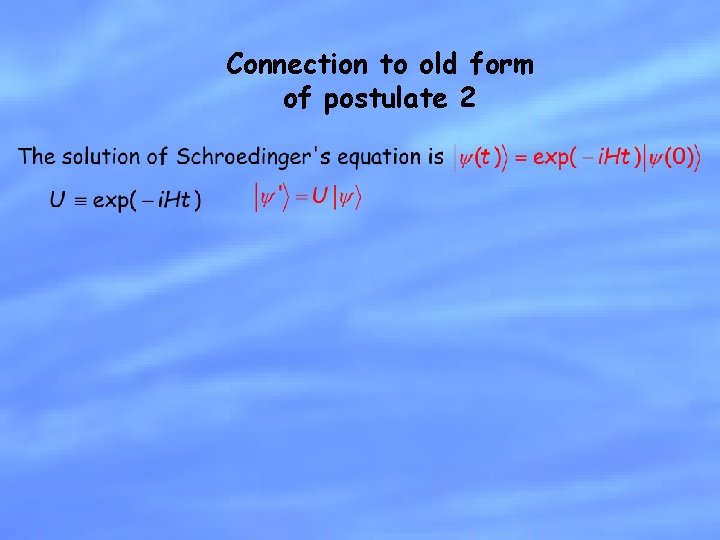
Connection to old form of postulate 2