
Quantum Mechanics and Spectroscopy Lauri Partanen What is

- Slides: 13
Quantum Mechanics and Spectroscopy Lauri Partanen
What is a wavefunction? Review: 1) First think by yourself: How would you define a wavefunction? What properties does a wavefunction has to fulfill? (5 mins) 2) Find a pair (different from last time) (10 mins) • Introduce yourself and get to know each other. Discuss your experiences with the first Perusall exercises. What were your impressions of the reading material? • Compare your definitions of the wavefunction. Incoporate aspects from each other’s definition to improve your original ones. List the properties that the wavefunction has to fulfill.
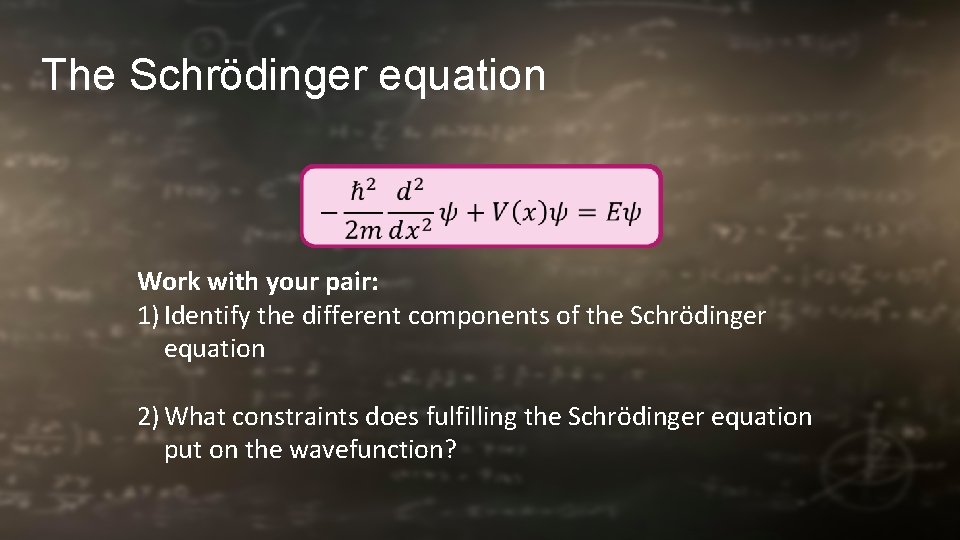
The Schrödinger equation Work with your pair: 1) Identify the different components of the Schrödinger equation 2) What constraints does fulfilling the Schrödinger equation put on the wavefunction?
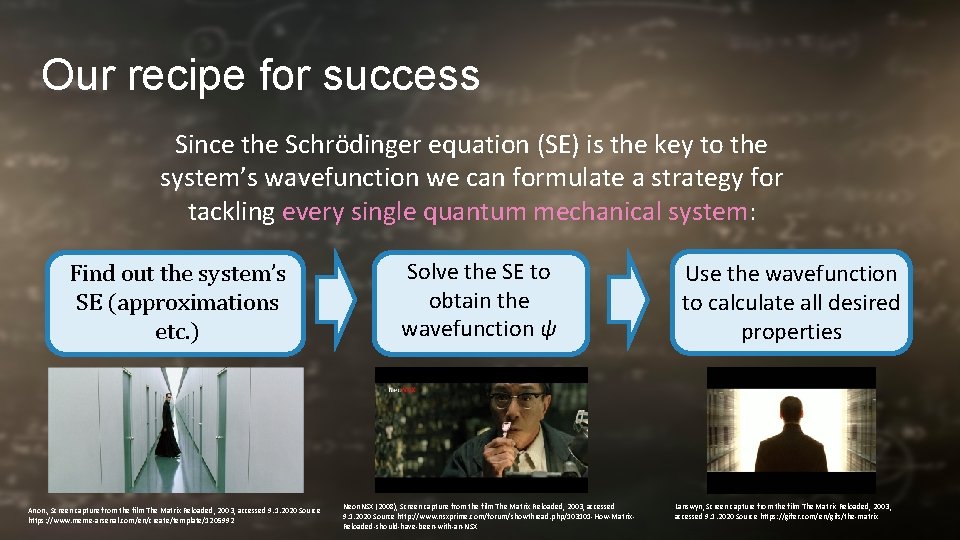
Our recipe for success Since the Schrödinger equation (SE) is the key to the system’s wavefunction we can formulate a strategy for tackling every single quantum mechanical system: Find out the system’s SE (approximations etc. ) Anon. , Screen capture from the film The Matrix Reloaded, 2003, accessed 9. 1. 2020 Source https: //www. meme-arsenal. com/en/create/template/1205992 Solve the SE to obtain the wavefunction ψ Neon. NSX (2008), Screen capture from the film The Matrix Reloaded, 2003, accessed 9. 1. 2020 Source http: //www. nsxprime. com/forum/showthread. php/103101 -How-Matrix. Reloaded-should-have-been-with-an-NSX Use the wavefunction to calculate all desired properties Lanswyn, Screen capture from the film The Matrix Reloaded, 2003, accessed 9. 1. 2020 Source https: //gifer. com/en/gifs/the-matrix
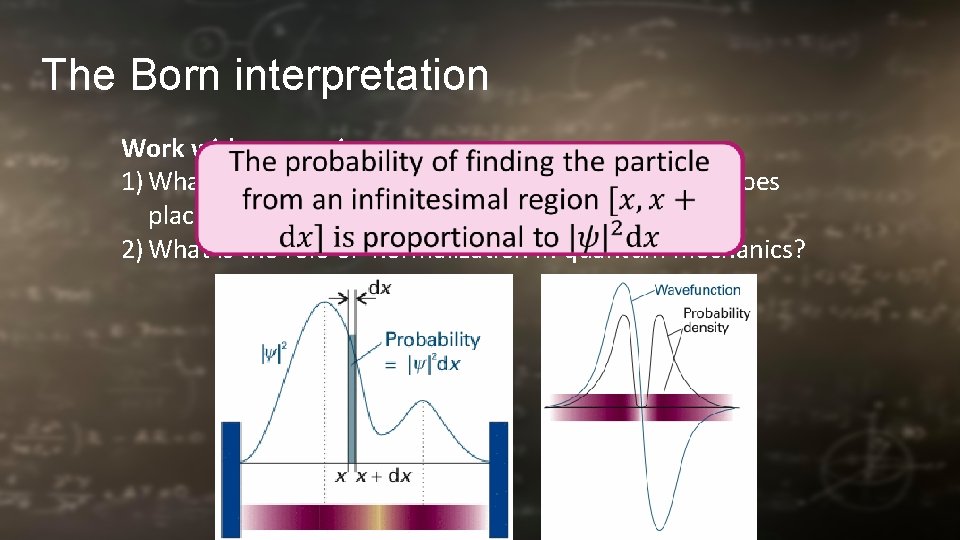
The Born interpretation Work with your pair: 1) What is the Born interpretation? What constraints does place on the wavefunction? 2) What is the role of normalization in quantum mechanics?
The 3 D Born interpretation
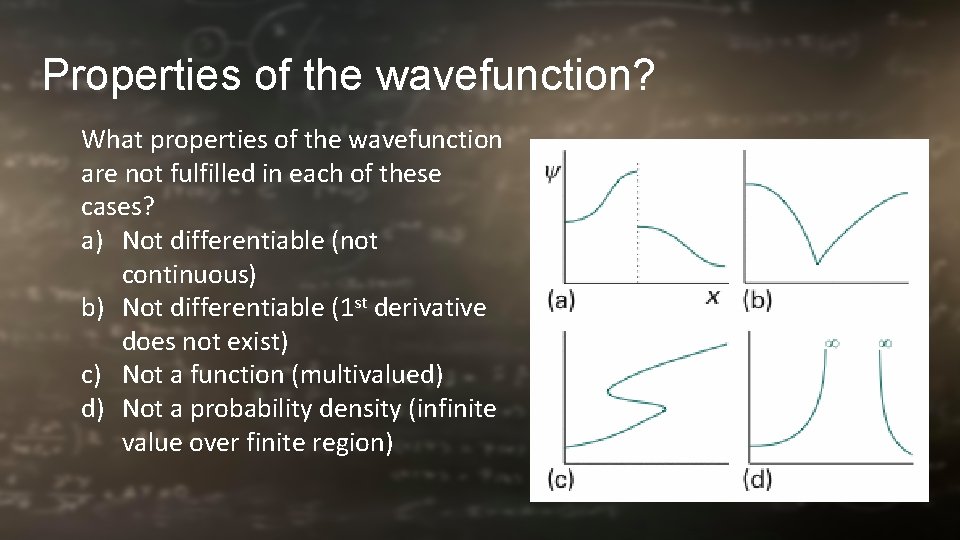
Properties of the wavefunction? What properties of the wavefunction are not fulfilled in each of these cases? a) Not differentiable (not continuous) b) Not differentiable (1 st derivative does not exist) c) Not a function (multivalued) d) Not a probability density (infinite value over finite region)
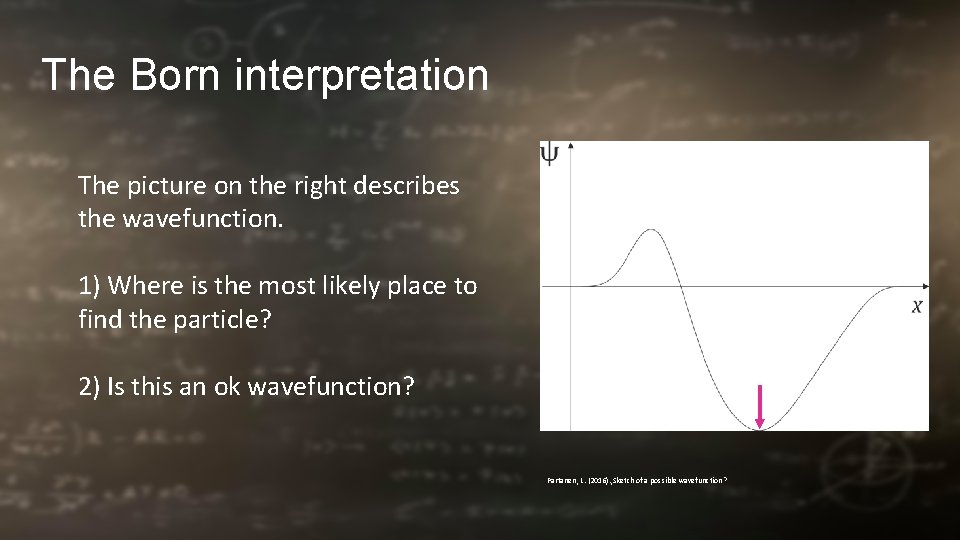
The Born interpretation The picture on the right describes the wavefunction. 1) Where is the most likely place to find the particle? 2) Is this an ok wavefunction? Partanen, L. (2016). , Sketch of a possible wavefunction?
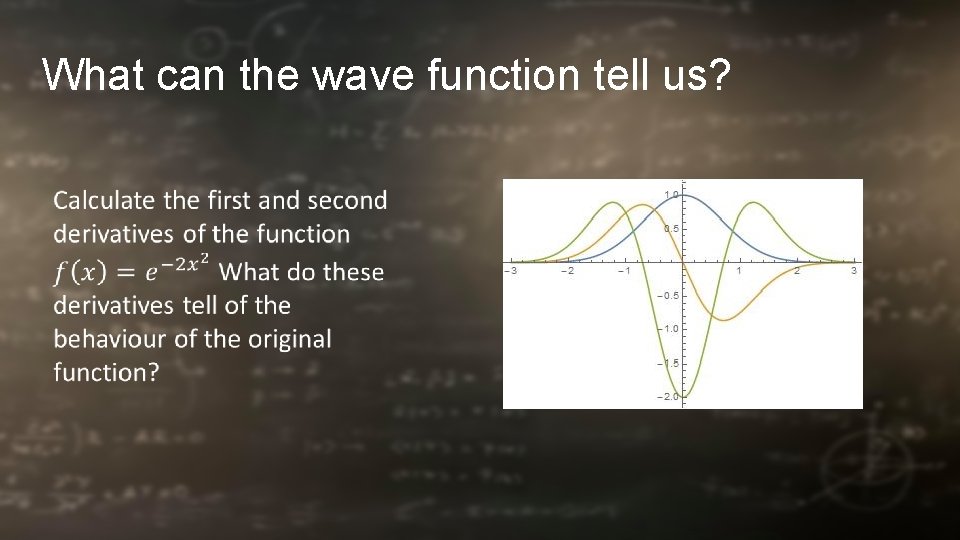
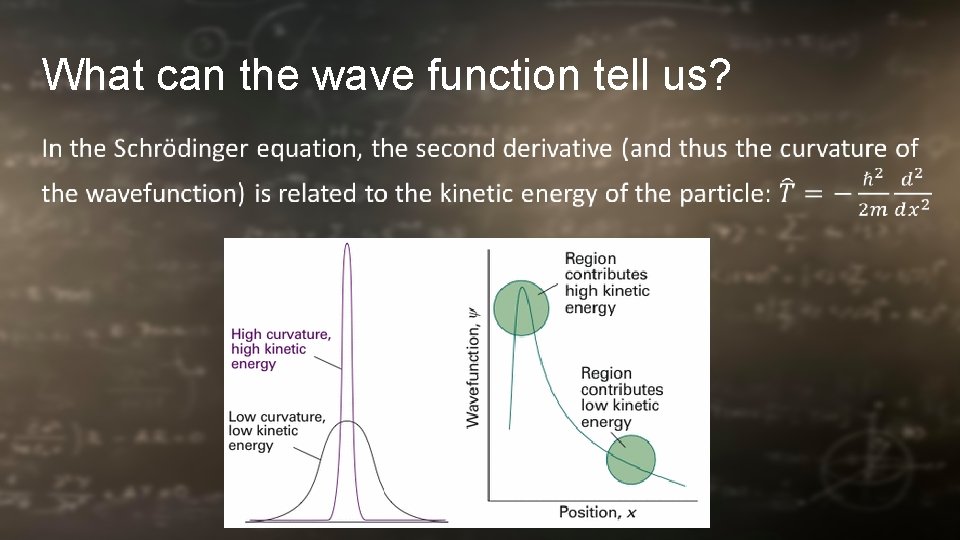
What can the wave function tell us?
What can the wave function tell us?
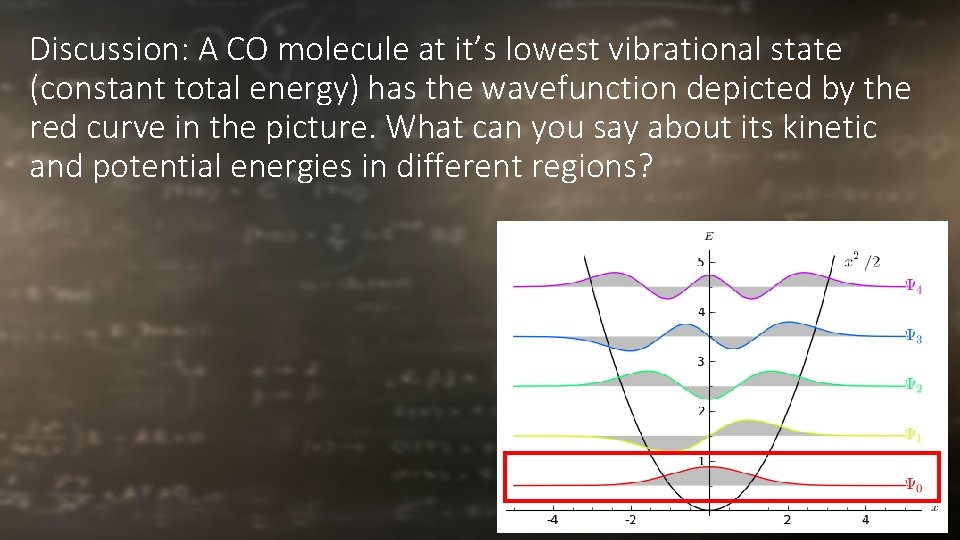
Discussion: A CO molecule at it’s lowest vibrational state (constant total energy) has the wavefunction depicted by the red curve in the picture. What can you say about its kinetic and potential energies in different regions?
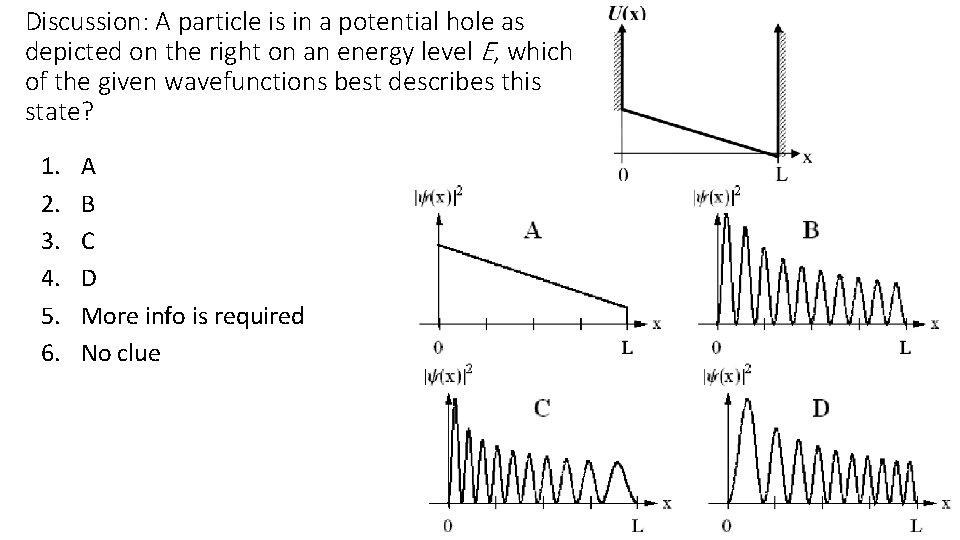
Discussion: A particle is in a potential hole as depicted on the right on an energy level E, which of the given wavefunctions best describes this state? 1. 2. 3. 4. 5. 6. A B C D More info is required No clue
Figure references Unless otherwise noted all Figures are taken from Chapter 7 of Atkins, P. ja De Paula, J. , L. (2014), Atkins’ Physical Chemistry, 10 th edition, Oxford University Press, Oxford, New York.