
Quantum Mechanical Model of the Atom Problem with
Quantum Mechanical Model of the Atom
Problem with Bohr’s Model • Bohr’s model of the atom could not explain why the spectra of other elements had too many lines. What appeared to be a single line in a spectrum was actually several lines closely grouped together.
Modified Bohr Model • By breaking Bohr’s energy levels into sublevels, it was possible to explain these spectra. Therefore, an energy level is actually made up of many energy states that are closely grouped together. • Bohr’s levels were broken into the following sublevels: Sharp Principle Diffuse Fundamental
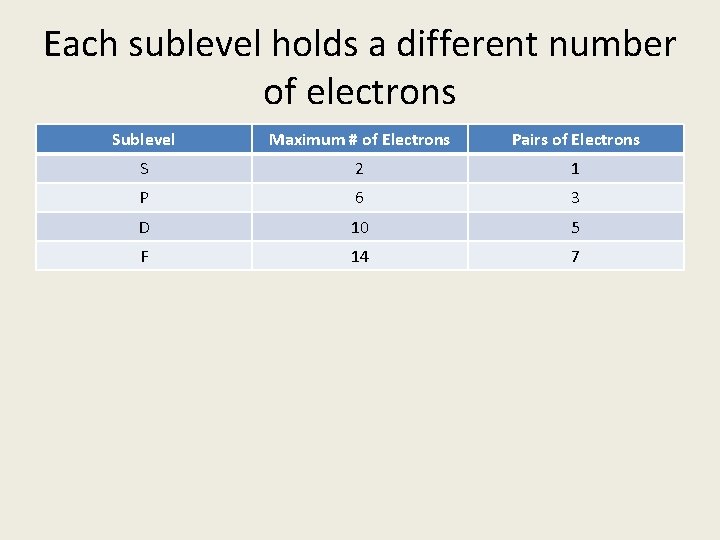
Each sublevel holds a different number of electrons Sublevel Maximum # of Electrons Pairs of Electrons S 2 1 P 6 3 D 10 5 F 14 7
Orbitals • The space occupied by a pair of electrons is called an orbital. Each orbital can hold one pair of electrons. Orbital describe regions in space where is electron is more likely to be found.
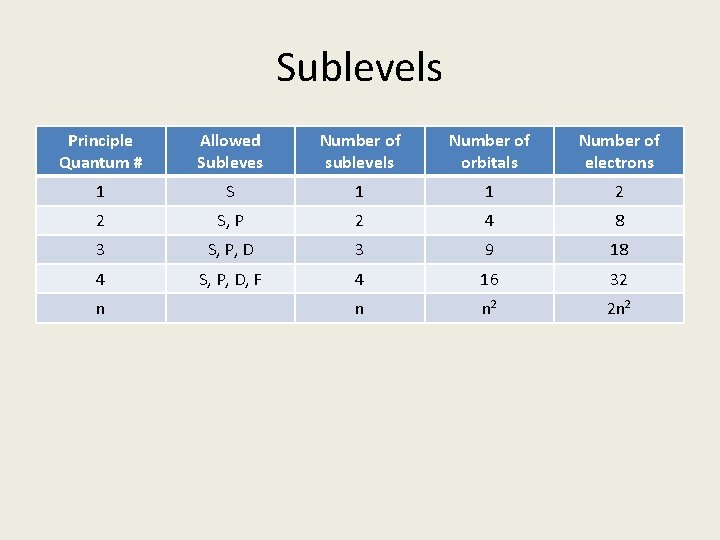
Sublevels Principle Quantum # Allowed Subleves Number of sublevels Number of orbitals Number of electrons 1 S 1 1 2 2 S, P 2 4 8 3 S, P, D 3 9 18 4 S, P, D, F 4 16 32 n n 2 2 n 2 n
Energy levels and multi-electron atoms • To construct a model of an atom, follow these two rules: (1) Aufbau Principle – Electrons always enter orbitals of the lowest energy first. (2) There is a maximum number of electrons for each energy level. The number is given by 2 n 2 where n is the principle quantum number.
Pauli Exclusion Principle • An atomic orbital may describe at most two electrons. To occupy the same orbitals, two electrons must have opposite spins. Spin is a quantum property of electrons and may be clockwise (represented by an upward pointing arrow ↑) or counterclockwise (represented by a downward pointing arrow ↓).
Hund’s Rule • When electrons occupy orbitals of equal energy, one electron enters each orbital until all the orbitals contain one electron with spins parallel (either all the spins are clockwise or all the spins are counterclockwise). Second electrons then add to each orbital so that their spins are paired with the first electrons in the orbital.
Steps to Writing the Electron Configuration of an Atom • Step 1 • Get a Periodic Table of Elements • Find out how many electrons the atom has. On the periodic table, the atomic number is the number of protons of the atom, and thus equals the number of electrons in an atom with zero charge.
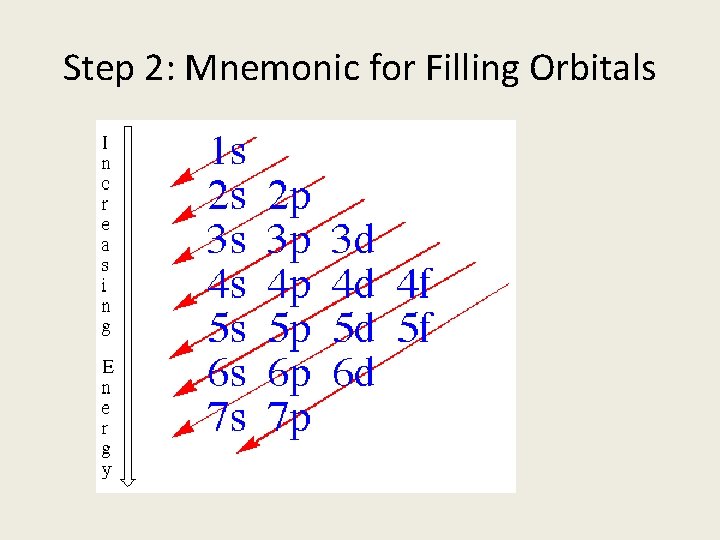
Step 2: Mnemonic for Filling Orbitals
Step 3 • Put one electron into the highest energy orbital available, starting with 1 s (holds a maximum of two electrons). Fill the orbitals in this order (the number in superscript following the sublevel is the maximum number of electrons it can hold): – 1 s 2 2 p 6 3 s 2 3 p 6 4 s 2 3 d 10 4 p 6 5 s 2 4 d 10 5 p 6 6 s 2 4 f 14 5 d 10 6 p 6 7 s 2 5 f 14 6 d 10 – Note: Energy level changes as you go up. For example, when you are about to go up to the 4 th energy level, it becomes 4 s first, then 3 d. After the fourth energy level, you'll move onto the 5 th where it follows the order once again. This only happens after the 3 rd energy level!
Step 4 • Once you've put every electron into an orbital (according to the order), write the configuration as shown at the end of step 3. Only write the orbitals that contain electrons. • So, an uncharged antimony atom's electron configuration would be 1 s 2 2 p 6 3 s 2 3 p 6 4 s 2 3 d 10 4 p 6 5 s 2 4 d 10 5 p 3. Notice that the superscript number following 5 p is 3. That's because only three electrons are in the 5 p sublevel, so the sublevel is not completely occupied (it lacks three more electrons).
Practice • Write the electron configuration for the first 20 elements. • Write the electron configuration of Br, Ag, Ba, Au, and U.
Energy Level Diagrams • The electron configuration of atoms can also be shown in energy level diagrams. In such diagrams, individual orbital are represented by spheres, boxes, or lines. Each orbital can hold a maximum of 2 electrons containing opposite spins. The height of each orbital is representative of its energy. The higher the orbital is in the diagrams, the higher is its energy.
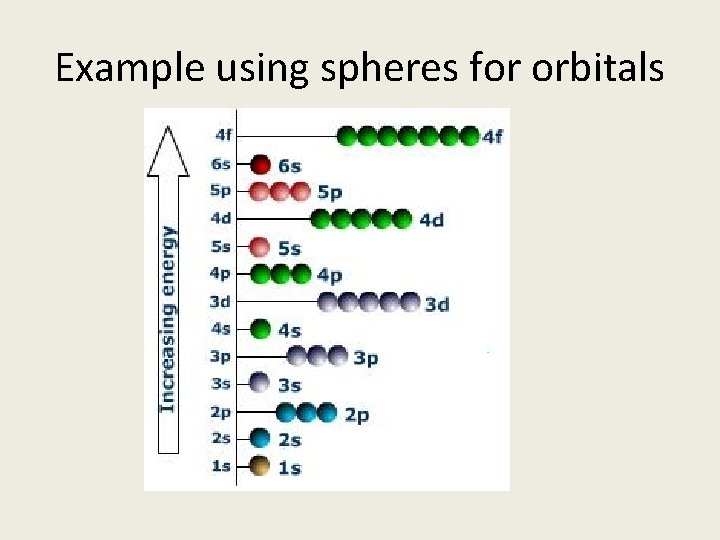
Example using spheres for orbitals
Examples • I will use boxes to represent individual orbitals. Examples • Hydrogen Oxygen Potassium
Practice • Draw the energy level diagram for the following: Lithium Fluorine Silver
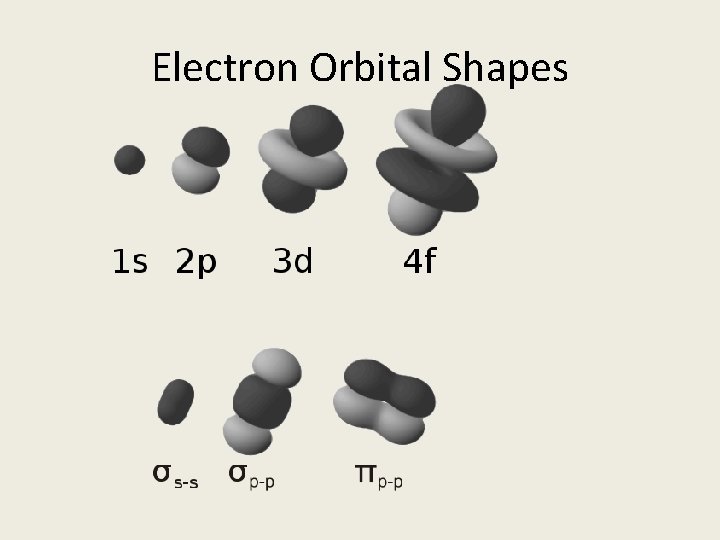
Electron Orbital Shapes
- Slides: 19