
Quantum Mechanical Model and Electron Configurations 5 1

- Slides: 21
Quantum Mechanical Model and Electron Configurations
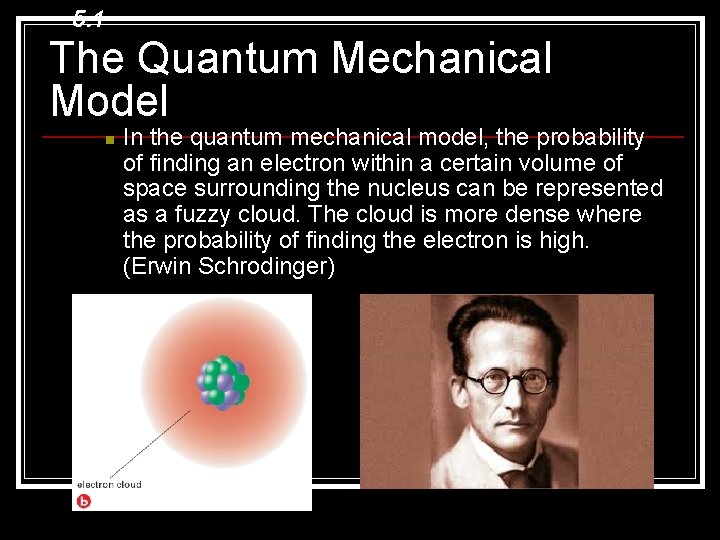
5. 1 The Quantum Mechanical Model n In the quantum mechanical model, the probability of finding an electron within a certain volume of space surrounding the nucleus can be represented as a fuzzy cloud. The cloud is more dense where the probability of finding the electron is high. (Erwin Schrodinger)
5. 1 Atomic Orbitals n An atomic orbital is often thought of as a region of space in which there is a high probability of finding an electron. § Each energy sublevel corresponds to an orbital of a different shape, which describes where the electron is likely to be found.
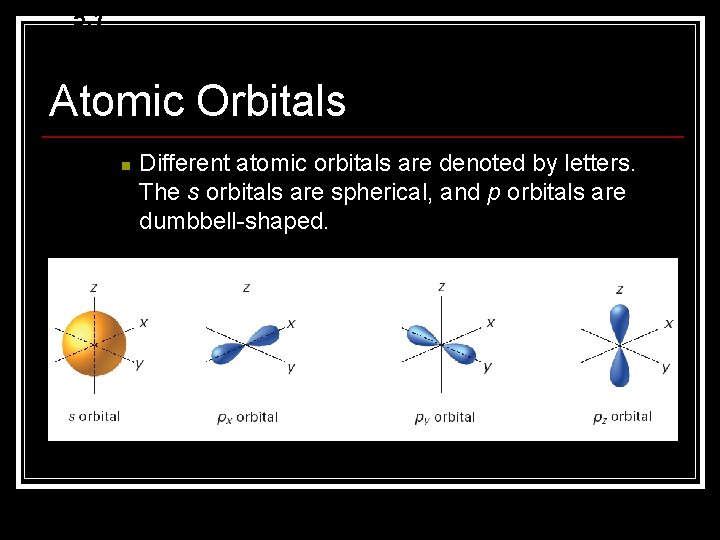
5. 1 Atomic Orbitals n Different atomic orbitals are denoted by letters. The s orbitals are spherical, and p orbitals are dumbbell-shaped.
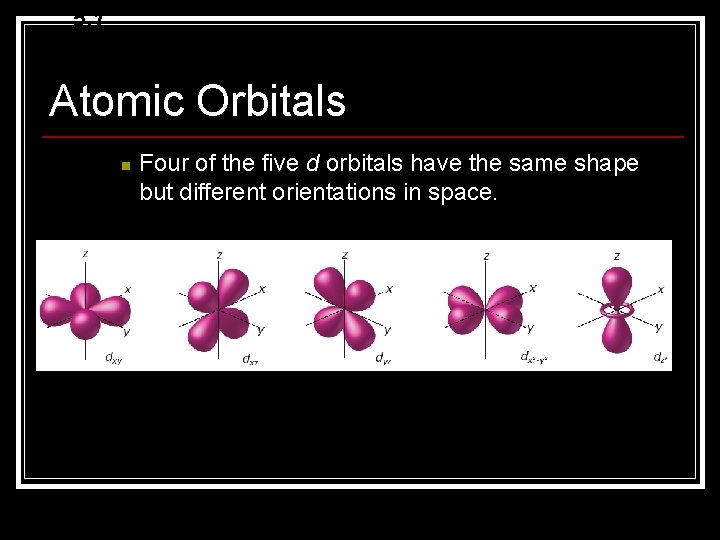
5. 1 Atomic Orbitals n Four of the five d orbitals have the same shape but different orientations in space.
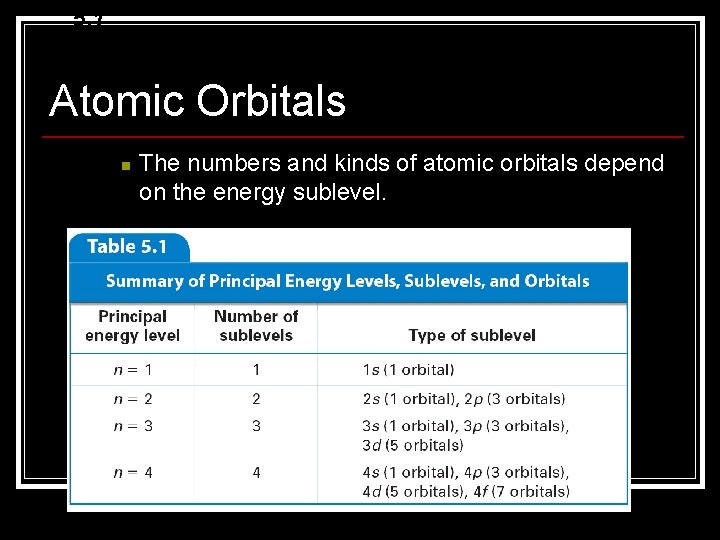
5. 1 Atomic Orbitals n The numbers and kinds of atomic orbitals depend on the energy sublevel.
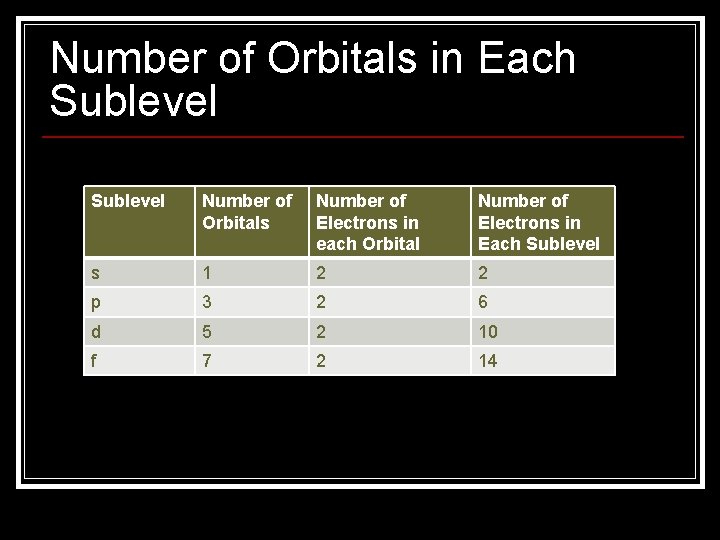
Number of Orbitals in Each Sublevel Number of Orbitals Number of Electrons in each Orbital Number of Electrons in Each Sublevel s 1 2 2 p 3 2 6 d 5 2 10 f 7 2 14
5. 2 Electron Configurations n What are three rules for writing the electron configurations of elements?
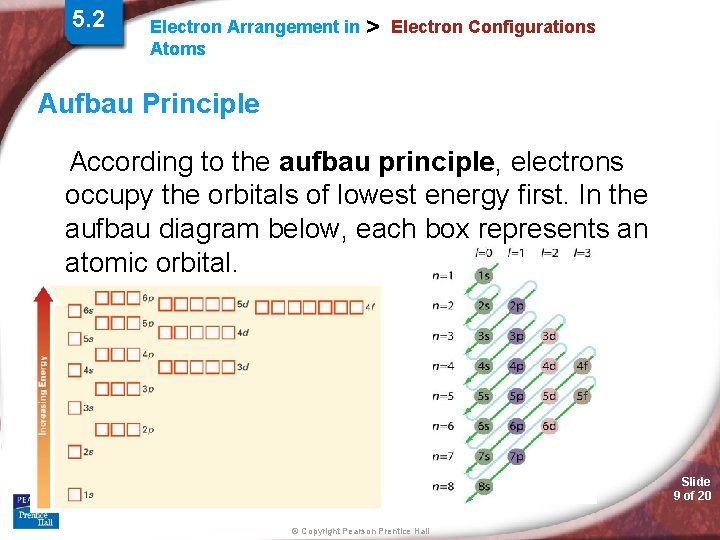
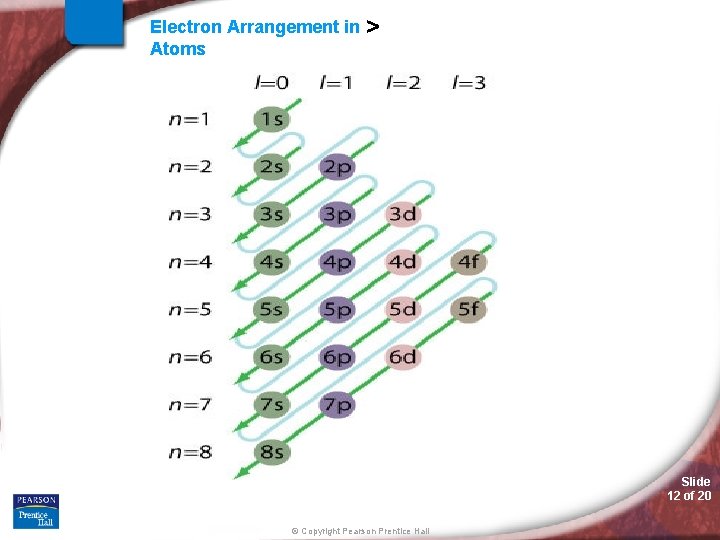
5. 2 Electron Arrangement in Atoms > Electron Configurations Aufbau Principle According to the aufbau principle, electrons occupy the orbitals of lowest energy first. In the aufbau diagram below, each box represents an atomic orbital. Slide 9 of 20 © Copyright Pearson Prentice Hall
5. 2 Electron Arrangement in Atoms > Electron Configurations Pauli Exclusion Principle According to the Pauli exclusion principle, an atomic orbital may describe at most two electrons. To occupy the same orbital, two electrons must have opposite spins; that is, the electron spins must be paired. Slide 10 of 20 © Copyright Pearson Prentice Hall
5. 2 Electron Arrangement in Atoms > Electron Configurations Hund’s Rule Hund’s rule states that electrons occupy orbitals of the same energy in a way that makes the number of electrons with the same spin direction as large as possible. Slide 11 of 20 © Copyright Pearson Prentice Hall
Electron Arrangement in Atoms > Slide 12 of 20 © Copyright Pearson Prentice Hall
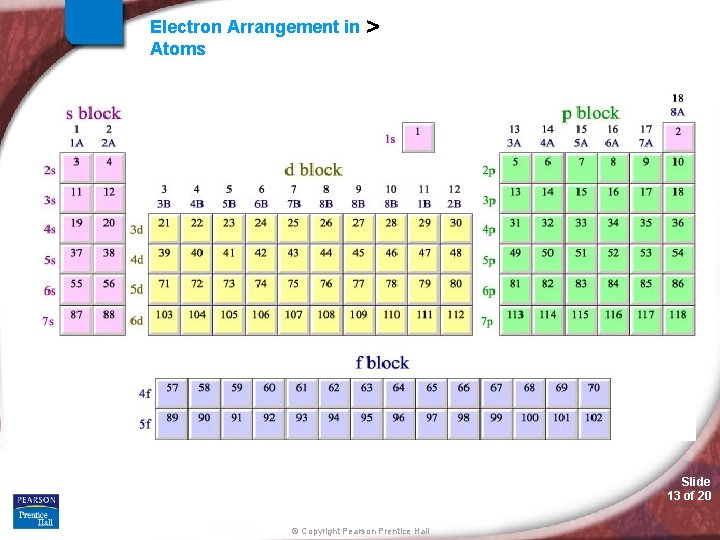
Electron Arrangement in Atoms > Slide 13 of 20 © Copyright Pearson Prentice Hall
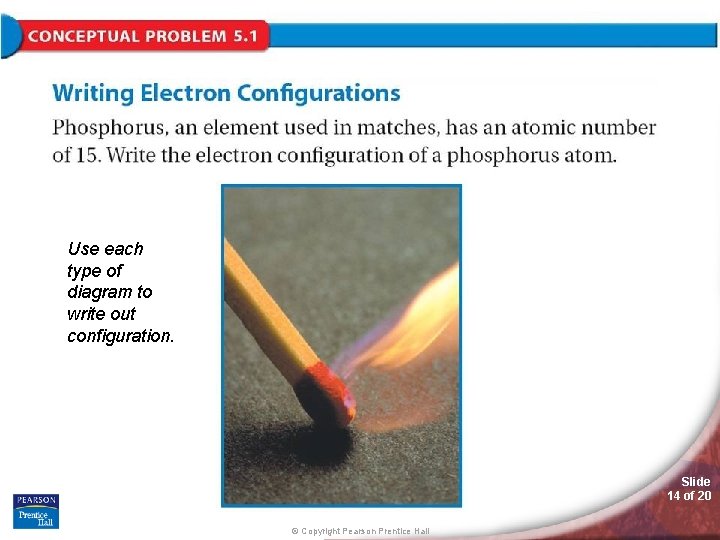
Use each type of diagram to write out configuration. Slide 14 of 20 © Copyright Pearson Prentice Hall
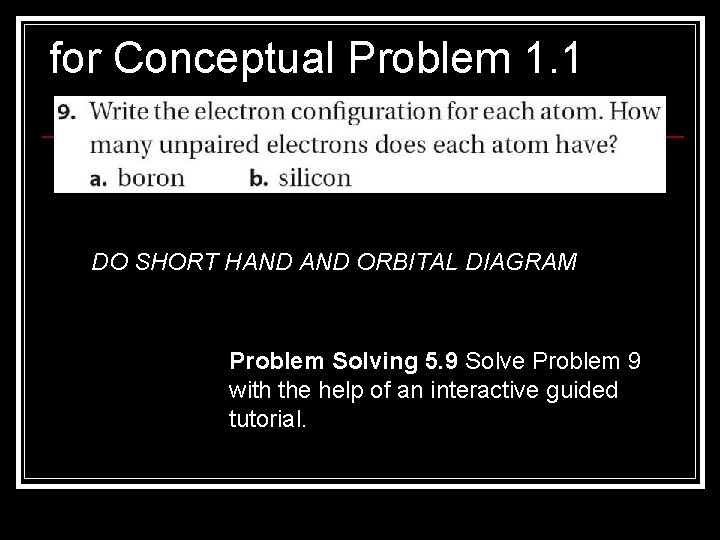
for Conceptual Problem 1. 1 DO SHORT HAND ORBITAL DIAGRAM Problem Solving 5. 9 Solve Problem 9 with the help of an interactive guided tutorial.
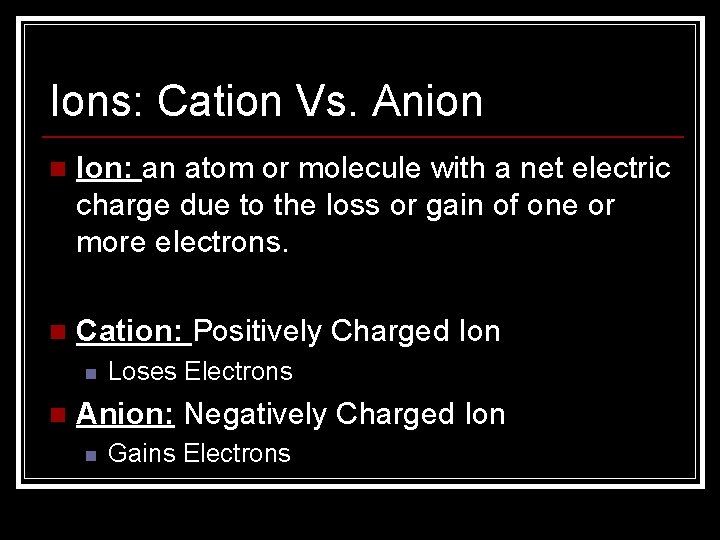
Ions: Cation Vs. Anion n Ion: an atom or molecule with a net electric charge due to the loss or gain of one or more electrons. n Cation: Positively Charged Ion n n Loses Electrons Anion: Negatively Charged Ion n Gains Electrons
Ion Electron Configurations n What charges do elements tend to have to be stable? GET OUT PERSONAL PERIODIC TABLES n Charges for Groups 1, 2, 15, 16, 17, 18 n
Octet Rule and Valence Electrons Atoms follow the octet rule because they always seek the most stable electron configuration. n Valence Electrons: Electrons in outermost shell. How do we find them? n Octet = 8 n n Elements want to have 8 electrons in their outer shell…
Practice: Electron Configuration of Ions Cl-1 n O-2 n Na+1 n Ca+2 Do short hand orbital diagram. n
Weird Stuff n http: //www. newscientist. com/blogs/nstv/20 11/09/one-minute-physics-is-schrodingers -cat-dead-or-alive. html
END OF SHOW