
Quantum Lower Bounds The Polynomial and Adversary Methods
Quantum Lower Bounds The Polynomial and Adversary Methods Scott Aaronson September 14, 2001 Prelim Exam Talk

Motivation • Quantum computing: model of computation based on our best-confirmed physical theory • To understand quantum computing, must know limitations as well as capabilities • E. g. , can QC’s decide NP in polynomial time? – Smart money says no, but proving it implies P NP • Popular alternative: study restricted models

Talk Overview • Intro to Quantum Model • Polynomial Method (Beals et al. 1998) – N lower bound for search – Part of D(f)1/6 bound for total functions • Adversary Method (Ambainis 2000) – Density matrices and entanglement – N lower bound for search (again)

The Quantum Model • State of computer: superposition over binary strings • To each string Y, associate complex amplitude Y • Y | Y|2 = 1 • On measuring, see Y with probability | Y|2 • Dirac ket notation: State written | = Y Y |Y • Each |Y is called a basis state

Unitary Evolution • Quantum state changes by multiplying amplitude vector with unitary matrix: | (t+1) = U| (t) • U is unitary iff U-1=U†, † conjugate transpose (Linear transformation that preserves norm=1) • Example: 1/ 2 -1/ 2 (|0 + |1 )/ 2 = |1 1/ 2 • Circuit model: U must be efficiently computable Black-box model: No such restriction
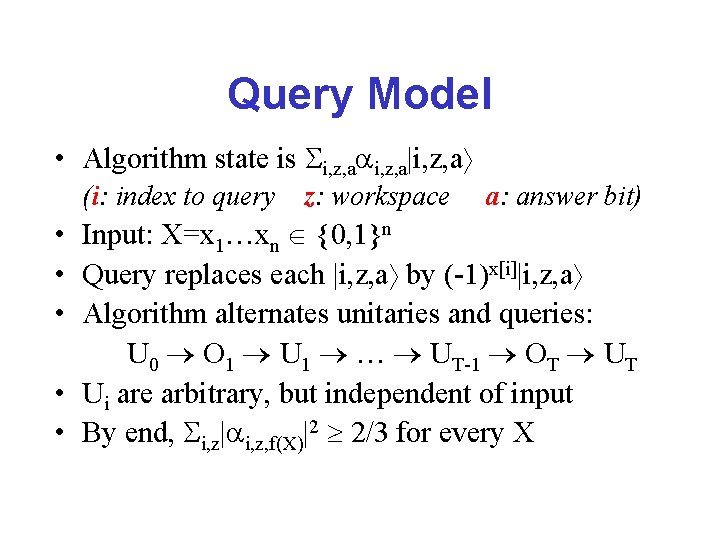
Query Model • Algorithm state is i, z, a|i, z, a (i: index to query z: workspace a: answer bit) • Input: X=x 1…xn {0, 1}n • Query replaces each |i, z, a by (-1)x[i]|i, z, a • Algorithm alternates unitaries and queries: U 0 O 1 U 1 … UT-1 OT UT • Ui are arbitrary, but independent of input • By end, i, z| i, z, f(X)|2 2/3 for every X

Lower Bounds by Polynomials Beals, Buhrman, Cleve, Mosca, de Wolf, FOCS 1998 Key Idea • Let Q 2(f) = minimum no. of queries used by quantum alg that evaluates f: {0, 1}n {0, 1} w. p. 2/3 for all X=x 1…xn {0, 1}n • If quantum algorithm makes T queries, acceptance probability is degree-2 T polynomial over input bits • Implies Q 2(f) ~deg(f)/2, where ~deg(f) = min degree of polynomial p s. t. |p(X)–f(X)| 1/3 for all X • Show ~deg(f) is large for function f of interest
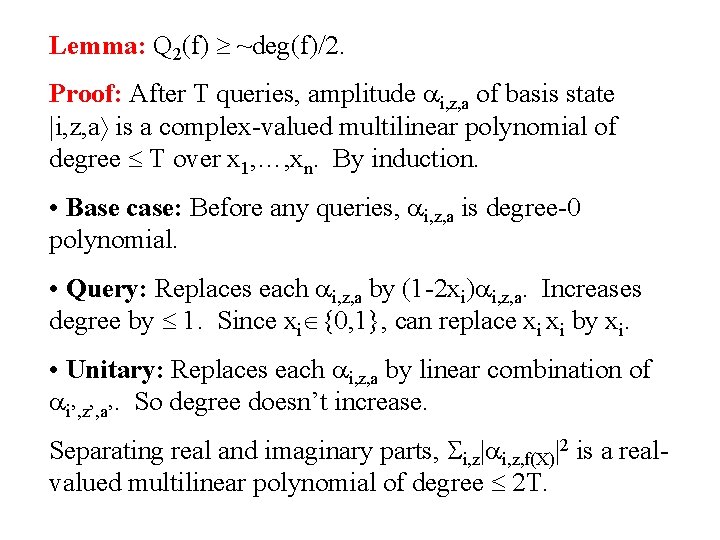
Lemma: Q 2(f) ~deg(f)/2. Proof: After T queries, amplitude i, z, a of basis state |i, z, a is a complex-valued multilinear polynomial of degree T over x 1, …, xn. By induction. • Base case: Before any queries, i, z, a is degree-0 polynomial. • Query: Replaces each i, z, a by (1 -2 xi) i, z, a. Increases degree by 1. Since xi {0, 1}, can replace xi xi by xi. • Unitary: Replaces each i, z, a by linear combination of i’, z’, a’. So degree doesn’t increase. Separating real and imaginary parts, i, z| i, z, f(X)|2 is a realvalued multilinear polynomial of degree 2 T.

Lemma (Minsky, Papert 1968): If p: Rn R is a multilinear polynomial, there’s a polynomial q: R R s. t. (1) deg(q) deg(p), (2) q(|X|) = psym(X) = (1/n!) S(n)p( (X)) (3)(|X|: Hamming weight of X S(n): Symmetric group) (4)Proof: Let d = deg(psym) deg(p). Let Vj = sum of all products of j distinct variables. Since psym is symmetrical, (5) psym(X) = a 0 + a 1 V 1 + … + ad. Vd (6)for some ai R. Vj assumes value (7) choose(|X|, j) = |X|(|X|-1)(|X|-2)…(|X|-j+1)/j! (8)on X, which is a polynomial of degree j of |X|. So construct q(|X|) of degree d accordingly.
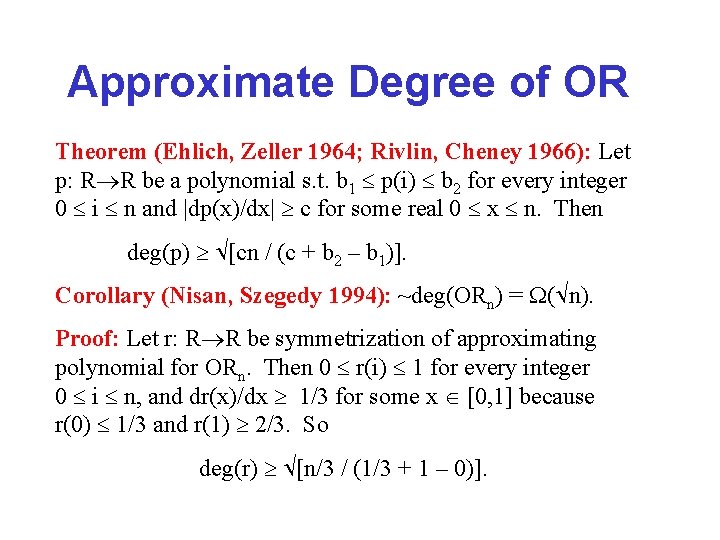
Approximate Degree of OR Theorem (Ehlich, Zeller 1964; Rivlin, Cheney 1966): Let p: R R be a polynomial s. t. b 1 p(i) b 2 for every integer 0 i n and |dp(x)/dx| c for some real 0 x n. Then deg(p) [cn / (c + b 2 – b 1)]. Corollary (Nisan, Szegedy 1994): ~deg(ORn) = ( n). Proof: Let r: R R be symmetrization of approximating polynomial for ORn. Then 0 r(i) 1 for every integer 0 i n, and dr(x)/dx 1/3 for some x [0, 1] because r(0) 1/3 and r(1) 2/3. So deg(r) [n/3 / (1/3 + 1 – 0)].
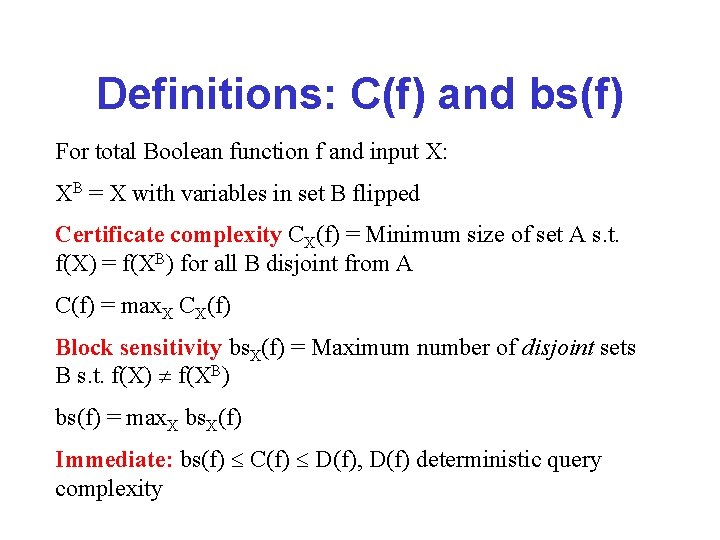
Definitions: C(f) and bs(f) For total Boolean function f and input X: XB = X with variables in set B flipped Certificate complexity CX(f) = Minimum size of set A s. t. f(X) = f(XB) for all B disjoint from A C(f) = max. X CX(f) Block sensitivity bs. X(f) = Maximum number of disjoint sets B s. t. f(X) f(XB) bs(f) = max. X bs. X(f) Immediate: bs(f) C(f) D(f), D(f) deterministic query complexity
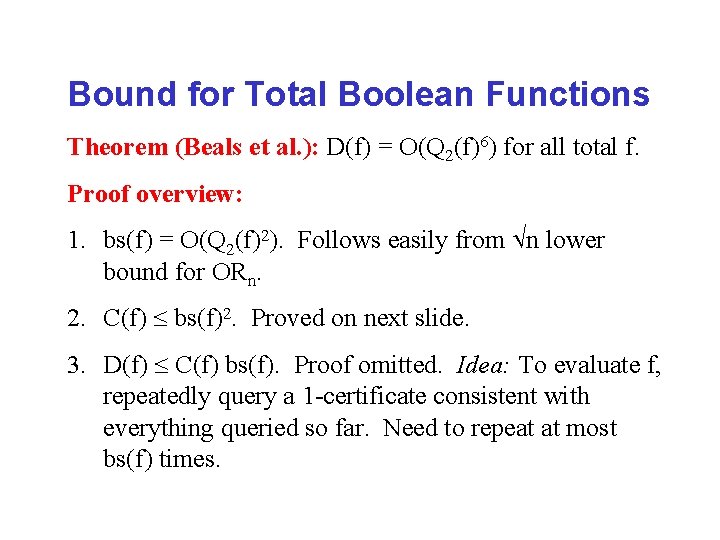
Bound for Total Boolean Functions Theorem (Beals et al. ): D(f) = O(Q 2(f)6) for all total f. Proof overview: 1. bs(f) = O(Q 2(f)2). Follows easily from n lower bound for ORn. 2. C(f) bs(f)2. Proved on next slide. 3. D(f) C(f) bs(f). Proof omitted. Idea: To evaluate f, repeatedly query a 1 -certificate consistent with everything queried so far. Need to repeat at most bs(f) times.
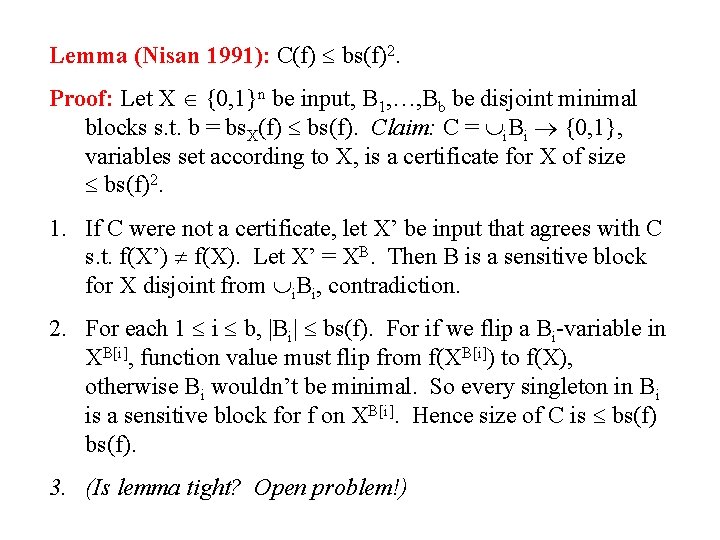
Lemma (Nisan 1991): C(f) bs(f)2. Proof: Let X {0, 1}n be input, B 1, …, Bb be disjoint minimal blocks s. t. b = bs. X(f) bs(f). Claim: C = i. Bi {0, 1}, variables set according to X, is a certificate for X of size bs(f)2. 1. If C were not a certificate, let X’ be input that agrees with C s. t. f(X’) f(X). Let X’ = XB. Then B is a sensitive block for X disjoint from i. Bi, contradiction. 2. For each 1 i b, |Bi| bs(f). For if we flip a Bi-variable in XB[i], function value must flip from f(XB[i]) to f(X), otherwise Bi wouldn’t be minimal. So every singleton in Bi is a sensitive block for f on XB[i]. Hence size of C is bs(f). 3. (Is lemma tight? Open problem!)
Quantum Adversary Method Ambainis, STOC’ 2000, to appear in JCSS • Key Idea – Give algorithm superposition of inputs – Consider (I=inputs, A=algorithm) as bipartite quantum state. – Initially I and A are unentangled. By end of computation, they must be highly entangled. – Upper-bound how much entanglement can increase via a single query. – How? Density matrices.
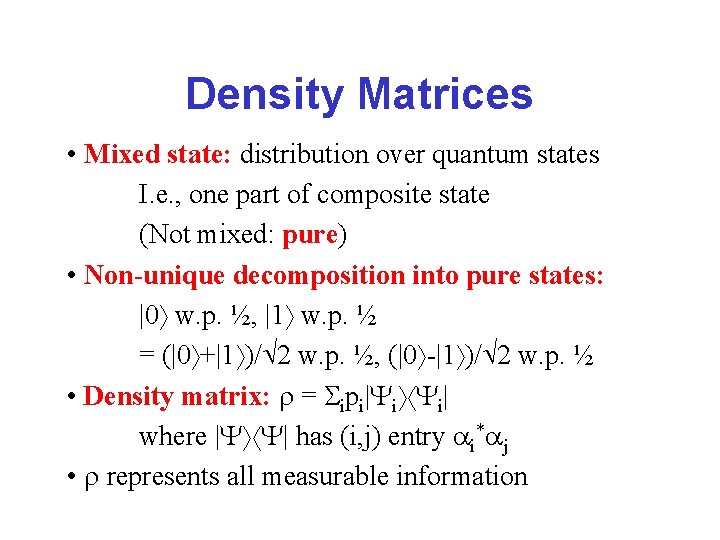
Density Matrices • Mixed state: distribution over quantum states I. e. , one part of composite state (Not mixed: pure) • Non-unique decomposition into pure states: |0 w. p. ½, |1 w. p. ½ = (|0 +|1 )/ 2 w. p. ½, (|0 -|1 )/ 2 w. p. ½ • Density matrix: = ipi| i i| where | | has (i, j) entry i* j • represents all measurable information
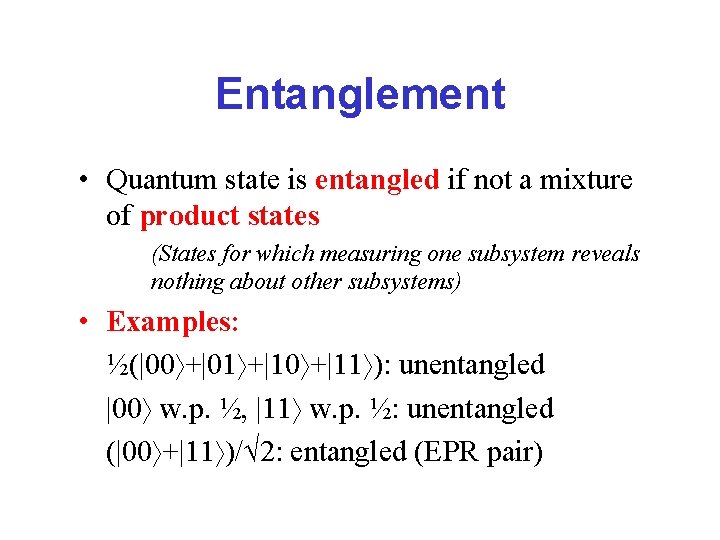
Entanglement • Quantum state is entangled if not a mixture of product states (States for which measuring one subsystem reveals nothing about other subsystems) • Examples: ½(|00 +|01 +|10 +|11 ): unentangled |00 w. p. ½, |11 w. p. ½: unentangled (|00 +|11 )/ 2: entangled (EPR pair)
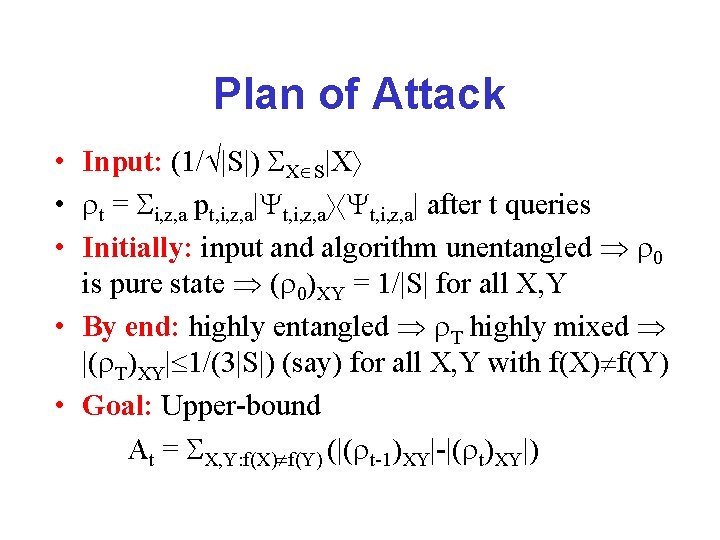
Plan of Attack • Input: (1/ |S|) X S|X • t = i, z, a pt, i, z, a| t, i, z, a| after t queries • Initially: input and algorithm unentangled 0 is pure state ( 0)XY = 1/|S| for all X, Y • By end: highly entangled T highly mixed |( T)XY| 1/(3|S|) (say) for all X, Y with f(X) f(Y) • Goal: Upper-bound At = X, Y: f(X) f(Y) (|( t-1)XY|-|( t)XY|)
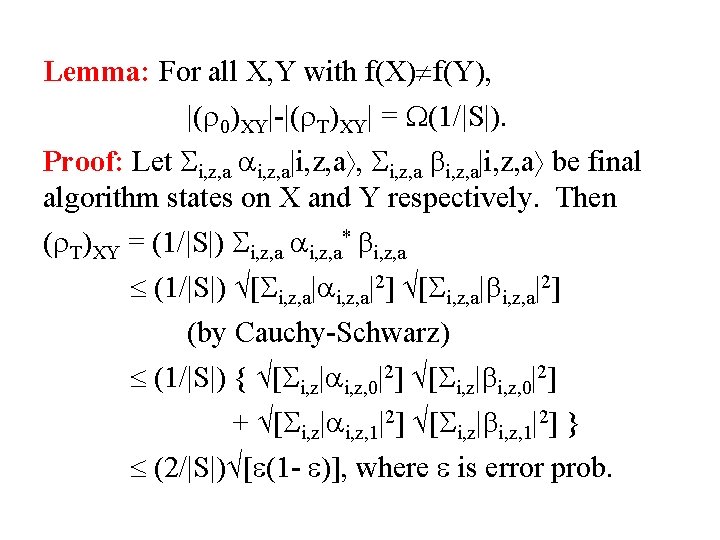
Lemma: For all X, Y with f(X) f(Y), |( 0)XY|-|( T)XY| = (1/|S|). Proof: Let i, z, a|i, z, a , i, z, a|i, z, a be final algorithm states on X and Y respectively. Then ( T)XY = (1/|S|) i, z, a* i, z, a (1/|S|) [ i, z, a|2] (by Cauchy-Schwarz) (1/|S|) { [ i, z| i, z, 0|2] + [ i, z| i, z, 1|2] } (2/|S|) [ (1 - )], where is error prob.
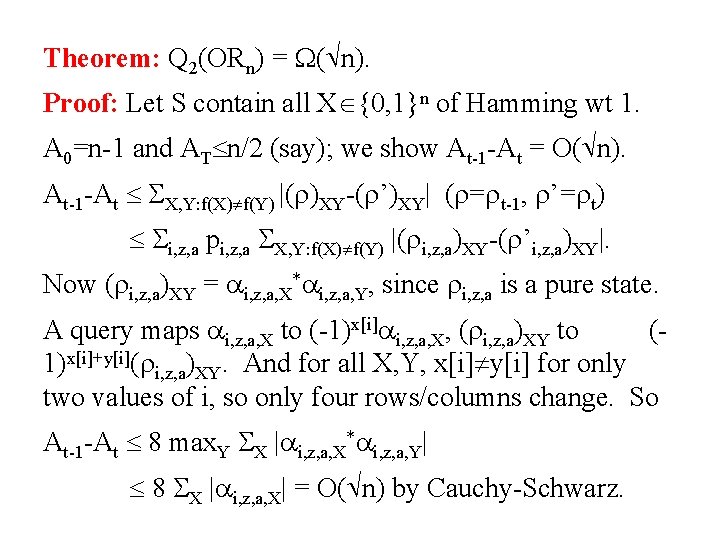
Theorem: Q 2(ORn) = ( n). Proof: Let S contain all X {0, 1}n of Hamming wt 1. A 0=n-1 and AT n/2 (say); we show At-1 -At = O( n). At-1 -At X, Y: f(X) f(Y) |( )XY-( ’)XY| ( = t-1, ’= t) i, z, a pi, z, a X, Y: f(X) f(Y) |( i, z, a)XY-( ’i, z, a)XY|. Now ( i, z, a)XY = i, z, a, X* i, z, a, Y, since i, z, a is a pure state. A query maps i, z, a, X to (-1)x[i] i, z, a, X, ( i, z, a)XY to (1)x[i]+y[i]( i, z, a)XY. And for all X, Y, x[i] y[i] for only two values of i, so only four rows/columns change. So At-1 -At 8 max. Y X | i, z, a, X* i, z, a, Y| 8 X | i, z, a, X| = O( n) by Cauchy-Schwarz.
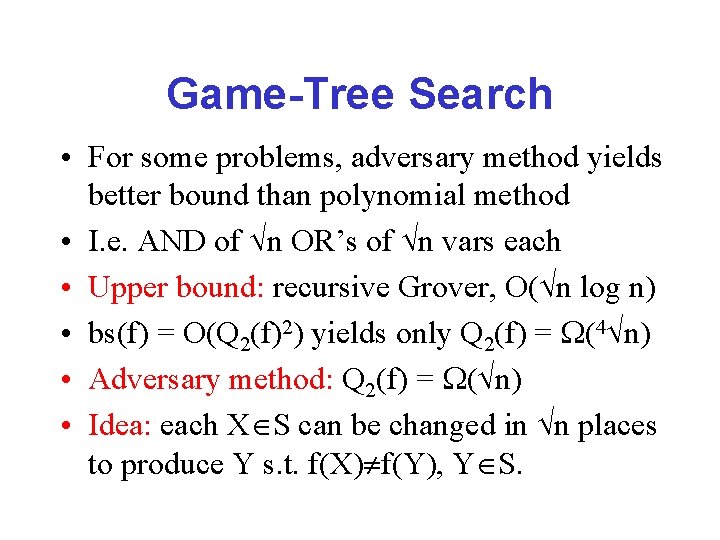
Game-Tree Search • For some problems, adversary method yields better bound than polynomial method • I. e. AND of n OR’s of n vars each • Upper bound: recursive Grover, O( n log n) • bs(f) = O(Q 2(f)2) yields only Q 2(f) = (4 n) • Adversary method: Q 2(f) = ( n) • Idea: each X S can be changed in n places to produce Y s. t. f(X) f(Y), Y S.
- Slides: 20