
Quantum Key Distribution Portion of Rieffel Polak Chapter
Quantum Key Distribution Portion of Rieffel & Polak Chapter 2 Dr. Charles Tappert The information presented here, although greatly condensed, comes almost entirely from the textbook
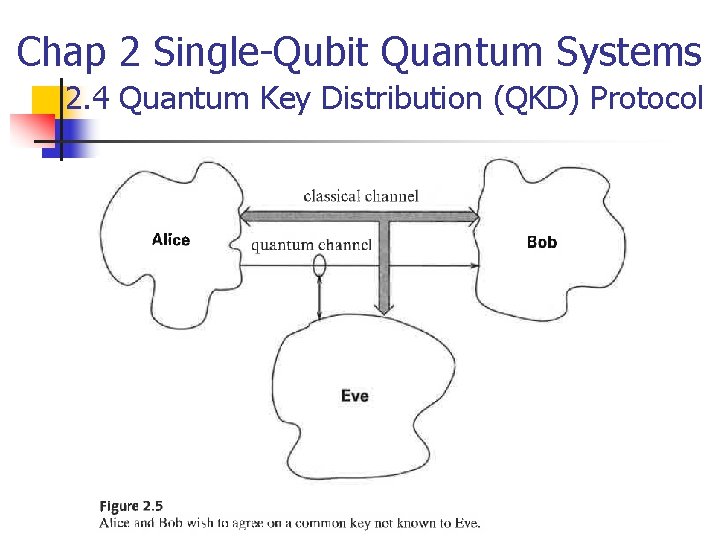
Chap 2 Single-Qubit Quantum Systems 2. 4 Quantum Key Distribution (QKD) Protocol n QKD enables the one-time pad encryption technique that cannot be cracked n n Counters Shor’s encryption cracking algorithm Limited by distance range – Zurich banks Quantum key distribution protocol establishes a symmetric key between 2 parties, Alice & Bob connected by two public channels n n n Bidirectional classical channel Unidirectional quantum channel for sending qubits Channels observed by eavesdropper Eve
Chap 2 Single-Qubit Quantum Systems 2. 4 Quantum Key Distribution (QKD) Protocol

Chap 2 Single-Qubit Quantum Systems 2. 4 Quantum Key Distribution (QKD) Protocol n Alice generates a random sequence of bits n n Random subset of sequence will be the private key Alice randomly encodes each bit of the sequence in the polarization state of a photon n Randomly choosing for each bit one of the bases
Chap 2 Single-Qubit Quantum Systems 2. 4 Quantum Key Distribution (QKD) Protocol n n n Alice sends the sequence of photons to Bob measures the state of each photon he receives by randomly picking either basis Over the classical channel, Alice and Bob tell each other the bases they used for each bit When choice of bases agree, Bob’s measured bit values agree with bit values Alice sent Without revealing bit values, they discard all bits on which their bases differed (about 50%)
Chap 2 Single-Qubit Quantum Systems 2. 4 Quantum Key Distribution (QKD) Protocol n n About 50% of bits transmitted remain Then Alice and Bob compare a certain number of bit values to check if eavesdropping occurred The checked bits are also discarded The remaining bits will now be used as the private key
- Slides: 6