
Quantum Griffiths Phases of Correlated Electrons Vladimir Dobrosavljevic
Quantum Griffiths Phases of Correlated Electrons Vladimir Dobrosavljevic Department of Physics and National High Magnetic Field Laboratory Florida State University, USA Collaborators: Eric Adrade (Campinas) Matthew Case (FSU) Eduardo Miranda (Campinas) Funding: NSF grants: DMR-9974311 DMR-0234215 DMR-0542026 REVIEW: Reports on Progress in Physics 68, 2337– 2408 (2005)
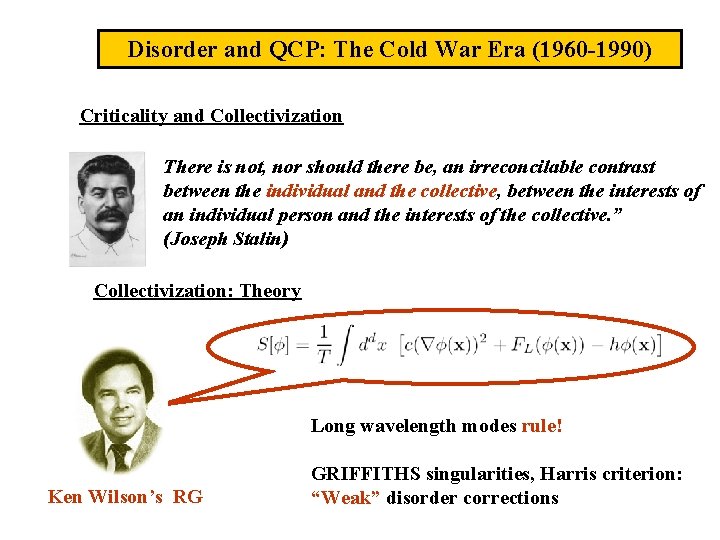
Disorder and QCP: The Cold War Era (1960 -1990) Criticality and Collectivization There is not, nor should there be, an irreconcilable contrast between the individual and the collective, between the interests of an individual person and the interests of the collective. ” (Joseph Stalin) Collectivization: Theory Long wavelength modes rule! Ken Wilson’s RG GRIFFITHS singularities, Harris criterion: “Weak” disorder corrections
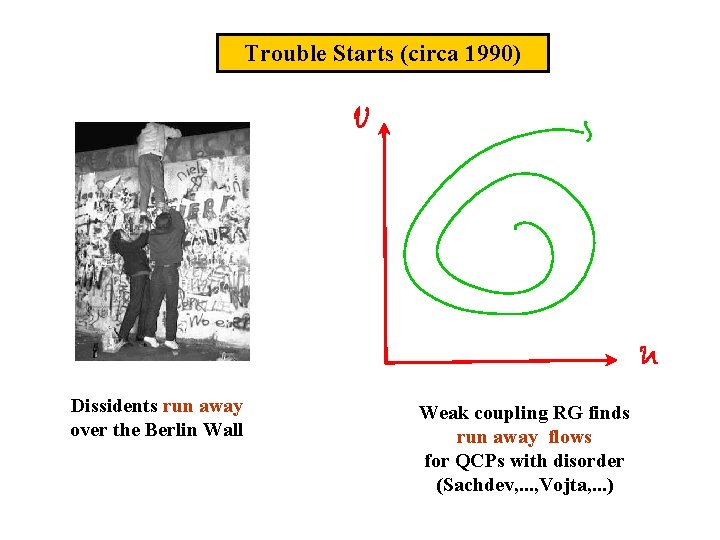
Trouble Starts (circa 1990) Dissidents run away over the Berlin Wall Weak coupling RG finds run away flows for QCPs with disorder (Sachdev, . . . , Vojta, . . . )
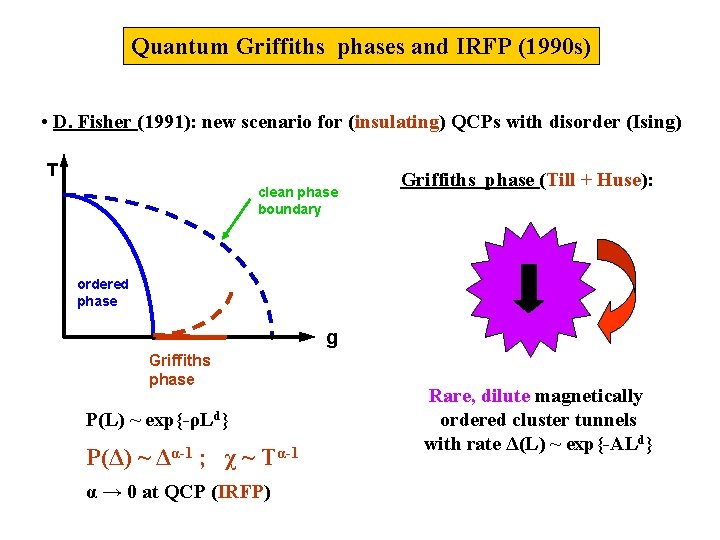
Quantum Griffiths phases and IRFP (1990 s) • D. Fisher (1991): new scenario for (insulating) QCPs with disorder (Ising) T clean phase boundary Griffiths phase (Till + Huse): ordered phase g Griffiths phase P(L) ~ exp{-ρLd} P(Δ) ~ Δα-1 ; χ ~ Tα-1 α → 0 at QCP (IRFP) Rare, dilute magnetically ordered cluster tunnels with rate Δ(L) ~ exp{-ALd}
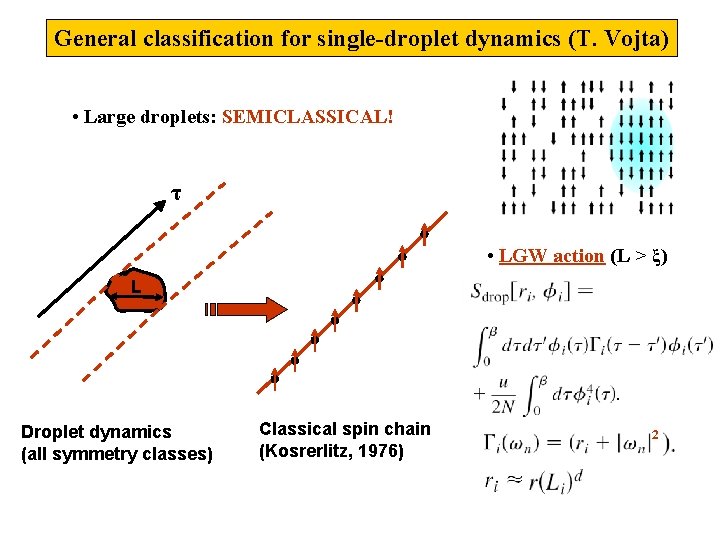
General classification for single-droplet dynamics (T. Vojta) • Large droplets: SEMICLASSICAL! τ • LGW action (L > ξ) L Droplet dynamics (all symmetry classes) Classical spin chain (Kosrerlitz, 1976) 2
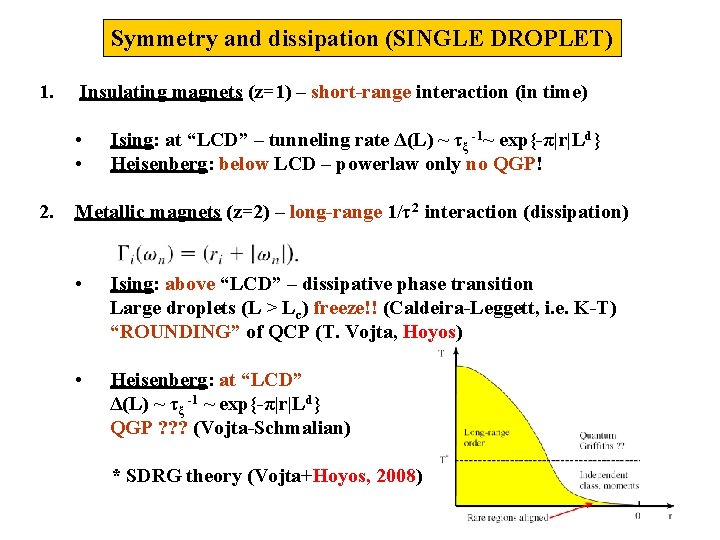
Symmetry and dissipation (SINGLE DROPLET) 1. Insulating magnets (z=1) – short-range interaction (in time) • • 2. Ising: at “LCD” – tunneling rate Δ(L) ~ τξ -1~ exp{-π|r|Ld} Heisenberg: below LCD – powerlaw only no QGP! Metallic magnets (z=2) – long-range 1/τ2 interaction (dissipation) • Ising: above “LCD” – dissipative phase transition Large droplets (L > Lc) freeze!! (Caldeira-Leggett, i. e. K-T) “ROUNDING” of QCP (T. Vojta, Hoyos) • Heisenberg: at “LCD” Δ(L) ~ τξ -1 ~ exp{-π|r|Ld} QGP ? ? ? (Vojta-Schmalian) * SDRG theory (Vojta+Hoyos, 2008)
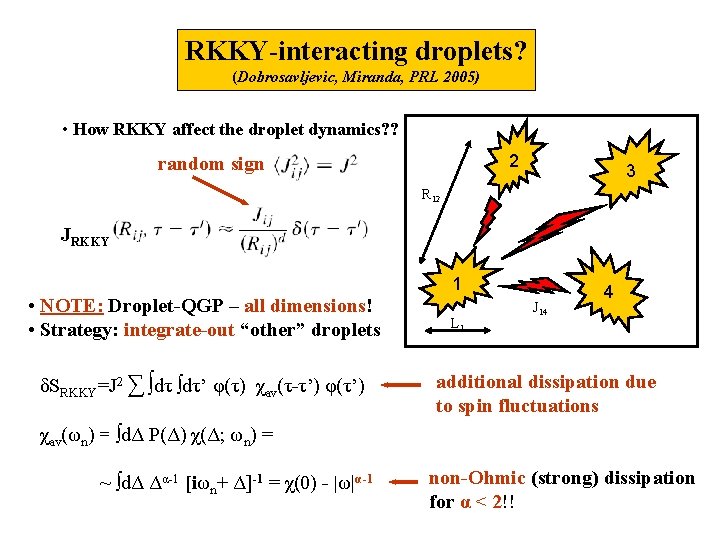
RKKY-interacting droplets? (Dobrosavljevic, Miranda, PRL 2005) • How RKKY affect the droplet dynamics? ? 2 random sign 3 R 12 JRKKY 1 • NOTE: Droplet-QGP – all dimensions! • Strategy: integrate-out “other” droplets δSRKKY=J 2 ∑ ∫dτ’ φ(τ) χav(τ-τ’) φ(τ’) L 1 J 14 4 additional dissipation due to spin fluctuations χav(ωn) = ∫dΔ P(Δ) χ(Δ; ωn) = ~ ∫dΔ Δα-1 [iωn+ Δ]-1 = χ(0) - |ω|α-1 non-Ohmic (strong) dissipation for α < 2!!
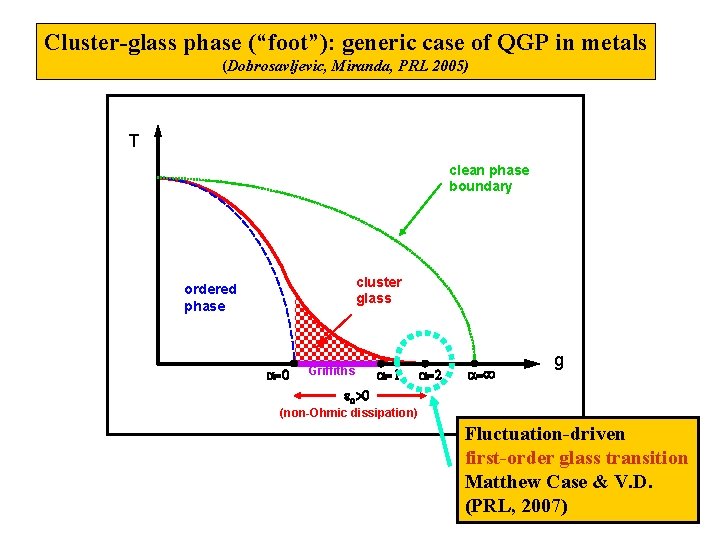
Cluster-glass phase (“foot”): generic case of QGP in metals (Dobrosavljevic, Miranda, PRL 2005) T clean phase boundary cluster glass ordered phase =0 Griffiths =1 =2 = g eo>0 (non-Ohmic dissipation) Fluctuation-driven first-order glass transition Matthew Case & V. D. (PRL, 2007)
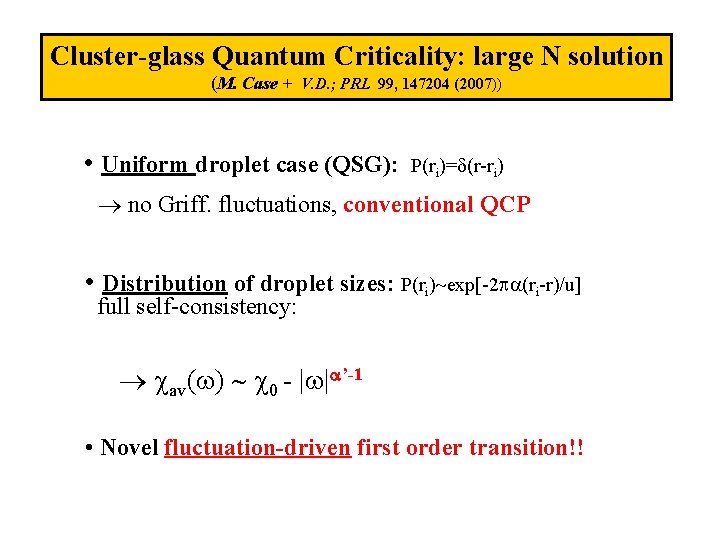
Cluster-glass Quantum Criticality: large N solution (M. Case + V. D. ; PRL 99, 147204 (2007)) • Uniform droplet case (QSG): P(ri)= (r-ri) no Griff. fluctuations, conventional QCP • Distribution of droplet sizes: P(ri) exp[-2 (ri-r)/u] full self-consistency: av( ) 0 - | | ’-1 • Novel fluctuation-driven first order transition!!
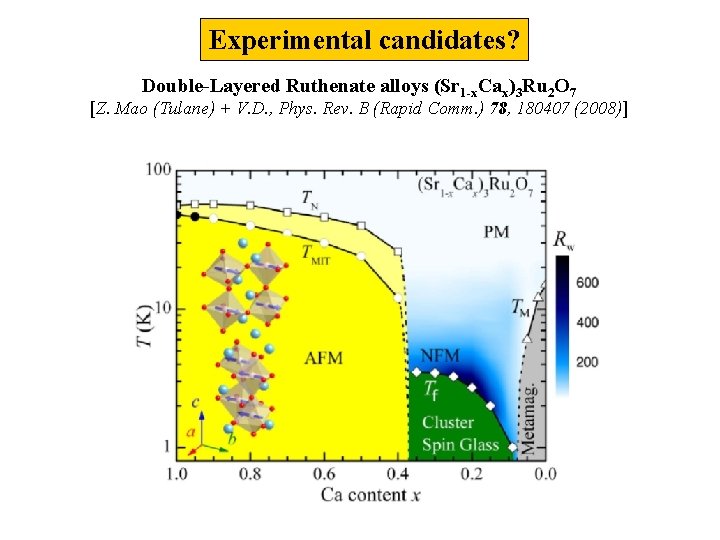
Experimental candidates? Double-Layered Ruthenate alloys (Sr 1 -x. Cax)3 Ru 2 O 7 [Z. Mao (Tulane) + V. D. , Phys. Rev. B (Rapid Comm. ) 78, 180407 (2008)]
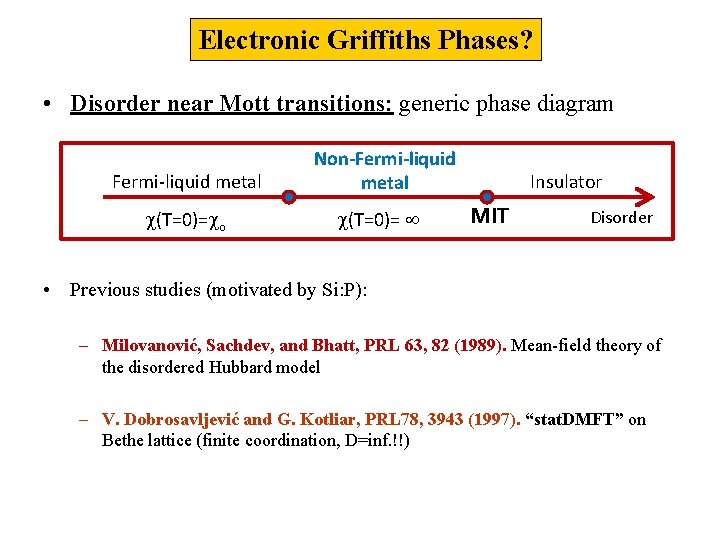
Electronic Griffiths Phases? • Disorder near Mott transitions: generic phase diagram Fermi-liquid metal (T=0)= o Non-Fermi-liquid metal (T=0)= ¥ Insulator MIT Disorder • Previous studies (motivated by Si: P): – Milovanović, Sachdev, and Bhatt, PRL 63, 82 (1989). Mean-field theory of the disordered Hubbard model – V. Dobrosavljević and G. Kotliar, PRL 78, 3943 (1997). “stat. DMFT” on Bethe lattice (finite coordination, D=inf. !!)
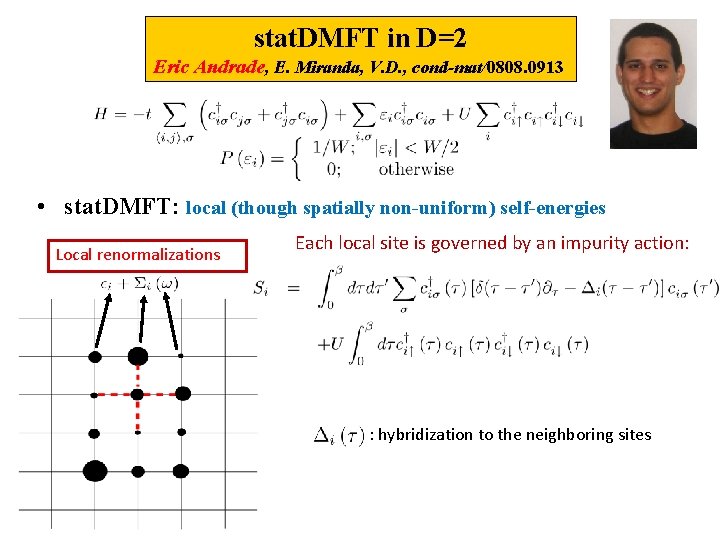
stat. DMFT in D=2 Eric Andrade, E. Miranda, V. D. , cond-mat/0808. 0913 • stat. DMFT: local (though spatially non-uniform) self-energies Local renormalizations Each local site is governed by an impurity action: : hybridization to the neighboring sites
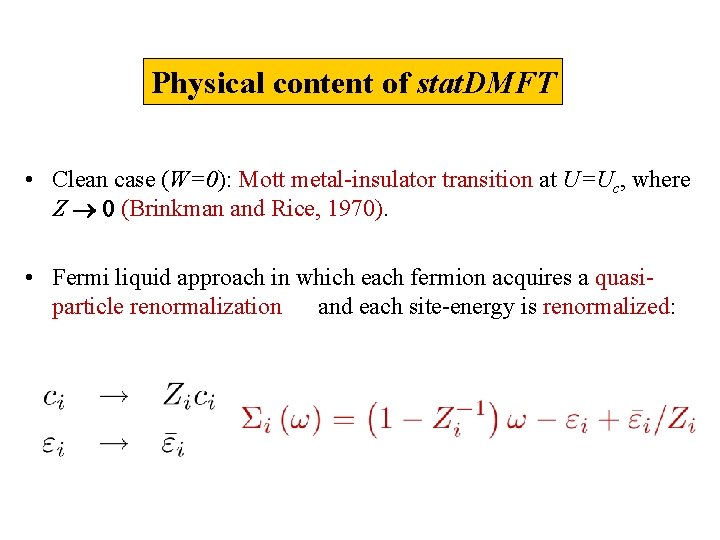
Physical content of stat. DMFT • Clean case (W=0): Mott metal-insulator transition at U=Uc, where Z ® 0 (Brinkman and Rice, 1970). • Fermi liquid approach in which each fermion acquires a quasiparticle renormalization and each site-energy is renormalized:
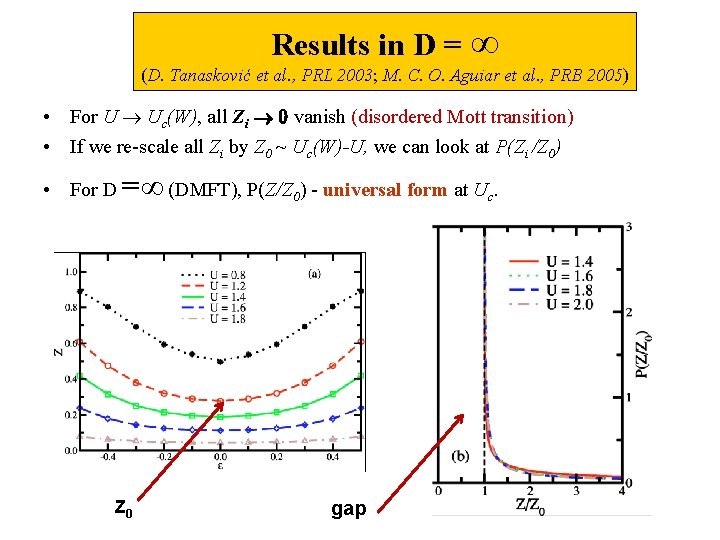
Results in D = ∞ (D. Tanasković et al. , PRL 2003; M. C. O. Aguiar et al. , PRB 2005) • For U Uc(W), all Zi ® 0 vanish (disordered Mott transition) • If we re-scale all Zi by Z 0 ~ Uc(W)-U, we can look at P(Zi /Z 0) • For D =∞ (DMFT), P(Z/Z 0) - universal form at Uc. Z 0 gap
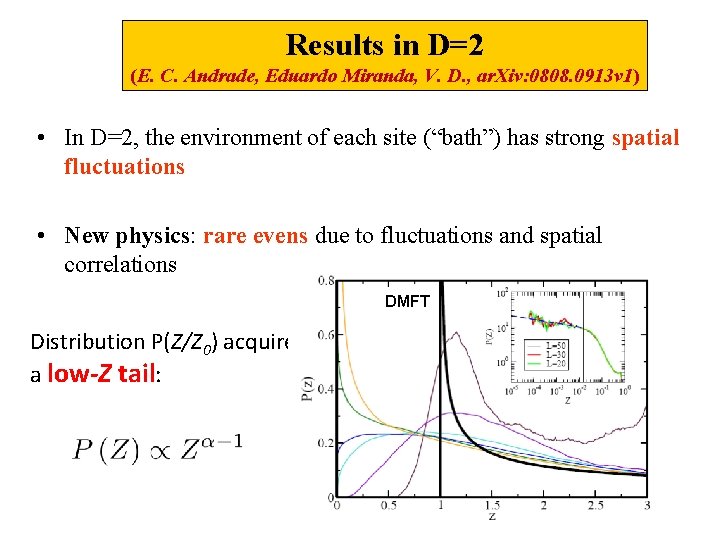
Results in D=2 (E. C. Andrade, Eduardo Miranda, V. D. , ar. Xiv: 0808. 0913 v 1) • In D=2, the environment of each site (“bath”) has strong spatial fluctuations • New physics: rare evens due to fluctuations and spatial correlations DMFT Distribution P(Z/Z 0) acquires a low-Z tail:
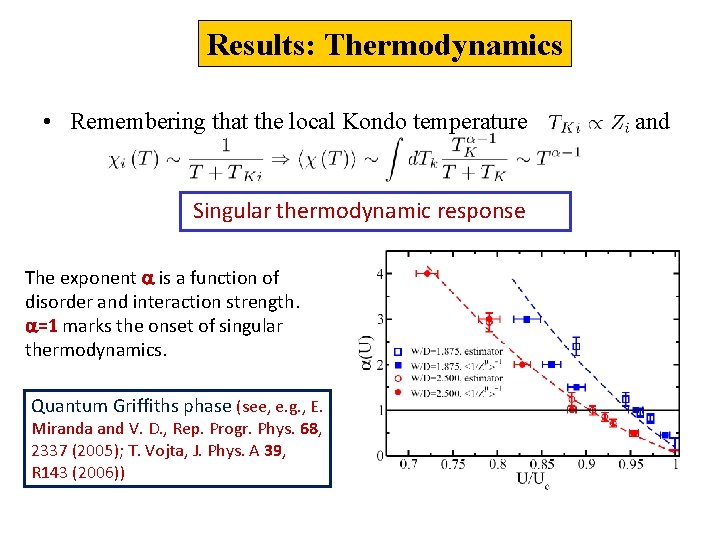
Results: Thermodynamics • Remembering that the local Kondo temperature and Singular thermodynamic response The exponent is a function of disorder and interaction strength. =1 marks the onset of singular thermodynamics. Quantum Griffiths phase (see, e. g. , E. Miranda and V. D. , Rep. Progr. Phys. 68, 2337 (2005); T. Vojta, J. Phys. A 39, R 143 (2006))
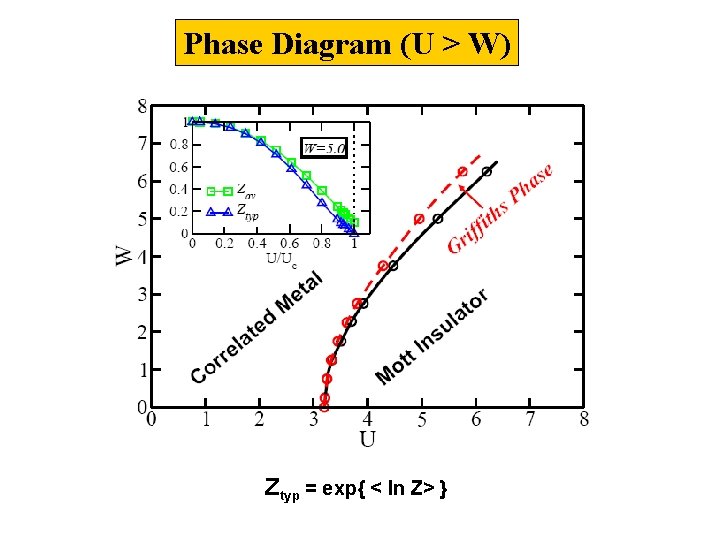
Phase Diagram (U > W) Ztyp = exp{ < ln Z> }
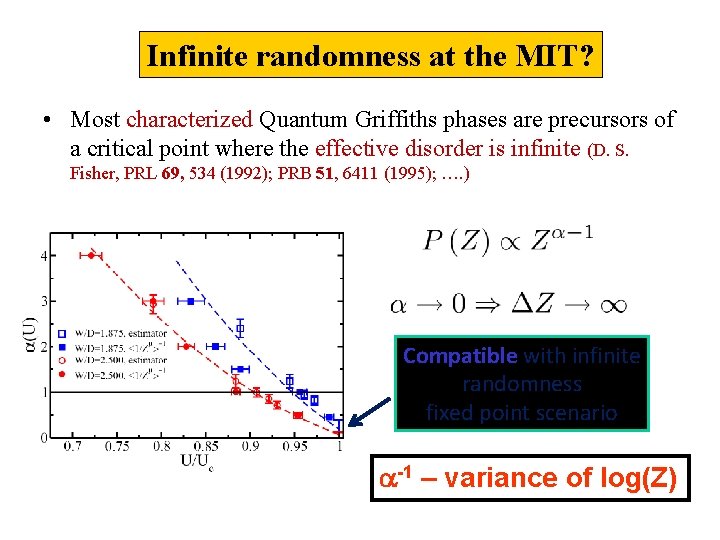
Infinite randomness at the MIT? • Most characterized Quantum Griffiths phases are precursors of a critical point where the effective disorder is infinite (D. S. Fisher, PRL 69, 534 (1992); PRB 51, 6411 (1995); …. ) Compatible with infinite randomness fixed point scenario -1 – variance of log(Z)
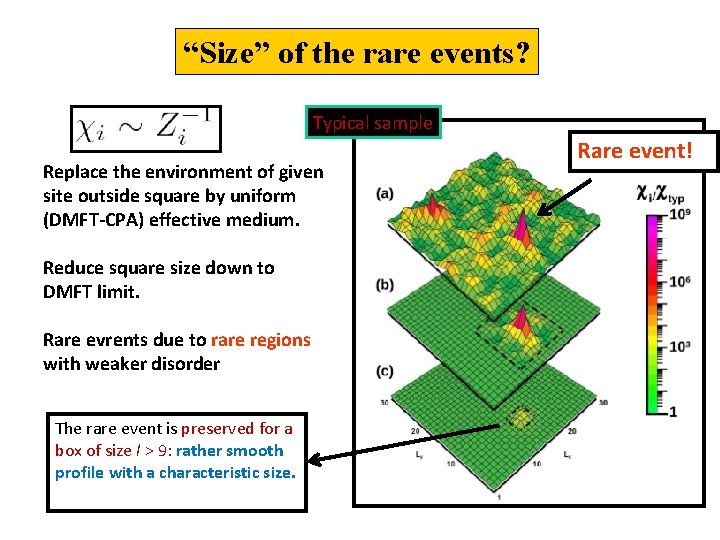
“Size” of the rare events? Typical sample Replace the environment of given site outside square by uniform (DMFT-CPA) effective medium. Rare event! Reduce square size down to DMFT limit. Rare evrents due to rare regions with weaker disorder The rare event is preserved for a box of size l > 9: rather smooth profile with a characteristic size. U=0. 96 Uc; W=2. 5 D
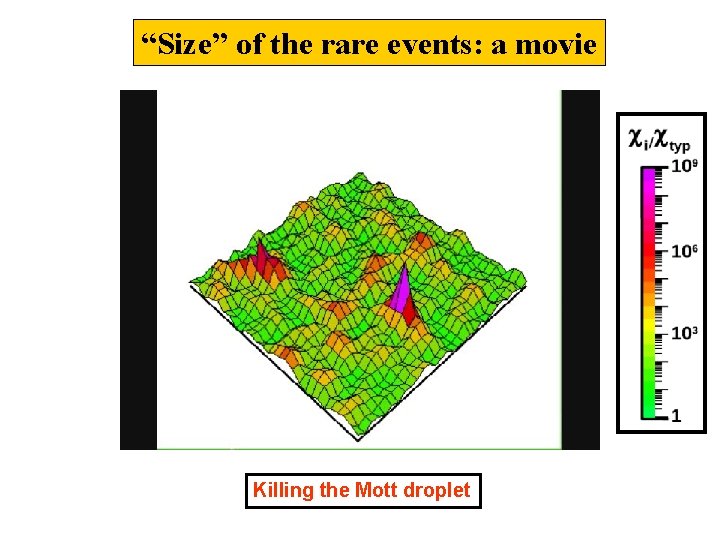
“Size” of the rare events: a movie Killing the Mott droplet
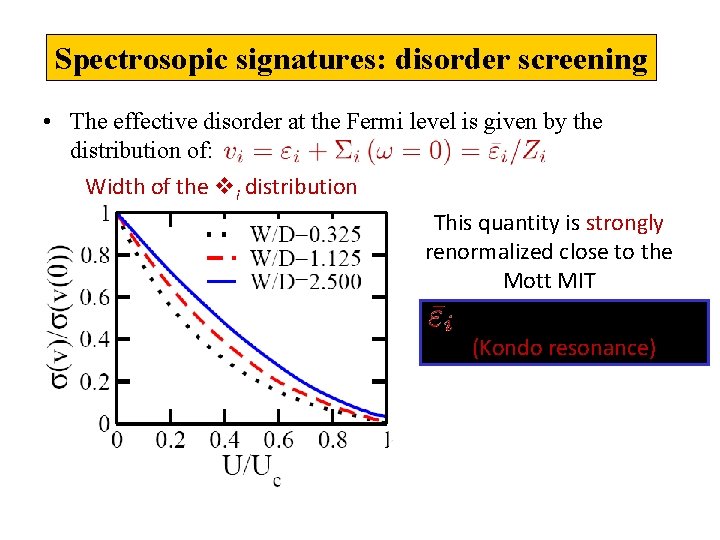
Spectrosopic signatures: disorder screening • The effective disorder at the Fermi level is given by the distribution of: Width of the vi distribution This quantity is strongly renormalized close to the Mott MIT is pinned to Fermi level (Kondo resonance)
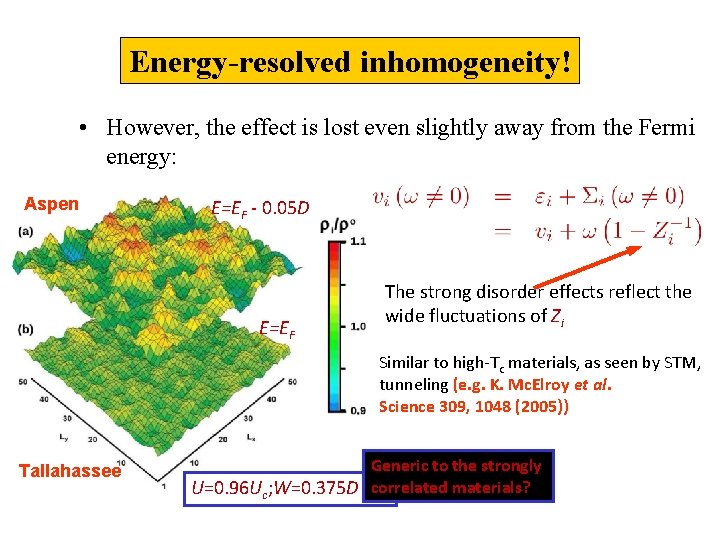
Energy-resolved inhomogeneity! • However, the effect is lost even slightly away from the Fermi energy: Aspen E=EF - 0. 05 D E=EF The strong disorder effects reflect the wide fluctuations of Zi Similar to high-Tc materials, as seen by STM, tunneling (e. g. K. Mc. Elroy et al. Science 309, 1048 (2005)) Tallahassee Generic to the strongly U=0. 96 Uc; W=0. 375 D correlated materials?
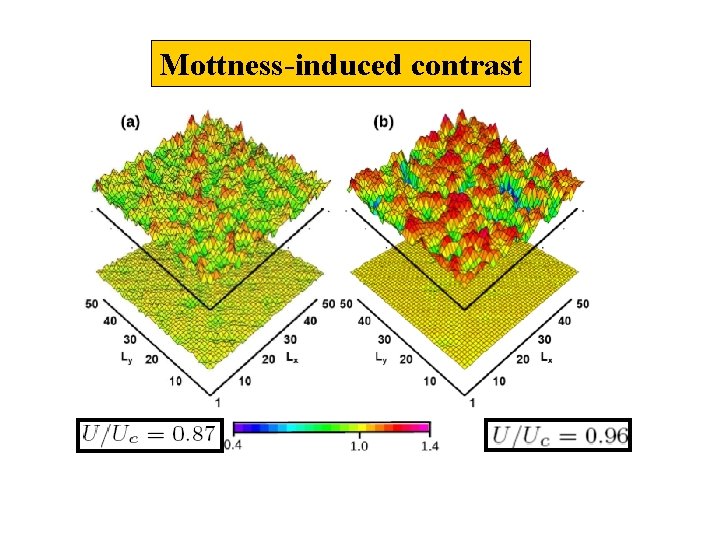
Mottness-induced contrast
Conclusions and. . . • An electronic Griffiths phase emerges as a precursor to the disordered Mott MIT (non-Fermi liquid metal) • Strong-correlation-induced healing of disorder at low energies, but very inhomogeneous away • Infinite randomness fixed point: new type of critical behavior for disordered MIT? ? ? • (Weak) localization vs. interactions: is there a true 2 D metal in D=2? ? ?
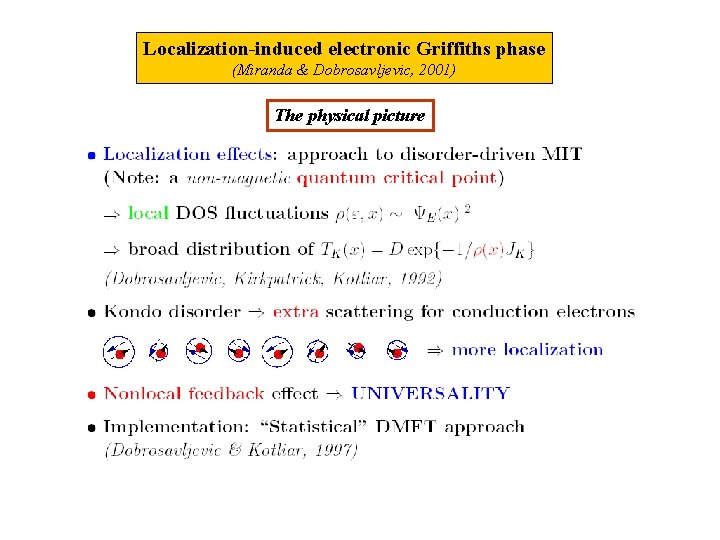
Localization-induced electronic Griffiths phase (Miranda & Dobrosavljevic, 2001) The physical picture
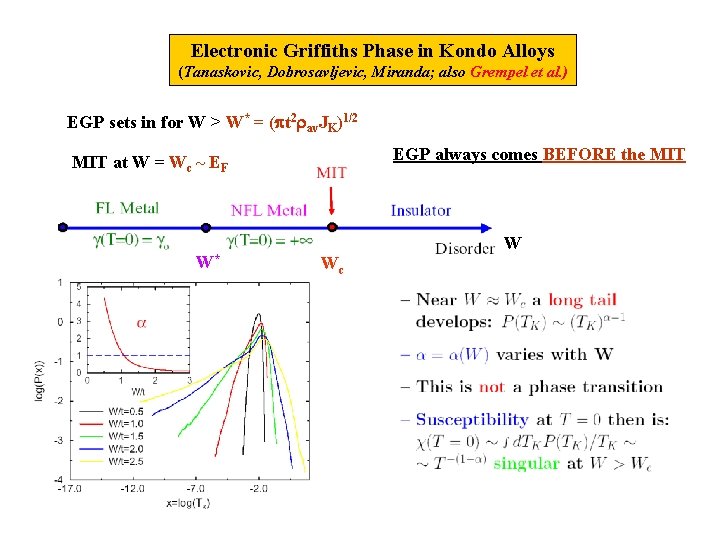
Electronic Griffiths Phase in Kondo Alloys (Tanaskovic, Dobrosavljevic, Miranda; also Grempel et al. ) EGP sets in for W > W* = (pt 2 rav. JK)1/2 EGP always comes BEFORE the MIT at W = Wc ~ EF W* W Wc
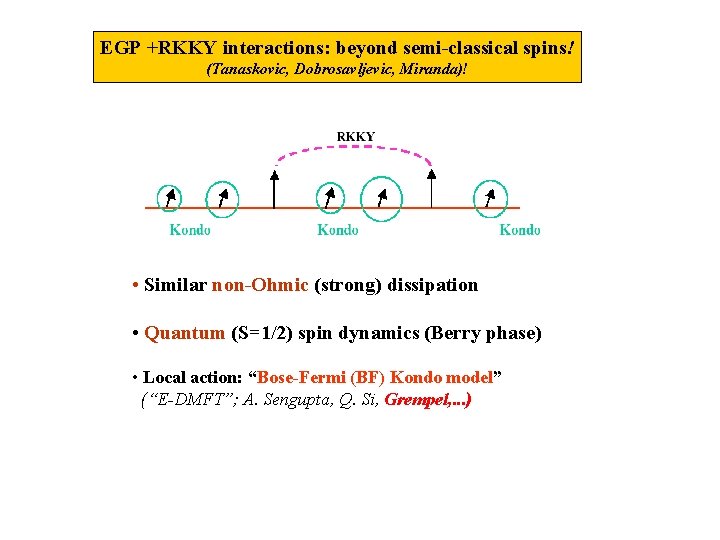
EGP +RKKY interactions: beyond semi-classical spins! (Tanaskovic, Dobrosavljevic, Miranda)! • Similar non-Ohmic (strong) dissipation • Quantum (S=1/2) spin dynamics (Berry phase) • Local action: “Bose-Fermi (BF) Kondo model” (“E-DMFT”; A. Sengupta, Q. Si, Grempel, . . . )
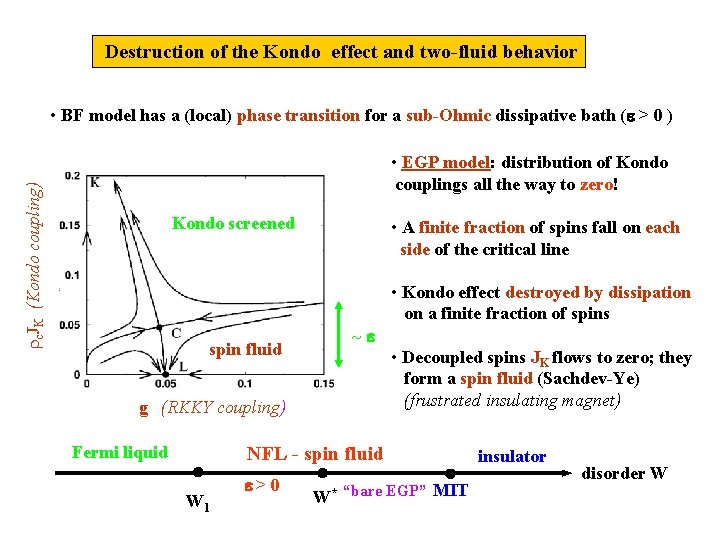
Destruction of the Kondo effect and two-fluid behavior • BF model has a (local) phase transition for a sub-Ohmic dissipative bath (e > 0 ) rc. JK (Kondo coupling) • EGP model: distribution of Kondo couplings all the way to zero! Kondo screened • A finite fraction of spins fall on each side of the critical line • Kondo effect destroyed by dissipation on a finite fraction of spins spin fluid ~ e • Decoupled spins JK flows to zero; they form a spin fluid (Sachdev-Ye) (frustrated insulating magnet) g (RKKY coupling) NFL - spin fluid Fermi liquid W 1 e > 0 W* “bare EGP” MIT insulator disorder W
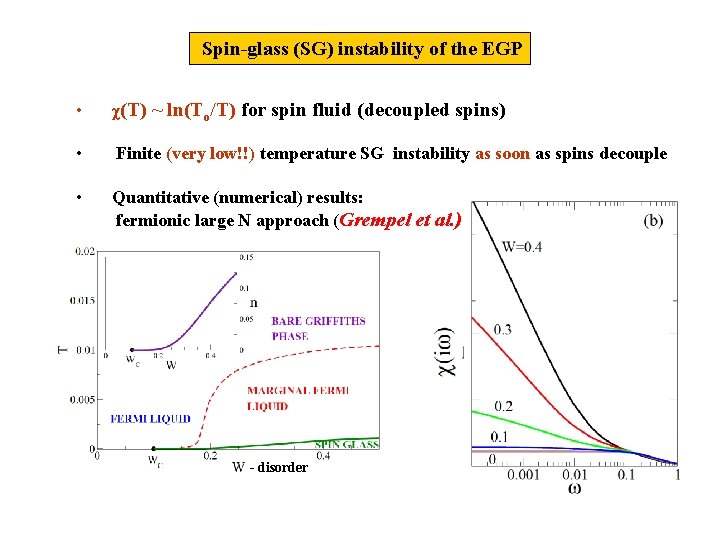
Spin-glass (SG) instability of the EGP • χ(T) ~ ln(To/T) for spin fluid (decoupled spins) • Finite (very low!!) temperature SG instability as soon as spins decouple • Quantitative (numerical) results: fermionic large N approach (Grempel et al. ) - disorder
Conclusions: • In metals dissipation destroys QGP at lowest T → (quantum) glassy ordering • Magnetic (QCP) QGP: → semi-classical dynamics at T > TG • Fluctuation–driven first-order QCP of the “cluster glass” • Spin liquid in EGP at T > TG
- Slides: 30