
Quantum Electrodynamics Dirac Equation spin 12 Feynmann Diagrams
- Slides: 13
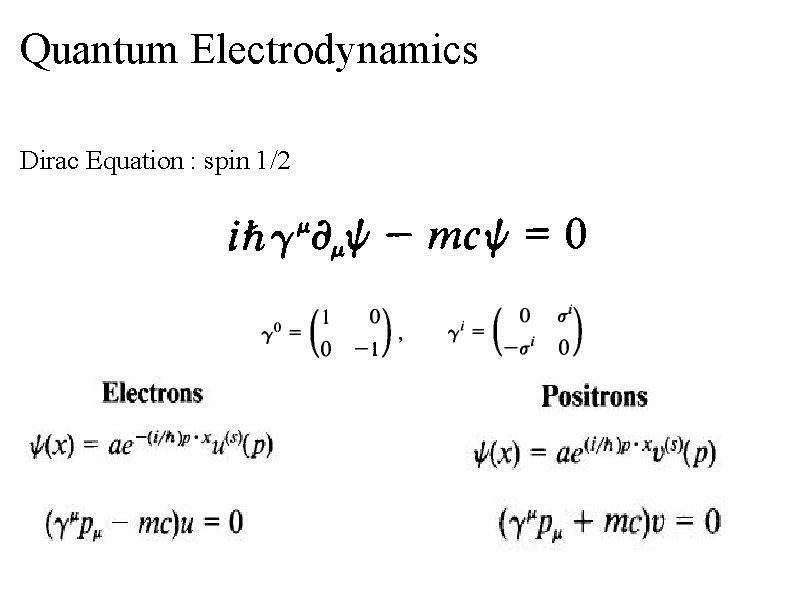
Quantum Electrodynamics Dirac Equation : spin 1/2
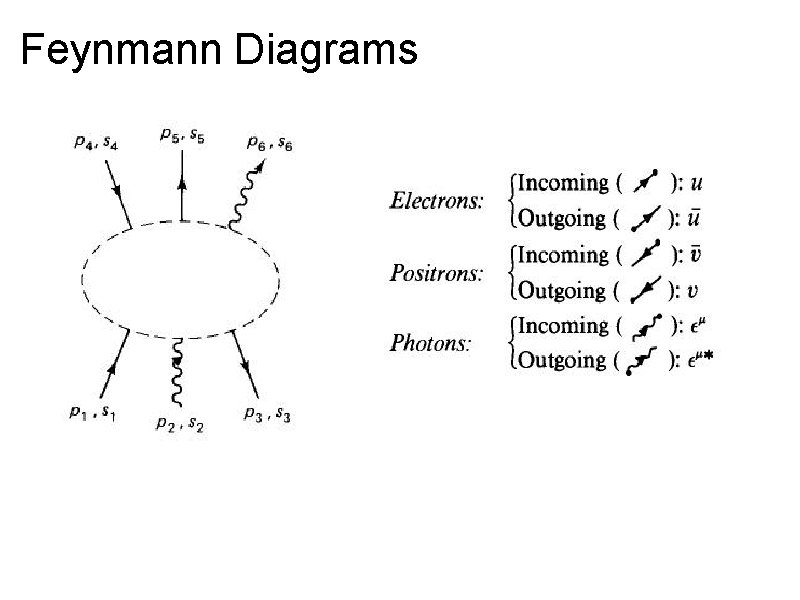
Feynmann Diagrams
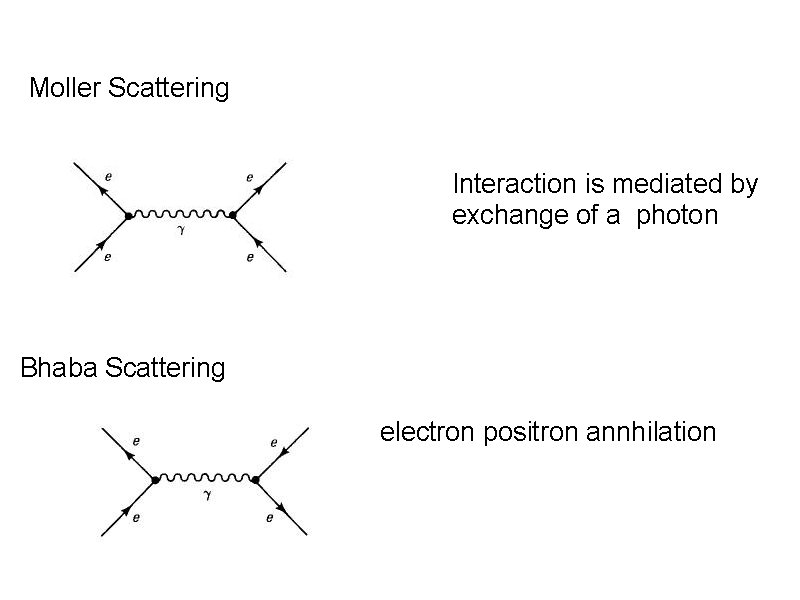
Moller Scattering Interaction is mediated by exchange of a photon Bhaba Scattering electron positron annhilation
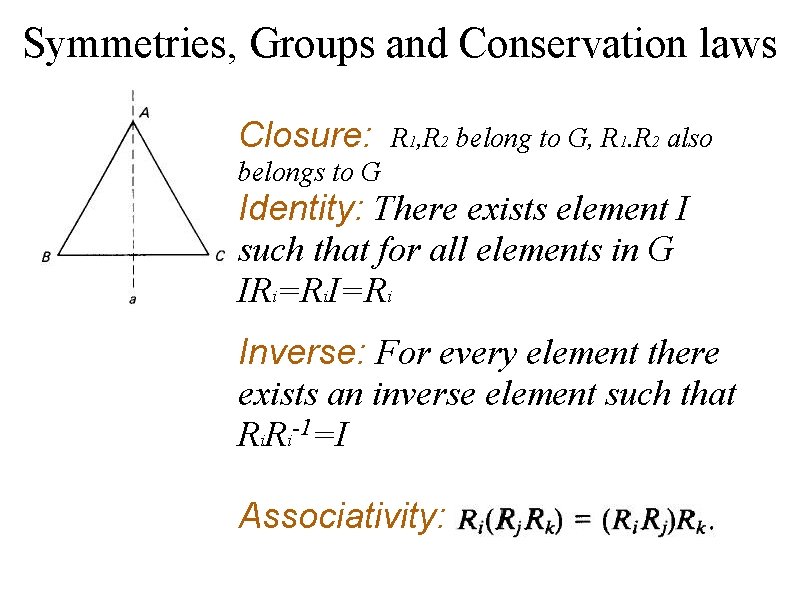
Symmetries, Groups and Conservation laws Closure: R 1, R 2 belong to G, R 1. R 2 also belongs to G Identity: There exists element I such that for all elements in G IRi=Ri. I=Ri Inverse: For every element there exists an inverse element such that Ri. Ri-1=I Associativity:
Symmetries and Conservation Laws Noether's theorem: Every continuous symmetry implies a corresponding conservation law and conversely, every conservation law reveals a symmetry in the system. Rotation ---- Angular momentum Time translation ----- Energy
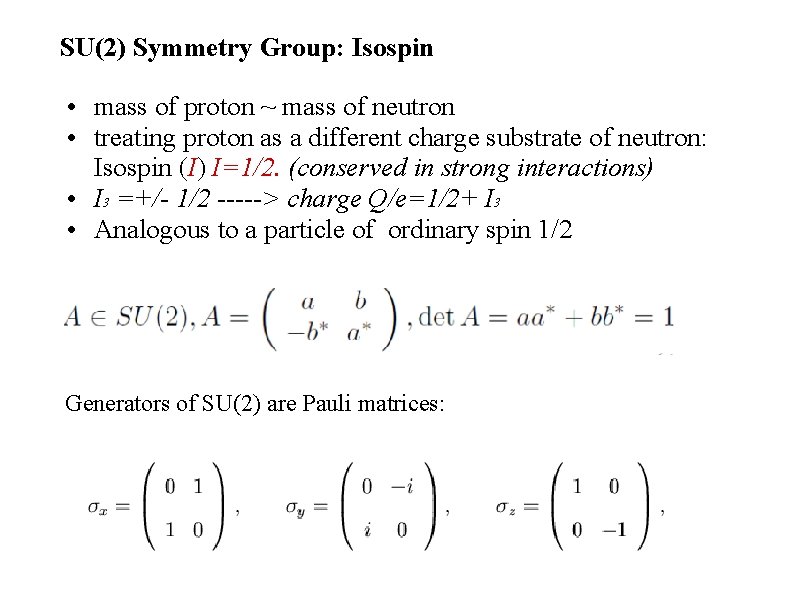
SU(2) Symmetry Group: Isospin • mass of proton ~ mass of neutron • treating proton as a different charge substrate of neutron: Isospin (I) I=1/2. (conserved in strong interactions) • I 3 =+/- 1/2 -----> charge Q/e=1/2+ I 3 • Analogous to a particle of ordinary spin 1/2 Generators of SU(2) are Pauli matrices:
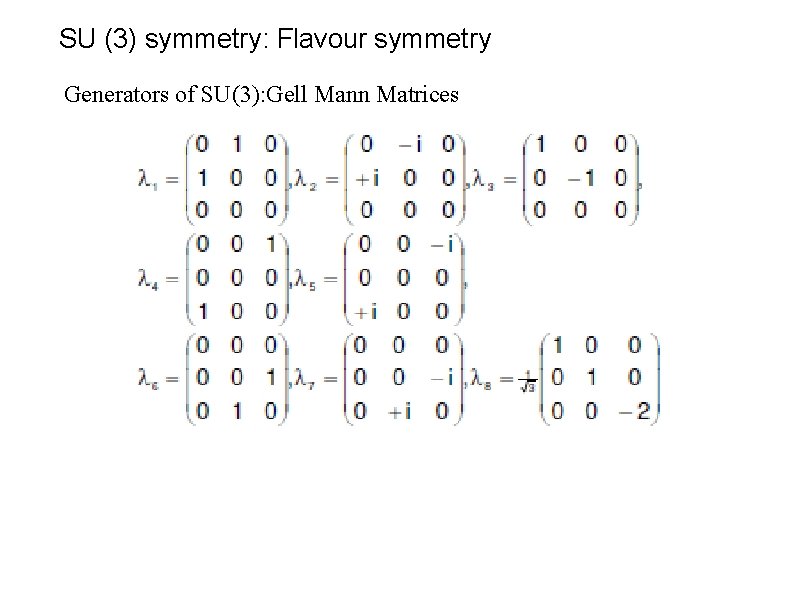
SU (3) symmetry: Flavour symmetry Generators of SU(3): Gell Mann Matrices
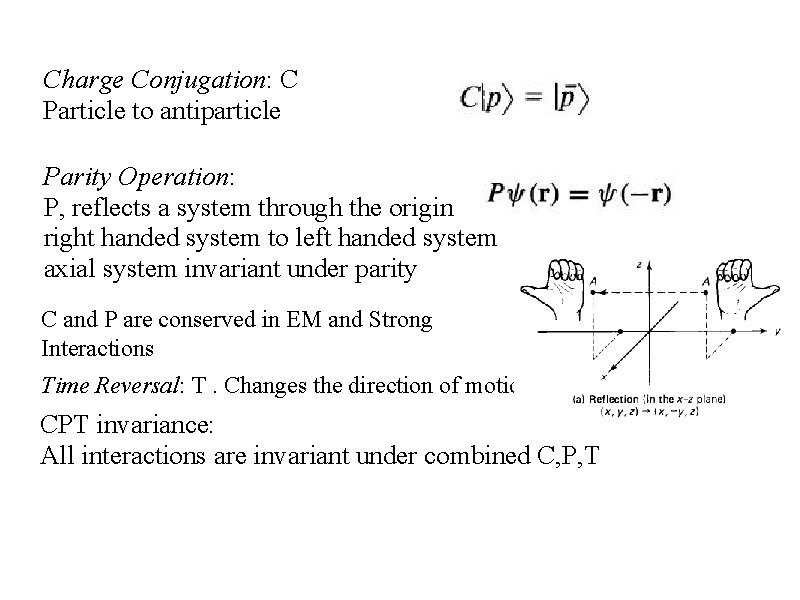
Charge Conjugation: C Particle to antiparticle Parity Operation: P, reflects a system through the origin right handed system to left handed system axial system invariant under parity C and P are conserved in EM and Strong Interactions Time Reversal: T. Changes the direction of motion CPT invariance: All interactions are invariant under combined C, P, T
Weak Interactions • • All quarks, leptons carry "weak charge" Short range interaction Interact via exchange of W+, W- and Z bosons (massive) two kinds of weak interactions: charged (W bosons) and neutral (Z boson) • Examples : decay processes
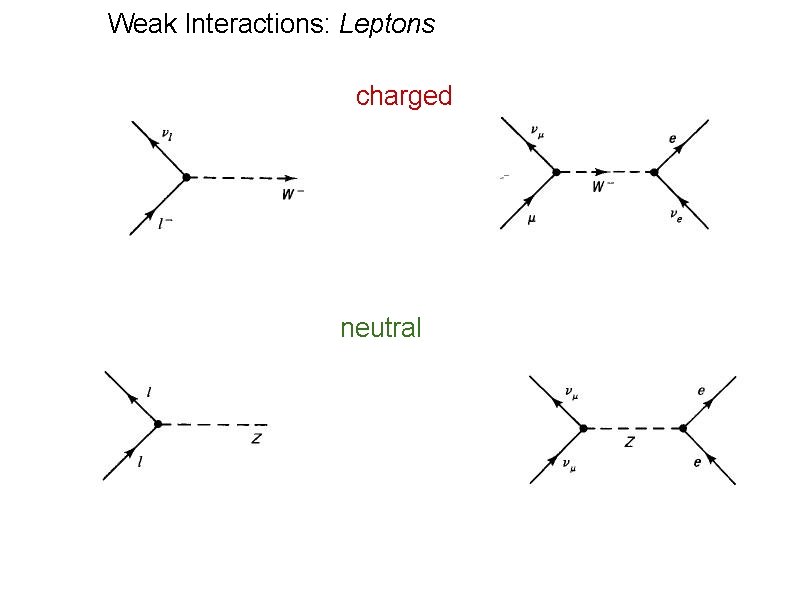
Weak Interactions: Leptons charged neutral
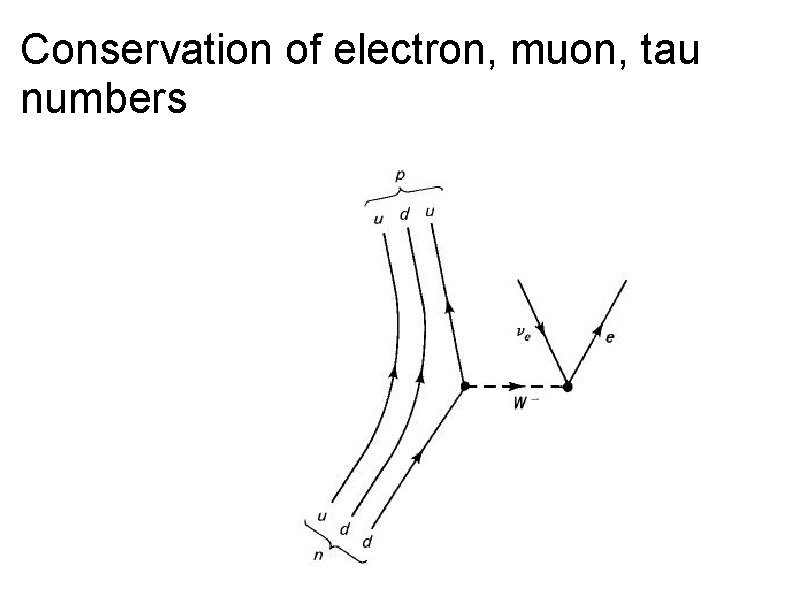
Conservation of electron, muon, tau numbers
Conservation laws in WI • Conservation of charge • Conservation of Colour • Conservation of Baryon number • Electron, muon, tau number
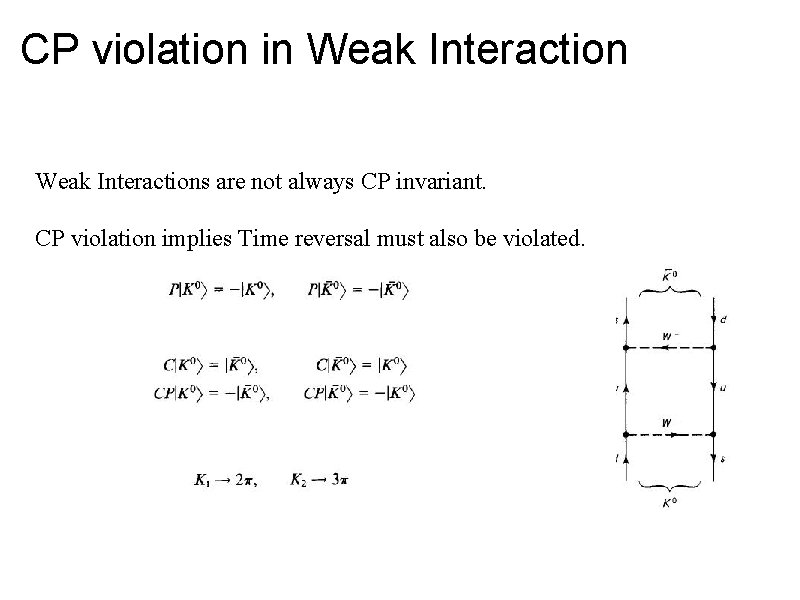
CP violation in Weak Interactions are not always CP invariant. CP violation implies Time reversal must also be violated.