
Quantum Dots www nano 4 me org 2018

- Slides: 41
Quantum Dots www. nano 4 me. org © 2018 The Pennsylvania State University Quantum Dots 1
Outline • Introduction • Quantum Confinement • QD Synthesis – Colloidal Methods – Epitaxial Growth • Applications – Biological – Light Emitters – Additional Applications www. nano 4 me. org © 2018 The Pennsylvania State University Quantum Dots 2
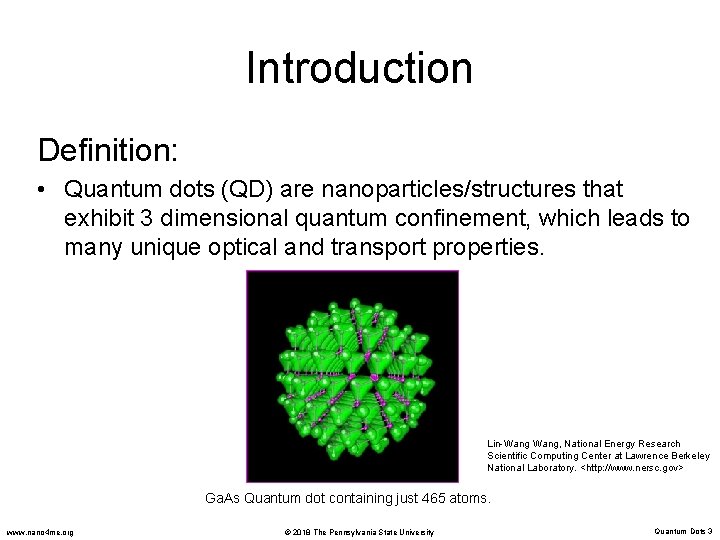
Introduction Definition: • Quantum dots (QD) are nanoparticles/structures that exhibit 3 dimensional quantum confinement, which leads to many unique optical and transport properties. Lin-Wang, National Energy Research Scientific Computing Center at Lawrence Berkeley National Laboratory. <http: //www. nersc. gov> Ga. As Quantum dot containing just 465 atoms. www. nano 4 me. org © 2018 The Pennsylvania State University Quantum Dots 3
Introduction • Quantum dots are usually regarded as semiconductors by definition. • Similar behavior is observed in some metals. Therefore, in some cases it may be acceptable to speak about metal quantum dots. • Typically, quantum dots are composed of groups II-VI, III-V, and IV-VI materials. • QDs are bandgap tunable by size which means their optical and electrical properties can be engineered to meet specific applications. www. nano 4 me. org © 2018 The Pennsylvania State University Quantum Dots 4
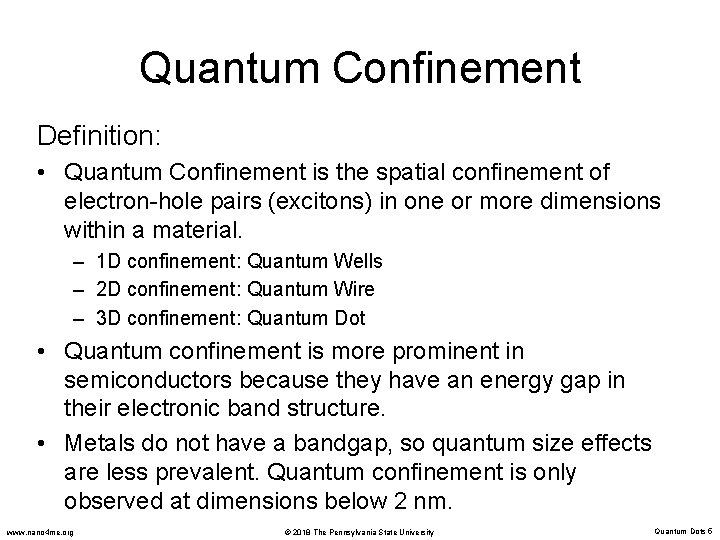
Quantum Confinement Definition: • Quantum Confinement is the spatial confinement of electron-hole pairs (excitons) in one or more dimensions within a material. – 1 D confinement: Quantum Wells – 2 D confinement: Quantum Wire – 3 D confinement: Quantum Dot • Quantum confinement is more prominent in semiconductors because they have an energy gap in their electronic band structure. • Metals do not have a bandgap, so quantum size effects are less prevalent. Quantum confinement is only observed at dimensions below 2 nm. www. nano 4 me. org © 2018 The Pennsylvania State University Quantum Dots 5
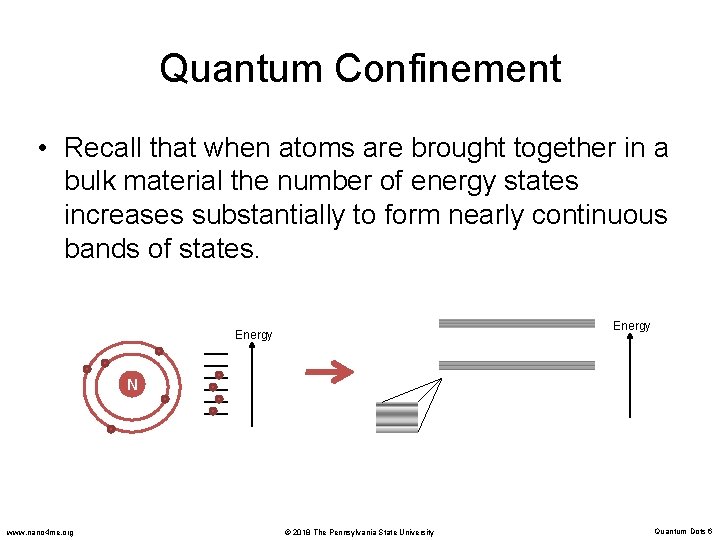
Quantum Confinement • Recall that when atoms are brought together in a bulk material the number of energy states increases substantially to form nearly continuous bands of states. Energy N www. nano 4 me. org © 2018 The Pennsylvania State University Quantum Dots 6
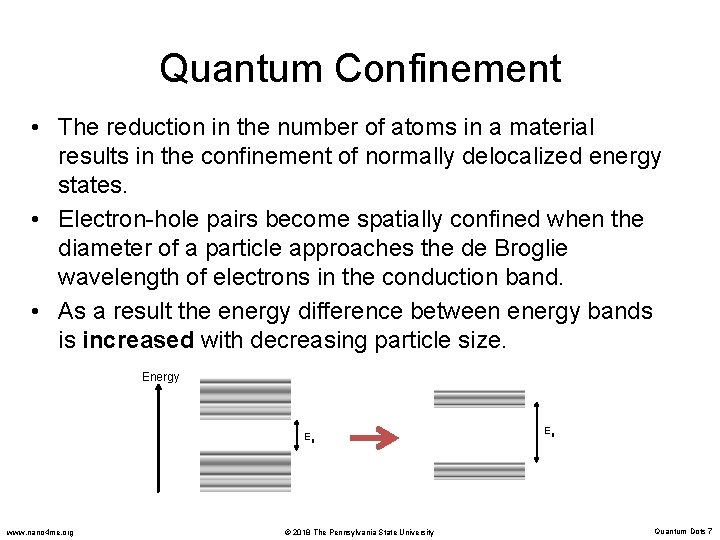
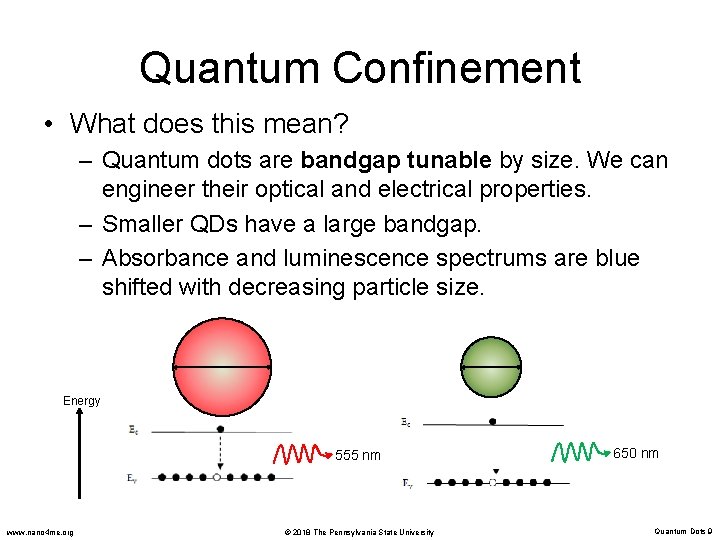
Quantum Confinement • The reduction in the number of atoms in a material results in the confinement of normally delocalized energy states. • Electron-hole pairs become spatially confined when the diameter of a particle approaches the de Broglie wavelength of electrons in the conduction band. • As a result the energy difference between energy bands is increased with decreasing particle size. Energy Eg www. nano 4 me. org © 2018 The Pennsylvania State University Eg Quantum Dots 7
Quantum Confinement • This is very similar to the famous particle-in-a-box scenario and can be understood by examining the Heisenberg Uncertainty Principle. • The Uncertainty Principle states that the more precisely one knows the position of a particle, the more uncertainty in its momentum (and vice versa). • Therefore, the more spatially confined and localized a particle becomes, the broader the range of its momentum/energy. • This is manifested as an increase in the average energy of electrons in the conduction band = increased energy level spacing = larger bandgap • The bandgap of a spherical quantum dot is increased from its bulk value by a factor of 1/R 2, where R is the particle radius. * * Based upon single particle solutions of the schrodinger wave equation valid for R< the exciton bohr radius. www. nano 4 me. org © 2018 The Pennsylvania State University Quantum Dots 8
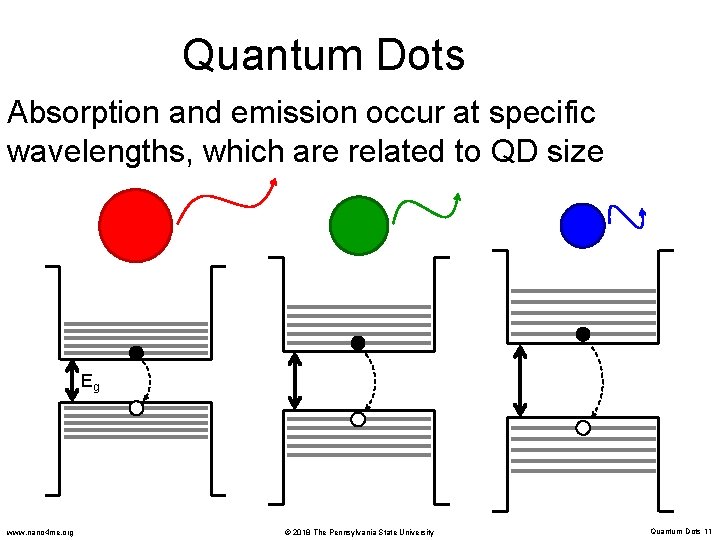
Quantum Confinement • What does this mean? – Quantum dots are bandgap tunable by size. We can engineer their optical and electrical properties. – Smaller QDs have a large bandgap. – Absorbance and luminescence spectrums are blue shifted with decreasing particle size. Energy 555 nm www. nano 4 me. org © 2018 The Pennsylvania State University 650 nm Quantum Dots 9
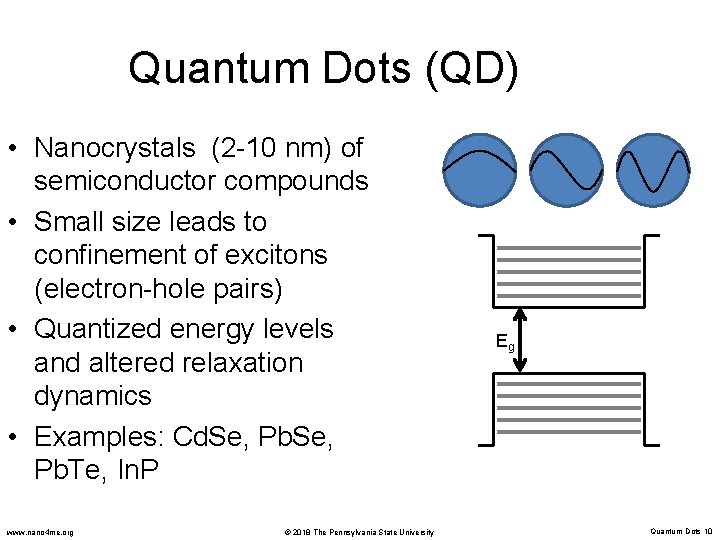
Quantum Dots (QD) • Nanocrystals (2 -10 nm) of semiconductor compounds • Small size leads to confinement of excitons (electron-hole pairs) • Quantized energy levels and altered relaxation dynamics • Examples: Cd. Se, Pb. Te, In. P www. nano 4 me. org © 2018 The Pennsylvania State University Eg Quantum Dots 10
Quantum Dots Absorption and emission occur at specific wavelengths, which are related to QD size Eg www. nano 4 me. org © 2018 The Pennsylvania State University Quantum Dots 11
Outline • Introduction • Quantum Confinement • QD Synthesis – Colloidal Methods – Epitaxial Growth • Applications – Biological – Light Emitters – Additional Applications www. nano 4 me. org © 2018 The Pennsylvania State University Quantum Dots 12
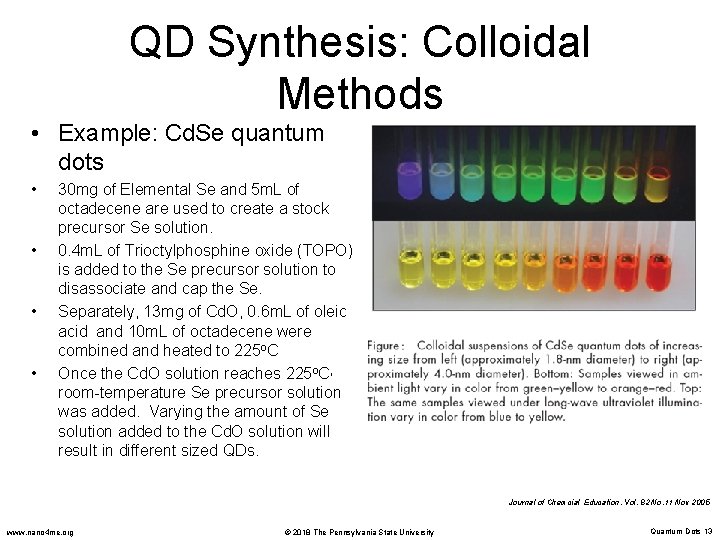
QD Synthesis: Colloidal Methods • Example: Cd. Se quantum dots • • 30 mg of Elemental Se and 5 m. L of octadecene are used to create a stock precursor Se solution. 0. 4 m. L of Trioctylphosphine oxide (TOPO) is added to the Se precursor solution to disassociate and cap the Se. Separately, 13 mg of Cd. O, 0. 6 m. L of oleic acid and 10 m. L of octadecene were combined and heated to 225 o. C Once the Cd. O solution reaches 225 o. C, room-temperature Se precursor solution was added. Varying the amount of Se solution added to the Cd. O solution will result in different sized QDs. Journal of Chemcial Education. Vol. 82 No. 11 Nov 2005 www. nano 4 me. org © 2018 The Pennsylvania State University Quantum Dots 13
QD Synthesis: Epitaxial Growth • Epitaxial growth refers to the layer by layer deposition/growth of monocrystalline films. • A liquid or gaseous precursor condenses to form crystallites on the surface of a substrate. • The substrate acts as a seed crystal. Its lattice structure and crystallographic orientation dictate the morphology of epitaxial film. • Epitaxial growth techniques can be used to fabricate QD core/shell structures and QD films. www. nano 4 me. org © 2018 The Pennsylvania State University Quantum Dots 14
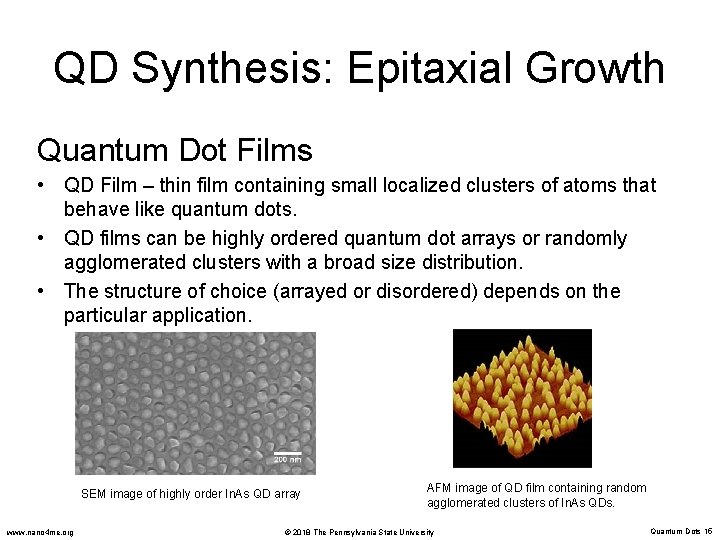
QD Synthesis: Epitaxial Growth Quantum Dot Films • QD Film – thin film containing small localized clusters of atoms that behave like quantum dots. • QD films can be highly ordered quantum dot arrays or randomly agglomerated clusters with a broad size distribution. • The structure of choice (arrayed or disordered) depends on the particular application. SEM image of highly order In. As QD array www. nano 4 me. org AFM image of QD film containing random agglomerated clusters of In. As QDs. © 2018 The Pennsylvania State University Quantum Dots 15
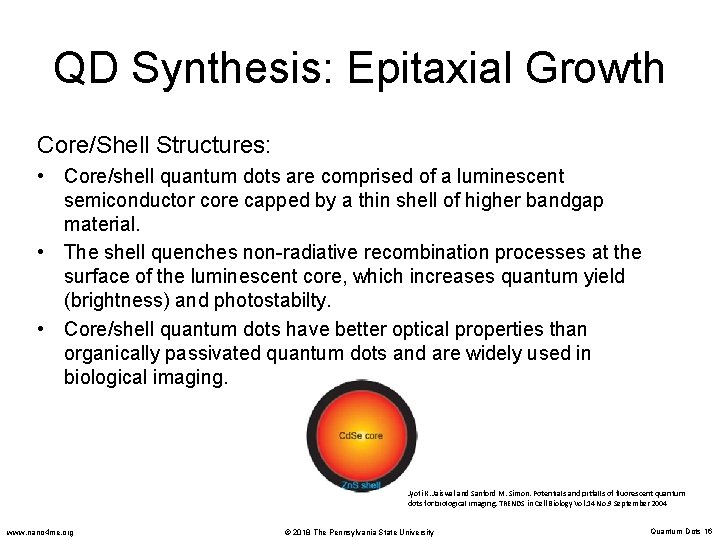
QD Synthesis: Epitaxial Growth Core/Shell Structures: • Core/shell quantum dots are comprised of a luminescent semiconductor core capped by a thin shell of higher bandgap material. • The shell quenches non-radiative recombination processes at the surface of the luminescent core, which increases quantum yield (brightness) and photostabilty. • Core/shell quantum dots have better optical properties than organically passivated quantum dots and are widely used in biological imaging. Jyoti K. Jaiswal and Sanford M. Simon. Potentials and pitfalls of fluorescent quantum dots for biological imaging. TRENDS in Cell Biology Vol. 14 No. 9 September 2004 www. nano 4 me. org © 2018 The Pennsylvania State University Quantum Dots 16
QD Synthesis: Epitaxial Growth • There a variety of epitaxial methods, which each have their own subtechniques: – Laser Abblation – Vapor Phase Epitaxy (VPE) – Liquid Phase Epitaxy (LPE) – Molecular Beam Epitaxy (MBE) www. nano 4 me. org © 2018 The Pennsylvania State University Quantum Dots 17
Outline • Introduction • Quantum Confinement • QD Synthesis – Colloidal Methods – Epitaxial Growth • Applications – Biological – Light Emitters – Additional Applications www. nano 4 me. org © 2018 The Pennsylvania State University Quantum Dots 18
Applications of QDs: Biological • Biological Tagging and Labeling – Biological assays and microarrays – Labeling of cells and intracellular structures – in vivo and in vitro imaging – Pathogen and Toxin detection www. nano 4 me. org © 2018 The Pennsylvania State University Quantum Dots 19
Applications of QDs: Biological • Biological Tagging – Organic fluorophores such as genetically encoded fluorescent protein, like GFP, or chemically synthesized fluorescent dyes have been the most common way of tagging biological entities. – Some limitations of organic fluorophores: • do not continuously fluoresce for extended periods of time • Degrade or photo-bleach • are not optimized for multicolor applications www. nano 4 me. org © 2018 The Pennsylvania State University Quantum Dots 20
Applications of QDs: Biological • The unique optical properties of quantum dots make them suitable for biological tagging and labeling applications. • QDs are excellent fluorophores. – Fluorescence is a type of luminescence in which the absorption of an incident photon triggers the emission of a lower energy or longer wavelength photon. – Quantum dots absorb over a broad spectrum and fluoresce over a narrow range of wavelengths. This is tunable by particle size. – So, a single excitation source can be used to excite QDs of different colors making them ideal for imaging multiple targets simultaneously. www. nano 4 me. org © 2018 The Pennsylvania State University Quantum Dots 21
Applications of QDs: Biological Absorption and emission Spectra of Cd. Se/Zn. S QDs compared to Rhodamine, a common organic die. – The absorption spectrum (dashed lines) of the QD (green) is very broad, whereas that of the organic die (orange) is narrow. – Conversely, the emission spectrum (solid lines) of the QD is more narrow than that of the organic die Jyoti K. Jaiswal and Sanford M. Simon. Potentials and pitfalls of fluorescent quantum dots for biological imaging. TRENDS in Cell Biology Vol. 14 No. 9 September 2004 www. nano 4 me. org © 2018 The Pennsylvania State University Quantum Dots 22
Applications of QDs: Biological • A broad absorption and narrow emission spectrum means a single excitation source can be used to excite QDs of different colors making them ideal for imaging multiple targets simultaneously. Cd. Se/Zn. S QDs used to image cancer cells in a live mouse. Gao, Xiaohu. "In vivo cancer targeting and imaging with. " Nature Biotechnology 22(2004): 8. www. nano 4 me. org © 2018 The Pennsylvania State University Quantum Dots 23
Applications of QDs: Biological • Quantum dots are an attractive alternative to traditional organic dies because of their high quantum yield and photostability. • Quantum Yield = # emitted photons / # absorbed photons. – Quantum dots have a high quantum yield because they have a high density of energy states near the bandgap. – A higher quantum yield means a brighter emission. The quantum yield of some QDs is 20 times greater than traditional organic fluorophores. • Photostability is a fluorophore’s resistance to photobleaching or photochemical degradation due to prolonged exposure to the excitation source. www. nano 4 me. org © 2018 The Pennsylvania State University Quantum Dots 24
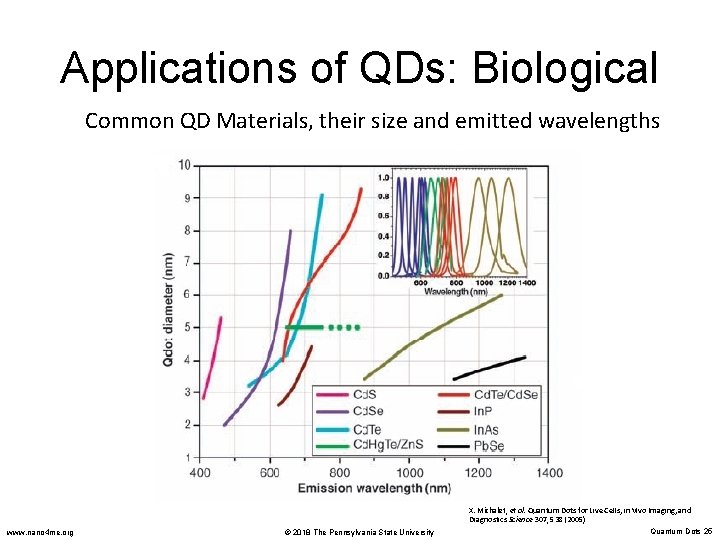
Applications of QDs: Biological Common QD Materials, their size and emitted wavelengths www. nano 4 me. org © 2018 The Pennsylvania State University X. Michalet, et al. Quantum Dots for Live Cells, in Vivo Imaging, and Diagnostics Science 307, 538 (2005) Quantum Dots 25
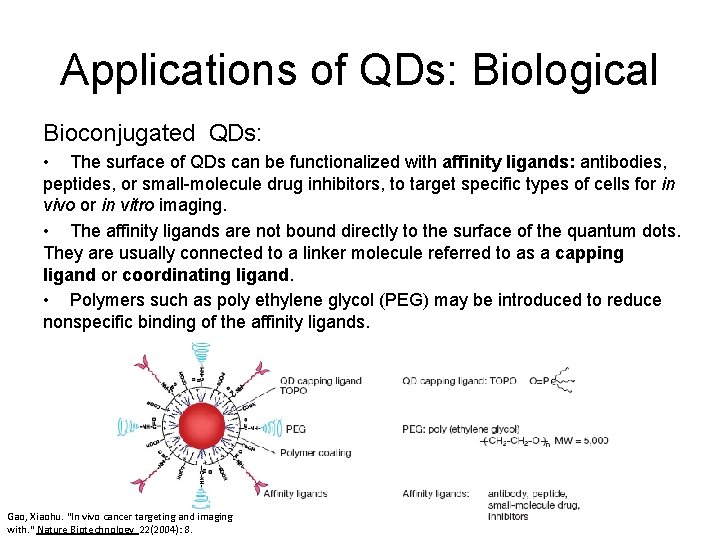
Applications of QDs: Biological Bioconjugated QDs: • The surface of QDs can be functionalized with affinity ligands: antibodies, peptides, or small-molecule drug inhibitors, to target specific types of cells for in vivo or in vitro imaging. • The affinity ligands are not bound directly to the surface of the quantum dots. They are usually connected to a linker molecule referred to as a capping ligand or coordinating ligand. • Polymers such as poly ethylene glycol (PEG) may be introduced to reduce nonspecific binding of the affinity ligands. Gao, Xiaohu. "In vivo cancer targeting and imaging with. " Nature Biotechnology 22(2004): 8.
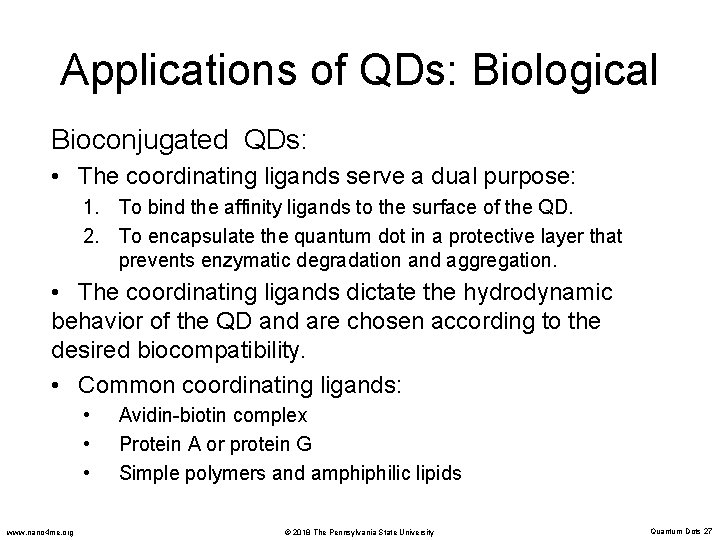
Applications of QDs: Biological Bioconjugated QDs: • The coordinating ligands serve a dual purpose: 1. To bind the affinity ligands to the surface of the QD. 2. To encapsulate the quantum dot in a protective layer that prevents enzymatic degradation and aggregation. • The coordinating ligands dictate the hydrodynamic behavior of the QD and are chosen according to the desired biocompatibility. • Common coordinating ligands: • • • www. nano 4 me. org Avidin-biotin complex Protein A or protein G Simple polymers and amphiphilic lipids © 2018 The Pennsylvania State University Quantum Dots 27
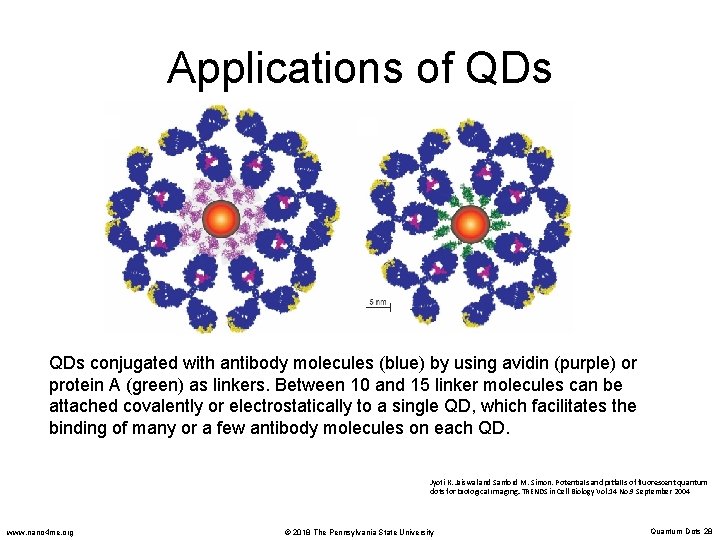
Applications of QDs conjugated with antibody molecules (blue) by using avidin (purple) or protein A (green) as linkers. Between 10 and 15 linker molecules can be attached covalently or electrostatically to a single QD, which facilitates the binding of many or a few antibody molecules on each QD. Jyoti K. Jaiswal and Sanford M. Simon. Potentials and pitfalls of fluorescent quantum dots for biological imaging. TRENDS in Cell Biology Vol. 14 No. 9 September 2004 www. nano 4 me. org © 2018 The Pennsylvania State University Quantum Dots 28
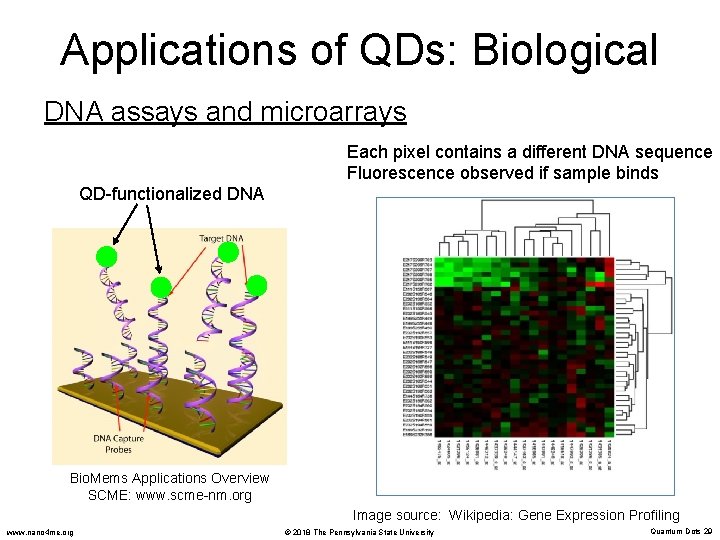
Applications of QDs: Biological DNA assays and microarrays Each pixel contains a different DNA sequence Fluorescence observed if sample binds QD-functionalized DNA Bio. Mems Applications Overview SCME: www. scme-nm. org Image source: Wikipedia: Gene Expression Profiling www. nano 4 me. org © 2018 The Pennsylvania State University Quantum Dots 29
Outline • Introduction • Quantum Confinement • QD Synthesis – Colloidal Methods – Epitaxial Growth • Applications – Biological – Light Emitters – Additional Applications www. nano 4 me. org © 2018 The Pennsylvania State University Quantum Dots 30
Applications of QDs: Light Emitters • The discovery of quantum dots has led to the development of an entirely new gamut of materials for the active regions in LEDs and laser diodes. • Indirect gap semiconductors that don’t luminesce in their bulk form such as Si become efficient light emitters at the nanoscale due quantum confinement effects. • The study of QDs has advanced our understanding of the emission mechanisms in conventional LED materials such as In. Ga. N, the active region of blue LEDs. • The high radiative-recombination efficiency of epitaxial In. Ga. N is due to self-assembled, localized, In rich clusters that behave like QDs. www. nano 4 me. org © 2018 The Pennsylvania State University Quantum Dots 31
Outline • Introduction • Quantum Confinement • QD Synthesis – Colloidal Methods – Epitaxial Growth • Applications – Biological – Light Emitters – Additional Applications www. nano 4 me. org © 2018 The Pennsylvania State University Quantum Dots 32
Additional Applications of QDs • New applications for QDs are continuously being discovered. • For example: Solar cells that incorporate QDs may lead to more efficient light harvesting and energy conversion. www. nano 4 me. org © 2018 The Pennsylvania State University Quantum Dots 33
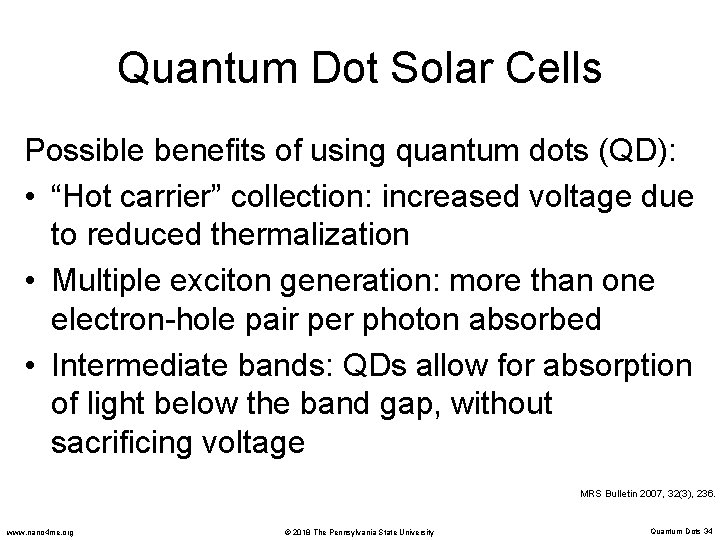
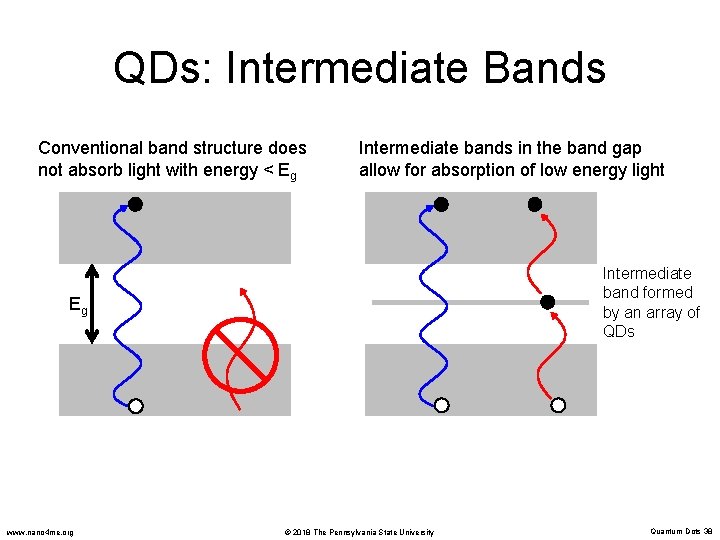
Quantum Dot Solar Cells Possible benefits of using quantum dots (QD): • “Hot carrier” collection: increased voltage due to reduced thermalization • Multiple exciton generation: more than one electron-hole pair per photon absorbed • Intermediate bands: QDs allow for absorption of light below the band gap, without sacrificing voltage MRS Bulletin 2007, 32(3), 236. www. nano 4 me. org © 2018 The Pennsylvania State University Quantum Dots 34
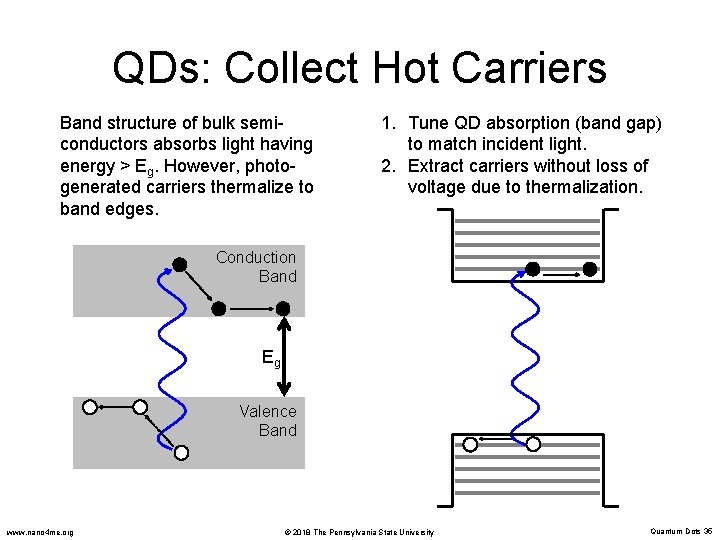
QDs: Collect Hot Carriers Band structure of bulk semiconductors absorbs light having energy > Eg. However, photogenerated carriers thermalize to band edges. 1. Tune QD absorption (band gap) to match incident light. 2. Extract carriers without loss of voltage due to thermalization. Conduction Band Eg Valence Band www. nano 4 me. org © 2018 The Pennsylvania State University Quantum Dots 35
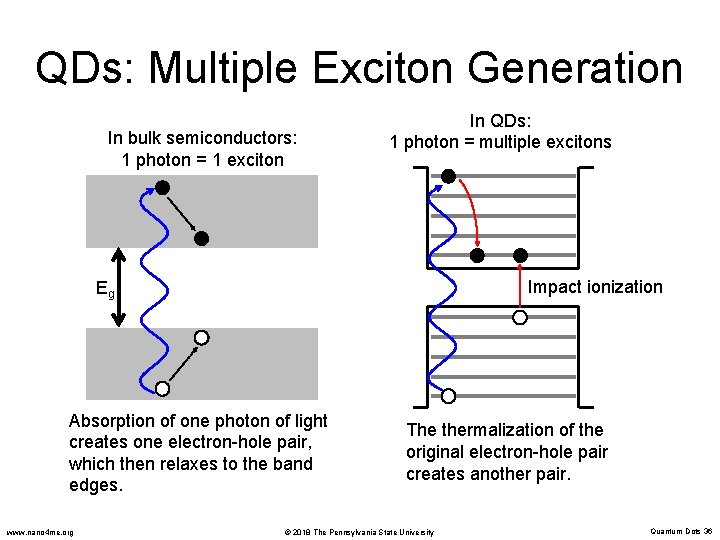
QDs: Multiple Exciton Generation In bulk semiconductors: 1 photon = 1 exciton In QDs: 1 photon = multiple excitons Impact ionization Eg Absorption of one photon of light creates one electron-hole pair, which then relaxes to the band edges. www. nano 4 me. org The thermalization of the original electron-hole pair creates another pair. © 2018 The Pennsylvania State University Quantum Dots 36
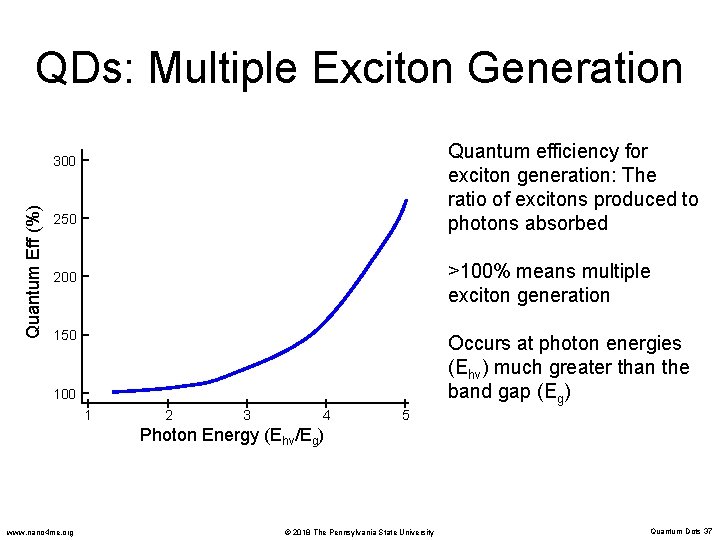
QDs: Multiple Exciton Generation Quantum efficiency for exciton generation: The ratio of excitons produced to photons absorbed Quantum Eff (%) 300 250 >100% means multiple exciton generation 200 150 Occurs at photon energies (Ehv) much greater than the band gap (Eg) 100 1 2 3 4 5 Photon Energy (Ehv/Eg) www. nano 4 me. org © 2018 The Pennsylvania State University Quantum Dots 37
QDs: Intermediate Bands Conventional band structure does not absorb light with energy < Eg Intermediate bands in the band gap allow for absorption of low energy light Intermediate band formed by an array of QDs Eg www. nano 4 me. org © 2018 The Pennsylvania State University Quantum Dots 38
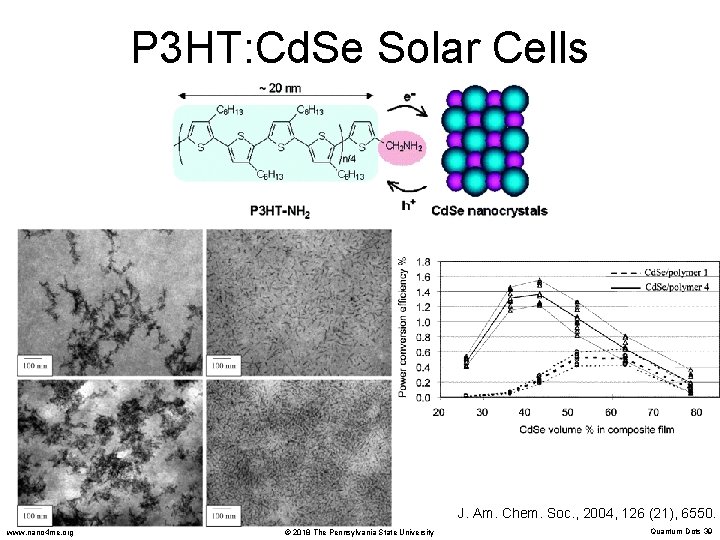
P 3 HT: Cd. Se Solar Cells J. Am. Chem. Soc. , 2004, 126 (21), 6550. www. nano 4 me. org © 2018 The Pennsylvania State University Quantum Dots 39
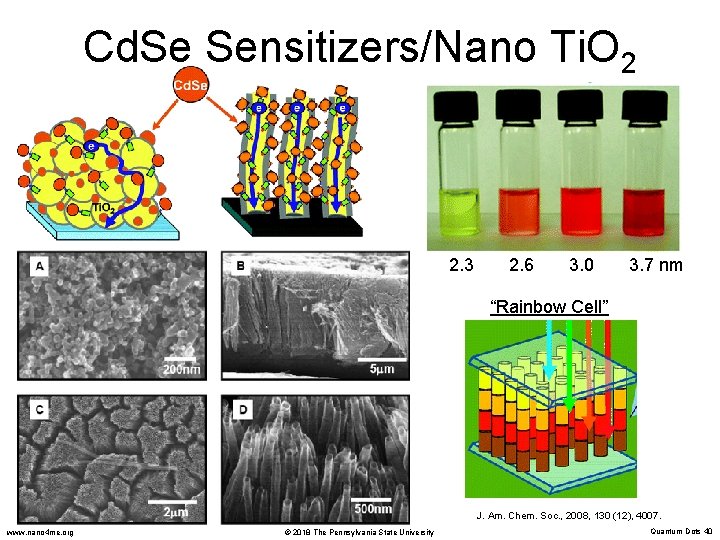
Cd. Se Sensitizers/Nano Ti. O 2 2. 3 2. 6 3. 0 3. 7 nm “Rainbow Cell” J. Am. Chem. Soc. , 2008, 130 (12), 4007. www. nano 4 me. org © 2018 The Pennsylvania State University Quantum Dots 40
Conclusion • Introduction • Quantum Confinement • QD Synthesis – Colloidal Methods – Epitaxial Growth • Applications – Biological – Light Emitters – Additional Applications www. nano 4 me. org © 2018 The Pennsylvania State University Quantum Dots 41