
Quantum Dots in the Undergraduate Chemistry Curriculum Authors
- Slides: 20
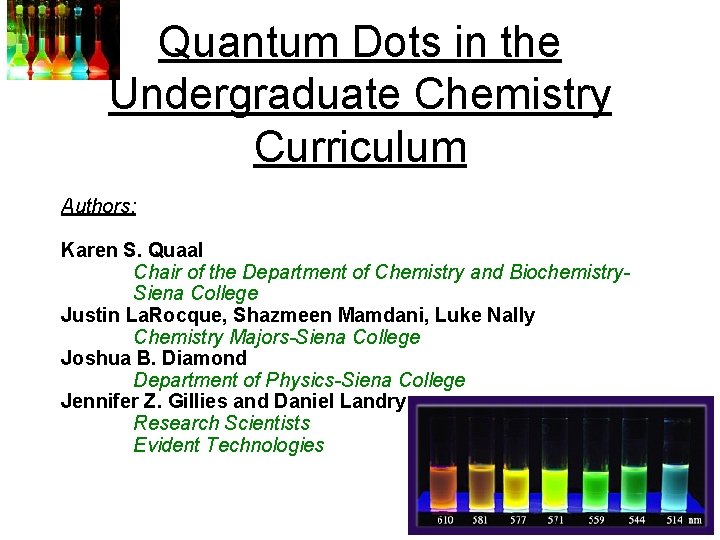
Quantum Dots in the Undergraduate Chemistry Curriculum Authors: Karen S. Quaal Chair of the Department of Chemistry and Biochemistry. Siena College Justin La. Rocque, Shazmeen Mamdani, Luke Nally Chemistry Majors-Siena College Joshua B. Diamond Department of Physics-Siena College Jennifer Z. Gillies and Daniel Landry Research Scientists Evident Technologies
Siena College: Background For Project: Mid-1990: NSF Poly-Ed Scholar • Developed modules for incorporating polymer chemistry topics into the undergraduate curriculum. Modules: • Applicable to small departments that lack the resources (time, students and/or money) to develop an entire course devoted to polymer chemistry. For this project, we used a similar approach as a template for integrating nanotechnology into the undergraduate curriculum.
Why Nanotechnology? • Recognized that nanotechnology is a rapidly growing field in science. • Capital District-Tech Valley. • Recognized that there was a need to educate our majors about the field of nanoscience and nanotechnology. Why cross-disciplines and cross-academicindustrial? • Recognized the nature of the field of nanotechnology.
The Plan Develop two 5 -week modules for incorporating aspects of nanotechnology into the typical undergraduate curriculum. 1. Chemistry Module: * Offered as a junior-level course * Integrated Laboratory II (1 credit) * Laboratory using applications of Inorganic Synthesis, Physical Chemistry II and Spectroscopy 2. Physics Module: * Offered as a portion of a Special Topics course for sophomores-seniors * Course involved a collaborative effort in which the chemistry majors synthesized the Quantum Dot samples and the physics majors measured analyzed some of their optical properties * Effects on electron-hole excitation spectrum 3. Evident Technologies: * Served as industrial partners in the project * Provided access to resources * Internship sites
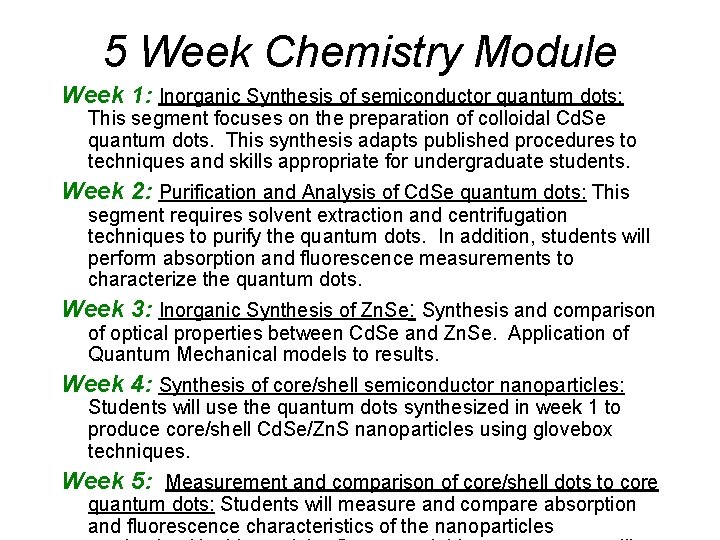
5 Week Chemistry Module Week 1: Inorganic Synthesis of semiconductor quantum dots: This segment focuses on the preparation of colloidal Cd. Se quantum dots. This synthesis adapts published procedures to techniques and skills appropriate for undergraduate students. Week 2: Purification and Analysis of Cd. Se quantum dots: This segment requires solvent extraction and centrifugation techniques to purify the quantum dots. In addition, students will perform absorption and fluorescence measurements to characterize the quantum dots. Week 3: Inorganic Synthesis of Zn. Se: Synthesis and comparison of optical properties between Cd. Se and Zn. Se. Application of Quantum Mechanical models to results. Week 4: Synthesis of core/shell semiconductor nanoparticles: Students will use the quantum dots synthesized in week 1 to produce core/shell Cd. Se/Zn. S nanoparticles using glovebox techniques. Week 5: Measurement and comparison of core/shell dots to core quantum dots: Students will measure and compare absorption and fluorescence characteristics of the nanoparticles
Quantum Dot Seminar “What is a Quantum Dot” One hour lecture presented by Mr. Daniel Landry, Vice President of Evident Technologies • Overview of Nanotechnology • Description of a Quantum Dot • Explanation of Quantum Confinement of the exciton
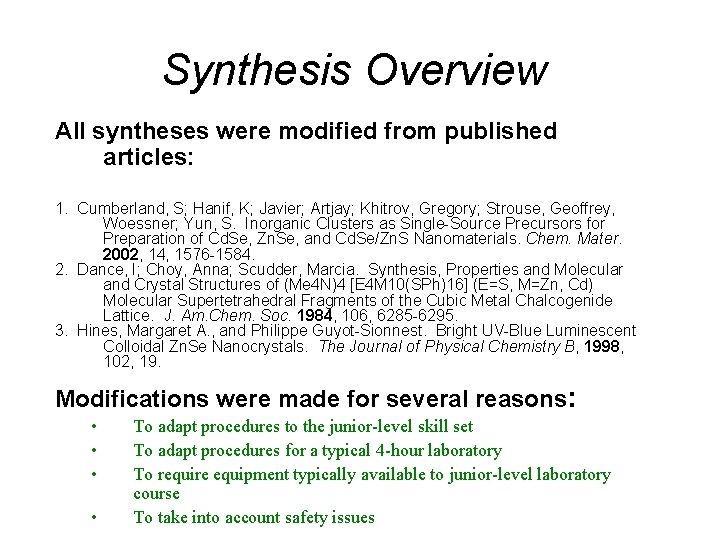
Synthesis Overview All syntheses were modified from published articles: 1. Cumberland, S; Hanif, K; Javier; Artjay; Khitrov, Gregory; Strouse, Geoffrey, Woessner; Yun, S. Inorganic Clusters as Single-Source Precursors for Preparation of Cd. Se, Zn. Se, and Cd. Se/Zn. S Nanomaterials. Chem. Mater. 2002, 14, 1576 -1584. 2. Dance, I; Choy, Anna; Scudder, Marcia. Synthesis, Properties and Molecular and Crystal Structures of (Me 4 N)4 [E 4 M 10(SPh)16] (E=S, M=Zn, Cd) Molecular Supertetrahedral Fragments of the Cubic Metal Chalcogenide Lattice. J. Am. Chem. Soc. 1984, 106, 6285 -6295. 3. Hines, Margaret A. , and Philippe Guyot-Sionnest. Bright UV-Blue Luminescent Colloidal Zn. Se Nanocrystals. The Journal of Physical Chemistry B, 1998, 102, 19. Modifications were made for several reasons: • • To adapt procedures to the junior-level skill set To adapt procedures for a typical 4 -hour laboratory To require equipment typically available to junior-level laboratory course To take into account safety issues
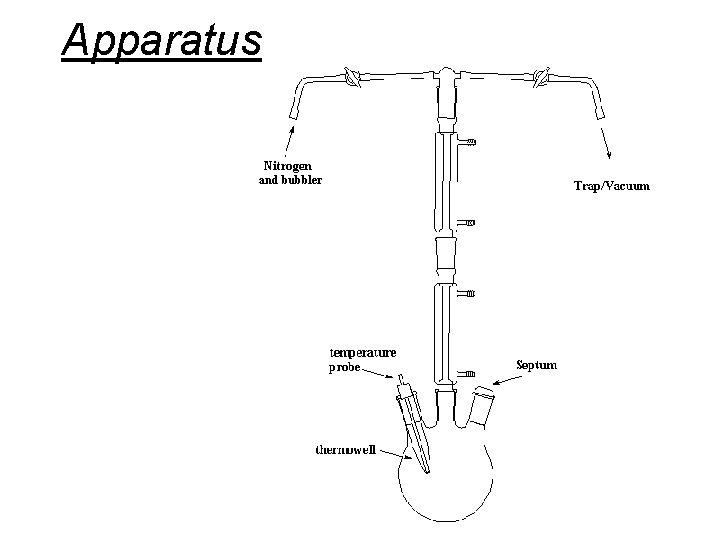
Apparatus and bubbler
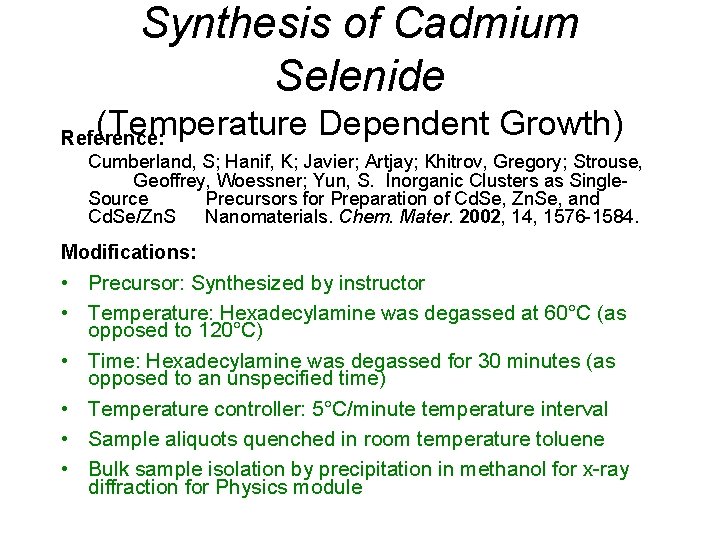
Synthesis of Cadmium Selenide (Temperature Dependent Growth) Reference: Cumberland, S; Hanif, K; Javier; Artjay; Khitrov, Gregory; Strouse, Geoffrey, Woessner; Yun, S. Inorganic Clusters as Single. Source Precursors for Preparation of Cd. Se, Zn. Se, and Cd. Se/Zn. S Nanomaterials. Chem. Mater. 2002, 14, 1576 -1584. Modifications: • Precursor: Synthesized by instructor • Temperature: Hexadecylamine was degassed at 60°C (as opposed to 120°C) • Time: Hexadecylamine was degassed for 30 minutes (as opposed to an unspecified time) • Temperature controller: 5°C/minute temperature interval • Sample aliquots quenched in room temperature toluene • Bulk sample isolation by precipitation in methanol for x-ray diffraction for Physics module
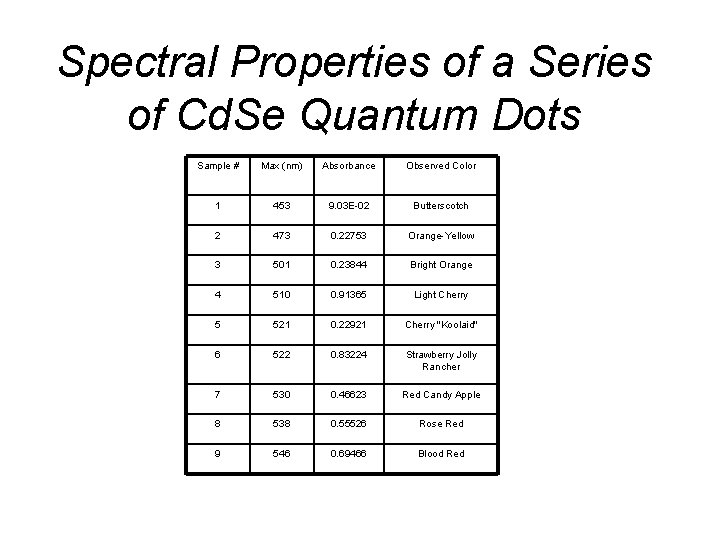
Spectral Properties of a Series of Cd. Se Quantum Dots Sample # Max (nm) Absorbance Observed Color 1 453 9. 03 E-02 Butterscotch 2 473 0. 22753 Orange-Yellow 3 501 0. 23844 Bright Orange 4 510 0. 91365 Light Cherry 5 521 0. 22921 Cherry "Koolaid" 6 522 0. 83224 Strawberry Jolly Rancher 7 530 0. 46623 Red Candy Apple 8 538 0. 55526 Rose Red 9 546 0. 69466 Blood Red
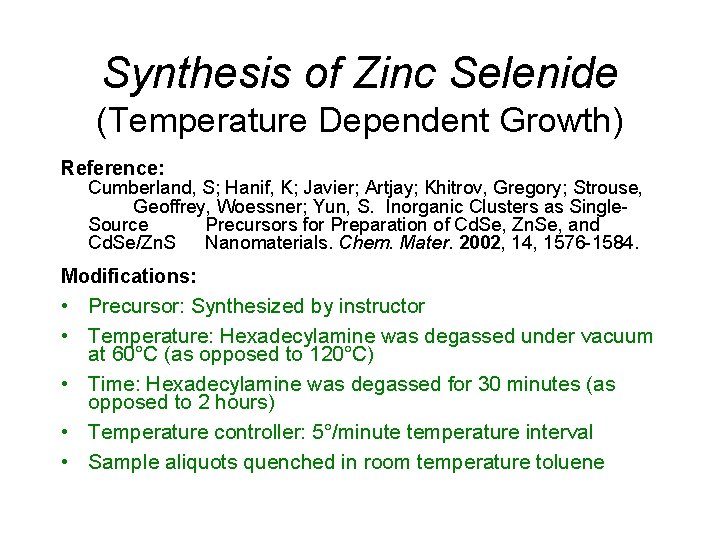
Synthesis of Zinc Selenide (Temperature Dependent Growth) Reference: Cumberland, S; Hanif, K; Javier; Artjay; Khitrov, Gregory; Strouse, Geoffrey, Woessner; Yun, S. Inorganic Clusters as Single. Source Precursors for Preparation of Cd. Se, Zn. Se, and Cd. Se/Zn. S Nanomaterials. Chem. Mater. 2002, 14, 1576 -1584. Modifications: • Precursor: Synthesized by instructor • Temperature: Hexadecylamine was degassed under vacuum at 60°C (as opposed to 120°C) • Time: Hexadecylamine was degassed for 30 minutes (as opposed to 2 hours) • Temperature controller: 5°/minute temperature interval • Sample aliquots quenched in room temperature toluene
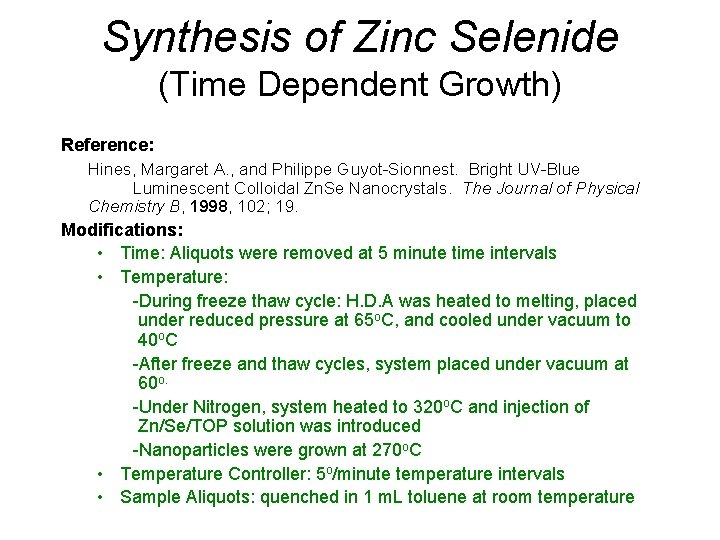
Synthesis of Zinc Selenide (Time Dependent Growth) Reference: Hines, Margaret A. , and Philippe Guyot-Sionnest. Bright UV-Blue Luminescent Colloidal Zn. Se Nanocrystals. The Journal of Physical Chemistry B, 1998, 102; 19. Modifications: • Time: Aliquots were removed at 5 minute time intervals • Temperature: -During freeze thaw cycle: H. D. A was heated to melting, placed under reduced pressure at 65 o. C, and cooled under vacuum to 40 o. C -After freeze and thaw cycles, system placed under vacuum at 60 o. -Under Nitrogen, system heated to 320 o. C and injection of Zn/Se/TOP solution was introduced -Nanoparticles were grown at 270 o. C • Temperature Controller: 5 o/minute temperature intervals • Sample Aliquots: quenched in 1 m. L toluene at room temperature
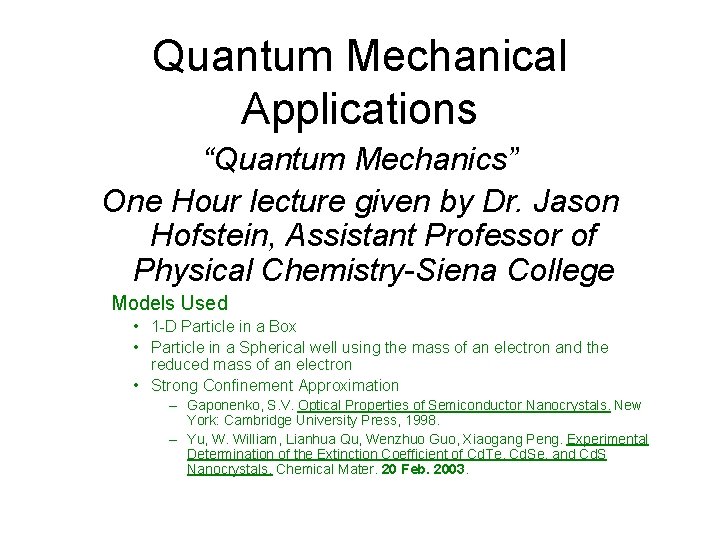
Quantum Mechanical Applications “Quantum Mechanics” One Hour lecture given by Dr. Jason Hofstein, Assistant Professor of Physical Chemistry-Siena College Models Used • 1 -D Particle in a Box • Particle in a Spherical well using the mass of an electron and the reduced mass of an electron • Strong Confinement Approximation – Gaponenko, S. V. Optical Properties of Semiconductor Nanocrystals. New York: Cambridge University Press, 1998. – Yu, W. William, Lianhua Qu, Wenzhuo Guo, Xiaogang Peng. Experimental Determination of the Extinction Coefficient of Cd. Te, Cd. Se, and Cd. S Nanocrystals. Chemical Mater. 20 Feb. 2003.
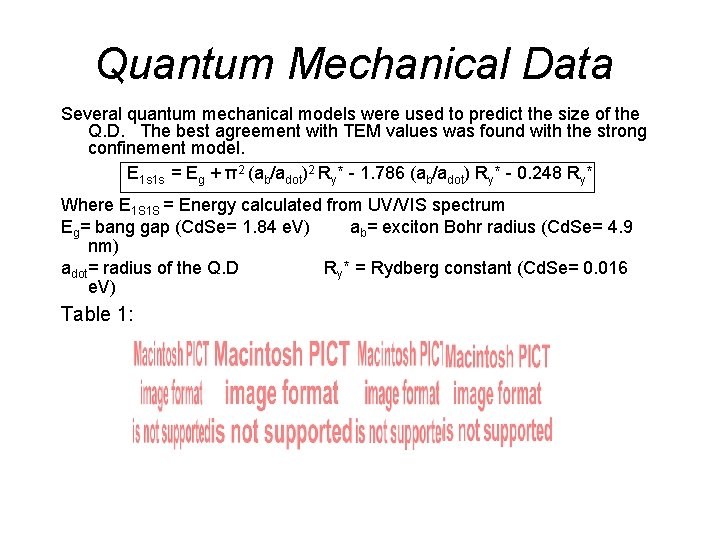
Quantum Mechanical Data Several quantum mechanical models were used to predict the size of the Q. D. The best agreement with TEM values was found with the strong confinement model. E 1 s 1 s = Eg + π2 (ab/adot)2 Ry* - 1. 786 (ab/adot) Ry* - 0. 248 Ry* Where E 1 S 1 S = Energy calculated from UV/VIS spectrum Eg= bang gap (Cd. Se= 1. 84 e. V) ab= exciton Bohr radius (Cd. Se= 4. 9 nm) adot= radius of the Q. D Ry* = Rydberg constant (Cd. Se= 0. 016 e. V) Table 1: Cd. Se Spectral Data
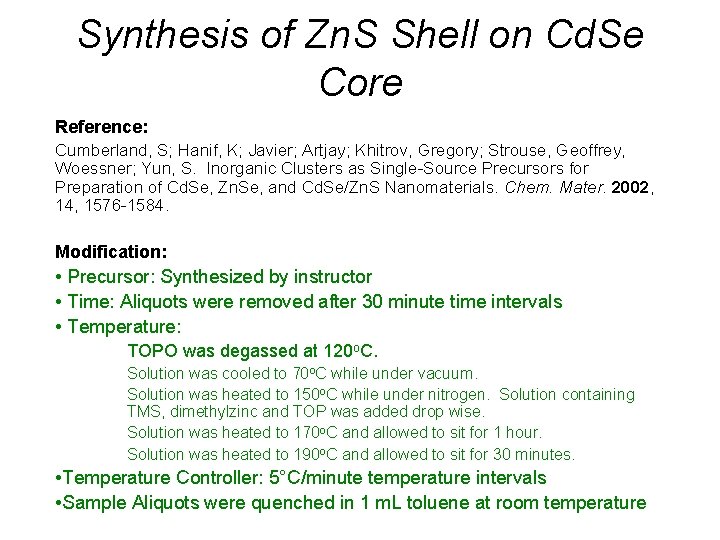
Synthesis of Zn. S Shell on Cd. Se Core Reference: Cumberland, S; Hanif, K; Javier; Artjay; Khitrov, Gregory; Strouse, Geoffrey, Woessner; Yun, S. Inorganic Clusters as Single-Source Precursors for Preparation of Cd. Se, Zn. Se, and Cd. Se/Zn. S Nanomaterials. Chem. Mater. 2002, 14, 1576 -1584. Modification: • Precursor: Synthesized by instructor • Time: Aliquots were removed after 30 minute time intervals • Temperature: TOPO was degassed at 120 o. C. Solution was cooled to 70 o. C while under vacuum. Solution was heated to 150 o. C while under nitrogen. Solution containing TMS, dimethylzinc and TOP was added drop wise. Solution was heated to 170 o. C and allowed to sit for 1 hour. Solution was heated to 190 o. C and allowed to sit for 30 minutes. • Temperature Controller: 5°C/minute temperature intervals • Sample Aliquots were quenched in 1 m. L toluene at room temperature
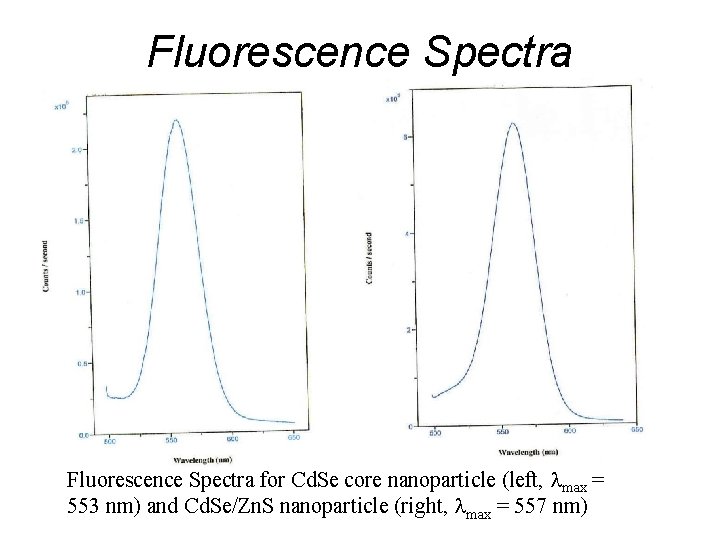
Fluorescence Spectra for Cd. Se core nanoparticle (left, max = 553 nm) and Cd. Se/Zn. S nanoparticle (right, max = 557 nm)
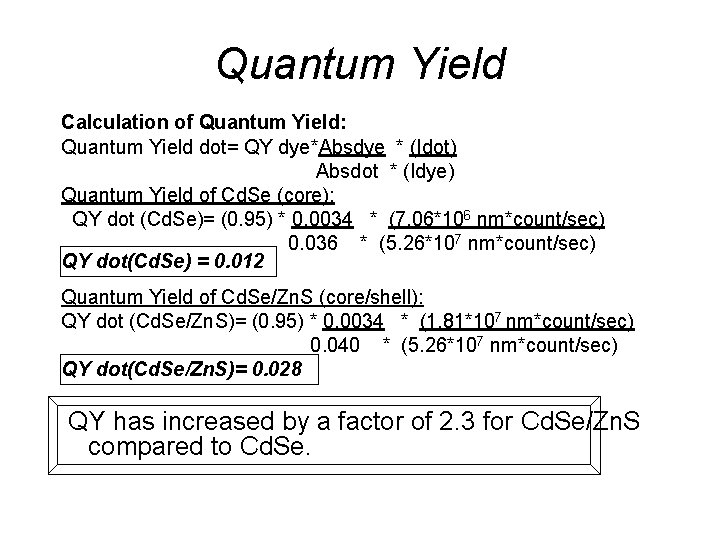
Quantum Yield Calculation of Quantum Yield: Quantum Yield dot= QY dye*Absdye * (Idot) Absdot * (Idye) Quantum Yield of Cd. Se (core): QY dot (Cd. Se)= (0. 95) * 0. 0034 * (7. 06*106 nm*count/sec) 0. 036 * (5. 26*107 nm*count/sec) QY dot(Cd. Se) = 0. 012 Quantum Yield of Cd. Se/Zn. S (core/shell): QY dot (Cd. Se/Zn. S)= (0. 95) * 0. 0034 * (1. 81*107 nm*count/sec) 0. 040 * (5. 26*107 nm*count/sec) QY dot(Cd. Se/Zn. S)= 0. 028 QY has increased by a factor of 2. 3 for Cd. Se/Zn. S compared to Cd. Se.
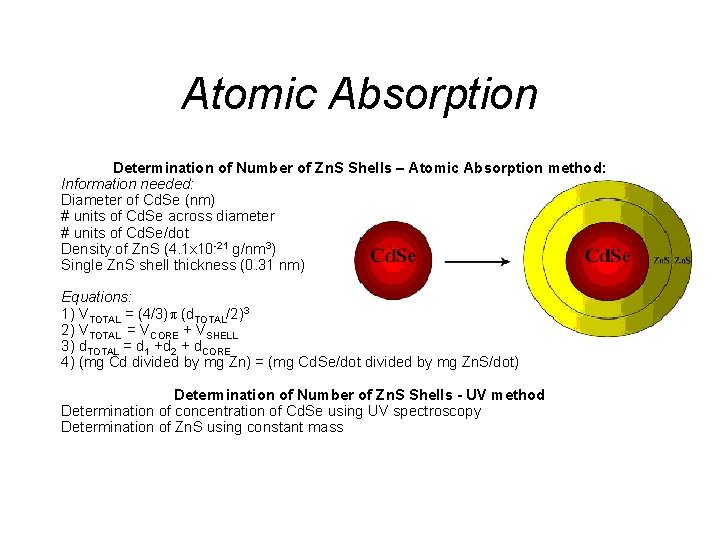
Atomic Absorption Determination of Number of Zn. S Shells – Atomic Absorption method: Information needed: Diameter of Cd. Se (nm) # units of Cd. Se across diameter # units of Cd. Se/dot Density of Zn. S (4. 1 x 10 -21 g/nm 3) Single Zn. S shell thickness (0. 31 nm) Equations: 1) VTOTAL = (4/3) (d. TOTAL/2)3 2) VTOTAL = VCORE + VSHELL 3) d. TOTAL = d 1 +d 2 + d. CORE 4) (mg Cd divided by mg Zn) = (mg Cd. Se/dot divided by mg Zn. S/dot) Determination of Number of Zn. S Shells - UV method Determination of concentration of Cd. Se using UV spectroscopy Determination of Zn. S using constant mass
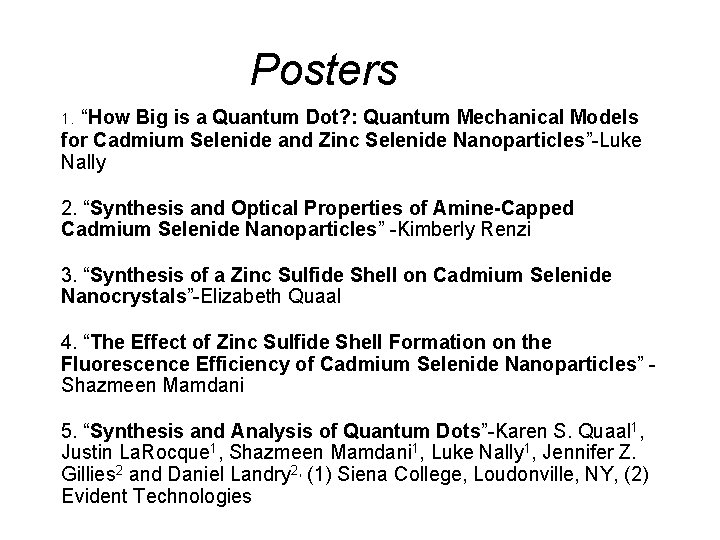
Posters 1. “How Big is a Quantum Dot? : Quantum Mechanical Models for Cadmium Selenide and Zinc Selenide Nanoparticles”-Luke Nally 2. “Synthesis and Optical Properties of Amine-Capped Cadmium Selenide Nanoparticles” -Kimberly Renzi 3. “Synthesis of a Zinc Sulfide Shell on Cadmium Selenide Nanocrystals”-Elizabeth Quaal 4. “The Effect of Zinc Sulfide Shell Formation on the Fluorescence Efficiency of Cadmium Selenide Nanoparticles” Shazmeen Mamdani 5. “Synthesis and Analysis of Quantum Dots”-Karen S. Quaal 1, Justin La. Rocque 1, Shazmeen Mamdani 1, Luke Nally 1, Jennifer Z. Gillies 2 and Daniel Landry 2, (1) Siena College, Loudonville, NY, (2) Evident Technologies
Acknowledgements NSF grant DMR-0303992 Nanotechnology Undergraduate Education (NUE) program. Siena College. Evident Technologies. Research Students: Justin La. Rocque, Shazmeen Mamdani, and Luke Nally http: //www. siena. edu/chemistry/quaal. asp