
Quantum criticality in insulators metals and superconductors Eugene
- Slides: 37
Quantum criticality in insulators, metals and superconductors Eugene Demler (Harvard) Kwon Park (Maryland) Anatoli Polkovnikov Subir Sachdev T. Senthil (MIT) Matthias Vojta (Karlsruhe) Ying Zhang (Maryland) Colloquium article in Reviews of Modern Physics, July 2003, cond-mat/0211005. Talk online: Sachdev
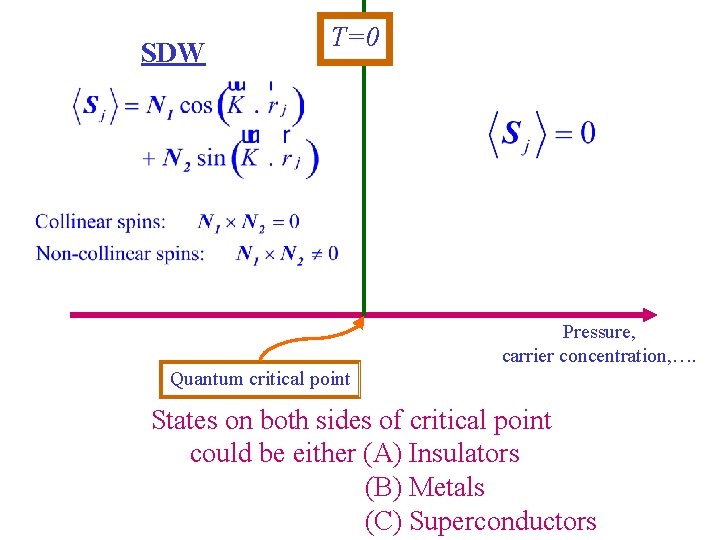
SDW T=0 Pressure, carrier concentration, …. Quantum critical point States on both sides of critical point could be either (A) Insulators (B) Metals (C) Superconductors
(A) Insulators Coupled ladder antiferromagnet
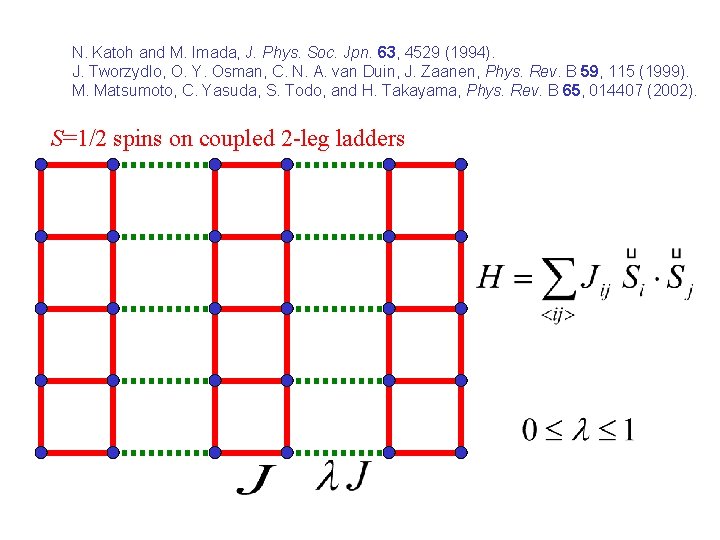
N. Katoh and M. Imada, J. Phys. Soc. Jpn. 63, 4529 (1994). J. Tworzydlo, O. Y. Osman, C. N. A. van Duin, J. Zaanen, Phys. Rev. B 59, 115 (1999). M. Matsumoto, C. Yasuda, S. Todo, and H. Takayama, Phys. Rev. B 65, 014407 (2002). S=1/2 spins on coupled 2 -leg ladders
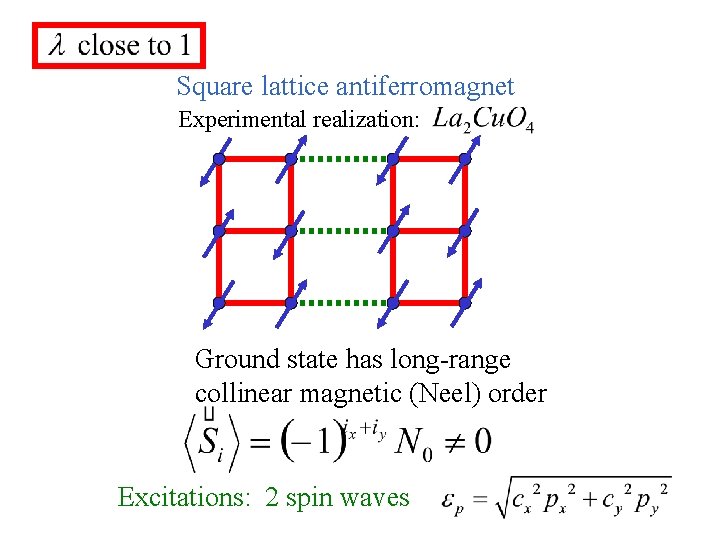
Square lattice antiferromagnet Experimental realization: Ground state has long-range collinear magnetic (Neel) order Excitations: 2 spin waves
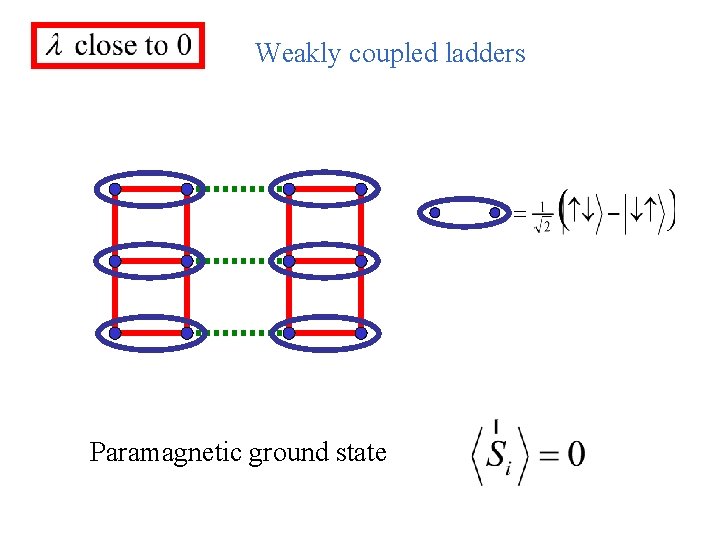
Weakly coupled ladders Paramagnetic ground state
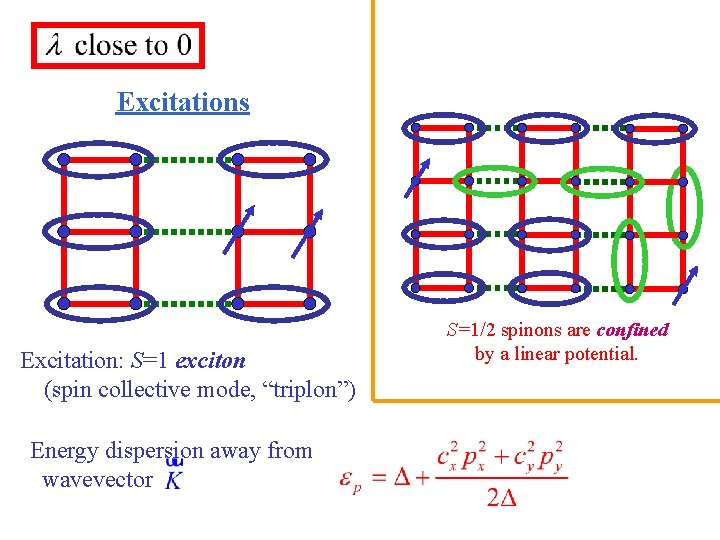
Excitations Excitation: S=1 exciton (spin collective mode, “triplon”) Energy dispersion away from wavevector S=1/2 spinons are confined by a linear potential.
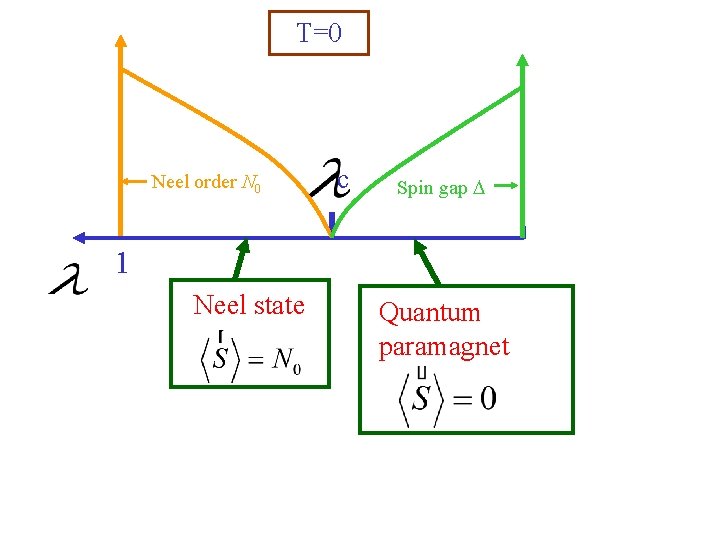
T=0 Neel order N 0 c Spin gap D 1 Neel state Quantum paramagnet
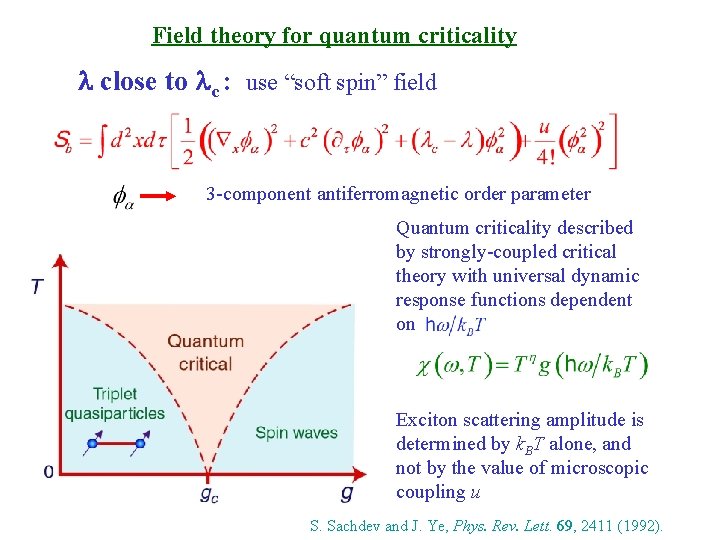
Field theory for quantum criticality l close to lc : use “soft spin” field 3 -component antiferromagnetic order parameter Quantum criticality described by strongly-coupled critical theory with universal dynamic response functions dependent on Exciton scattering amplitude is determined by k. BT alone, and not by the value of microscopic coupling u S. Sachdev and J. Ye, Phys. Rev. Lett. 69, 2411 (1992).
(B) Metals Spin density wave order in the presence of a Fermi surface
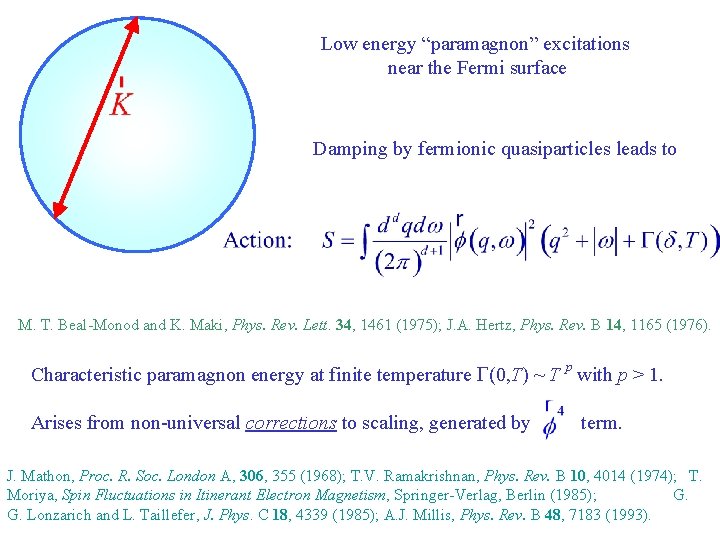
Low energy “paramagnon” excitations near the Fermi surface Damping by fermionic quasiparticles leads to M. T. Beal-Monod and K. Maki, Phys. Rev. Lett. 34, 1461 (1975); J. A. Hertz, Phys. Rev. B 14, 1165 (1976). Characteristic paramagnon energy at finite temperature G(0, T) ~ T p with p > 1. Arises from non-universal corrections to scaling, generated by term. J. Mathon, Proc. R. Soc. London A, 306, 355 (1968); T. V. Ramakrishnan, Phys. Rev. B 10, 4014 (1974); T. Moriya, Spin Fluctuations in Itinerant Electron Magnetism, Springer-Verlag, Berlin (1985); G. G. Lonzarich and L. Taillefer, J. Phys. C 18, 4339 (1985); A. J. Millis, Phys. Rev. B 48, 7183 (1993).
(C) Superconductors Co-existence of superconductivity and spindensity wave order
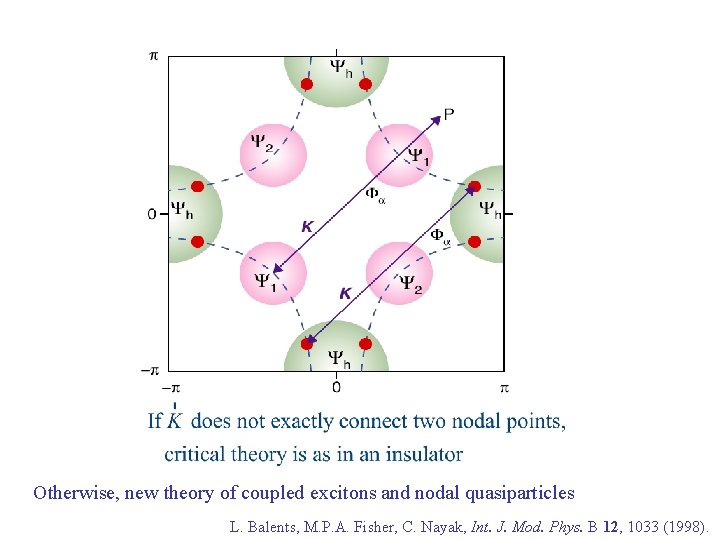
Otherwise, new theory of coupled excitons and nodal quasiparticles L. Balents, M. P. A. Fisher, C. Nayak, Int. J. Mod. Phys. B 12, 1033 (1998).
Effect of an applied magnetic field
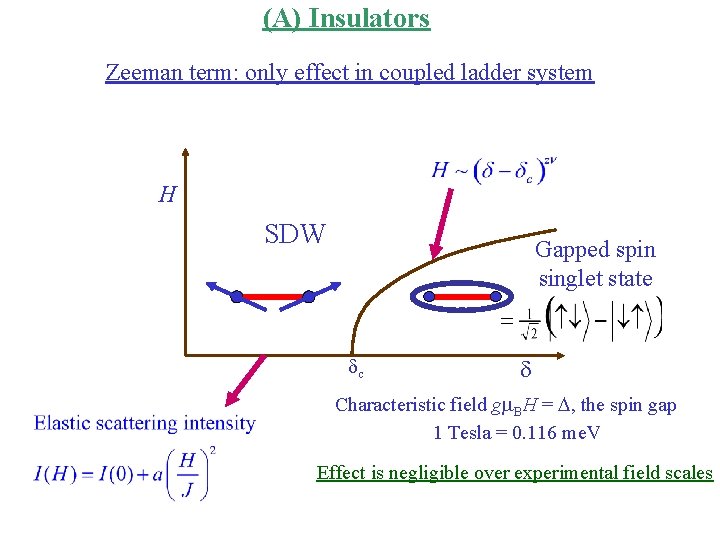
(A) Insulators Zeeman term: only effect in coupled ladder system H SDW Gapped spin singlet state dc d Characteristic field gm. BH = D, the spin gap 1 Tesla = 0. 116 me. V Effect is negligible over experimental field scales
(B) Metals Weak effects (shifts in phase boundary) of order H 2 at small H. (First order) transitions involving changes in Fermi surface topology at large H
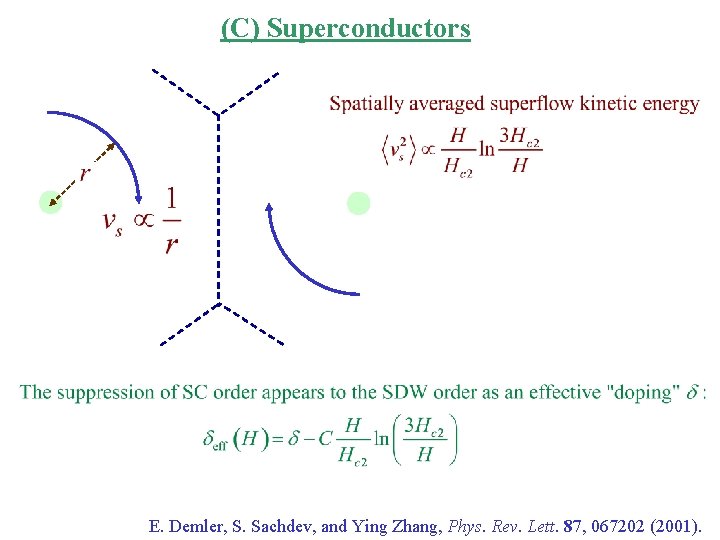
(C) Superconductors E. Demler, S. Sachdev, and Ying Zhang, Phys. Rev. Lett. 87, 067202 (2001).
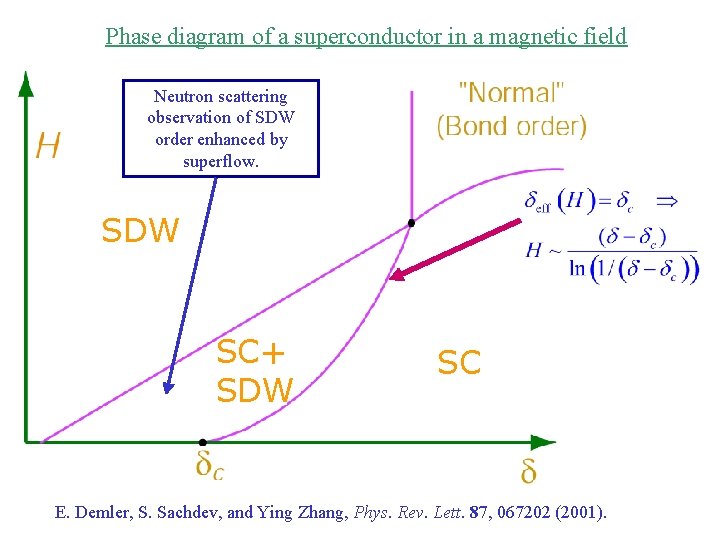
Phase diagram of a superconductor in a magnetic field Neutron scattering observation of SDW order enhanced by superflow. SDW SC+ SDW SC E. Demler, S. Sachdev, and Ying Zhang, Phys. Rev. Lett. 87, 067202 (2001).
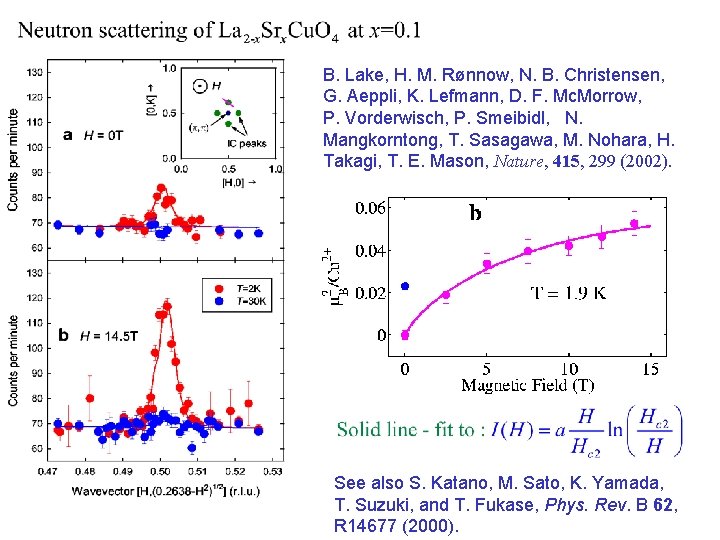
B. Lake, H. M. Rønnow, N. B. Christensen, G. Aeppli, K. Lefmann, D. F. Mc. Morrow, P. Vorderwisch, P. Smeibidl, N. Mangkorntong, T. Sasagawa, M. Nohara, H. Takagi, T. E. Mason, Nature, 415, 299 (2002). See also S. Katano, M. Sato, K. Yamada, T. Suzuki, and T. Fukase, Phys. Rev. B 62, R 14677 (2000).
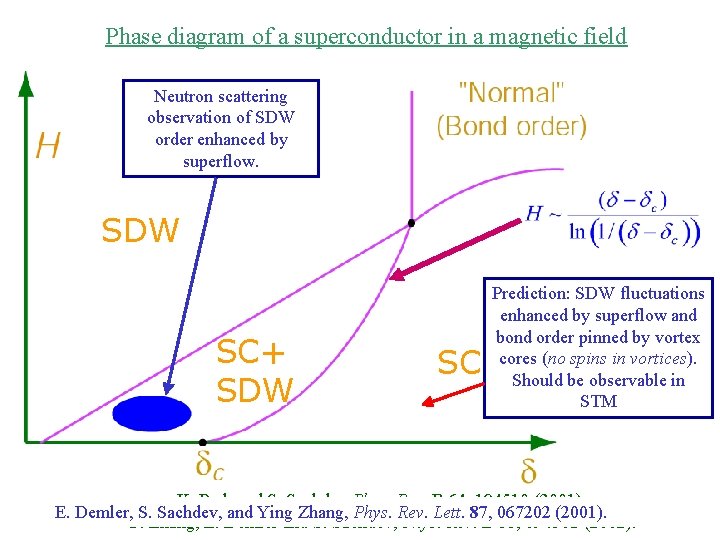
Phase diagram of a superconductor in a magnetic field Neutron scattering observation of SDW order enhanced by superflow. SDW SC+ SDW SC Prediction: SDW fluctuations enhanced by superflow and bond order pinned by vortex cores (no spins in vortices). Should be observable in STM K. Park and S. Sachdev Phys. Rev. B 64, 184510 (2001). E. Demler, S. Sachdev, and Ying Zhang, Phys. Rev. Lett. 87, 067202 (2001). Y. Zhang, E. Demler and S. Sachdev, Phys. Rev. B 66, 094501 (2002).
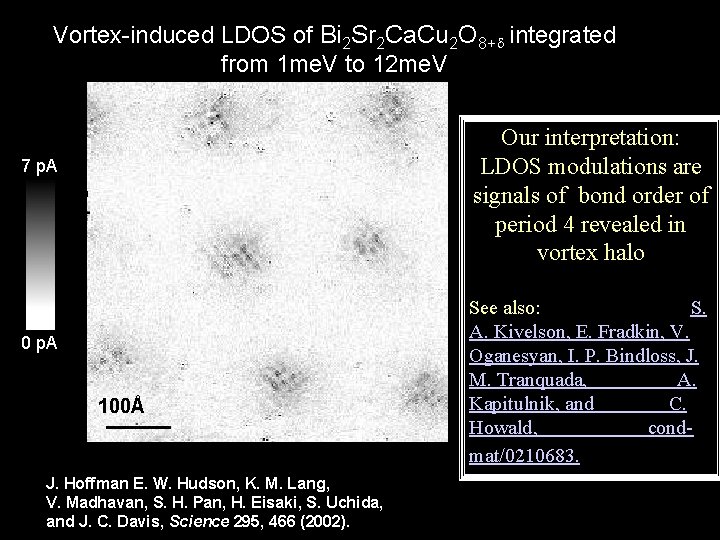
Vortex-induced LDOS of Bi 2 Sr 2 Ca. Cu 2 O 8+d integrated from 1 me. V to 12 me. V Our interpretation: LDOS modulations are signals of bond order of period 4 revealed in vortex halo 7 p. A b 0 p. A 100Å J. Hoffman E. W. Hudson, K. M. Lang, V. Madhavan, S. H. Pan, H. Eisaki, S. Uchida, and J. C. Davis, Science 295, 466 (2002). See also: S. A. Kivelson, E. Fradkin, V. Oganesyan, I. P. Bindloss, J. M. Tranquada, A. Kapitulnik, and C. Howald, condmat/0210683.
Similar results apply to quantum critical points with other “conventional” (fermion bilinear) order parameters e. g. charge density wave, orbital currents…
Compact U(1) gauge theory: bond order and confined spinons in d=2
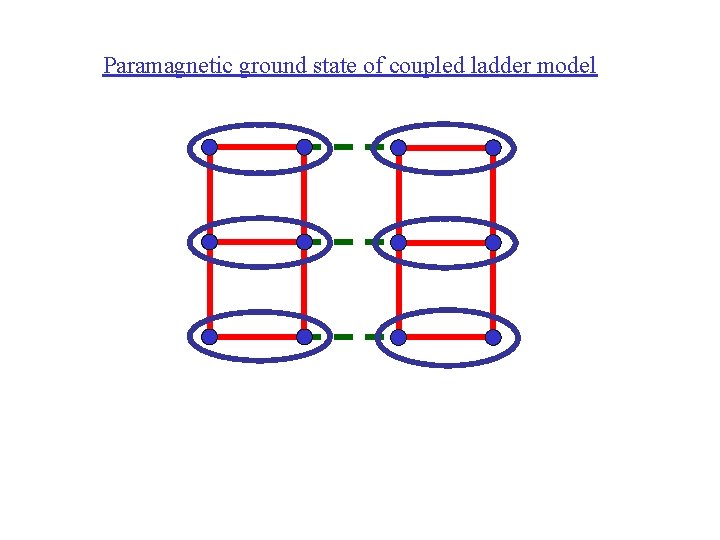
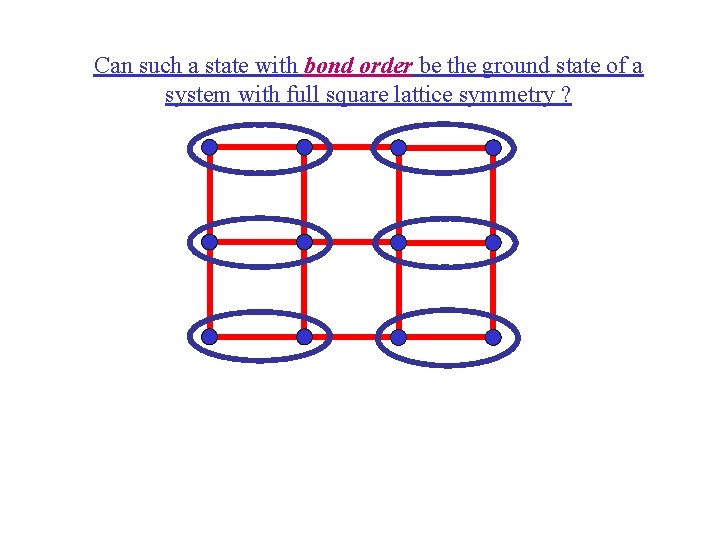
Paramagnetic ground state of coupled ladder model
Can such a state with bond order be the ground state of a system with full square lattice symmetry ?
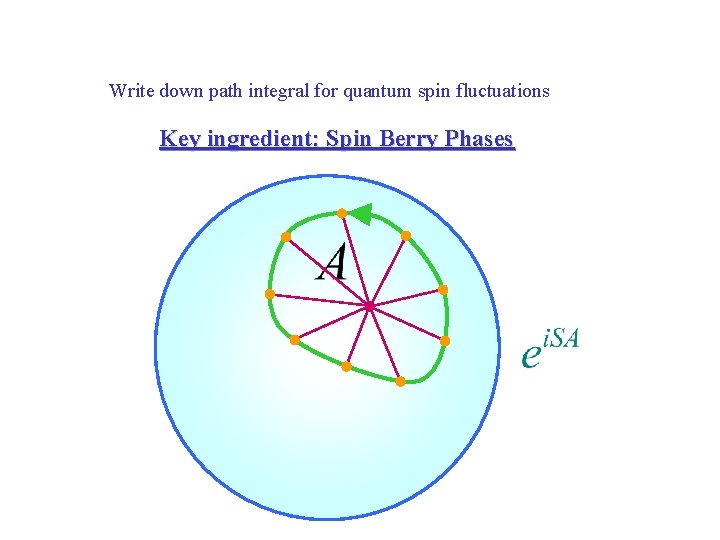
Write down path integral for quantum spin fluctuations Key ingredient: Spin Berry Phases
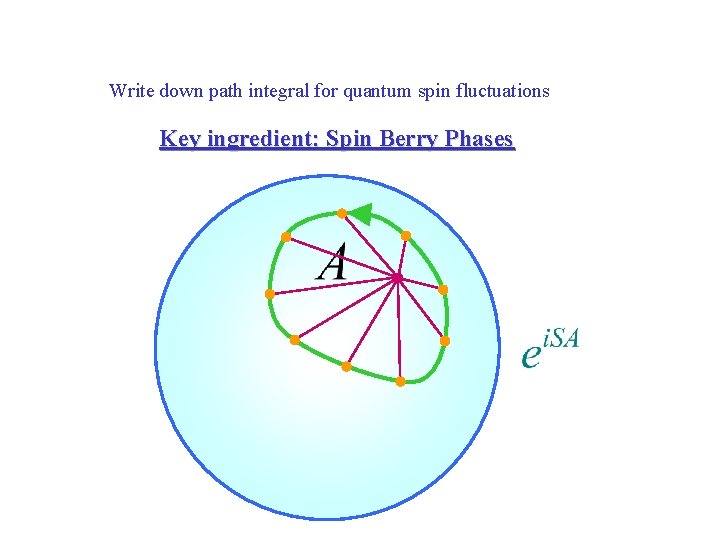
Write down path integral for quantum spin fluctuations Key ingredient: Spin Berry Phases
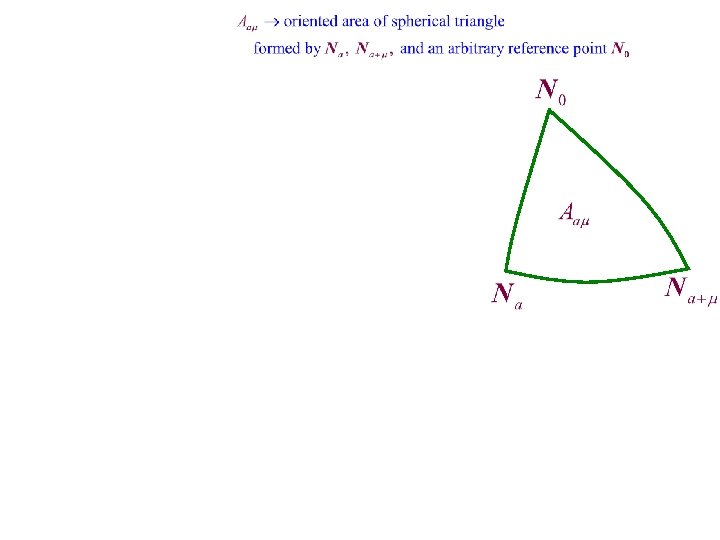
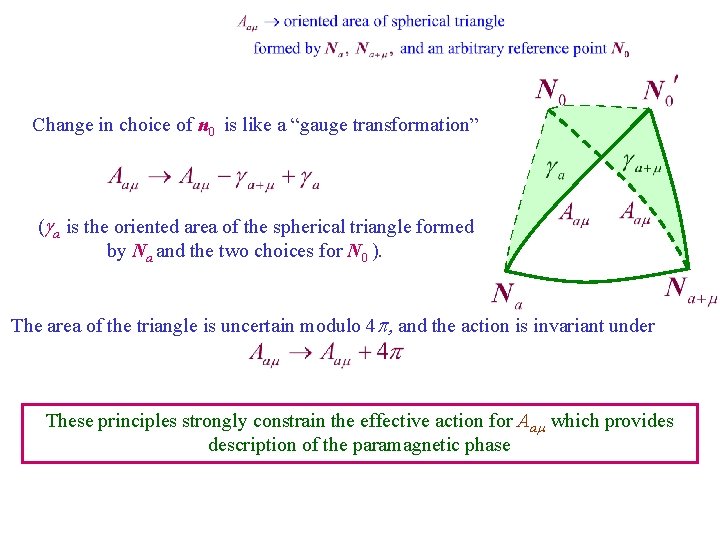
Change in choice of n 0 is like a “gauge transformation” (ga is the oriented area of the spherical triangle formed by Na and the two choices for N 0 ). The area of the triangle is uncertain modulo 4 p, and the action is invariant under These principles strongly constrain the effective action for Aam which provides description of the paramagnetic phase
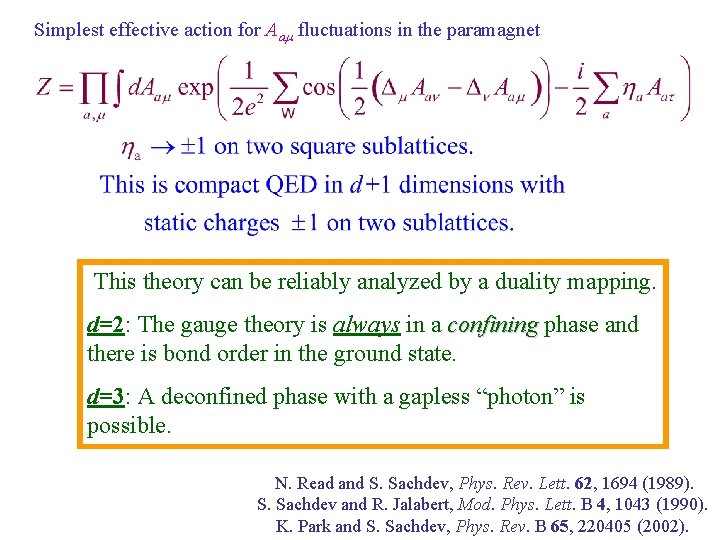
Simplest effective action for Aam fluctuations in the paramagnet This theory can be reliably analyzed by a duality mapping. d=2: The gauge theory is always in a confining phase and there is bond order in the ground state. d=3: A deconfined phase with a gapless “photon” is possible. N. Read and S. Sachdev, Phys. Rev. Lett. 62, 1694 (1989). S. Sachdev and R. Jalabert, Mod. Phys. Lett. B 4, 1043 (1990). K. Park and S. Sachdev, Phys. Rev. B 65, 220405 (2002).
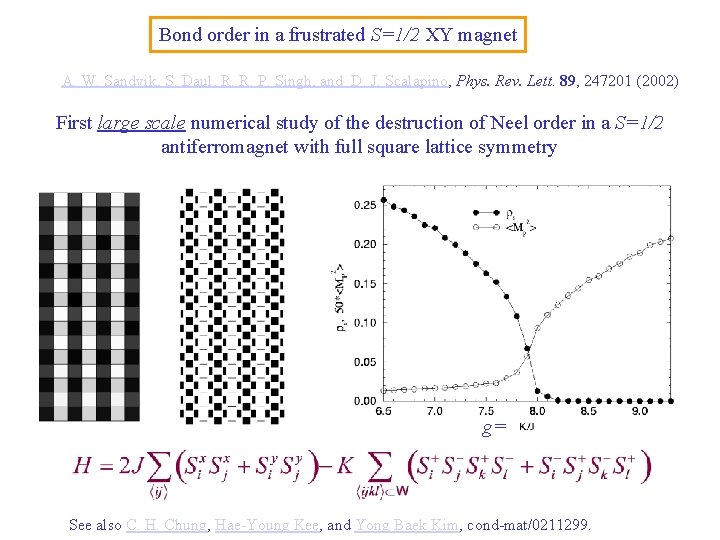
Bond order in a frustrated S=1/2 XY magnet A. W. Sandvik, S. Daul, R. R. P. Singh, and D. J. Scalapino, Phys. Rev. Lett. 89, 247201 (2002) First large scale numerical study of the destruction of Neel order in a S=1/2 antiferromagnet with full square lattice symmetry g= See also C. H. Chung, Hae-Young Kee, and Yong Baek Kim, cond-mat/0211299.
Competing order parameters in the cuprate superconductors 1. Pairing order of BCS theory (Bose-Einstein) condensation of d-wave Cooper pairs Orders associated with proximate Mott insulator 2. Collinear magnetic order 3. Bond/charge/stripe order (couples strongly to half-breathing phonons) S. Sachdev and N. Read, Int. J. Mod. Phys. B 5, 219 (1991). M. Vojta and S. Sachdev, Phys. Rev. Lett. 83, 3916 (1999); M. Vojta, Y. Zhang, and S. Sachdev, Phys. Rev. B 62, 6721 (2000); M. Vojta, Phys. Rev. B 66, 104505 (2002).
Compact U(1) gauge theory: Deconfined spinons and quantum criticality in heavy fermion compounds in d=3 (talk by Matthias Vojta on Friday 10: 00)
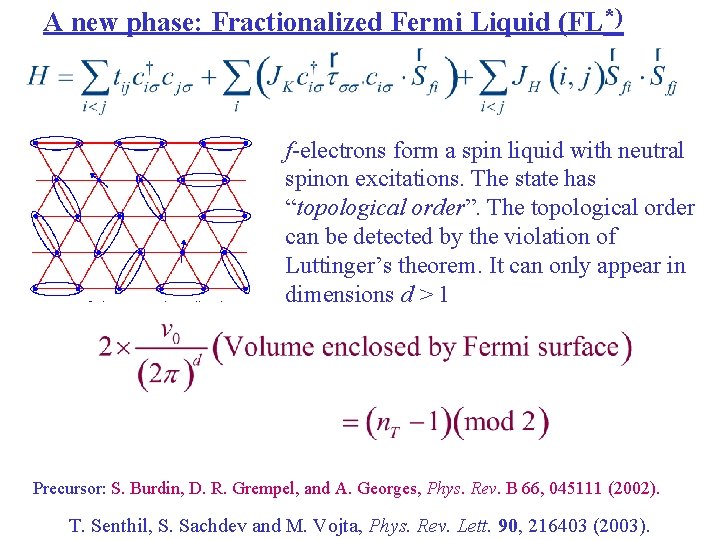
A new phase: Fractionalized Fermi Liquid (FL*) f-electrons form a spin liquid with neutral spinon excitations. The state has “topological order”. The topological order can be detected by the violation of Luttinger’s theorem. It can only appear in dimensions d > 1 Precursor: S. Burdin, D. R. Grempel, and A. Georges, Phys. Rev. B 66, 045111 (2002). T. Senthil, S. Sachdev and M. Vojta, Phys. Rev. Lett. 90, 216403 (2003).
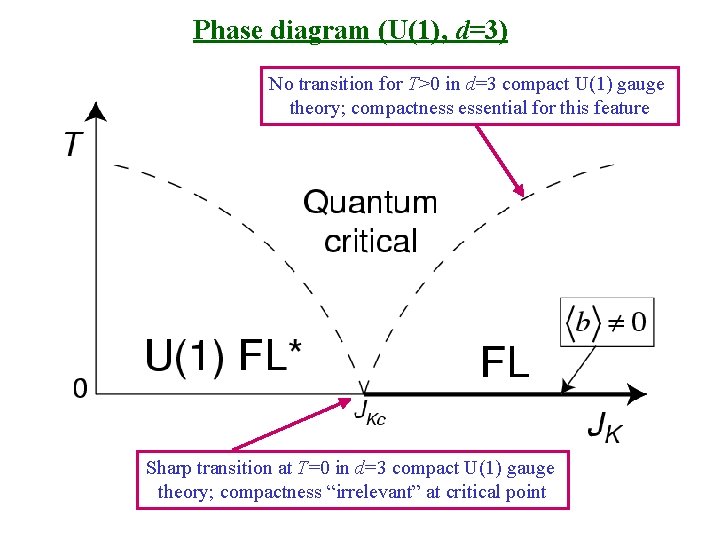
Phase diagram (U(1), d=3) No transition for T>0 in d=3 compact U(1) gauge theory; compactness essential for this feature Sharp transition at T=0 in d=3 compact U(1) gauge theory; compactness “irrelevant” at critical point
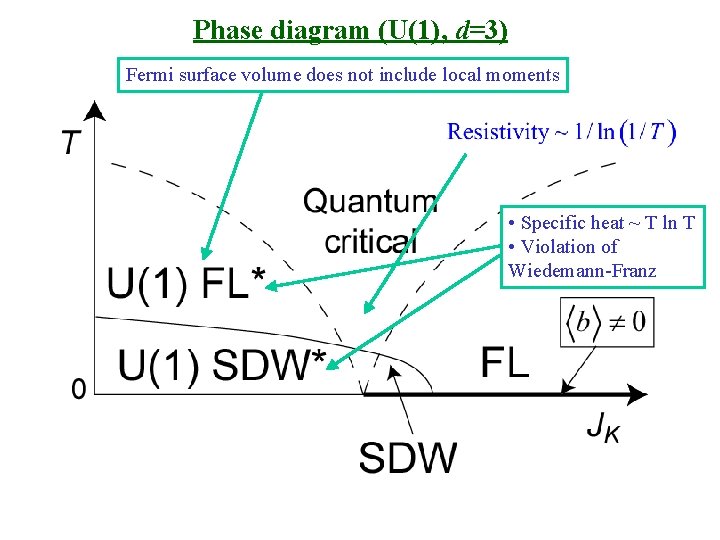
Phase diagram (U(1), d=3) Fermi surface volume does not include local moments • Specific heat ~ T ln T • Violation of Wiedemann-Franz
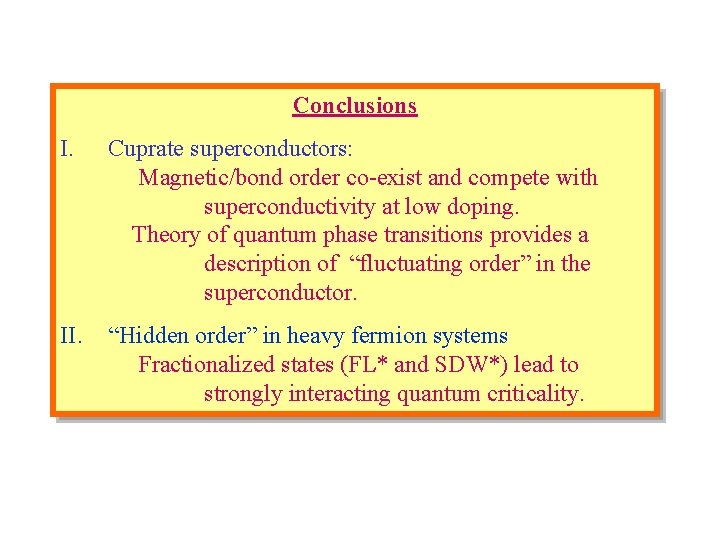
Conclusions I. Cuprate superconductors: Magnetic/bond order co-exist and compete with superconductivity at low doping. Theory of quantum phase transitions provides a description of “fluctuating order” in the superconductor. II. “Hidden order” in heavy fermion systems Fractionalized states (FL* and SDW*) lead to strongly interacting quantum criticality.