
Quantum Computing Rieffel Polak Chapter 3 Drs Charles

- Slides: 18
Quantum Computing, Rieffel & Polak Chapter 3 Drs. Charles Tappert and Ron Frank The information presented here, although greatly condensed, comes almost entirely from the textbook
Chapter 3 – Multiple-Qubit Systems n The state space of a quantum system grows exponentially with the number of qubits n n Entangled states are a critical ingredient of quantum computation n n Large state spaces speed computation – main focus of book Most states in a multiple-qubit system are entangled Difference between the way classical and quantum states combine n n Classical uses direct sum of two or more vector spaces Quantum uses the tensor product of a set of vector spaces
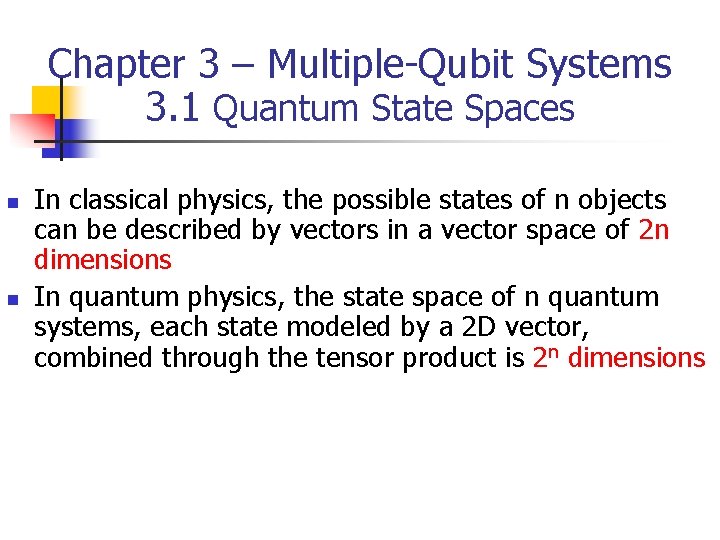
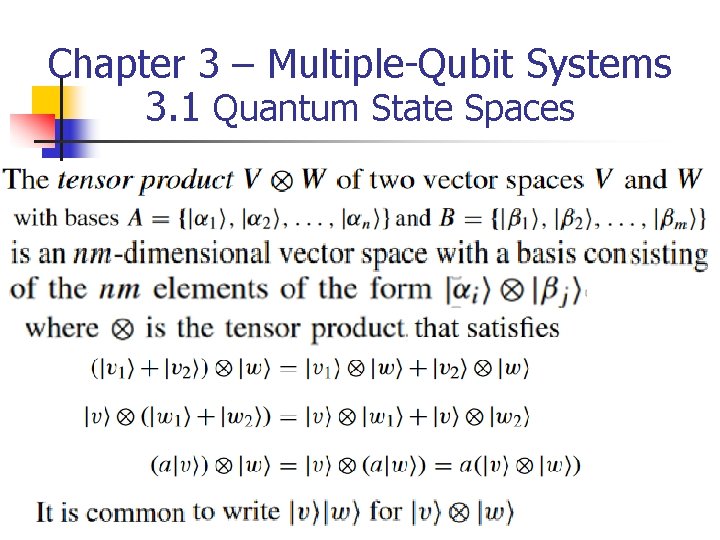
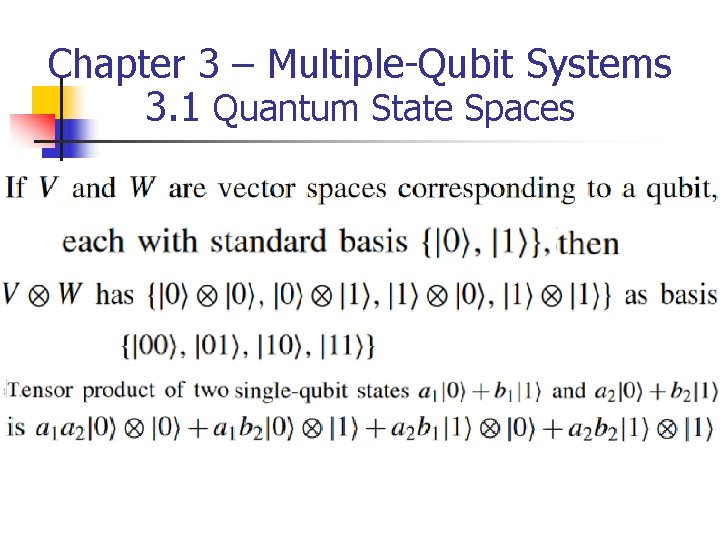
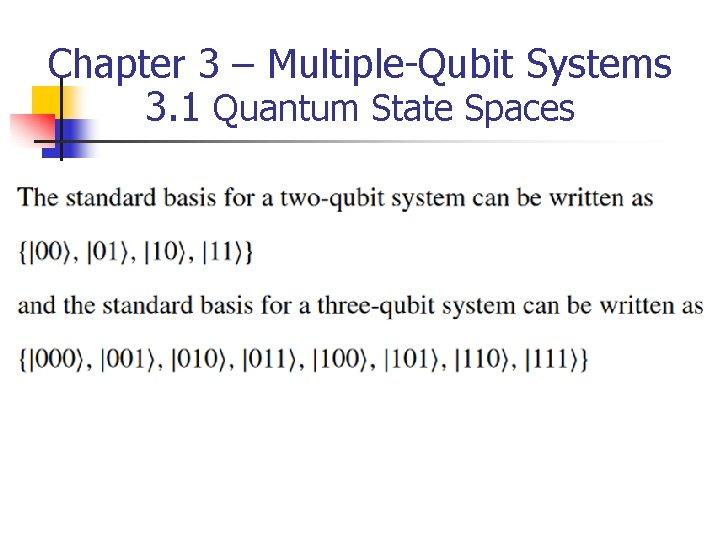
Chapter 3 – Multiple-Qubit Systems 3. 1 Quantum State Spaces n n In classical physics, the possible states of n objects can be described by vectors in a vector space of 2 n dimensions In quantum physics, the state space of n quantum systems, each state modeled by a 2 D vector, combined through the tensor product is 2 n dimensions
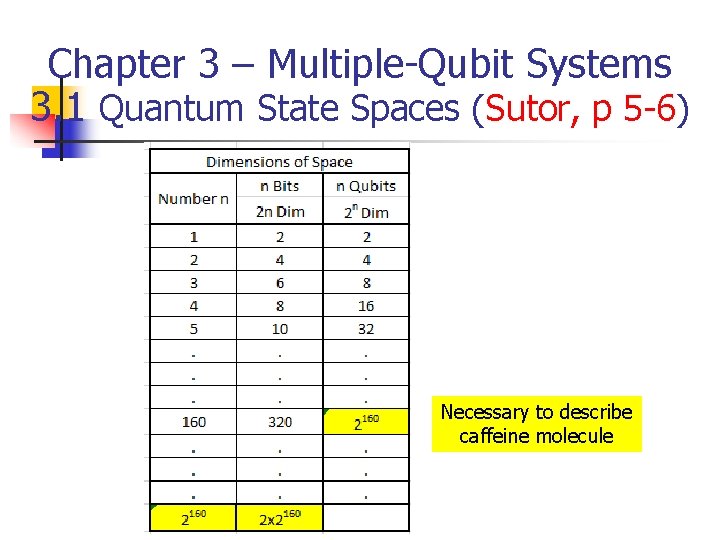
Chapter 3 – Multiple-Qubit Systems 3. 1 Quantum State Spaces (Sutor, p 5 -6) n n Sutor discusses the caffeine molecule C 8 H 10 N 4 O 2 To describe the molecule’s energy configuration – structure and bonds – requires 1048 bits of information n n But there are between 1049 and 1050 atoms in our planet However, 160 qubits could hold 2160 = 1. 46 x 1048 bits of information
Chapter 3 – Multiple-Qubit Systems 3. 1 Quantum State Spaces (Sutor, p 5 -6) Necessary to describe caffeine molecule
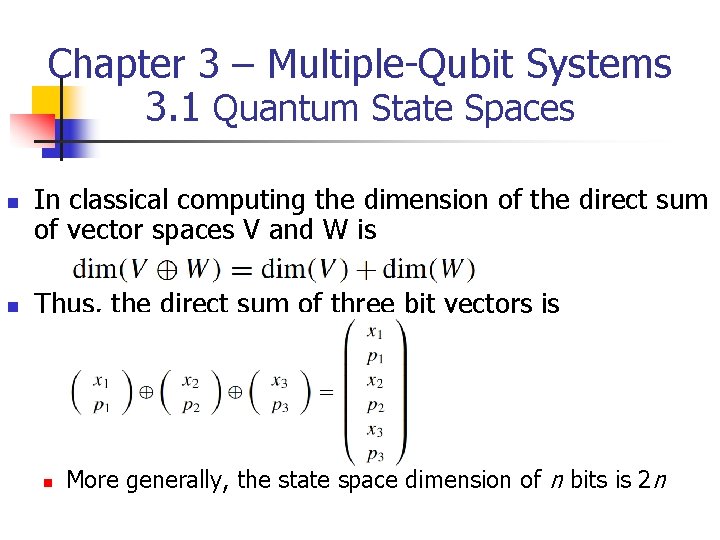
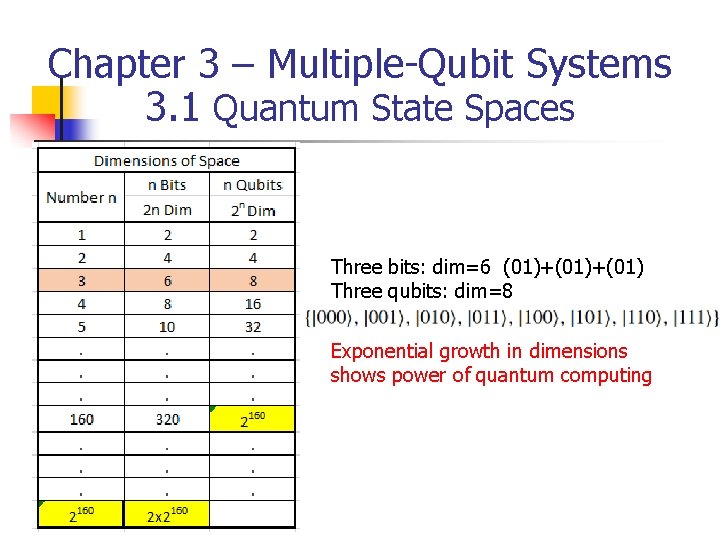
Chapter 3 – Multiple-Qubit Systems 3. 1 Quantum State Spaces n n In classical computing the dimension of the direct sum of vector spaces V and W is Thus, the direct sum of three bit vectors is n More generally, the state space dimension of n bits is 2 n
Chapter 3 – Multiple-Qubit Systems 3. 1 Quantum State Spaces
Chapter 3 – Multiple-Qubit Systems 3. 1 Quantum State Spaces
Chapter 3 – Multiple-Qubit Systems 3. 1 Quantum State Spaces
Chapter 3 – Multiple-Qubit Systems 3. 1 Quantum State Spaces Three bits: dim=6 (01)+(01) Three qubits: dim=8 Exponential growth in dimensions shows power of quantum computing
Chapter 3 – Multiple-Qubit Systems 3. 1 Quantum State Spaces
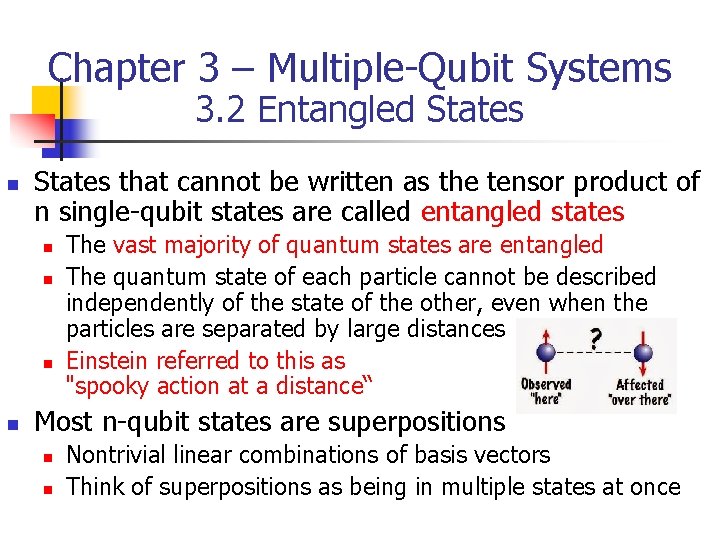
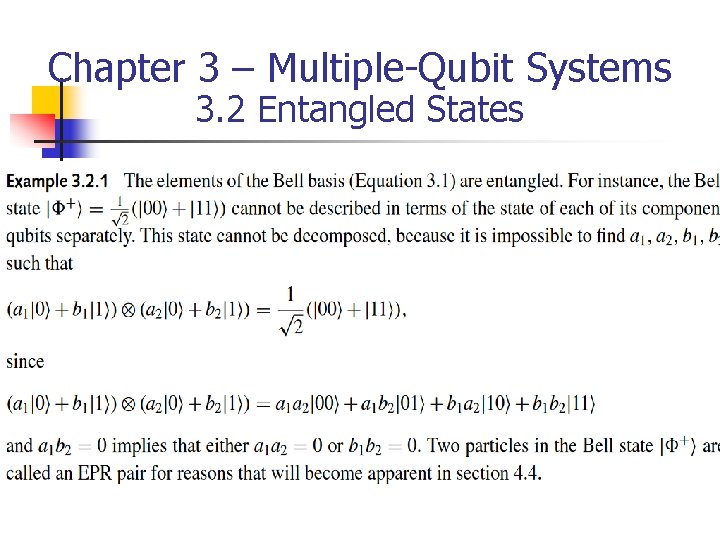
Chapter 3 – Multiple-Qubit Systems 3. 2 Entangled States n States that cannot be written as the tensor product of n single-qubit states are called entangled states n n The vast majority of quantum states are entangled The quantum state of each particle cannot be described independently of the state of the other, even when the particles are separated by large distances Einstein referred to this as "spooky action at a distance“ Most n-qubit states are superpositions n n Nontrivial linear combinations of basis vectors Think of superpositions as being in multiple states at once
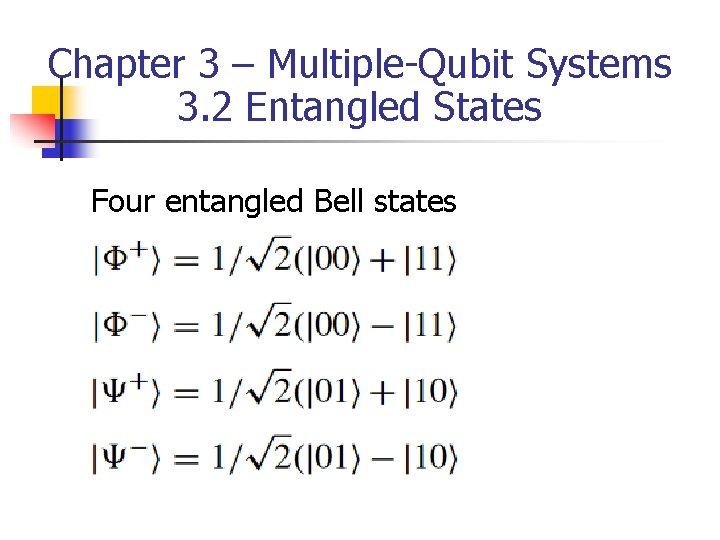
Chapter 3 – Multiple-Qubit Systems 3. 2 Entangled States Four entangled Bell states
Chapter 3 – Multiple-Qubit Systems 3. 2 Entangled States
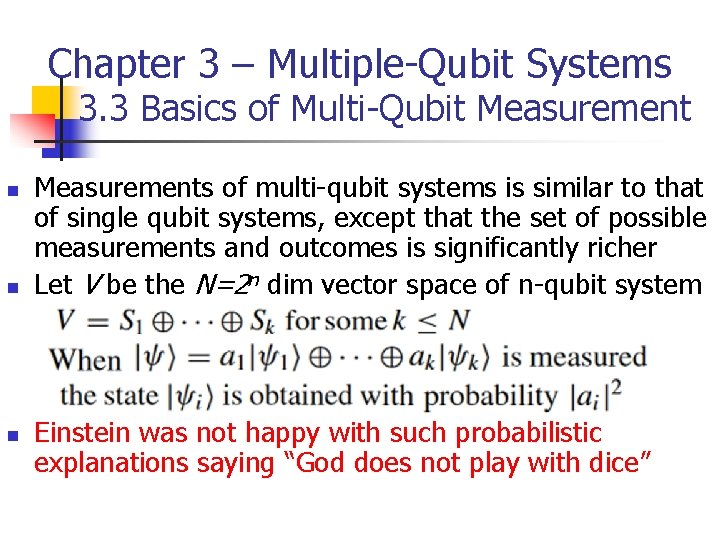
Chapter 3 – Multiple-Qubit Systems 3. 3 Basics of Multi-Qubit Measurement n n n Measurements of multi-qubit systems is similar to that of single qubit systems, except that the set of possible measurements and outcomes is significantly richer Let V be the N=2 n dim vector space of n-qubit system Einstein was not happy with such probabilistic explanations saying “God does not play with dice”
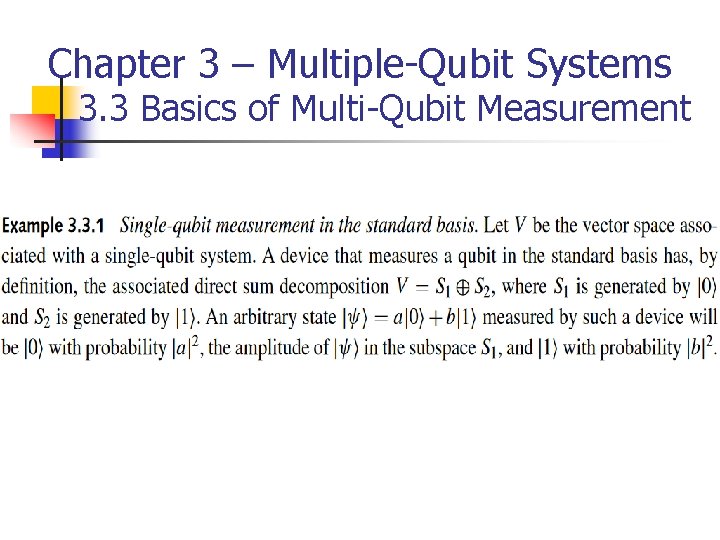
Chapter 3 – Multiple-Qubit Systems 3. 3 Basics of Multi-Qubit Measurement
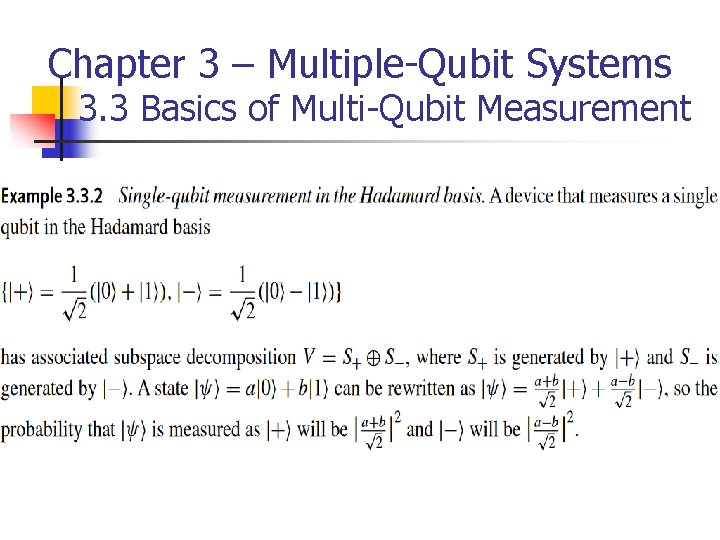
Chapter 3 – Multiple-Qubit Systems 3. 3 Basics of Multi-Qubit Measurement
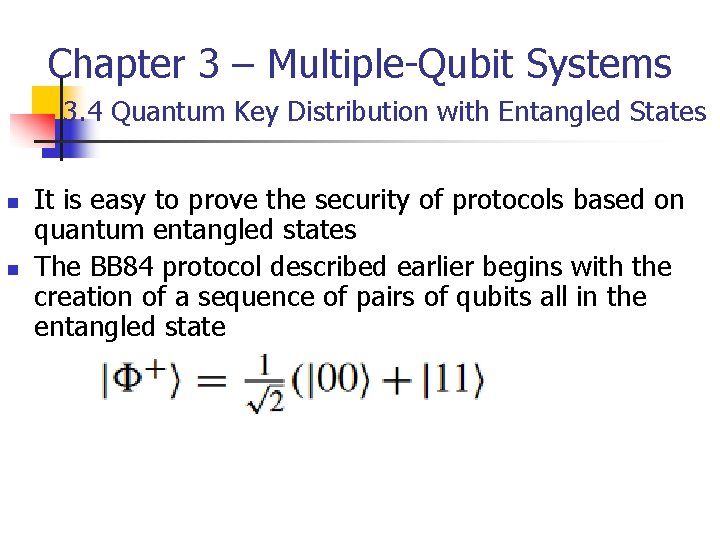
Chapter 3 – Multiple-Qubit Systems 3. 4 Quantum Key Distribution with Entangled States n n It is easy to prove the security of protocols based on quantum entangled states The BB 84 protocol described earlier begins with the creation of a sequence of pairs of qubits all in the entangled state