
Quantum Computing Lecture 19 Robert Mann Nuclear Magnetic
Quantum Computing Lecture 19 Robert Mann
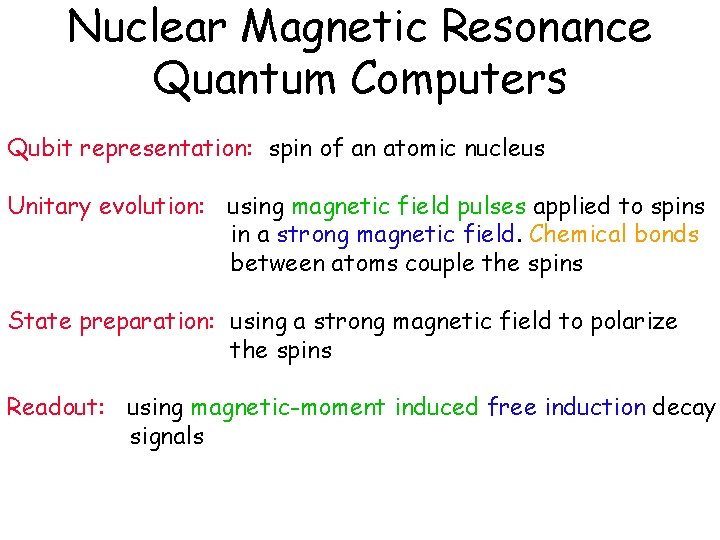
Nuclear Magnetic Resonance Quantum Computers Qubit representation: spin of an atomic nucleus Unitary evolution: using magnetic field pulses applied to spins in a strong magnetic field. Chemical bonds between atoms couple the spins State preparation: using a strong magnetic field to polarize the spins Readout: using magnetic-moment induced free induction decay signals
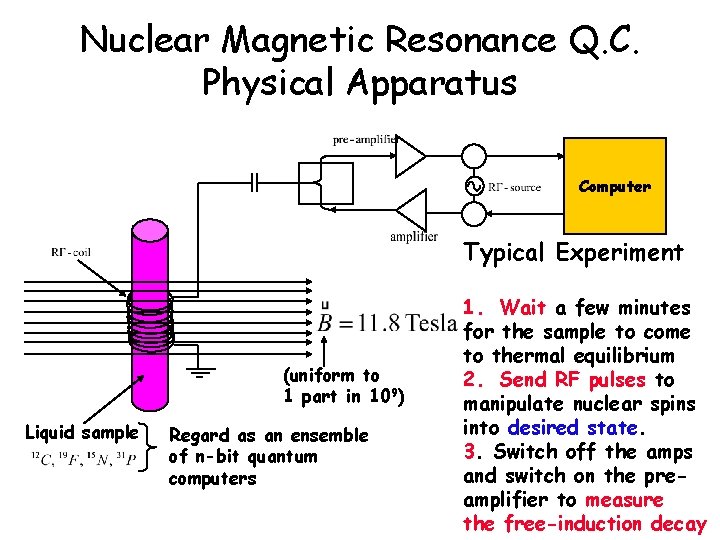
Nuclear Magnetic Resonance Q. C. Physical Apparatus Computer Typical Experiment (uniform to 1 part in 109) Liquid sample Regard as an ensemble of n-bit quantum computers 1. Wait a few minutes for the sample to come to thermal equilibrium 2. Send RF pulses to manipulate nuclear spins into desired state. 3. Switch off the amps and switch on the preamplifier to measure the free-induction decay
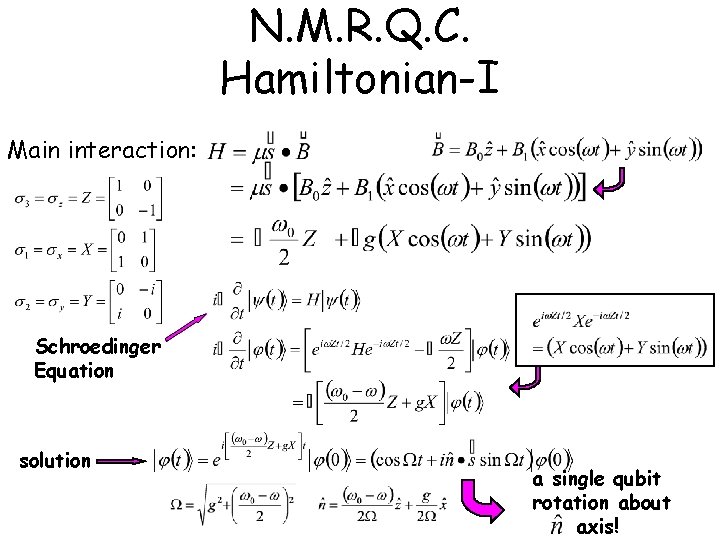
N. M. R. Q. C. Hamiltonian-I Main interaction: Schroedinger Equation solution a single qubit rotation about axis!
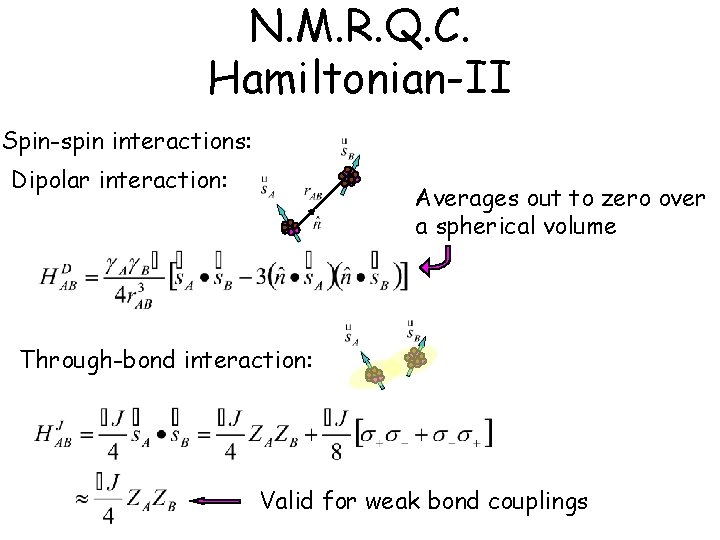
N. M. R. Q. C. Hamiltonian-II Spin-spin interactions: Dipolar interaction: Averages out to zero over a spherical volume Through-bond interaction: Valid for weak bond couplings

N. M. R. Q. C. Hamiltonian-III Thermal Equilibrium: For n spins, the density matrix is a mixture of the pure states Magnetization Readout: For kth spin Decoherence effects: Models decoherence effects due to inhomogeneities, thermalization, etc.
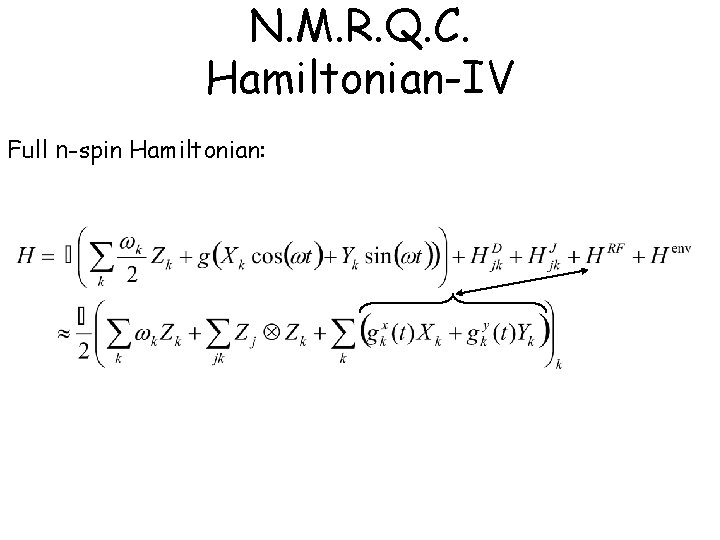
N. M. R. Q. C. Hamiltonian-IV Full n-spin Hamiltonian:
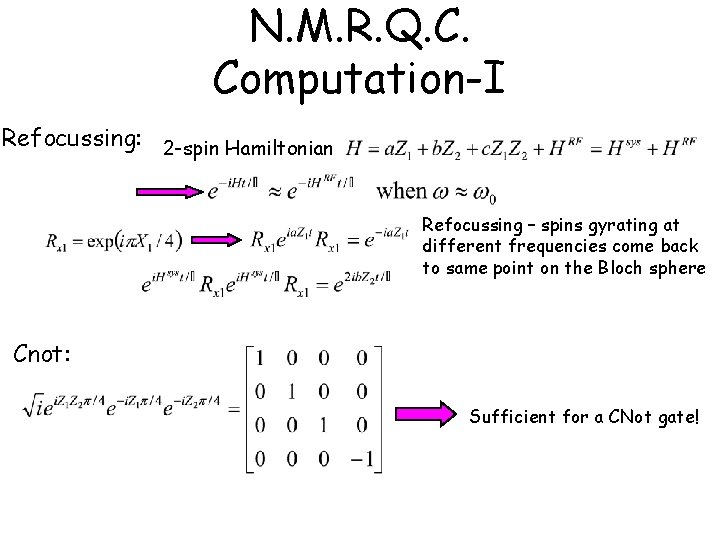
N. M. R. Q. C. Computation-I Refocussing: 2 -spin Hamiltonian Refocussing – spins gyrating at different frequencies come back to same point on the Bloch sphere Cnot: Sufficient for a CNot gate!
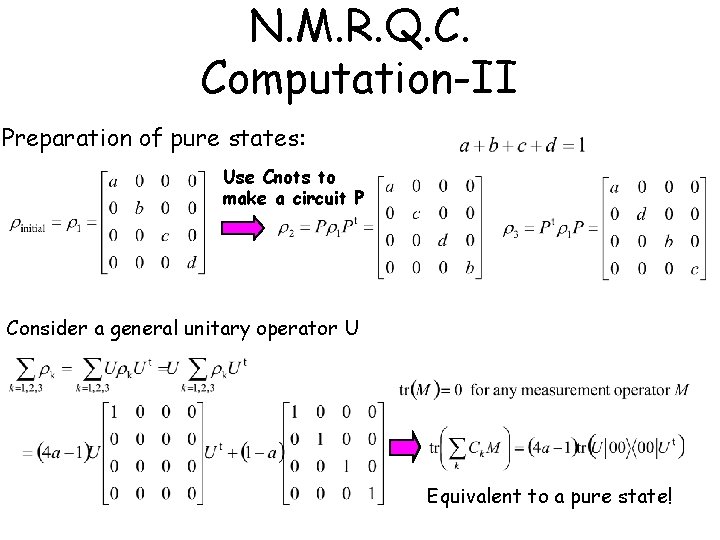
N. M. R. Q. C. Computation-II Preparation of pure states: Use Cnots to make a circuit P Consider a general unitary operator U Equivalent to a pure state!
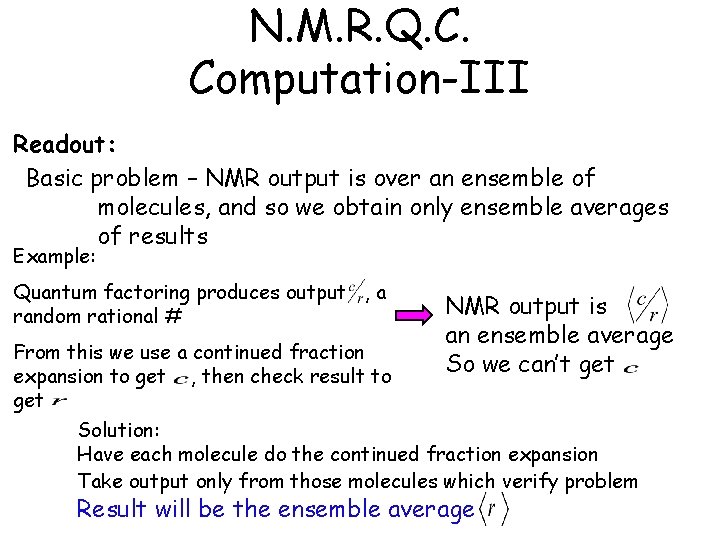
N. M. R. Q. C. Computation-III Readout: Basic problem – NMR output is over an ensemble of molecules, and so we obtain only ensemble averages of results Example: Quantum factoring produces output , a random rational # From this we use a continued fraction expansion to get , then check result to get NMR output is an ensemble average So we can’t get Solution: Have each molecule do the continued fraction expansion Take output only from those molecules which verify problem Result will be the ensemble average
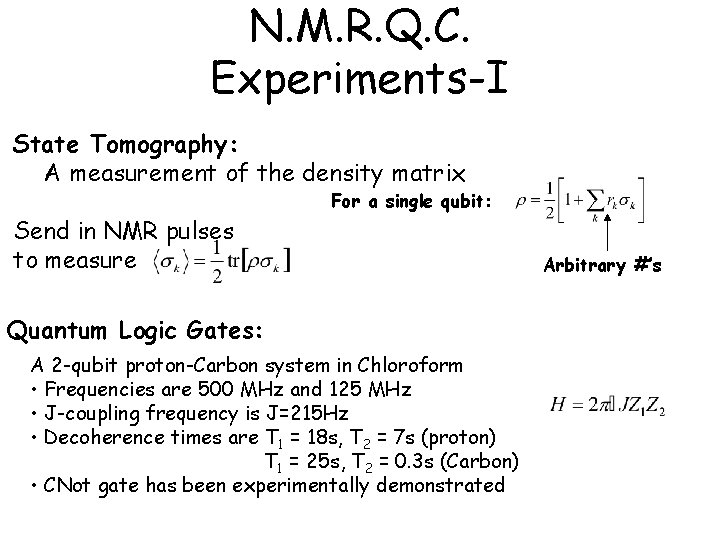
N. M. R. Q. C. Experiments-I State Tomography: A measurement of the density matrix For a single qubit: Send in NMR pulses to measure Quantum Logic Gates: A 2 -qubit proton-Carbon system in Chloroform • Frequencies are 500 MHz and 125 MHz • J-coupling frequency is J=215 Hz • Decoherence times are T 1 = 18 s, T 2 = 7 s (proton) T 1 = 25 s, T 2 = 0. 3 s (Carbon) • CNot gate has been experimentally demonstrated Arbitrary #’s
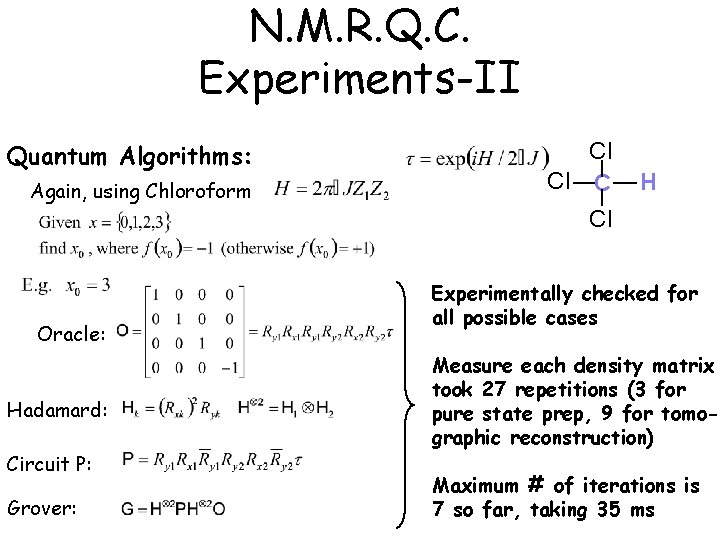
N. M. R. Q. C. Experiments-II Quantum Algorithms: Again, using Chloroform Cl Cl C H Cl Oracle: Hadamard: Circuit P: Grover: Experimentally checked for all possible cases Measure each density matrix took 27 repetitions (3 for pure state prep, 9 for tomographic reconstruction) Maximum # of iterations is 7 so far, taking 35 ms
N. M. R. Q. C. Drawbacks 1. Total Signal decreases exponentially as the number of qubits distilled into a pure state 2. Structure of the molecule constrains the computer architecture – determining what qubits interact with each other
- Slides: 13