
Quantum Computing Fact vs Fiction Scott Aaronson University
- Slides: 10
Quantum Computing: Fact vs. Fiction Scott Aaronson (University of Texas at Austin) Chicago Quantum Summit, November 12, 2020
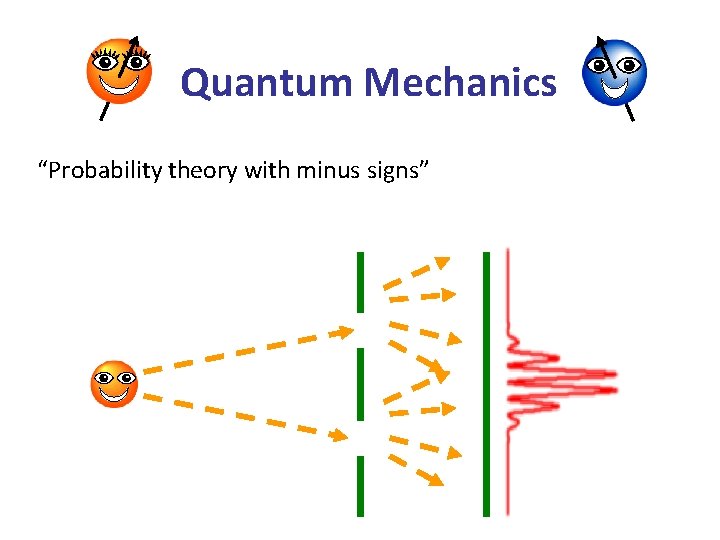
Quantum Mechanics “Probability theory with minus signs”
THE RULES: If a system can be in two distinguishable states, labeled |0 and |1 , it can also be in a superposition, written |0 + |1 Here and are complex numbers called amplitudes, which satisfy | |2+| |2=1. A 2 -state superposition is called a qubit. If we observe, we see |0 with probability | |2 and |1 with probability | |2. But if the qubit is isolated, it evolves by rules different from those of classical probability. In the 1980 s, Feynman, Deutsch, and others noticed that a system of n qubits seems to take ~2 n steps to simulate on a classical computer, because of the phenomenon of entanglement between the qubits. They had the amazing idea of building a quantum computer to overcome that problem
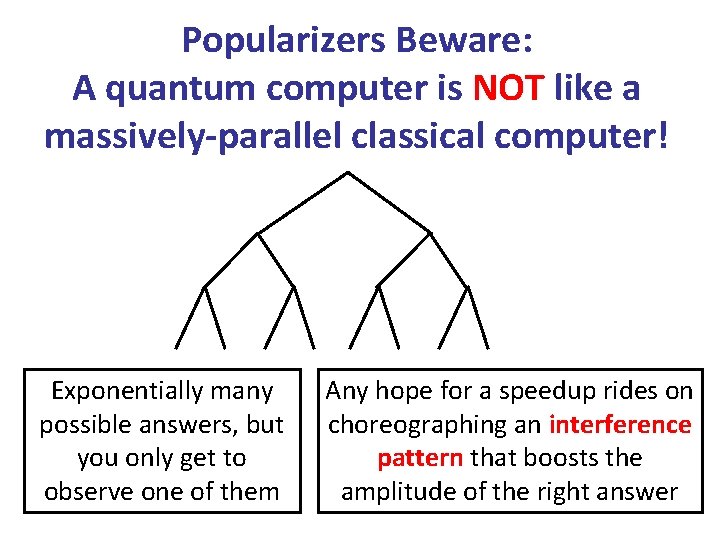
Popularizers Beware: A quantum computer is NOT like a massively-parallel classical computer! Exponentially many possible answers, but you only get to observe one of them Any hope for a speedup rides on choreographing an interference pattern that boosts the amplitude of the right answer
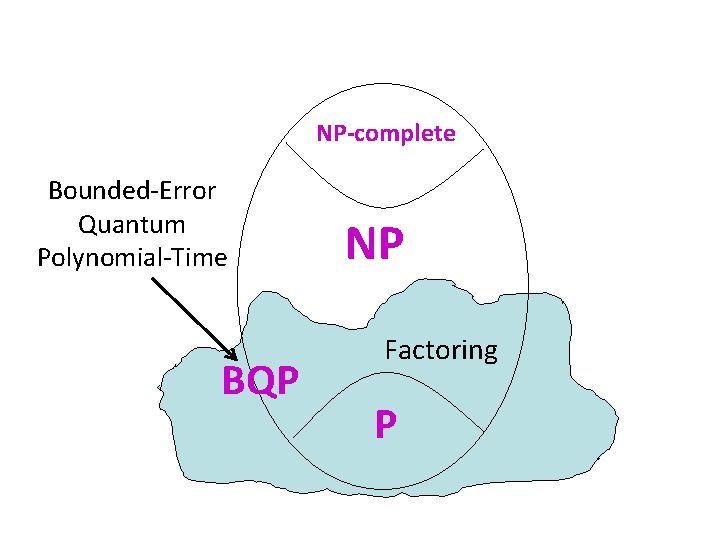
NP-complete Bounded-Error Quantum Polynomial-Time BQP NP Factoring P
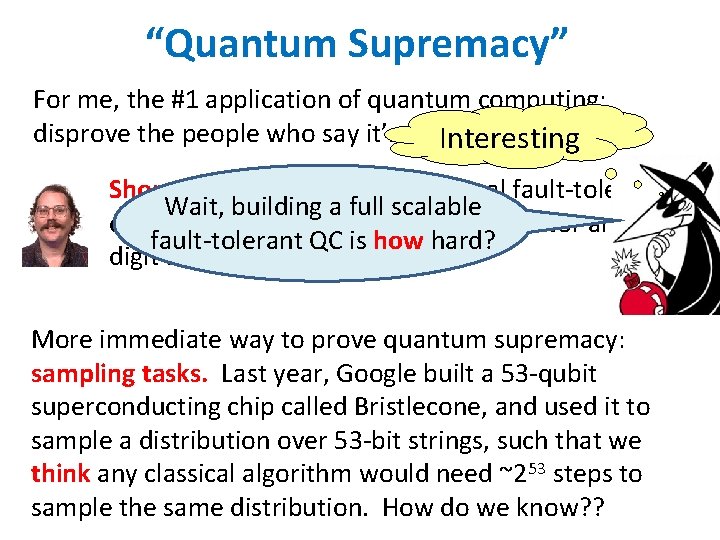
“Quantum Supremacy” For me, the #1 application of quantum computing: disprove the people who say it’s not. Interesting possible! Shor 1994: Fully scalable, universal fault-tolerant Wait, building a full scalable quantum computers will be able to factor an nfault-tolerant QC is 2 how hard? digit integer in only ~n steps More immediate way to prove quantum supremacy: sampling tasks. Last year, Google built a 53 -qubit superconducting chip called Bristlecone, and used it to sample a distribution over 53 -bit strings, such that we think any classical algorithm would need ~253 steps to sample the same distribution. How do we know? ?
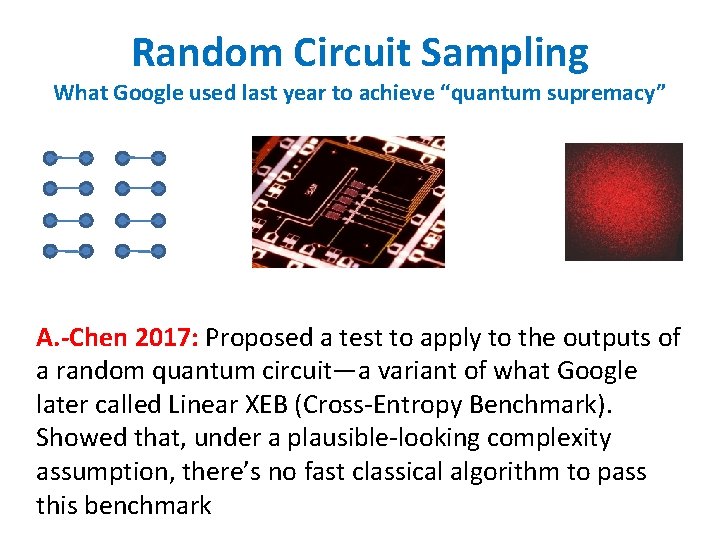
Random Circuit Sampling What Google used last year to achieve “quantum supremacy” A. -Chen 2017: Proposed a test to apply to the outputs of a random quantum circuit—a variant of what Google later called Linear XEB (Cross-Entropy Benchmark). Showed that, under a plausible-looking complexity assumption, there’s no fast classical algorithm to pass this benchmark
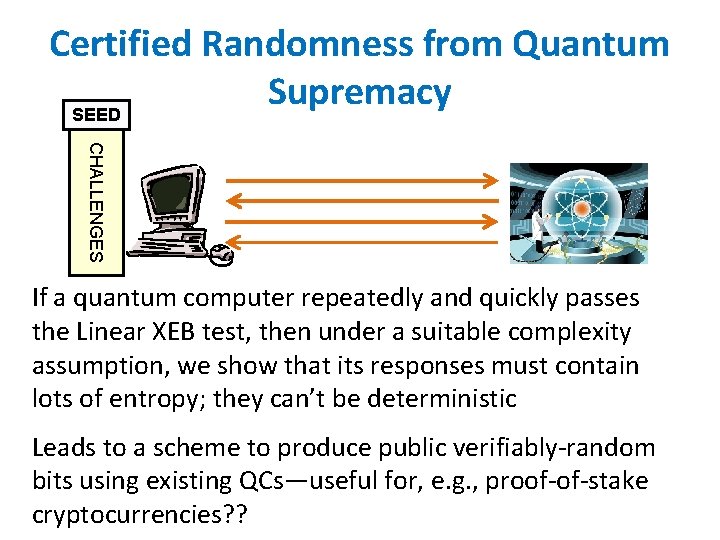
Certified Randomness from Quantum Supremacy SEED CHALLENGES If a quantum computer repeatedly and quickly passes the Linear XEB test, then under a suitable complexity assumption, we show that its responses must contain lots of entropy; they can’t be deterministic Leads to a scheme to produce public verifiably-random bits using existing QCs—useful for, e. g. , proof-of-stake cryptocurrencies? ?
Ewin Tang’s Breakthrough (2018) Ewin was a junior in my Intro to Quantum Information Science undergrad course at UT For her senior thesis, she “de-quantized” the main example we’d had of a quantum algorithm thought to get exponential speedup for a real-world machine learning problem: the Kerenidis-Prakash algorithm for recommending products in Netflix-like systems I. e. , gave a classical randomized algorithm that was only polynomially slower This was the opposite of what we and others expected, and underscores the need for careful theoretical study of quantum speedups
Summary This is a particularly exciting time for QC. After decades of theory and experiment, we’ve finally started to see clear speedups over classical computers for specialized problems, with ~50 -70 qubit devices Achieving full scalability and fault-tolerance, and threatening public-key crypto, will take longer Quantum speedups are subtle and depend on structure Not just free exponential parallelism—”weirder than a sci-fi writer would have had the imagination to invent!”