
Quantum Computing and the Limits of the Efficiently






- Slides: 21
Quantum Computing and the Limits of the Efficiently Computable Scott Aaronson (UT Austin) Cornell Messenger Lecture, November 28, 2017 Papers and slides at www. scottaaronson. com
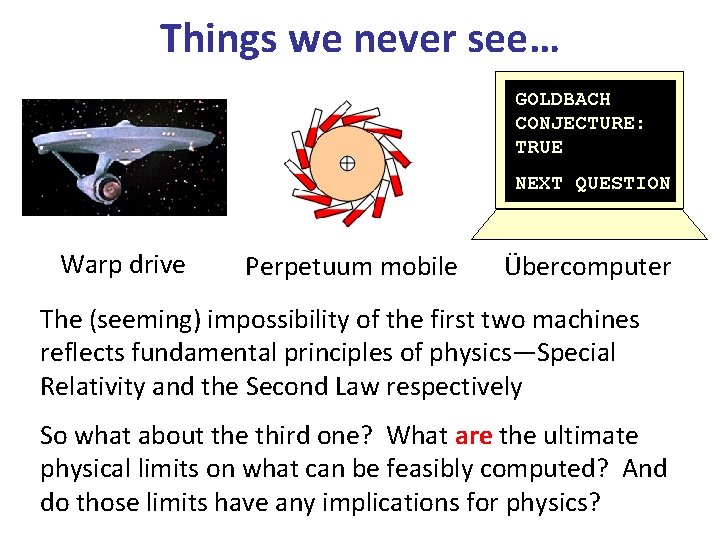
Things we never see… GOLDBACH CONJECTURE: TRUE NEXT QUESTION Warp drive Perpetuum mobile Übercomputer The (seeming) impossibility of the first two machines reflects fundamental principles of physics—Special Relativity and the Second Law respectively So what about the third one? What are the ultimate physical limits on what can be feasibly computed? And do those limits have any implications for physics?
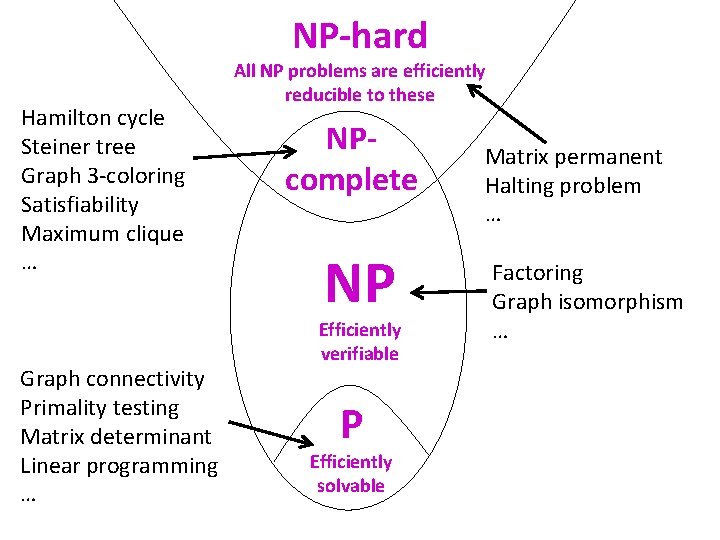
NP-hard Hamilton cycle Steiner tree Graph 3 -coloring Satisfiability Maximum clique … Graph connectivity Primality testing Matrix determinant Linear programming … All NP problems are efficiently reducible to these NPcomplete NP Efficiently verifiable P Efficiently solvable Matrix permanent Halting problem … Factoring Graph isomorphism …
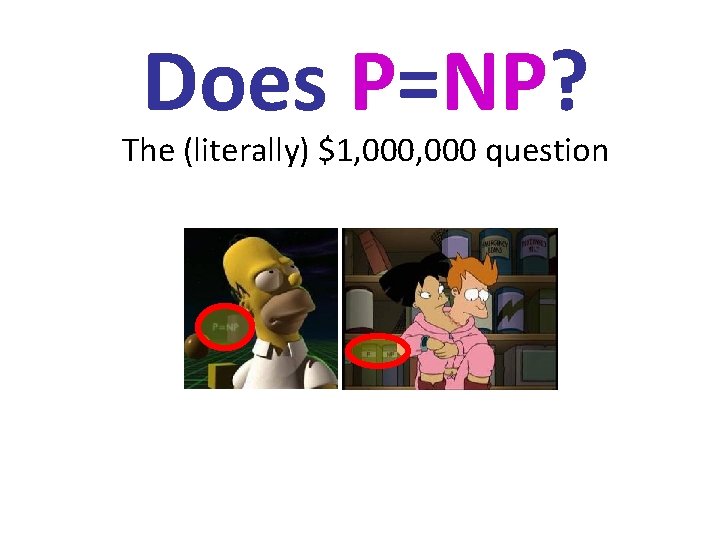
Does P=NP? The (literally) $1, 000 question
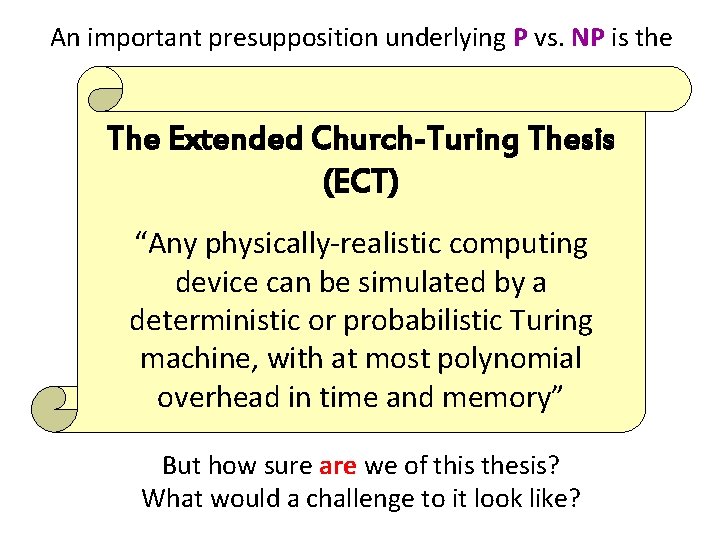
An important presupposition underlying P vs. NP is the The Extended Church-Turing Thesis (ECT) “Any physically-realistic computing device can be simulated by a deterministic or probabilistic Turing machine, with at most polynomial overhead in time and memory” But how sure are we of this thesis? What would a challenge to it look like?
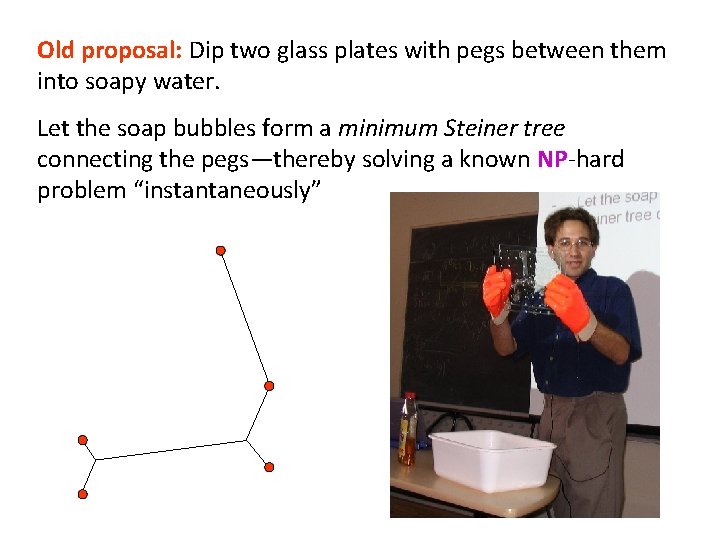
Old proposal: Dip two glass plates with pegs between them into soapy water. Let the soap bubbles form a minimum Steiner tree connecting the pegs—thereby solving a known NP-hard problem “instantaneously”
Relativity Computer DONE
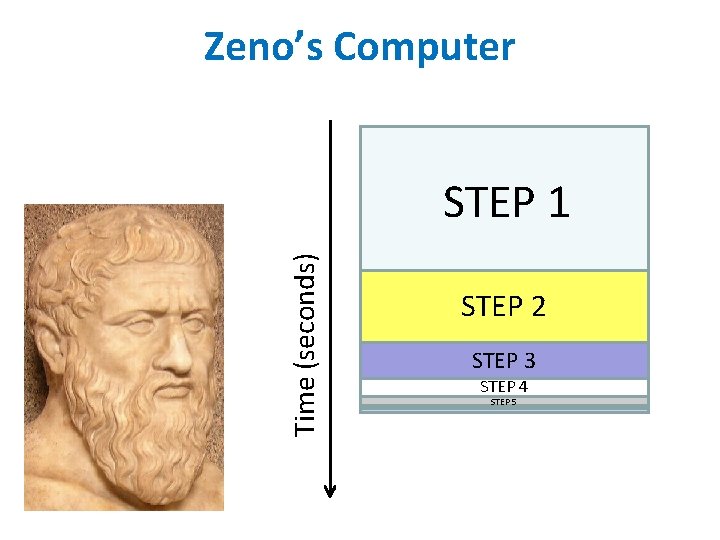
Zeno’s Computer Time (seconds) STEP 1 STEP 2 STEP 3 STEP 4 STEP 5
Ah, but what about quantum computing? (you knew it was coming) Quantum mechanics: “Probability theory with minus signs” (Nature seems to prefer it that way)
The Famous Double-Slit Experiment Probability of landing in “dark patch” = |amplitude|2 = |amplitude. Slit 1 + amplitude. Slit 2|2 = 0 Yet if you close one of the slits, the photon can appear in that previously dark patch!
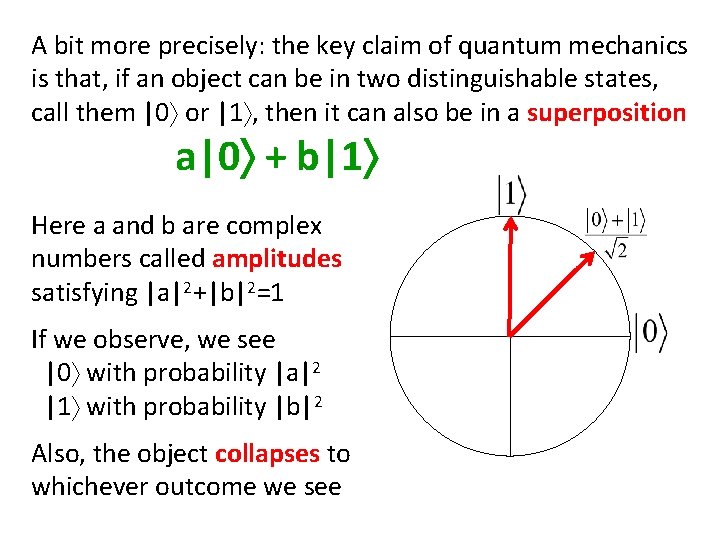
A bit more precisely: the key claim of quantum mechanics is that, if an object can be in two distinguishable states, call them |0 or |1 , then it can also be in a superposition a|0 + b|1 Here a and b are complex numbers called amplitudes satisfying |a|2+|b|2=1 If we observe, we see |0 with probability |a|2 |1 with probability |b|2 Also, the object collapses to whichever outcome we see
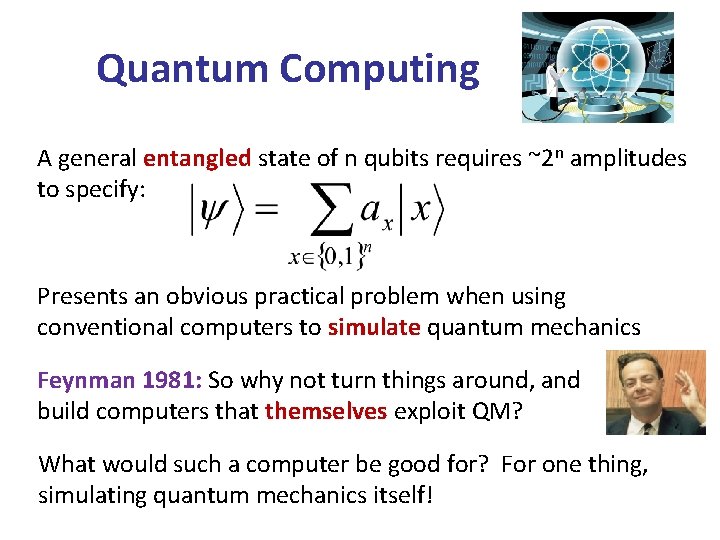
Quantum Computing A general entangled state of n qubits requires ~2 n amplitudes to specify: Presents an obvious practical problem when using conventional computers to simulate quantum mechanics Feynman 1981: So why not turn things around, and build computers that themselves exploit QM? What would such a computer be good for? For one thing, simulating quantum mechanics itself!
Journalists Beware: A quantum computer is NOT like a massively-parallel classical computer! Exponentially many possible outcomes, but you only get to observe one of them Any hope for a speedup rides on the magic of quantum interference
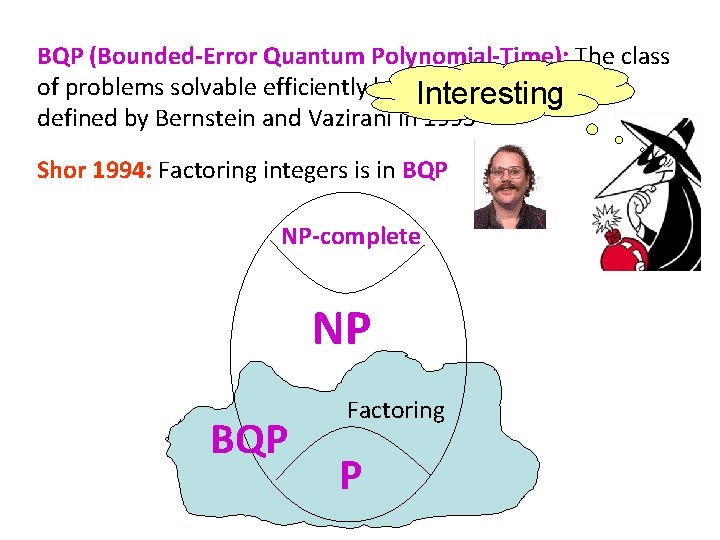
BQP (Bounded-Error Quantum Polynomial-Time): The class of problems solvable efficiently by a. Interesting quantum computer, defined by Bernstein and Vazirani in 1993 Shor 1994: Factoring integers is in BQP NP-complete NP BQP Factoring P
Can QCs Actually Be Built? Where we are now with implementing Shor’s factoring algorithm: 21 = 3 7 with high probability Why is scaling up so hard? Because of decoherence: unwanted interaction between a QC and its external environment, “prematurely measuring” the quantum state A few skeptics, in CS and physics, even argue that QC beyond some size is fundamentally impossible The #1 application of QC, in my mind: disproving those people! What makes many of us optimistic of eventual success: the Quantum Fault-Tolerance Theorem
Can QCs Solve NP-complete Problems in Polynomial Time? We don’t know—but most of us conjecture not Grover’s Algorithm (1996): Searches any space of N possible solutions in only about N steps, assuming you can check the solutions in superposition Bennett, Bernstein, Brassard, Vazirani: For “black-box” searching, Grover’s algorithm is the best you can do, even with a quantum computer So if there were a fast quantum algorithm for NP-complete problems, it would have to exploit their structure somehow
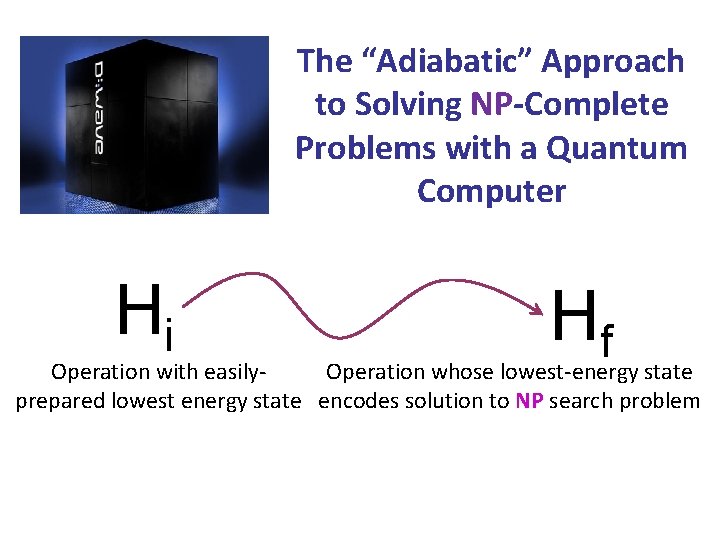
The “Adiabatic” Approach to Solving NP-Complete Problems with a Quantum Computer Hi Hf Operation with easily. Operation whose lowest-energy state prepared lowest energy state encodes solution to NP search problem
Hope: “Quantum tunneling” could give speedups over classical optimization methods for finding global optima Remains unclear how much useful speedup adiabatic optimization can give over the best classical heuristics, even Problem: “Eigenvalue gap” assuming perfect hardware (unlike D-Wave) can be exponentially small
“Quantum Supremacy” Getting a clear quantum speedup for some task—not necessarily a useful one Boson. Sampling (with Alex Arkhipov): A proposal for a simple optical quantum computer to sample a distribution that (we think) can’t be Experimentally demonstrated with 6 sampled efficiently classically photons by group at Bristol Random Quantum Circuit Sampling: Groups at Google and IBM are building systems with ~50 highquality superconducting qubits this year; we’ve been studying what to do with them that’s classically hard
Complexity of Decoding Hawking Radiation Hawking famously asked in the 1970 s how information can escape from a black hole, as it must if QM is universally valid His question led to the proposal of black hole complementarity (Susskind, ‘t Hooft 1990 s) More broadly: We’ve been able to use ideas from But then the “firewall paradox” (AMPS 2012) said that, by theory to Hawking get new radiation, insights you doingquantum a suitablecomputing measurement on the condensed-matter physics, inside quantum gravity, couldinto destroy the spacetime geometry the black hole! and even classical computer science (e. g. “quantum Harlow andfor Hayden 2013: Yes, but that measurement would proofs classical theorems”) probably require performing an exponentially long quantum computation! (For a solar-mass black hole: ~210^67 years) I’ve improved Harlow and Hayden’s argument to base it on “standard” hardness assumptions in cryptography
Summary Quantum computers are the most powerful kind of computer allowed by currently known laws of physics The first clear quantum speedups may be achieved in a year Useful speedups will take longer, but are also a serious prospect Contrary to what you read, we expect exponential speedups only for certain special problems! (And polynomial speedups more broadly) The limits of QCs seem subtler than any sci-fi writer would’ve had the imagination to invent But those limits could help protect our cryptography in a world with QCs—not to mention the geometry of spacetime!