
Quantum Computing Amarendra Chaudhary Overview Introduction Data Representation

- Slides: 23
Quantum Computing Amarendra Chaudhary
Overview § Introduction § Data Representation § Operations on Data § Conclusion and Open Questions
Quantum In physics, a quantum is the minimum amount of any physical entity involved in an interaction.
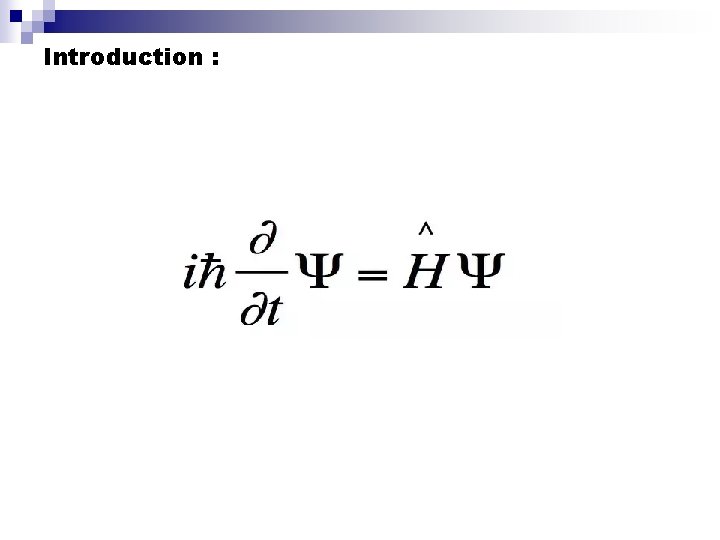
Introduction :
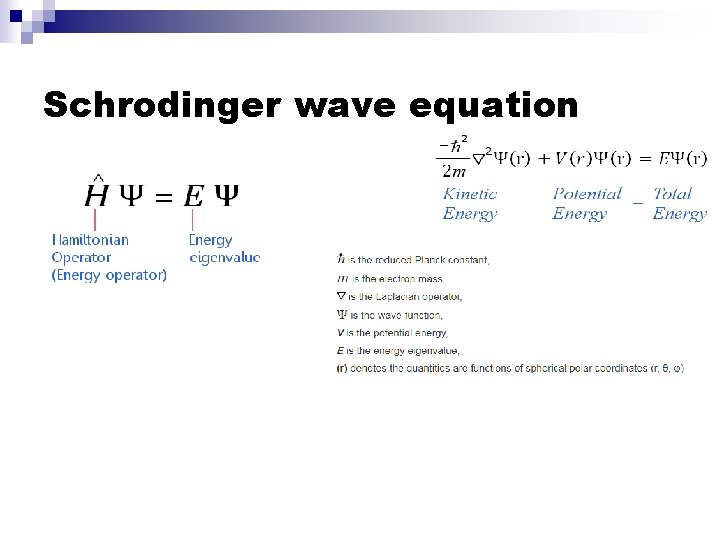
Schrodinger wave equation
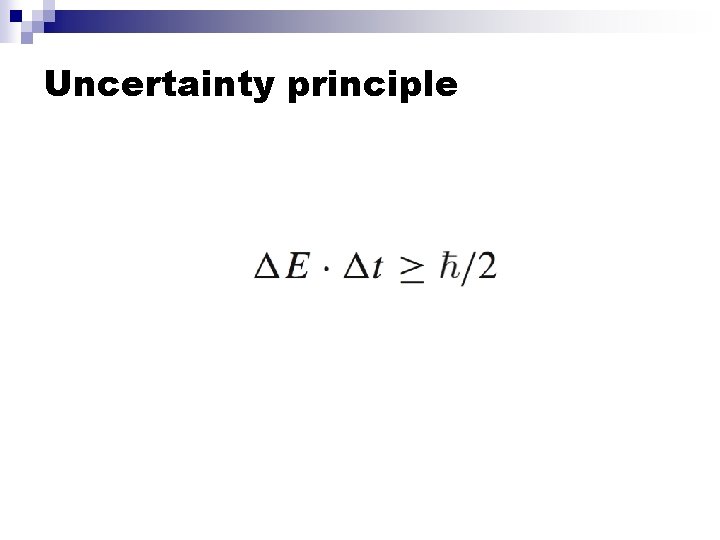
Uncertainty principle
Introduction: What is a quantum computer? § A quantum computer is a machine that performs calculations based on the laws of quantum mechanics, which is the behavior of particles at the sub-atomic level.
Overview ü Introduction and History § Data Representation § Operations on Data § Shor’s Algorithm § Conclusion and Open Questions
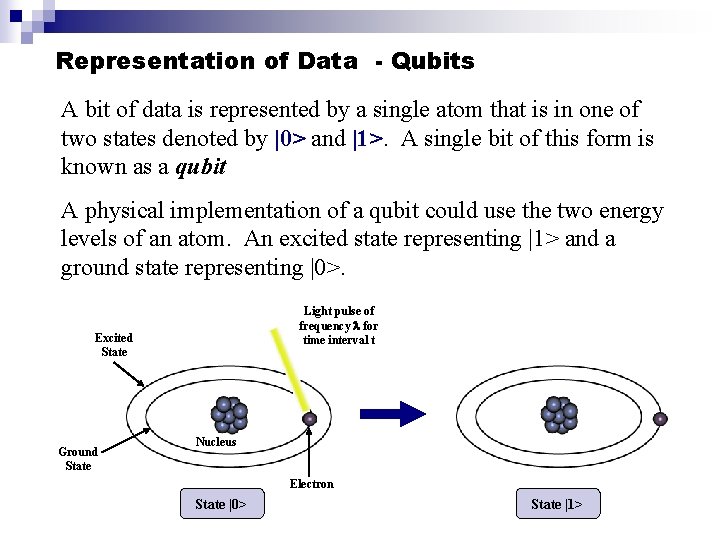
Representation of Data - Qubits A bit of data is represented by a single atom that is in one of two states denoted by |0> and |1>. A single bit of this form is known as a qubit A physical implementation of a qubit could use the two energy levels of an atom. An excited state representing |1> and a ground state representing |0>. Light pulse of frequency for time interval t Excited State Ground State Nucleus Electron State |0> State |1>
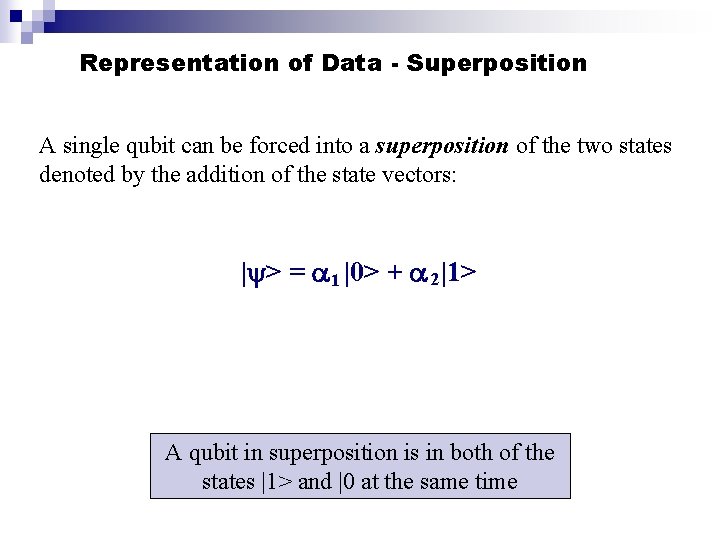
Representation of Data - Superposition A single qubit can be forced into a superposition of the two states denoted by the addition of the state vectors: | > = 1 |0> + 2 |1> A qubit in superposition is in both of the states |1> and |0 at the same time
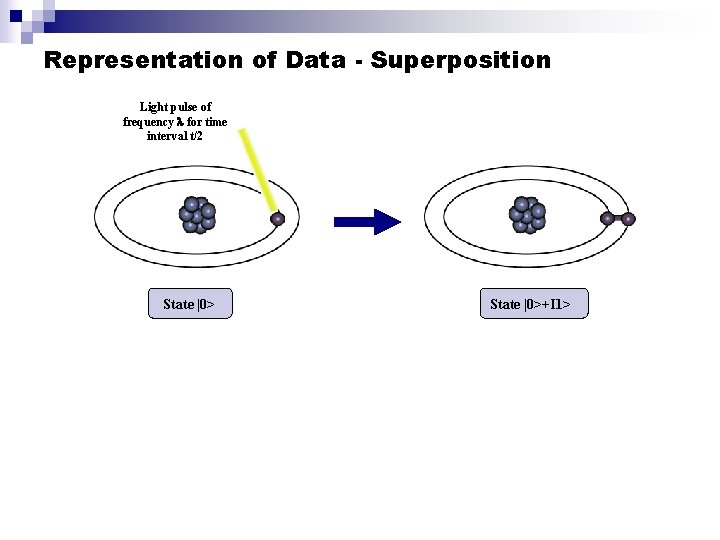
Representation of Data - Superposition Light pulse of frequency for time interval t/2 State |0>+I 1>
Quantum bit |1> n n n |0> 2 -dimensional vector of length 1. Basis states |0>, |1>. Arbitrary state: � |0>+� |1>, � complex, |� | 2+ |� |2=1.
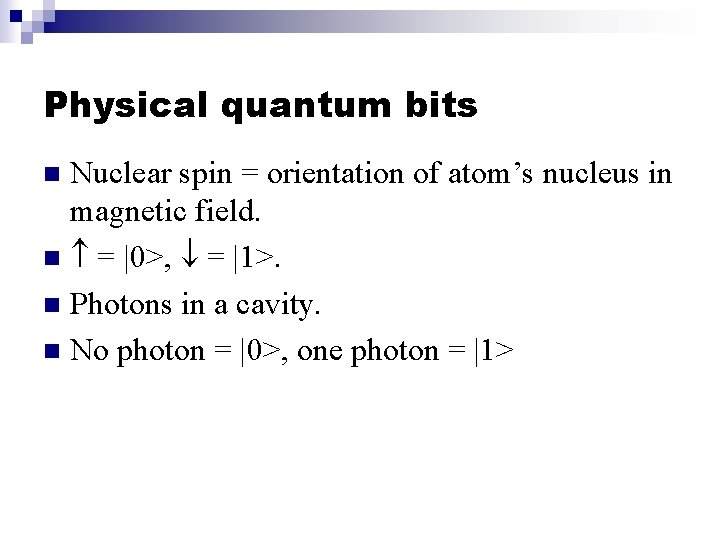
Physical quantum bits Nuclear spin = orientation of atom’s nucleus in magnetic field. n = |0>, = |1>. n Photons in a cavity. n No photon = |0>, one photon = |1> n
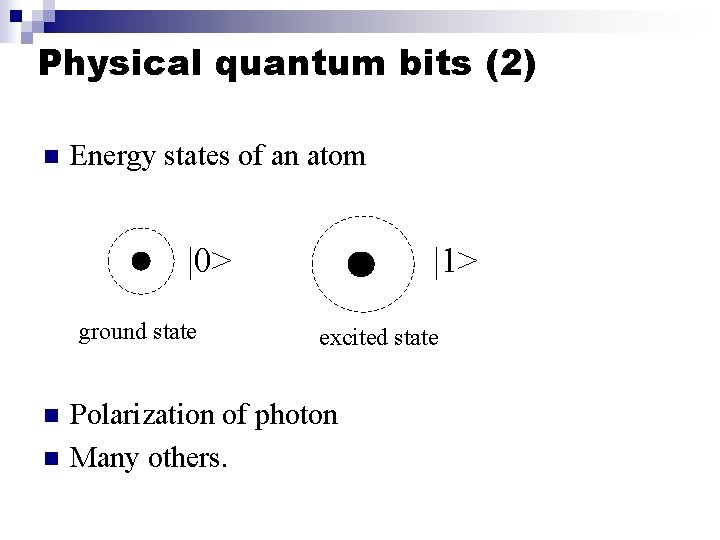
Physical quantum bits (2) n Energy states of an atom |0> ground state n n |1> excited state Polarization of photon Many others.
Overview ü Introduction and History ü Data Representation § Operations on Data § Shor’s Algorithm § Conclusion and Open Questions
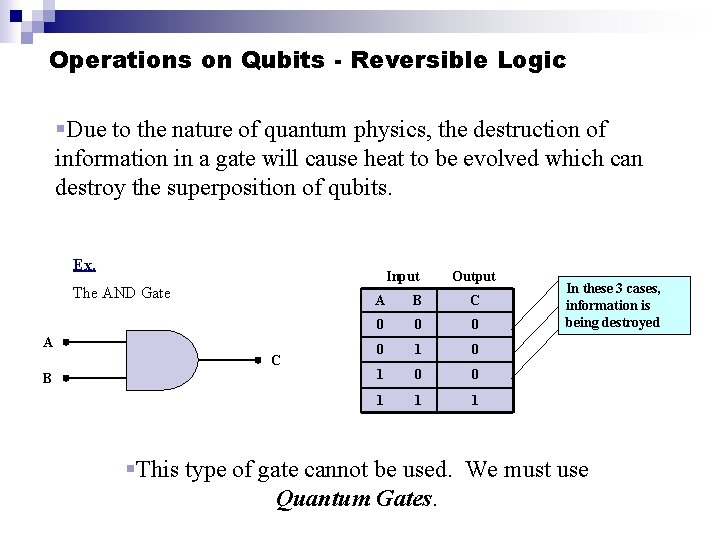
Operations on Qubits - Reversible Logic §Due to the nature of quantum physics, the destruction of information in a gate will cause heat to be evolved which can destroy the superposition of qubits. Ex. Input The AND Gate A C B Output A B C 0 0 1 1 1 In these 3 cases, information is being destroyed §This type of gate cannot be used. We must use Quantum Gates.
Quantum Gates § Quantum Gates are similar to classical gates, but do not have a degenerate output. i. e. their original input state can be derived from their output state, uniquely. They must be reversible. §This means that a deterministic computation can be performed on a quantum computer only if it is reversible. Luckily, it has been shown that any deterministic computation can be made reversible. (Charles Bennet, 1973)
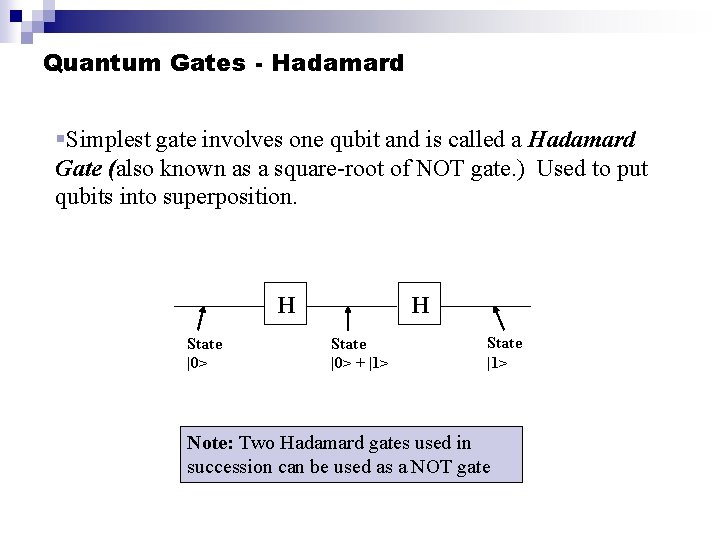
Quantum Gates - Hadamard §Simplest gate involves one qubit and is called a Hadamard Gate (also known as a square-root of NOT gate. ) Used to put qubits into superposition. H State |0> + |1> State |1> Note: Two Hadamard gates used in succession can be used as a NOT gate
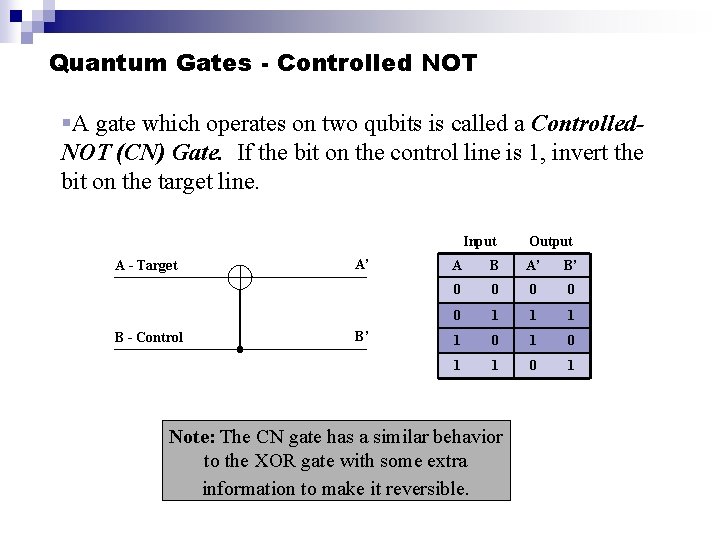
Quantum Gates - Controlled NOT §A gate which operates on two qubits is called a Controlled. NOT (CN) Gate. If the bit on the control line is 1, invert the bit on the target line. Input A - Target B - Control A’ B’ Output A B A’ B’ 0 0 0 1 1 0 1 Note: The CN gate has a similar behavior to the XOR gate with some extra information to make it reversible.
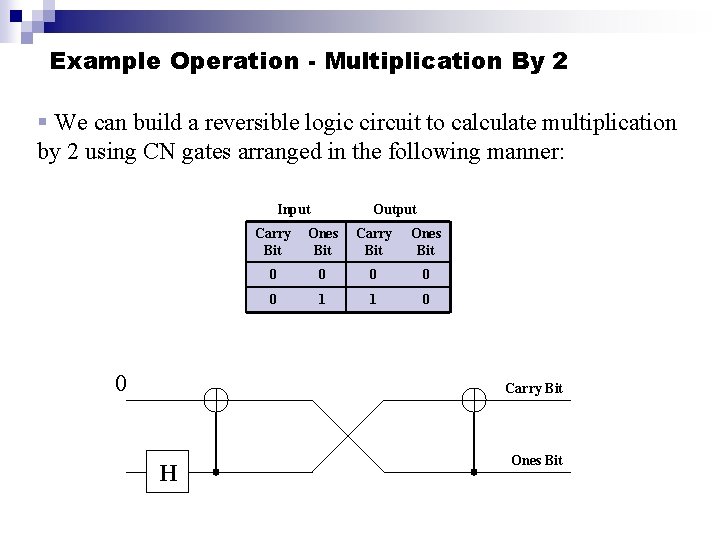
Example Operation - Multiplication By 2 § We can build a reversible logic circuit to calculate multiplication by 2 using CN gates arranged in the following manner: Input 0 Output Carry Bit Ones Bit 0 0 0 1 1 0 Carry Bit H Ones Bit
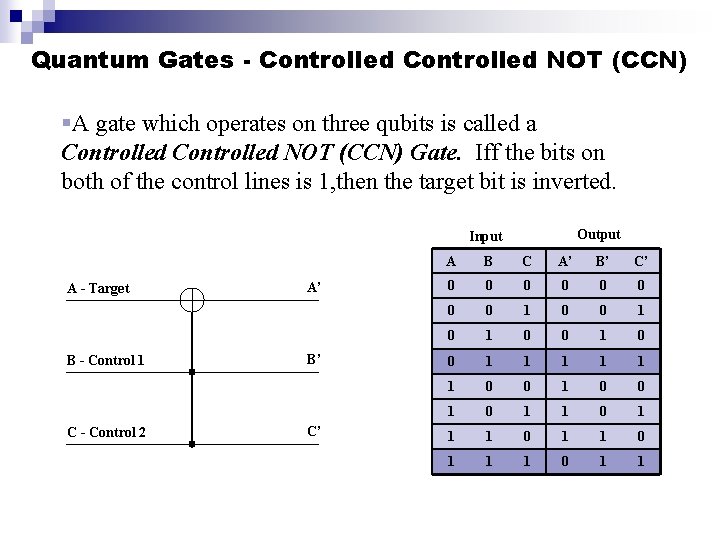
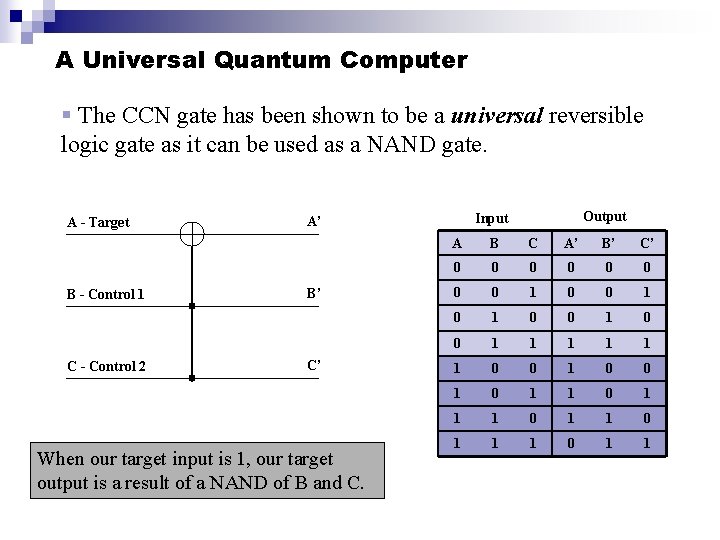
Quantum Gates - Controlled NOT (CCN) §A gate which operates on three qubits is called a Controlled NOT (CCN) Gate. Iff the bits on both of the control lines is 1, then the target bit is inverted. Output Input A - Target B - Control 1 C - Control 2 A’ B’ C’ A B C A’ B’ C’ 0 0 0 0 1 0 0 1 1 1 0 0 1 0 1 1 1 0 1 1
A Universal Quantum Computer § The CCN gate has been shown to be a universal reversible logic gate as it can be used as a NAND gate. A - Target B - Control 1 C - Control 2 B’ C’ When our target input is 1, our target output is a result of a NAND of B and C. Output Input A’ A B C A’ B’ C’ 0 0 0 0 1 0 0 1 1 1 0 0 1 0 1 1 1 0 1 1
Conclusion § In 2001, a 7 qubit machine was built and programmed to run Shor’s algorithm to successfully factor 15. § What algorithms will be discovered next? §Can quantum computers solve NP Complete problems in polynomial time?