
Quantum Computational Geometry Marco Lanzagorta Jeffrey K Uhlmann

- Slides: 32
Quantum Computational Geometry Marco Lanzagorta Jeffrey K. Uhlmann Center for Computational Science US Naval Research Laboratory Department for Computer Science University of Missouri-Columbia Unclassified 1
Introduction Unclassified 2
Objective • To investigate how a quantum computer could be used as a fully functional computational device to solve real problems found in a wide variety of scientific, industrial and military software systems. – Explore the applications of QC beyond its use as a dedicated cryptographic device or a quantum physics simulator. Unclassified 3
Computational Geometry • Computational Geometry is concerned with the computational complexity of geometric problems that arise in a variety of disciplines. – Computer Graphics – Computer Vision – Virtual Reality – Multi-Object Simulation and Visualization – Multi-Target Tracking. Unclassified 4
Some Computational Geometry Problems • Many of the most fundamental problems in computational geometry involve: – Multidimensional searches • Search for those objects in space that satisfy a certain query criteria. – Representation of spatial information • Determination of the convex hull of a set of points. • Determination of object-object intersections. Unclassified 5
Relevance to Naval Systems • These computational geometry problems arise in a wide variety of defense systems of interest to the US Navy. – – – Modeling & Simulation of Combat Platforms VR Training Systems Command Control Systems Missile Defense Systems Missile and Unmanned Aerial Vehicles Guidance Systems – Data Fusion in Network Centric Warfare Systems – Robotics Unclassified 6
Grover’s Algorithm Unclassified 7
Grover’s Algorithm Quantum algorithm developed by Grover to perform a search of an item from an unsorted, unstructured list of N records. – Performs the search in O(N 1/2) • Instead of the O(N) required by brute force methods in classical computing. • It can be shown that Grover’s algorithm is optimal: no other quantum algorithm can solve the search problem in less than O(N 1/2). Unclassified 8
Classical Data Structures • Any comparative analysis between CC and QC should acknowledge the existence of classical data structures. – Speed up classical computational tasks – Reorganize the original format of the data set in a way that increases efficiency, abstraction and reusability – Caveats: Require a non-constant time process to store the data, and it may increase the space/storage complexity of the original data set. Unclassified 9
Exact-Match Retrieval Queries • Exact-match retrieval queries: Is a specific element present in the database? • If a classical algorithm is permitted to spend O(N log(N)) time to structure the database a variety of searches can be performed in O(log(N)) time or better. – A “hash table” can be created in O(N) and it can find an item in a list in O(1). • Therefore, classical data structures seem to be superior to any quantum algorithm in terms of asymptotic query-time complexity. Unclassified 10
What Grover’s Algorithm Isn’t Good For • If there is no way to sort and/or structure the dataset, then Grover’s algorithm for exact-match retrieval is unbeatable. • However, all the known scientific, industrial, military and financial datasets of practical interest are alphanumerical strings that somehow can be sorted, structured and ordered. • Grover’s algorithm is most appropriate for some multidimensional spatial search problems found in the realm of computational geometry. Unclassified 11
Quantum Multidimensional Range Searches Unclassified 12
Multidimensional Range Searches • Multidimensional search problems are usually cast in the form of query-answer: – Given a collection of points in space, one is to find those that satisfy a certain query criteria. • Range queries require the identification of all points within a d-dimensional coordinate aligned box. – Range queries are the most general multidimensional queries and special cases of general region queries. – Optimality results for range queries provide lower bounds for more sophisticated queries. Unclassified 13
Classical Range Queries: Linear Space • Given a dataset of N points, a classical data structure of size O(N) can be used to satisfy range queries in O(N 1 -1/d + k) time, where k is the number of points satisfying the query and d is the number of dimensions. This is optimal. Unclassified 14
Classical Range Queries: Non-Linear Space • In many applications it is possible within the CC framework to optimize a tradeoff between execution time and storage. • In particular, range queries can be satisfied in O(log d-1 N + k) time using O(N log d-1 N) storage. • The storage complexity becomes problematic for large N, e. g. , if N is 1 million, the storage in 3 D is multiplied by a factor of 400. Unclassified 15
Quantum Range Queries • It can be shown that Grover’s quantum search algorithm permits general spatial search queries to be performed with O((N/k)1/2 + k log k) complexity. • If k is essentially a constant, then quantum range queries can be satisfied in O(N 1/2) time, where the exponent is independent of the dimensionality. Unclassified 16
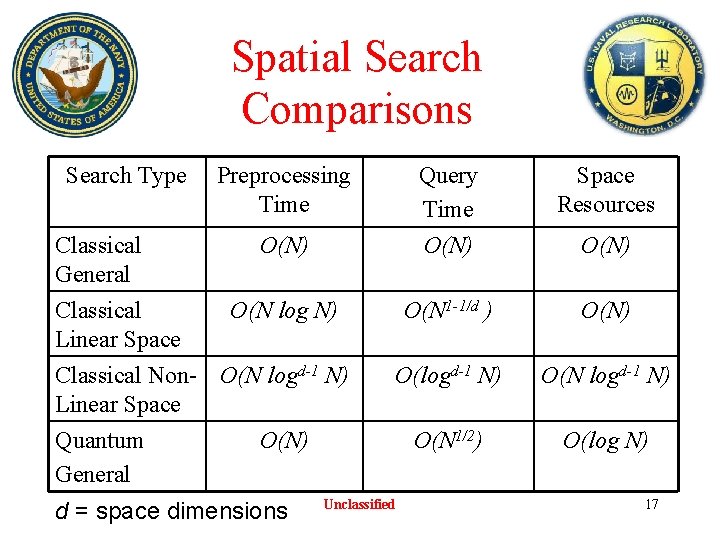
Spatial Search Comparisons Search Type Classical General Preprocessing Time Space Resources O(N 1 -1/d ) O(N) O(logd-1 N) O(N 1/2) O(log N) O(N) Classical O(N log N) Linear Space Classical Non- O(N logd-1 N) Linear Space Quantum General Query Time O(N) d = space dimensions Unclassified O(N) 17
Practical Considerations • By far the greatest practical advantage offered by quantum computing is the ability to store pointers to N data items using only log(N) qubits. • The quantum O(N 1/2) complexity may prove to be problematic for large N if the QC runtime coefficients are not extremely small. Unclassified 18
Quantum Determination of the Convex Hull Unclassified 19
The Convex Hull • The convex hull of a set of points S is the smallest convex set that contains S. • The determination of the convex hull is a computational geometry problem that emphasizes the representation of spatial information. • The convex hull of a set of points is used to represent its spatial extent. Unclassified 20
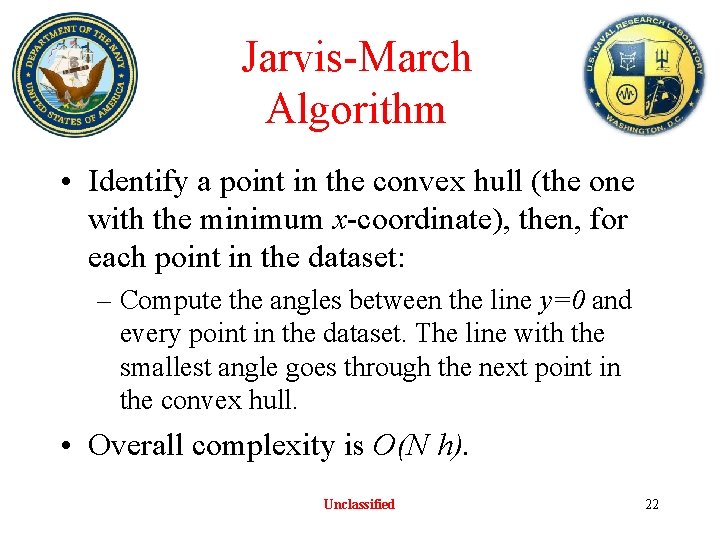
CC Convex Hull Algorithms • The most efficient classical algorithm (known to date) to compute the convex hull requires O(N log(h)) time for N objects with h points forming the convex hull. – h is usually a constant. • The Jarvis-March algorithm calculates the convex hull in O(N h), but it is a good candidate to be ported to a quantum computer using Grover’s algorithm. Unclassified 21
Jarvis-March Algorithm • Identify a point in the convex hull (the one with the minimum x-coordinate), then, for each point in the dataset: – Compute the angles between the line y=0 and every point in the dataset. The line with the smallest angle goes through the next point in the convex hull. • Overall complexity is O(N h). Unclassified 22
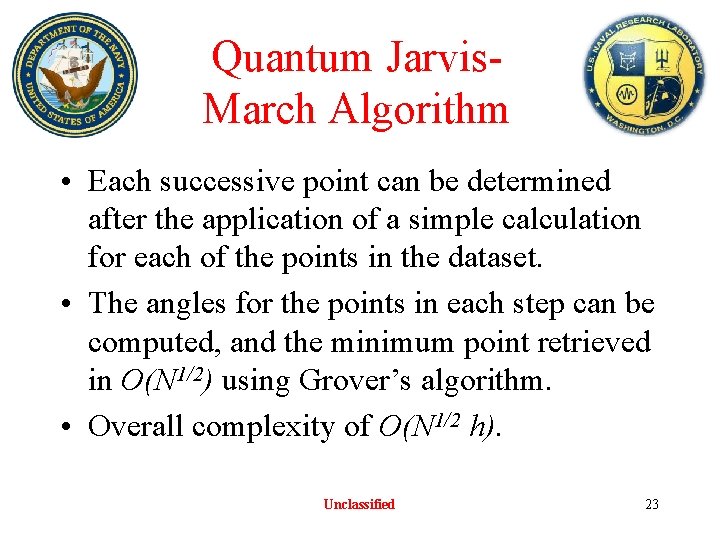
Quantum Jarvis. March Algorithm • Each successive point can be determined after the application of a simple calculation for each of the points in the dataset. • The angles for the points in each step can be computed, and the minimum point retrieved in O(N 1/2) using Grover’s algorithm. • Overall complexity of O(N 1/2 h). Unclassified 23
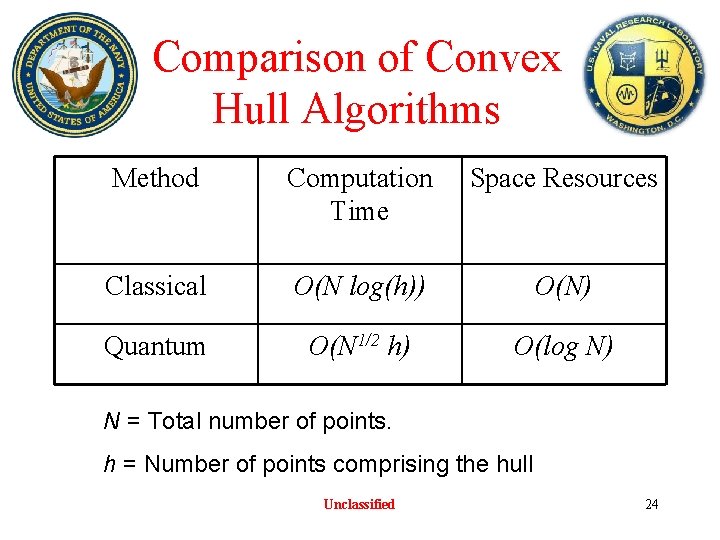
Comparison of Convex Hull Algorithms Method Computation Time Space Resources Classical O(N log(h)) O(N) Quantum O(N 1/2 h) O(log N) N = Total number of points. h = Number of points comprising the hull Unclassified 24
Quantum Determination of Object-Object Intersections Unclassified 25
Classical Algorithms • Given a set of N objects, in general it is impossible to avoid spending O(N 2) time checking whether or not each pair of objects intersect. • For coordinated-aligned orthogonal boxes, it is possible to determine the intersections in O(N logd-2(N) + m) time, where m is the total number of intersections. Unclassified 26
A Grover-Based Quantum Algorithm • Assume that O(1) time is sufficient to determine whether a pair of objects intersect. • Construct a quantum register that enumerates all the possible N 2 pairs of objects in O(log N) time. • Use Grover’s algorithm to determine which objects intersect and retrieve them. • This algorithm has O(N/m 1/2 + m log m) time complexity. Unclassified 27
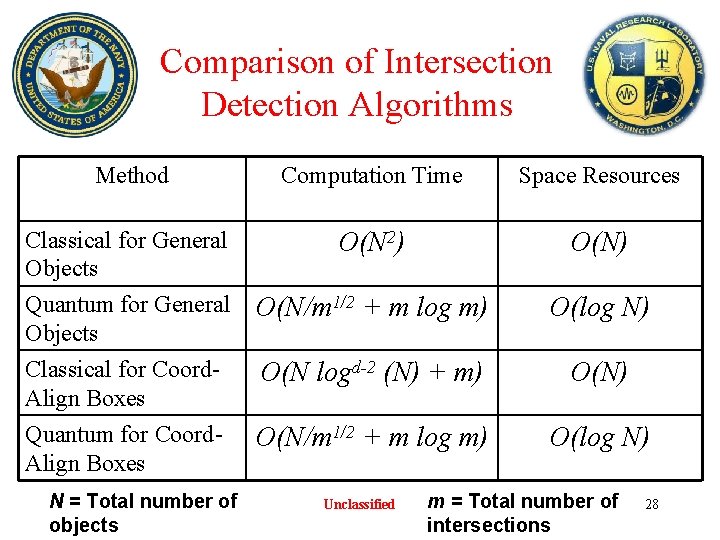
Comparison of Intersection Detection Algorithms Method Computation Time Space Resources Classical for General Objects O(N 2) O(N) Quantum for General Objects O(N/m 1/2 + m log m) O(log N) Classical for Coord. Align Boxes O(N logd-2 (N) + m) O(N) Quantum for Coord. Align Boxes O(N/m 1/2 + m log m) O(log N) N = Total number of objects Unclassified m = Total number of intersections 28
Advantages of the Quantum Solution • The quantum algorithm is attractive because of its generality. • The complexity of the quantum algorithm holds for any class of objects for which comparisons take O(1) time. – Annuli with arbitrary radii for sonar applications. – Nurbs and surface patches in computer graphics. • No classical method exists for efficiently identifying intersections among general objects with curved surfaces. Unclassified 29
Conclusions Unclassified 30
On the positive side… • We have discussed efficient applications of Grover’s algorithm to computational geometry problems. • We have described quantum algorithms which outperform the best classical computing algorithms currently known. • The algorithms describe combine classical and quantum computing techniques, and resources from both types of hardware. Unclassified 31
On the negative side… • The success of these algorithms presumes: – A smooth integration between classical and quantum computational systems. – The realization of an efficient (approximate) quantum register copying circuit. – Quantum software able to compile general purpose Grover’s “black box” functions and oracles. – The engineering and manufacturing of stable (quantum noise resistant) quantum registers with logarithmic space complexity. Unclassified 32