
Quantum Computation Using Optical Lattices Ben Zaks Victor
Quantum Computation Using Optical Lattices Ben Zaks Victor Acosta Physics 191 Prof. Whaley UC-Berkeley
Contents • • Standing Wave Light Field Egg Crate Potential Atom Cooling Gates and Qubits
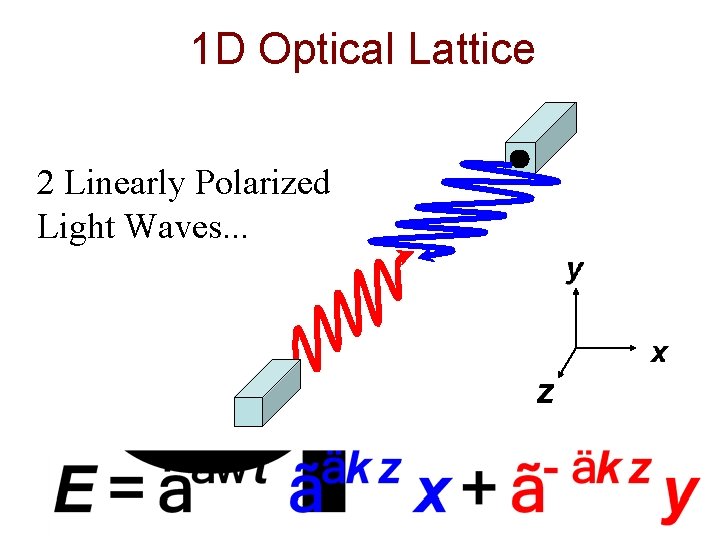
1 D Optical Lattice 2 Linearly Polarized Light Waves. . .
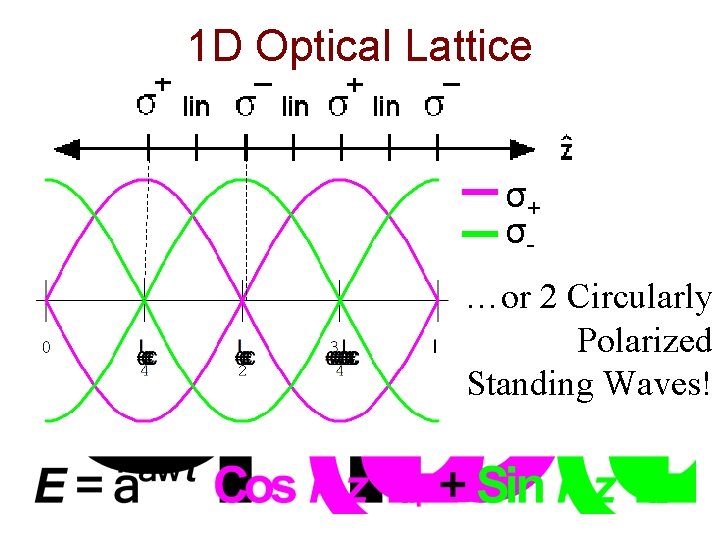
1 D Optical Lattice σ+ σ…or 2 Circularly Polarized Standing Waves!
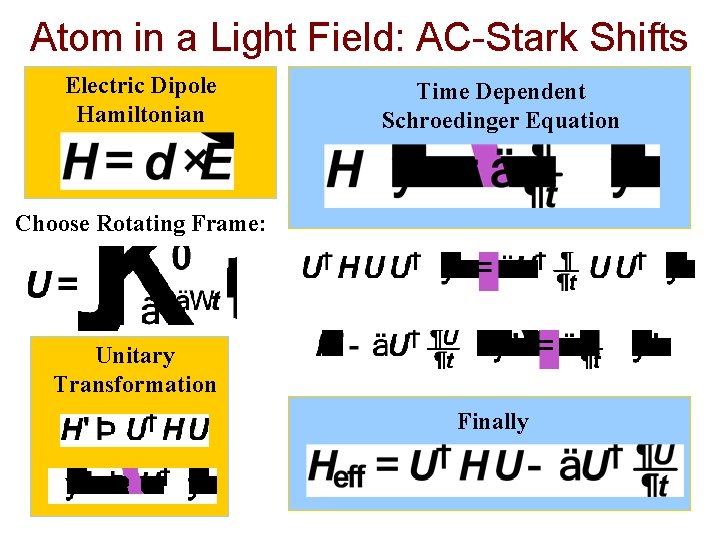
Atom in a Light Field: AC-Stark Shifts Electric Dipole Hamiltonian Time Dependent Schroedinger Equation Choose Rotating Frame: Unitary Transformation Finally
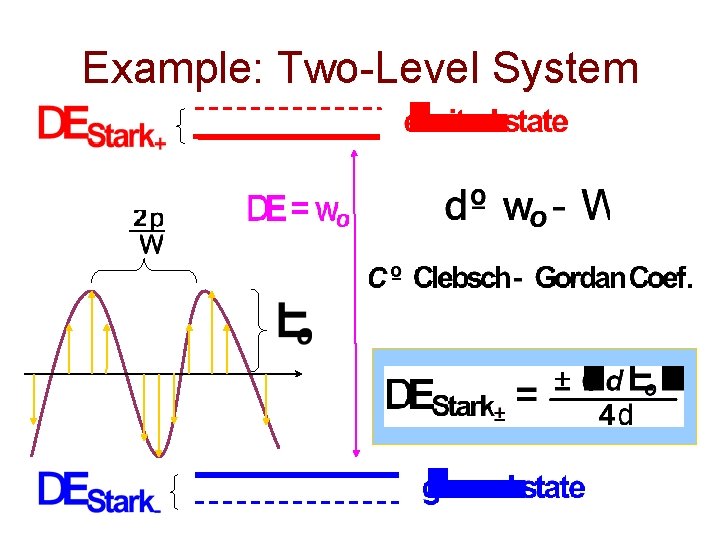
Example: Two-Level System
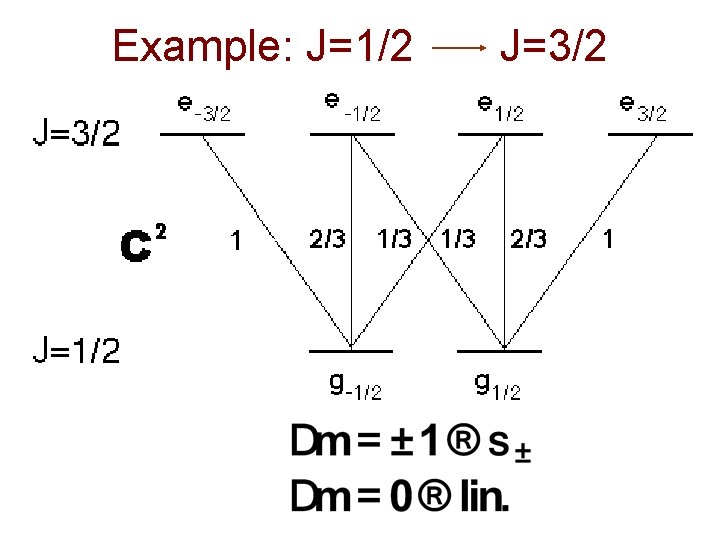
Example: J=1/2 J=3/2
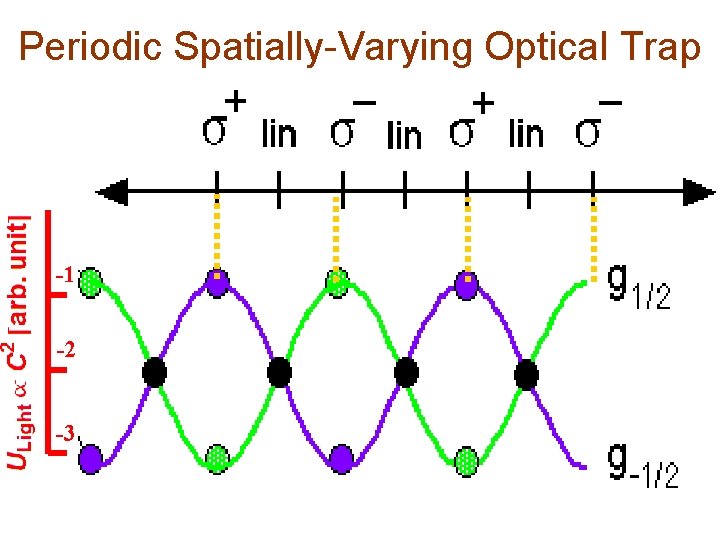
Periodic Spatially-Varying Optical Trap -1 -2 -3
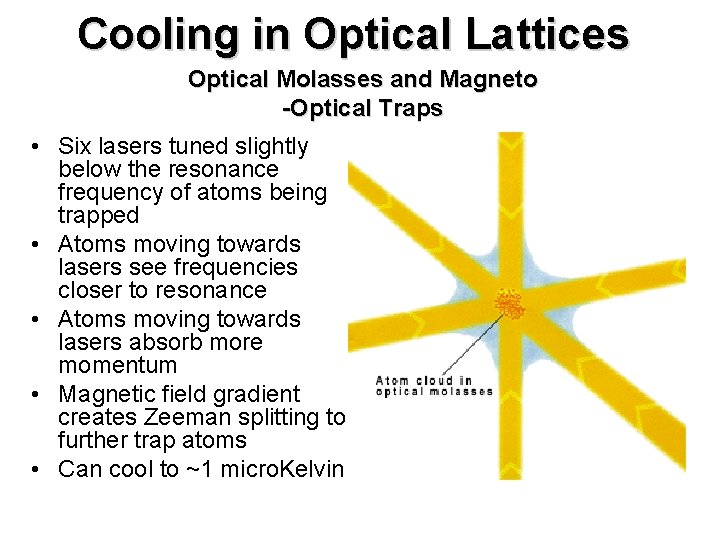
Cooling in Optical Lattices Optical Molasses and Magneto -Optical Traps • Six lasers tuned slightly below the resonance frequency of atoms being trapped • Atoms moving towards lasers see frequencies closer to resonance • Atoms moving towards lasers absorb more momentum • Magnetic field gradient creates Zeeman splitting to further trap atoms • Can cool to ~1 micro. Kelvin
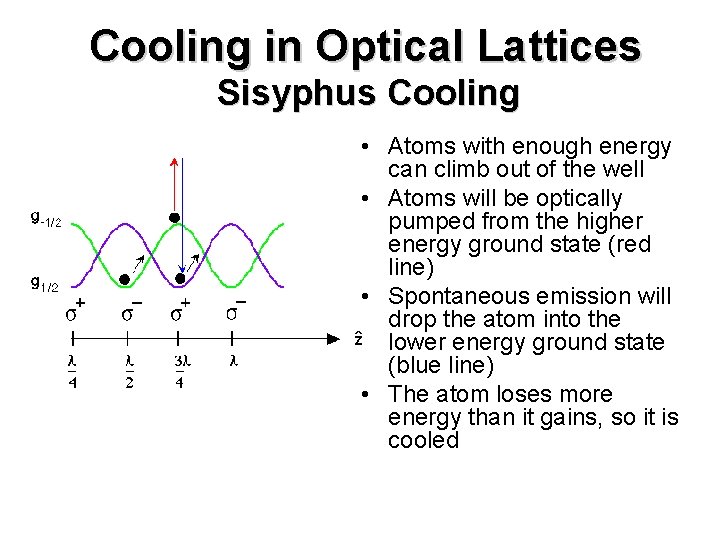
Cooling in Optical Lattices Sisyphus Cooling • Atoms with enough energy can climb out of the well • Atoms will be optically pumped from the higher energy ground state (red line) • Spontaneous emission will drop the atom into the lower energy ground state (blue line) • The atom loses more energy than it gains, so it is cooled
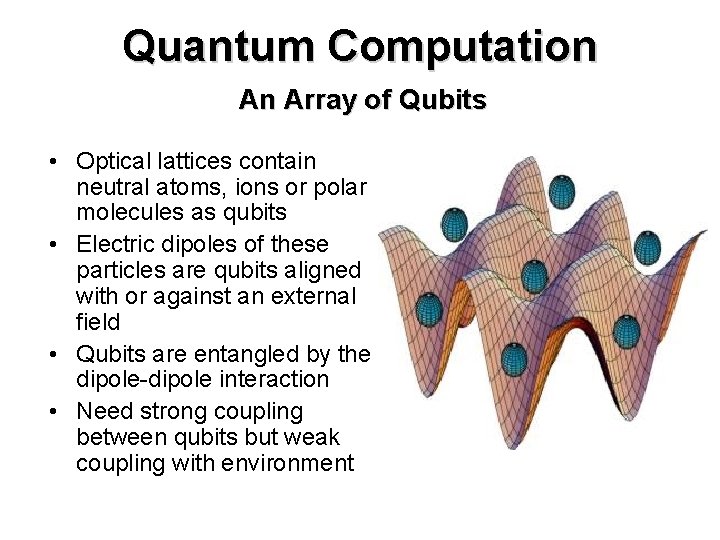
Quantum Computation An Array of Qubits • Optical lattices contain neutral atoms, ions or polar molecules as qubits • Electric dipoles of these particles are qubits aligned with or against an external field • Qubits are entangled by the dipole-dipole interaction • Need strong coupling between qubits but weak coupling with environment
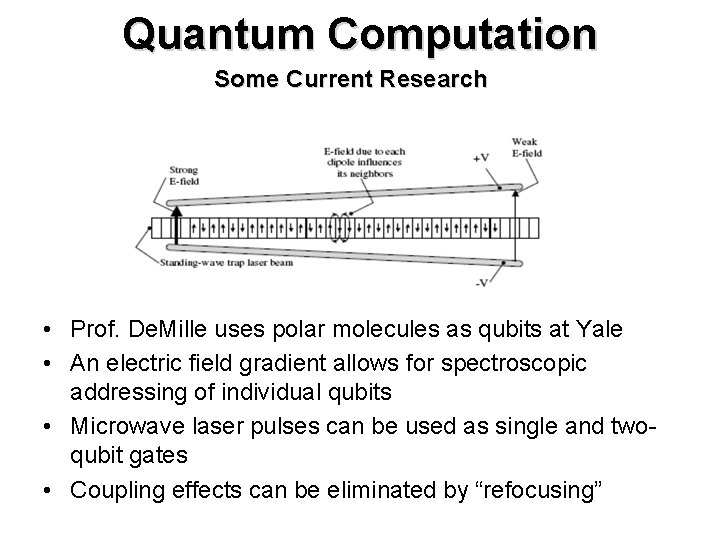
Quantum Computation Some Current Research • Prof. De. Mille uses polar molecules as qubits at Yale • An electric field gradient allows for spectroscopic addressing of individual qubits • Microwave laser pulses can be used as single and twoqubit gates • Coupling effects can be eliminated by “refocusing”
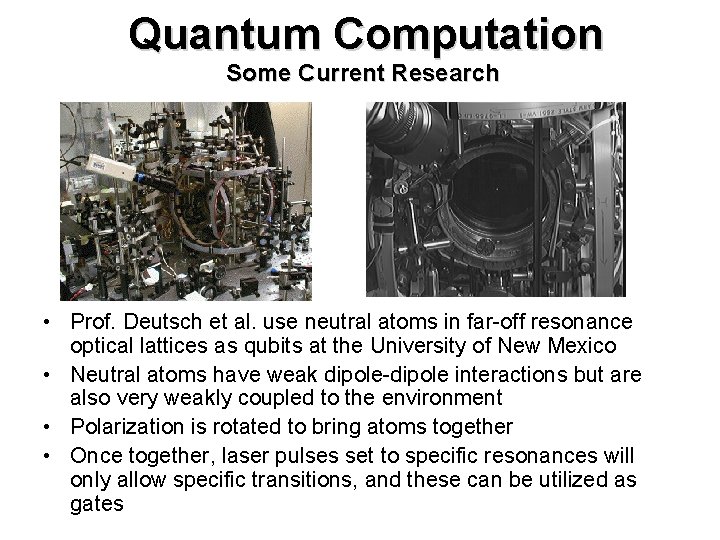
Quantum Computation Some Current Research • Prof. Deutsch et al. use neutral atoms in far-off resonance optical lattices as qubits at the University of New Mexico • Neutral atoms have weak dipole-dipole interactions but are also very weakly coupled to the environment • Polarization is rotated to bring atoms together • Once together, laser pulses set to specific resonances will only allow specific transitions, and these can be utilized as gates

Thank you to the following websites for their resources • • • http: //quaser. physics. lsa. umich. edu/projects/lattice/ http: //web. arizona. edu/~lascool/research. html http: //nobelprize. org/physics/laureates/1997/illpres/ http: //www. yale. edu/physics/research/atomic. html http: //physics. nist. gov/Divisions/Div 842/Gp 4/lattices. html
- Slides: 14