
Quantum Computation and Simulation Christopher Monroe Joint Quantum
- Slides: 13
Quantum Computation and Simulation Christopher Monroe Joint Quantum Institute and Department of Physics NIST and University of Maryland
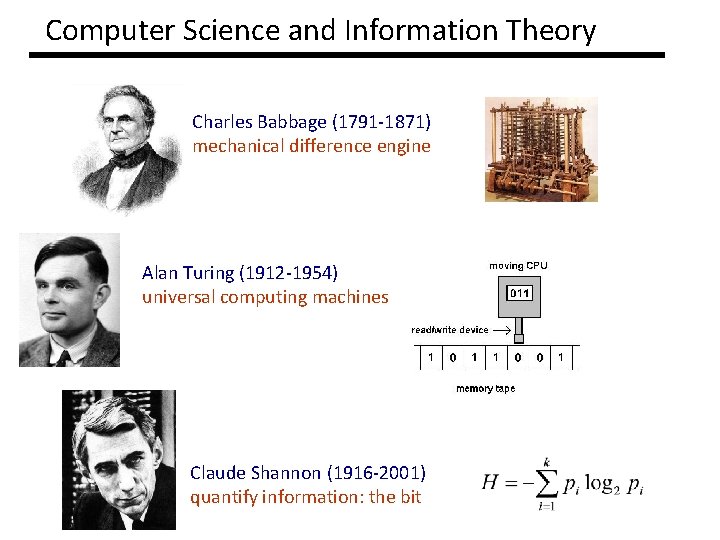
Computer Science and Information Theory Charles Babbage (1791 -1871) mechanical difference engine Alan Turing (1912 -1954) universal computing machines Claude Shannon (1916 -2001) quantify information: the bit
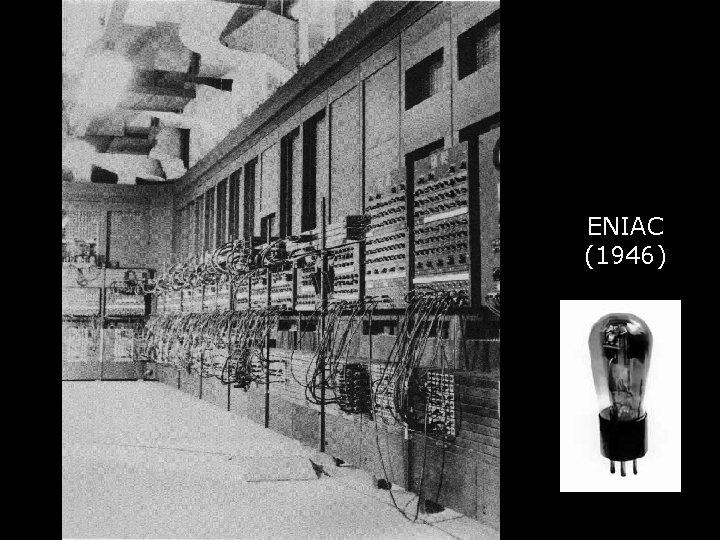
ENIAC (1946)
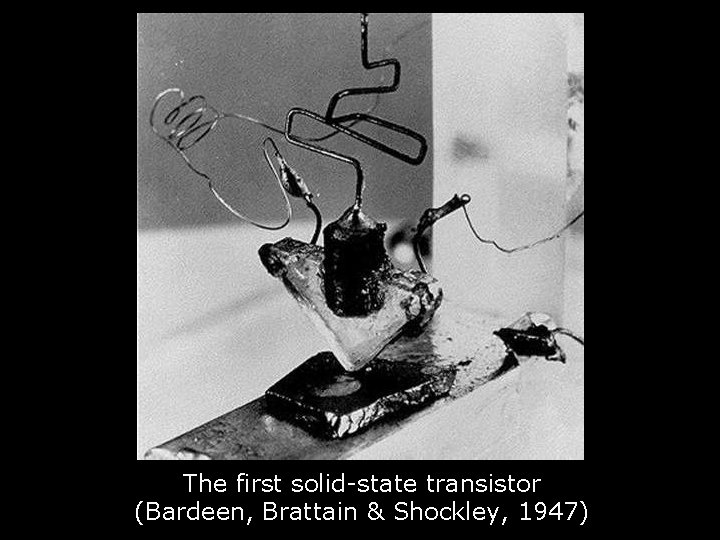
The first solid-state transistor (Bardeen, Brattain & Shockley, 1947)
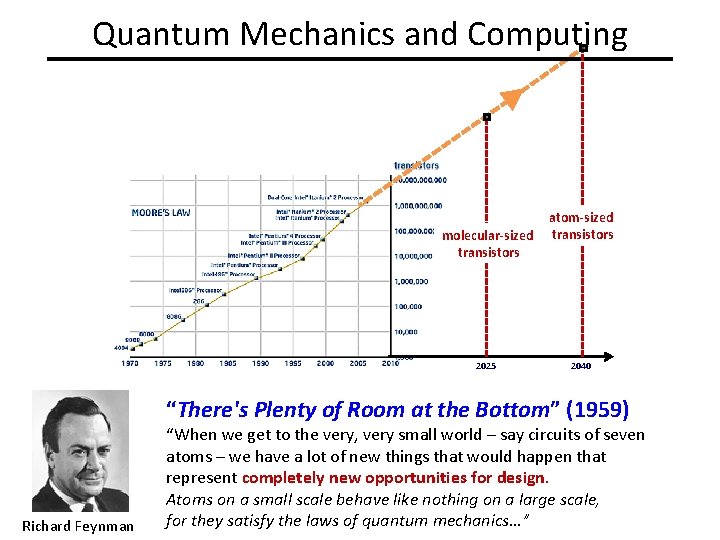
Quantum Mechanics and Computing molecular-sized transistors 2025 atom-sized transistors 2040 “There's Plenty of Room at the Bottom” (1959) Richard Feynman “When we get to the very, very small world – say circuits of seven atoms – we have a lot of new things that would happen that represent completely new opportunities for design. Atoms on a small scale behave like nothing on a large scale, for they satisfy the laws of quantum mechanics…”
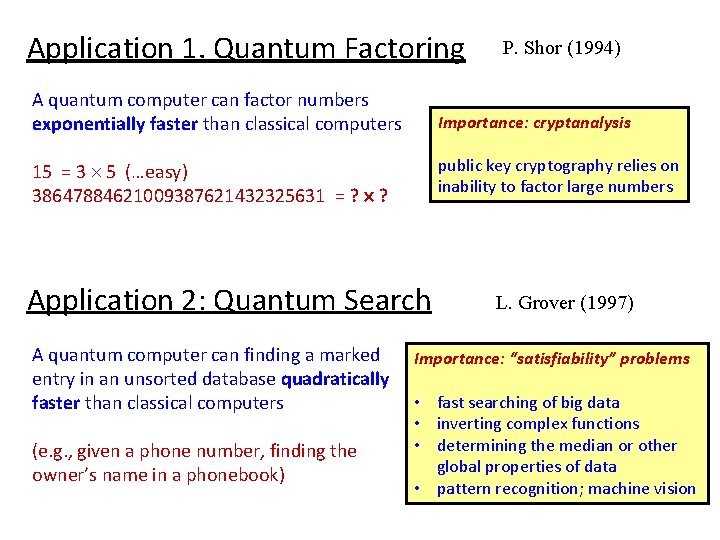
Application 1. Quantum Factoring A quantum computer can factor numbers exponentially faster than classical computers Importance: cryptanalysis public key cryptography relies on inability to factor large numbers 15 = 3 5 (…easy) 38647884621009387621432325631 = ? ? Application 2: Quantum Search A quantum computer can finding a marked entry in an unsorted database quadratically faster than classical computers (e. g. , given a phone number, finding the owner’s name in a phonebook) P. Shor (1994) L. Grover (1997) Importance: “satisfiability” problems • fast searching of big data • inverting complex functions • determining the median or other global properties of data • pattern recognition; machine vision
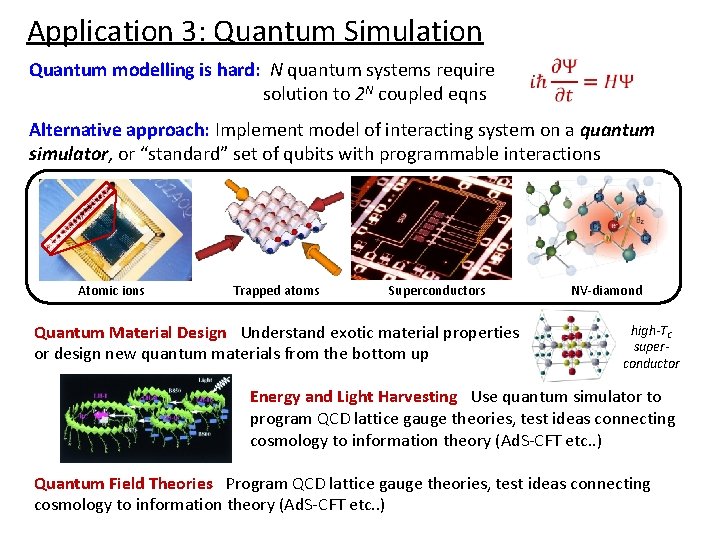
Application 3: Quantum Simulation Quantum modelling is hard: N quantum systems require solution to 2 N coupled eqns Alternative approach: Implement model of interacting system on a quantum simulator, or “standard” set of qubits with programmable interactions Atomic ions Trapped atoms Superconductors Quantum Material Design Understand exotic material properties or design new quantum materials from the bottom up NV-diamond high-TC superconductor Energy and Light Harvesting Use quantum simulator to program QCD lattice gauge theories, test ideas connecting cosmology to information theory (Ad. S-CFT etc. . ) Quantum Field Theories Program QCD lattice gauge theories, test ideas connecting cosmology to information theory (Ad. S-CFT etc. . )
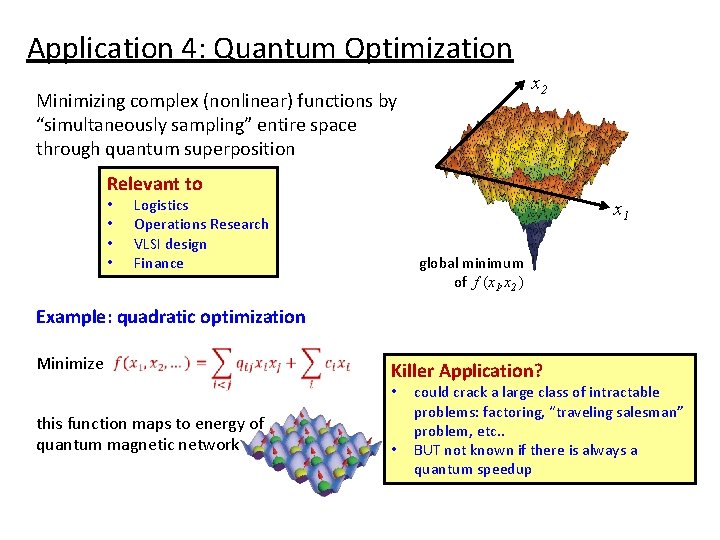
Application 4: Quantum Optimization x 2 Minimizing complex (nonlinear) functions by “simultaneously sampling” entire space through quantum superposition Relevant to • • Logistics Operations Research VLSI design Finance x 1 global minimum of f (x 1, x 2 ) Example: quadratic optimization Minimize Killer Application? • this function maps to energy of quantum magnetic network • could crack a large class of intractable problems: factoring, “traveling salesman” problem, etc. . BUT not known if there is always a quantum speedup
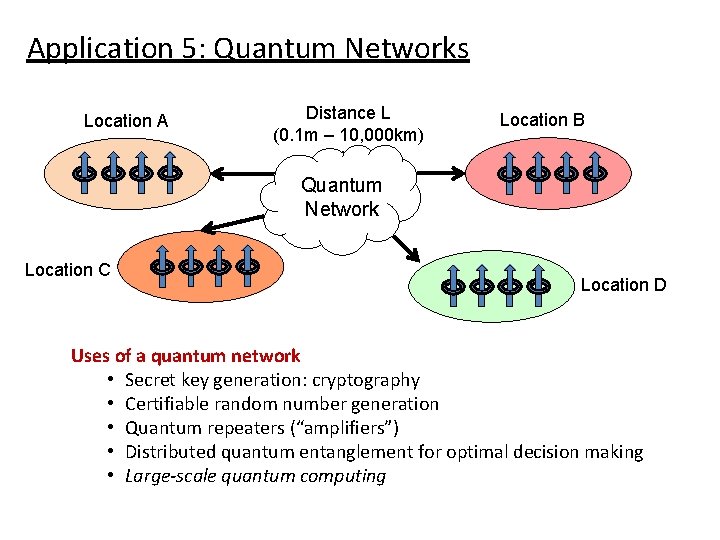
Application 5: Quantum Networks Location A Distance L (0. 1 m – 10, 000 km) Location B Quantum Network Location C Location D Uses of a quantum network • Secret key generation: cryptography • Certifiable random number generation • Quantum repeaters (“amplifiers”) • Distributed quantum entanglement for optimal decision making • Large-scale quantum computing
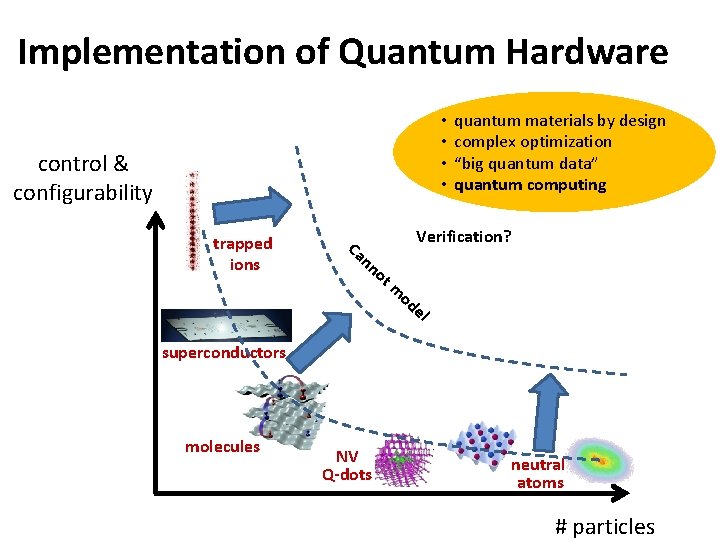
Implementation of Quantum Hardware • • control & configurability trapped ions Verification? Ca nn ot quantum materials by design complex optimization “big quantum data” quantum computing m od el superconductors molecules NV Q-dots neutral atoms # particles
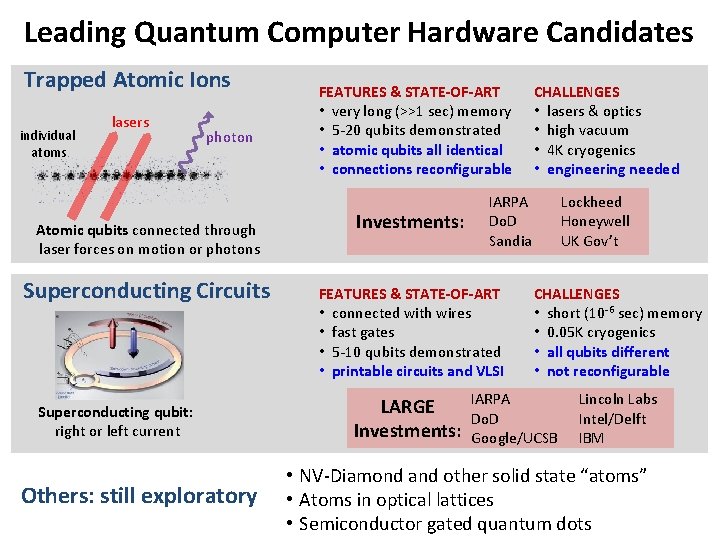
Leading Quantum Computer Hardware Candidates Trapped Atomic Ions individual atoms lasers photon Atomic qubits connected through laser forces on motion or photons Superconducting Circuits Superconducting qubit: right or left current Others: still exploratory FEATURES & STATE-OF-ART • very long (>>1 sec) memory • 5 -20 qubits demonstrated • atomic qubits all identical • connections reconfigurable Investments: IARPA Do. D Sandia FEATURES & STATE-OF-ART • connected with wires • fast gates • 5 -10 qubits demonstrated • printable circuits and VLSI LARGE Investments: CHALLENGES • lasers & optics • high vacuum • 4 K cryogenics • engineering needed Lockheed Honeywell UK Gov’t CHALLENGES • short (10 -6 sec) memory • 0. 05 K cryogenics • all qubits different • not reconfigurable IARPA Do. D Google/UCSB Lincoln Labs Intel/Delft IBM • NV-Diamond and other solid state “atoms” • Atoms in optical lattices • Semiconductor gated quantum dots
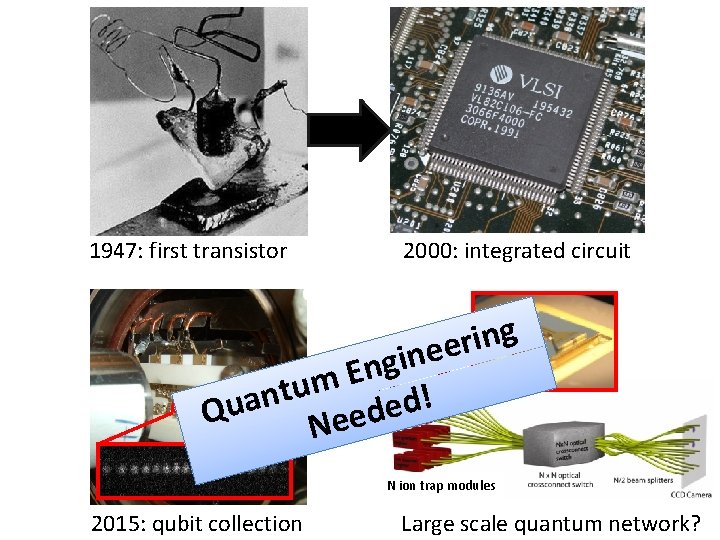
1947: first transistor 2000: integrated circuit single module g n i r e e n i g n E m u t n Qua Needed! N ion trap modules 2015: qubit collection Large scale quantum network?