
Quantum communication from Alice to Bob Aram Harrow
Quantum communication from Alice to Bob Aram Harrow, MIT quant-ph/0308044 Andreas Winter, Bristol Igor Devetak, USC
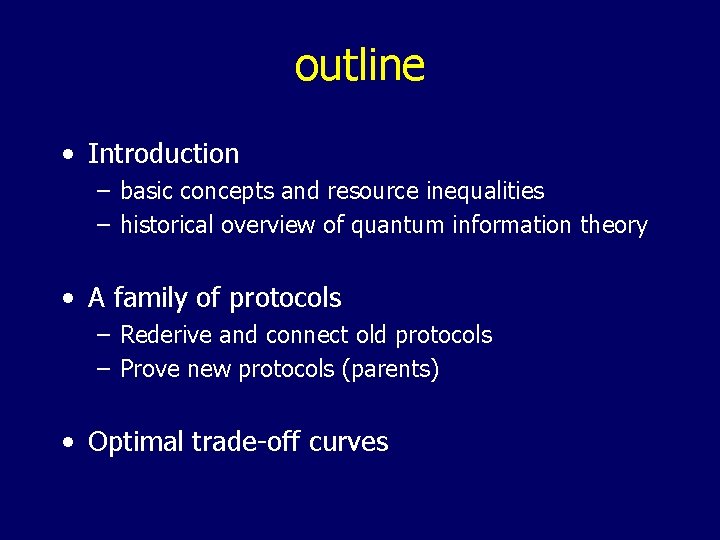
outline • Introduction – basic concepts and resource inequalities – historical overview of quantum information theory • A family of protocols – Rederive and connect old protocols – Prove new protocols (parents) • Optimal trade-off curves
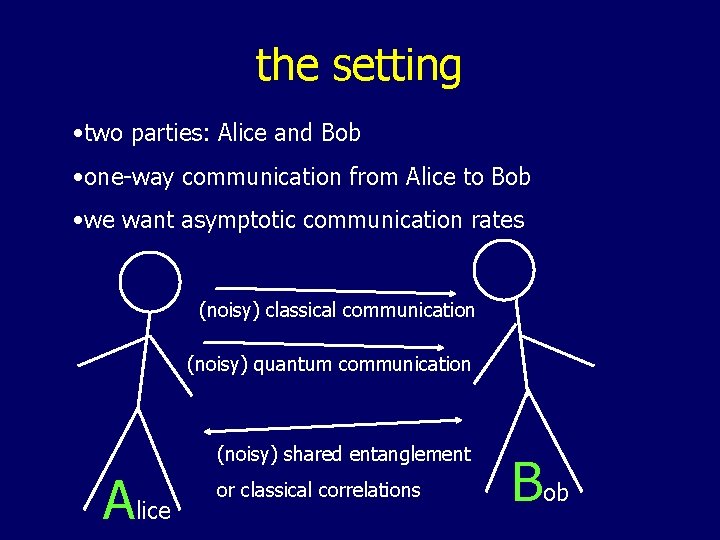
the setting • two parties: Alice and Bob • one-way communication from Alice to Bob • we want asymptotic communication rates (noisy) classical communication (noisy) quantum communication Alice (noisy) shared entanglement or classical correlations Bob
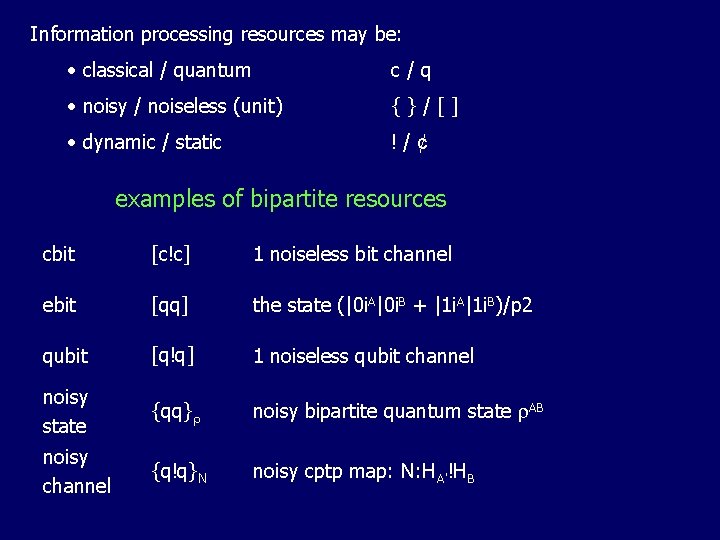
Information processing resources may be: • classical / quantum c/q • noisy / noiseless (unit) {}/[] • dynamic / static !/¢ examples of bipartite resources cbit [c!c] 1 noiseless bit channel ebit [qq] the state (|0 i. A|0 i. B + |1 i. A|1 i. B)/p 2 qubit [q!q] 1 noiseless qubit channel noisy state {qq}r noisy bipartite quantum state r. AB noisy channel {q!q}N noisy cptp map: N: HA’!HB
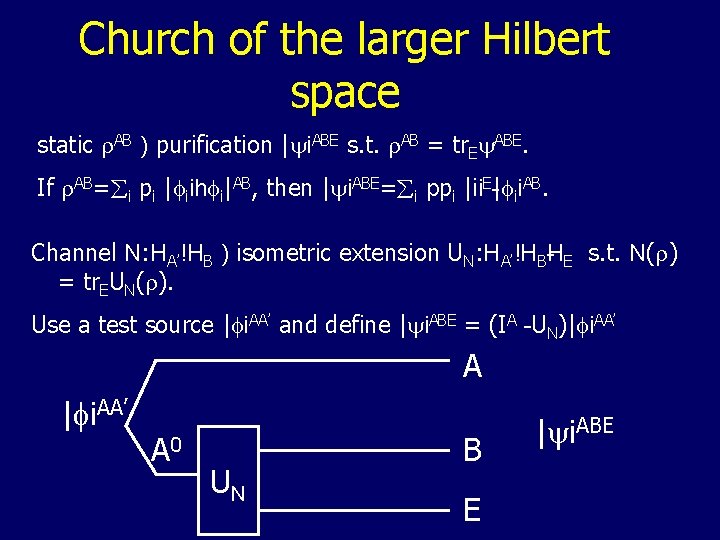
Church of the larger Hilbert space static r. AB ) purification |yi. ABE s. t. r. AB = tr. Ey. ABE. If r. AB=åi pi |fiihfi|AB, then |yi. ABE=åi ppi |ii. E |fii. AB. Channel N: HA’!HB ) isometric extension UN: HA’!HB HE s. t. N(r) = tr. EUN(r). Use a test source |fi. AA’ and define |yi. ABE = (IA UN)|fi. AA’ A 0 UN B E |yi. ABE
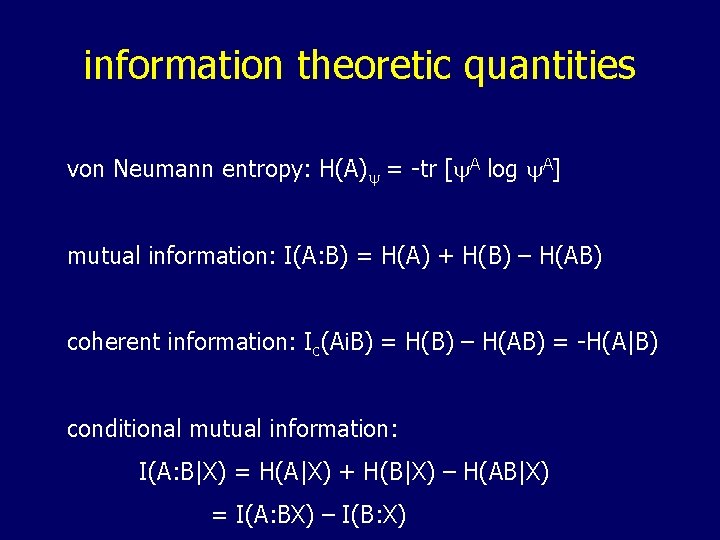
information theoretic quantities von Neumann entropy: H(A)y = -tr [y. A log y. A] mutual information: I(A: B) = H(A) + H(B) – H(AB) coherent information: Ic(Ai. B) = H(B) – H(AB) = -H(A|B) conditional mutual information: I(A: B|X) = H(A|X) + H(B|X) – H(AB|X) = I(A: BX) – I(B: X)
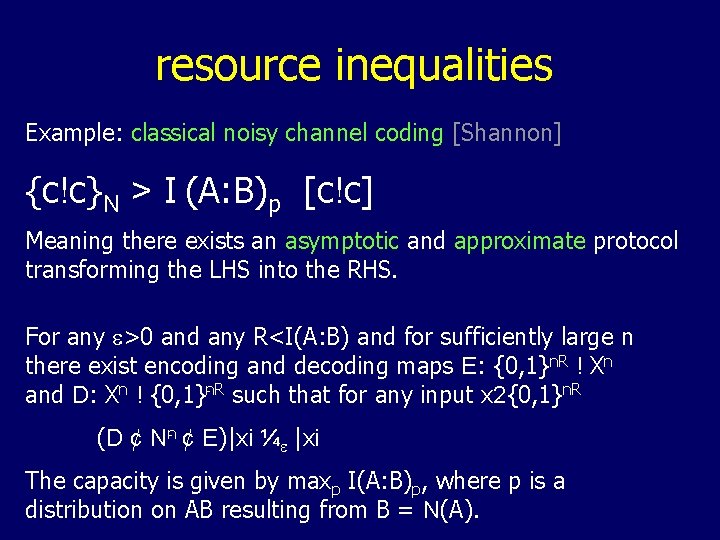
resource inequalities Example: classical noisy channel coding [Shannon] {c!c}N > I (A: B)p [c!c] Meaning there exists an asymptotic and approximate protocol transforming the LHS into the RHS. For any e>0 and any R<I(A: B) and for sufficiently large n there exist encoding and decoding maps E: {0, 1}n. R ! Xn and D: Xn ! {0, 1} n. R such that for any input x 2{0, 1}n. R (D ¢ N n ¢ E)|xi ¼e |xi The capacity is given by maxp I(A: B)p, where p is a distribution on AB resulting from B = N(A).
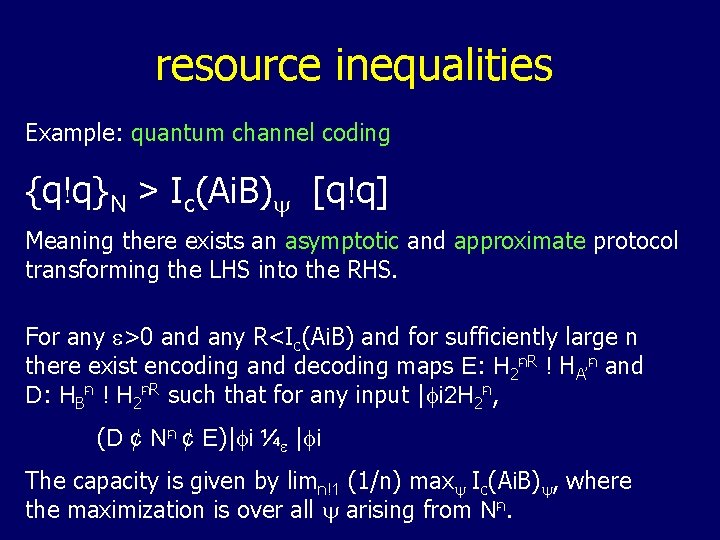
resource inequalities Example: quantum channel coding {q!q}N > Ic(Ai. B)y [q!q] Meaning there exists an asymptotic and approximate protocol transforming the LHS into the RHS. For any e>0 and any R<Ic(Ai. B) and for sufficiently large n there exist encoding and decoding maps E: H 2 n. R ! HA’ n and D: HB n ! H 2 n. R such that for any input |fi 2 H 2 n, (D ¢ N n ¢ E)|fi ¼e |fi The capacity is given by limn!1 (1/n) maxy Ic(Ai. B)y, where the maximization is over all y arising from N n.
the history of quantum information theory, part one
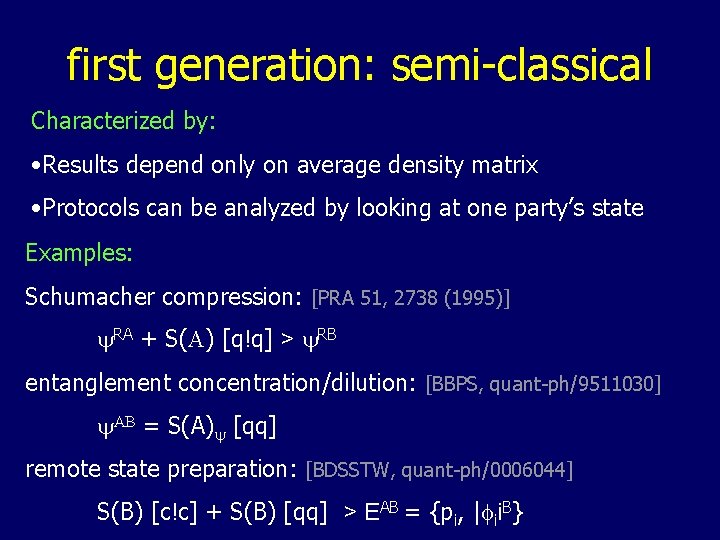
first generation: semi-classical Characterized by: • Results depend only on average density matrix • Protocols can be analyzed by looking at one party’s state Examples: Schumacher compression: [PRA 51, 2738 (1995)] y. RA + S(A) [q!q] > y. RB entanglement concentration/dilution: [BBPS, quant-ph/9511030] y. AB = S(A)y [qq] remote state preparation: [BDSSTW, quant-ph/0006044] S(B) [c!c] + S(B) [qq] > EAB = {pi, |fii. B}
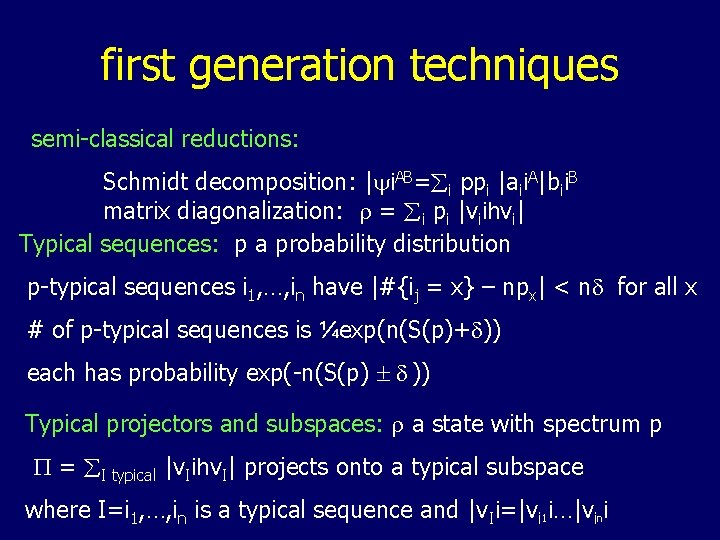
first generation techniques semi-classical reductions: Schmidt decomposition: |yi. AB=åi ppi |aii. A|bii. B matrix diagonalization: r = åi pi |viihvi| Typical sequences: p a probability distribution p-typical sequences i 1, …, in have |#{ij = x} – npx| < nd for all x # of p-typical sequences is ¼exp(n(S(p)+d)) each has probability exp(-n(S(p) ± d )) Typical projectors and subspaces: r a state with spectrum p P = åI typical |v. Iihv. I| projects onto a typical subspace where I=i 1, …, in is a typical sequence and |v. Ii=|vi 1 i…|vini
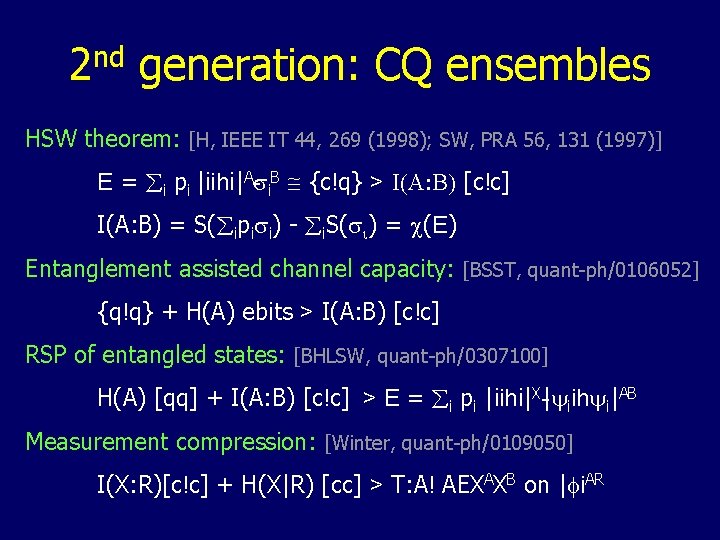
nd 2 generation: CQ ensembles HSW theorem: [H, IEEE IT 44, 269 (1998); SW, PRA 56, 131 (1997)] E = åi pi |iihi|A si. B @ {c!q} > I(A: B) [c!c] I(A: B) = S(åipisi) - åi. S(si) = c(E) Entanglement assisted channel capacity: [BSST, quant-ph/0106052] {q!q} + H(A) ebits > I(A: B) [c!c] RSP of entangled states: [BHLSW, quant-ph/0307100] H(A) [qq] + I(A: B) [c!c] > E = åi pi |iihi|X |yiihyi|AB Measurement compression: [Winter, quant-ph/0109050] I(X: R)[c!c] + H(X|R) [cc] > T: A! AEXAXB on |fi. AR
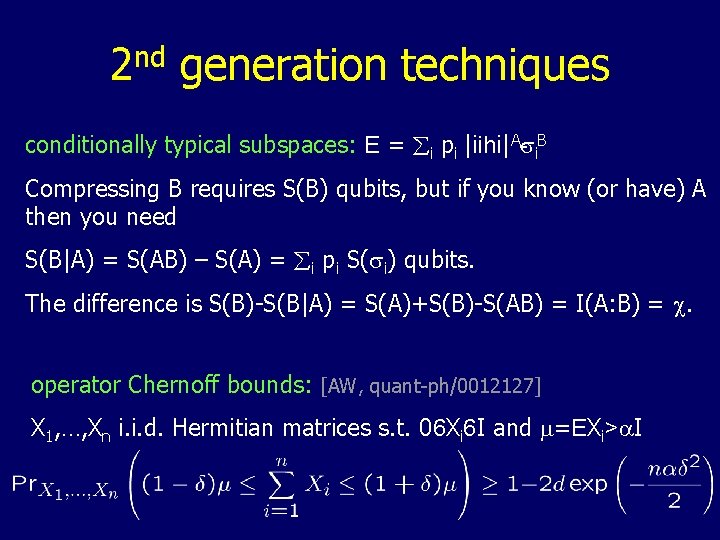
nd 2 generation techniques conditionally typical subspaces: E = åi pi |iihi|A si. B Compressing B requires S(B) qubits, but if you know (or have) A then you need S(B|A) = S(AB) – S(A) = åi pi S(si) qubits. The difference is S(B)-S(B|A) = S(A)+S(B)-S(AB) = I(A: B) = c. operator Chernoff bounds: [AW, quant-ph/0012127] X 1, …, Xn i. i. d. Hermitian matrices s. t. 06 Xi 6 I and m=EXi>a. I
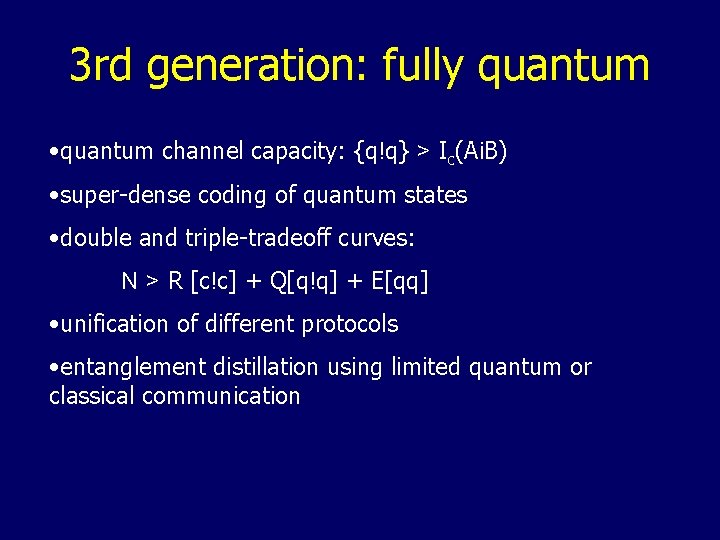
3 rd generation: fully quantum • quantum channel capacity: {q!q} > Ic(Ai. B) • super-dense coding of quantum states • double and triple-tradeoff curves: N > R [c!c] + Q[q!q] + E[qq] • unification of different protocols • entanglement distillation using limited quantum or classical communication
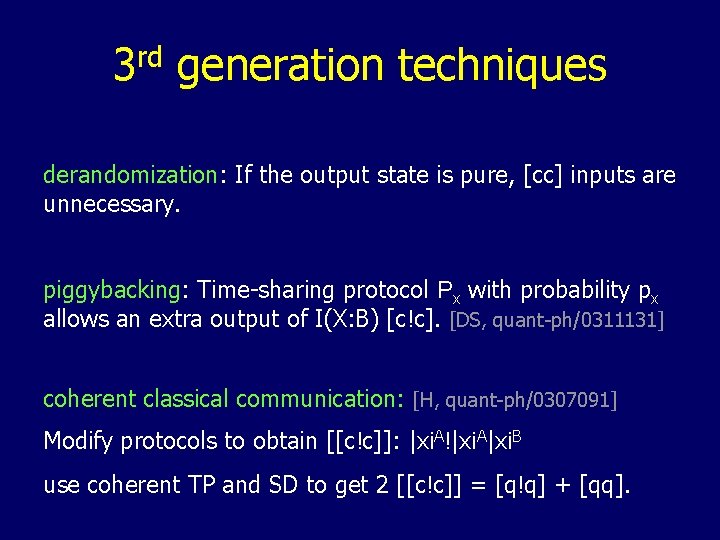
rd 3 generation techniques derandomization: If the output state is pure, [cc] inputs are unnecessary. piggybacking: Time-sharing protocol Px with probability px allows an extra output of I(X: B) [c!c]. [DS, quant-ph/0311131] coherent classical communication: [H, quant-ph/0307091] Modify protocols to obtain [[c!c]]: |xi. A!|xi. A|xi. B use coherent TP and SD to get 2 [[c!c]] = [q!q] + [qq].

main result #1: parent protocols father: {q!q} + ½ I(A: E) [qq] > ½ I(A: B) [q!q] mother: {qq} + ½ I(A: E) [q!q] > ½ I(A: B) [qq] Basic protocols combine with parents to get children. (TP) 2[c!c] + [qq] > {q!q} (SD) [q!q] + [qq] > 2[c!c] (QE) [q!q] > [qq]
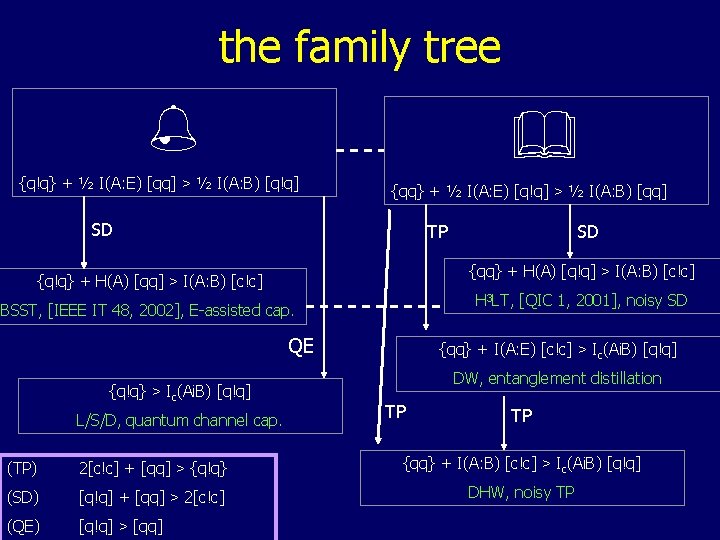
the family tree {q!q} + ½ I(A: E) [qq] > ½ I(A: B) [q!q] {qq} + ½ I(A: E) [q!q] > ½ I(A: B) [qq] SD TP {qq} + H(A) [q!q] > I(A: B) [c!c] {q!q} + H(A) [qq] > I(A: B) [c!c] H 3 LT, [QIC 1, 2001], noisy SD BSST, [IEEE IT 48, 2002], E-assisted cap. QE {q!q} > Ic(Ai. B) [q!q] L/S/D, quantum channel cap. SD {qq} + I(A: E) [c!c] > Ic(Ai. B) [q!q] DW, entanglement distillation TP TP (TP) 2[c!c] + [qq] > {q!q} {qq} + I(A: B) [c!c] > Ic(Ai. B) [q!q] (SD) [q!q] + [qq] > 2[c!c] DHW, noisy TP (QE) [q!q] > [qq]
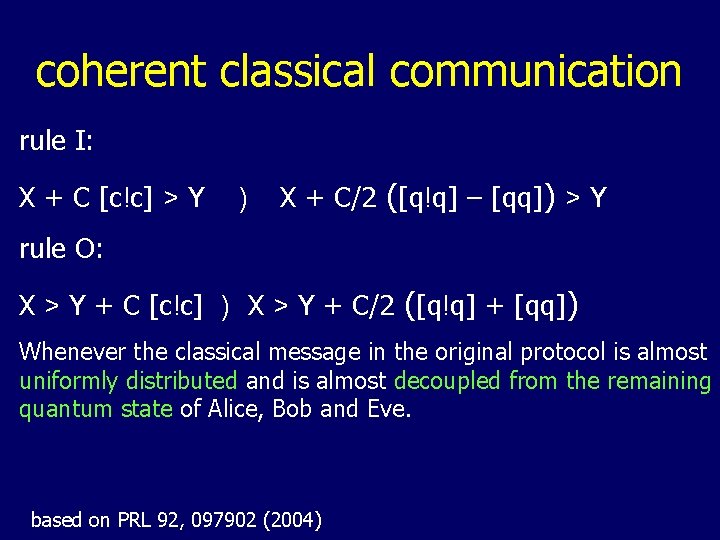
coherent classical communication rule I: X + C [c!c] > Y ) X + C/2 ([q!q] – [qq]) > Y rule O: X > Y + C [c!c] ) X > Y + C/2 ([q!q] + [qq]) Whenever the classical message in the original protocol is almost uniformly distributed and is almost decoupled from the remaining quantum state of Alice, Bob and Eve. based on PRL 92, 097902 (2004)
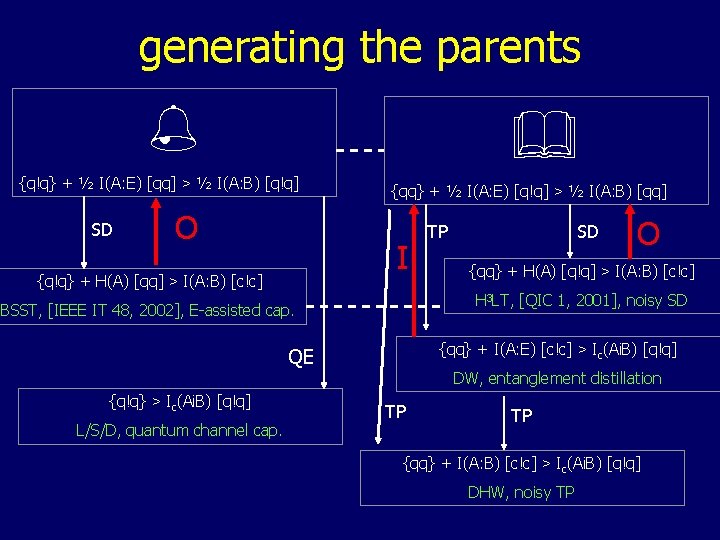
generating the parents {q!q} + ½ I(A: E) [qq] > ½ I(A: B) [q!q] SD O {qq} + ½ I(A: E) [q!q] > ½ I(A: B) [qq] I {q!q} + H(A) [qq] > I(A: B) [c!c] TP SD O {qq} + H(A) [q!q] > I(A: B) [c!c] H 3 LT, [QIC 1, 2001], noisy SD BSST, [IEEE IT 48, 2002], E-assisted cap. {qq} + I(A: E) [c!c] > Ic(Ai. B) [q!q] QE DW, entanglement distillation {q!q} > Ic(Ai. B) [q!q] L/S/D, quantum channel cap. TP TP {qq} + I(A: B) [c!c] > Ic(Ai. B) [q!q] DHW, noisy TP
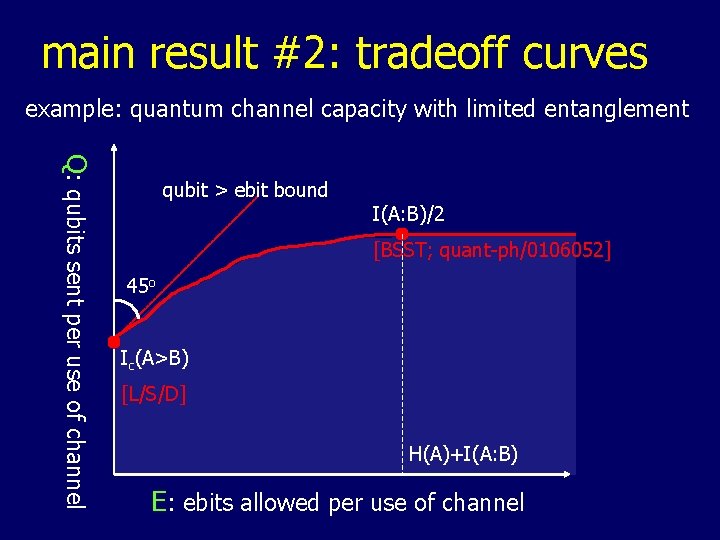
main result #2: tradeoff curves example: quantum channel capacity with limited entanglement Q: qubits sent per use of channel qubit > ebit bound I(A: B)/2 [BSST; quant-ph/0106052] 45 o Ic(A>B) [L/S/D] H(A)+I(A: B) E: ebits allowed per use of channel
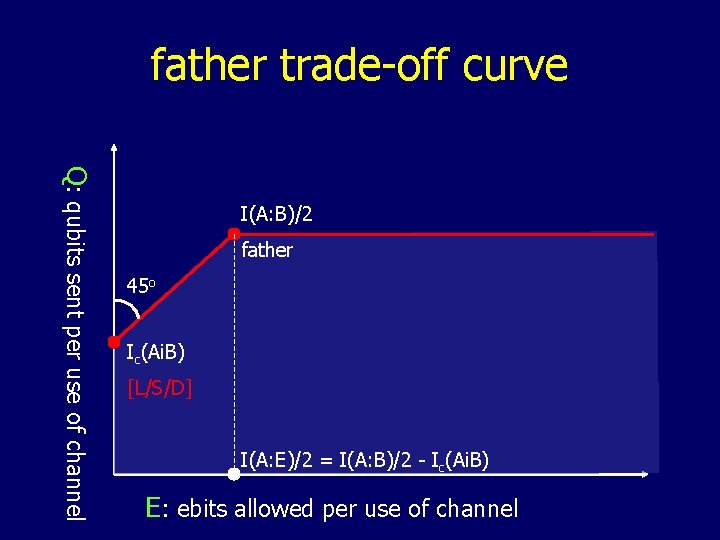
father trade-off curve Q: qubits sent per use of channel I(A: B)/2 father 45 o Ic(Ai. B) [L/S/D] I(A: E)/2 = I(A: B)/2 - Ic(Ai. B) E: ebits allowed per use of channel

mother trade-off curve {qq} + ½ I(A: E) [q!q] > ½ I(A: B)[qq] preprocessing instrument T: A!AE’X {qq} + ½ I(A: EE’|X) [q!q] + H(X)[c!c] > ½ I(A: B|X)[qq] H(X) [c!c] measurement compression I(X: BE) [c!c] + H(X|BE) [cc] derandomization I(X: BE) [c!c] rule I ½ I(X: BE) ([q!q] – [qq]) {qq} + ½ (I(A: EE’|X) + I(X: BE)) [q!q] > ½ (I(A: B|X) + I(X: BE)) [qq]
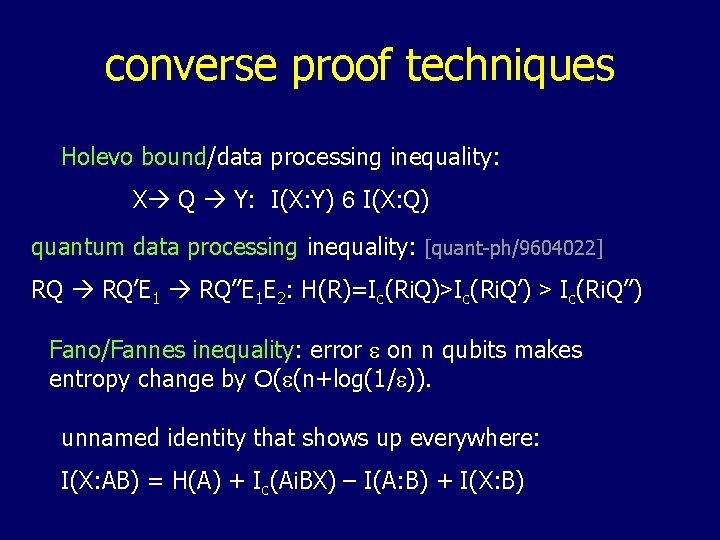
converse proof techniques Holevo bound/data processing inequality: X Q Y: I(X: Y) 6 I(X: Q) quantum data processing inequality: [quant-ph/9604022] RQ RQ’E 1 RQ’’E 1 E 2: H(R)=Ic(Ri. Q)>Ic(Ri. Q’) > Ic(Ri. Q’’) Fano/Fannes inequality: error e on n qubits makes entropy change by O(e(n+log(1/e)). unnamed identity that shows up everywhere: I(X: AB) = H(A) + Ic(Ai. BX) – I(A: B) + I(X: B)
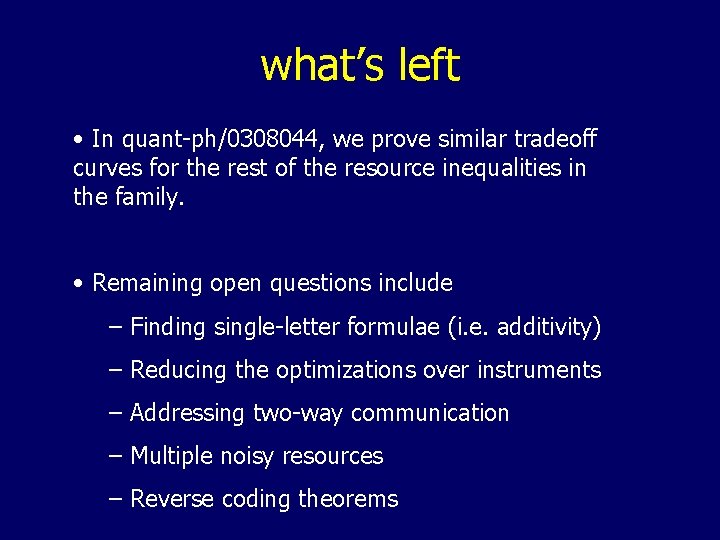
what’s left • In quant-ph/0308044, we prove similar tradeoff curves for the rest of the resource inequalities in the family. • Remaining open questions include – Finding single-letter formulae (i. e. additivity) – Reducing the optimizations over instruments – Addressing two-way communication – Multiple noisy resources – Reverse coding theorems
- Slides: 24