
QUANTUM COMMUNICATION Aditi SenDe HarishChandra Research Institute India

- Slides: 112
QUANTUM COMMUNICATION Aditi Sen(De) Harish-Chandra Research Institute, India
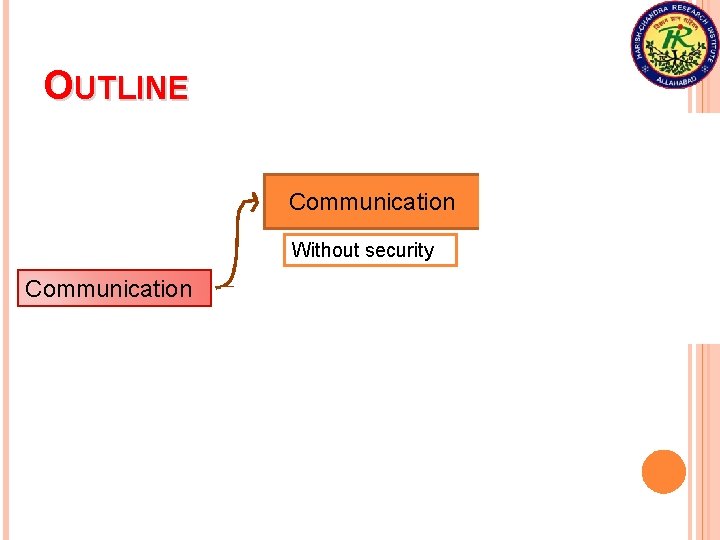
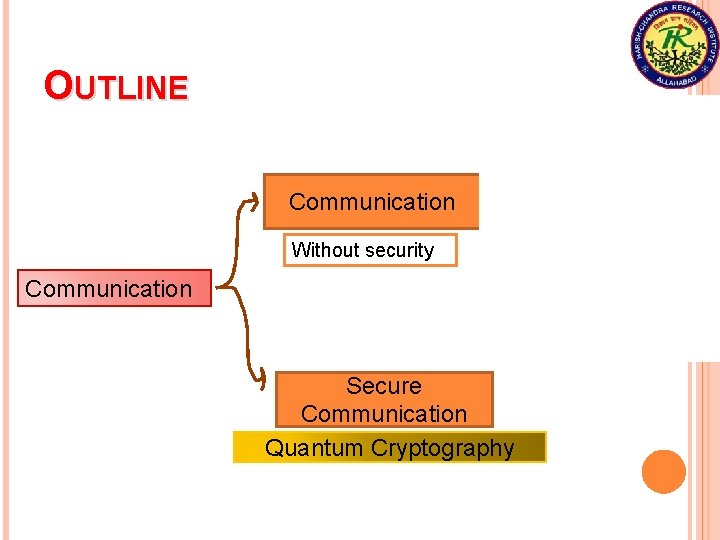
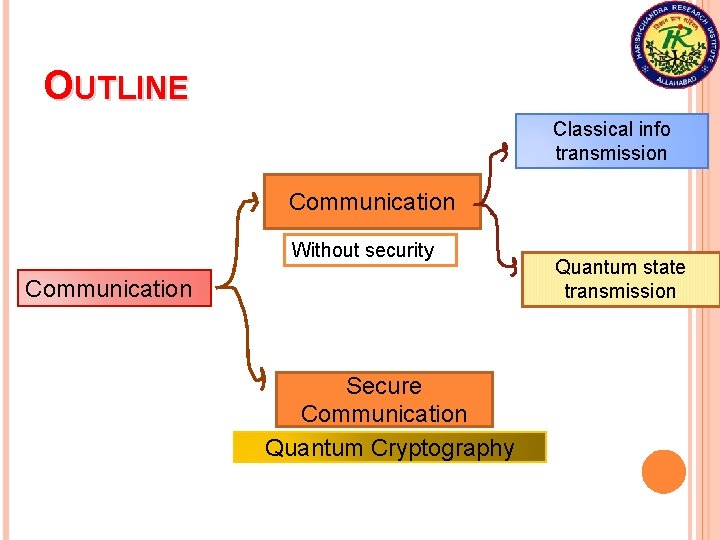
OUTLINE Communication Secure Communication Quantum Cryptography
OUTLINE Classical info transmission Communication Without security Communication Secure Communication Quantum Cryptography Quantum state transmission
OUTLINE Classical info transmission Communication Without security Communication Secure Communication Quantum Cryptography Quantum state transmission
OUTLINE Classical info transmission Communication Without security Communication Secure Communication Quantum Cryptography Quantum state transmission
COMMUNICATION
COMMUNICATION
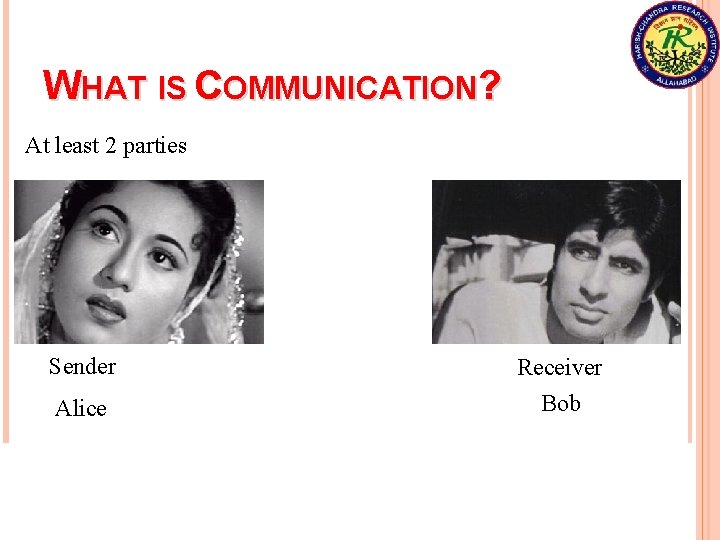
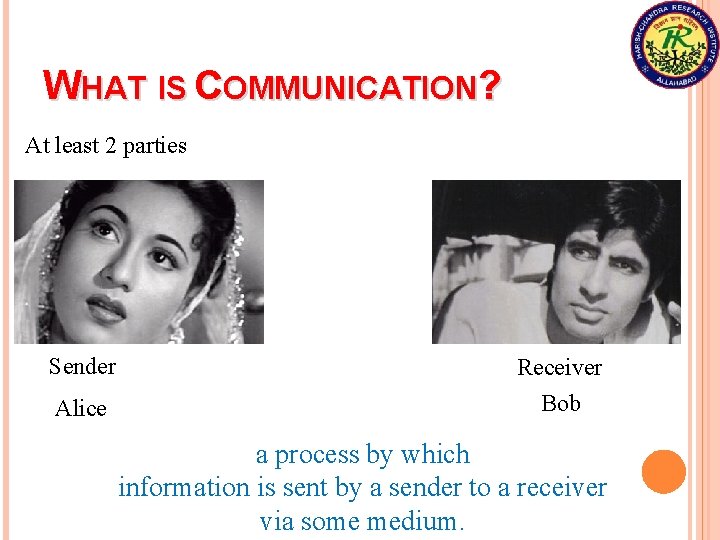
WHAT IS COMMUNICATION? At least 2 parties Sender Alice Receiver Bob Communication is a process by which information is sent by a sender to a receiver via some medium.
WHAT IS COMMUNICATION? At least 2 parties Sender Alice Receiver Bob Communication is a process by which information is sent by a sender to a receiver via some medium.
WHAT IS COMMUNICATION? At least 2 parties Sender Alice Receiver Bob Communication is a process by which information is sent by a sender to a receiver via some medium.
WHAT IS COMMUNICATION? At least 2 parties Sender Alice Receiver Bob Communication is a process by which information is sent by a sender to a receiver via some medium.
WHAT IS COMMUNICATION? At least 2 parties Sender Alice Receiver Bob a process by which information is sent by a sender to a receiver via some medium.
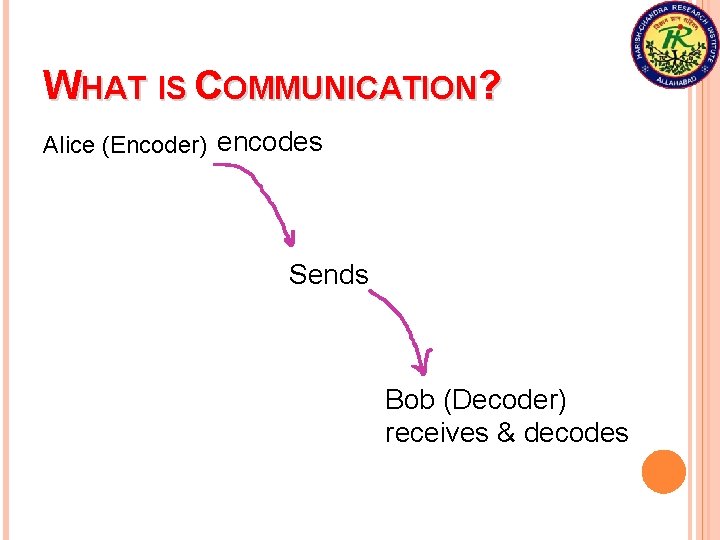
WHAT IS COMMUNICATION? Alice (Encoder) encodes Sends Bob (Decoder) receives & decodes
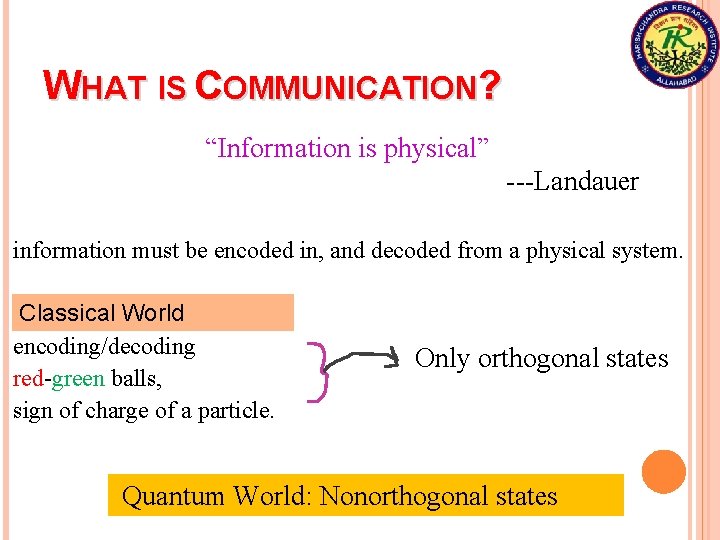
WHAT IS COMMUNICATION? “Information is physical” ---Landauer information must be encoded in, and decoded from a physical system. Classical World encoding/Decoding red-green balls, sign of charge of a particle. Only orthogonal states Quantum World: Nonorthogonal states
WHAT IS COMMUNICATION? “Information is physical” ---Landauer information must be encoded in, and decoded from a physical system. Classical World encoding/Decoding red-green balls, sign of charge of a particle. Only orthogonal states Quantum World: Nonorthogonal states
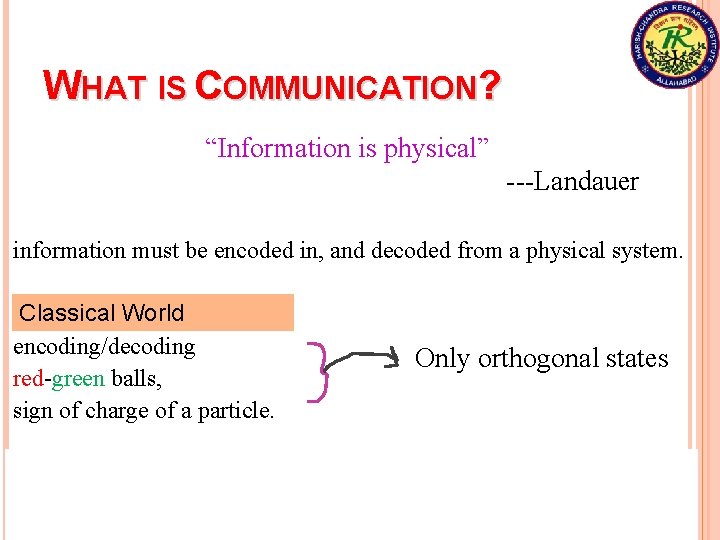
WHAT IS COMMUNICATION? “Information is physical” ---Landauer information must be encoded in, and decoded from a physical system. Classical World encoding/decoding red-green balls, sign of charge of a particle. Only orthogonal states Quantum World: Nonorthogonal states
WHAT IS COMMUNICATION? “Information is physical” ---Landauer information must be encoded in, and decoded from a physical system. Classical World encoding/decoding red-green balls, sign of charge of a particle. Only orthogonal states Quantum World: Nonorthogonal states
WHAT IS COMMUNICATION? “Information is physical” ---Landauer information must be encoded in, and decoded from a physical system. Classical World encoding/decoding red-green balls, Doof quantum states sign charge of a particle. Only orthogonal states advantageous? Quantum World: Nonorthogonal states
Classical Information Transmission via Quantum States Part 1
Quantum Dense Coding Bennett & Wiesner, PRL 1992
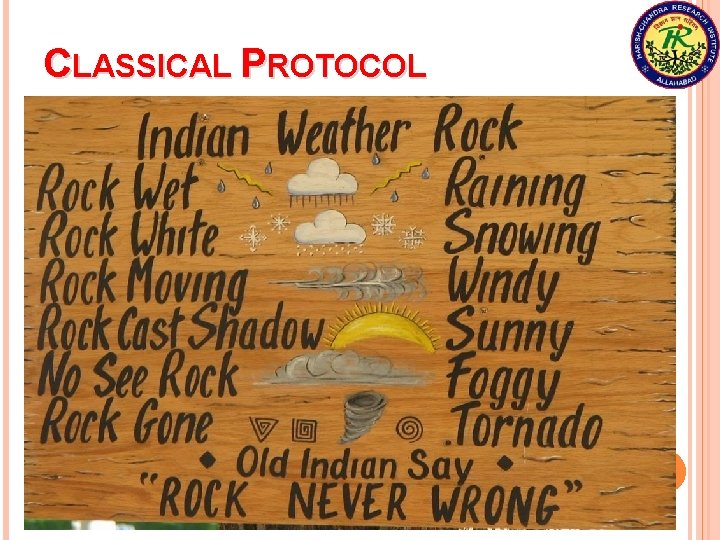
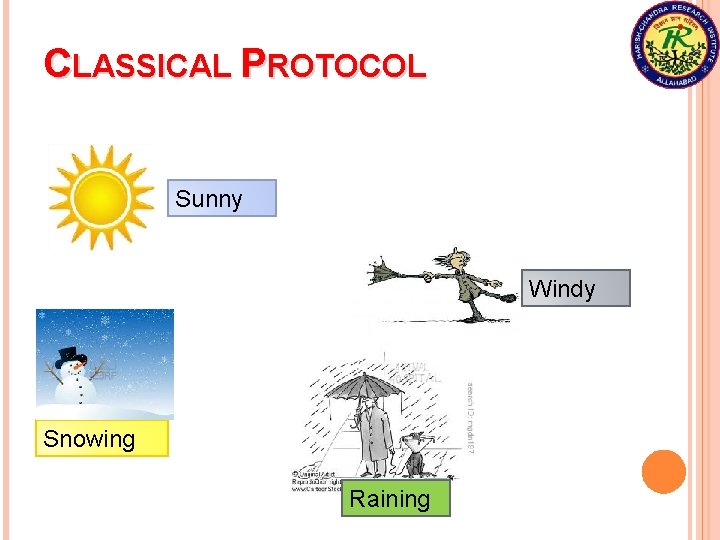
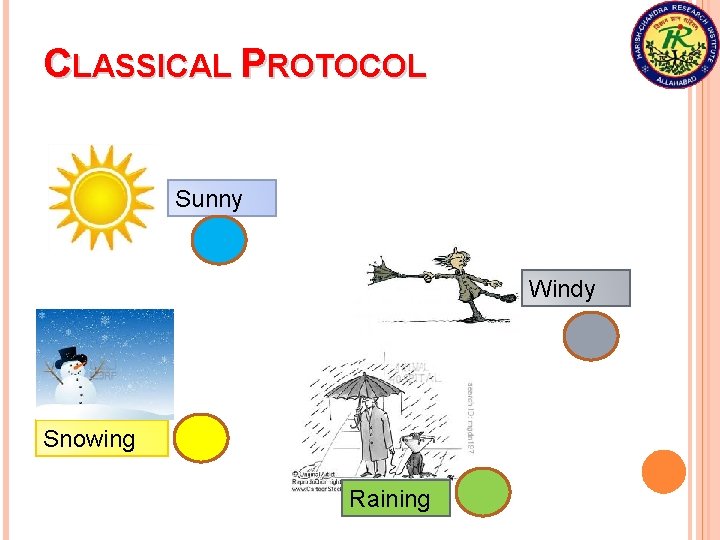
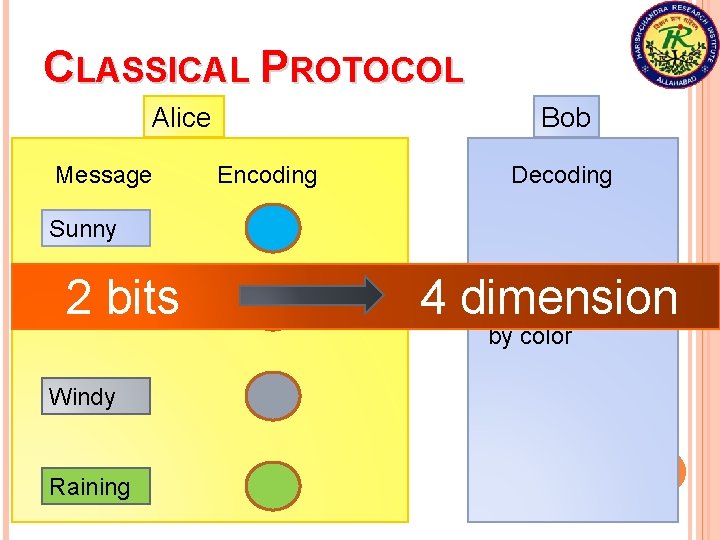
CLASSICAL PROTOCOL Sunny Windy Snowing Raining
CLASSICAL PROTOCOL Sunny Windy Snowing Raining
CLASSICAL PROTOCOL Sunny Windy
CLASSICAL PROTOCOL Sunny Windy Snowing Raining
CLASSICAL PROTOCOL Sunny Windy Snowing Raining
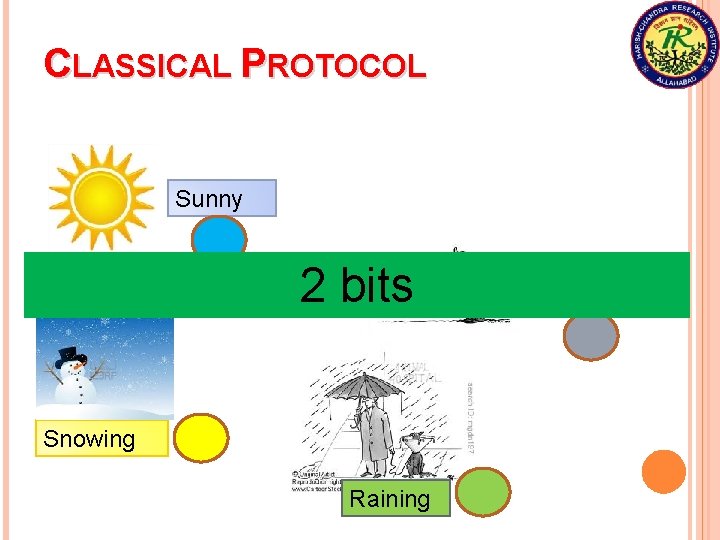
CLASSICAL PROTOCOL Sunny 2 bits Snowing Raining Windy
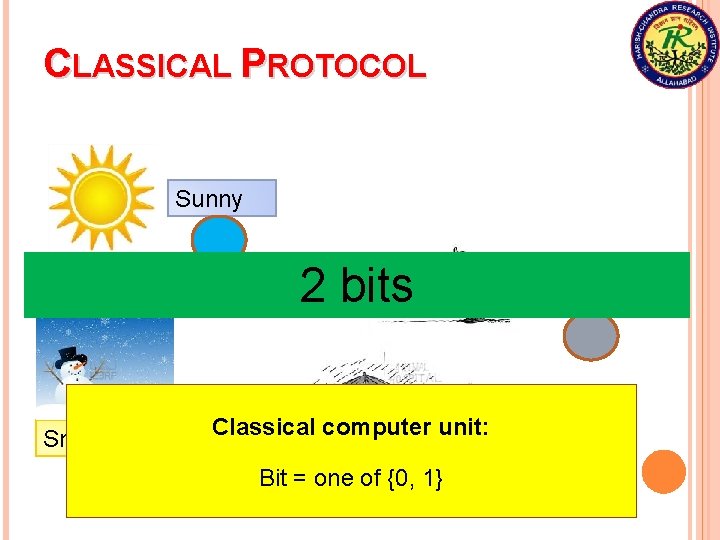
CLASSICAL PROTOCOL Sunny 2 bits Snowing Classical computer unit: Bit = one of {0, 1} Raining Windy
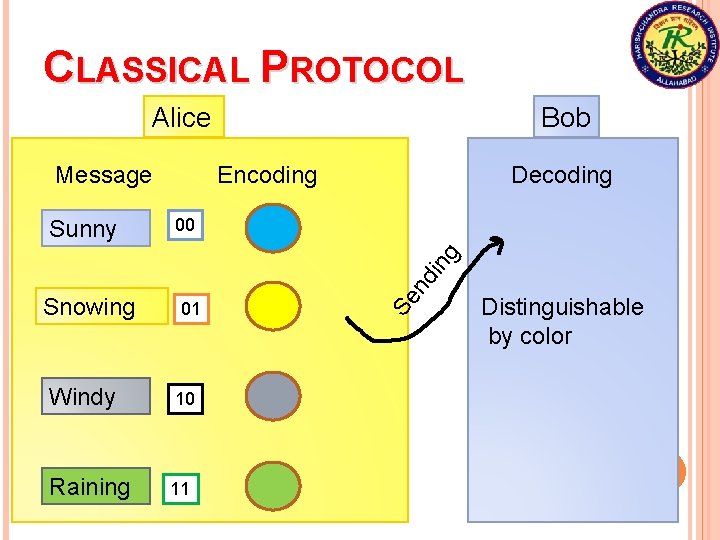
CLASSICAL PROTOCOL Alice Message Encoding Decoding 00 01 Windy 10 Raining 11 Se Snowing nd i ng Sunny Bob Distinguishable by color
CLASSICAL PROTOCOL Alice Message Bob Encoding Decoding Sunny 2 bits Snowing Windy Raining 4 dimension Distinguishable by color
What abt Quantum?
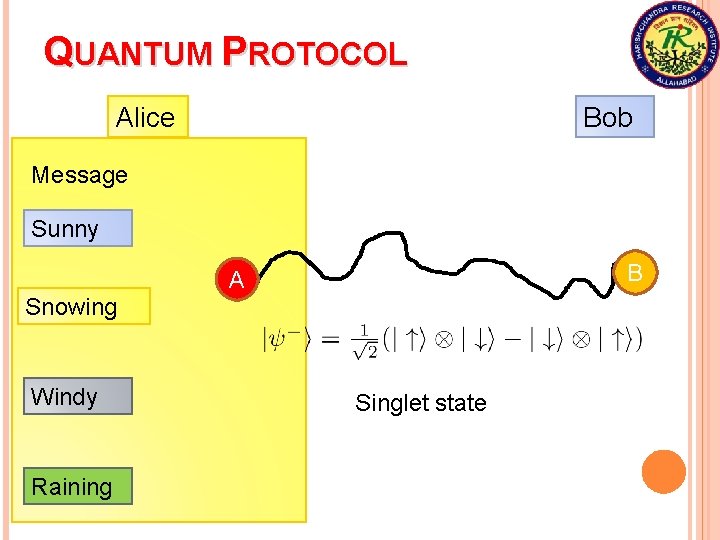
QUANTUM PROTOCOL Alice Bob Message Sunny B A Snowing Windy Raining Singlet state
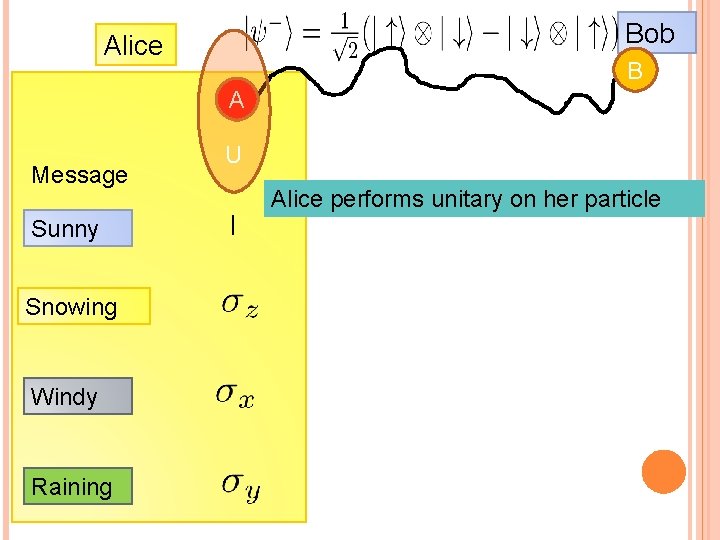
Bob Alice B A Message Sunny Snowing Windy Raining U I Alice performs unitary on her particle
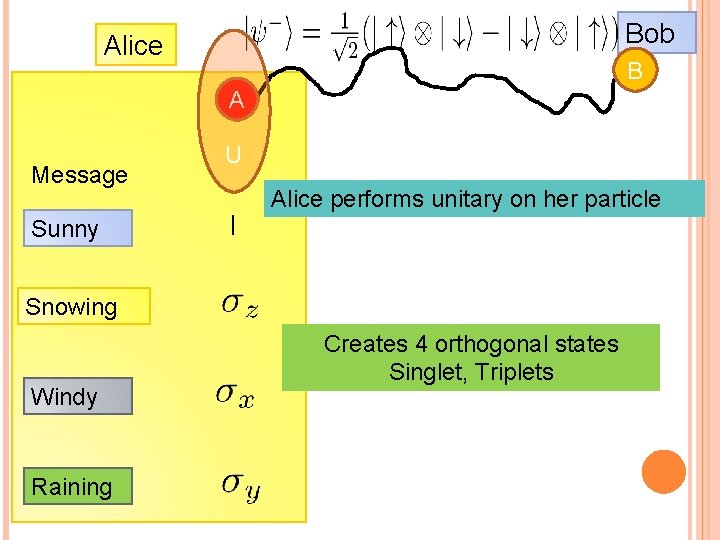
Bob Alice B A Message Sunny U I Alice performs unitary on her particle Snowing Windy Raining Creates 4 orthogonal states Singlet, Triplets
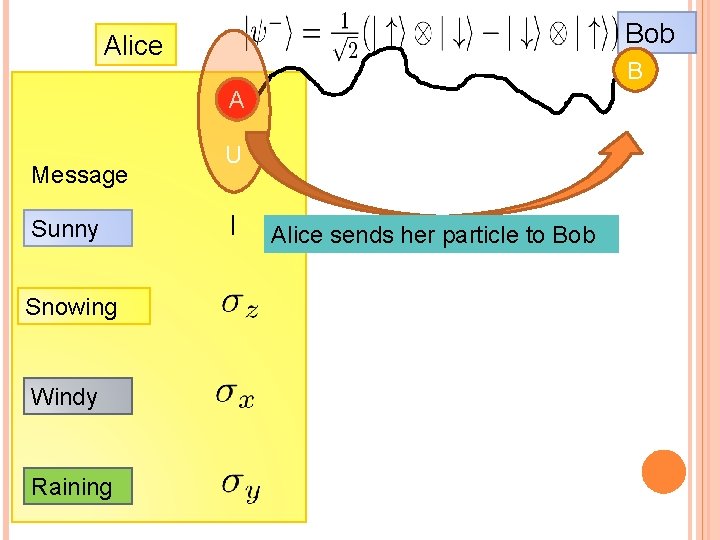
Bob Alice B A Message Sunny Snowing Windy Raining U I Alice sends her particle to Bob
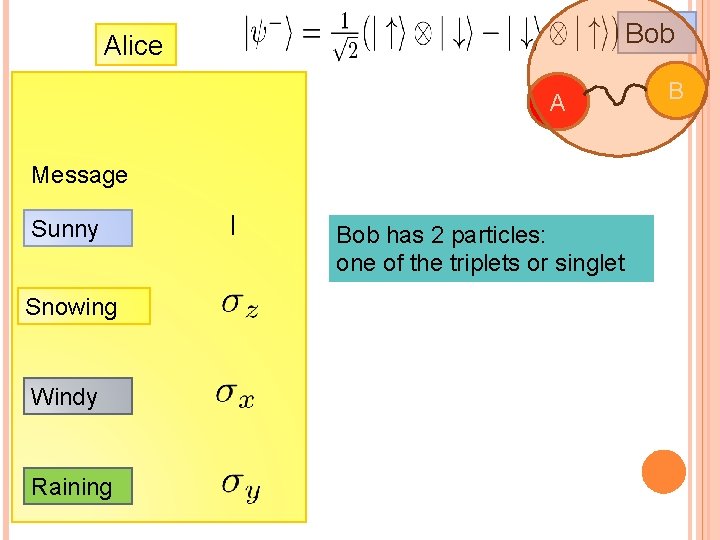
Bob Alice A Message Sunny Snowing Windy Raining I Bob has 2 particles: one of the triplets or singlet B
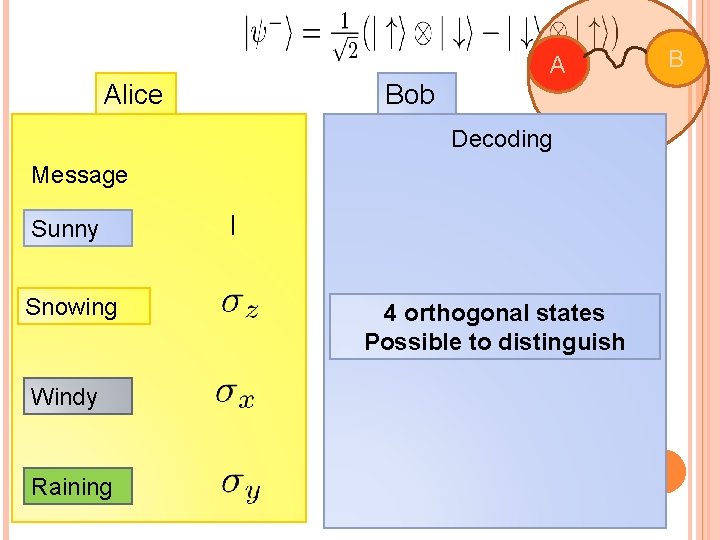
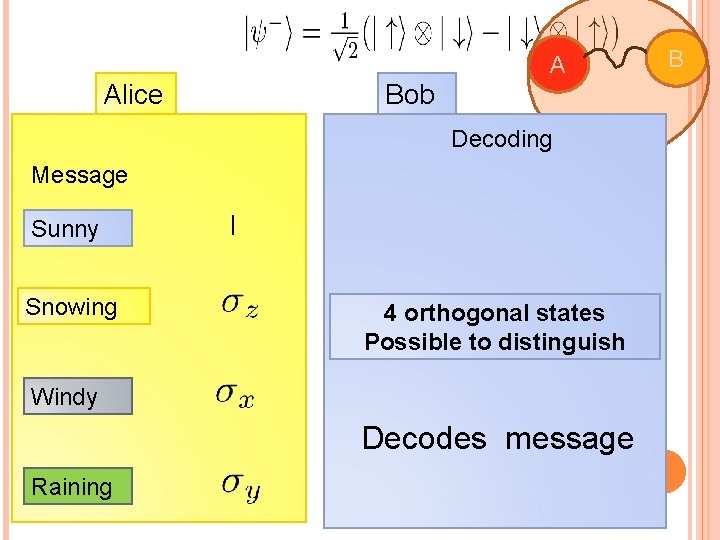
A Alice Bob Decoding Message Sunny Snowing Windy Raining I 4 orthogonal states Possible to distinguish B
A Alice Bob Decoding Message Sunny Snowing I 4 orthogonal states Possible to distinguish Windy Decodes message Raining B
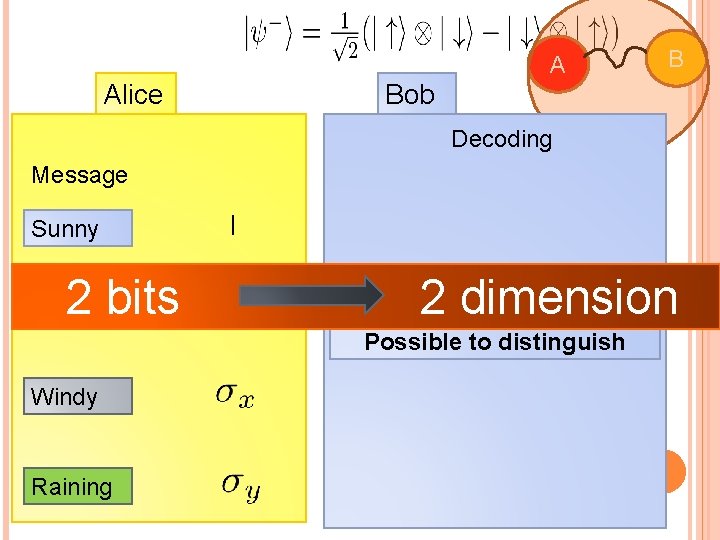
A Alice B Bob Decoding Message Sunny 2 bits Snowing Windy Raining I 2 dimension 4 orthogonal states Possible to distinguish
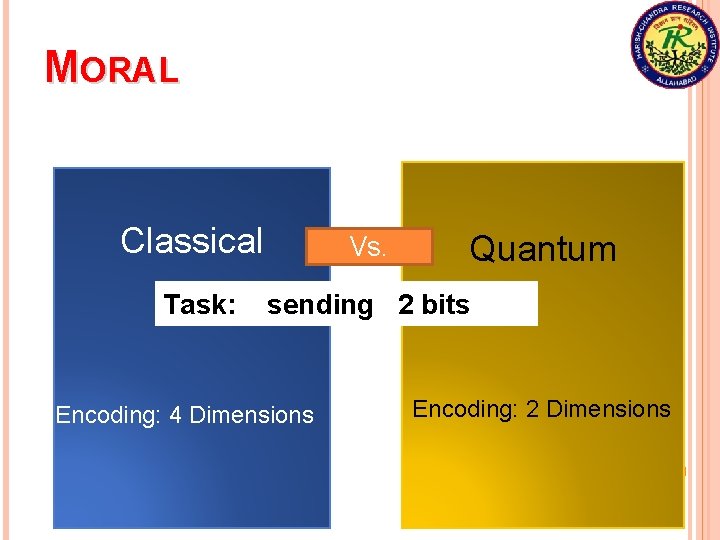
MORAL Classical Vs. Task: sending 2 bits Encoding: 4 Dimensions Quantum Encoding: 2 Dimensions
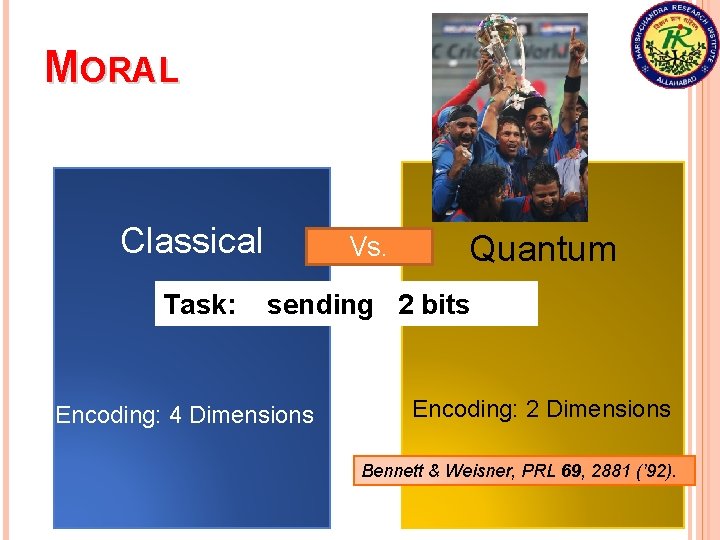
MORAL Classical Vs. Task: sending 2 bits Encoding: 4 Dimensions Quantum Encoding: 2 Dimensions Bennett & Weisner, PRL 69, 2881 (’ 92).
DENSE CODING FOR ARBITRARY STATE Hiroshima, J. Phys. A ’ 01; Ziman & Buzek, PRA ’ 03, Bruss, D’Ariano, Lewenstein, Macchiavello, ASD, Sen, PRL’ 04
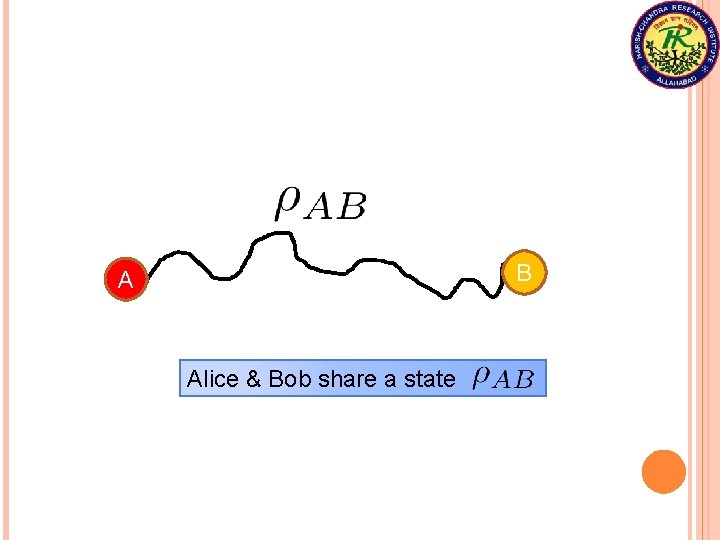
B A Alice & Bob share a state
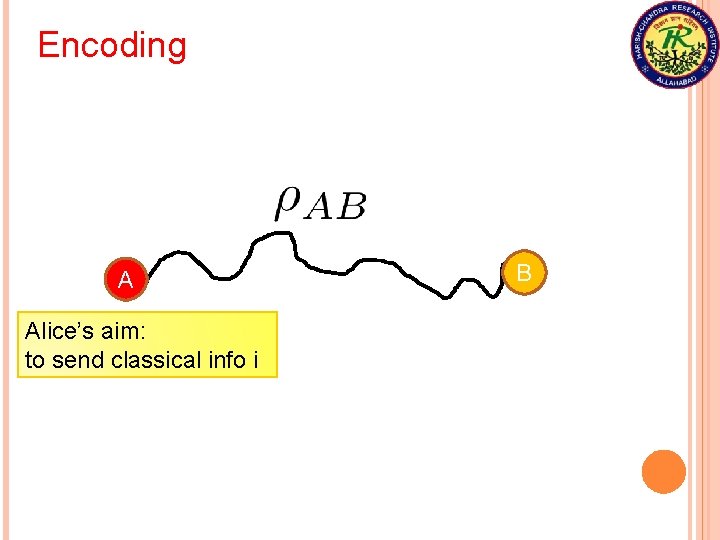
Encoding A Alice’s aim: to send classical info i B
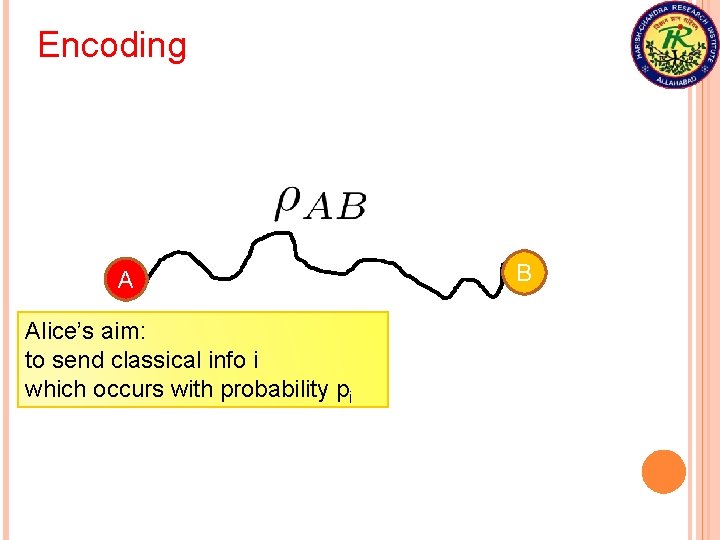
Encoding A Alice’s aim: to send classical info i which occurs with probability pi B
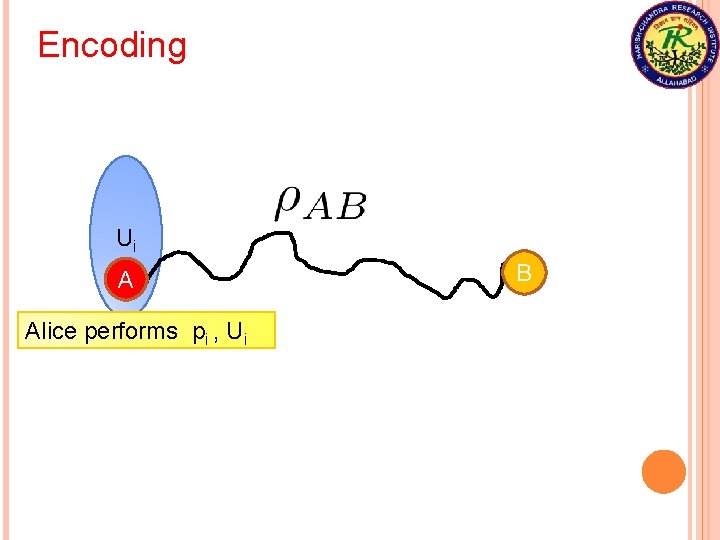
Encoding Ui A Alice performs pi , Ui B
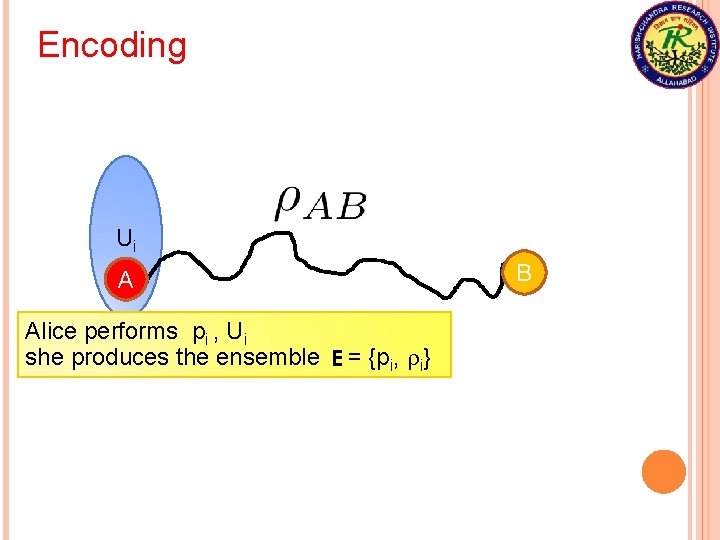
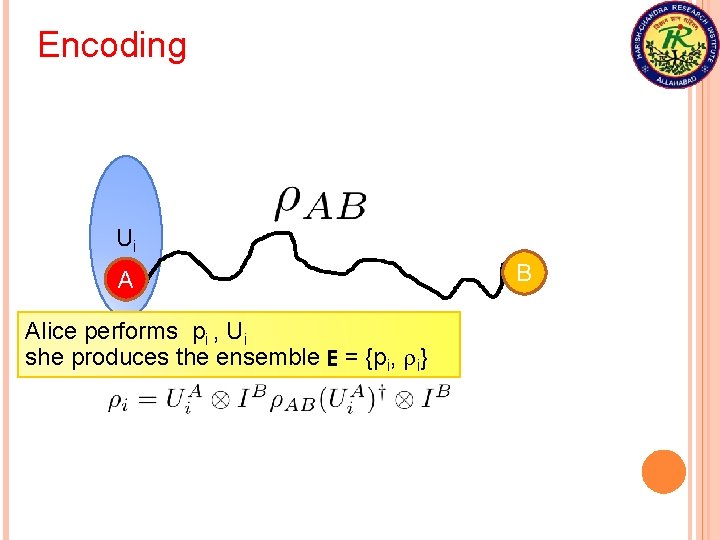
Encoding Ui A Alice performs pi , Ui she produces the ensemble E = {pi, ri} B
Encoding Ui A Alice performs pi , Ui she produces the ensemble E = {pi, ri} B
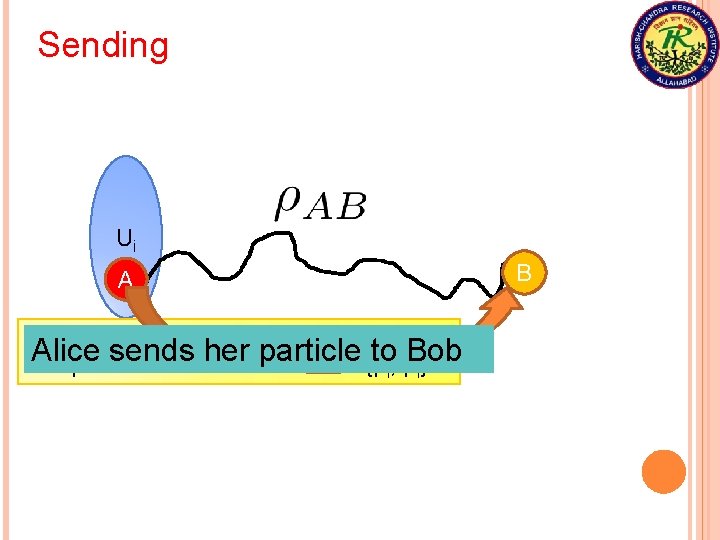
Sending Ui A Alice performs pi , Ui Alice sends particle to, r. Bob she produces theher ensemble E = {p i i} B
Decoding A Alice B Bob
Decoding A Alice B Bob’s task: Gather info abt i
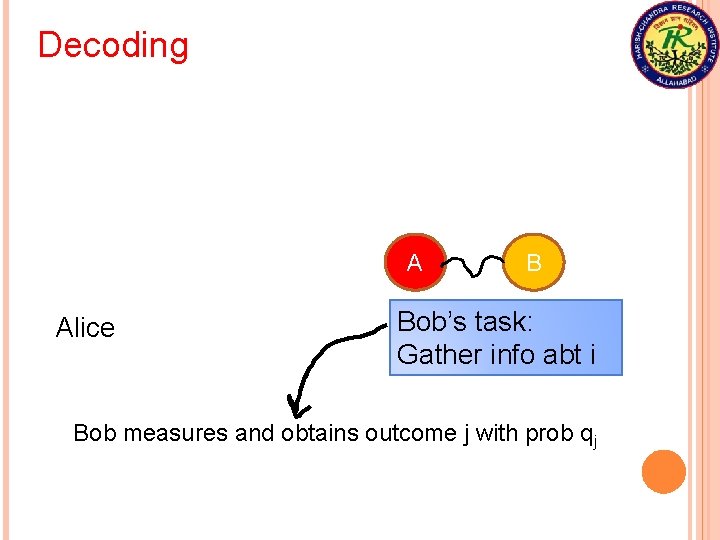
Decoding A Alice B Bob’s task: Gather info abt i Bob measures and obtains outcome j with prob qj
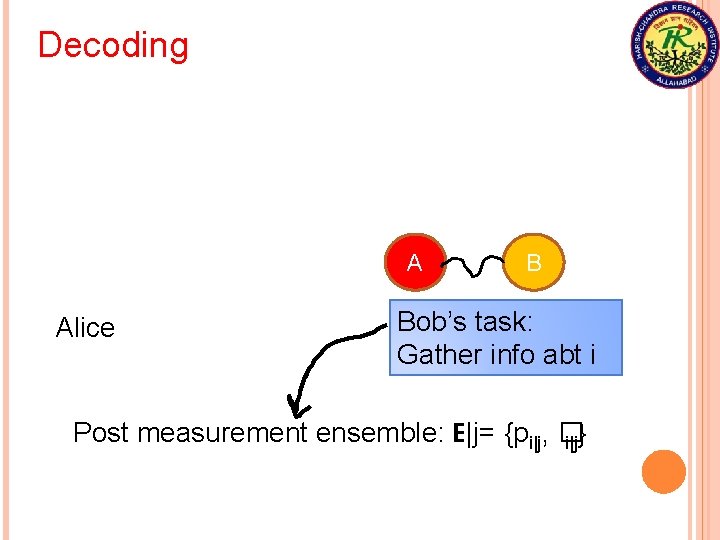
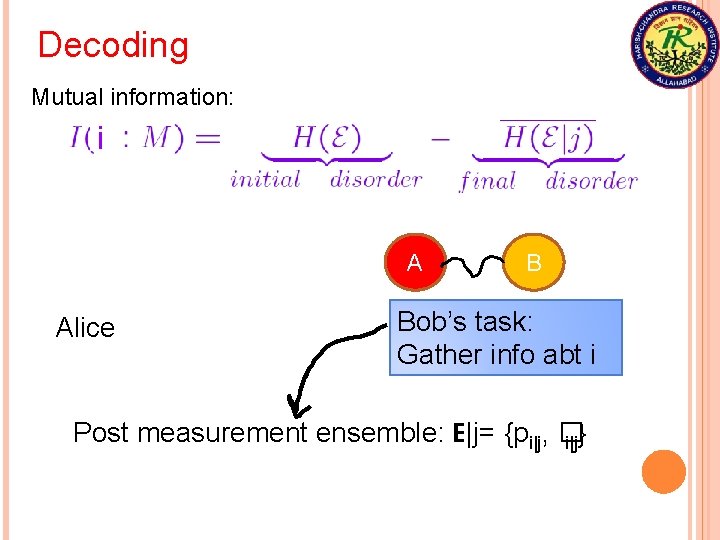
Decoding A Alice B Bob’s task: Gather info abt i Post measurement ensemble: E|j= {pi|j, � i|j}
Decoding Mutual information: i A Alice B Bob’s task: Gather info abt i Post measurement ensemble: E|j= {pi|j, � i|j}
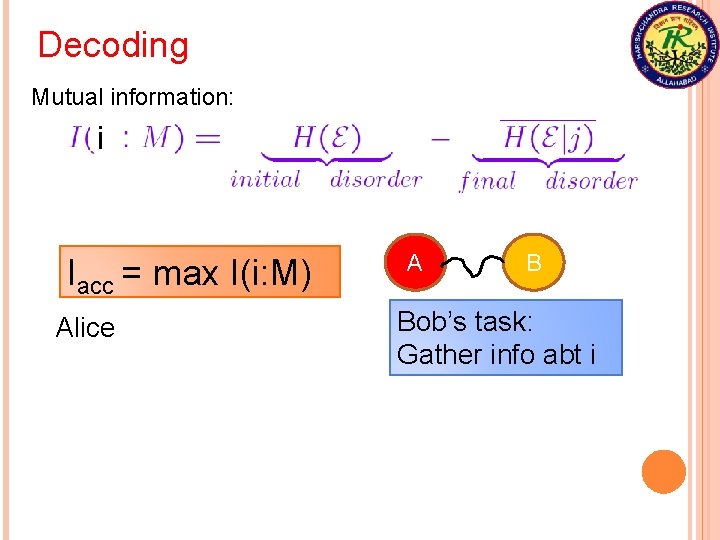
Decoding Mutual information: i Iacc = max I(i: M) Alice A B Bob’s task: Gather info abt i
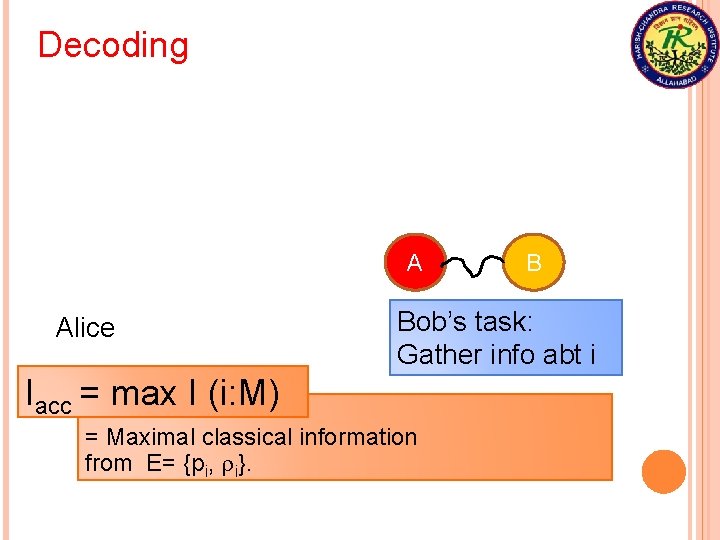
Decoding A Alice B Bob’s task: Gather info abt i Iacc = max I (i: M) = Maximal classical information from E= {pi, ri}.
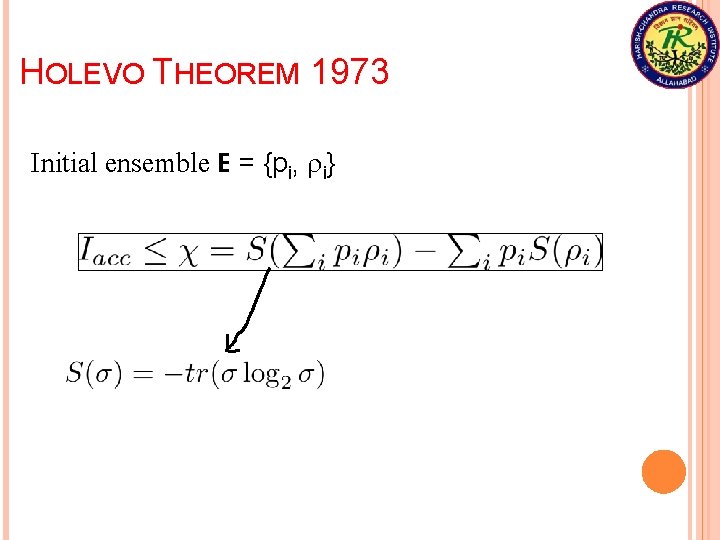
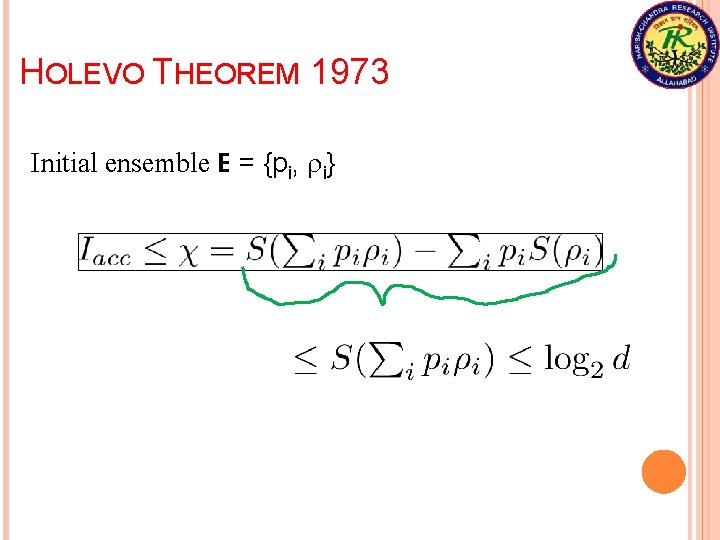
HOLEVO THEOREM 1973 Initial ensemble E = {pi, ri}
HOLEVO THEOREM 1973 Initial ensemble E = {pi, ri}
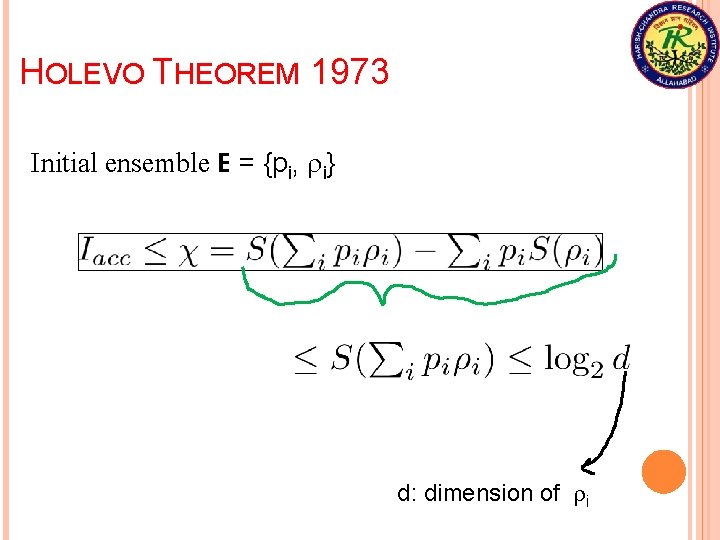
HOLEVO THEOREM 1973 Initial ensemble E = {pi, ri} d: dimension of ri
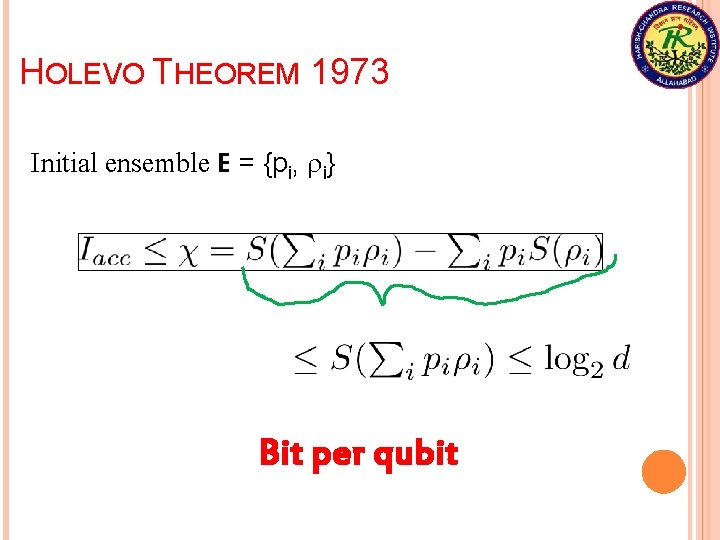
HOLEVO THEOREM 1973 Initial ensemble E = {pi, ri} Bit per qubit
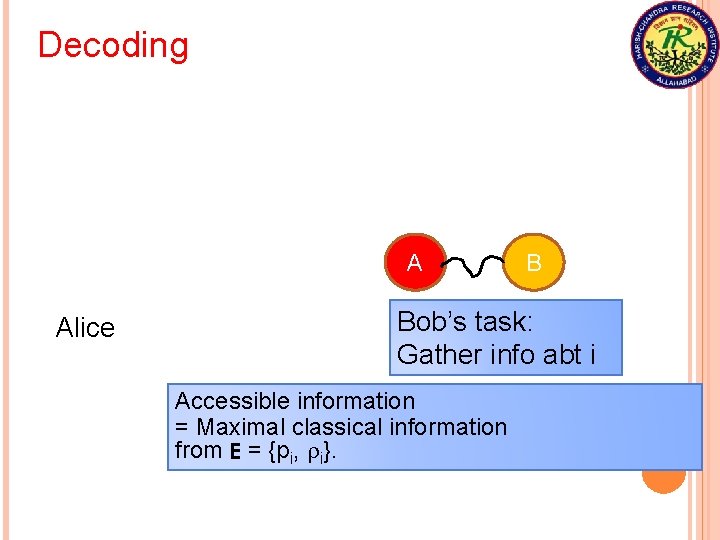
Decoding A Alice B Bob’s task: Gather info abt i Accessible information = Maximal classical information from E = {pi, ri}.
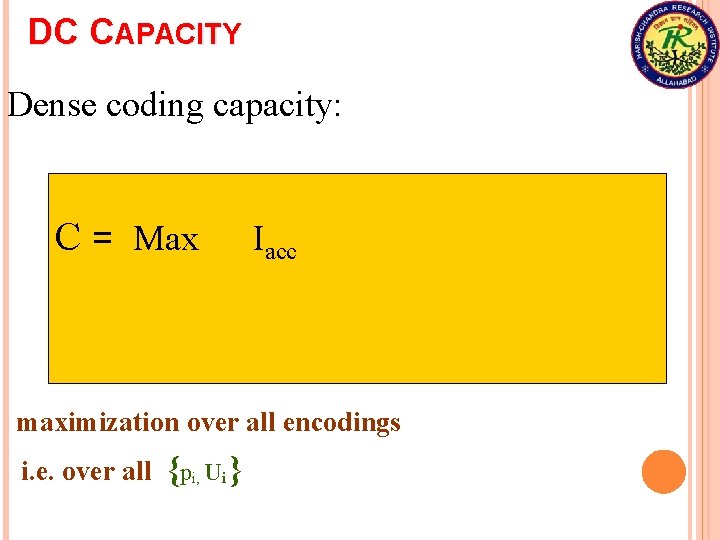
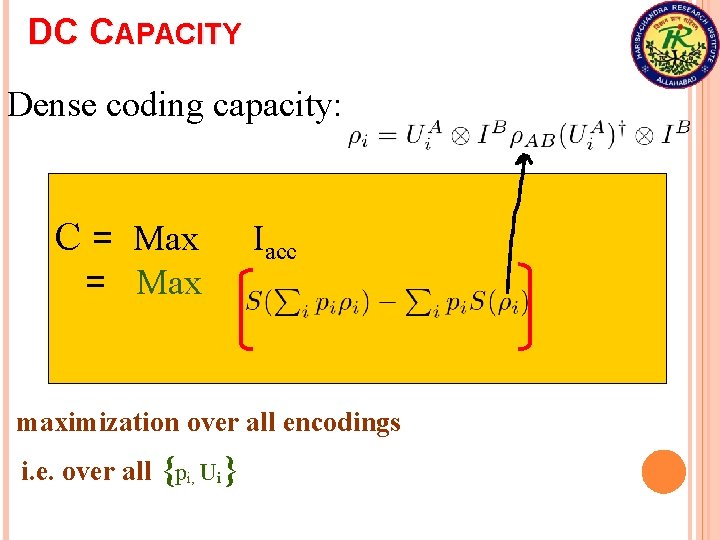
DC CAPACITY Dense coding capacity: C = Max Iacc maximization over all encodings i. e. over all {pi, Ui }
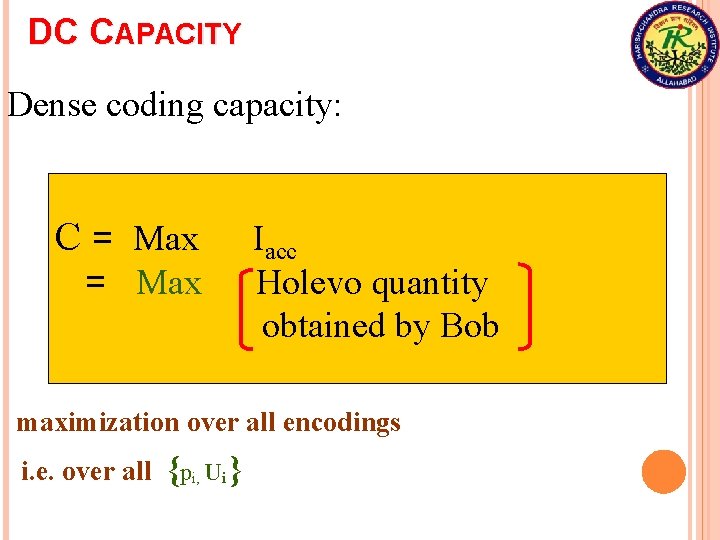
DC CAPACITY Dense coding capacity: C = Max Iacc Holevo quantity obtained by Bob maximization over all encodings i. e. over all {pi, Ui }
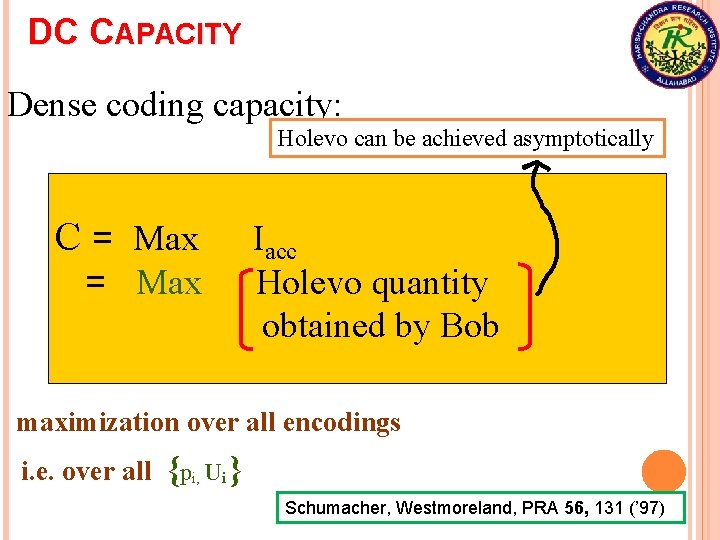
DC CAPACITY Dense coding capacity: Holevo can be achieved asymptotically C = Max Iacc Holevo quantity obtained by Bob maximization over all encodings i. e. over all {pi, Ui } Schumacher, Westmoreland, PRA 56, 131 (’ 97)
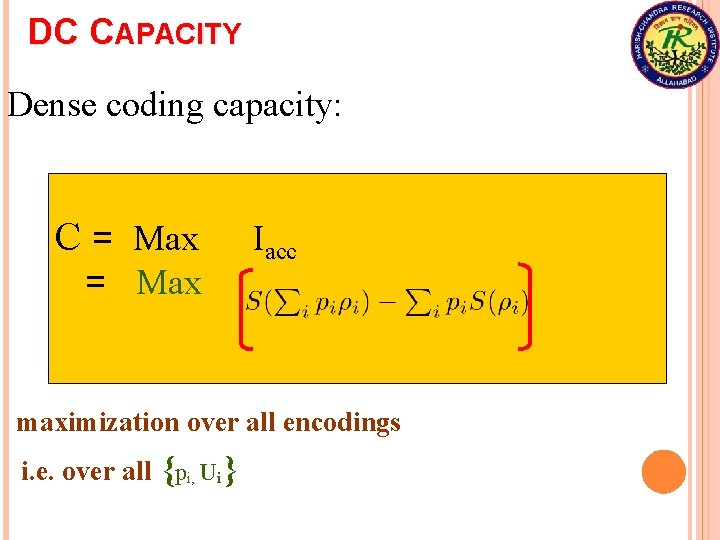
DC CAPACITY Dense coding capacity: C = Max Iacc maximization over all encodings i. e. over all {pi, Ui }
DC CAPACITY Dense coding capacity: C = Max Iacc maximization over all encodings i. e. over all {pi, Ui }
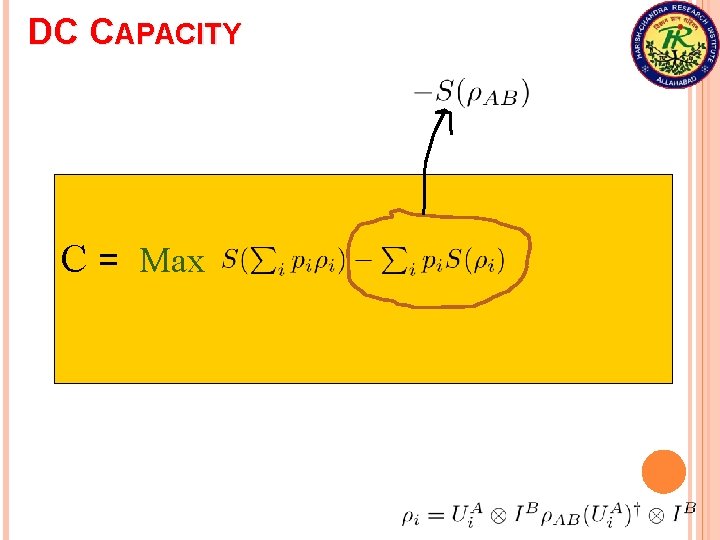
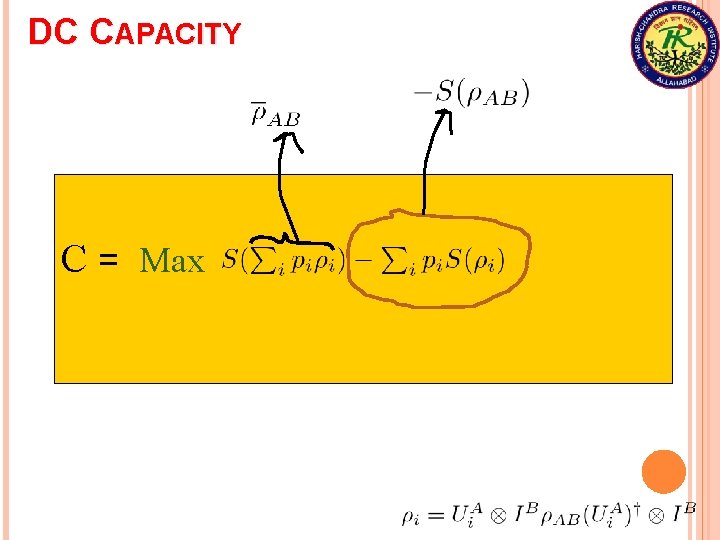
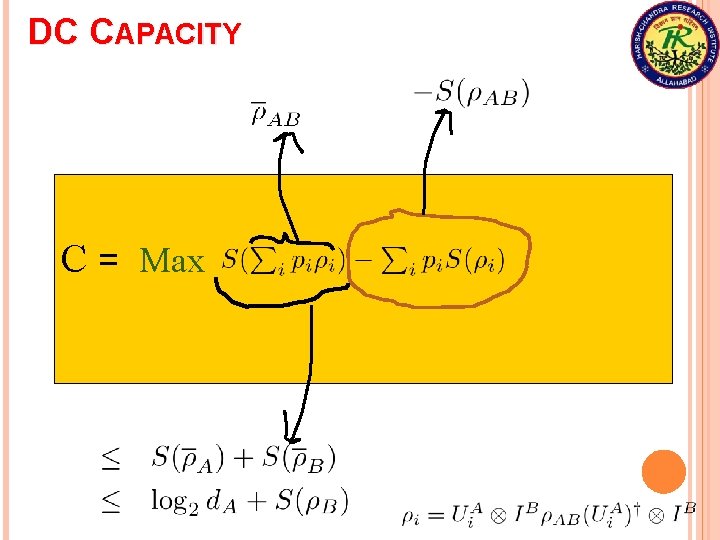
DC CAPACITY C = Max
DC CAPACITY C = Max
DC CAPACITY C = Max
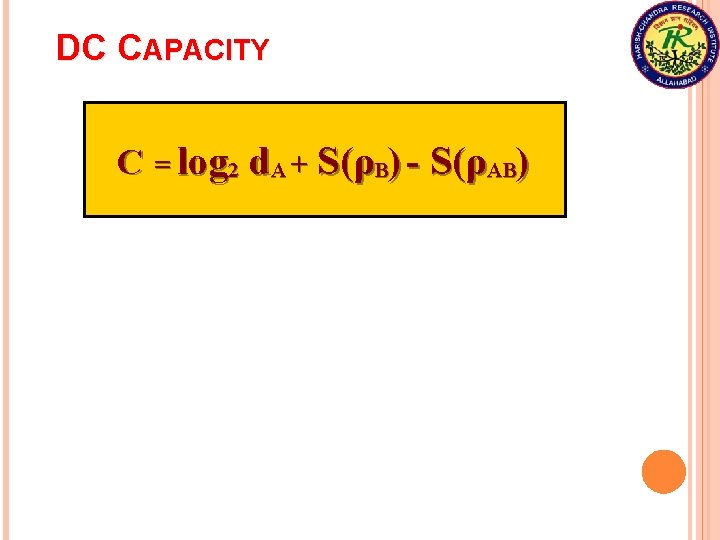
DC CAPACITY C = log 2 d. A + S(ρB) - S(ρAB)
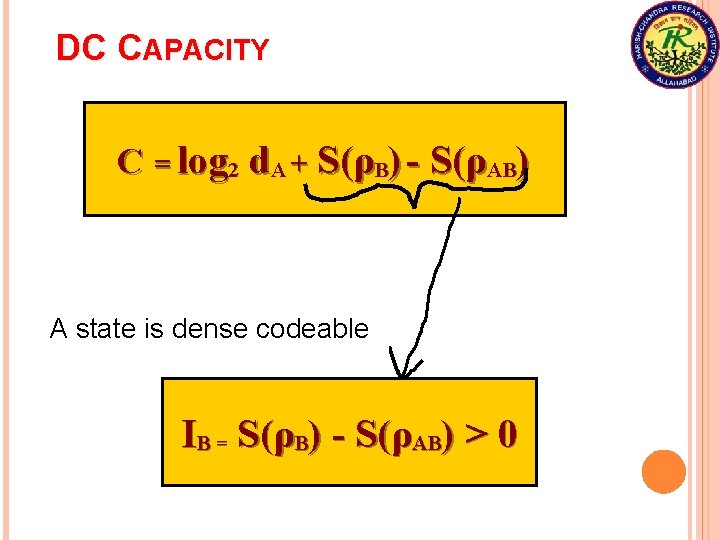
DC CAPACITY C = log 2 d. A + S(ρB) - S(ρAB) A state is dense codeable IB = S(ρB) - S(ρAB) > 0
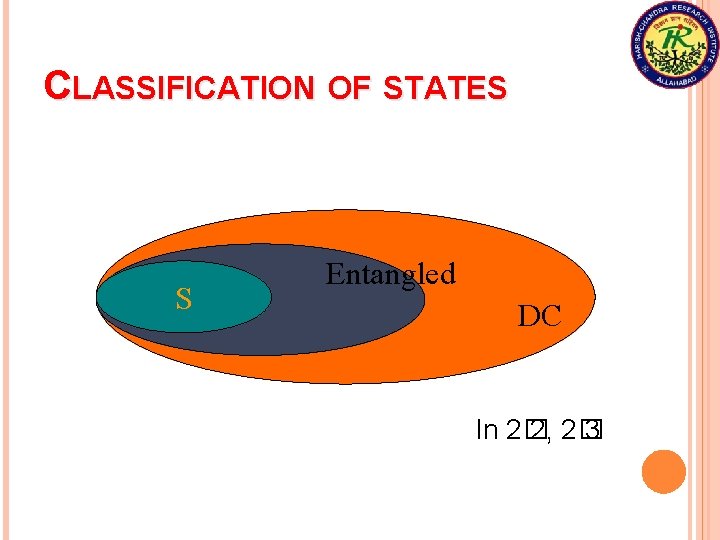
CLASSIFICATION OF STATES S Entangled DC In 2� 2, 2� 3
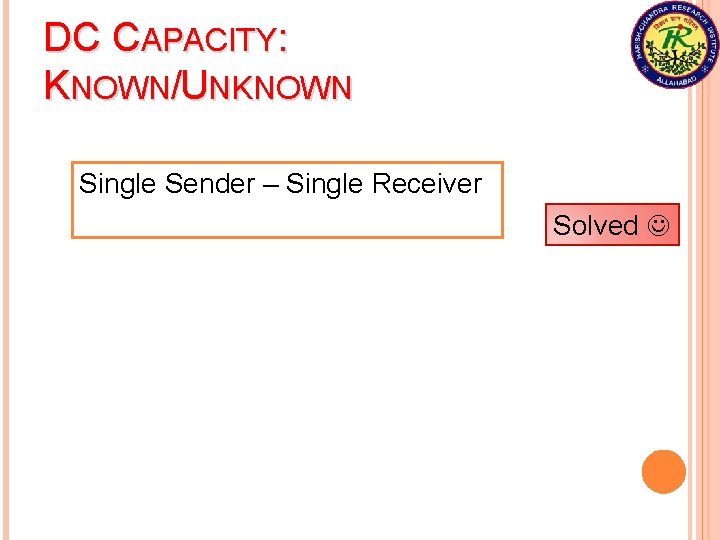
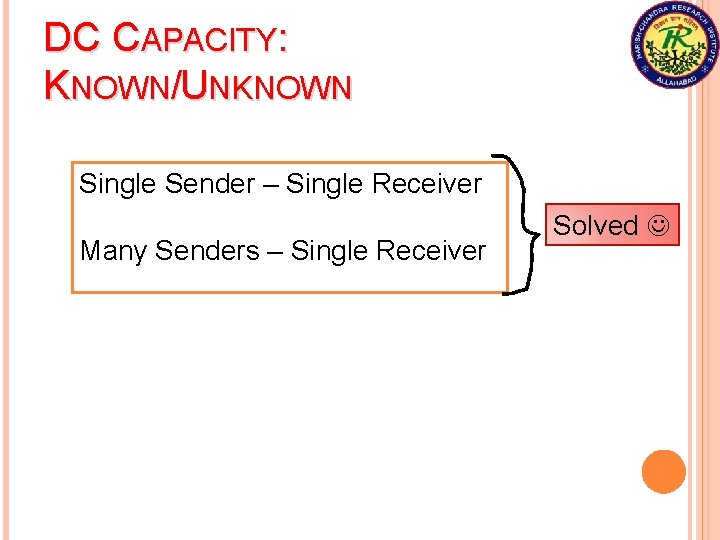
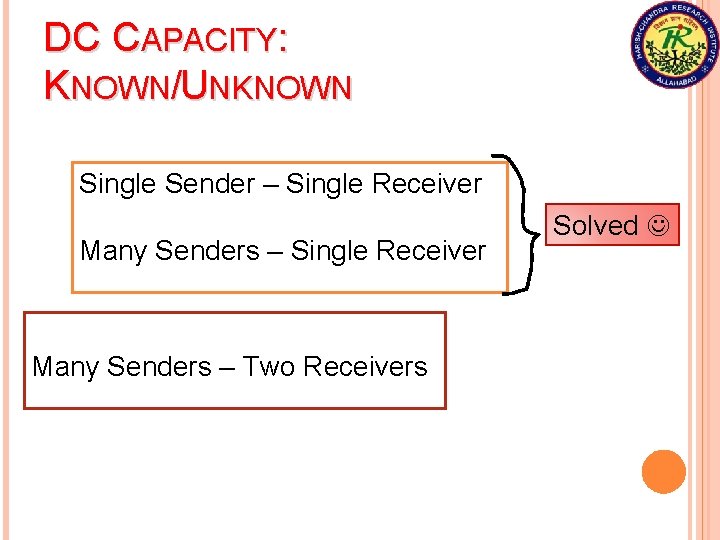
DC CAPACITY: KNOWN/UNKNOWN Single Sender – Single Receiver Solved
DENSE CODING NETWORK
WHY QUANTUM DENSE CODING NETWORK? Point to point communication has limited commercial use
WHY QUANTUM DENSE CODING NETWORK? To build a quantum computer, or communication network
WHY QUANTUM DENSE CODING NETWORK? To build a quantum computer, or communication network, classical info transmission
WHY QUANTUM DENSE CODING NETWORK? To build a quantum computer, or communication network, classical info transmission via quantum state in network
Dense Coding Network 1
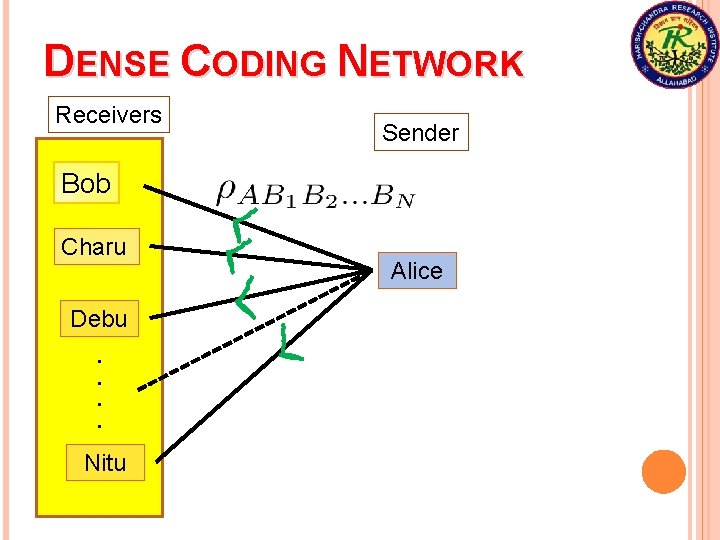
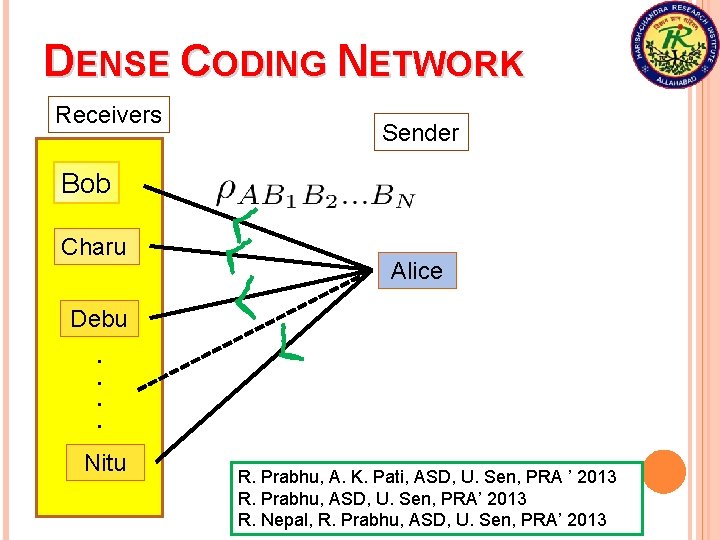
DENSE CODING NETWORK Receivers Sender Bob Charu Debu. . Nitu Alice
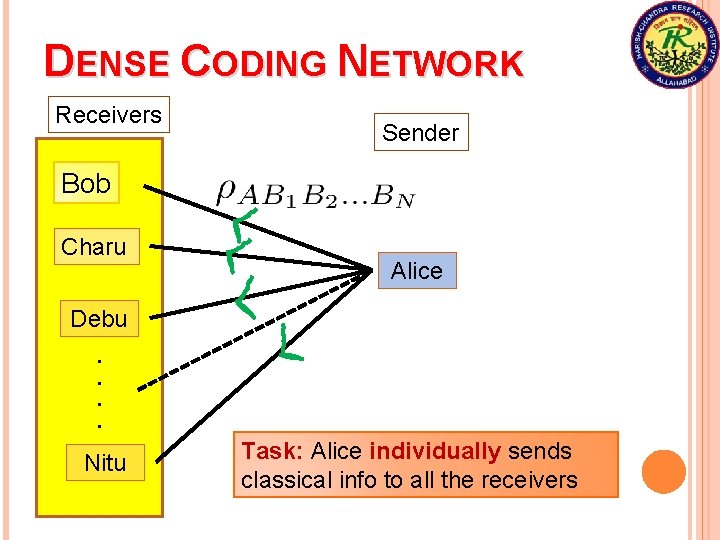
DENSE CODING NETWORK Receivers Sender Bob Charu Alice Debu. . Nitu Task: Alice individually sends classical info to all the receivers
DENSE CODING NETWORK Receivers Sender Bob Charu Alice Debu. . Nitu R. Prabhu, A. K. Pati, ASD, U. Sen, PRA ’ 2013 R. Prabhu, ASD, U. Sen, PRA’ 2013 R. Nepal, R. Prabhu, ASD, U. Sen, PRA’ 2013
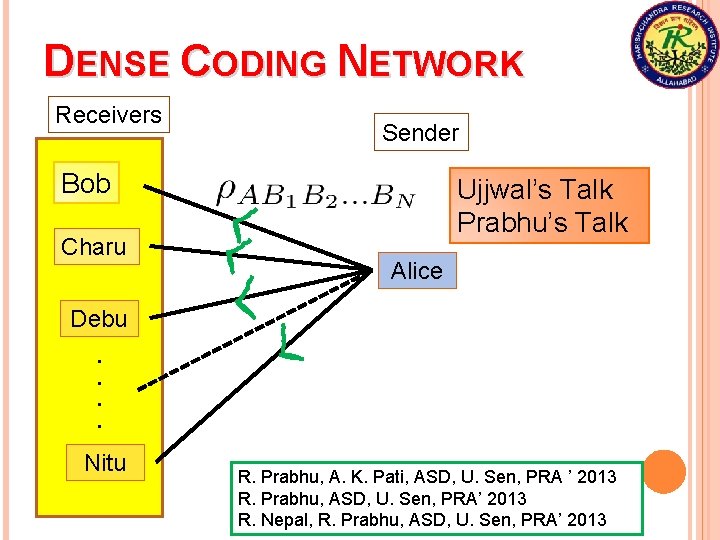
DENSE CODING NETWORK Receivers Sender Bob Charu Ujjwal’s Talk Prabhu’s Talk Alice Debu. . Nitu R. Prabhu, A. K. Pati, ASD, U. Sen, PRA ’ 2013 R. Prabhu, ASD, U. Sen, PRA’ 2013 R. Nepal, R. Prabhu, ASD, U. Sen, PRA’ 2013
Dense Coding Network 2
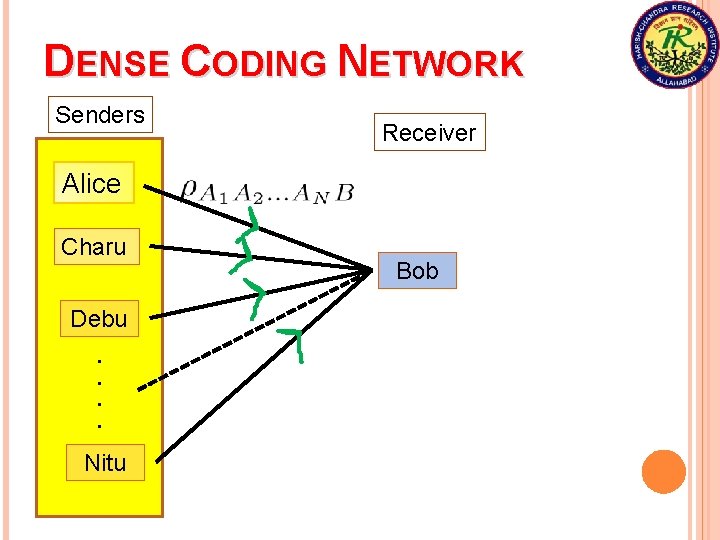
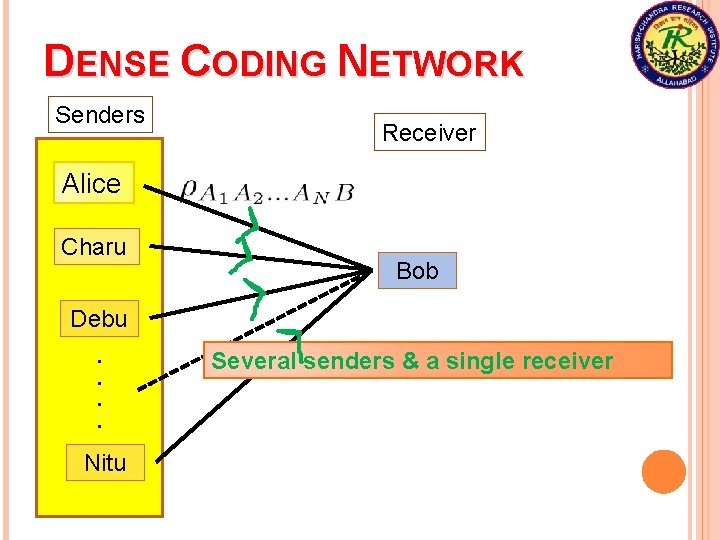
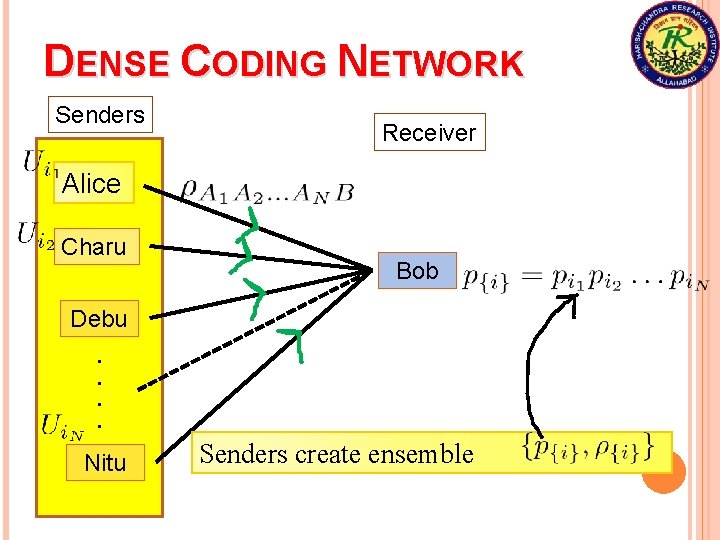
DENSE CODING NETWORK Senders Receiver Alice Charu Debu. . Nitu Bob
DENSE CODING NETWORK Senders Receiver Alice Charu Bob Debu. . Nitu Several senders & a single receiver
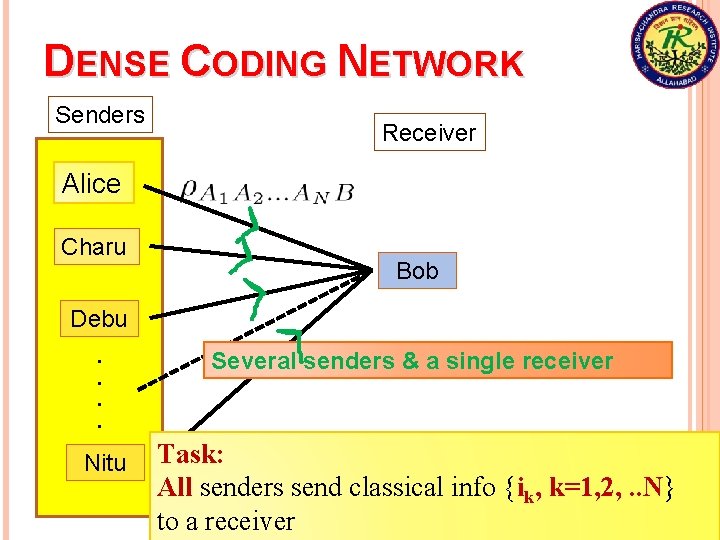
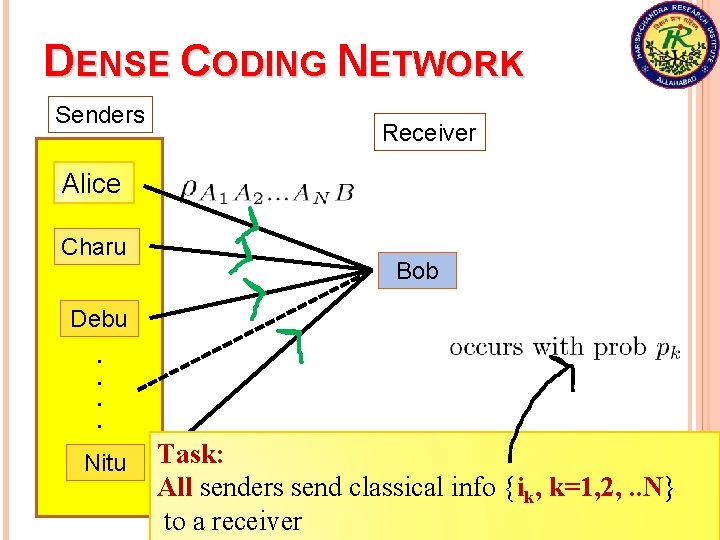
DENSE CODING NETWORK Senders Receiver Alice Charu Bob Debu. . Nitu Several senders & a single receiver Task: All senders send classical info {ik, k=1, 2, . . N} to a receiver
DENSE CODING NETWORK Senders Receiver Alice Charu Bob Debu. . Nitu Task: All senders send classical info {ik, k=1, 2, . . N} to a receiver
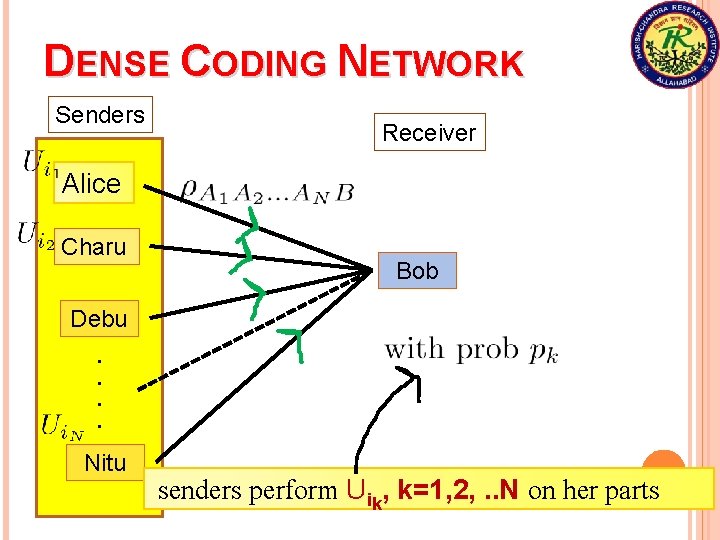
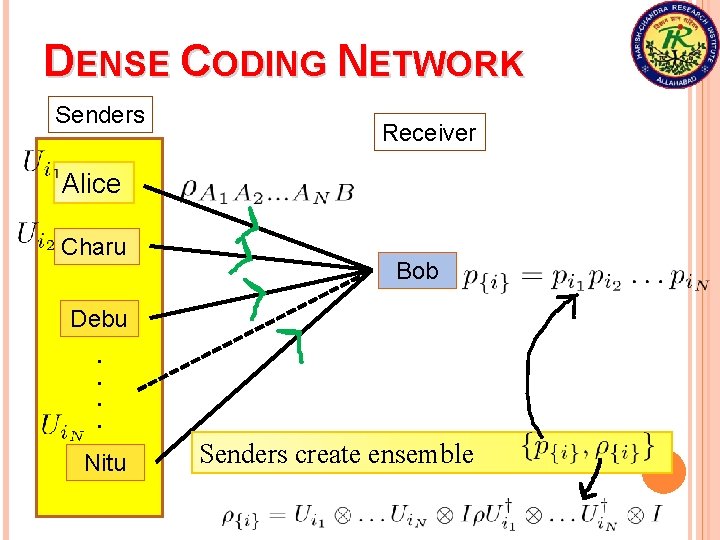
DENSE CODING NETWORK Senders Receiver Alice Charu Bob Debu. . Nitu senders perform Uik, k=1, 2, . . N on her parts
DENSE CODING NETWORK Senders Receiver Alice Charu Bob Debu. . Nitu Senders create ensemble
DENSE CODING NETWORK Senders Receiver Alice Charu Bob Debu. . Nitu Senders create ensemble
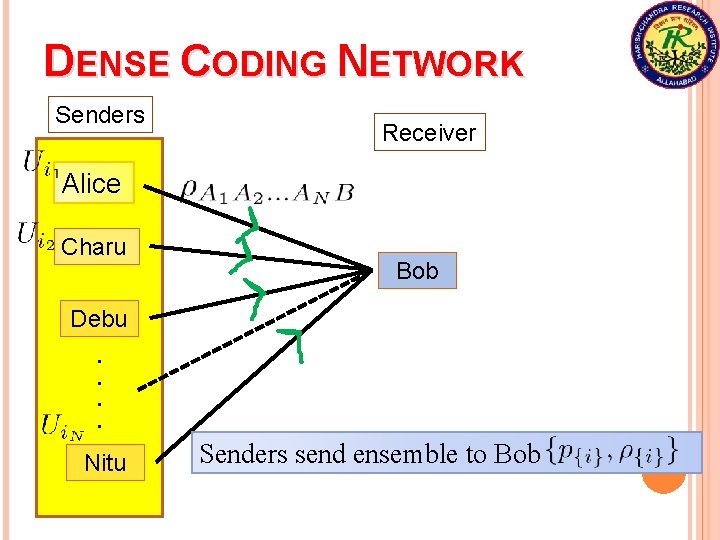
DENSE CODING NETWORK Senders Receiver Alice Charu Bob Debu. . Nitu Senders send ensemble to Bob
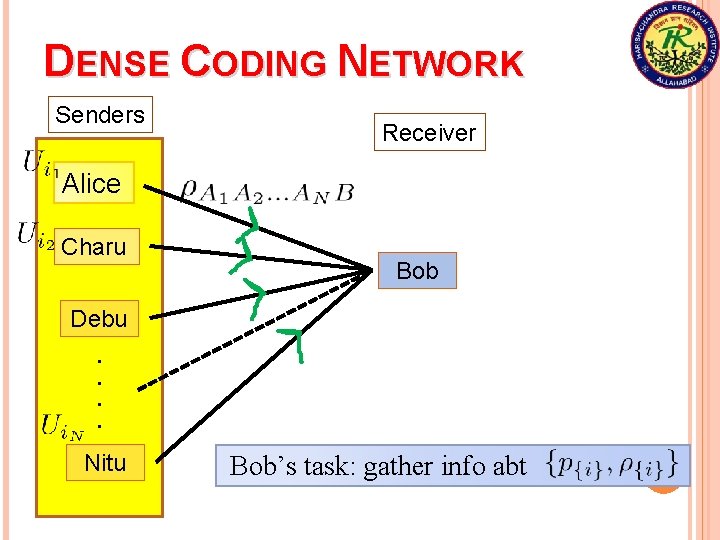
DENSE CODING NETWORK Senders Receiver Alice Charu Bob Debu. . Nitu Bob’s task: gather info abt
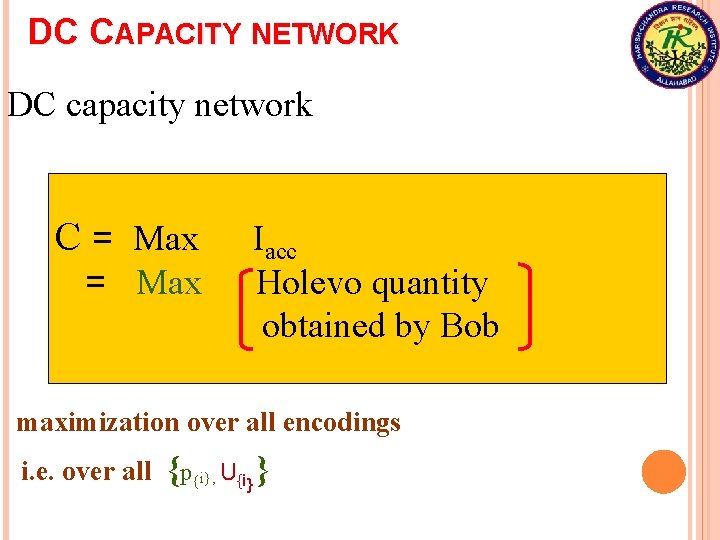
DC CAPACITY NETWORK DC capacity network C = Max Iacc Holevo quantity obtained by Bob maximization over all encodings i. e. over all {p{i}, U{i} }
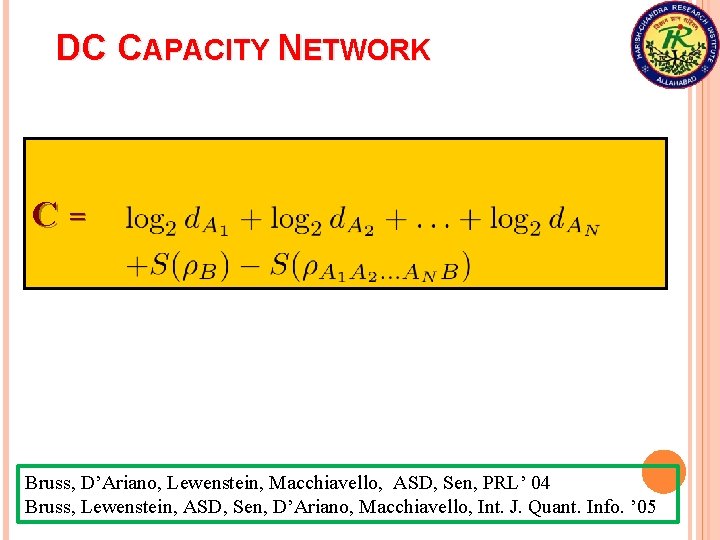
DC CAPACITY NETWORK C= Bruss, D’Ariano, Lewenstein, Macchiavello, ASD, Sen, PRL’ 04 Bruss, Lewenstein, ASD, Sen, D’Ariano, Macchiavello, Int. J. Quant. Info. ’ 05
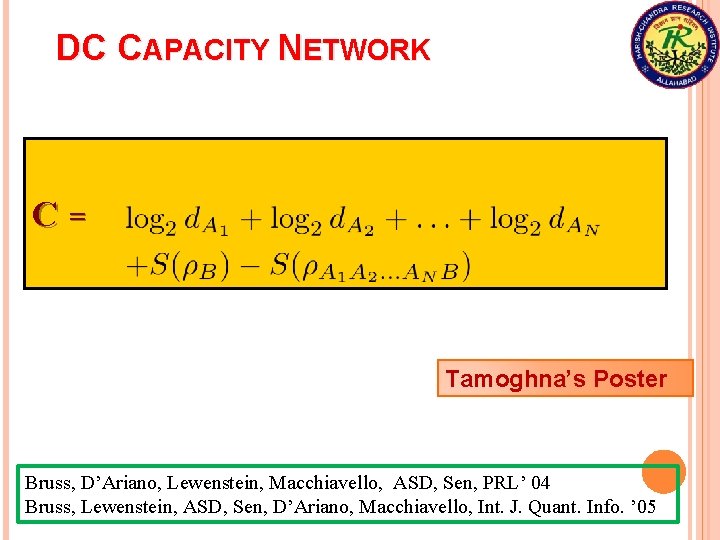
DC CAPACITY NETWORK C= Tamoghna’s Poster Bruss, D’Ariano, Lewenstein, Macchiavello, ASD, Sen, PRL’ 04 Bruss, Lewenstein, ASD, Sen, D’Ariano, Macchiavello, Int. J. Quant. Info. ’ 05
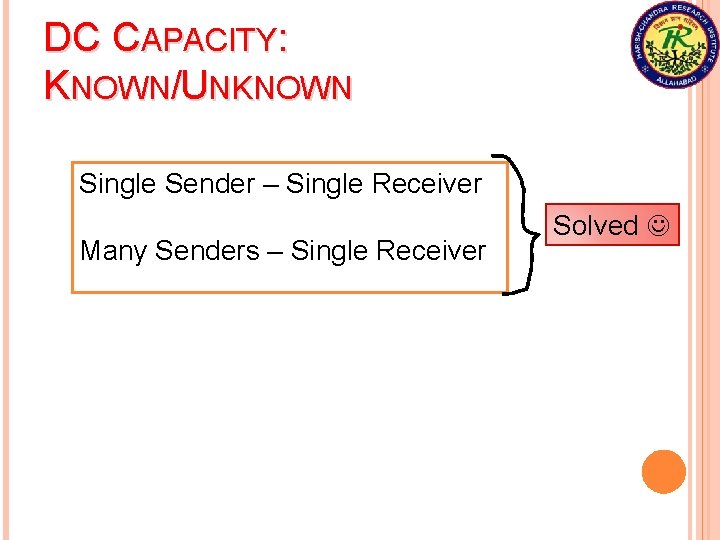
DC CAPACITY: KNOWN/UNKNOWN Single Sender – Single Receiver Many Senders – Single Receiver Solved
Dense Coding Network 3
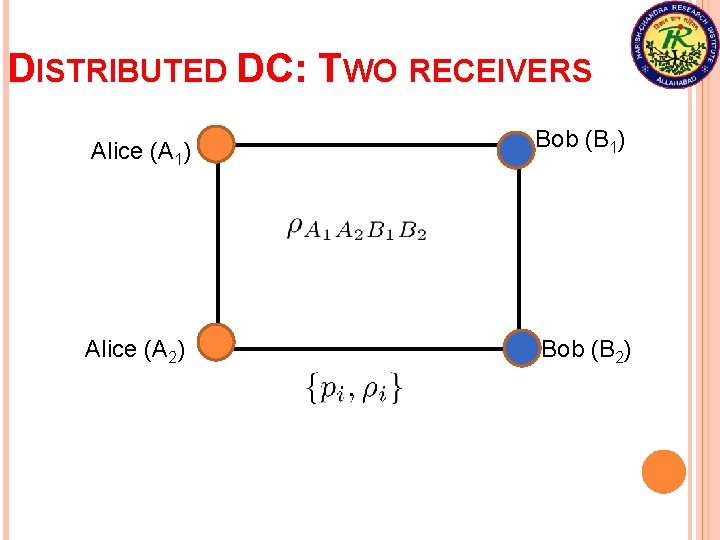
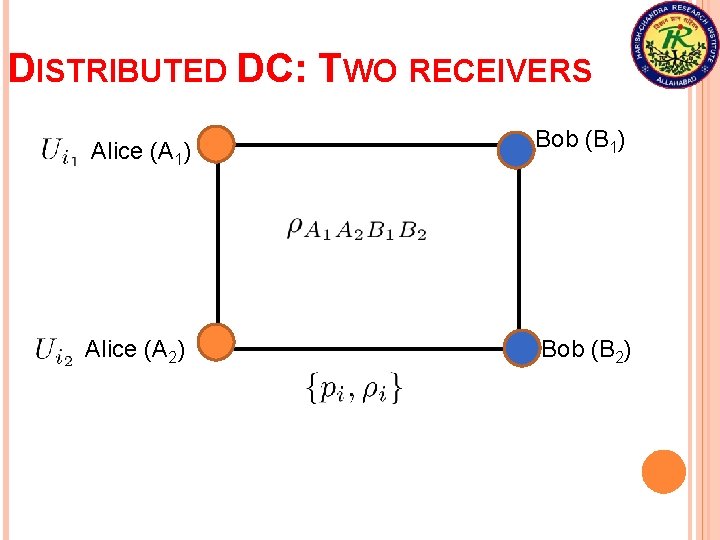
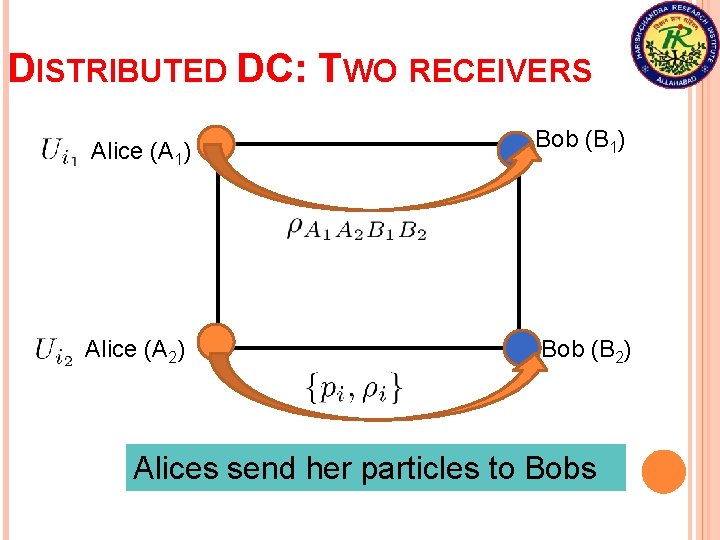
DISTRIBUTED DC: TWO RECEIVERS Alice (A 1) Alice (A 2) Bob (B 1) Bob (B 2)
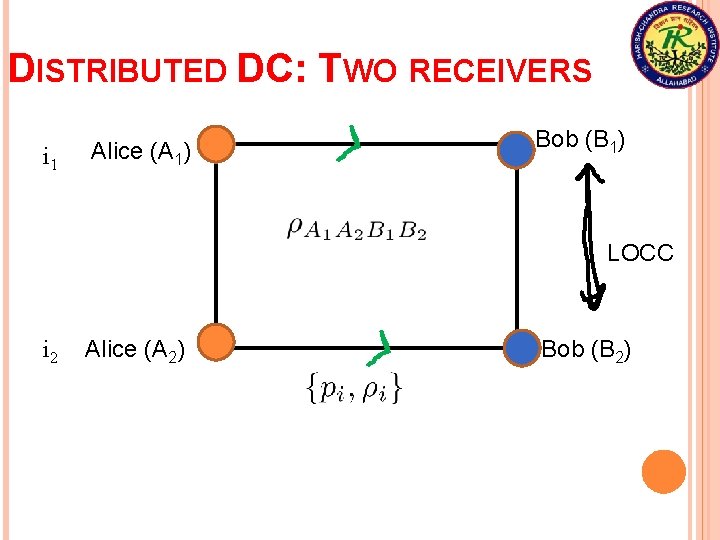
DISTRIBUTED DC: TWO RECEIVERS i 1 Alice (A 1) Bob (B 1) LOCC i 2 Alice (A 2) Bob (B 2)
DISTRIBUTED DC: TWO RECEIVERS Alice (A 1) Alice (A 2) Bob (B 1) Bob (B 2)
DISTRIBUTED DC: TWO RECEIVERS Alice (A 1) Alice (A 2) Bob (B 1) Bob (B 2) Alices send her particles to Bobs
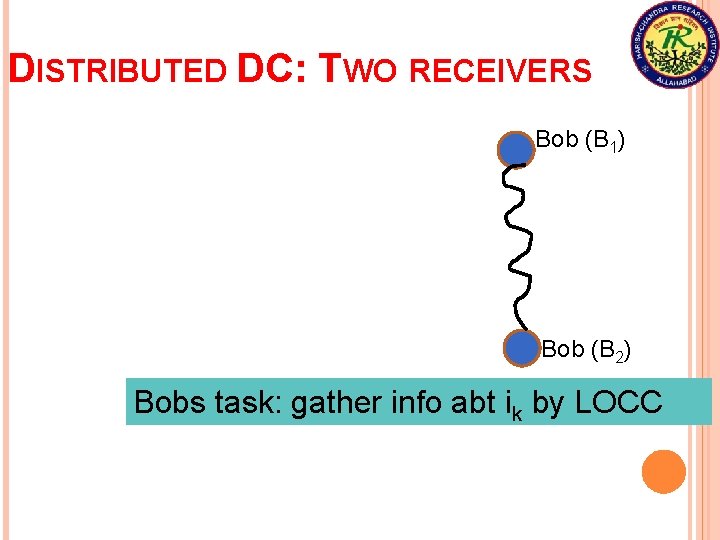
DISTRIBUTED DC: TWO RECEIVERS Bob (B 1) Bob (B 2) Bobs task: gather info abt ik by LOCC
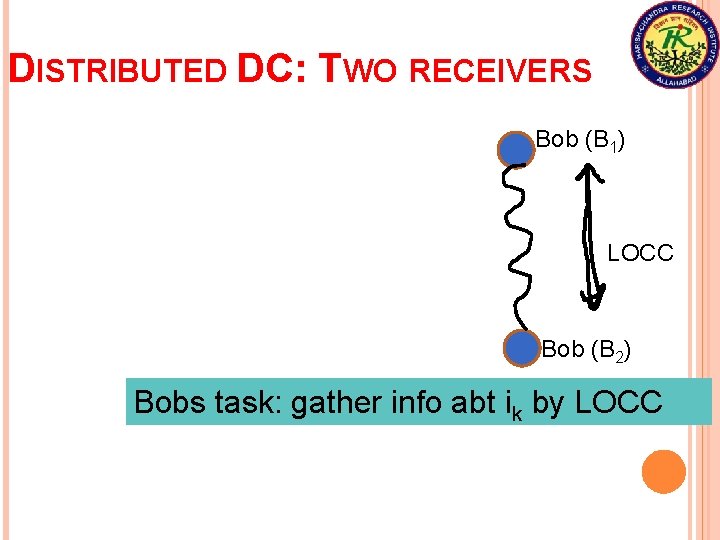
DISTRIBUTED DC: TWO RECEIVERS Bob (B 1) LOCC Bob (B 2) Bobs task: gather info abt ik by LOCC
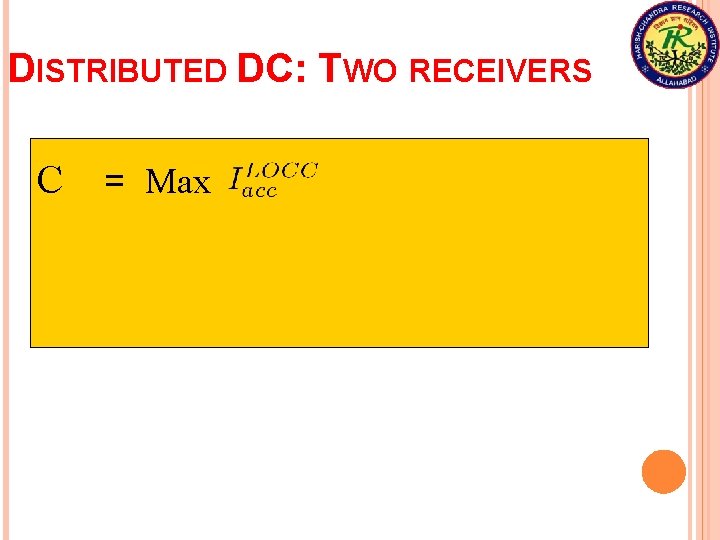
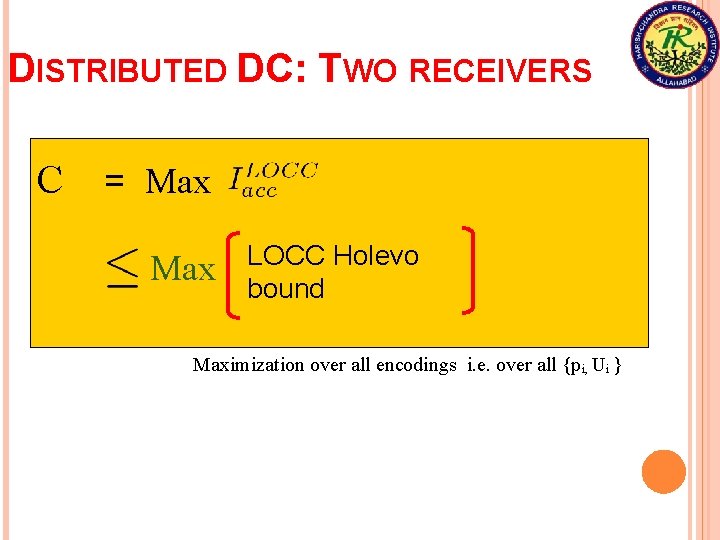
DISTRIBUTED DC: TWO RECEIVERS C = Max
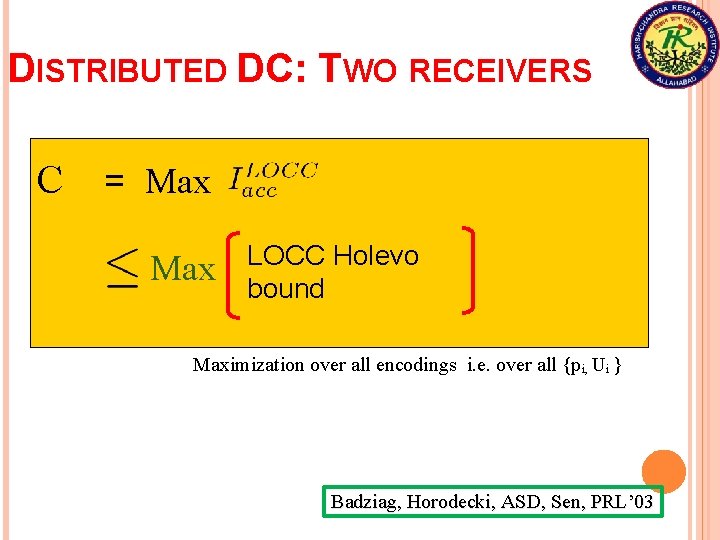
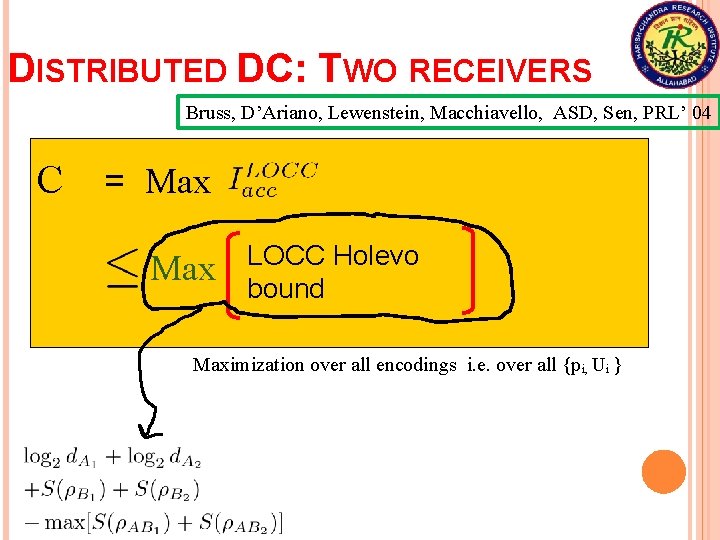
DISTRIBUTED DC: TWO RECEIVERS C = Max LOCC Holevo bound Maximization over all encodings i. e. over all {pi, Ui }
DISTRIBUTED DC: TWO RECEIVERS C = Max LOCC Holevo bound Maximization over all encodings i. e. over all {pi, Ui } Badziag, Horodecki, ASD, Sen, PRL’ 03
DISTRIBUTED DC: TWO RECEIVERS Bruss, D’Ariano, Lewenstein, Macchiavello, ASD, Sen, PRL’ 04 C = Max LOCC Holevo bound Maximization over all encodings i. e. over all {pi, Ui }
DC CAPACITY: KNOWN/UNKNOWN Single Sender – Single Receiver Many Senders – Single Receiver Solved
DC CAPACITY: KNOWN/UNKNOWN Single Sender – Single Receiver Many Senders – Two Receivers Solved
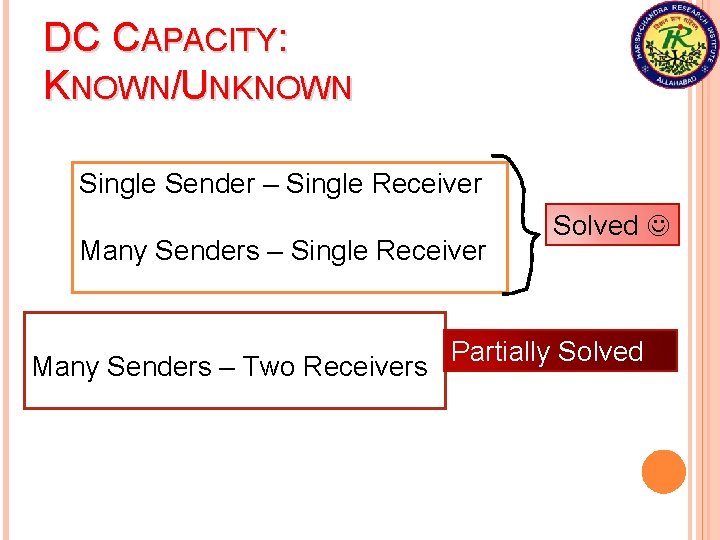
DC CAPACITY: KNOWN/UNKNOWN Single Sender – Single Receiver Many Senders – Two Receivers Solved Partially Solved
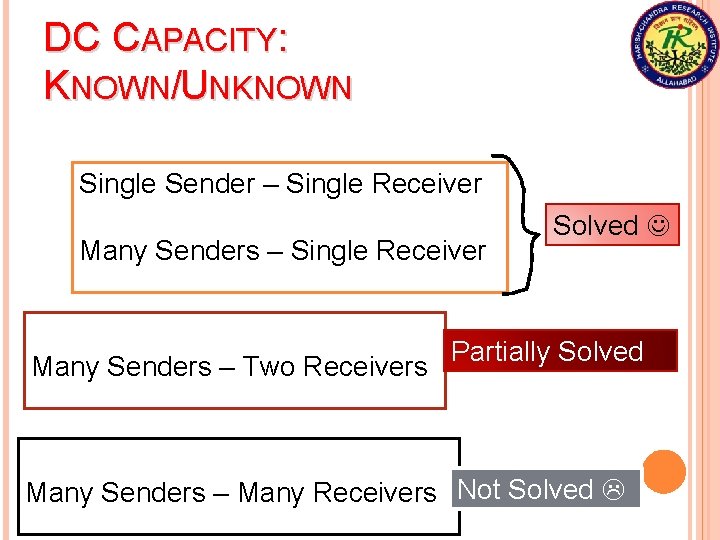
DC CAPACITY: KNOWN/UNKNOWN Single Sender – Single Receiver Many Senders – Two Receivers Solved Partially Solved Many Senders – Many Receivers Not Solved