
Quantum Chromodynamics Suki Hyman Remember Quarks Matter Particles
Quantum Chromodynamics Suki Hyman
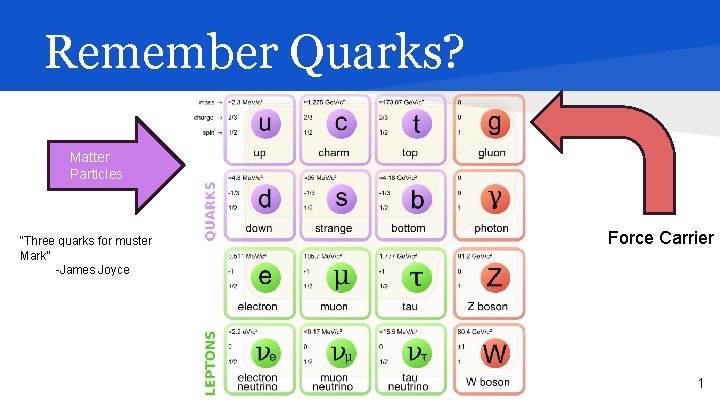
Remember Quarks? Matter Particles “Three quarks for muster Mark” -James Joyce Force Carrier 1

A Brief History of Quarks. . . ● In 1961 Murray Gell-Mann created a classification scheme for hadrons called The Eightfold Way ● In 1964 Murray Gell-Mann postulated the existence of quarks ● In 1972 Harald Fritzsch introduced Color Charge as a conserved quantum number 2
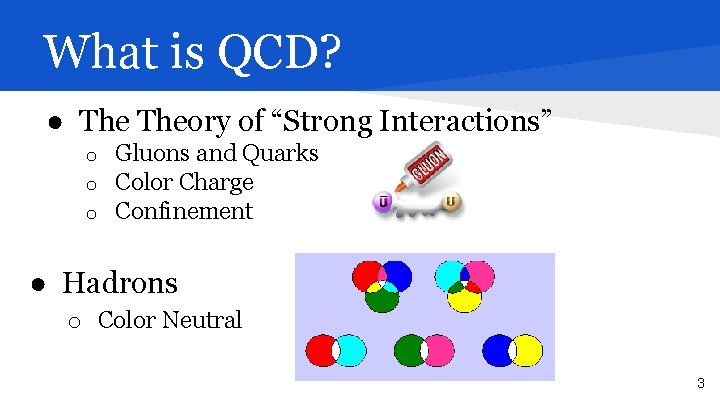
What is QCD? ● Theory of “Strong Interactions” o o o Gluons and Quarks Color Charge Confinement (Warning: Not actually how they work) ● Hadrons o Color Neutral 3
The Strong Force Visible in two ways: ● Residual Nuclear Force: Confining Nucleons o o Color neutral pions 1 -3 fm ● Strong Nuclear Force: Confining Quarks o o Color+Anticolor gluons <0. 8 fm 4
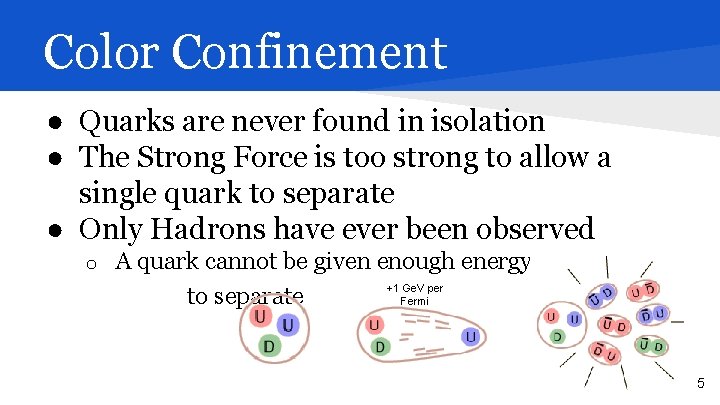
Color Confinement ● Quarks are never found in isolation ● The Strong Force is too strong to allow a single quark to separate ● Only Hadrons have ever been observed o A quark cannot be given enough energy +1 Ge. V per to separate Fermi 5
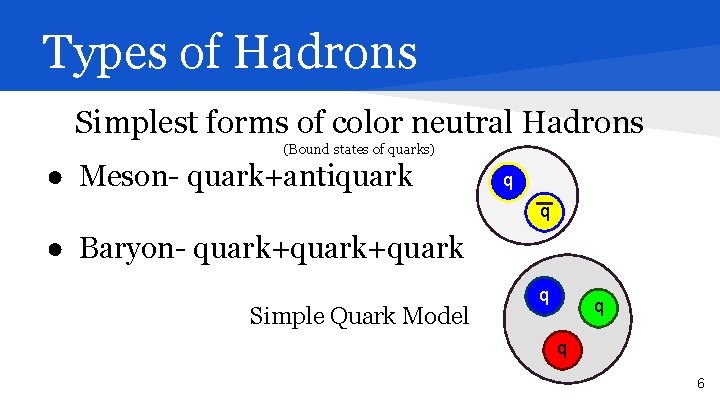
Types of Hadrons Simplest forms of color neutral Hadrons (Bound states of quarks) ● Meson- quark+antiquark q q ● Baryon- quark+quark Simple Quark Model q q q 6
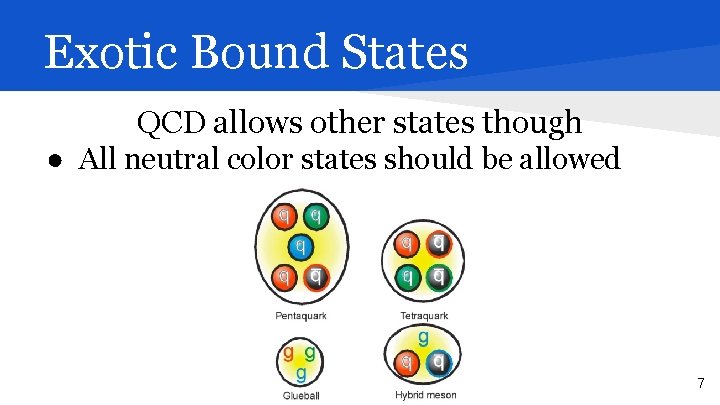
Exotic Bound States QCD allows other states though ● All neutral color states should be allowed 7
The Eightfold Way ● Gell-Mann’s system for organizing Hadrons ● Scaled by Strangeness and Electric Charge o o Strangeness: Electric: ± 2/3 or ± 1/3 for each quark Values for spin ±Integer 8
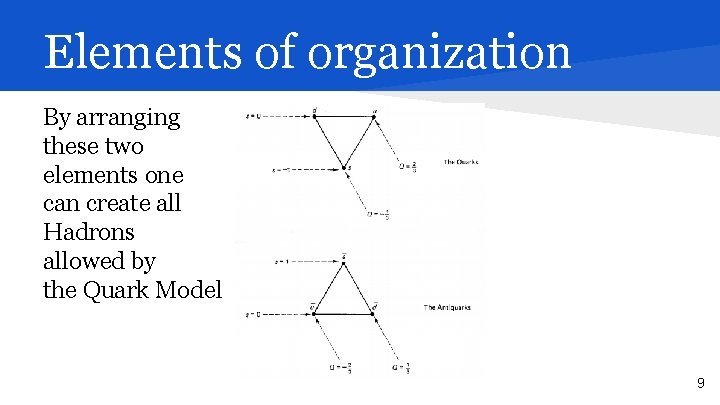
Elements of organization By arranging these two elements one can create all Hadrons allowed by the Quark Model 9
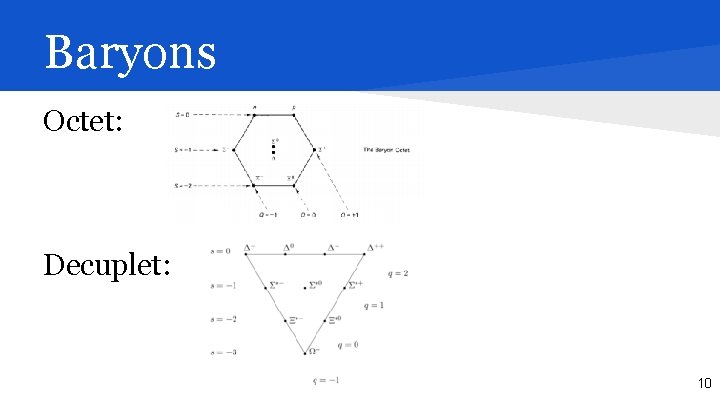
Baryons Octet: Lightest Baryons Decuplet: Heavier Baryons 10

Mesons Meson Octet: 11
What’s Next? ● ● ● Experiments are being done to try to detect these exotic states Glue. X Experiment CERN’s LHCb Experiment Japan-Belle Experiment COSY Experiment etc. 12

Questions
- Slides: 14