
Quantum Chemical Characterization of Sulfur Compounds and Their


- Slides: 23
Quantum Chemical Characterization of Sulfur Compounds and Their Chemistry for Venus and the Interstellar Medium David E. Woon FA 08
Overview of Talk Sulfur (and Chlorine) in Venus Atmospheric Chemistry Conditions and composition of Venus’s atmosphere Status of Venus atmospheric modeling Computational Approach Goals and strategy for properties and reactions Properties m, a Reactions Reaction types S + SH OH + HSCl
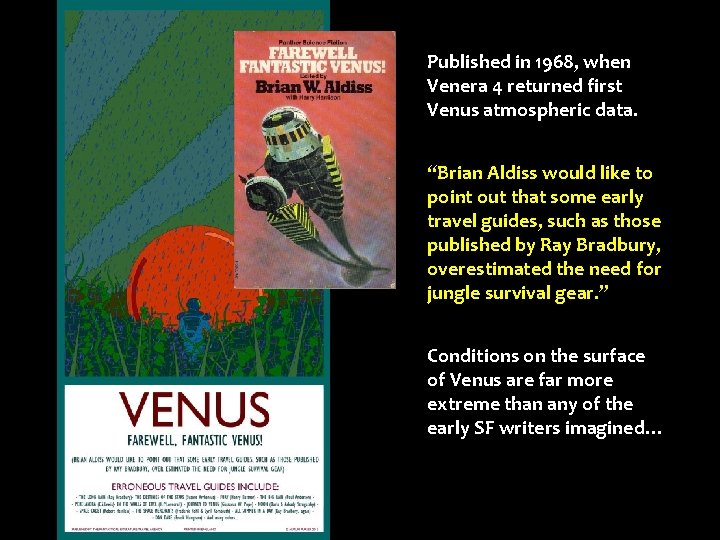
Published in 1968, when Venera 4 returned first Venus atmospheric data. “Brian Aldiss would like to point out that some early travel guides, such as those published by Ray Bradbury, overestimated the need for jungle survival gear. ” Conditions on the surface of Venus are far more extreme than any of the early SF writers imagined…
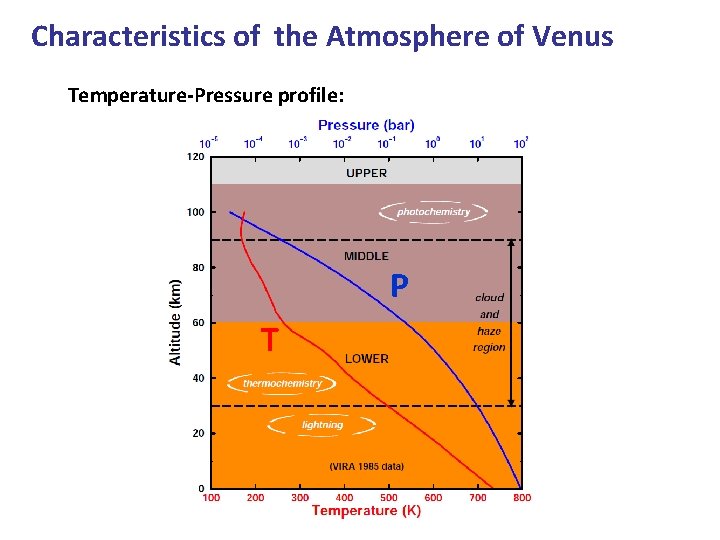
Characteristics of the Atmosphere of Venus Temperature-Pressure profile: P T
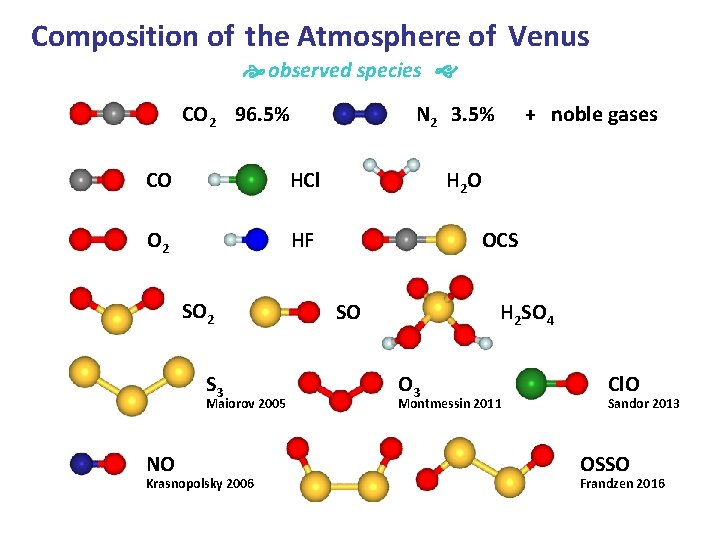
Composition of the Atmosphere of Venus observed species CO 2 96. 5% N 2 3. 5% CO HCl O 2 HF SO 2 S 3 Maiorov 2005 NO Krasnopolsky 2006 + noble gases H 2 O OCS SO H 2 SO 4 O 3 Montmessin 2011 Cl. O Sandor 2013 OSSO Frandzen 2016
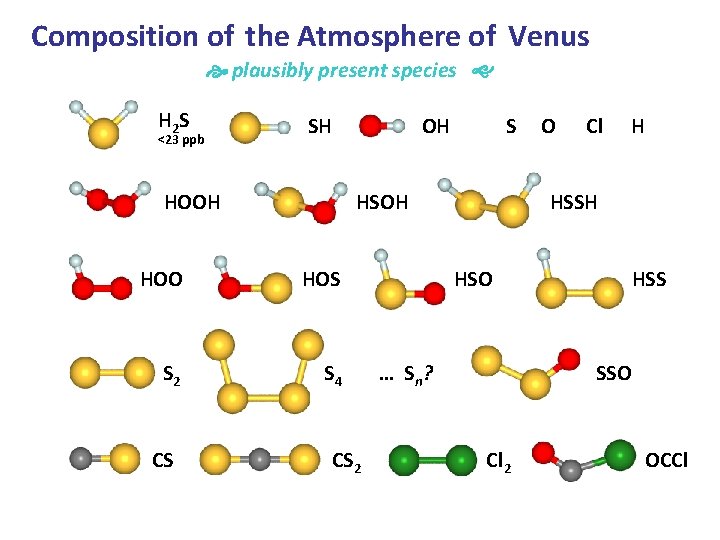
Composition of the Atmosphere of Venus plausibly present species H 2 S <23 ppb SH HOOH S HSOH HOO HOS S 2 S 4 CS OH CS 2 O Cl H HSSH HSO … Sn ? HSS SSO Cl 2 OCCl
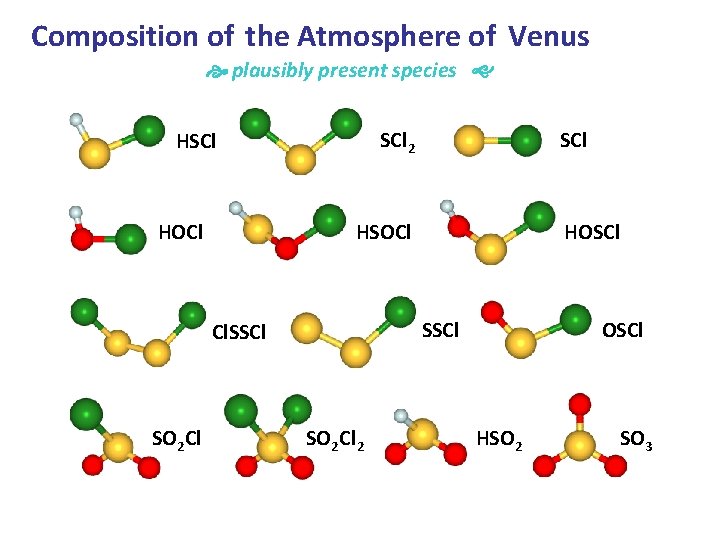
Composition of the Atmosphere of Venus plausibly present species SCl 2 HSCl HOCl HSOCl HOSCl SSCl Cl. SSCl SO 2 Cl 2 OSCl HSO 2 SO 3
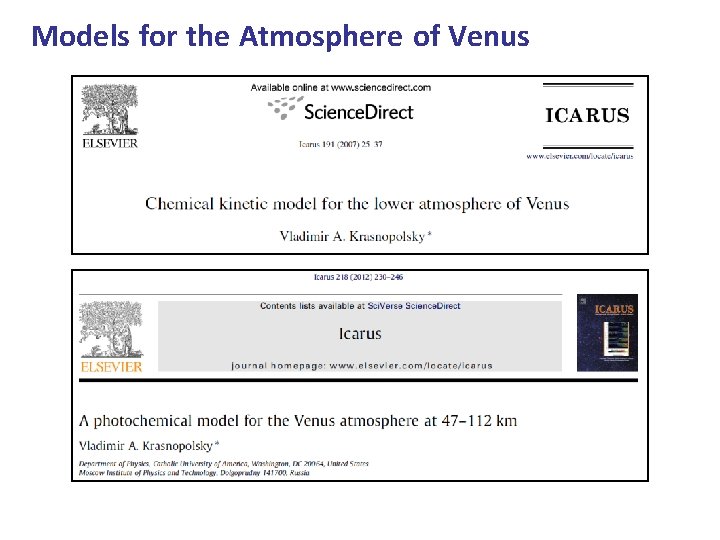
Models for the Atmosphere of Venus
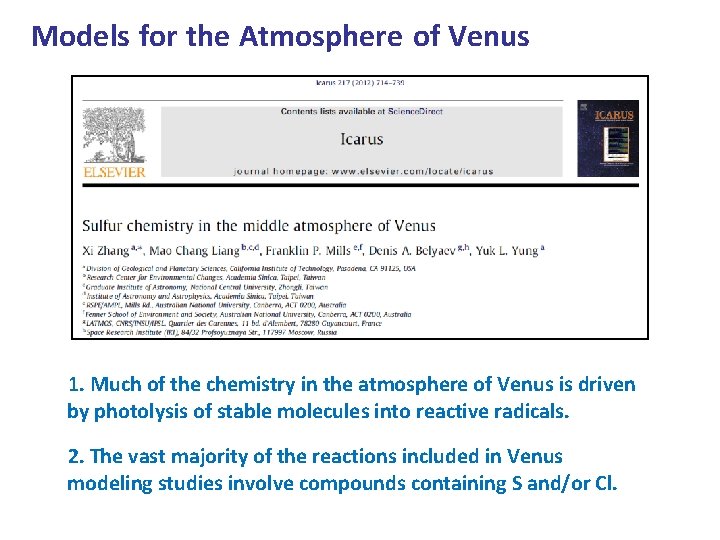
Models for the Atmosphere of Venus 1. Much of the chemistry in the atmosphere of Venus is driven by photolysis of stable molecules into reactive radicals. 2. The vast majority of the reactions included in Venus modeling studies involve compounds containing S and/or Cl.
Models for the Atmosphere of Venus: Status PRIMARY: The rate coefficients of many of the reactions included in the models have not been measured or treated with high level theory. Viable pathways are missing. Compounds that may plausibly be present are missing. SECONDARY: Spectroscopic characterization of many exotic compounds containing S and/or Cl is incomplete, making it difficult to identify them with probes or remote observations.
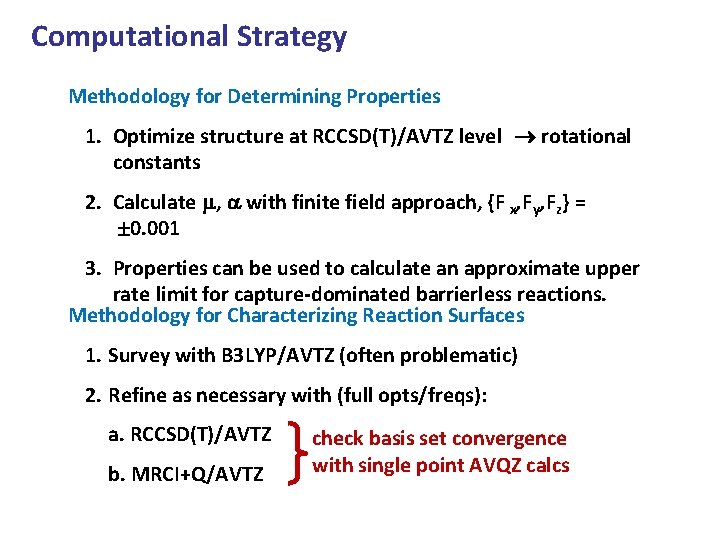
Computational Strategy Methodology for Determining Properties 1. Optimize structure at RCCSD(T)/AVTZ level rotational constants 2. Calculate m, a with finite field approach, {F x, Fy, Fz} = 0. 001 3. Properties can be used to calculate an approximate upper rate limit for capture-dominated barrierless reactions. Methodology for Characterizing Reaction Surfaces 1. Survey with B 3 LYP/AVTZ (often problematic) 2. Refine as necessary with (full opts/freqs): a. RCCSD(T)/AVTZ b. MRCI+Q/AVTZ check basis set convergence with single point AVQZ calcs
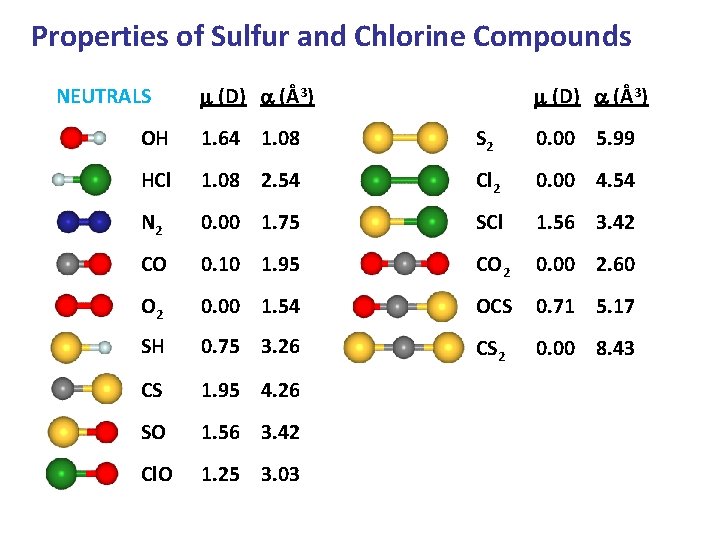
Properties of Sulfur and Chlorine Compounds NEUTRALS m (D) a (Å3) OH 1. 64 1. 08 S 2 0. 00 5. 99 HCl 1. 08 2. 54 Cl 2 0. 00 4. 54 N 2 0. 00 1. 75 SCl 1. 56 3. 42 CO 0. 10 1. 95 CO 2 0. 00 2. 60 O 2 0. 00 1. 54 OCS 0. 71 5. 17 SH 0. 75 3. 26 CS 2 0. 00 8. 43 CS 1. 95 4. 26 SO 1. 56 3. 42 Cl. O 1. 25 3. 03
Properties of Sulfur and Chlorine Compounds NEUTRALS m (D) a (Å3) H 2 O 1. 85 1. 41 HO 2 2. 13 1. 95 O 3 0. 55 2. 81 H 2 S 0. 96 3. 60 HOS 1. 58 3. 96 HSO 2. 44 3. 84 HOCl 1. 50 3. 33 m (D) a (Å3) OCCl 0. 47 4. 67 SO 2 1. 66 3. 81 HS 2 1. 44 6. 47 S 3 1. 16 5. 51 S 2 O 1. 50 6. 73 OSCl 1. 54 5. 95
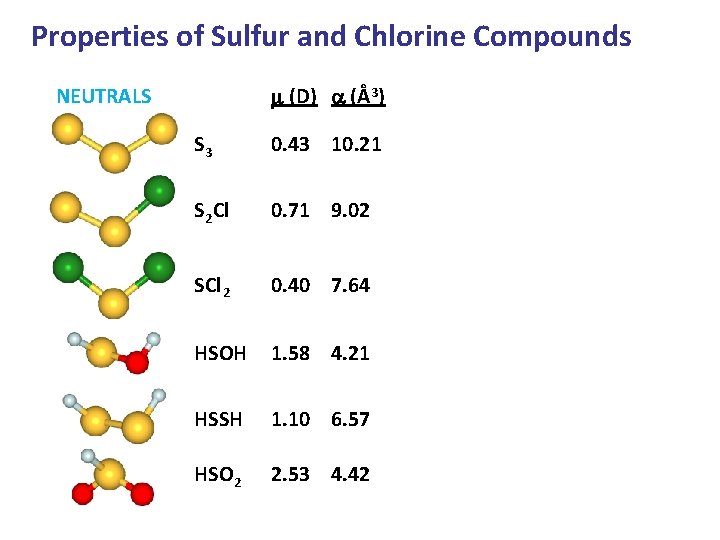
Properties of Sulfur and Chlorine Compounds m (D) a (Å3) NEUTRALS S 3 0. 43 10. 21 S 2 Cl 0. 71 9. 02 SCl 2 0. 40 7. 64 HSOH 1. 58 4. 21 HSSH 1. 10 6. 57 HSO 2 2. 53 4. 42
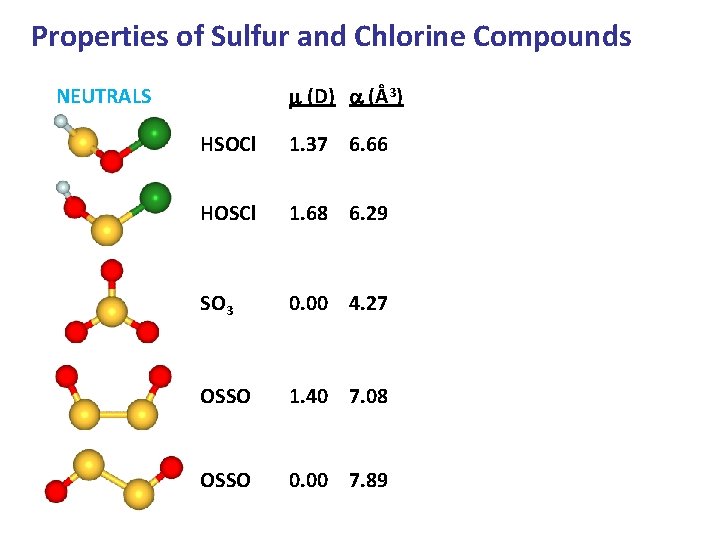
Properties of Sulfur and Chlorine Compounds m (D) a (Å3) NEUTRALS HSOCl 1. 37 6. 66 HOSCl 1. 68 6. 29 SO 3 0. 00 4. 27 OSSO 1. 40 7. 08 OSSO 0. 00 7. 89
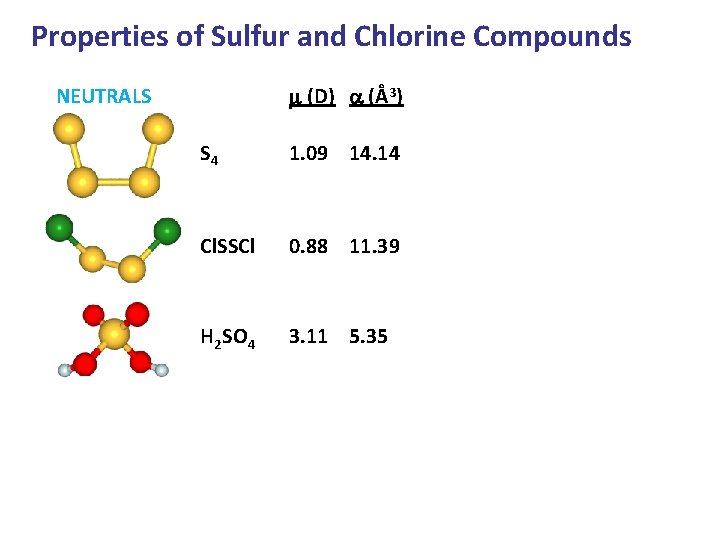
Properties of Sulfur and Chlorine Compounds m (D) a (Å3) NEUTRALS S 4 1. 09 14. 14 Cl. SSCl 0. 88 11. 39 H 2 SO 4 3. 11 5. 35
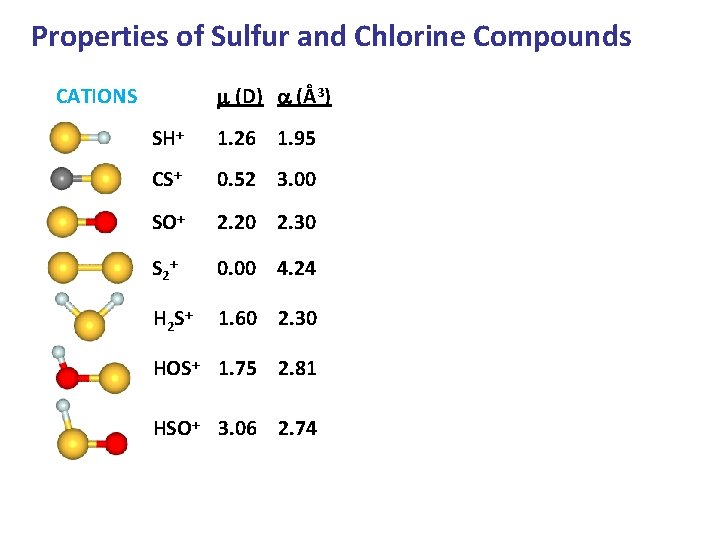
Properties of Sulfur and Chlorine Compounds m (D) a (Å3) CATIONS SH+ 1. 26 1. 95 CS + 0. 52 3. 00 SO+ 2. 20 2. 30 S 2 + 0. 00 4. 24 H 2 S+ 1. 60 2. 30 HOS+ 1. 75 2. 81 HSO+ 3. 06 2. 74
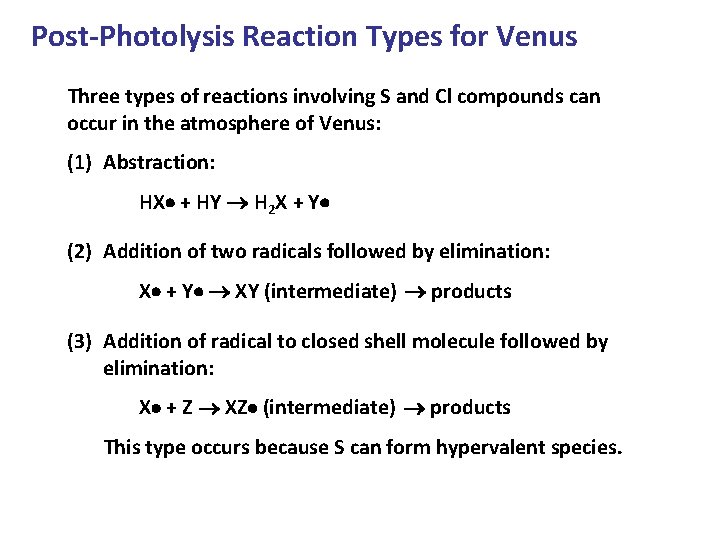
Post-Photolysis Reaction Types for Venus Three types of reactions involving S and Cl compounds can occur in the atmosphere of Venus: (1) Abstraction: HX + HY H 2 X + Y (2) Addition of two radicals followed by elimination: X + Y XY (intermediate) products (3) Addition of radical to closed shell molecule followed by elimination: X + Z XZ (intermediate) products This type occurs because S can form hypervalent species.
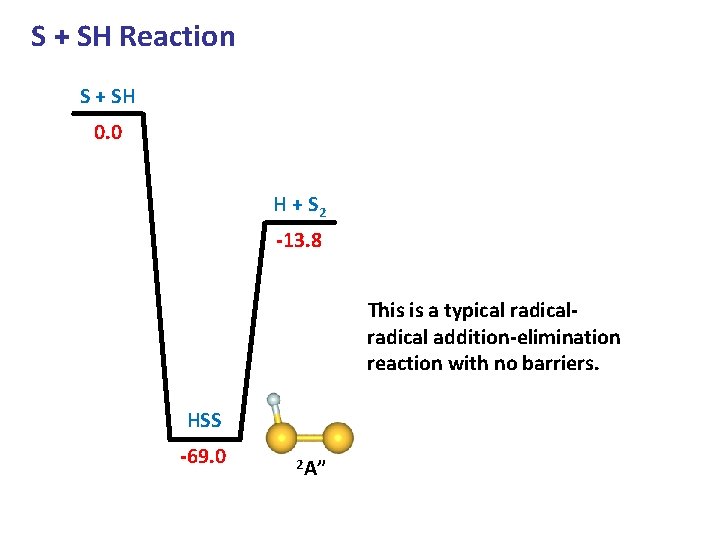
S + SH Reaction S + SH 0. 0 H + S 2 -13. 8 This is a typical radical addition-elimination reaction with no barriers. HSS -69. 0 2 A”
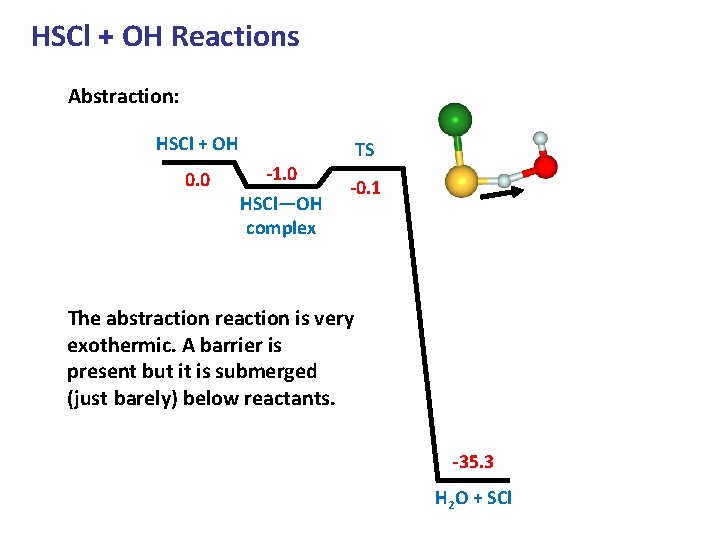
HSCl + OH Reactions Abstraction: HSCl + OH 0. 0 -1. 0 HSCl—OH complex TS -0. 1 The abstraction reaction is very exothermic. A barrier is present but it is submerged (just barely) below reactants. -35. 3 H 2 O + SCl
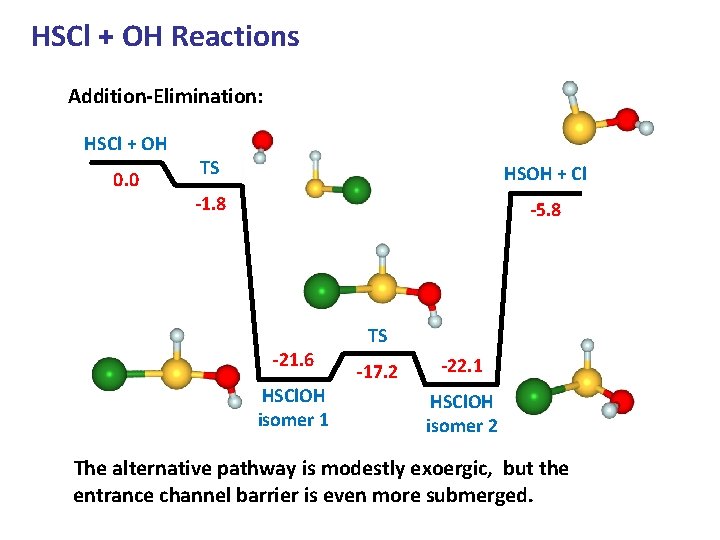
HSCl + OH Reactions Addition-Elimination: HSCl + OH 0. 0 TS HSOH + Cl -1. 8 -5. 8 -21. 6 HSCl. OH isomer 1 TS -17. 2 -22. 1 HSCl. OH isomer 2 The alternative pathway is modestly exoergic, but the entrance channel barrier is even more submerged.
Acknowledgments Funding source: NASA Grant NNX 14 AK 32 G from the Planetary Atmospheres program.