
Quantum anomalous Hall effect QAHE and the quantum
- Slides: 30
Quantum anomalous Hall effect (QAHE) and the quantum spin Hall effect (QSHE) Shoucheng Zhang, Stanford University Les Houches, June 2006
References: • • • Murakami, Nagaosa and Zhang, Science 301, 1348 (2003) Murakami, Nagaosa, Zhang, PRL 93, 156804 (2004) Bernevig and Zhang, PRL 95, 016801 (2005) Bernevig and Zhang, PRL 96, 106802 (2006); Qi, Wu, Zhang, condmat/0505308; Wu, Bernevig and Zhang, PRL 96, 106401 (2006); • • (Haldane, PRL 61, 2015 (1988)); Kane and Mele, PRL 95 226801 (2005); Sheng et al, PRL 95, 136602 (2005); Xu and Moore cond-mat/0508291……
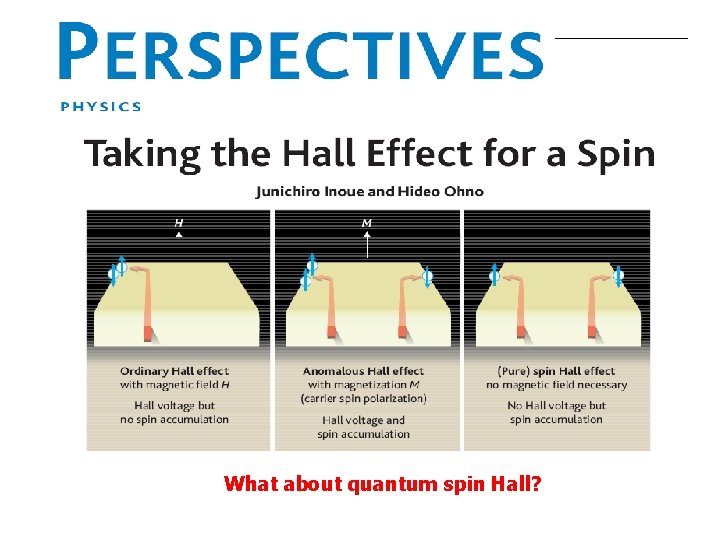
What about quantum spin Hall?
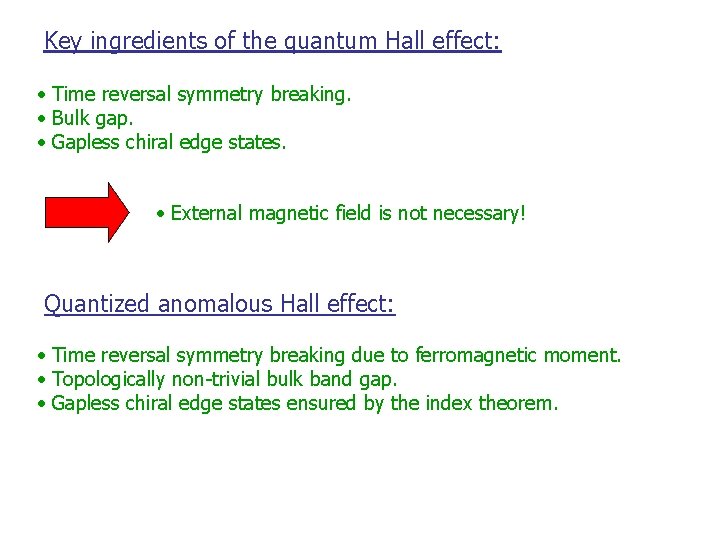
Key ingredients of the quantum Hall effect: • Time reversal symmetry breaking. • Bulk gap. • Gapless chiral edge states. • External magnetic field is not necessary! Quantized anomalous Hall effect: • Time reversal symmetry breaking due to ferromagnetic moment. • Topologically non-trivial bulk band gap. • Gapless chiral edge states ensured by the index theorem.
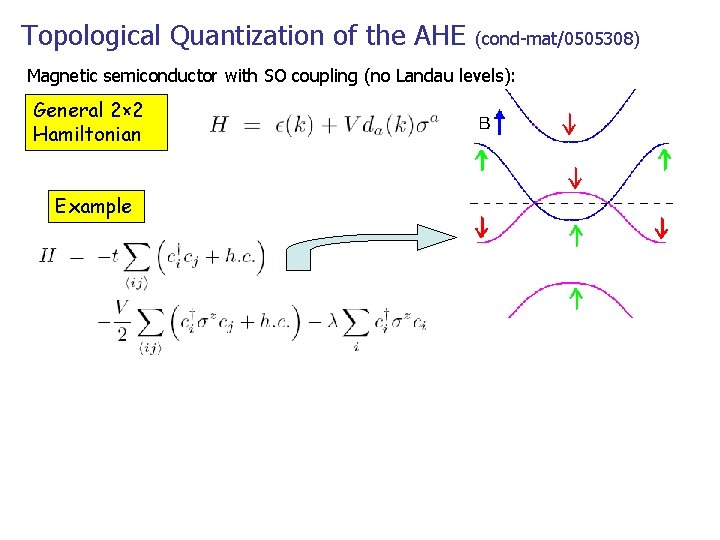
Topological Quantization of the AHE (cond-mat/0505308) Magnetic semiconductor with SO coupling (no Landau levels): General 2× 2 Hamiltonian Example Rashbar Spinorbital Coupling
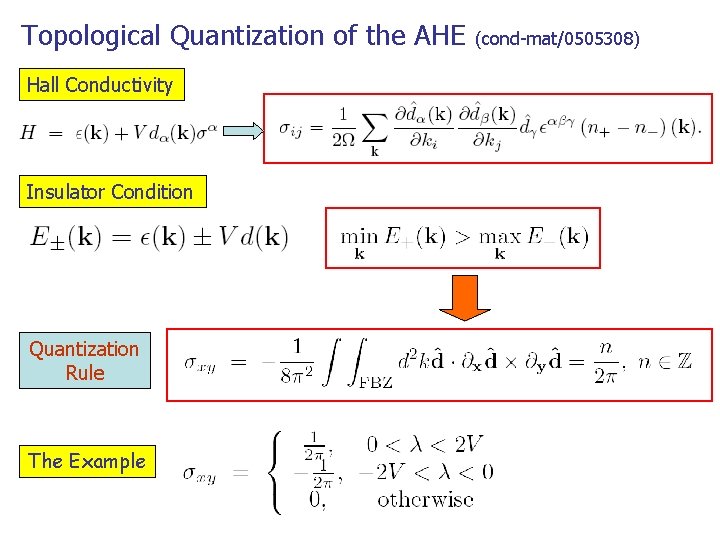
Topological Quantization of the AHE Hall Conductivity Insulator Condition Quantization Rule The Example (cond-mat/0505308)
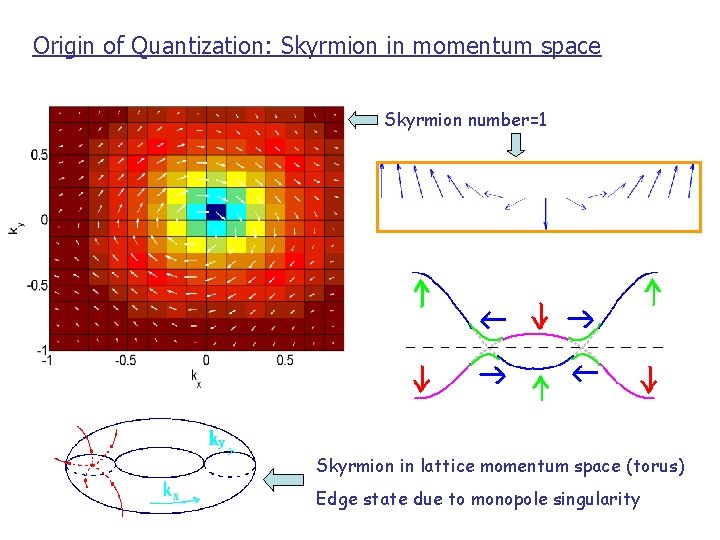
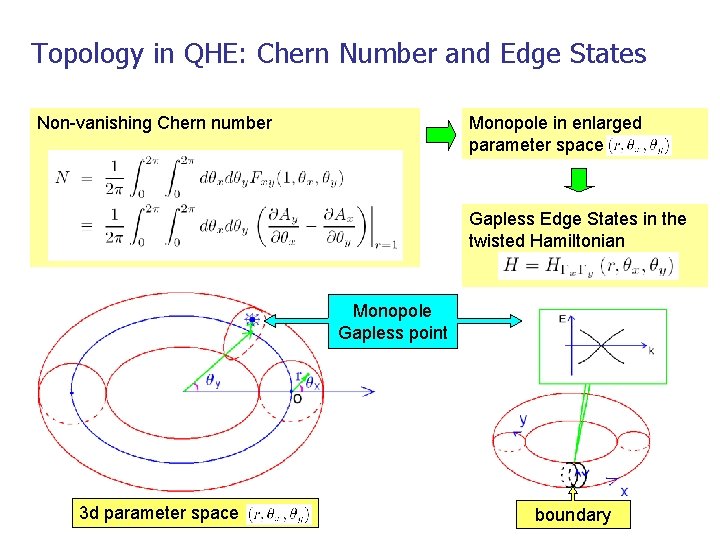
Origin of Quantization: Skyrmion in momentum space Skyrmion number=1 Skyrmion in lattice momentum space (torus) Edge state due to monopole singularity
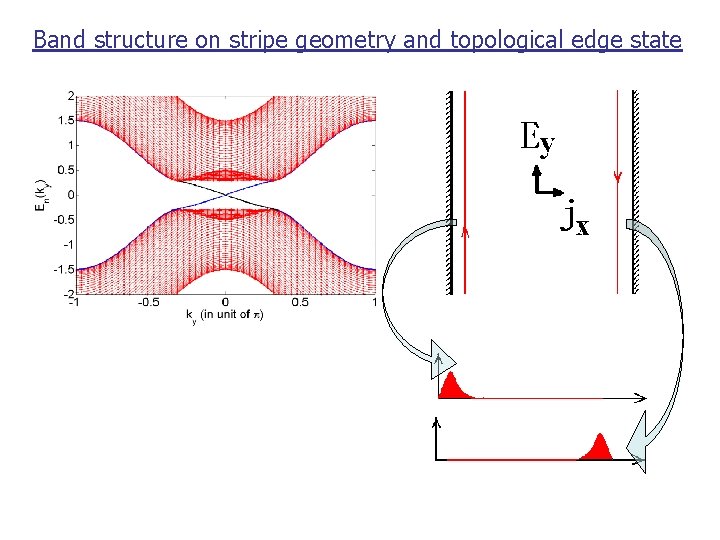
Band structure on stripe geometry and topological edge state
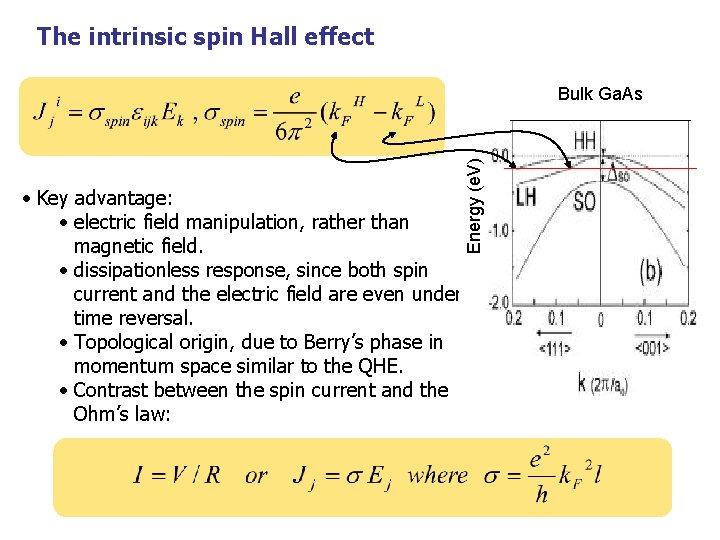
The intrinsic spin Hall effect • Key advantage: • electric field manipulation, rather than magnetic field. • dissipationless response, since both spin current and the electric field are even under time reversal. • Topological origin, due to Berry’s phase in momentum space similar to the QHE. • Contrast between the spin current and the Ohm’s law: Energy (e. V) Bulk Ga. As
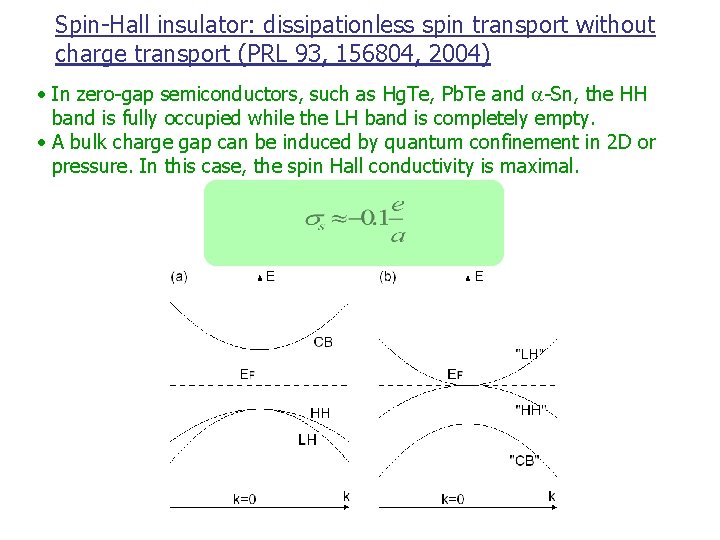
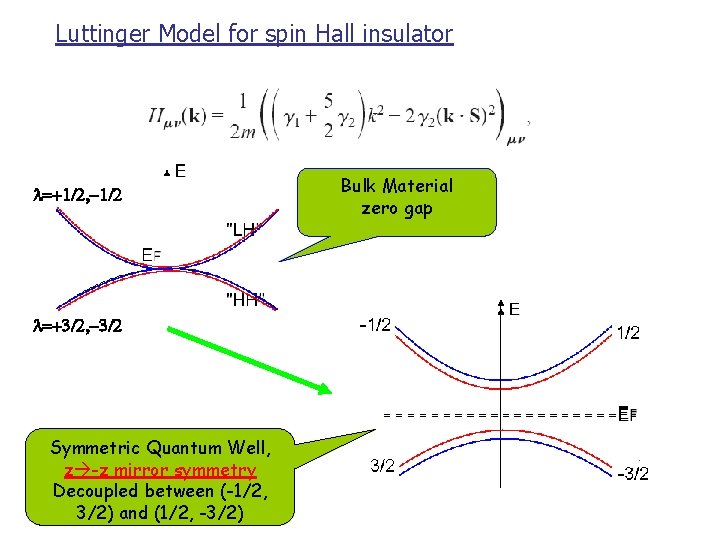
Spin-Hall insulator: dissipationless spin transport without charge transport (PRL 93, 156804, 2004) • In zero-gap semiconductors, such as Hg. Te, Pb. Te and a-Sn, the HH band is fully occupied while the LH band is completely empty. • A bulk charge gap can be induced by quantum confinement in 2 D or pressure. In this case, the spin Hall conductivity is maximal.
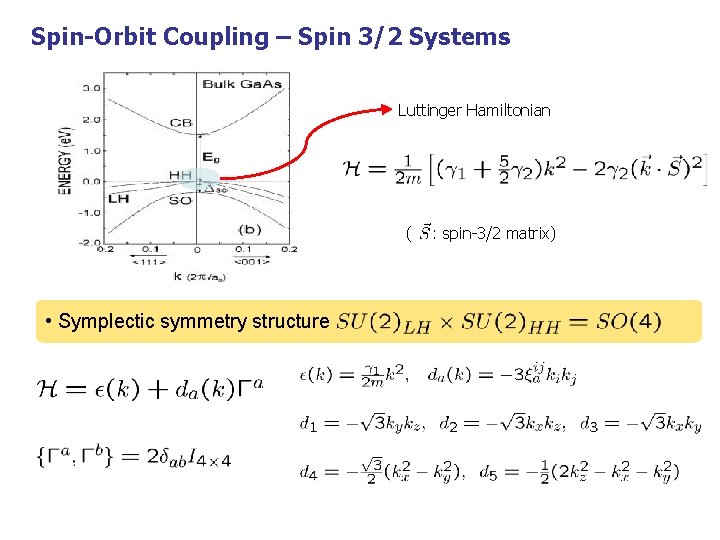
Spin-Orbit Coupling – Spin 3/2 Systems Luttinger Hamiltonian ( • Symplectic symmetry structure : spin-3/2 matrix)
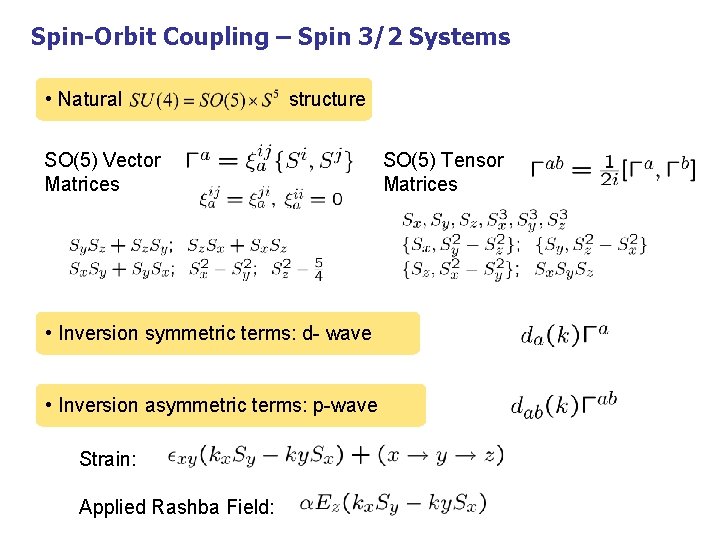
Spin-Orbit Coupling – Spin 3/2 Systems • Natural structure SO(5) Vector Matrices • Inversion symmetric terms: d- wave • Inversion asymmetric terms: p-wave Strain: Applied Rashba Field: SO(5) Tensor Matrices
Luttinger Model for spin Hall insulator l=+1/2, -1/2 l=+3/2, -3/2 Symmetric Quantum Well, z -z mirror symmetry Decoupled between (-1/2, 3/2) and (1/2, -3/2) Bulk Material zero gap
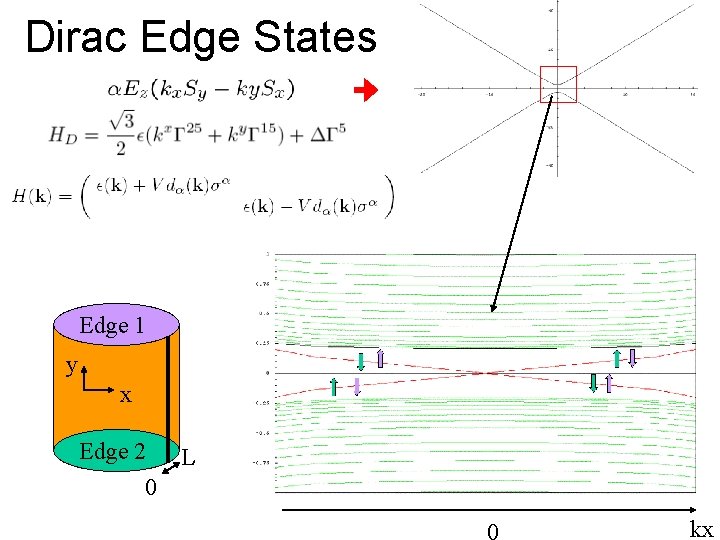
Dirac Edge States Edge 1 y x Edge 2 0 L 0 kx
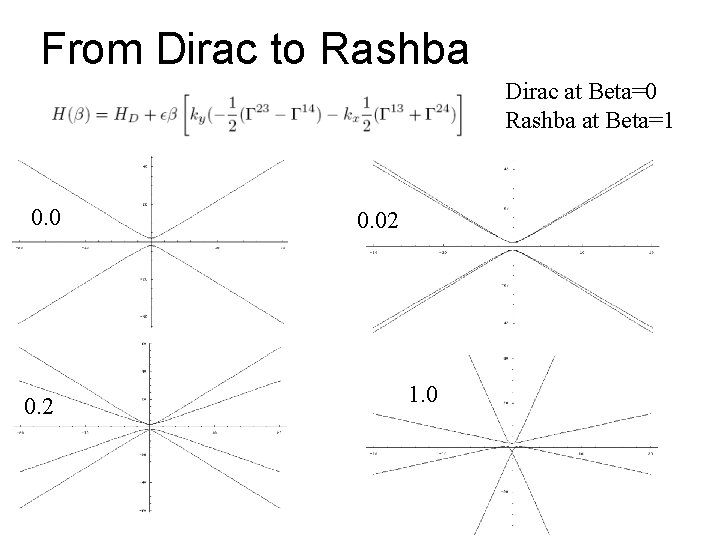
From Dirac to Rashba Dirac at Beta=0 Rashba at Beta=1 0. 0 0. 2 0. 02 1. 0
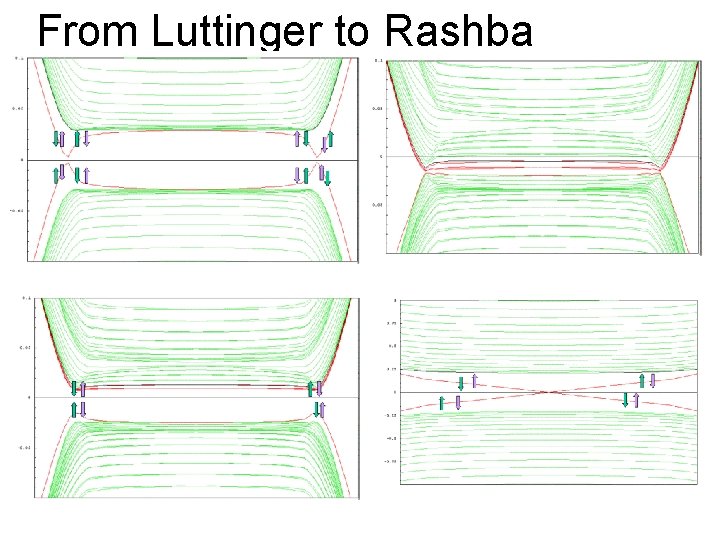
From Luttinger to Rashba
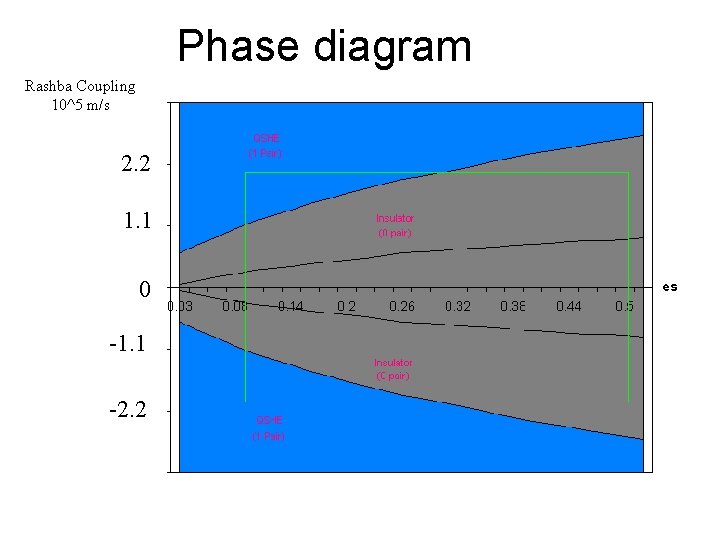
Phase diagram Rashba Coupling 10^5 m/s 2. 2 1. 1 0 -1. 1 -2. 2
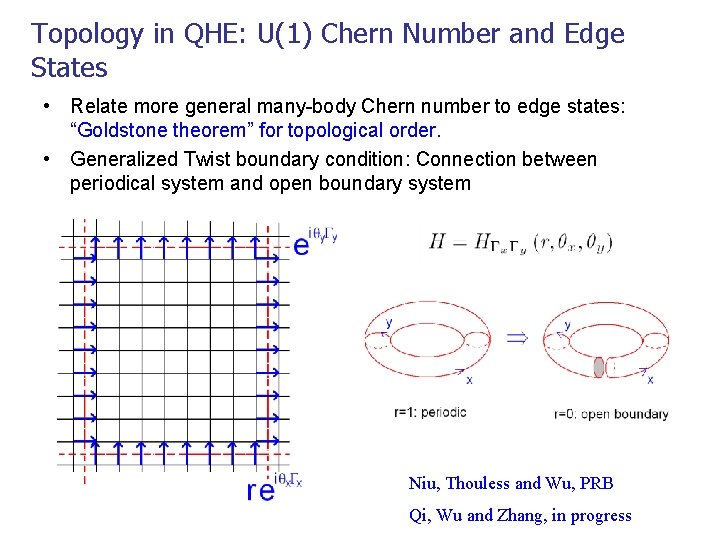
Topology in QHE: U(1) Chern Number and Edge States • Relate more general many-body Chern number to edge states: “Goldstone theorem” for topological order. • Generalized Twist boundary condition: Connection between periodical system and open boundary system Niu, Thouless and Wu, PRB Qi, Wu and Zhang, in progress
Topology in QHE: Chern Number and Edge States Non-vanishing Chern number Monopole in enlarged parameter space Gapless Edge States in the twisted Hamiltonian Monopole Gapless point 3 d parameter space boundary
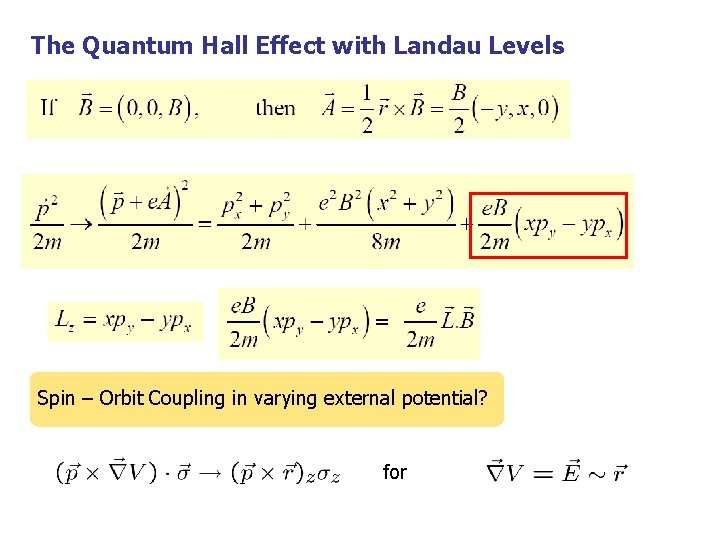
The Quantum Hall Effect with Landau Levels Spin – Orbit Coupling in varying external potential? for
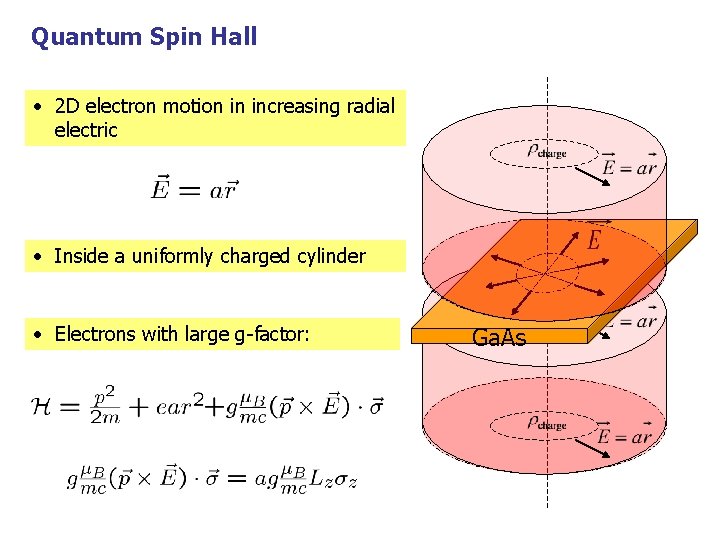
Quantum Spin Hall • 2 D electron motion in increasing radial electric • Inside a uniformly charged cylinder • Electrons with large g-factor: Ga. As
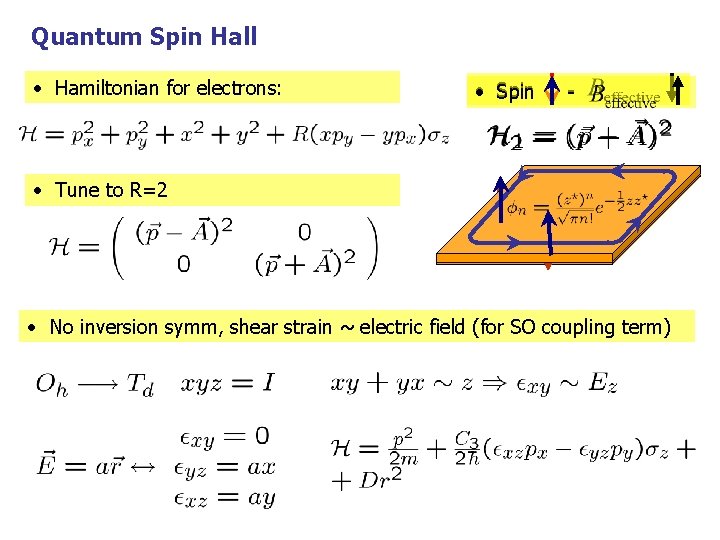
Quantum Spin Hall • Hamiltonian for electrons: • Spin - • Tune to R=2 • No inversion symm, shear strain ~ electric field (for SO coupling term)
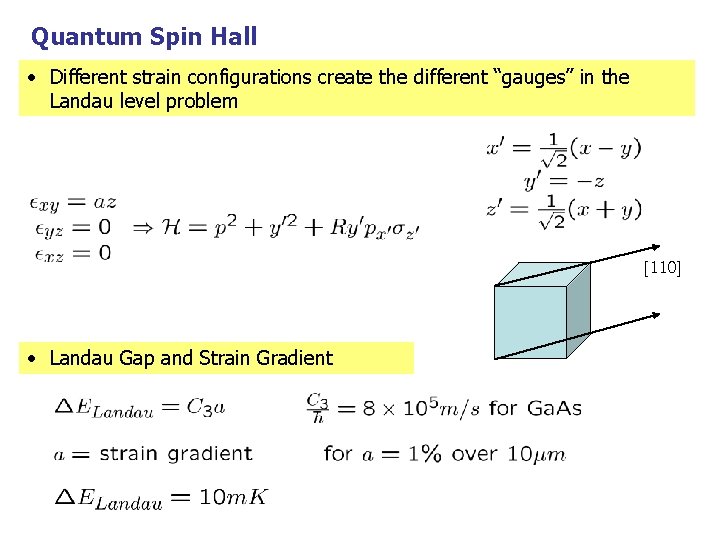
Quantum Spin Hall • Different strain configurations create the different “gauges” in the Landau level problem [110] • Landau Gap and Strain Gradient
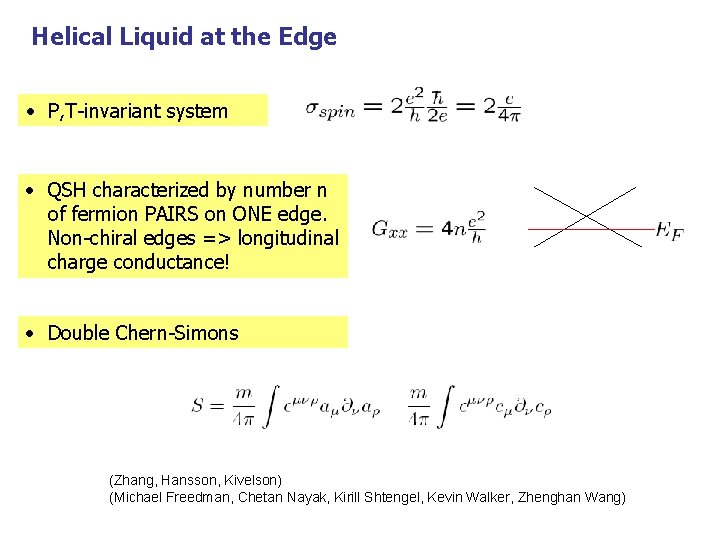
Helical Liquid at the Edge • P, T-invariant system • QSH characterized by number n of fermion PAIRS on ONE edge. Non-chiral edges => longitudinal charge conductance! • Double Chern-Simons (Zhang, Hansson, Kivelson) (Michael Freedman, Chetan Nayak, Kirill Shtengel, Kevin Walker, Zhenghan Wang)
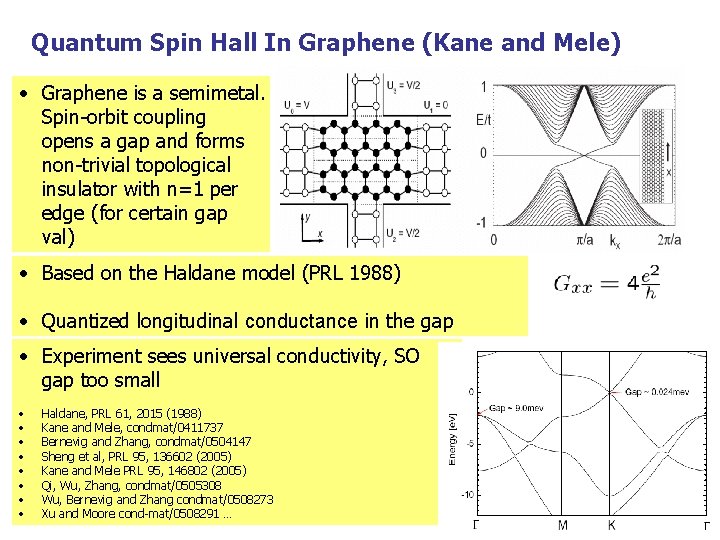
Quantum Spin Hall In Graphene (Kane and Mele) • Graphene is a semimetal. Spin-orbit coupling opens a gap and forms non-trivial topological insulator with n=1 per edge (for certain gap val) • Based on the Haldane model (PRL 1988) • Quantized longitudinal conductance in the gap • Experiment sees universal conductivity, SO gap too small • • Haldane, PRL 61, 2015 (1988) Kane and Mele, condmat/0411737 Bernevig and Zhang, condmat/0504147 Sheng et al, PRL 95, 136602 (2005) Kane and Mele PRL 95, 146802 (2005) Qi, Wu, Zhang, condmat/0505308 Wu, Bernevig and Zhang condmat/0508273 Xu and Moore cond-mat/0508291 …
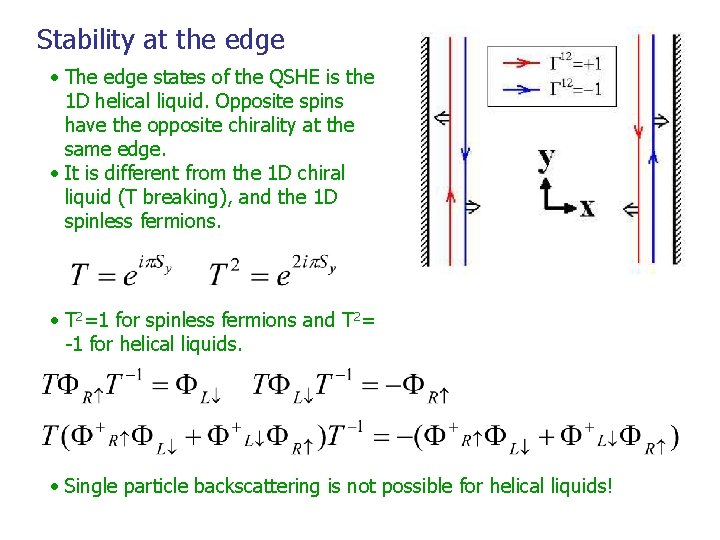
Stability at the edge • The edge states of the QSHE is the 1 D helical liquid. Opposite spins have the opposite chirality at the same edge. • It is different from the 1 D chiral liquid (T breaking), and the 1 D spinless fermions. • T 2=1 for spinless fermions and T 2= -1 for helical liquids. • Single particle backscattering is not possible for helical liquids!
Conclusions • Quantum AHE in ferromagnetic insulators. • Quantum SHE in “inverted band gap” insulators. • Quantum SHE with Landau levels, caused by strain. • New universality class of 1 D liquid: helical liquid. • QSHE is simpler to understand theoretically, well-classified by the global topology, easier to detect experimentally, purely intrinsic, can be engineered by band structure, enables spintronics without spin injection and spin detection.
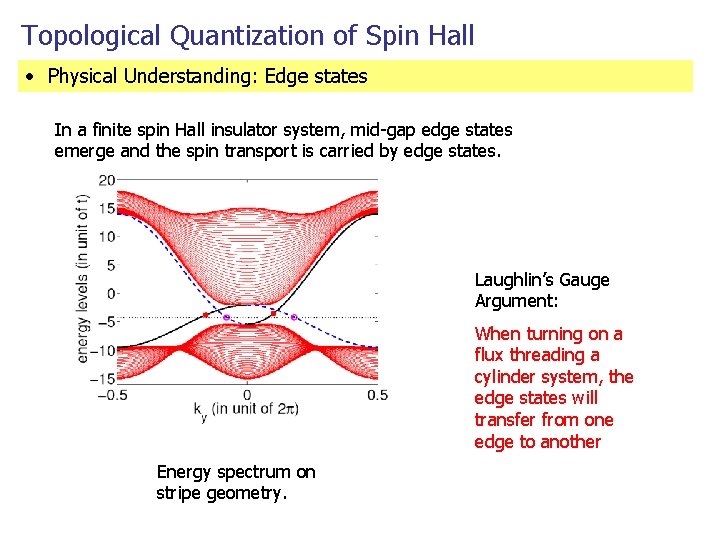
Topological Quantization of Spin Hall • Physical Understanding: Edge states In a finite spin Hall insulator system, mid-gap edge states emerge and the spin transport is carried by edge states. Laughlin’s Gauge Argument: When turning on a flux threading a cylinder system, the edge states will transfer from one edge to another Energy spectrum on stripe geometry.
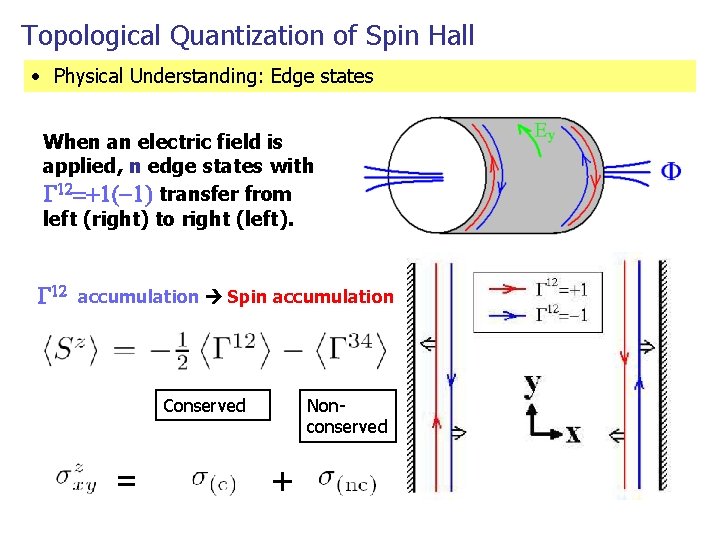
Topological Quantization of Spin Hall • Physical Understanding: Edge states When an electric field is applied, n edge states with G 12=+1(-1) transfer from left (right) to right (left). G 12 accumulation Spin accumulation Conserved = Nonconserved +
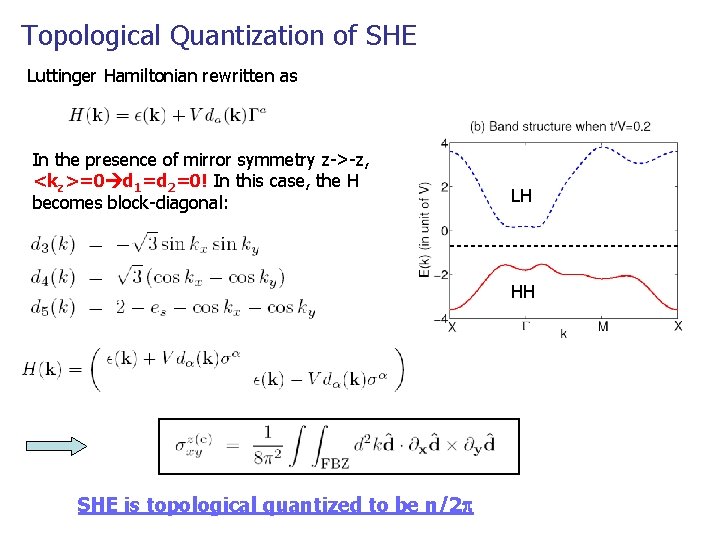
Topological Quantization of SHE Luttinger Hamiltonian rewritten as In the presence of mirror symmetry z->-z, <kz>=0 d 1=d 2=0! In this case, the H becomes block-diagonal: LH HH SHE is topological quantized to be n/2 p