
Quantum and classical photon correlation in four wave
- Slides: 1
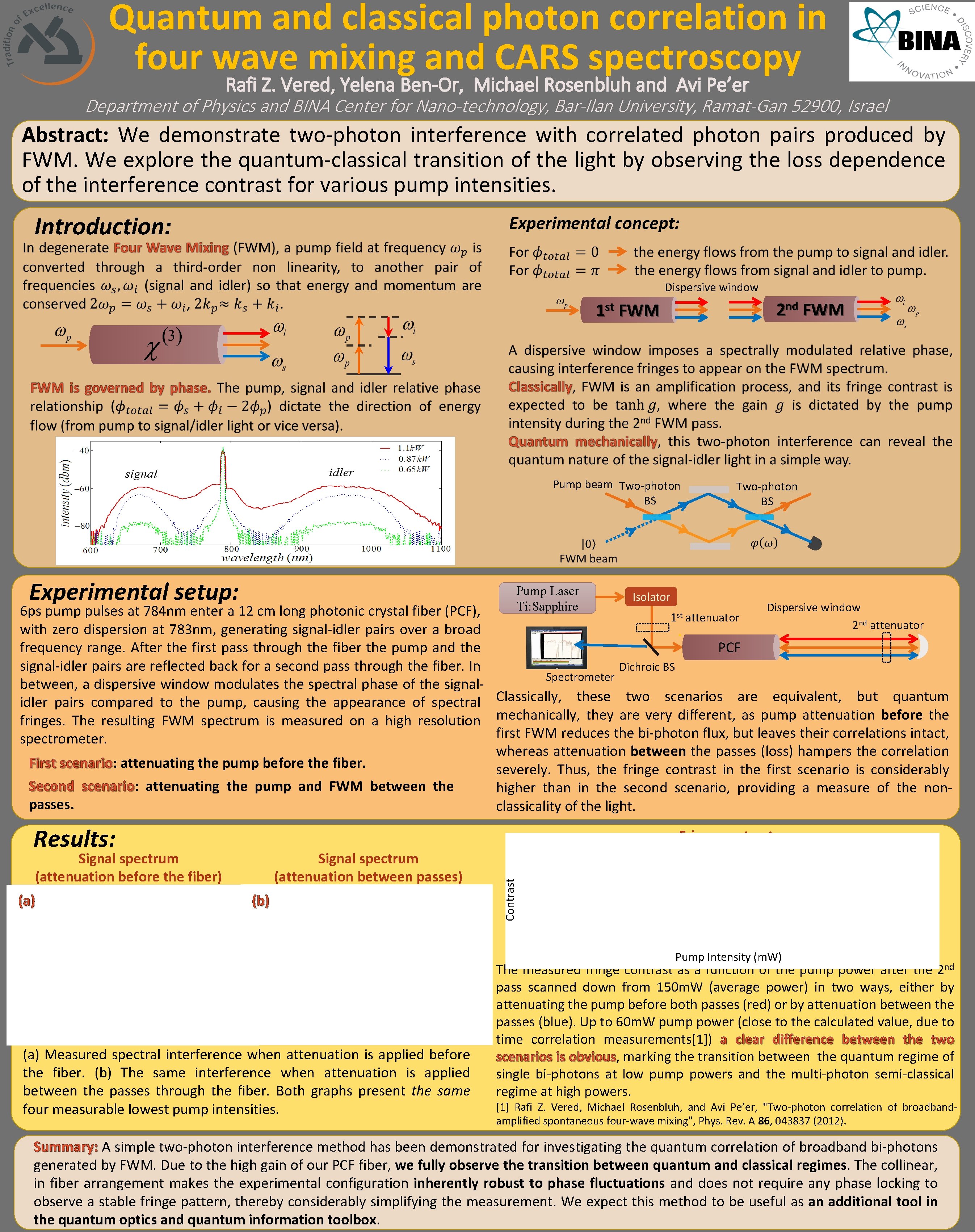
Quantum and classical photon correlation in four wave mixing and CARS spectroscopy Rafi Z. Vered, Yelena Ben-Or, Michael Rosenbluh and Avi Pe’er Department of Physics and BINA Center for Nano-technology, Bar-Ilan University, Ramat-Gan 52900, Israel Abstract: We demonstrate two-photon interference with correlated photon pairs produced by FWM. We explore the quantum-classical transition of the light by observing the loss dependence of the interference contrast for various pump intensities. Introduction: Experimental concept: Dispersive window st 1 nd 2 FWM Pump beam Two-photon BS Experimental setup: Pump Laser Ti: Sapphire FWM Two-photon BS Isolator Dispersive window 2 nd attenuator 6 ps pump pulses at 784 nm enter a 12 cm long photonic crystal fiber (PCF), 1 st attenuator with zero dispersion at 783 nm, generating signal-idler pairs over a broad frequency range. After the first pass through the fiber the pump and the PCF signal-idler pairs are reflected back for a second pass through the fiber. In Dichroic BS Spectrometer between, a dispersive window modulates the spectral phase of the signal. Classically, these two scenarios are equivalent, but quantum idler pairs compared to the pump, causing the appearance of spectral mechanically, they are very different, as pump attenuation before the fringes. The resulting FWM spectrum is measured on a high resolution first FWM reduces the bi-photon flux, but leaves their correlations intact, spectrometer. whereas attenuation between the passes (loss) hampers the correlation First scenario: scenario attenuating the pump before the fiber. severely. Thus, the fringe contrast in the first scenario is considerably Second scenario: scenario attenuating the pump and FWM between the higher than in the second scenario, providing a measure of the nonpasses. classicality of the light. Results: Signal spectrum (attenuation between passes) Signal spectrum (attenuation before the fiber) (a) (b) Contrast Fringe contrast Quantum regime Classical regime Pump Intensity (m. W) (a) Measured spectral interference when attenuation is applied before the fiber. (b) The same interference when attenuation is applied between the passes through the fiber. Both graphs present the same four measurable lowest pump intensities. The measured fringe contrast as a function of the pump power after the 2 nd pass scanned down from 150 m. W (average power) in two ways, either by attenuating the pump before both passes (red) or by attenuation between the passes (blue). Up to 60 m. W pump power (close to the calculated value, due to time correlation measurements[1]) a clear difference between the two scenarios is obvious, obvious marking the transition between the quantum regime of single bi-photons at low pump powers and the multi-photon semi-classical regime at high powers. [1] Rafi Z. Vered, Michael Rosenbluh, and Avi Pe’er, "Two-photon correlation of broadbandamplified spontaneous four-wave mixing", Phys. Rev. A 86, 043837 (2012). Summary: A simple two-photon interference method has been demonstrated for investigating the quantum correlation of broadband bi-photons generated by FWM. Due to the high gain of our PCF fiber, we fully observe the transition between quantum and classical regimes. The collinear, in fiber arrangement makes the experimental configuration inherently robust to phase fluctuations and does not require any phase locking to observe a stable fringe pattern, thereby considerably simplifying the measurement. We expect this method to be useful as an additional tool in the quantum optics and quantum information toolbox.