
Quantitative Spectroscopy in 3 D From Serial to
- Slides: 21
Quantitative Spectroscopy in 3 D From Serial to Parallel Computing A Personal View Lars Koesterke Texas Advanced Computing Center “Recent Directions in Astrophysical Quantitative Spectroscopy and Radiation Hydrodynamics” In Honor of Dimitri Mihalas
Overview Collaboration with: Carlos Allende Prieto University of Texas (Austin), now England Ivan Hubeny Arizona David Lambert University of Texas (Austin) Later with: Ivan Ramirez Hans-Günter Ludwig Martin Asplund Remo Collet Solar Abundances Calculating the Solar Spectrum ASSET: Advanced Spectrum Synthesis 3 D Tool What can Modern Software (Design) and Supercomputers do for you?
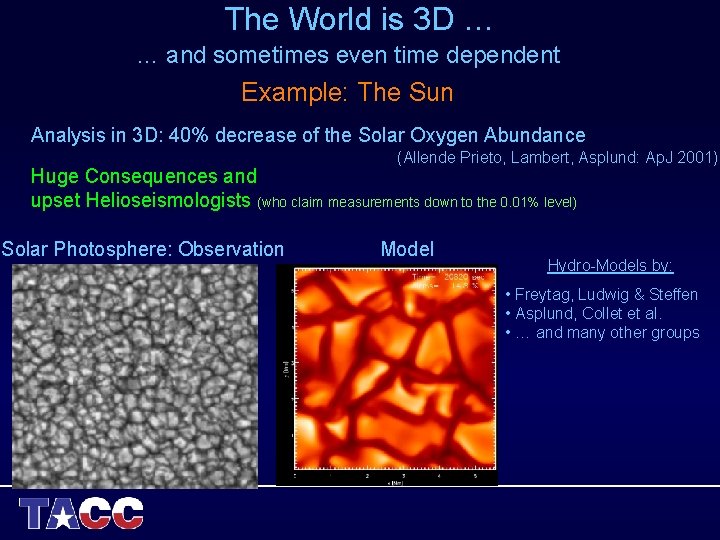
The World is 3 D … … and sometimes even time dependent Example: The Sun Analysis in 3 D: 40% decrease of the Solar Oxygen Abundance (Allende Prieto, Lambert, Asplund: Ap. J 2001) Huge Consequences and upset Helioseismologists (who claim measurements down to the 0. 01% level) Solar Photosphere: Observation Model Hydro-Models by: • Freytag, Ludwig & Steffen • Asplund, Collet et al. • … and many other groups
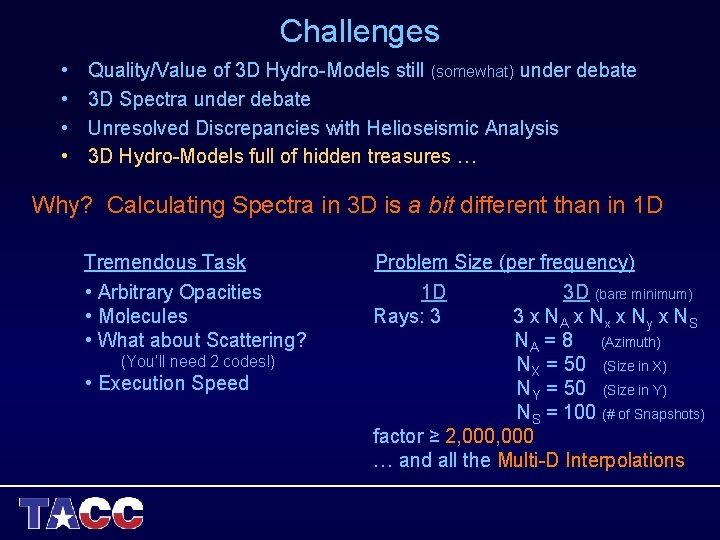
Challenges • • Quality/Value of 3 D Hydro-Models still (somewhat) under debate 3 D Spectra under debate Unresolved Discrepancies with Helioseismic Analysis 3 D Hydro-Models full of hidden treasures … Why? Calculating Spectra in 3 D is a bit different than in 1 D Tremendous Task Problem Size (per frequency) • Arbitrary Opacities • Molecules • What about Scattering? 1 D Rays: 3 (You’ll need 2 codes!) • Execution Speed 3 D (bare minimum) 3 x N A x Nx x Ny x NS NA = 8 (Azimuth) NX = 50 (Size in X) NY = 50 (Size in Y) NS = 100 (# of Snapshots) factor ≥ 2, 000 … and all the Multi-D Interpolations
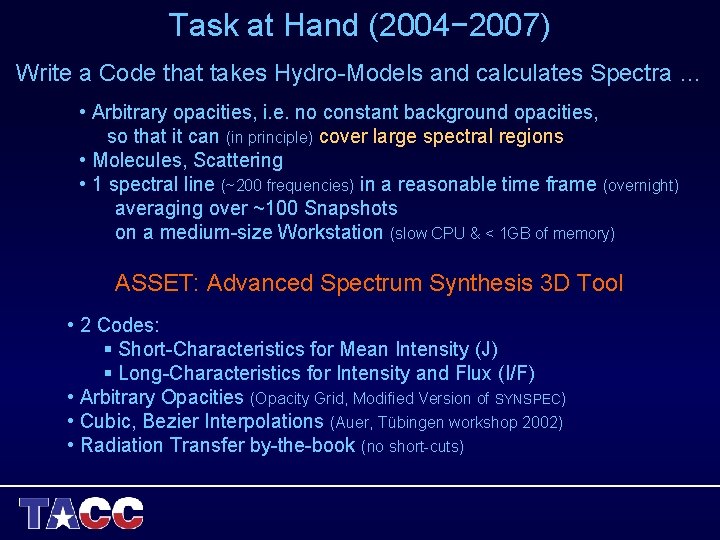
Task at Hand (2004− 2007) Write a Code that takes Hydro-Models and calculates Spectra … • Arbitrary opacities, i. e. no constant background opacities, so that it can (in principle) cover large spectral regions • Molecules, Scattering • 1 spectral line (~200 frequencies) in a reasonable time frame (overnight) averaging over ~100 Snapshots on a medium-size Workstation (slow CPU & < 1 GB of memory) ASSET: Advanced Spectrum Synthesis 3 D Tool • 2 Codes: § Short-Characteristics for Mean Intensity (J) § Long-Characteristics for Intensity and Flux (I/F) • Arbitrary Opacities (Opacity Grid, Modified Version of SYNSPEC) • Cubic, Bezier Interpolations (Auer, Tübingen workshop 2002) • Radiation Transfer by-the-book (no short-cuts)
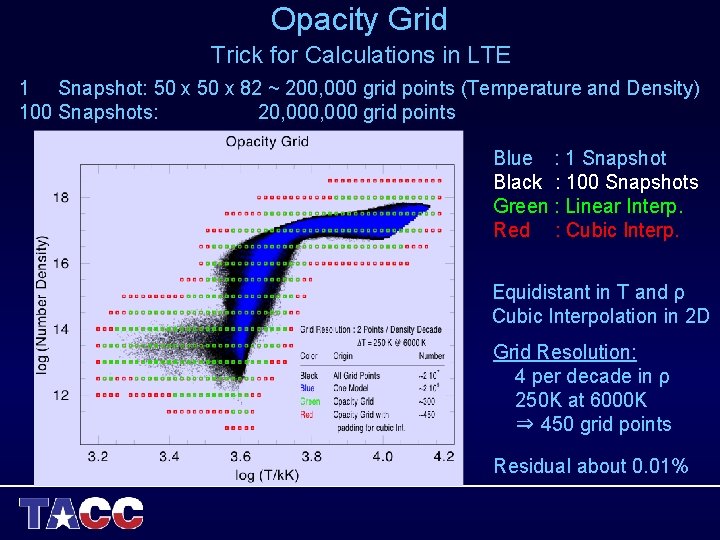
Opacity Grid Trick for Calculations in LTE 1 Snapshot: 50 x 82 ~ 200, 000 grid points (Temperature and Density) 100 Snapshots: 20, 000 grid points Blue : 1 Snapshot Black : 100 Snapshots Green : Linear Interp. Red : Cubic Interp. Equidistant in T and ρ Cubic Interpolation in 2 D Grid Resolution: 4 per decade in ρ 250 K at 6000 K ⇒ 450 grid points Residual about 0. 01%
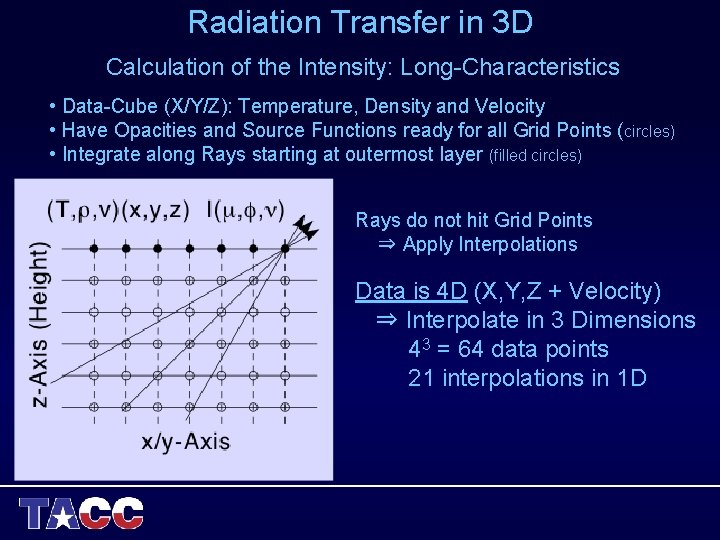
Radiation Transfer in 3 D Calculation of the Intensity: Long-Characteristics • Data-Cube (X/Y/Z): Temperature, Density and Velocity • Have Opacities and Source Functions ready for all Grid Points (circles) • Integrate along Rays starting at outermost layer (filled circles) Rays do not hit Grid Points ⇒ Apply Interpolations Data is 4 D (X, Y, Z + Velocity) ⇒ Interpolate in 3 Dimensions 43 = 64 data points 21 interpolations in 1 D
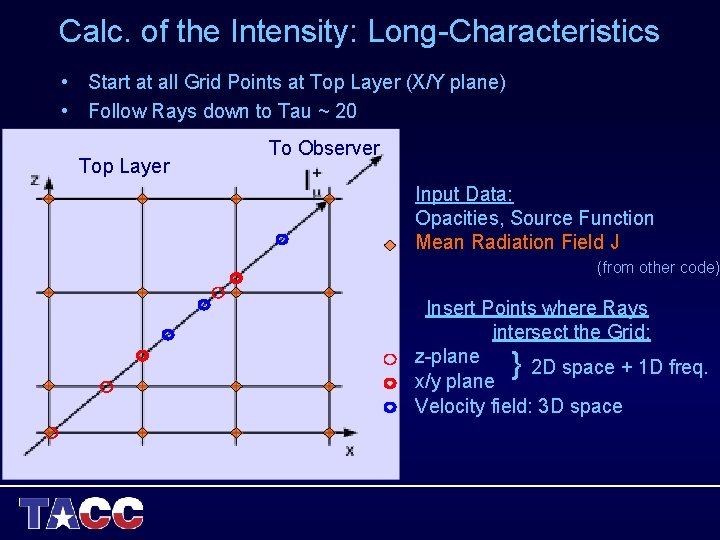
Calc. of the Intensity: Long-Characteristics • Start at all Grid Points at Top Layer (X/Y plane) • Follow Rays down to Tau ~ 20 Top Layer To Observer Input Data: Opacities, Source Function Mean Radiation Field J (from other code) Insert Points where Rays intersect the Grid: z-plane 2 D space + 1 D freq. x/y plane Velocity field: 3 D space }
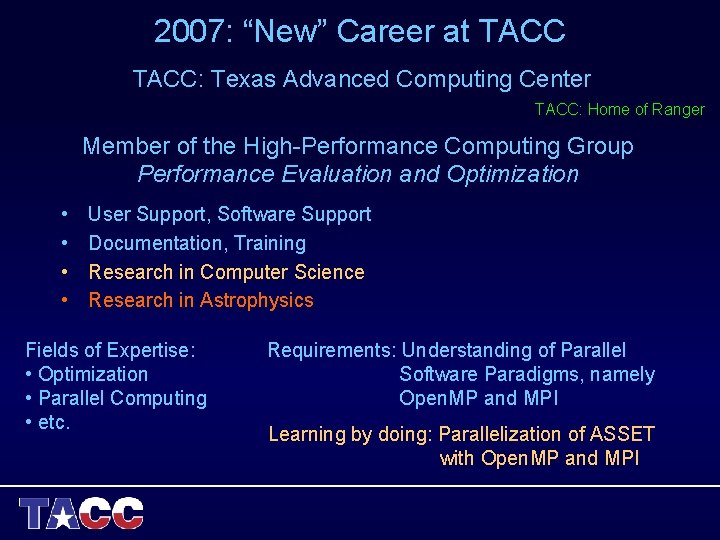
2007: “New” Career at TACC: Texas Advanced Computing Center TACC: Home of Ranger Member of the High-Performance Computing Group Performance Evaluation and Optimization • • User Support, Software Support Documentation, Training Research in Computer Science Research in Astrophysics Fields of Expertise: • Optimization • Parallel Computing • etc. Requirements: Understanding of Parallel Software Paradigms, namely Open. MP and MPI Learning by doing: Parallelization of ASSET with Open. MP and MPI
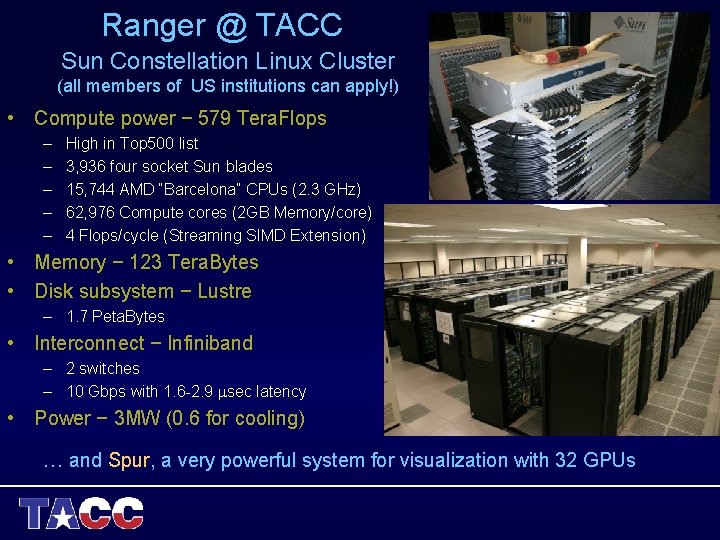
Ranger @ TACC Sun Constellation Linux Cluster (all members of US institutions can apply!) • Compute power − 579 Tera. Flops – – – High in Top 500 list 3, 936 four socket Sun blades 15, 744 AMD “Barcelona” CPUs (2. 3 GHz) 62, 976 Compute cores (2 GB Memory/core) 4 Flops/cycle (Streaming SIMD Extension) • Memory − 123 Tera. Bytes • Disk subsystem − Lustre – 1. 7 Peta. Bytes • Interconnect − Infiniband – 2 switches – 10 Gbps with 1. 6 -2. 9 sec latency • Power − 3 MW (0. 6 for cooling) … and Spur, a very powerful system for visualization with 32 GPUs
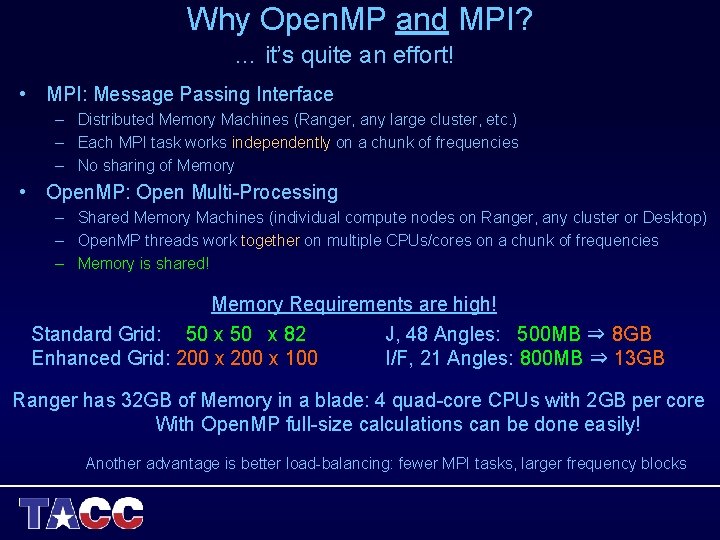
Why Open. MP and MPI? … it’s quite an effort! • MPI: Message Passing Interface – Distributed Memory Machines (Ranger, any large cluster, etc. ) – Each MPI task works independently on a chunk of frequencies – No sharing of Memory • Open. MP: Open Multi-Processing – Shared Memory Machines (individual compute nodes on Ranger, any cluster or Desktop) – Open. MP threads work together on multiple CPUs/cores on a chunk of frequencies – Memory is shared! Memory Requirements are high! Standard Grid: 50 x 82 J, 48 Angles: 500 MB ⇒ 8 GB Enhanced Grid: 200 x 100 I/F, 21 Angles: 800 MB ⇒ 13 GB Ranger has 32 GB of Memory in a blade: 4 quad-core CPUs with 2 GB per core With Open. MP full-size calculations can be done easily! Another advantage is better load-balancing: fewer MPI tasks, larger frequency blocks
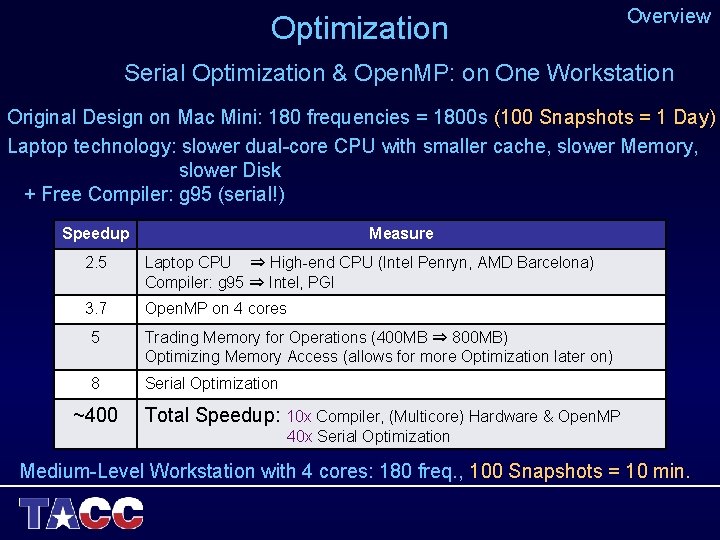
Optimization Overview Serial Optimization & Open. MP: on One Workstation Original Design on Mac Mini: 180 frequencies = 1800 s (100 Snapshots = 1 Day) Laptop technology: slower dual-core CPU with smaller cache, slower Memory, slower Disk + Free Compiler: g 95 (serial!) Speedup Measure 2. 5 Laptop CPU ⇒ High-end CPU (Intel Penryn, AMD Barcelona) Compiler: g 95 ⇒ Intel, PGI 3. 7 Open. MP on 4 cores 5 Trading Memory for Operations (400 MB ⇒ 800 MB) Optimizing Memory Access (allows for more Optimization later on) 8 Serial Optimization ~400 Total Speedup: 10 x Compiler, (Multicore) Hardware & Open. MP 40 x Serial Optimization Medium-Level Workstation with 4 cores: 180 freq. , 100 Snapshots = 10 min.
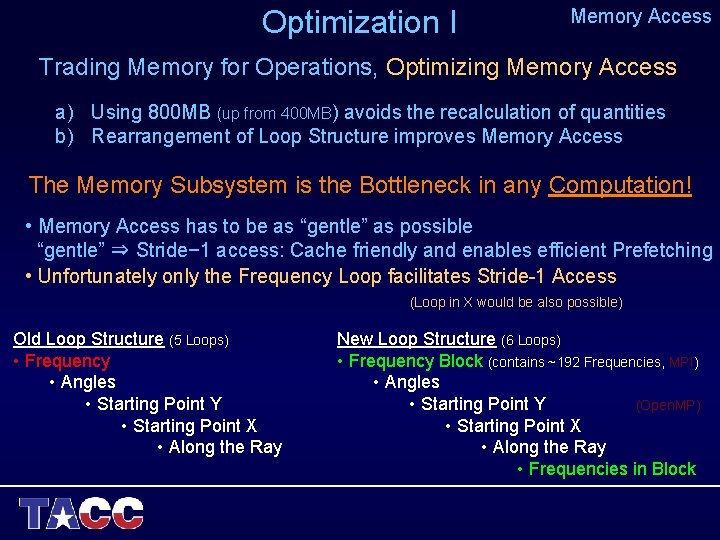
Optimization I Memory Access Trading Memory for Operations, Optimizing Memory Access a) Using 800 MB (up from 400 MB) avoids the recalculation of quantities b) Rearrangement of Loop Structure improves Memory Access The Memory Subsystem is the Bottleneck in any Computation! • Memory Access has to be as “gentle” as possible “gentle” ⇒ Stride− 1 access: Cache friendly and enables efficient Prefetching • Unfortunately only the Frequency Loop facilitates Stride-1 Access (Loop in X would be also possible) Old Loop Structure (5 Loops) • Frequency • Angles • Starting Point Y • Starting Point X • Along the Ray New Loop Structure (6 Loops) • Frequency Block (contains ~192 Frequencies, MPI) • Angles • Starting Point Y (Open. MP) • Starting Point X • Along the Ray • Frequencies in Block
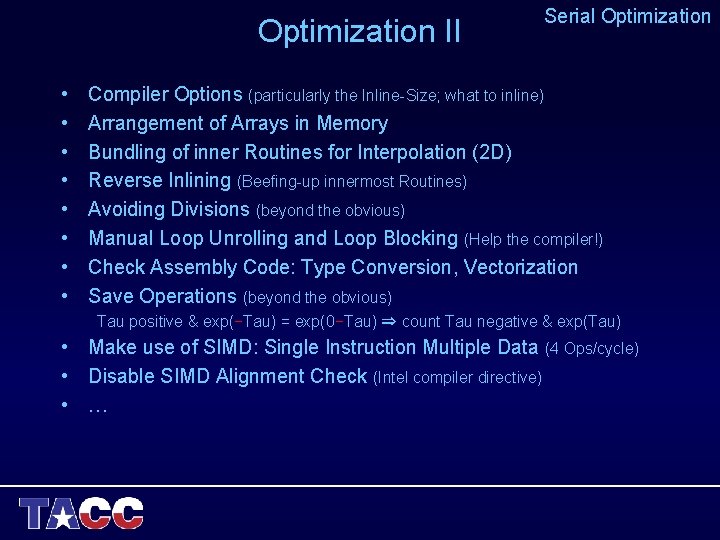
Optimization II • • Serial Optimization Compiler Options (particularly the Inline-Size; what to inline) Arrangement of Arrays in Memory Bundling of inner Routines for Interpolation (2 D) Reverse Inlining (Beefing-up innermost Routines) Avoiding Divisions (beyond the obvious) Manual Loop Unrolling and Loop Blocking (Help the compiler!) Check Assembly Code: Type Conversion, Vectorization Save Operations (beyond the obvious) Tau positive & exp(−Tau) = exp(0−Tau) ⇒ count Tau negative & exp(Tau) • Make use of SIMD: Single Instruction Multiple Data (4 Ops/cycle) • Disable SIMD Alignment Check (Intel compiler directive) • …
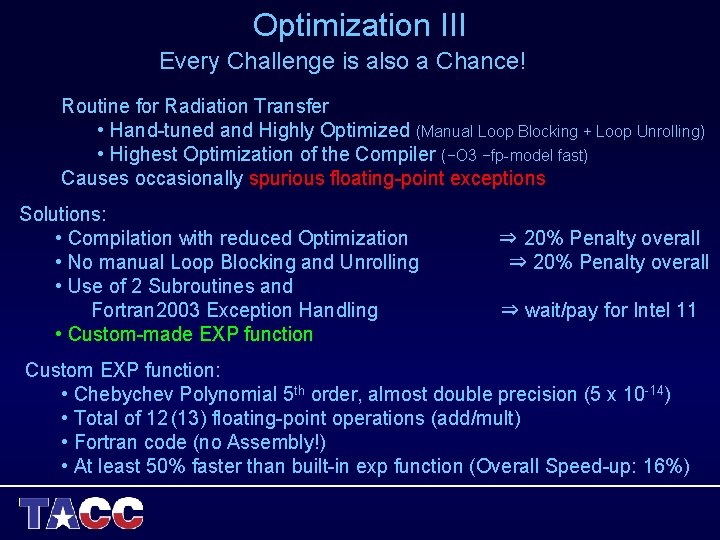
Optimization III Every Challenge is also a Chance! Routine for Radiation Transfer • Hand-tuned and Highly Optimized (Manual Loop Blocking + Loop Unrolling) • Highest Optimization of the Compiler (−O 3 −fp-model fast) Causes occasionally spurious floating-point exceptions Solutions: • Compilation with reduced Optimization • No manual Loop Blocking and Unrolling • Use of 2 Subroutines and Fortran 2003 Exception Handling • Custom-made EXP function ⇒ 20% Penalty overall ⇒ wait/pay for Intel 11 Custom EXP function: • Chebychev Polynomial 5 th order, almost double precision (5 x 10 -14) • Total of 12 (13) floating-point operations (add/mult) • Fortran code (no Assembly!) • At least 50% faster than built-in exp function (Overall Speed-up: 16%)
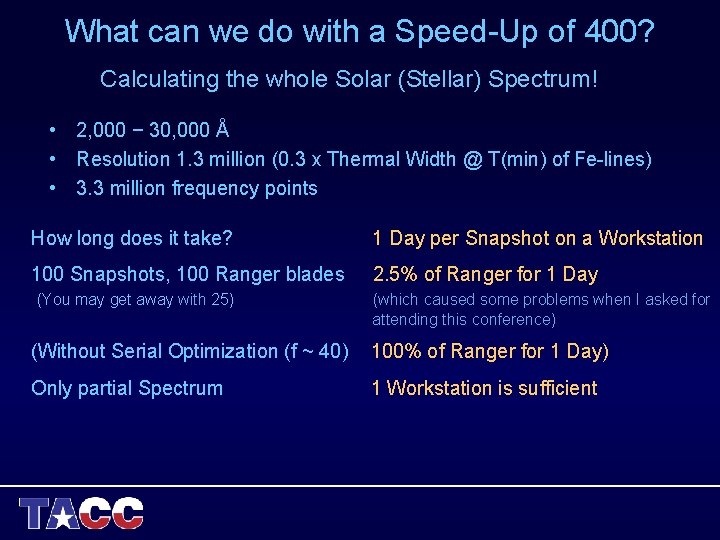
What can we do with a Speed-Up of 400? Calculating the whole Solar (Stellar) Spectrum! • 2, 000 − 30, 000 Å • Resolution 1. 3 million (0. 3 x Thermal Width @ T(min) of Fe-lines) • 3. 3 million frequency points How long does it take? 1 Day per Snapshot on a Workstation 100 Snapshots, 100 Ranger blades 2. 5% of Ranger for 1 Day (You may get away with 25) (which caused some problems when I asked for attending this conference) (Without Serial Optimization (f ~ 40) 100% of Ranger for 1 Day) Only partial Spectrum 1 Workstation is sufficient
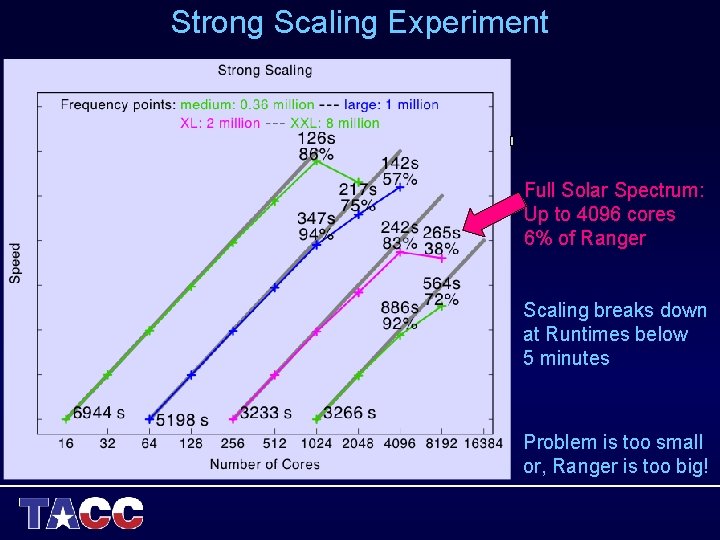
Strong Scaling Experiment Full Solar Spectrum: Up to 4096 cores 6% of Ranger Scaling breaks down at Runtimes below 5 minutes Problem is too small or, Ranger is too big!
1 D vs. 3 D We are now in 3 D where we were in 1 D in the early 90’s! • Desktop – Single line in a few minutes – Chunk of Spectrum (~500Å) overnight • Small Cluster – Full Spectrum overnight Get Ready to Explore the Spectra of 3 D Hydro-Models!
Current and Future Activities Current Activities: • Calculation/Analysis of the full Spectrum of K-Dwarfs – with Ivan Ramirez, Carlos Allende Prieto, et al. – Asplund models • Calculation/Analysis of the full Solar Spectrum – with Carlos Allende Prieto, Hans-Günter Ludwig, et al. – Asplund models and Co 5 Bold models … but there are more Hydro models out there … New Collaborations and Projects wanted! • Martin Asplund, Remo Collet and Regner Trampedach have ~20 Hydro-Time series covering a substantial part of the HRD … • There are other groups that might be interested in using ASSET … It’s a perfect opportunity: A powerful tool + Great access to compute resources
Activities: Code Development • Upgrading ASSET to calculate population numbers and spectra in non-LTE – Using the “J” code in an Accelerated Lambda Iteration (ALI) – Upgrading the “I/F” code for spectra/population numbers in non-LTE • Upgrading ASSET to Hydro-models with AMR (Adaptive Mesh Refinement) – I’d like to talk to some AMR experts at this conference to bounce some ideas around … Funding We collaborate with scientists and actively pursue funding opportunities! If you need somebody for … • Code Optimization (Serial & Parallel) • Porting code to Large Clusters • Improving Scalability • Implementation of Parallel Computing (Open. MP & MPI) • Code Development • Radiation Transfer … please let me know!
Thanks … … and Thank You Dimitri!