
Quantitative Software Management Cost Estimation Sizing Incorporating Risk

- Slides: 6
Quantitative Software Management: Cost Estimation & Sizing Incorporating Risk
JPL Recommended Risk Assessment Criteria and Risk Matrix Criticality 09/02/2004 Quantitative Software Management JMH-2
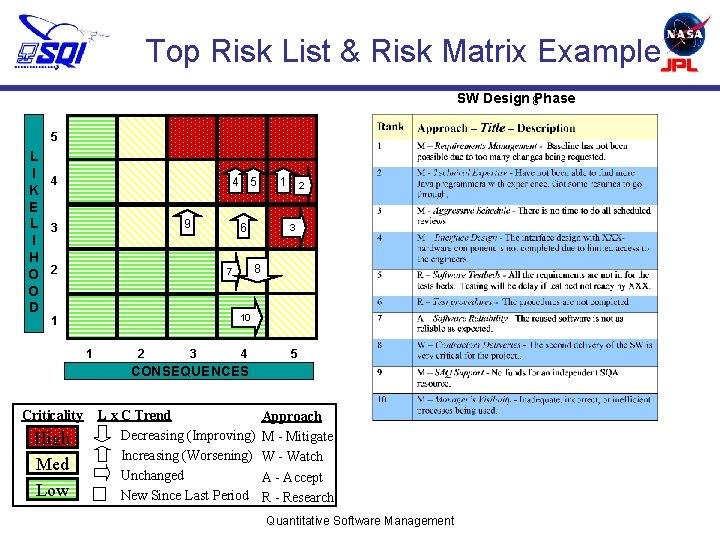
Top Risk List & Risk Matrix Example SW Design 8 Phase 5 L I 4 K E L 3 I H O 2 O D 4 5 9 6 1 2 3 8 7 10 1 1 2 3 4 5 CONSEQUENCES Criticality High Med Low L x C Trend Decreasing (Improving) Increasing (Worsening) Unchanged New Since Last Period Approach M - Mitigate W - Watch A - Accept R - Research Quantitative Software Management
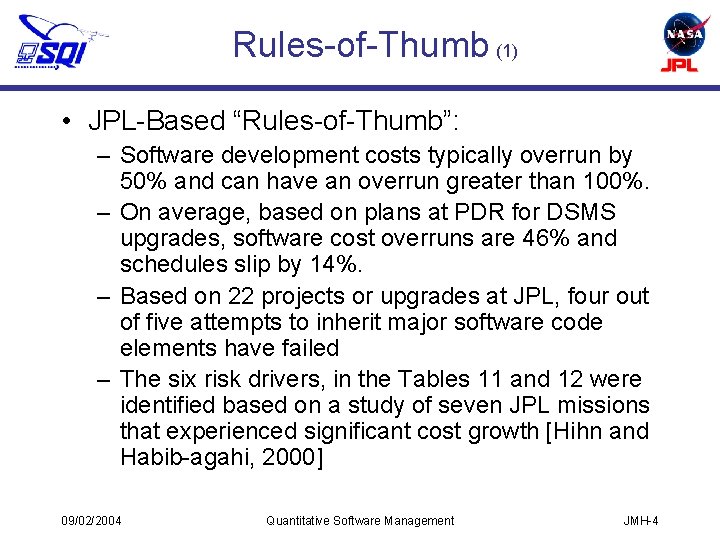
Rules-of-Thumb (1) • JPL-Based “Rules-of-Thumb”: – Software development costs typically overrun by 50% and can have an overrun greater than 100%. – On average, based on plans at PDR for DSMS upgrades, software cost overruns are 46% and schedules slip by 14%. – Based on 22 projects or upgrades at JPL, four out of five attempts to inherit major software code elements have failed – The six risk drivers, in the Tables 11 and 12 were identified based on a study of seven JPL missions that experienced significant cost growth [Hihn and Habib-agahi, 2000] 09/02/2004 Quantitative Software Management JMH-4
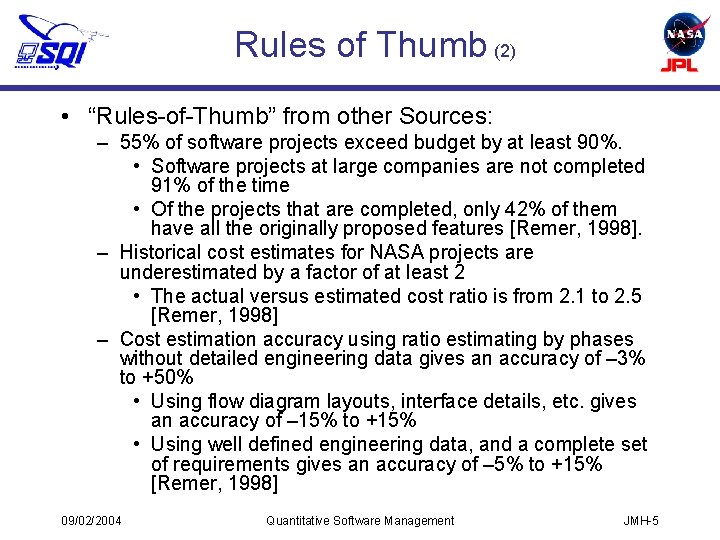
Rules of Thumb (2) • “Rules-of-Thumb” from other Sources: – 55% of software projects exceed budget by at least 90%. • Software projects at large companies are not completed 91% of the time • Of the projects that are completed, only 42% of them have all the originally proposed features [Remer, 1998]. – Historical cost estimates for NASA projects are underestimated by a factor of at least 2 • The actual versus estimated cost ratio is from 2. 1 to 2. 5 [Remer, 1998] – Cost estimation accuracy using ratio estimating by phases without detailed engineering data gives an accuracy of – 3% to +50% • Using flow diagram layouts, interface details, etc. gives an accuracy of – 15% to +15% • Using well defined engineering data, and a complete set of requirements gives an accuracy of – 5% to +15% [Remer, 1998] 09/02/2004 Quantitative Software Management JMH-5
Rules-of-Thumb (3) • An accuracy rate of – 10% to +10% requires that 7% of a rough order of magnitude budget and schedule be used to develop the plan and budget – Another way to look at this is to consider the percentage of total job calendar time required – When using existing technology, 8% of calendar/budget should be allocated to plan development – When high technology is used, then 18% of calendar/budget should be allocated to plan development [Remer, 1998] • According to Boehm [Boehm, et. al. , 2000], the impacts of certain risk drivers can be significantly higher than the JPL study: – Requirements volatility can increase cost by as much as 62% – Concurrent hardware platform development can increase cost by as much as 30% – Incorporating anything for the first time, such as new design methods, languages, tools, processes can increase cost by as much as 20%, and if there are multiple sources of newness, it can increase cost as much as 100% 09/02/2004 Quantitative Software Management JMH-6