
Quantitative Research Approaches Dr Sadasivam Karuppannan Quantitative approach




- Slides: 24
Quantitative Research Approaches Dr Sadasivam Karuppannan
Quantitative approach • The quantitative approach views phenomena as being amenable to objective study i. e. able to be measured. • It has its roots in positivism • It is the whole design: – Assumptions – Process of inquiry – Type of data collected – Measuring of findings
Characteristics of quantitative and qualitative research Source: Quoted from : Maginn, P. J. (2006) Urban Policy Analysis Through a Qualitative Lens: Overview to Special Issue, Urban Policy and Research, Vol 24(1) pp. 1 -15. Franklin, A. (1986) Ethnography and housing studies, Housing Studies, 5(2), pp. 92– 111. Punch, K. (1998) Introduction to Social Research (London: Sage). Spencer, L. , Ritchie, J. , Lewis, J. & Dillon, L. (2003) Quality in Qualitative Evaluation: A Framework for Assessing Research Evidence, Occasional Papers Series No. 2 (London: Government Chief Social Researcher’s Office). Winchester, H. P. M. (2000) Qualitative research and its place in human geography, in: I. Hay (Ed. ) Qualitative Research Methods in Human Geography, pp. 1– 22 (Oxford: Oxford University Press).
Quantitative research § Quantitative research aims at (causal) explanation. It answers primarily to why? § Both qualitative and quantitative research can aim at description of built environment. § Complementary - not contradictory § different kinds of research questions and objects of research § different perspectives on the same research objects / questions (methodological triangulation)
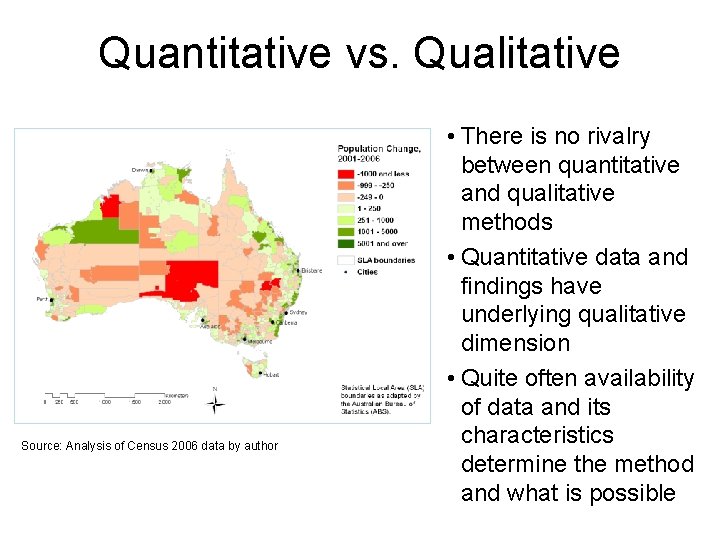
Quantitative vs. Qualitative Source: Analysis of Census 2006 data by author • There is no rivalry between quantitative and qualitative methods • Quantitative data and findings have underlying qualitative dimension • Quite often availability of data and its characteristics determine the method and what is possible
Choosing a methods • Include a rationale for using the chosen method • Sequence in which approach has data collected first • Appropriate data analysis techniques
Research methods • Defining and justifying research problems for quantitative studies • Theory and measurement • Sampling, survey, data collection, questionnaires • Experimental design • Choosing methods to match research problems Distinction between ‘Method’ and ‘Techniques and tools’ should not be confused
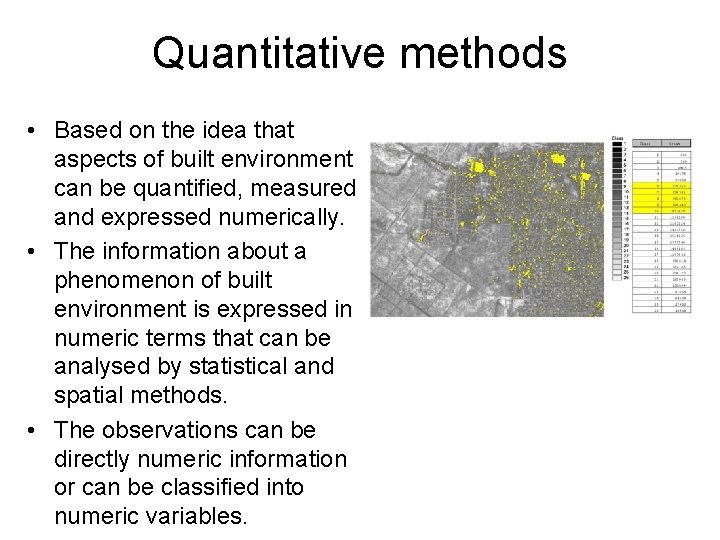
Quantitative methods • Based on the idea that aspects of built environment can be quantified, measured and expressed numerically. • The information about a phenomenon of built environment is expressed in numeric terms that can be analysed by statistical and spatial methods. • The observations can be directly numeric information or can be classified into numeric variables.
Steps • Stating in advance the hypothesis and research question. • Determine the methods of data collection and analysis. • Presenting the findings in statistical language. • It is similar to traditional scientific method
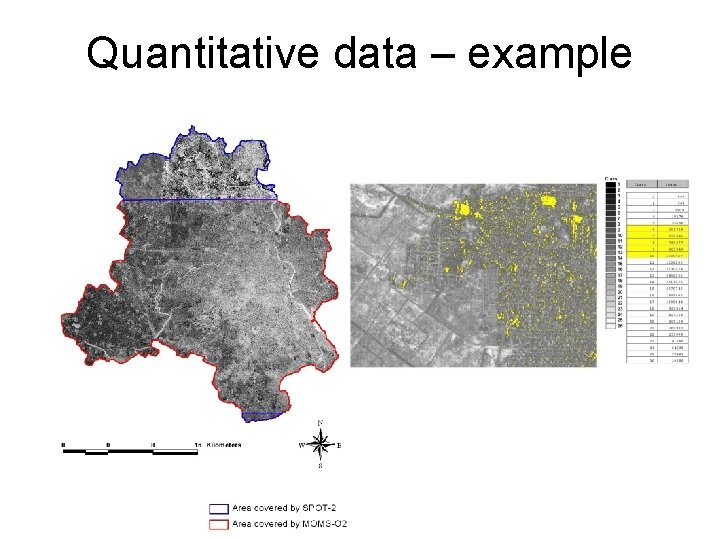
Quantitative data • Data are used to classify groups. • Examples; numbers, quantity, prevalence, incidence. • Variables can be classified as physical (population, infrastructure), social (poverty, slums), spatial (land use, proximity) etc.
Quantitative data – example
Measurement in quantitative research should fulfill • Validity - Are you measuring what you think you are measuring? • Objectivity - researchers stand outside the phenomena they study. Data collected are free from bias. • Reliability - if something was measured again using the same instrument, would it produce the same or nearly the same results? • Accuracy – Are the methods adequate to answer your questions? ; reveal credible information? ; convey important information? • Precision – How much trustable, how confident is the result.
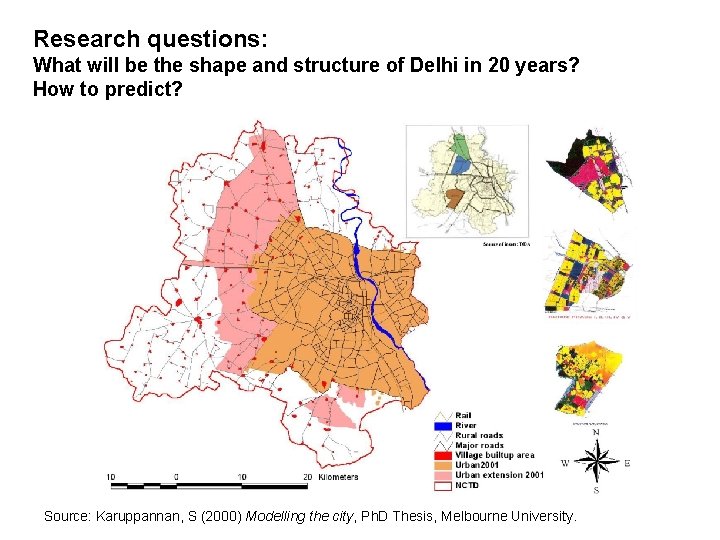
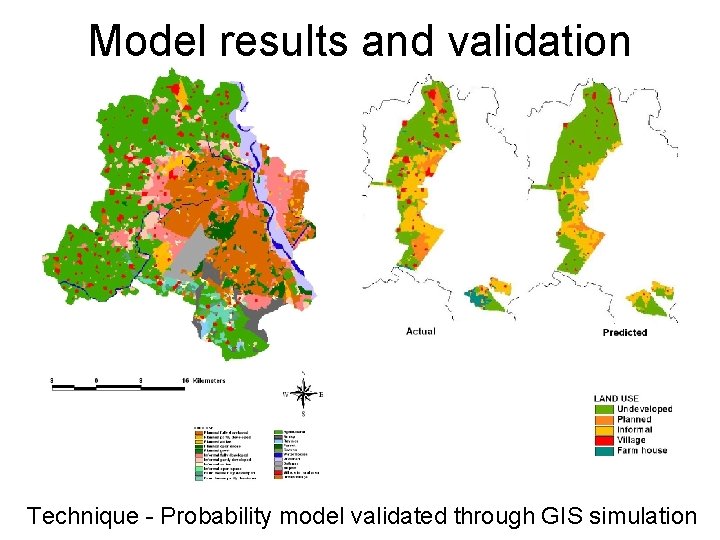
Research questions: What will be the shape and structure of Delhi in 20 years? How to predict? Source: Karuppannan, S (2000) Modelling the city, Ph. D Thesis, Melbourne University.
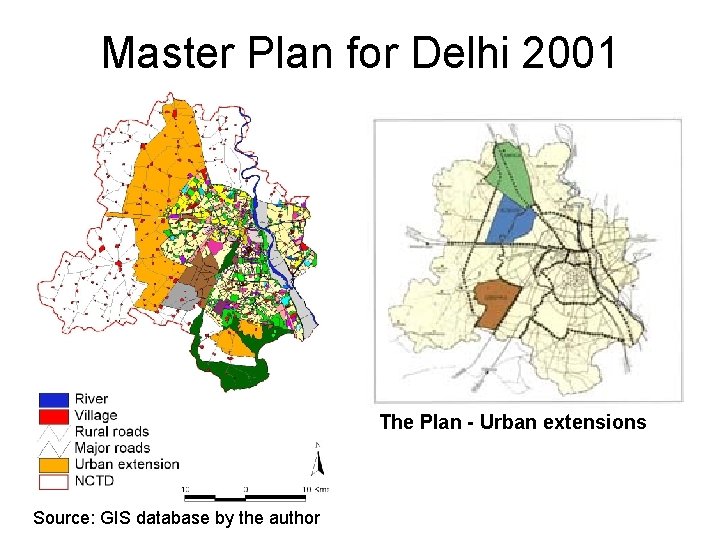
Master Plan for Delhi 2001 The Plan - Urban extensions Source: GIS database by the author
Model results and validation Technique - Probability model validated through GIS simulation
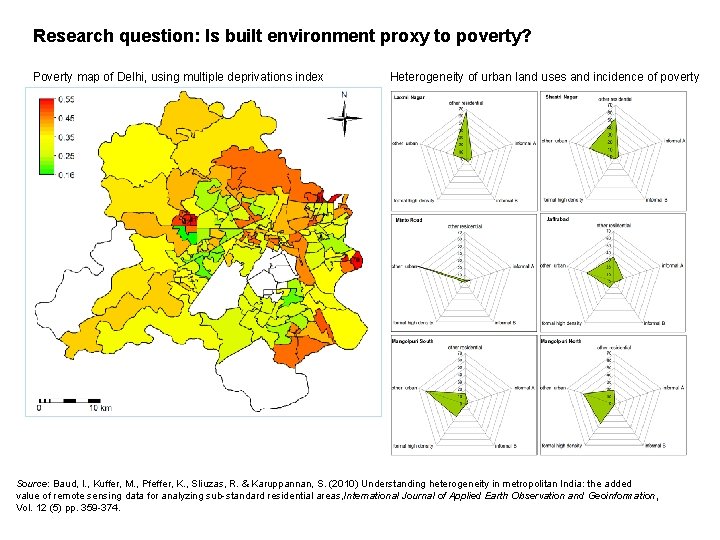
Research question: Is built environment proxy to poverty? Poverty map of Delhi, using multiple deprivations index Heterogeneity of urban land uses and incidence of poverty Source: Baud, I. , Kuffer, M. , Pfeffer, K. , Sliuzas, R. & Karuppannan, S. (2010) Understanding heterogeneity in metropolitan India: the added value of remote sensing data for analyzing sub-standard residential areas, International Journal of Applied Earth Observation and Geoinformation, Vol. 12 (5) pp. 359 -374.
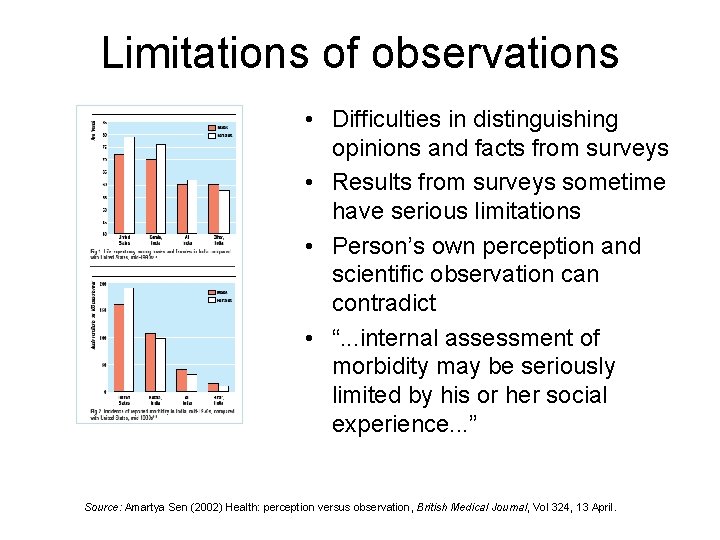
Limitations of observations • Difficulties in distinguishing opinions and facts from surveys • Results from surveys sometime have serious limitations • Person’s own perception and scientific observation can contradict • “. . . internal assessment of morbidity may be seriously limited by his or her social experience. . . ” Source: Amartya Sen (2002) Health: perception versus observation, British Medical Journal, Vol 324, 13 April.
Practicing Quantitative approach Climate change; changing urban planning policy and system : a study of Bangladesh Reazul Ahsan Ph. D candidate School of natural and Built Environments University of South Australia
Quantitative research • Quantitative research stands for an systematic empirical investigation of quantitative phenomenon and properties; • The aim of quantitative research is to develop a hypothesis pertaining to phenomena; • Numeric analysis and measurement are the key parts of quantitative research that state the fundamental connection between observation and analytical statement; • Quantitative methods are mostly used to justify hypotheses and draw hypotheses; the a general conclusion on selected • Statistics, tables and graphs, are often used to present the results of these methods.
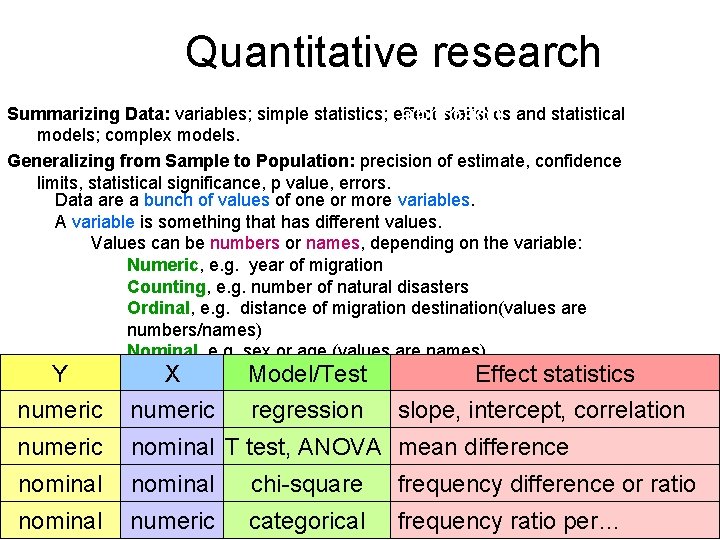
Quantitative research Using quantitative Summarizing Data: variables; simple statistics; effect statistics and statistical approach. . models; complex models. Generalizing from Sample to Population: precision of estimate, confidence limits, statistical significance, p value, errors. Data are a bunch of values of one or more variables. A variable is something that has different values. Values can be numbers or names, depending on the variable: Numeric, e. g. year of migration Counting, e. g. number of natural disasters Ordinal, e. g. distance of migration destination(values are numbers/names) Nominal, e. g. sex or age (values are names) Y X Model/Test Effect statistics numeric regression numeric nominal T test, ANOVA mean difference nominal chi-square frequency difference or ratio nominal numeric categorical frequency ratio per… slope, intercept, correlation
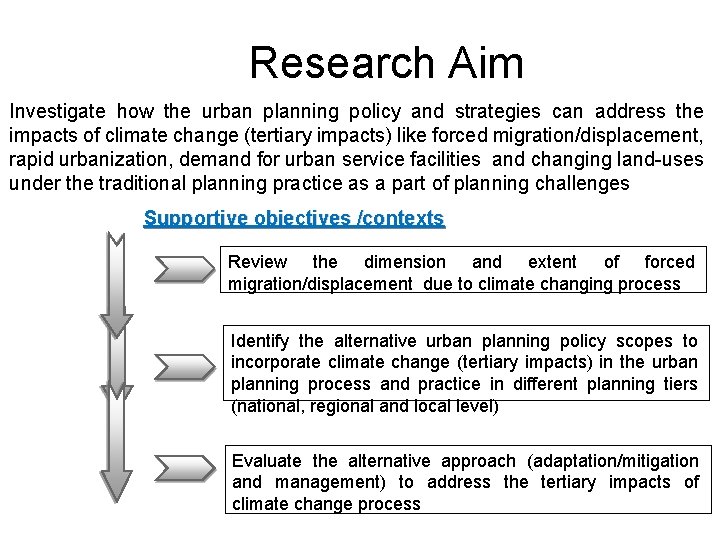
Research Aim Investigate how the urban planning policy and strategies can address the impacts of climate change (tertiary impacts) like forced migration/displacement, rapid urbanization, demand for urban service facilities and changing land-uses under the traditional planning practice as a part of planning challenges Supportive objectives /contexts Review the dimension and extent of forced migration/displacement due to climate changing process Identify the alternative urban planning policy scopes to incorporate climate change (tertiary impacts) in the urban planning process and practice in different planning tiers (national, regional and local level) Evaluate the alternative approach (adaptation/mitigation and management) to address the tertiary impacts of climate change process
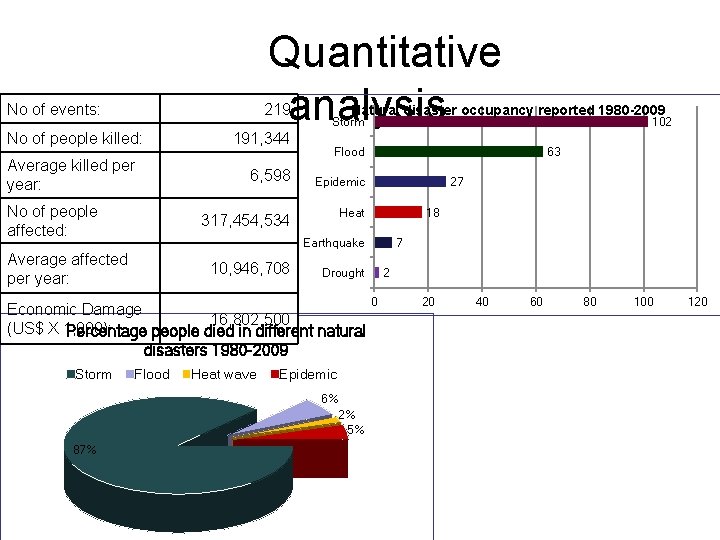
Quantitative analysis. . . No of events: 219 No of people killed: Average killed per year: No of people affected: 191, 344 6, 598 Natural disaster occupancy reported 1980 -2009 Storm Flood 18 7 Earthquake 10, 946, 708 Drought Flood Heat wave Epidemic 6% 2% 5% 87% 27 Heat Economic Damage 16, 802, 500 (US$ X 1, 000): Percentage people died in different natural disasters 1980 -2009 Storm 63 Epidemic 317, 454, 534 Average affected per year: 102 2 0 20 40 60 80 100 120
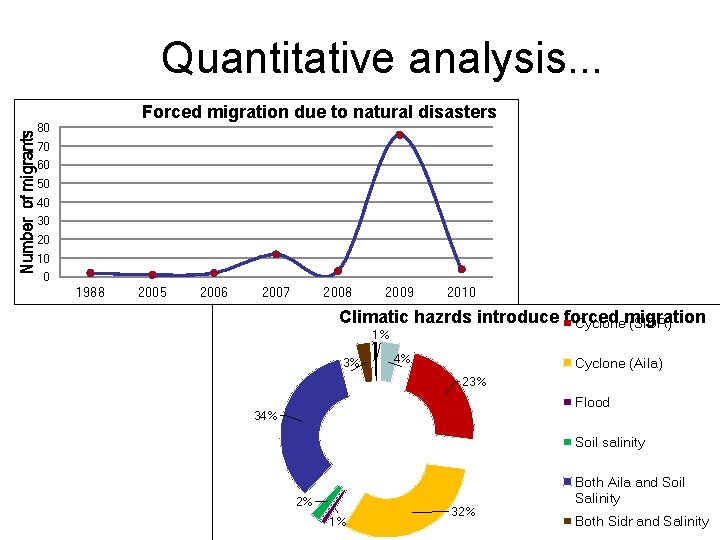
Number of migrants Quantitative analysis. . . Forced migration due to natural disasters 80 70 60 50 40 30 20 10 0 1988 2005 2006 2007 2008 2009 2010 River erosion Climatic hazrds introduce forced Cyclonemigration (SIDR) 1% 3% 4% Cyclone (Aila) 23% Flood 34% Soil salinity 2% 1% 32% Both Aila and Soil Salinity Both Sidr and Salinity
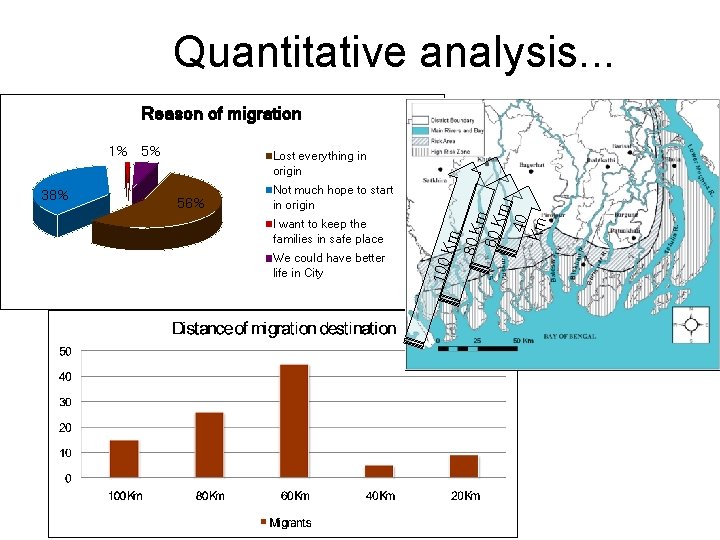
Quantitative analysis. . . Reason of migration 1% 5% Not much hope to start in origin I want to keep the families in safe place We could have better life in City Km 80 K m 60 K m 40 Km 56% 100 38% Lost everything in origin