
Quantitative Literacy Thinking Between the Lines Crauder Evans
Quantitative Literacy: Thinking Between the Lines Crauder, Evans, Johnson, Noell Chapter 4: Personal Finance © 2011 W. H. Freeman and Company 1
Chapter 4: Personal Finance Lesson Plan � Saving money: The power of compounding � Borrowing: How much car can you afford? � Savings for the long term: Build that nest egg � Credit cards: Paying off consumer debt � Inflation, taxes, and stocks: Managing your money 2
Chapter 4 Personal Finance 4. 1 Saving money: The power of compounding Learning Objectives: �Use the simple interest and compound interest formulas �Compute Annual Percentage Yield (APY) �Understand calculate the Present value and the Future value �Compute the exact doubling time �Estimate the doubling time using the Rule of 72 3
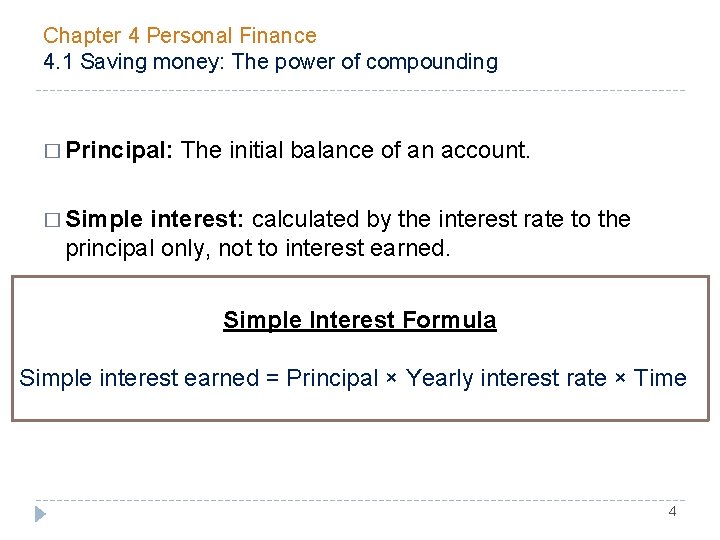
Chapter 4 Personal Finance 4. 1 Saving money: The power of compounding � Principal: The initial balance of an account. � Simple interest: calculated by the interest rate to the principal only, not to interest earned. Simple Interest Formula Simple interest earned = Principal × Yearly interest rate × Time 4
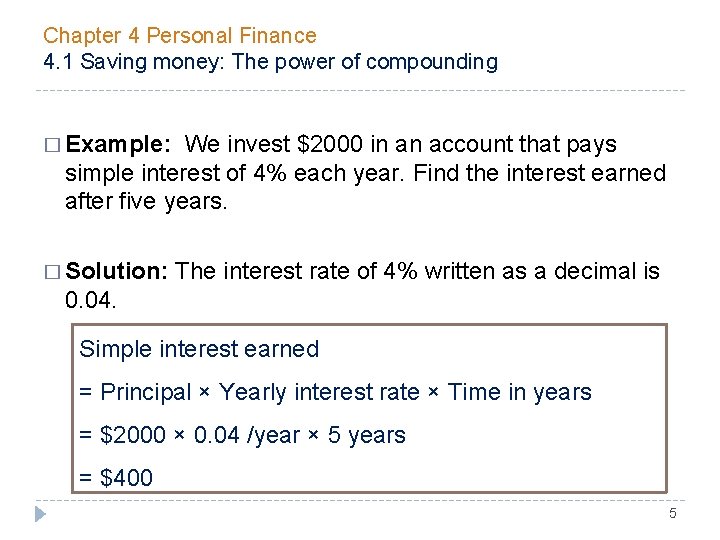
Chapter 4 Personal Finance 4. 1 Saving money: The power of compounding � Example: We invest $2000 in an account that pays simple interest of 4% each year. Find the interest earned after five years. � Solution: The interest rate of 4% written as a decimal is 0. 04. Simple interest earned = Principal × Yearly interest rate × Time in years = $2000 × 0. 04 /year × 5 years = $400 5
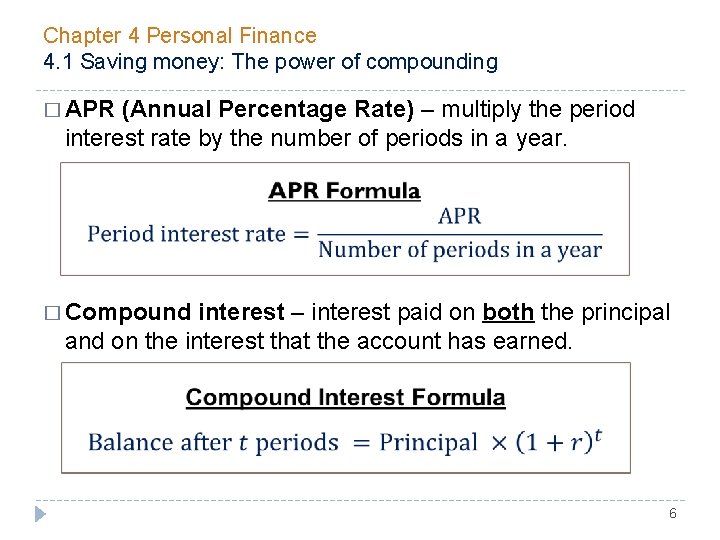
Chapter 4 Personal Finance 4. 1 Saving money: The power of compounding � APR (Annual Percentage Rate) – multiply the period interest rate by the number of periods in a year. � Compound interest – interest paid on both the principal and on the interest that the account has earned. 6
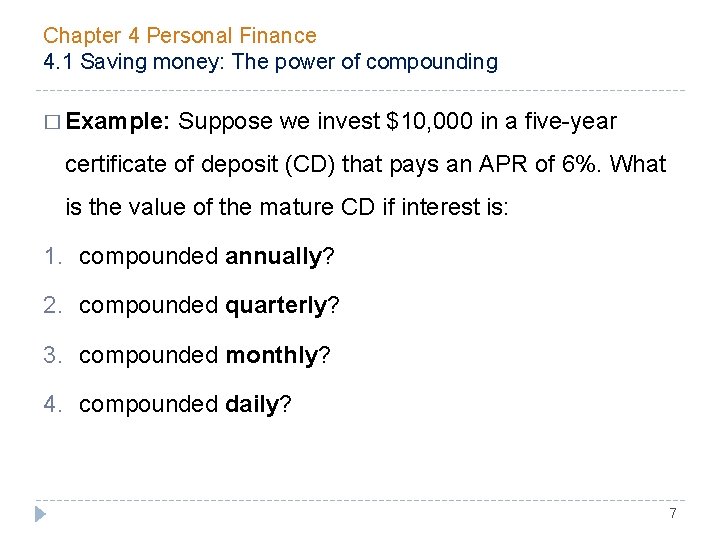
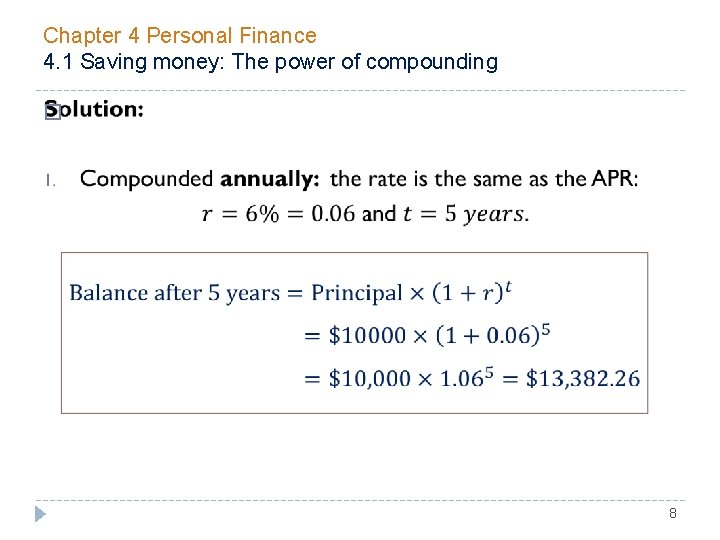
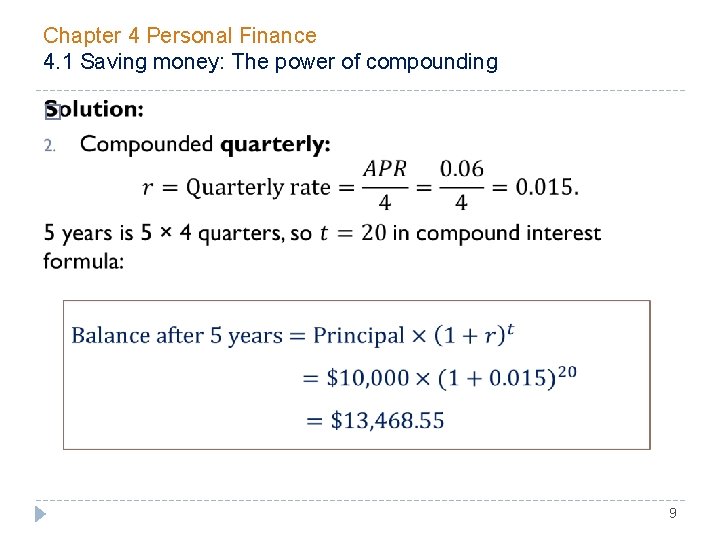
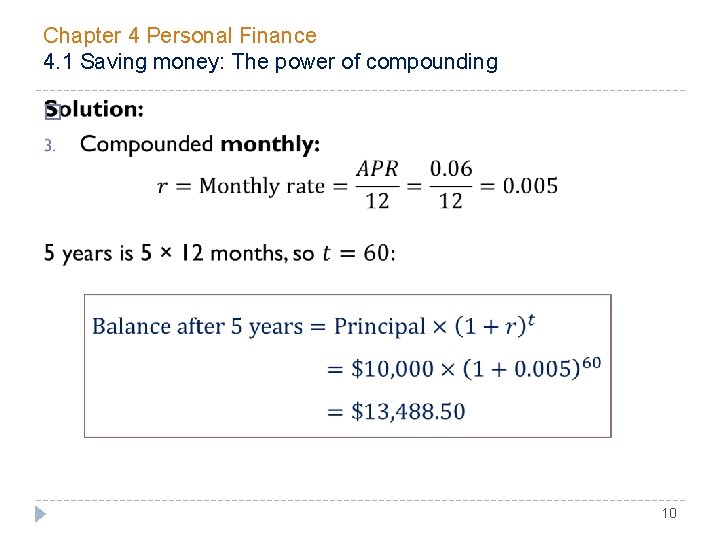
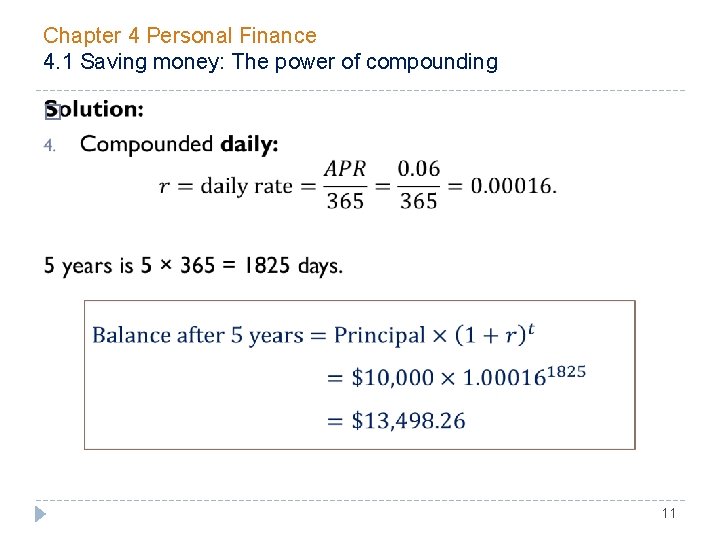
Chapter 4 Personal Finance 4. 1 Saving money: The power of compounding � Example: Suppose we invest $10, 000 in a five-year certificate of deposit (CD) that pays an APR of 6%. What is the value of the mature CD if interest is: 1. compounded annually? 2. compounded quarterly? 3. compounded monthly? 4. compounded daily? 7
Chapter 4 Personal Finance 4. 1 Saving money: The power of compounding � 8
Chapter 4 Personal Finance 4. 1 Saving money: The power of compounding � 9
Chapter 4 Personal Finance 4. 1 Saving money: The power of compounding � 10
Chapter 4 Personal Finance 4. 1 Saving money: The power of compounding � 11
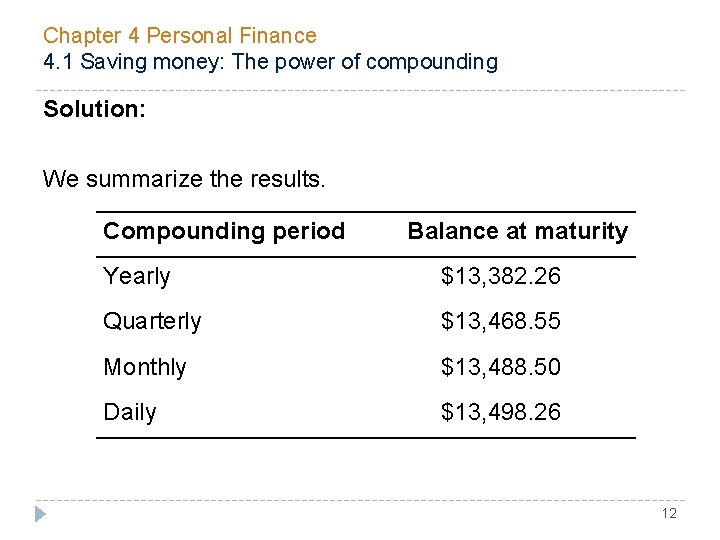
Chapter 4 Personal Finance 4. 1 Saving money: The power of compounding Solution: We summarize the results. Compounding period Balance at maturity Yearly $13, 382. 26 Quarterly $13, 468. 55 Monthly $13, 488. 50 Daily $13, 498. 26 12
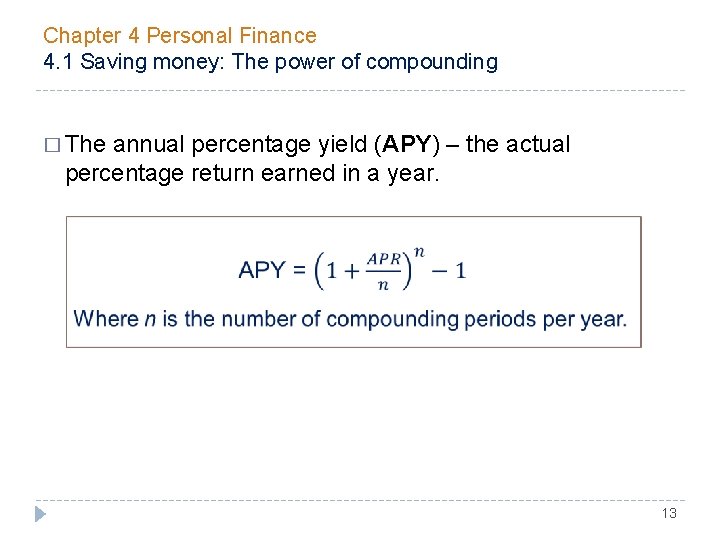
Chapter 4 Personal Finance 4. 1 Saving money: The power of compounding � The annual percentage yield (APY) – the actual percentage return earned in a year. 13
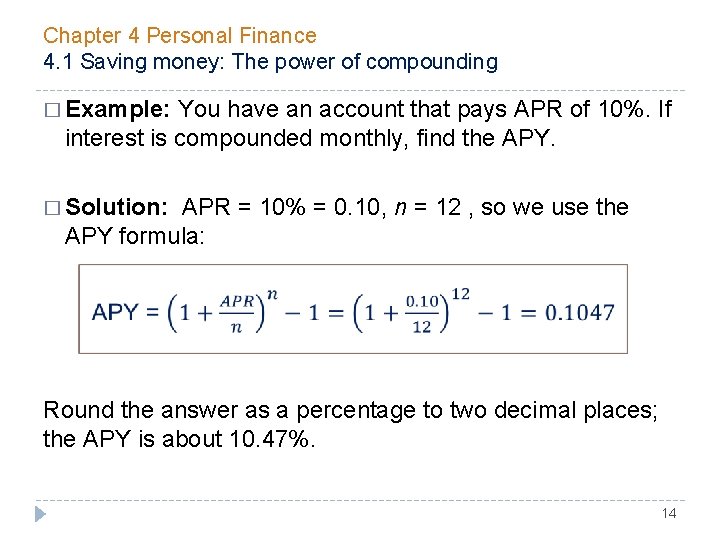
Chapter 4 Personal Finance 4. 1 Saving money: The power of compounding � Example: You have an account that pays APR of 10%. If interest is compounded monthly, find the APY. � Solution: APR = 10% = 0. 10, n = 12 , so we use the APY formula: Round the answer as a percentage to two decimal places; the APY is about 10. 47%. 14
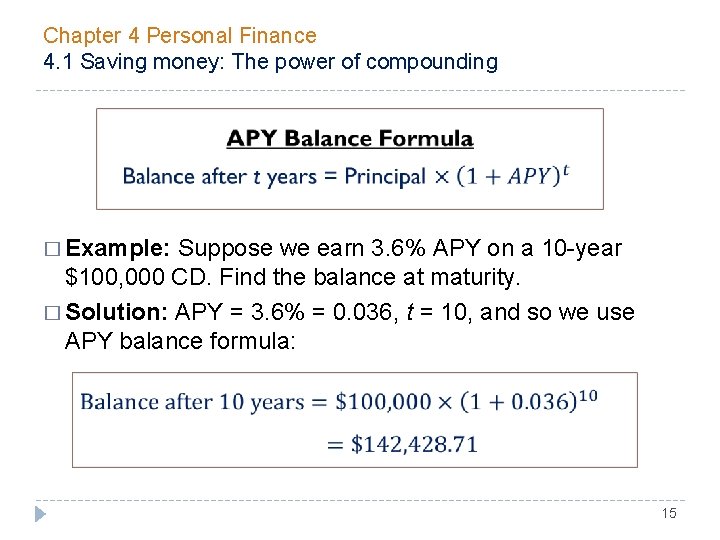
Chapter 4 Personal Finance 4. 1 Saving money: The power of compounding � Example: Suppose we earn 3. 6% APY on a 10 -year $100, 000 CD. Find the balance at maturity. � Solution: APY = 3. 6% = 0. 036, t = 10, and so we use APY balance formula: 15
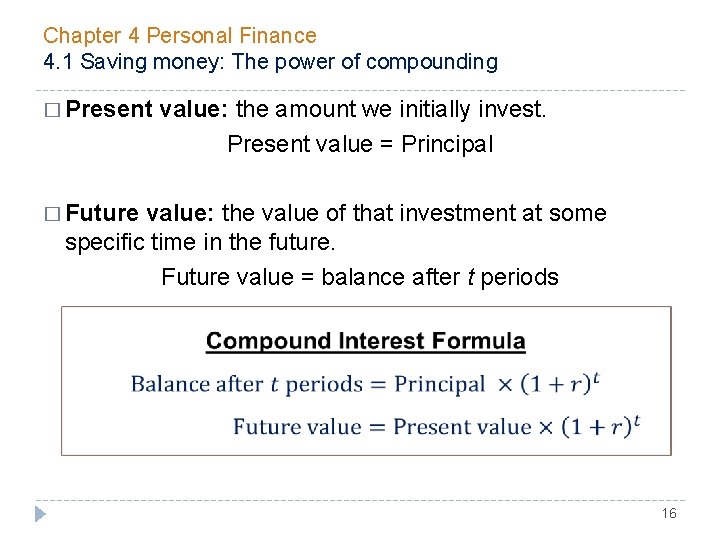
Chapter 4 Personal Finance 4. 1 Saving money: The power of compounding � Present value: the amount we initially invest. Present value = Principal � Future value: the value of that investment at some specific time in the future. Future value = balance after t periods 16
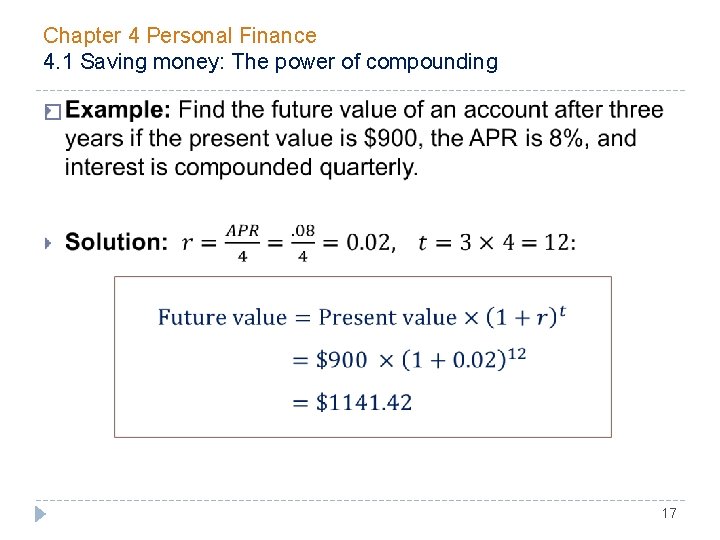
Chapter 4 Personal Finance 4. 1 Saving money: The power of compounding � 17
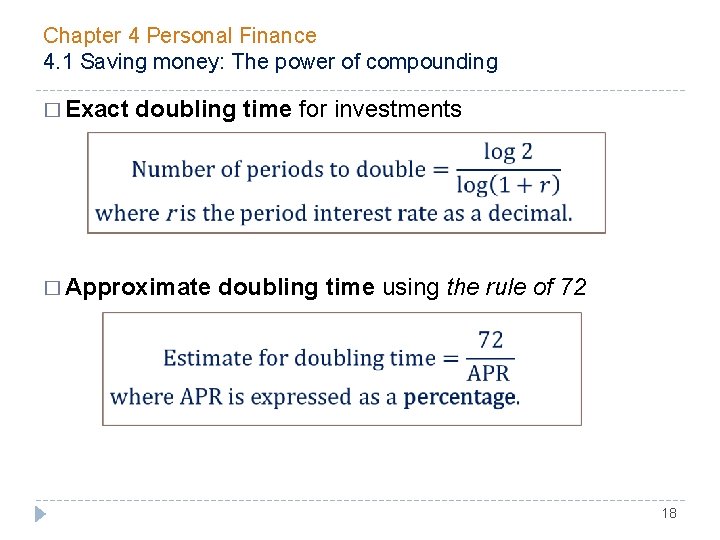
Chapter 4 Personal Finance 4. 1 Saving money: The power of compounding � Exact doubling time for investments � Approximate doubling time using the rule of 72 18
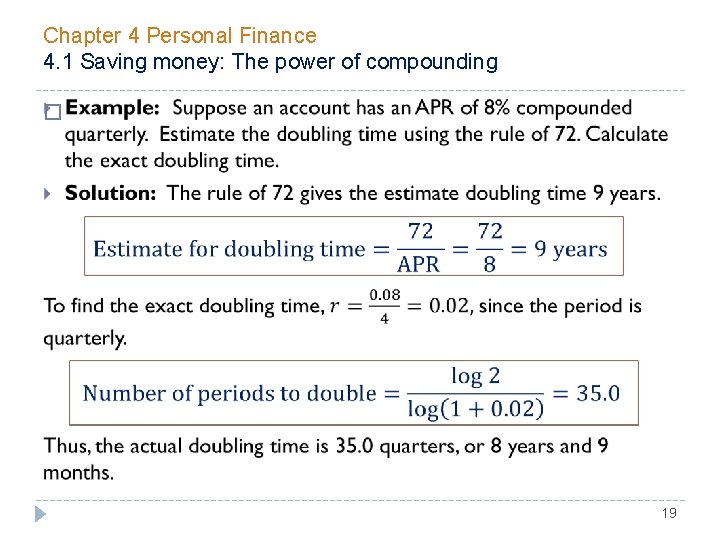
Chapter 4 Personal Finance 4. 1 Saving money: The power of compounding � 19
Chapter 4 Personal Finance 4. 2 Borrowing: How much car can you afford? Learning Objectives: �Understand installment loans �Calculate Monthly payment of a fixed loan �Calculate amount borrowed �Understand Amortization table and equity �Understand mortgage options: fixed-rate mortgage vs. Adjustable-rate mortgage �Compute the monthly payment for a mortgage 20
Chapter 4 Personal Finance 4. 2 Borrowing: How much car can you afford? � With an installment loan you borrow money for a fixed period of time, called the term of the loan, and you make regular payments (usually monthly) to pay off the loan plus interest accumulated during that time. � The amount of payment depends on three things: 1. the amount of money we borrow (the principal) 2. the interest rate (or APR) 3. the term of the loan 21
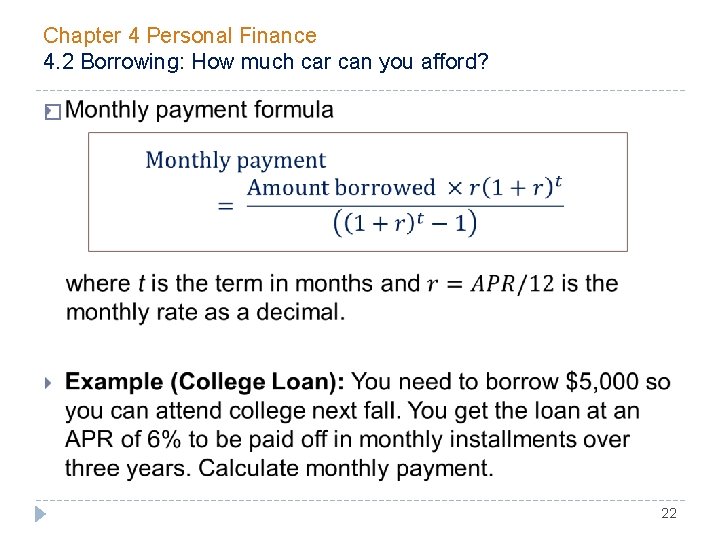
Chapter 4 Personal Finance 4. 2 Borrowing: How much car can you afford? � 22
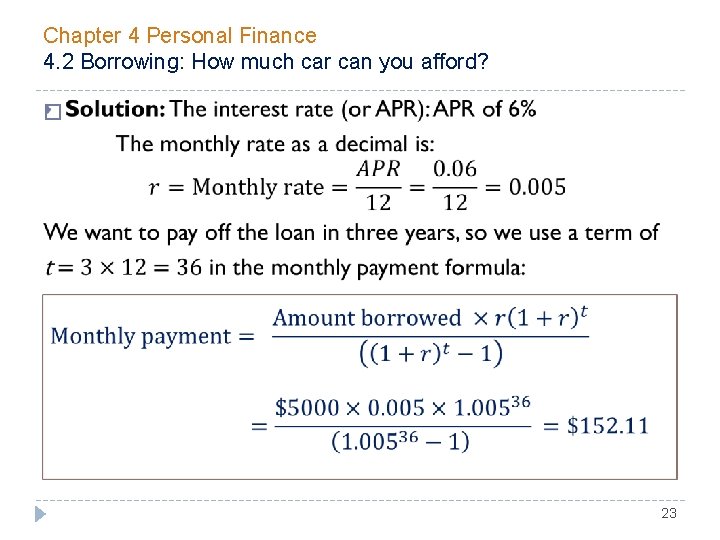
Chapter 4 Personal Finance 4. 2 Borrowing: How much car can you afford? � 23
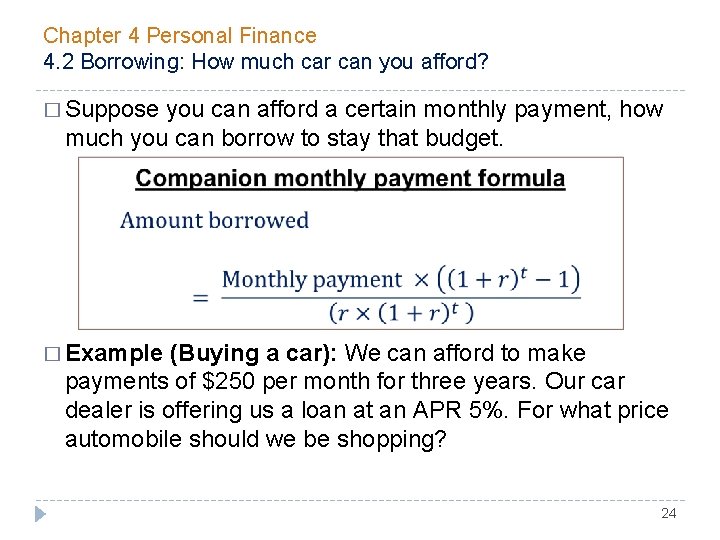
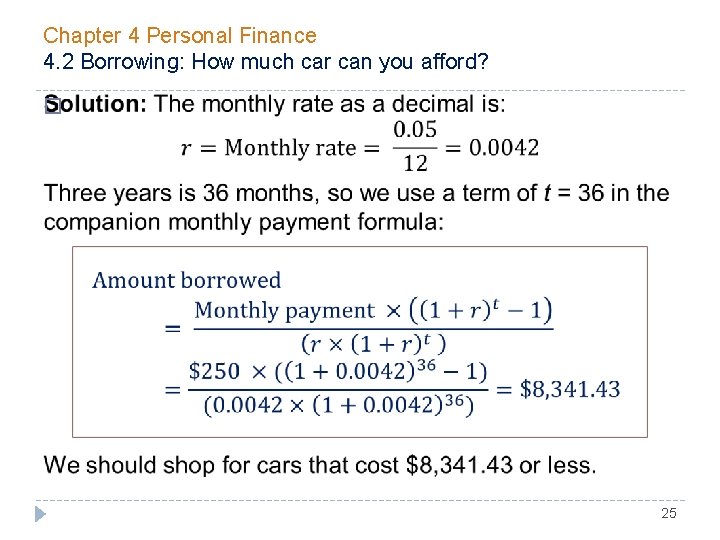
Chapter 4 Personal Finance 4. 2 Borrowing: How much car can you afford? � Suppose you can afford a certain monthly payment, how much you can borrow to stay that budget. � Example (Buying a car): We can afford to make payments of $250 per month for three years. Our car dealer is offering us a loan at an APR 5%. For what price automobile should we be shopping? 24
Chapter 4 Personal Finance 4. 2 Borrowing: How much car can you afford? � 25
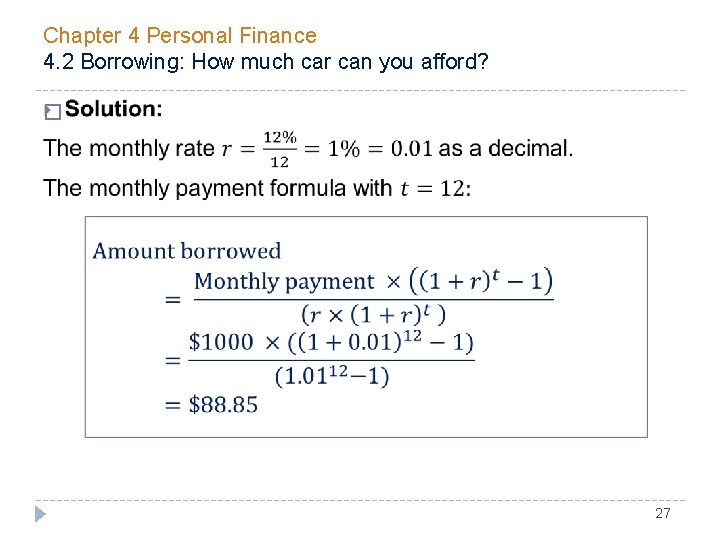
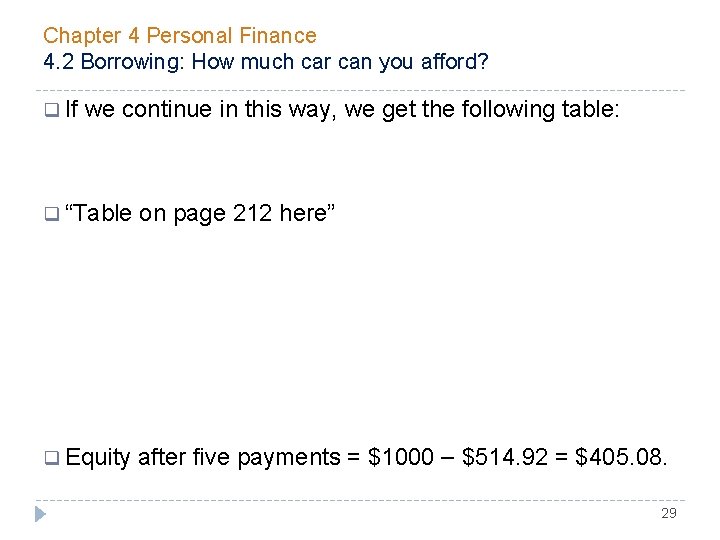
Chapter 4 Personal Finance 4. 2 Borrowing: How much car can you afford? � Amortization table (schedule): shows for each payment made the amount applied to interest, the amount applied to the balance owed, and the outstanding balance. � If you borrow money to pay for an item, your equity in that item at a given time is the part of the principal you have paid. � Example: Suppose you borrow $1, 000 at 12% APR to buy a computer. We pay off the loan in 12 monthly payments. Make an amortization table showing payments over the first five months. What is your equity in the computer after five payments? 26
Chapter 4 Personal Finance 4. 2 Borrowing: How much car can you afford? � 27
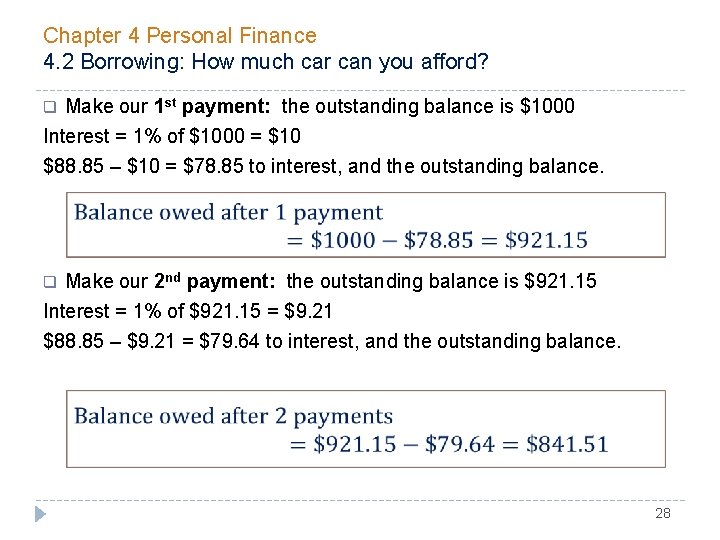
Chapter 4 Personal Finance 4. 2 Borrowing: How much car can you afford? Make our 1 st payment: the outstanding balance is $1000 Interest = 1% of $1000 = $10 q $88. 85 – $10 = $78. 85 to interest, and the outstanding balance. Make our 2 nd payment: the outstanding balance is $921. 15 Interest = 1% of $921. 15 = $9. 21 $88. 85 – $9. 21 = $79. 64 to interest, and the outstanding balance. q 28
Chapter 4 Personal Finance 4. 2 Borrowing: How much car can you afford? q If we continue in this way, we get the following table: q “Table on page 212 here” q Equity after five payments = $1000 $514. 92 = $405. 08. 29
Chapter 4 Personal Finance 4. 2 Borrowing: How much car can you afford? � 30
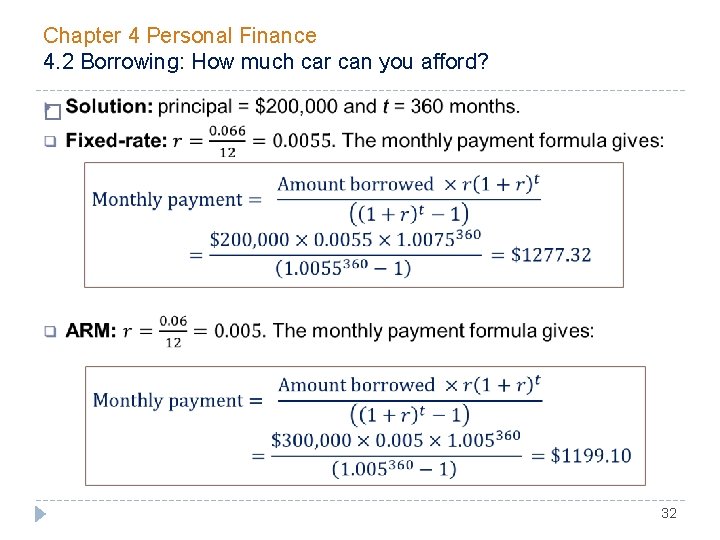
Chapter 4 Personal Finance 4. 2 Borrowing: How much car can you afford? � Fixed-rate mortgage: keeps the same interest rate over the life of the loan. � Adjustable-rate mortgage (ARM): the interest may vary over the life of the loan. � Example (comparing monthly payment): Fixed-rate mortgage and ARM. We want to borrow $200, 000 for a 30 -year home mortgage. We have found an APR of 6. 6% for a fixed-rate mortgage and an APR of 6% for an ARM. Compare the initial monthly payments for these loans. 31
Chapter 4 Personal Finance 4. 2 Borrowing: How much car can you afford? � 32
Chapter 4 Personal Finance 4. 3 Saving for the long term: Build that nest egg Learning Objectives: �Calculate a balance after t deposits �Calculate needed deposit to achieve a financial goal �Determine the value of nest eggs (an annuity) �Determine a monthly annuity yield �Determine an annuity yield goal (the nest egg needed) 33
Chapter 4 Personal Finance 4. 3 Saving for the long term: Build that nest egg � 34
Chapter 4 Personal Finance 4. 3 Saving for the long term: Build that nest egg � The following table shows the growth of this account through 10 months. � Table 4. 2(page 224) here 35
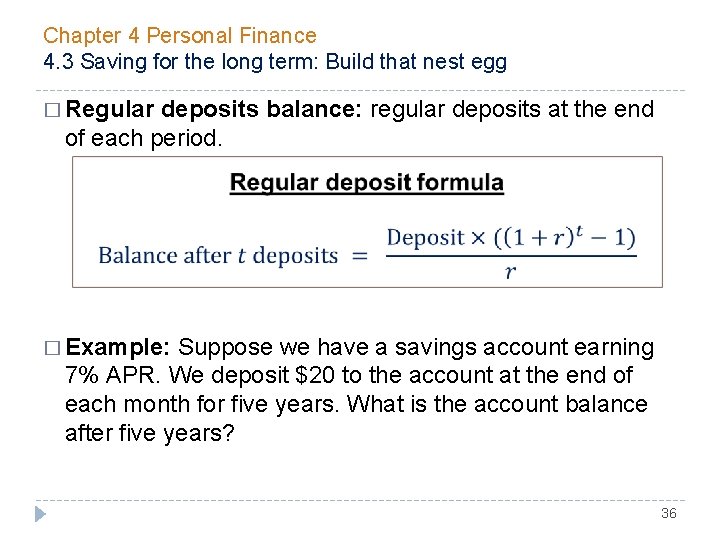
Chapter 4 Personal Finance 4. 3 Saving for the long term: Build that nest egg � Regular deposits balance: regular deposits at the end of each period. � Example: Suppose we have a savings account earning 7% APR. We deposit $20 to the account at the end of each month for five years. What is the account balance after five years? 36
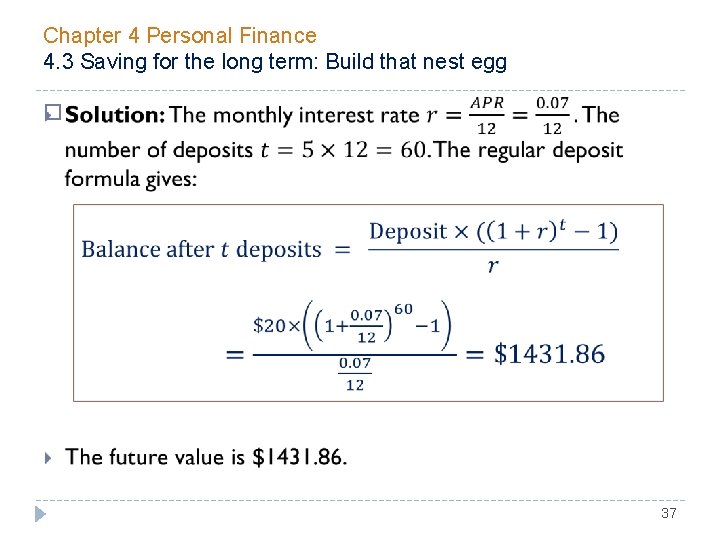
Chapter 4 Personal Finance 4. 3 Saving for the long term: Build that nest egg � 37
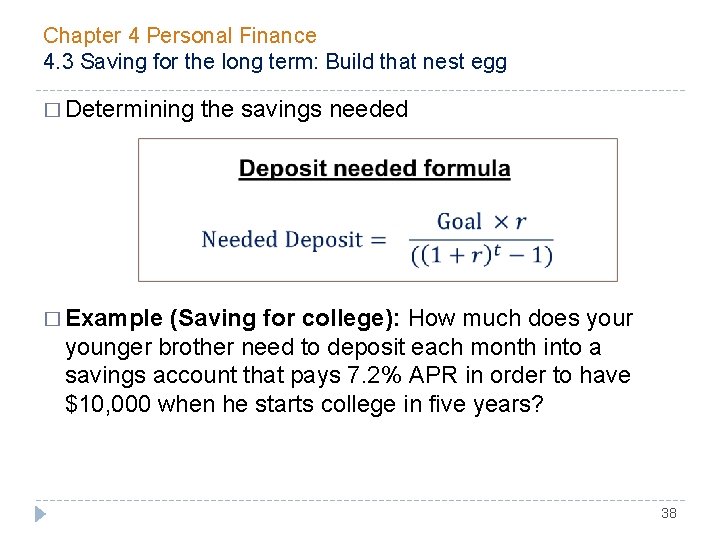
Chapter 4 Personal Finance 4. 3 Saving for the long term: Build that nest egg � Determining the savings needed � Example (Saving for college): How much does your younger brother need to deposit each month into a savings account that pays 7. 2% APR in order to have $10, 000 when he starts college in five years? 38
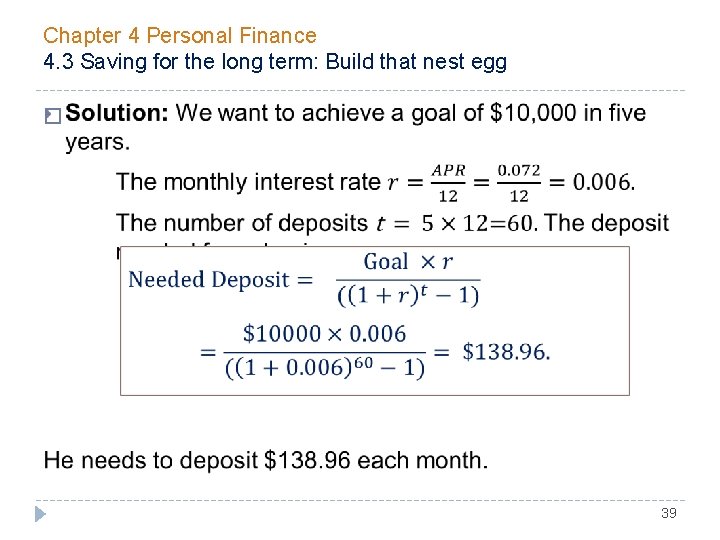
Chapter 4 Personal Finance 4. 3 Saving for the long term: Build that nest egg � 39
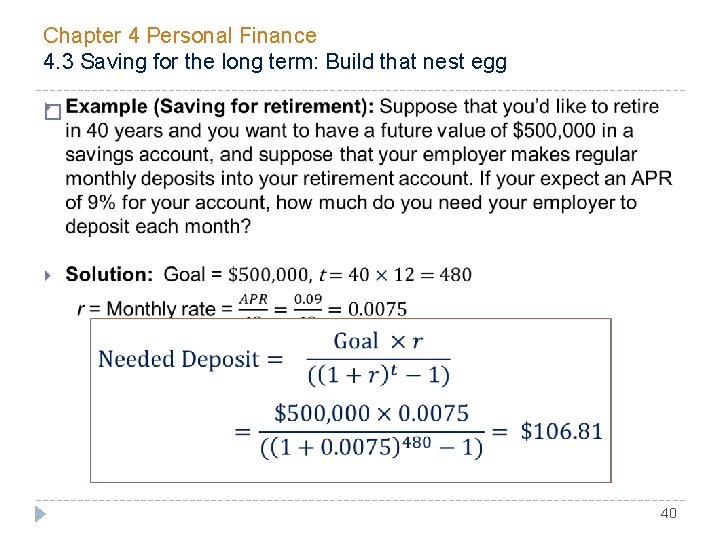
Chapter 4 Personal Finance 4. 3 Saving for the long term: Build that nest egg � 40
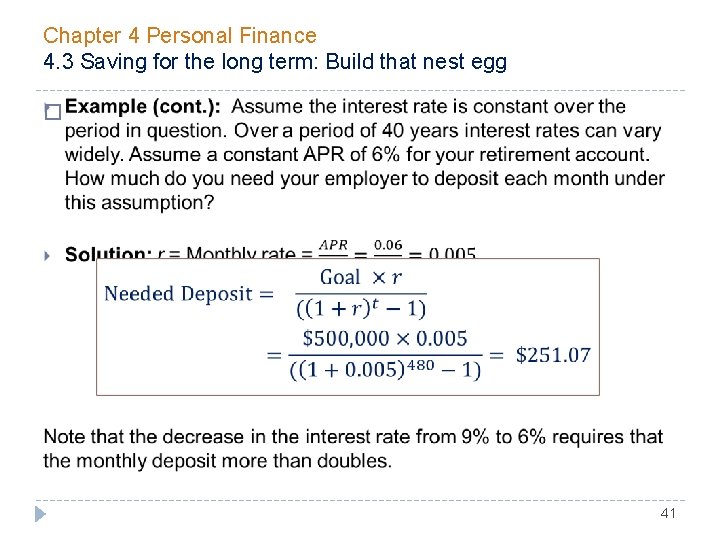
Chapter 4 Personal Finance 4. 3 Saving for the long term: Build that nest egg � 41
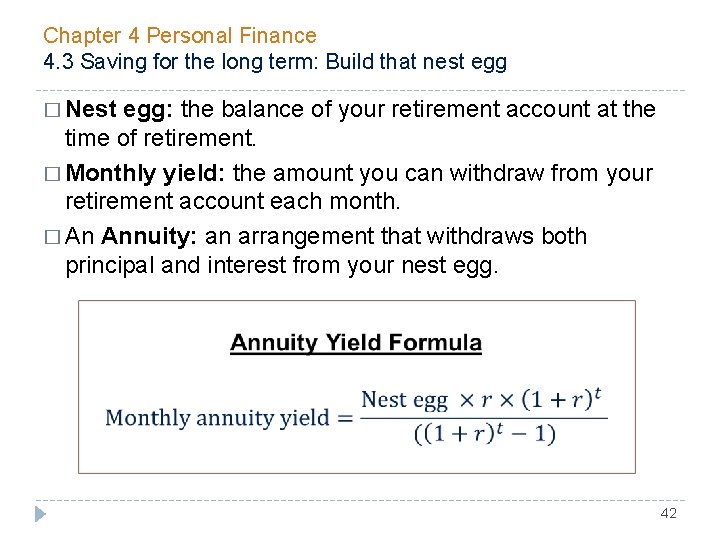
Chapter 4 Personal Finance 4. 3 Saving for the long term: Build that nest egg � Nest egg: the balance of your retirement account at the time of retirement. � Monthly yield: the amount you can withdraw from your retirement account each month. � An Annuity: an arrangement that withdraws both principal and interest from your nest egg. 42
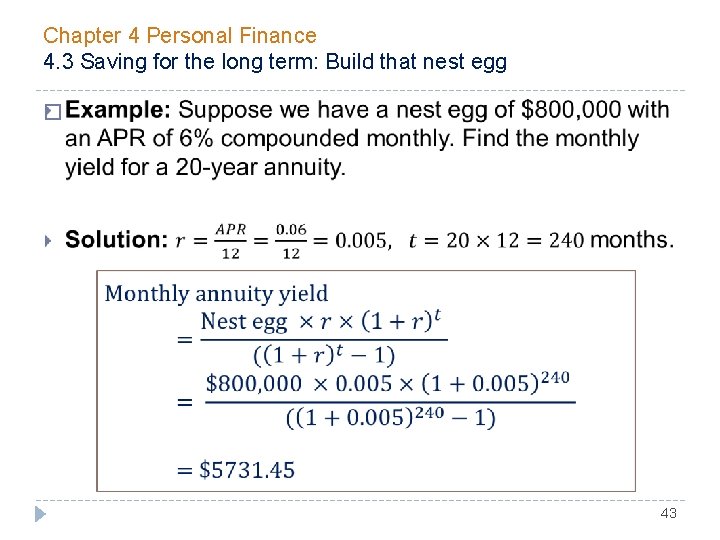
Chapter 4 Personal Finance 4. 3 Saving for the long term: Build that nest egg � 43
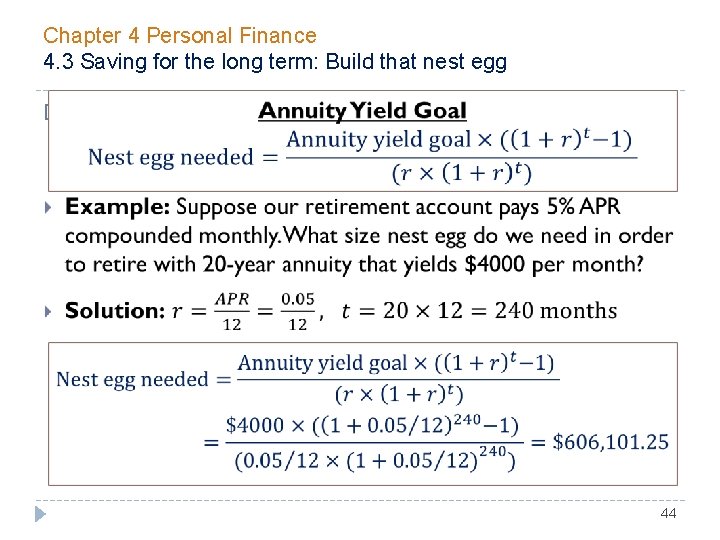
Chapter 4 Personal Finance 4. 3 Saving for the long term: Build that nest egg � 44
Chapter 4 Personal Finance 4. 4 Credit cards: Paying off consumer debt Learning Objectives: �Understand credit cards �Determine an amount subject to finance charges �Determine the minimum payment balance formula to find a balance after t minimum payments 45
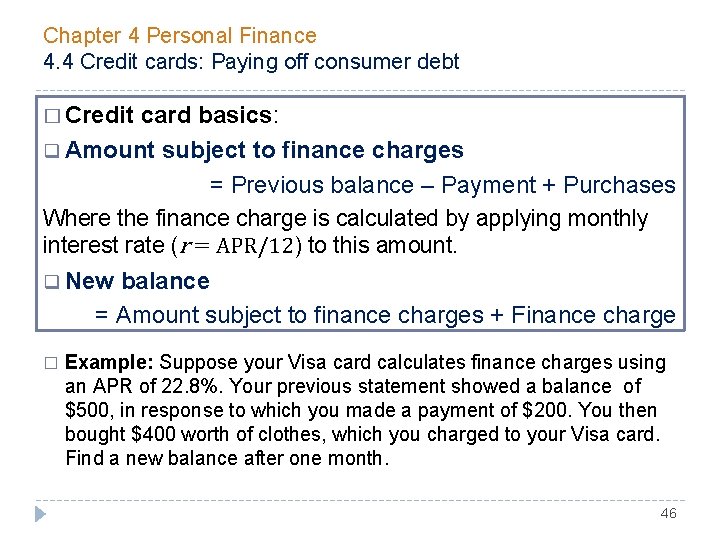
Chapter 4 Personal Finance 4. 4 Credit cards: Paying off consumer debt � Credit card basics: q Amount subject to finance charges = Previous balance – Payment + Purchases Where the finance charge is calculated by applying monthly interest rate (r = APR/12) to this amount. q New balance = Amount subject to finance charges + Finance charge � Example: Suppose your Visa card calculates finance charges using an APR of 22. 8%. Your previous statement showed a balance of $500, in response to which you made a payment of $200. You then bought $400 worth of clothes, which you charged to your Visa card. Find a new balance after one month. 46
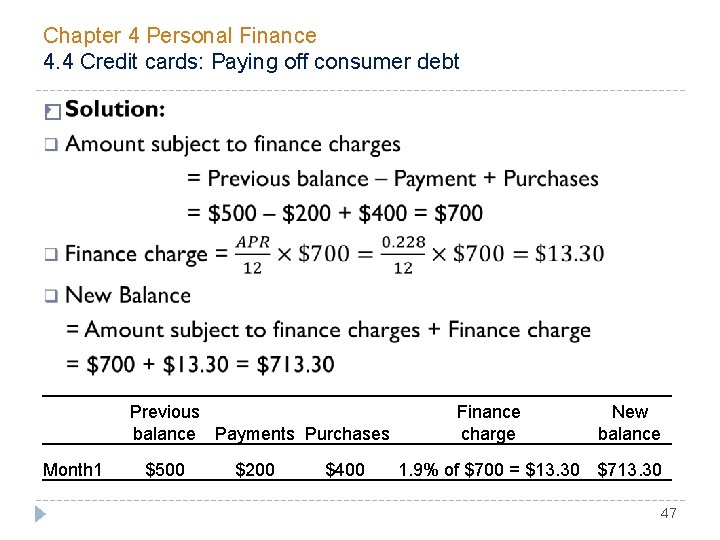
Chapter 4 Personal Finance 4. 4 Credit cards: Paying off consumer debt � Previous balance Payments Purchases Month 1 $500 $200 $400 Finance charge New balance 1. 9% of $700 = $13. 30 $713. 30 47
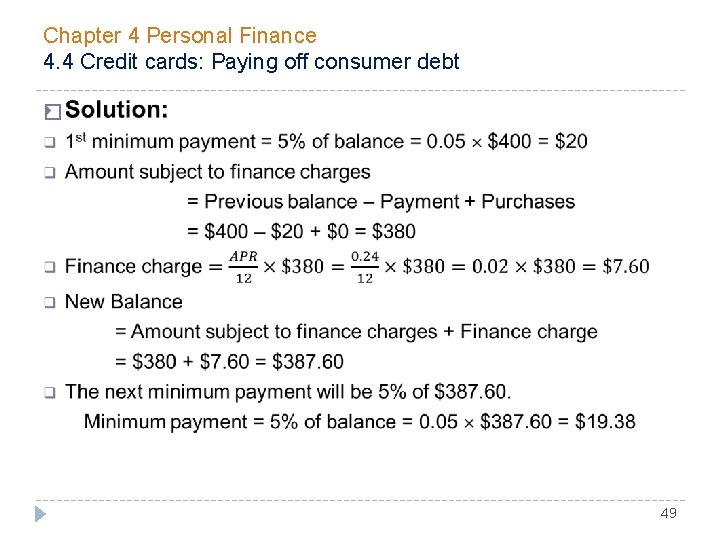
Chapter 4 Personal Finance 4. 4 Credit cards: Paying off consumer debt � Example: We have a card with an APR of 24%. The minimum payment is 5% of the balance. Suppose we have a balance of $400 on the card. We decide to stop charging and to pay it off by making the minimum payment each month. Calculate the new balance after we have made our first minimum payment, and then calculate the minimum payment due for the next month. 48
Chapter 4 Personal Finance 4. 4 Credit cards: Paying off consumer debt � 49
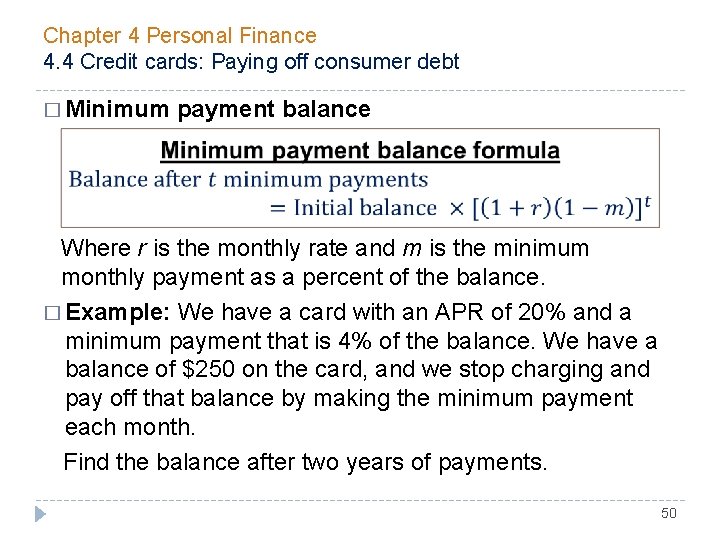
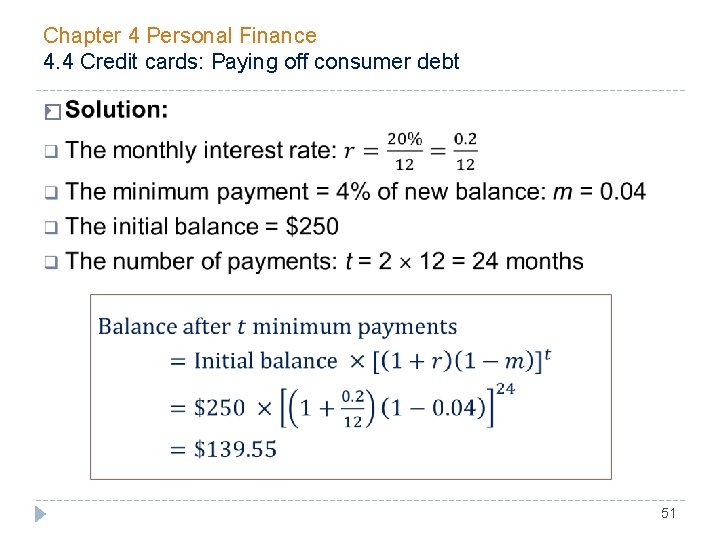
Chapter 4 Personal Finance 4. 4 Credit cards: Paying off consumer debt � Minimum payment balance Where r is the monthly rate and m is the minimum monthly payment as a percent of the balance. � Example: We have a card with an APR of 20% and a minimum payment that is 4% of the balance. We have a balance of $250 on the card, and we stop charging and pay off that balance by making the minimum payment each month. Find the balance after two years of payments. 50
Chapter 4 Personal Finance 4. 4 Credit cards: Paying off consumer debt � 51
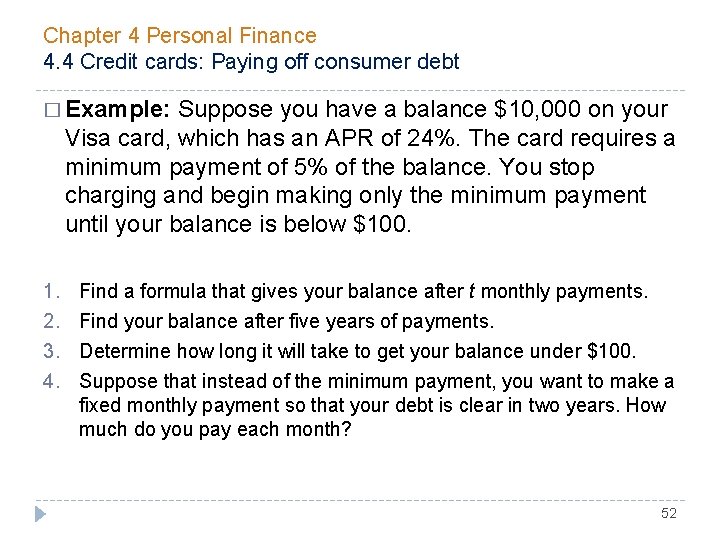
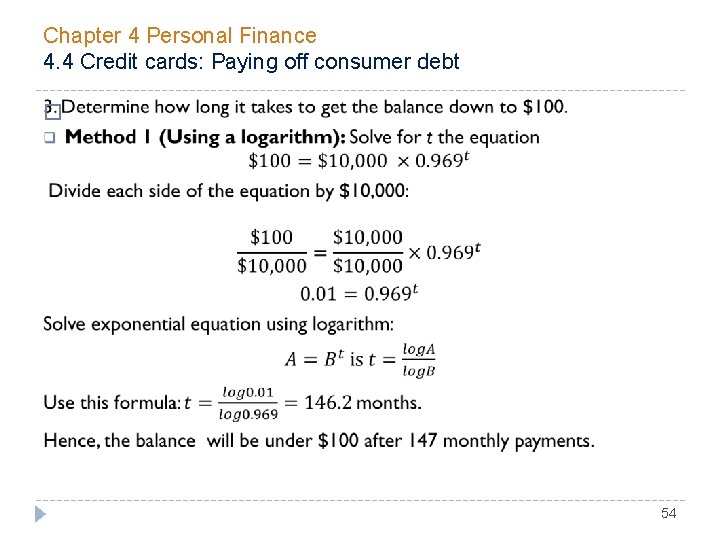
Chapter 4 Personal Finance 4. 4 Credit cards: Paying off consumer debt � Example: Suppose you have a balance $10, 000 on your Visa card, which has an APR of 24%. The card requires a minimum payment of 5% of the balance. You stop charging and begin making only the minimum payment until your balance is below $100. 1. 2. 3. 4. Find a formula that gives your balance after t monthly payments. Find your balance after five years of payments. Determine how long it will take to get your balance under $100. Suppose that instead of the minimum payment, you want to make a fixed monthly payment so that your debt is clear in two years. How much do you pay each month? 52
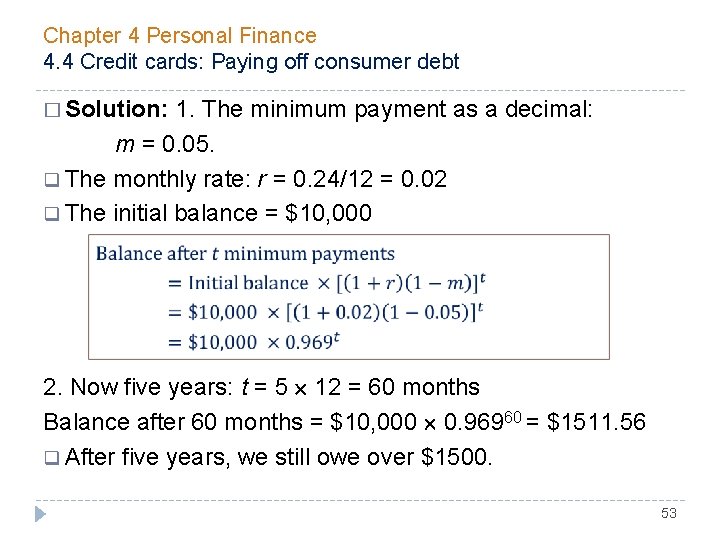
Chapter 4 Personal Finance 4. 4 Credit cards: Paying off consumer debt � Solution: 1. The minimum payment as a decimal: m = 0. 05. q The monthly rate: r = 0. 24/12 = 0. 02 q The initial balance = $10, 000 2. Now five years: t = 5 12 = 60 months Balance after 60 months = $10, 000 0. 96960 = $1511. 56 q After five years, we still owe over $1500. 53
Chapter 4 Personal Finance 4. 4 Credit cards: Paying off consumer debt � 54
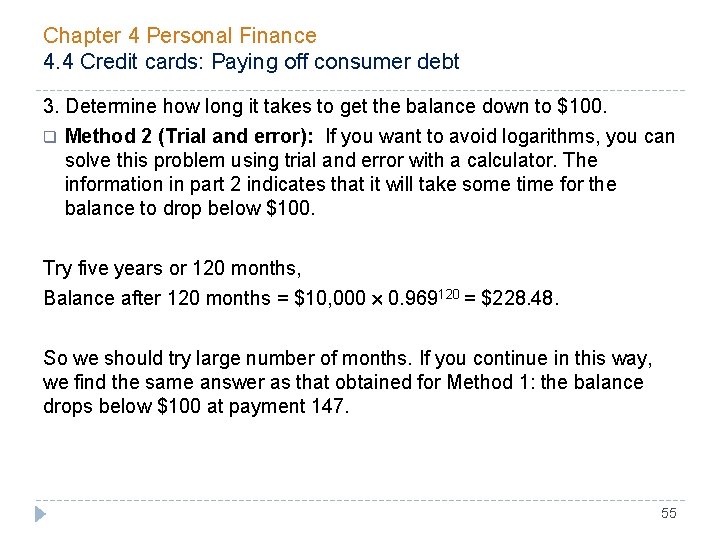
Chapter 4 Personal Finance 4. 4 Credit cards: Paying off consumer debt 3. Determine how long it takes to get the balance down to $100. q Method 2 (Trial and error): If you want to avoid logarithms, you can solve this problem using trial and error with a calculator. The information in part 2 indicates that it will take some time for the balance to drop below $100. Try five years or 120 months, Balance after 120 months = $10, 000 0. 969120 = $228. 48. So we should try large number of months. If you continue in this way, we find the same answer as that obtained for Method 1: the balance drops below $100 at payment 147. 55
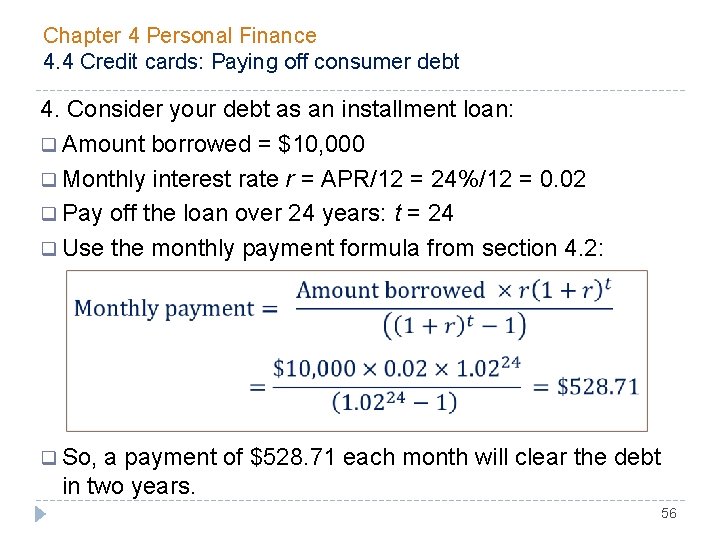
Chapter 4 Personal Finance 4. 4 Credit cards: Paying off consumer debt 4. Consider your debt as an installment loan: q Amount borrowed = $10, 000 q Monthly interest rate r = APR/12 = 24%/12 = 0. 02 q Pay off the loan over 24 years: t = 24 q Use the monthly payment formula from section 4. 2: q So, a payment of $528. 71 each month will clear the debt in two years. 56
Chapter 4 Personal Finance 4. 5 Inflation, taxes, and stocks: Managing your money Learning Objectives: �Understand Consumer Price Index (CPI), inflation, rate of inflation, and deflation �Determine the buying power formula and the inflation formula �Understand calculate taxes and stock price �Determine the Dow Jones Industrial Average (DJIA) changes 57
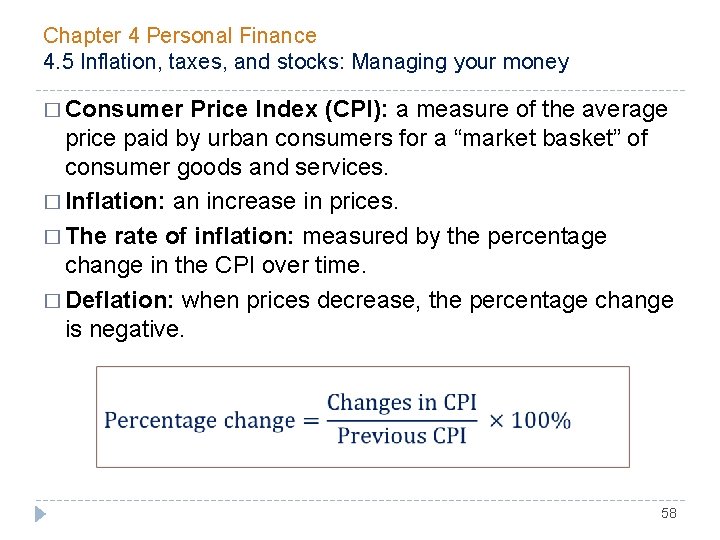
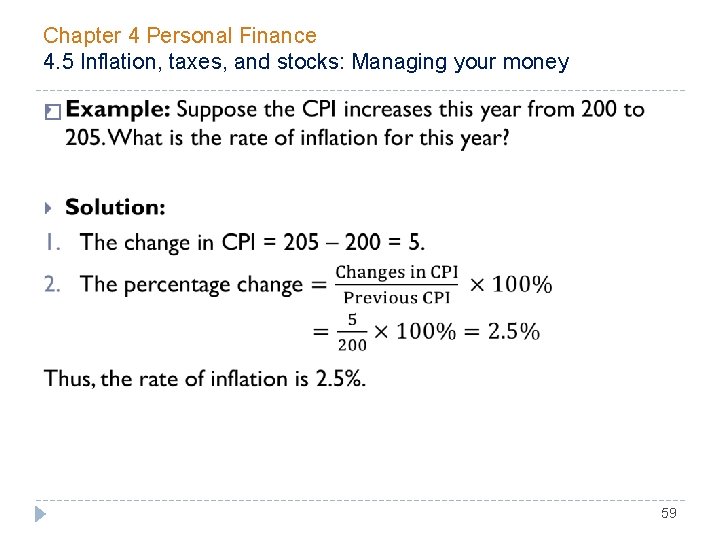
Chapter 4 Personal Finance 4. 5 Inflation, taxes, and stocks: Managing your money � Consumer Price Index (CPI): a measure of the average price paid by urban consumers for a “market basket” of consumer goods and services. � Inflation: an increase in prices. � The rate of inflation: measured by the percentage change in the CPI over time. � Deflation: when prices decrease, the percentage change is negative. 58
Chapter 4 Personal Finance 4. 5 Inflation, taxes, and stocks: Managing your money � 59
Chapter 4 Personal Finance 4. 5 Inflation, taxes, and stocks: Managing your money � 60
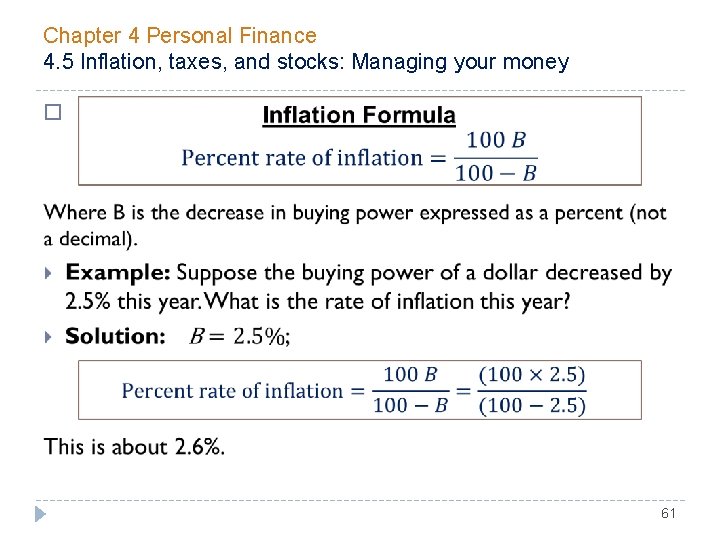
Chapter 4 Personal Finance 4. 5 Inflation, taxes, and stocks: Managing your money � 61
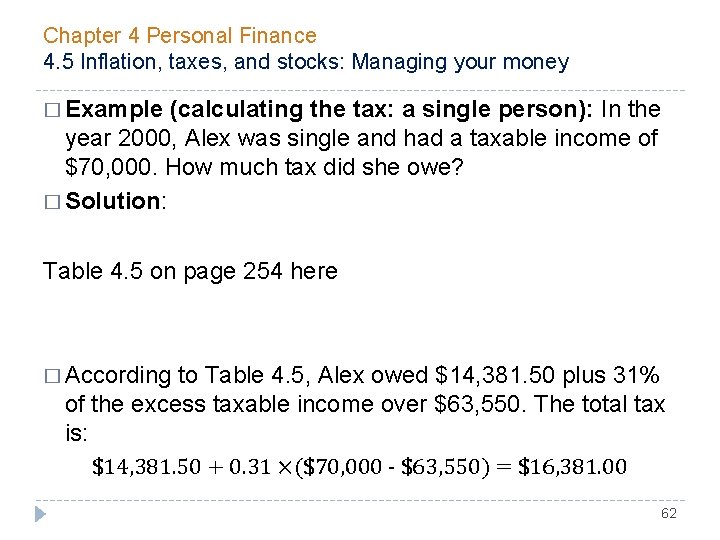
Chapter 4 Personal Finance 4. 5 Inflation, taxes, and stocks: Managing your money � Example (calculating the tax: a single person): In the year 2000, Alex was single and had a taxable income of $70, 000. How much tax did she owe? � Solution: Table 4. 5 on page 254 here � According to Table 4. 5, Alex owed $14, 381. 50 plus 31% of the excess taxable income over $63, 550. The total tax is: $14, 381. 50 + 0. 31 ×($70, 000 - $63, 550) = $16, 381. 00 62
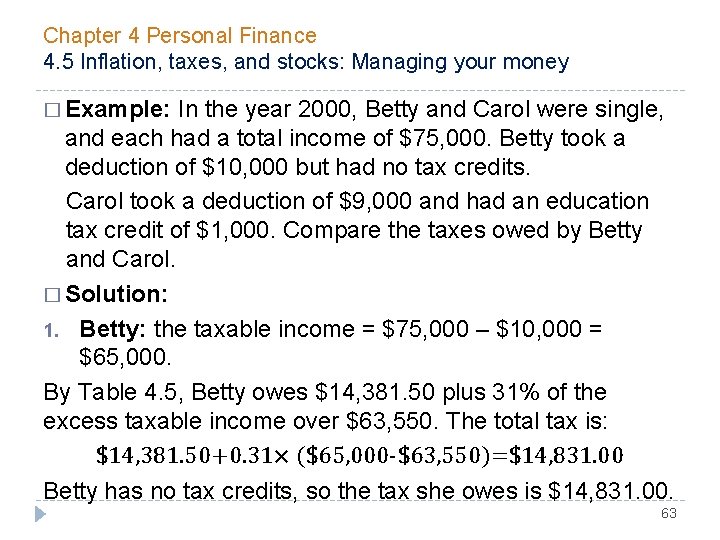
Chapter 4 Personal Finance 4. 5 Inflation, taxes, and stocks: Managing your money � Example: In the year 2000, Betty and Carol were single, and each had a total income of $75, 000. Betty took a deduction of $10, 000 but had no tax credits. Carol took a deduction of $9, 000 and had an education tax credit of $1, 000. Compare the taxes owed by Betty and Carol. � Solution: 1. Betty: the taxable income = $75, 000 – $10, 000 = $65, 000. By Table 4. 5, Betty owes $14, 381. 50 plus 31% of the excess taxable income over $63, 550. The total tax is: $14, 381. 50+0. 31× ($65, 000 -$63, 550)=$14, 831. 00 Betty has no tax credits, so the tax she owes is $14, 831. 00. 63
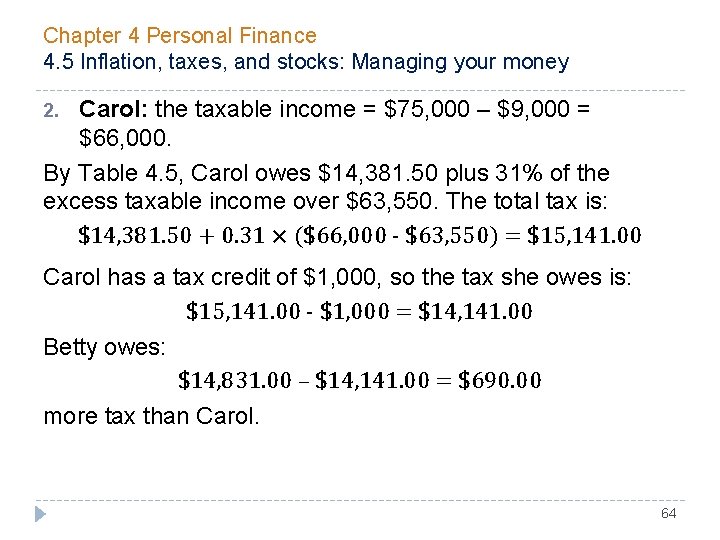
Chapter 4 Personal Finance 4. 5 Inflation, taxes, and stocks: Managing your money Carol: the taxable income = $75, 000 – $9, 000 = $66, 000. By Table 4. 5, Carol owes $14, 381. 50 plus 31% of the excess taxable income over $63, 550. The total tax is: $14, 381. 50 + 0. 31 × ($66, 000 - $63, 550) = $15, 141. 00 2. Carol has a tax credit of $1, 000, so the tax she owes is: $15, 141. 00 - $1, 000 = $14, 141. 00 Betty owes: $14, 831. 00 – $14, 141. 00 = $690. 00 more tax than Carol. 64
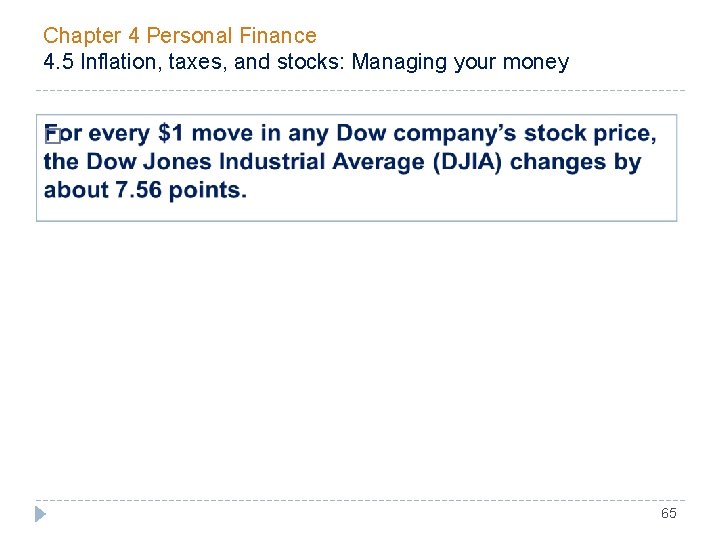
Chapter 4 Personal Finance 4. 5 Inflation, taxes, and stocks: Managing your money � 65
Chapter 4 Personal Finance: Chapter Summary �Savings: simple interest or compound interest � Formulas: simple interest earned period interest rate balance after t periods APY Present value or Future value Number of periods to double �Borrowing: an installment loan � Formulas: Monthly payment Amount borrowed � Fixed-rate mortgage vs. ARM 66
Chapter 4 Personal Finance: Chapter Summary �Saving for the long term: Build the nest egg (Annuity) � Formulas: Balance after t deposits Needed deposit Monthly annuity yield Nest egg needed �Credit cards � Formulas: Amount subject to finance charges Balance after t minimum payments �Inflation, taxes, and stocks � Understand CPI, taxes, DJIA 67
- Slides: 67