
Quantitative Energy Problems Units For Measuring Quantities of

Quantitative Energy Problems
Units For Measuring Quantities of Energy Joules (J) calories (cal) Calories (Cal) Kilocalories (kcal) 1 calorie = 4. 18 J 1 kcal = 1 Cal = 1000 cal
Heat of Fusion (Hf) For melting and freezing The amount of energy that needs to be transferred to melt 1 gram of a substance. Is different for different substances. Ex: Hf for water is 334 J/g
Heat of Vaporization (Hv) For vaporization, evaporation, or condensation The amount of energy that needs to be transferred to vaporize 1 g of a substance. Different Ex: for different substances. Hv for water is 2260 J/g
Heat Capacity (c) The amount of energy needed to raise the temperature of 1 g of a substance by 1 ⁰C. Different for different substances. Ex: The heat capacity for liquid water is 4. 18 J/ g ⁰C 4. 18 J of energy will have to be transferred to raise the temperature of 1 g of water by 1 ⁰C.
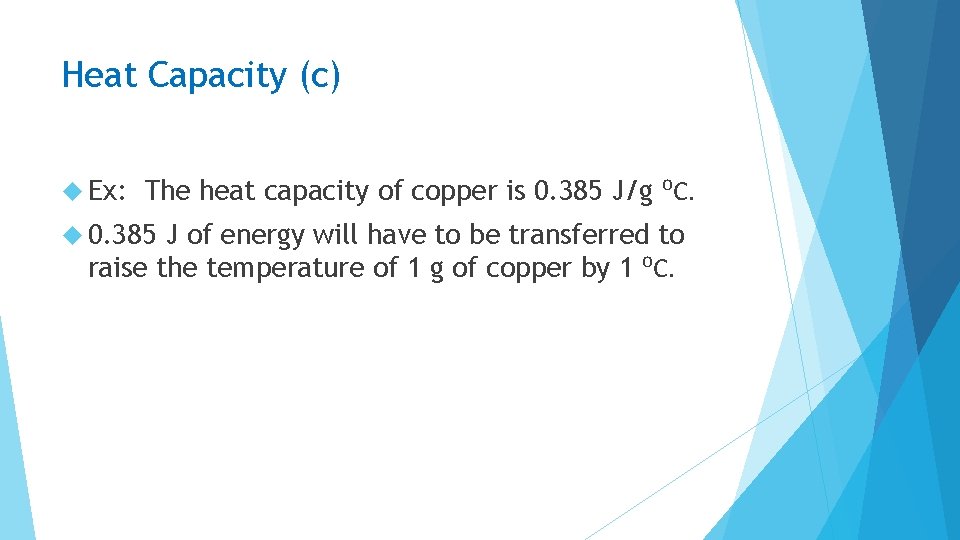
Heat Capacity (c) Ex: The heat capacity of copper is 0. 385 J/g ⁰C. 0. 385 J of energy will have to be transferred to raise the temperature of 1 g of copper by 1 ⁰C.
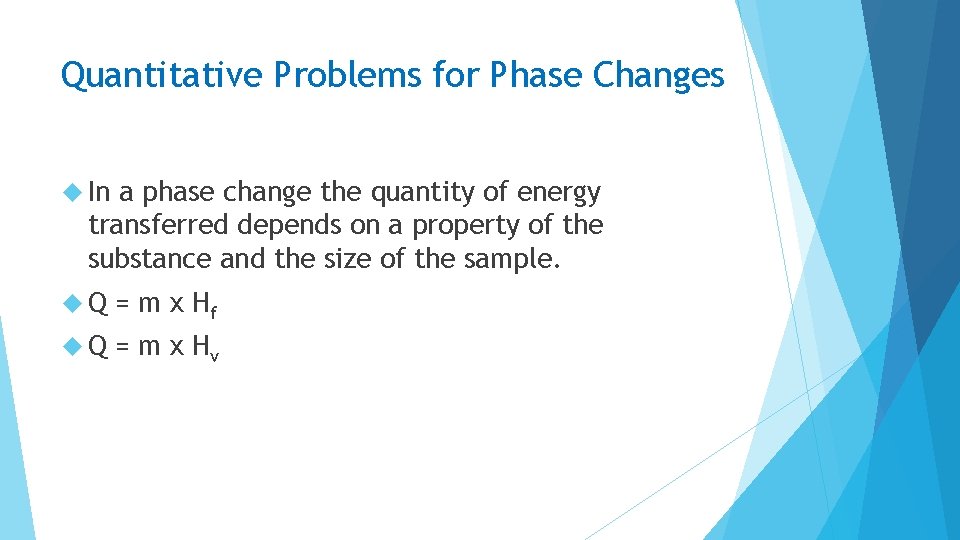
Quantitative Problems for Phase Changes In a phase change the quantity of energy transferred depends on a property of the substance and the size of the sample. Q = m x Hf Q = m x Hv
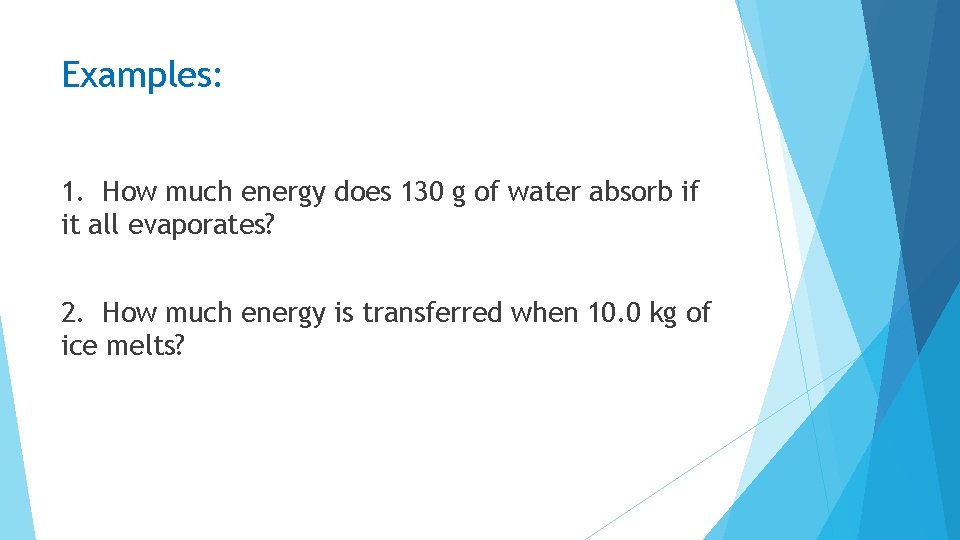
Examples: 1. How much energy does 130 g of water absorb if it all evaporates? 2. How much energy is transferred when 10. 0 kg of ice melts?
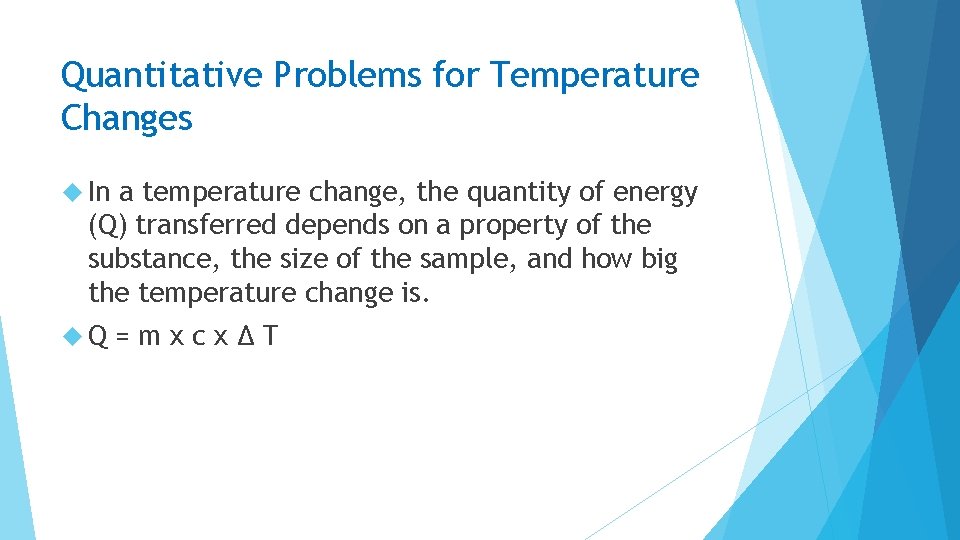
Quantitative Problems for Temperature Changes In a temperature change, the quantity of energy (Q) transferred depends on a property of the substance, the size of the sample, and how big the temperature change is. Q =mxcx∆T
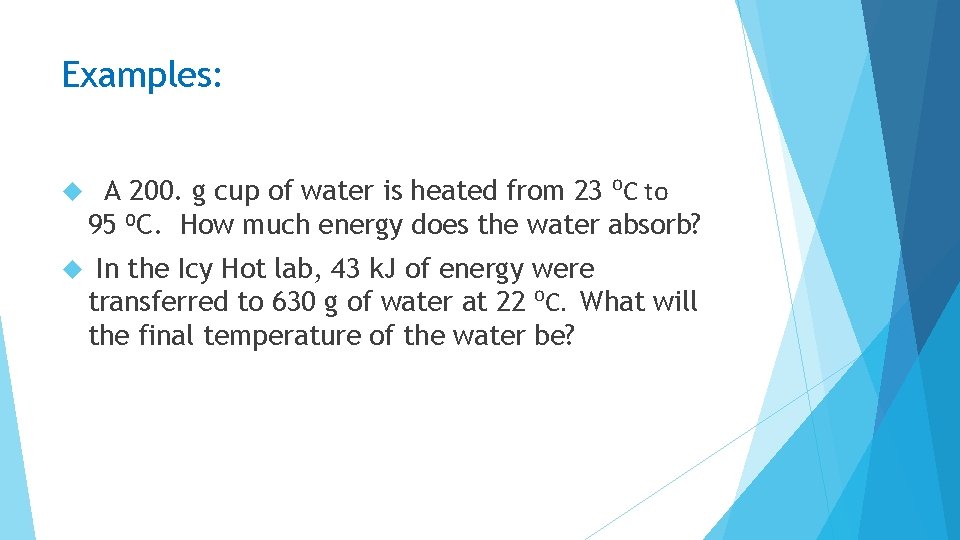
Examples: A 200. g cup of water is heated from 23 ⁰C to 95 ⁰C. How much energy does the water absorb? In the Icy Hot lab, 43 k. J of energy were transferred to 630 g of water at 22 ⁰C. What will the final temperature of the water be?
- Slides: 10