
Quantitative Chemistry Moles Molecule vs Ionic Compound n
- Slides: 6
Quantitative Chemistry Moles
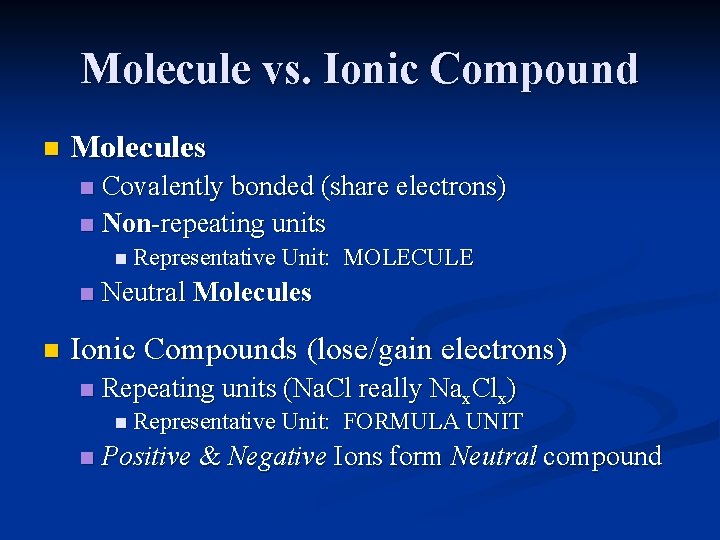
Molecule vs. Ionic Compound n Molecules Covalently bonded (share electrons) n Non-repeating units n n Representative Unit: n n MOLECULE Neutral Molecules Ionic Compounds (lose/gain electrons) n Repeating units (Na. Cl really Nax. Clx) n Representative Unit: n FORMULA UNIT Positive & Negative Ions form Neutral compound
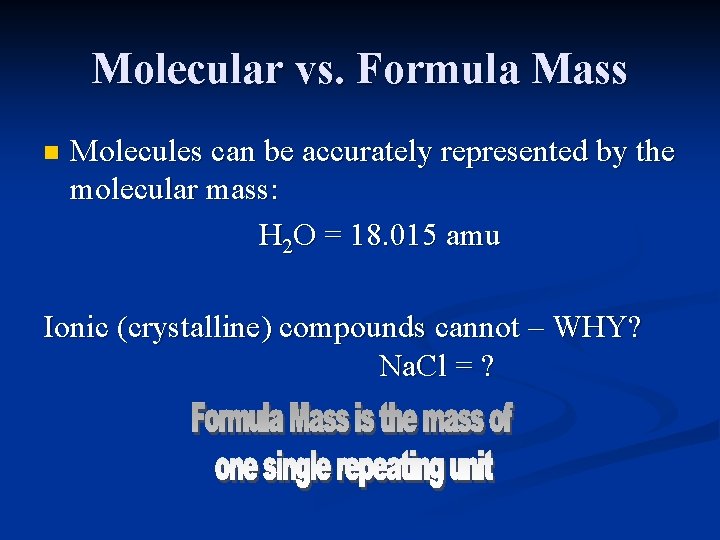
Molecular vs. Formula Mass n Molecules can be accurately represented by the molecular mass: H 2 O = 18. 015 amu Ionic (crystalline) compounds cannot – WHY? Na. Cl = ?
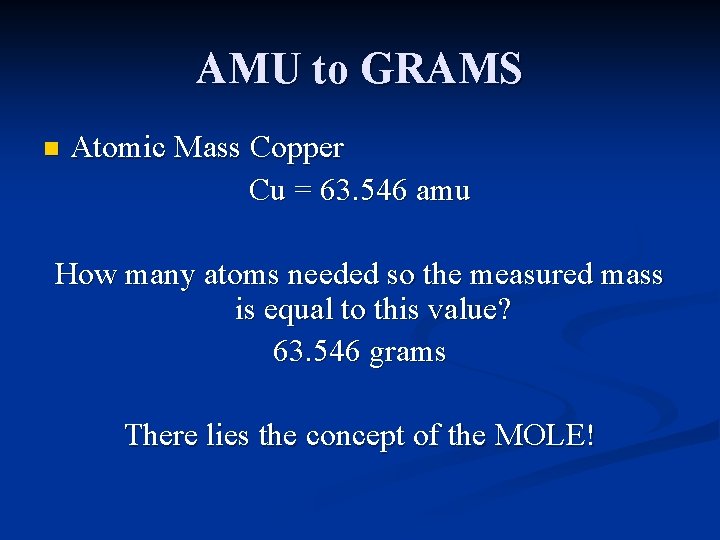
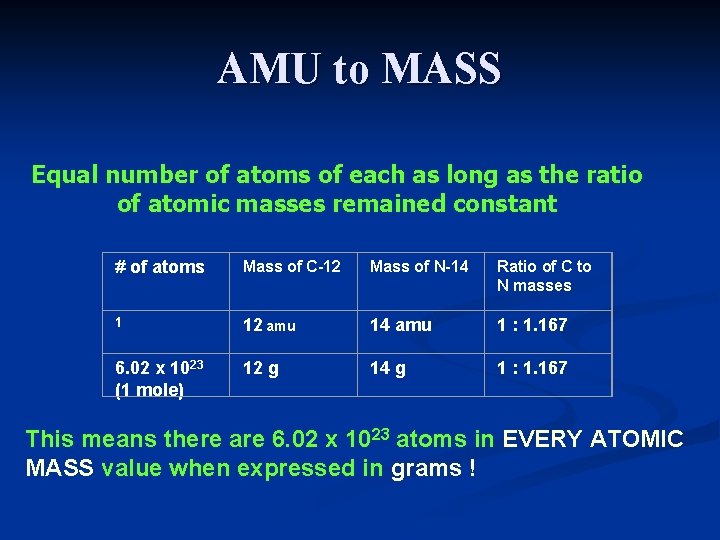
AMU to GRAMS n Atomic Mass Copper Cu = 63. 546 amu How many atoms needed so the measured mass is equal to this value? 63. 546 grams There lies the concept of the MOLE!
AMU to MASS Equal number of atoms of each as long as the ratio of atomic masses remained constant # of atoms Mass of C-12 Mass of N-14 Ratio of C to N masses 1 12 amu 14 amu 1 : 1. 167 6. 02 x 1023 (1 mole) 12 g 14 g 1 : 1. 167 This means there are 6. 02 x 1023 atoms in EVERY ATOMIC MASS value when expressed in grams !
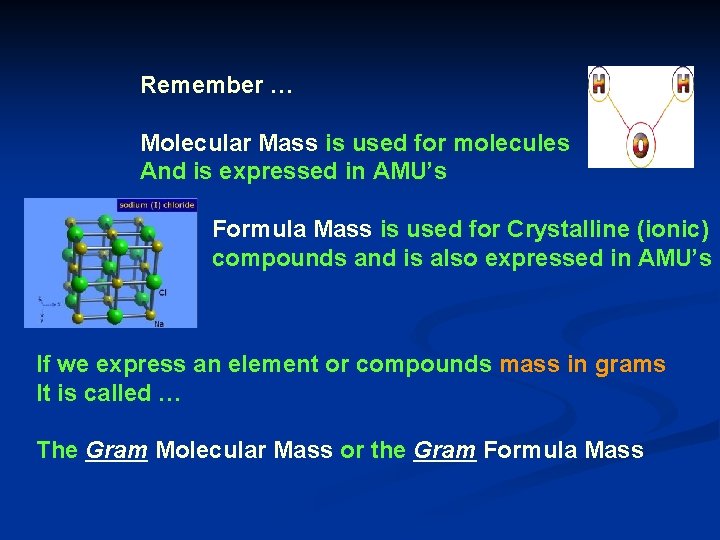
Remember … Molecular Mass is used for molecules And is expressed in AMU’s Formula Mass is used for Crystalline (ionic) compounds and is also expressed in AMU’s If we express an element or compounds mass in grams It is called … The Gram Molecular Mass or the Gram Formula Mass