
Quantitative Bioburden Testing with the ATP Test Understanding
Quantitative Bioburden Testing with the ATP Test Understanding what You are and are not Measuring
Quantitative Bioburden Testing • Microbiological tests • ATP as a big picture parameter • Test method validation – Knowing what you are measuring – Understanding heterogeneity – Developing correlations between ATP and other types of data; particularly culture data 2

Describing the Biotope • Biotope - an area of uniform environmental conditions providing a living place for a specific assemblage of organisms 3

Lay Terms – Defining Microbial Contamination • Question #1: what do we want to know about the microbial population? 4
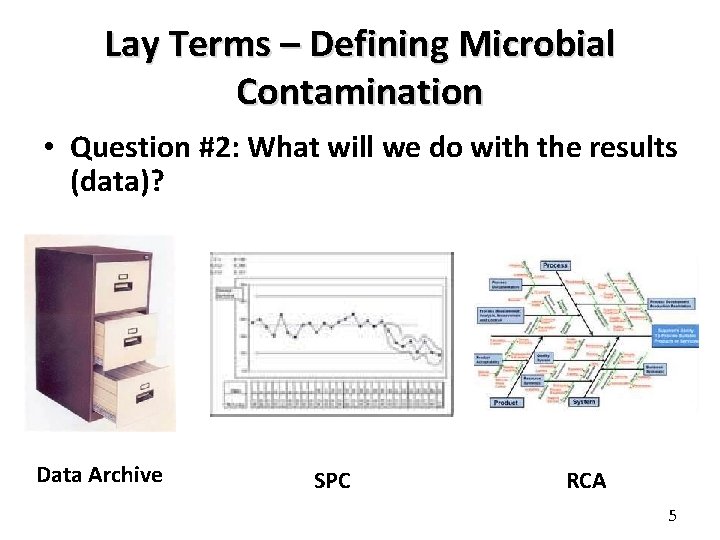
Lay Terms – Defining Microbial Contamination • Question #2: What will we do with the results (data)? Data Archive SPC RCA 5

Lay Terms – Defining Microbial Contamination • Question #3: What are your information priorities? 6
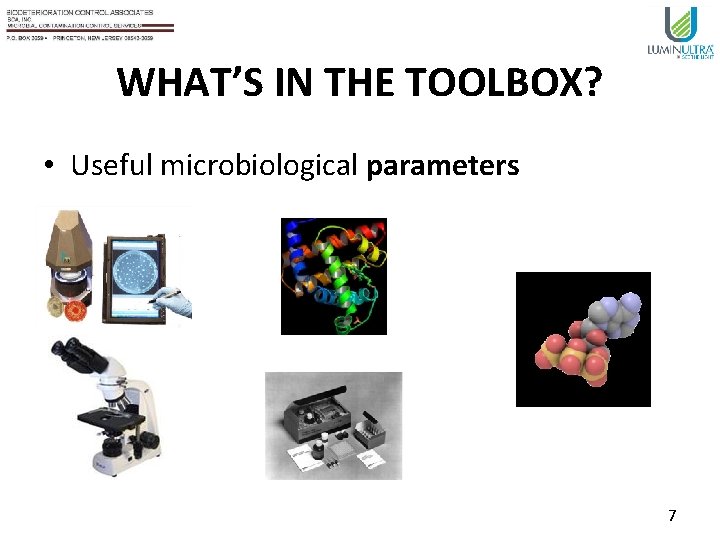
WHAT’S IN THE TOOLBOX? • Useful microbiological parameters 7
WHAT TO CHOOSE? • Put another way: which is the better tool? 8
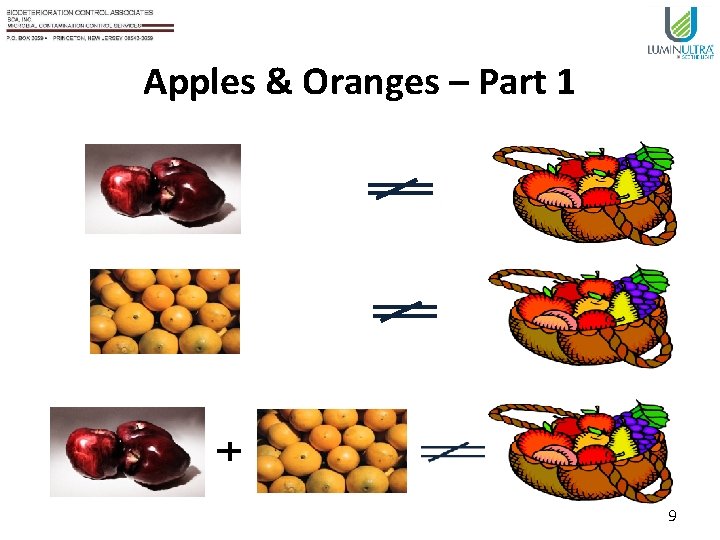
Apples & Oranges – Part 1 9

Apples & Oranges – Part 2 ni + ni fruity … + ni and but ni + ni fruity … + ni 10
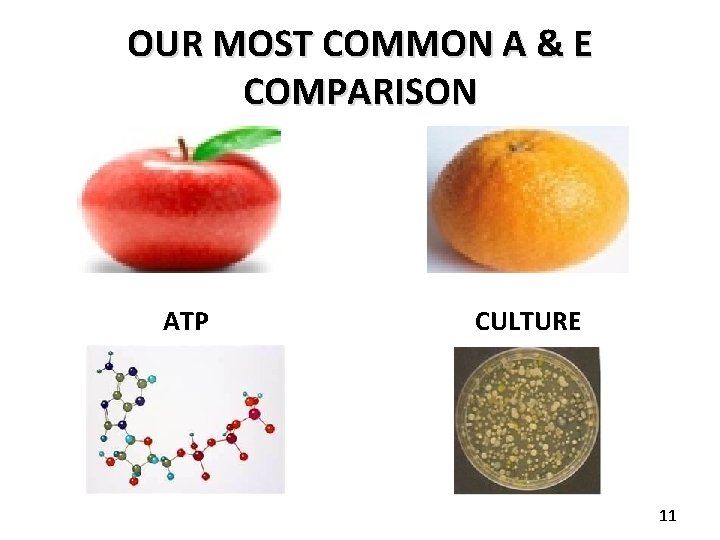
OUR MOST COMMON A & E COMPARISON ATP CULTURE 11
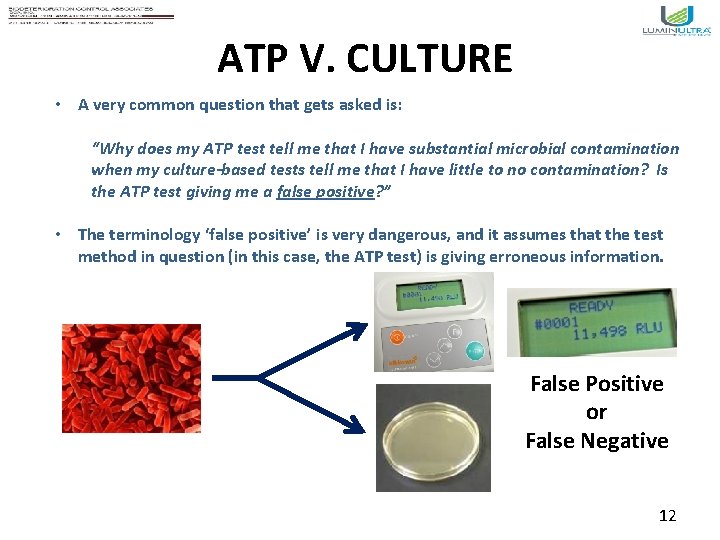
ATP V. CULTURE • A very common question that gets asked is: “Why does my ATP test tell me that I have substantial microbial contamination when my culture-based tests tell me that I have little to no contamination? Is the ATP test giving me a false positive? ” • The terminology ‘false positive’ is very dangerous, and it assumes that the test method in question (in this case, the ATP test) is giving erroneous information. False Positive or False Negative 12
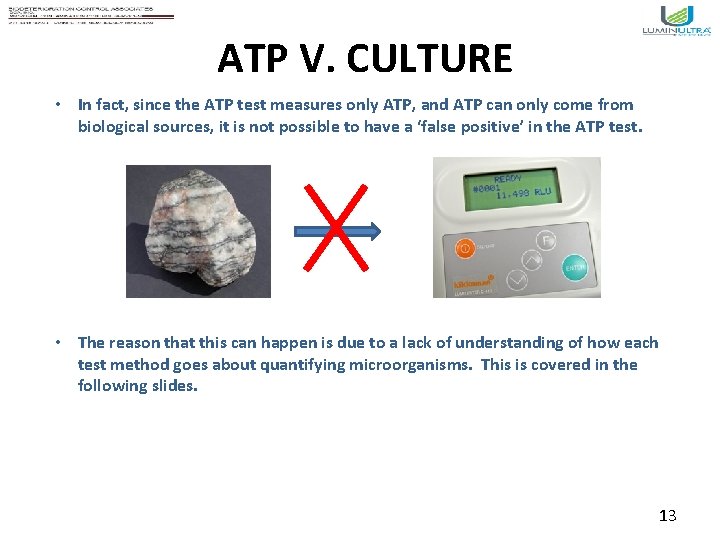
ATP V. CULTURE • In fact, since the ATP test measures only ATP, and ATP can only come from biological sources, it is not possible to have a ‘false positive’ in the ATP test. • The reason that this can happen is due to a lack of understanding of how each test method goes about quantifying microorganisms. This is covered in the following slides. 13
![ATP CULTURE X [ATP] cell-1 constant; no growth or metabolism needed after sample collected](http://slidetodoc.com/presentation_image_h2/497d71a32779c820f9a8bba28353bf67/image-14.jpg "ATP CULTURE X [ATP] cell-1 constant; no growth or metabolism needed after sample collected")
ATP CULTURE X [ATP] cell-1 constant; no growth or metabolism needed after sample collected @ 1 fg active cell-1 1, 000 cells pg -1 1 CFU m. L -1 Every active cell measured! +28 more generations visible colony 109 cells generation time 1 h 1. 5 d to visible colony X no reproduction no colony generation time 4 h ³ 5 d to visible colony Slow growing & injured active cells missed! 14
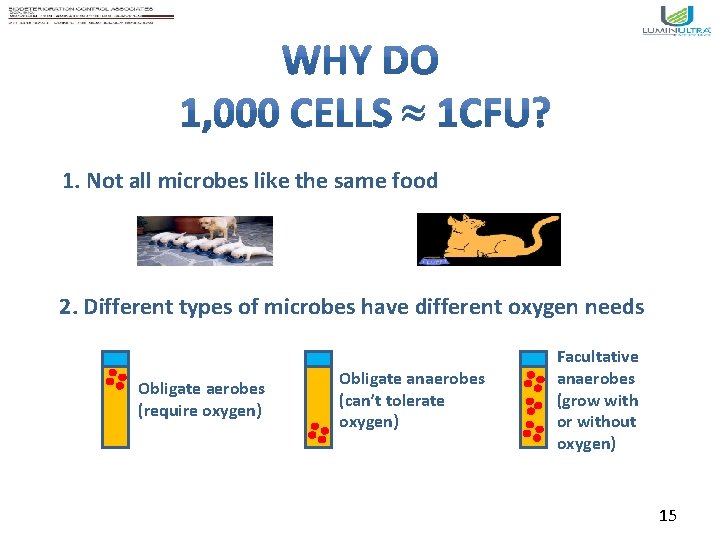
1. Not all microbes like the same food 2. Different types of microbes have different oxygen needs Obligate aerobes (require oxygen) Obligate anaerobes (can’t tolerate oxygen) Facultative anaerobes (grow with or without oxygen) 15
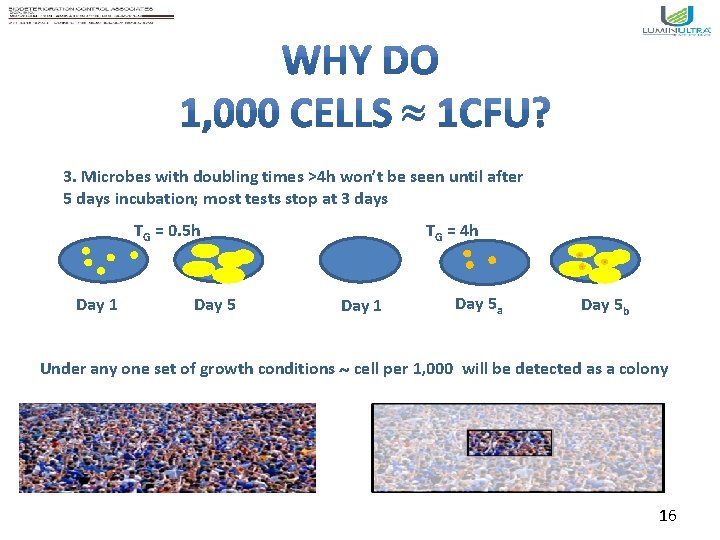
3. Microbes with doubling times >4 h won’t be seen until after 5 days incubation; most tests stop at 3 days TG = 0. 5 h Day 1 Day 5 TG = 4 h Day 1 Day 5 a Day 5 b Under any one set of growth conditions cell per 1, 000 will be detected as a colony 16
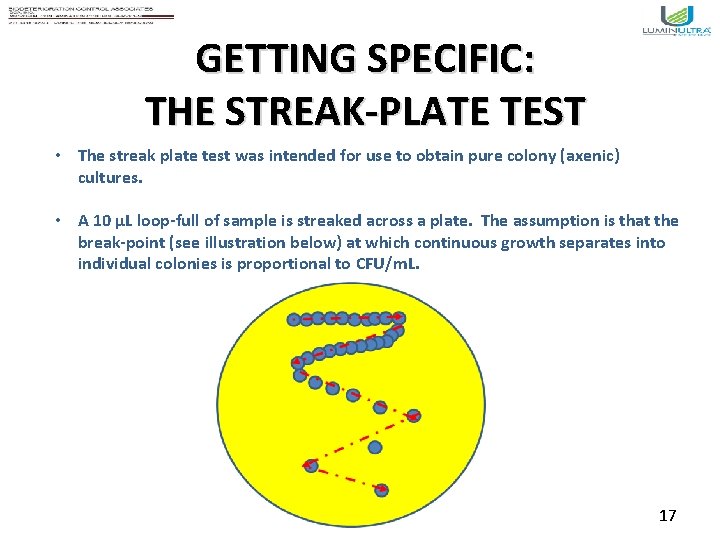
GETTING SPECIFIC: THE STREAK-PLATE TEST • The streak plate test was intended for use to obtain pure colony (axenic) cultures. • A 10 µL loop-full of sample is streaked across a plate. The assumption is that the break-point (see illustration below) at which continuous growth separates into individual colonies is proportional to CFU/m. L. 17
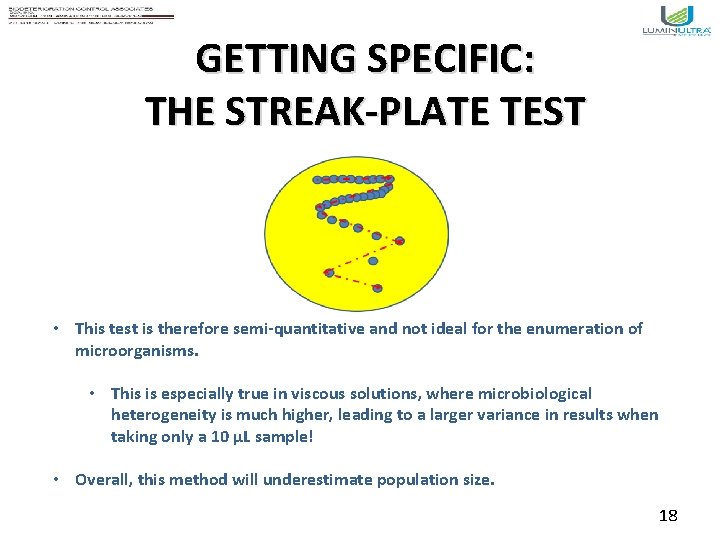
GETTING SPECIFIC: THE STREAK-PLATE TEST • This test is therefore semi-quantitative and not ideal for the enumeration of microorganisms. • This is especially true in viscous solutions, where microbiological heterogeneity is much higher, leading to a larger variance in results when taking only a 10 µL sample! • Overall, this method will underestimate population size. 18

ATP V. CULTURE: CONCLUSIONS • As is demonstrated in the previous slides, the key difference to understand is what, exactly each of these methods quantify: • The ATP test quantifies total active microorganisms. • The culture test (in any form) quantifies specific viable microorganisms depending on the parameters of the test method. • By recognizing the key differences between these methods, one can put them to action in the best ways and generate the best data possible to achieve process improvement! 19
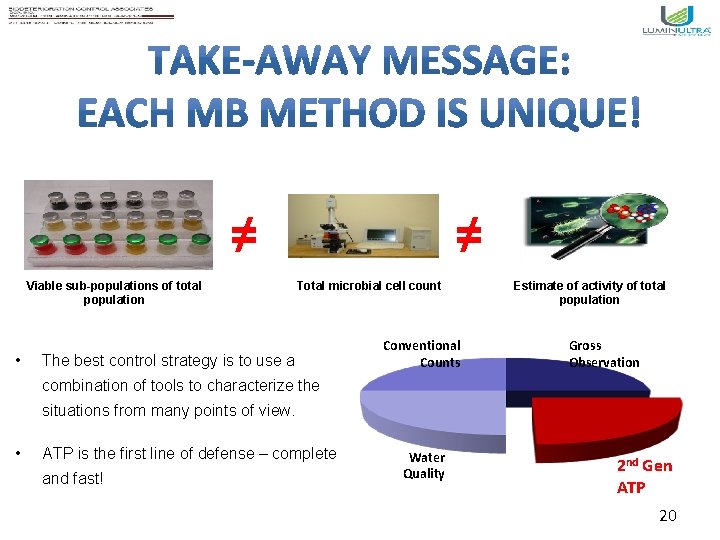
≠ Viable sub-populations of total population • ≠ Total microbial cell count The best control strategy is to use a Conventional Counts Estimate of activity of total population Gross Observation combination of tools to characterize the situations from many points of view. • ATP is the first line of defense – complete and fast! Water Quality 2 nd Gen ATP 20
![Developing Correlation Coefficients Log [ATP] via Numerous Samples Log CFU/m. L 21](http://slidetodoc.com/presentation_image_h2/497d71a32779c820f9a8bba28353bf67/image-21.jpg "Developing Correlation Coefficients Log [ATP] via Numerous Samples Log CFU/m. L 21")
Developing Correlation Coefficients Log [ATP] via Numerous Samples Log CFU/m. L 21
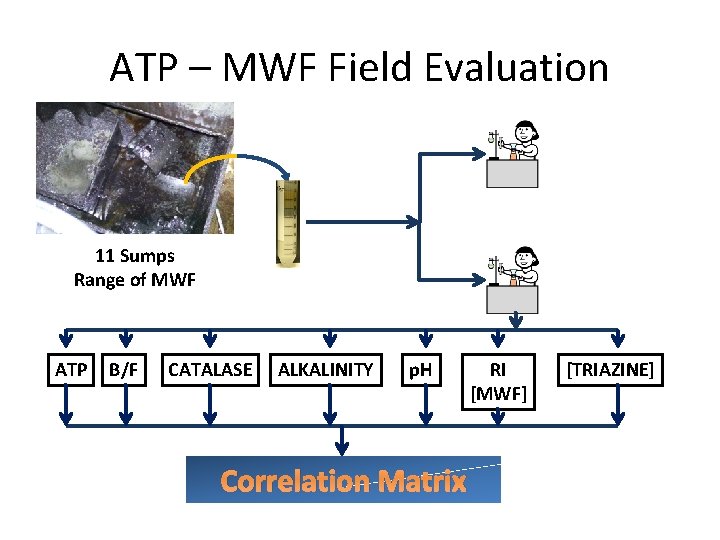
ATP – MWF Field Evaluation 11 Sumps Range of MWF ATP B/F CATALASE ALKALINITY p. H Correlation Matrix RI [MWF] [TRIAZINE]
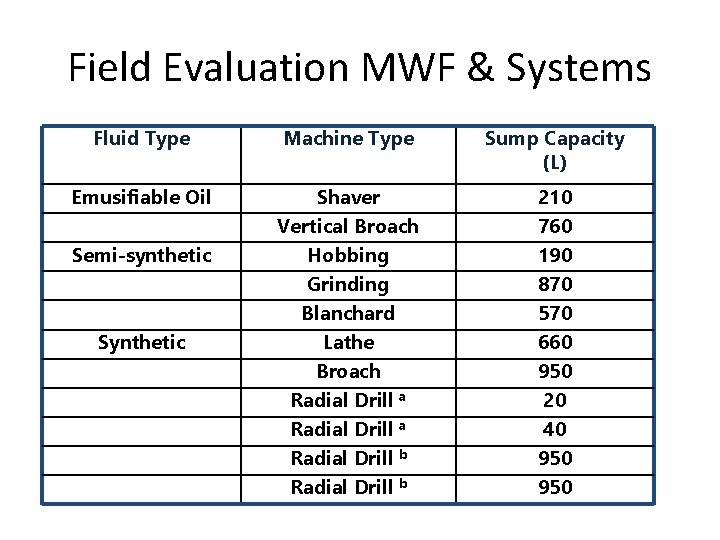
Field Evaluation MWF & Systems Fluid Type Machine Type Sump Capacity (L) Emusifiable Oil Shaver Vertical Broach Hobbing Grinding Blanchard Lathe Broach Radial Drill a Radial Drill b 210 760 190 870 570 660 950 20 40 950 Semi-synthetic Synthetic
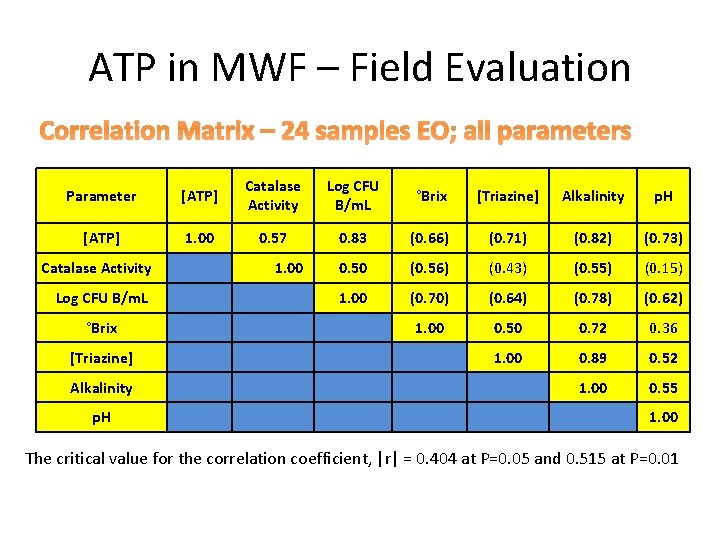
ATP in MWF – Field Evaluation Correlation Matrix – 24 samples EO; all parameters Parameter [ATP] Catalase Activity Log CFU B/m. L °Brix [Triazine] Alkalinity p. H [ATP] 1. 00 0. 57 0. 83 (0. 66) (0. 71) (0. 82) (0. 73) 0. 50 (0. 56) (0. 43) (0. 55) (0. 15) 1. 00 (0. 70) (0. 64) (0. 78) (0. 62) 1. 00 0. 50 0. 72 0. 36 1. 00 0. 89 0. 52 1. 00 0. 55 Catalase Activity Log CFU B/m. L °Brix [Triazine] Alkalinity p. H 1. 00 The critical value for the correlation coefficient, |r| = 0. 404 at P=0. 05 and 0. 515 at P=0. 01
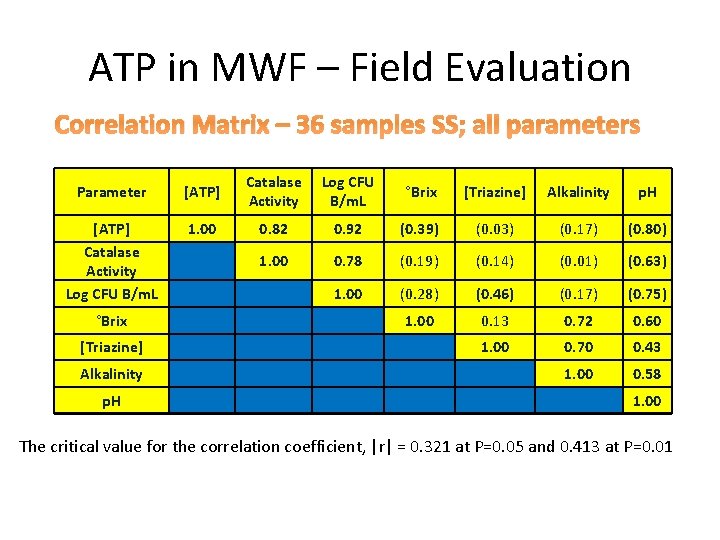
ATP in MWF – Field Evaluation Correlation Matrix – 36 samples SS; all parameters Parameter [ATP] Catalase Activity Log CFU B/m. L °Brix [Triazine] Alkalinity p. H [ATP] Catalase Activity Log CFU B/m. L 1. 00 0. 82 0. 92 (0. 39) (0. 03) (0. 17) (0. 80) 1. 00 0. 78 (0. 19) (0. 14) (0. 01) (0. 63) 1. 00 (0. 28) (0. 46) (0. 17) (0. 75) 1. 00 0. 13 0. 72 0. 60 1. 00 0. 70 0. 43 1. 00 0. 58 °Brix [Triazine] Alkalinity p. H 1. 00 The critical value for the correlation coefficient, |r| = 0. 321 at P=0. 05 and 0. 413 at P=0. 01
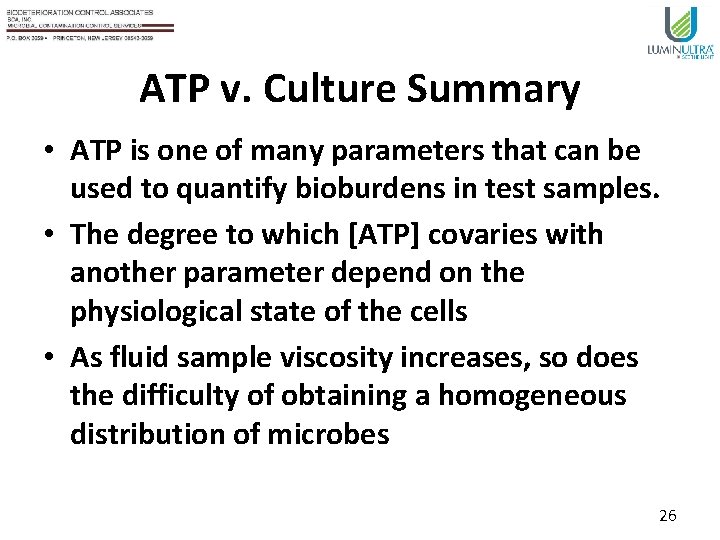
ATP v. Culture Summary • ATP is one of many parameters that can be used to quantify bioburdens in test samples. • The degree to which [ATP] covaries with another parameter depend on the physiological state of the cells • As fluid sample viscosity increases, so does the difficulty of obtaining a homogeneous distribution of microbes 26
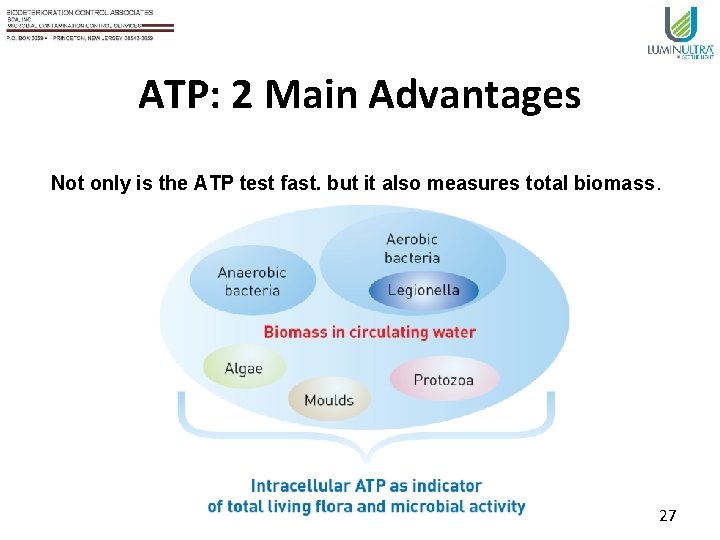
ATP: 2 Main Advantages Not only is the ATP test fast, but it also measures total biomass. 27
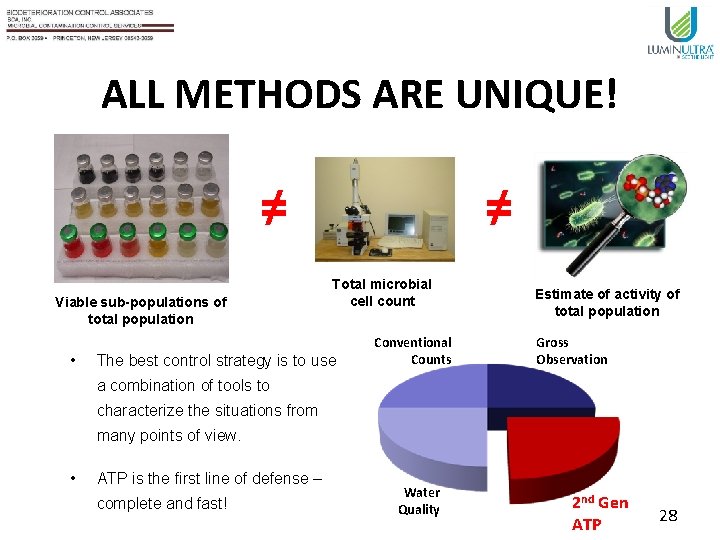
ALL METHODS ARE UNIQUE! ≠ Viable sub-populations of total population • ≠ Total microbial cell count The best control strategy is to use Conventional Counts Estimate of activity of total population Gross Observation a combination of tools to characterize the situations from many points of view. • ATP is the first line of defense – complete and fast! Water Quality 2 nd Gen ATP 28
- Slides: 28