
Quantitative assessment of skeletal muscle perfusion using a
- Slides: 1
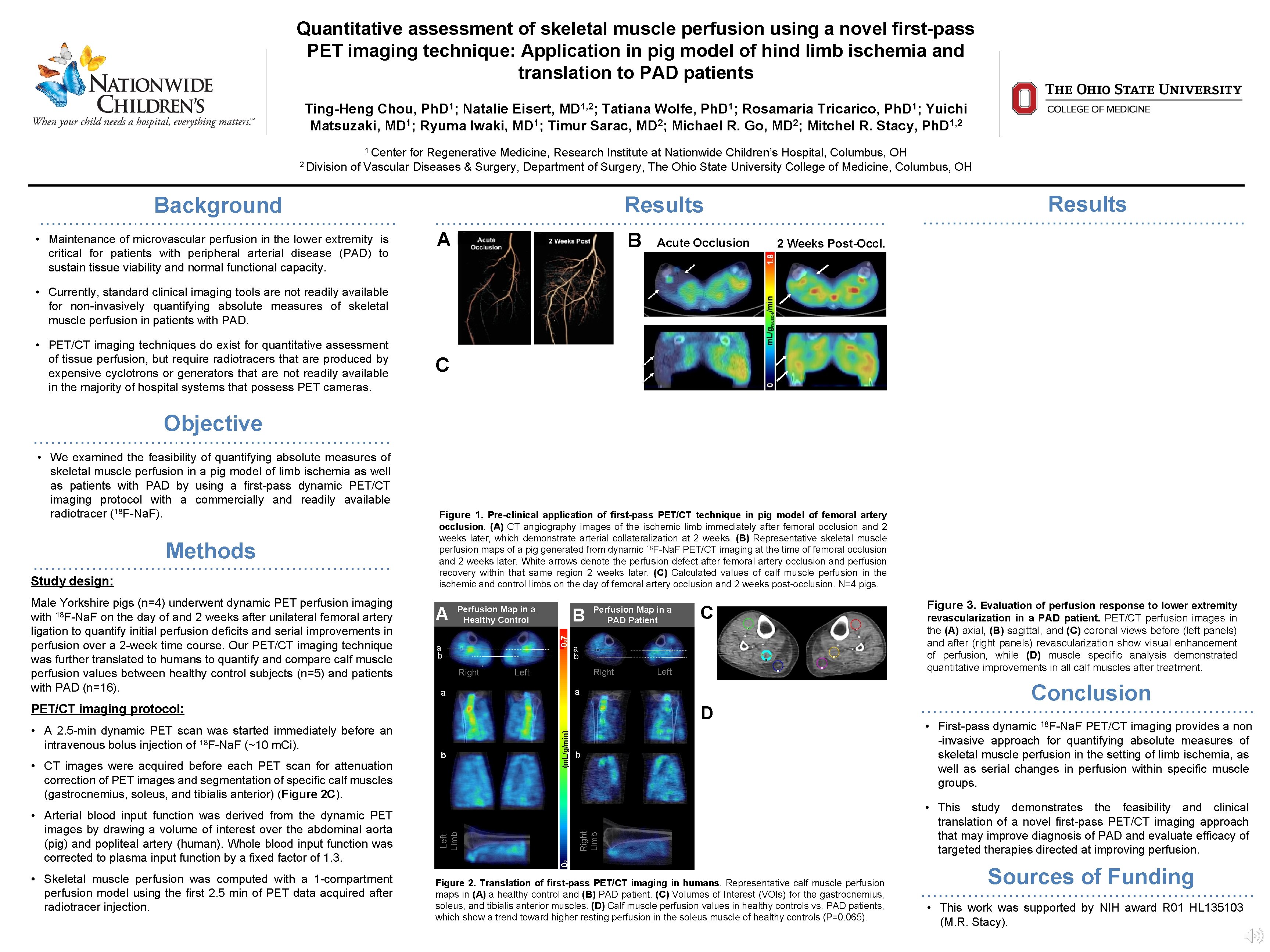
Quantitative assessment of skeletal muscle perfusion using a novel first-pass PET imaging technique: Application in pig model of hind limb ischemia and translation to PAD patients Ting-Heng Chou, Ph. D 1; Natalie Eisert, MD 1, 2; Tatiana Wolfe, Ph. D 1; Rosamaria Tricarico, Ph. D 1; Yuichi Matsuzaki, MD 1; Ryuma Iwaki, MD 1; Timur Sarac, MD 2; Michael R. Go, MD 2; Mitchel R. Stacy, Ph. D 1, 2 1 Center for Regenerative Medicine, Research Institute at Nationwide Children’s Hospital, Columbus, OH 2 Division of Vascular Diseases & Surgery, Department of Surgery, The Ohio State University College of Medicine, Columbus, OH • Maintenance of microvascular perfusion in the lower extremity is critical for patients with peripheral arterial disease (PAD) to sustain tissue viability and normal functional capacity. Results Background A B Acute Occlusion 2 Weeks Post-Occl. • Currently, standard clinical imaging tools are not readily available for non-invasively quantifying absolute measures of skeletal muscle perfusion in patients with PAD. • PET/CT imaging techniques do exist for quantitative assessment of tissue perfusion, but require radiotracers that are produced by expensive cyclotrons or generators that are not readily available in the majority of hospital systems that possess PET cameras. C Objective Methods Study design: Male Yorkshire pigs (n=4) underwent dynamic PET perfusion imaging with 18 F-Na. F on the day of and 2 weeks after unilateral femoral artery ligation to quantify initial perfusion deficits and serial improvements in perfusion over a 2 -week time course. Our PET/CT imaging technique was further translated to humans to quantify and compare calf muscle perfusion values between healthy control subjects (n=5) and patients with PAD (n=16). Figure 1. Pre-clinical application of first-pass PET/CT technique in pig model of femoral artery occlusion. (A) CT angiography images of the ischemic limb immediately after femoral occlusion and 2 weeks later, which demonstrate arterial collateralization at 2 weeks. (B) Representative skeletal muscle perfusion maps of a pig generated from dynamic 18 F-Na. F PET/CT imaging at the time of femoral occlusion and 2 weeks later. White arrows denote the perfusion defect after femoral artery occlusion and perfusion recovery within that same region 2 weeks later. (C) Calculated values of calf muscle perfusion in the ischemic and control limbs on the day of femoral artery occlusion and 2 weeks post-occlusion. N=4 pigs. A Perfusion Map in a Healthy Control B 0. 7 • We examined the feasibility of quantifying absolute measures of skeletal muscle perfusion in a pig model of limb ischemia as well as patients with PAD by using a first-pass dynamic PET/CT imaging protocol with a commercially and readily available radiotracer (18 F-Na. F). a b Right R L Perfusion Map in a PAD Patient a b Right Left • Skeletal muscle perfusion was computed with a 1 -compartment perfusion model using the first 2. 5 min of PET data acquired after radiotracer injection. b Right Limb (m. L/g/min) b 00 • Arterial blood input function was derived from the dynamic PET images by drawing a volume of interest over the abdominal aorta (pig) and popliteal artery (human). Whole blood input function was corrected to plasma input function by a fixed factor of 1. 3. D Left Limb • CT images were acquired before each PET scan for attenuation correction of PET images and segmentation of specific calf muscles (gastrocnemius, soleus, and tibialis anterior) (Figure 2 C). Left a a PET/CT imaging protocol: • A 2. 5 -min dynamic PET scan was started immediately before an intravenous bolus injection of 18 F-Na. F (~10 m. Ci). C Figure 2. Translation of first-pass PET/CT imaging in humans. Representative calf muscle perfusion maps in (A) a healthy control and (B) PAD patient. (C) Volumes of Interest (VOIs) for the gastrocnemius, soleus, and tibialis anterior muscles. (D) Calf muscle perfusion values in healthy controls vs. PAD patients, which show a trend toward higher resting perfusion in the soleus muscle of healthy controls (P=0. 065). Figure 3. Evaluation of perfusion response to lower extremity revascularization in a PAD patient. PET/CT perfusion images in the (A) axial, (B) sagittal, and (C) coronal views before (left panels) and after (right panels) revascularization show visual enhancement of perfusion, while (D) muscle specific analysis demonstrated quantitative improvements in all calf muscles after treatment. Conclusion • First-pass dynamic 18 F-Na. F PET/CT imaging provides a non -invasive approach for quantifying absolute measures of skeletal muscle perfusion in the setting of limb ischemia, as well as serial changes in perfusion within specific muscle groups. • This study demonstrates the feasibility and clinical translation of a novel first-pass PET/CT imaging approach that may improve diagnosis of PAD and evaluate efficacy of targeted therapies directed at improving perfusion. Sources of Funding • This work was supported by NIH award R 01 HL 135103 (M. R. Stacy).