
Quantitative analysis of steering adaptation on a high






- Slides: 27
Quantitative analysis of steering adaptation on a high performance driving simulator November 4, 2003 Daniel V. Mc. Gehee John D. Lee Matthew Rizzo Jeffrey Dawson Kirk Bateman University of Iowa 1
Background Most simulators do not completely replicate the driving experience and require time for drivers to adapt – This is particularly the case in static simulators Older drivers may be particularly vulnerable to differences between the simulator and the real vehicle We usually make subjective judgments as to a person’s adaptation to a simulator – 5 to 15 minutes of training frequently cited in the literature University of Iowa 2
The simulator versus a real car: lags University of Iowa Computer—transport delay Steering Braking Visual The longer the lag, the less stable the system But, hey, we adapt, right? 3
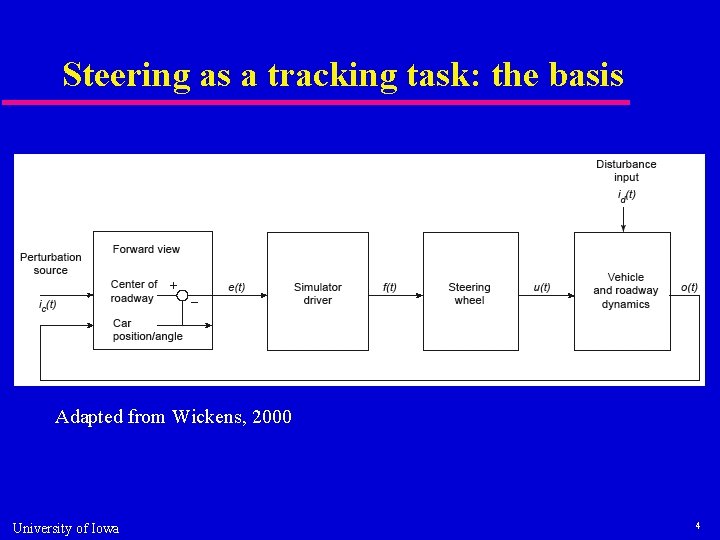
Steering as a tracking task: the basis Adapted from Wickens, 2000 University of Iowa 4
Objective University of Iowa Examine how long it takes for younger and older drivers to adapt their steering control on a fixed-base driving simulator Most salient adaptation is in steering control 5
Hypotheses University of Iowa Older drivers will have more variability than younger drivers in steering position variation, number of 6 -degree steering wheel reversals per minute, and lane position variation. A greater amount of high frequency variability will also be seen between younger and older drivers using Fourier analyses to measure the low-, medium- and high-frequency variability of steering and lane position. Both older and younger drivers will adapt to the simulator within five minutes of starting the drive, and will have no more than two deviations greater than six degrees per minute after that time (during normal driving). 6
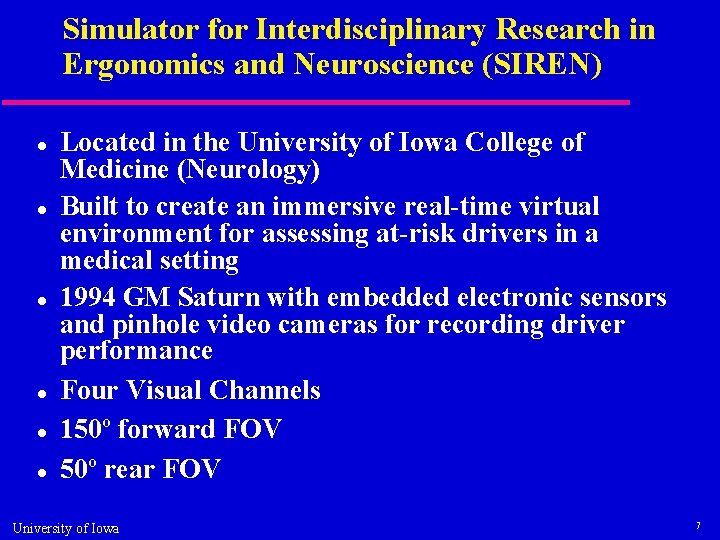
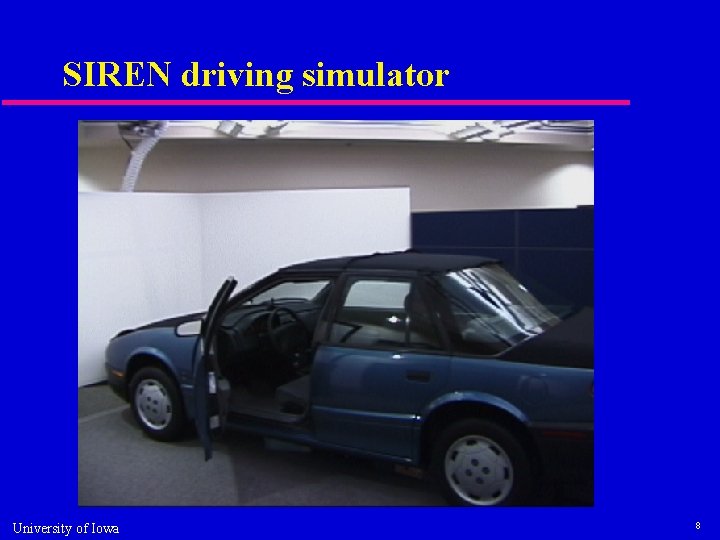
Simulator for Interdisciplinary Research in Ergonomics and Neuroscience (SIREN) Located in the University of Iowa College of Medicine (Neurology) Built to create an immersive real-time virtual environment for assessing at-risk drivers in a medical setting 1994 GM Saturn with embedded electronic sensors and pinhole video cameras for recording driver performance Four Visual Channels 150º forward FOV 50º rear FOV University of Iowa 7
SIREN driving simulator University of Iowa 8
Methods University of Iowa 52 drivers 25 -45 and 28 drivers over 65 years of age drove the SIREN for 25 minutes The drive was comprised of rural, two-lane roadways with traffic Participants interacted with other vehicles, made judgments about traffic lights, and responded to potential collision conditions Three one-mile (1. 6 kilometer) sections of uneventful driving were extracted – Start – 4 miles in – 15 miles in 9
Steering analysis–background University of Iowa Steering wheel reversals are used in driving research to examine attention demand vehicle control An increase in steering reversals greater than six degrees, with a decreased frequency of small reversals, has been associated with increased attention demand 10
Steering analysis (cont. ) University of Iowa We used the six-degree steering wheel reversal criterion to evaluate drivers’ adaptation to the simulator Examined the number of steering wheel reversals greater than six degrees per minute during each of three sections of the 25 -minute drive 11
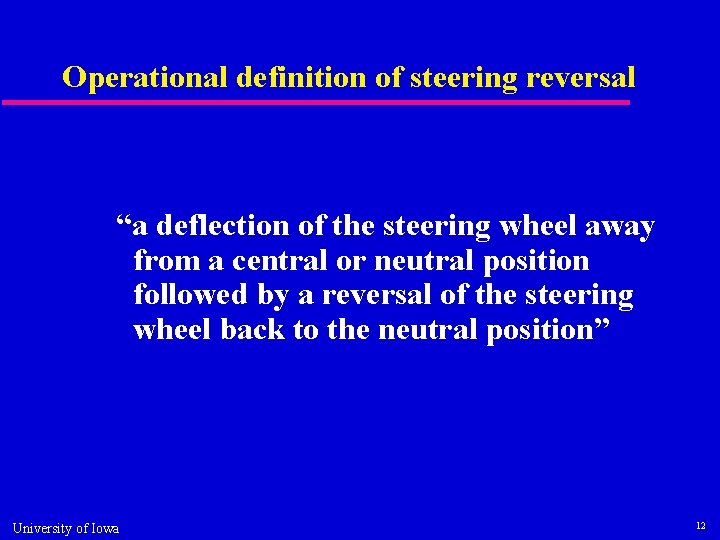
Operational definition of steering reversal “a deflection of the steering wheel away from a central or neutral position followed by a reversal of the steering wheel back to the neutral position” University of Iowa 12
Fourier analyses University of Iowa Distinguishes behavior that would otherwise be indistinguishable. Specifically, a standard measure of lane and steering variation, such as RMS lane position, does not differentiate between the rapid oscillations that might occur when someone is weaving erratically and a slow gradual drift from side to side. The difference between these types of variability could be of great theoretical and practical interest. Describes the relative degree of slow and fast variation by integrating the power over different parts of the frequency spectrum. 13
Fourier analyses (cont. ) The degree of variability was measured in three frequency bands for steering wheel and lane position. The bands included a low-frequency band that was: – between 0. 075 and 0. 5 Hz – a middle-frequency band of 0. 5 -1. 5 Hz, – and a high-frequency band of 1. 5 -5. 0 Hz. University of Iowa Frequency bands were chosen based on a preliminary inspection of the data with the objective of dividing the response frequencies into three approximately equal segments in terms of contribution to the overall signal. 14
Results: Steering wheel angle deviation (degrees) University of Iowa 15
Steering wheel reversals/minute University of Iowa 16
RMS lane deviation University of Iowa 17
Fourier analyses results University of Iowa 18
Segment 1: Older drivers
Segment 1: Younger drivers University of Iowa 20
Segment 2: Older drivers University of Iowa 21
Segment 2: Younger drivers University of Iowa 22
Segment 3: Older drivers University of Iowa 23
Segment 3: Younger drivers University of Iowa 24
Conclusions University of Iowa Drivers in this study needed about two to three minutes to adapt and get the “feel” of the simulator Before this time driving behavior in the simulator may not be representative of actual driving performance 25
Future University of Iowa Examine other driving performance metrics to develop general criteria for determining practice requirements Smart algorithms could examine steering in real-time and inform the experimenter if drivers are stable or not NADS 26
Acknowledgments University of Iowa This research was supported by the U. S. National Institutes of Aging (NIA AG 15071 & NIA AG 17177) 27