
Quantitative Analysis of Control Flow Checking Mechanisms for
![Experimental setup � Setup � Compiler � LLVM [Lattner et al. , CGO 2004]](https://slidetodoc.com/presentation_image_h2/4aedd2412871546fede7a57634b656fe/image-19.jpg "Experimental setup � Setup � Compiler � LLVM [Lattner et al. , CGO 2004]")
- Slides: 22
Quantitative Analysis of Control Flow Checking Mechanisms for Soft Errors Aviral Shrivastava, Abhishek Rhisheekesan, Reiley Jeyapaul, and Carole-Jean Wu Compiler Microarchitecture Lab Arizona State University http: //aviral. lab. asu. edu
OR Existing Techniques for Control Flow Checking are not useful for protection from Soft Errors Aviral Shrivastava, Abhishek Rhisheekesan, Reiley Jeyapaul, and Carole-Jean Wu Compiler Microarchitecture Lab Arizona State University http: //aviral. lab. asu. edu
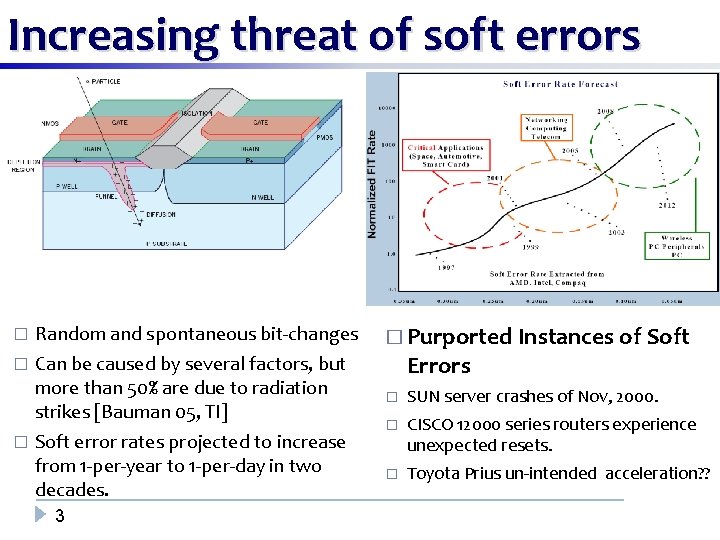
Increasing threat of soft errors � Random and spontaneous bit-changes Can be caused by several factors, but more than 50% are due to radiation strikes [Bauman 05, TI] � Soft error rates projected to increase from 1 -per-year to 1 -per-day in two decades. � Purported Instances of Soft Errors � 3 � SUN server crashes of Nov, 2000. � CISCO 12000 series routers experience unexpected resets. � Toyota Prius un-intended acceleration? ?
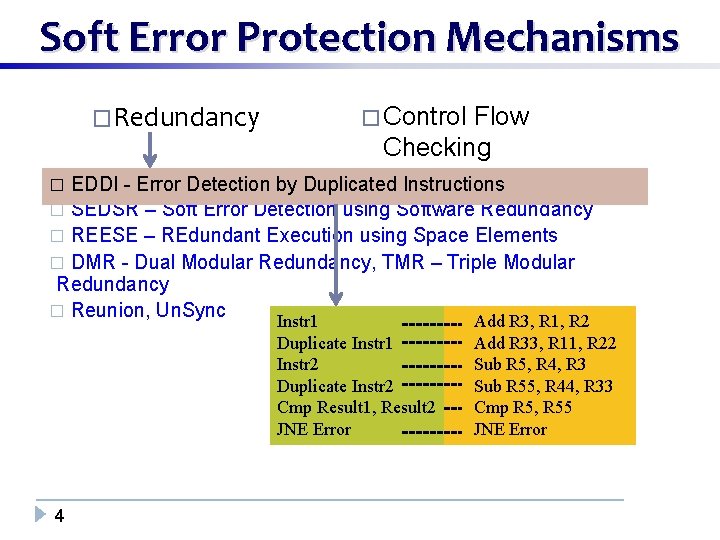
Soft Error Protection Mechanisms �Redundancy � Control Flow Checking EDDI - Error Detection by Duplicated Instructions � SEDSR – Soft Error Detection using Software Redundancy � REESE – REdundant Execution using Space Elements � DMR - Dual Modular Redundancy, TMR – Triple Modular Redundancy � Reunion, Un. Sync Instr 1 Add R 3, R 1, R 2 � Duplicate Instr 1 Instr 2 Duplicate Instr 2 Cmp Result 1, Result 2 JNE Error 4 Add R 33, R 11, R 22 Sub R 5, R 4, R 3 Sub R 55, R 44, R 33 Cmp R 5, R 55 JNE Error
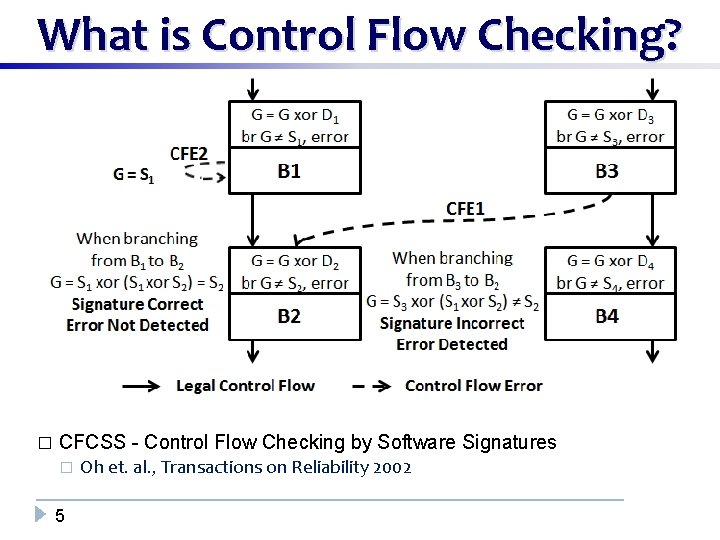
What is Control Flow Checking? � CFCSS - Control Flow Checking by Software Signatures � 5 Oh et. al. , Transactions on Reliability 2002
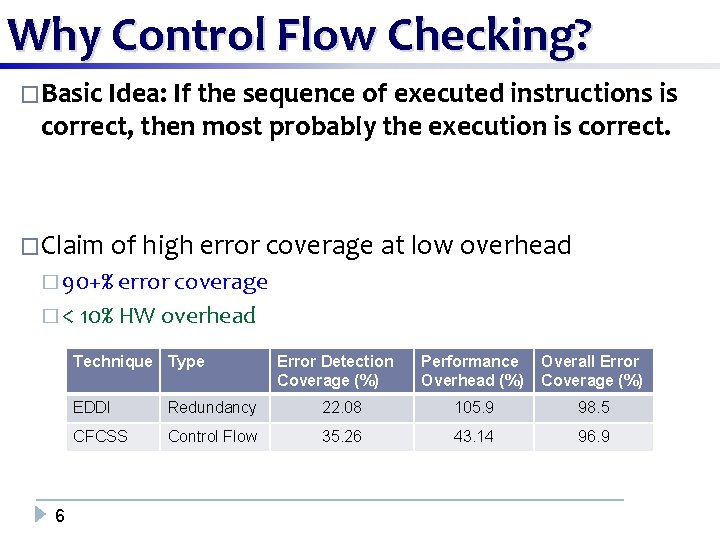
Why Control Flow Checking? �Basic Idea: If the sequence of executed instructions is correct, then most probably the execution is correct. �Claim of high error coverage at low overhead � 90+% error coverage � < 10% HW overhead Technique Type 6 Error Detection Coverage (%) Performance Overhead (%) Overall Error Coverage (%) EDDI Redundancy 22. 08 105. 9 98. 5 CFCSS Control Flow 35. 26 43. 14 96. 9
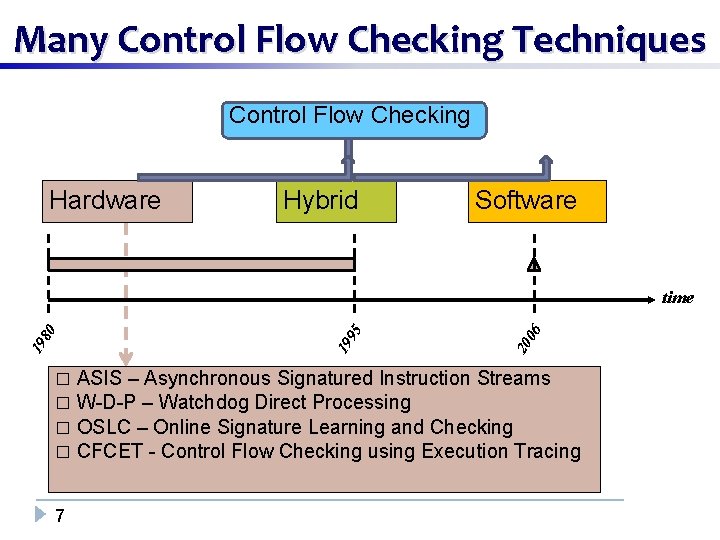
Many Control Flow Checking Techniques Control Flow Checking Hardware Hybrid Software 06 20 95 19 19 80 time ASIS – Asynchronous Signatured Instruction Streams � W-D-P – Watchdog Direct Processing � OSLC – Online Signature Learning and Checking � CFCET - Control Flow Checking using Execution Tracing � 7
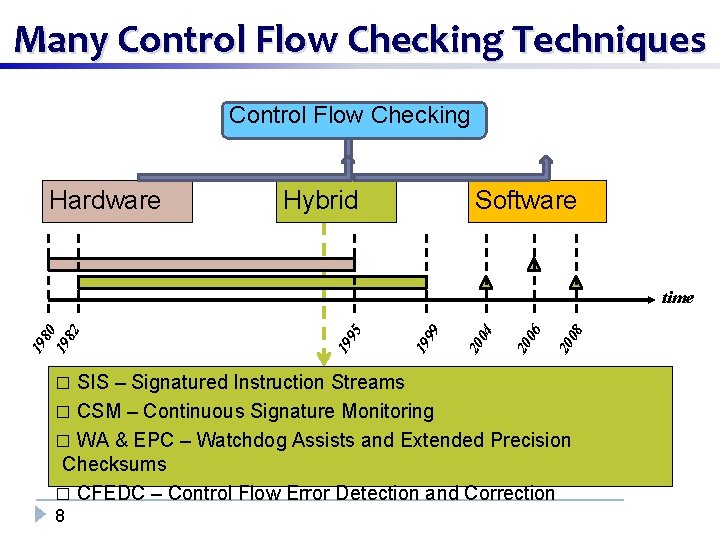
Many Control Flow Checking Techniques Control Flow Checking Hardware Hybrid Software 08 20 06 20 04 20 99 19 95 19 19 80 19 82 time SIS – Signatured Instruction Streams � CSM – Continuous Signature Monitoring � WA & EPC – Watchdog Assists and Extended Precision Checksums � CFEDC – Control Flow Error Detection and Correction � 8
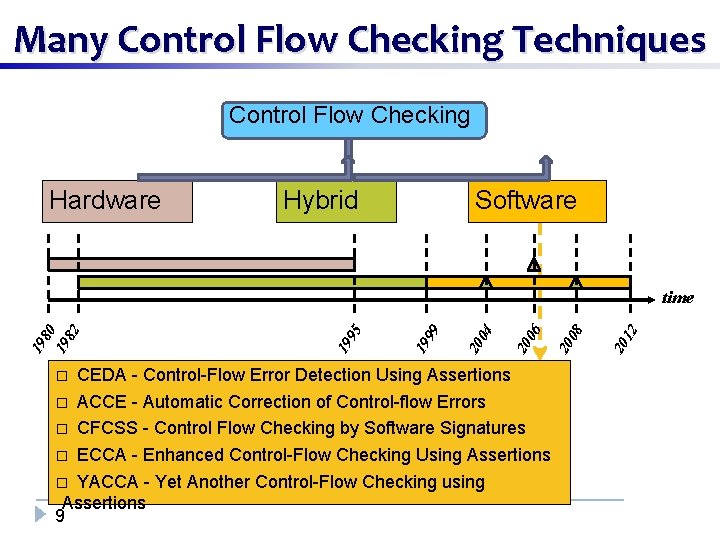
Many Control Flow Checking Techniques Control Flow Checking Hardware Hybrid Software CEDA - Control-Flow Error Detection Using Assertions � ACCE - Automatic Correction of Control-flow Errors � CFCSS - Control Flow Checking by Software Signatures � ECCA - Enhanced Control-Flow Checking Using Assertions � YACCA - Yet Another Control-Flow Checking using Assertions 9 � 12 20 08 20 06 20 04 20 99 19 95 19 19 80 19 82 time
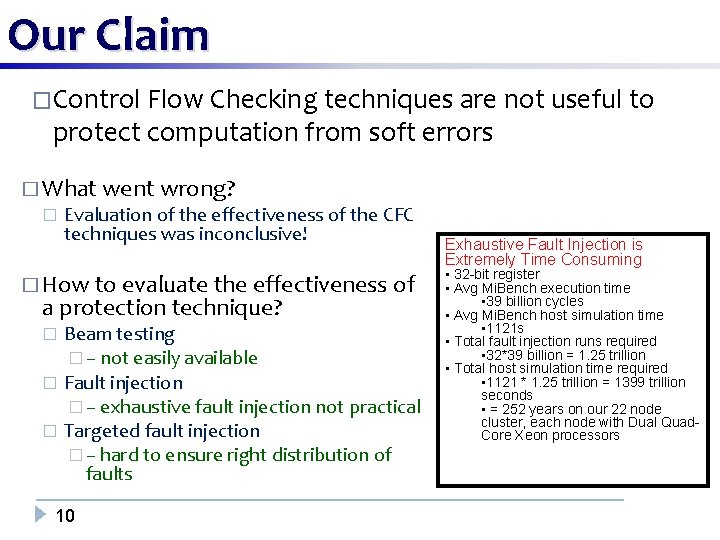
Our Claim �Control Flow Checking techniques are not useful to protect computation from soft errors � What went wrong? � Evaluation of the effectiveness of the CFC techniques was inconclusive! � How to evaluate the effectiveness a protection technique? of Beam testing � – not easily available � Fault injection � – exhaustive fault injection not practical � Targeted fault injection � – hard to ensure right distribution of faults � 10 Exhaustive Fault Injection is Extremely Time Consuming • 32 -bit register • Avg Mi. Bench execution time • 39 billion cycles • Avg Mi. Bench host simulation time • 1121 s • Total fault injection runs required • 32*39 billion = 1. 25 trillion • Total host simulation time required • 1121 * 1. 25 trillion = 1399 trillion seconds • = 252 years on our 22 node cluster, each node with Dual Quad. Core Xeon processors
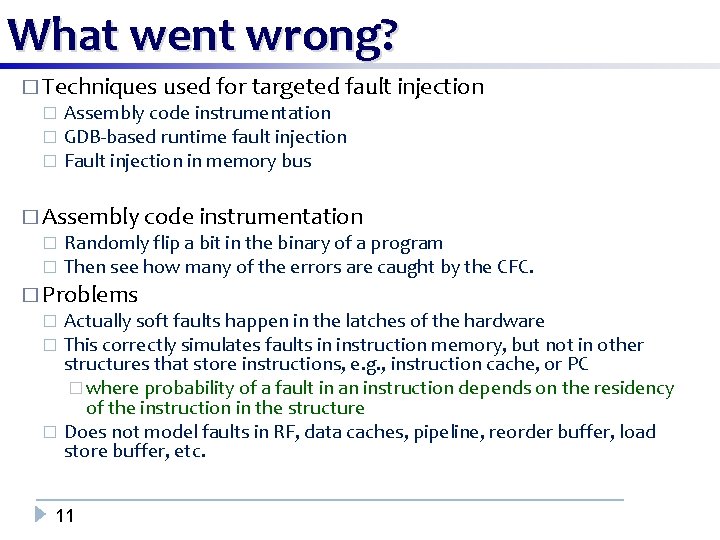
What went wrong? � Techniques used for targeted fault injection Assembly code instrumentation � GDB-based runtime fault injection � Fault injection in memory bus � � Assembly code instrumentation Randomly flip a bit in the binary of a program � Then see how many of the errors are caught by the CFC. � � Problems Actually soft faults happen in the latches of the hardware � This correctly simulates faults in instruction memory, but not in other structures that store instructions, e. g. , instruction cache, or PC � where probability of a fault in an instruction depends on the residency of the instruction in the structure � Does not model faults in RF, data caches, pipeline, reorder buffer, load store buffer, etc. � 11
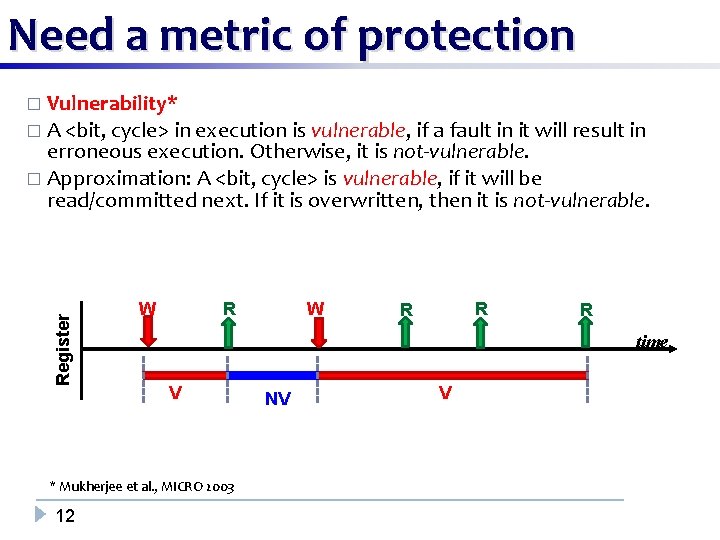
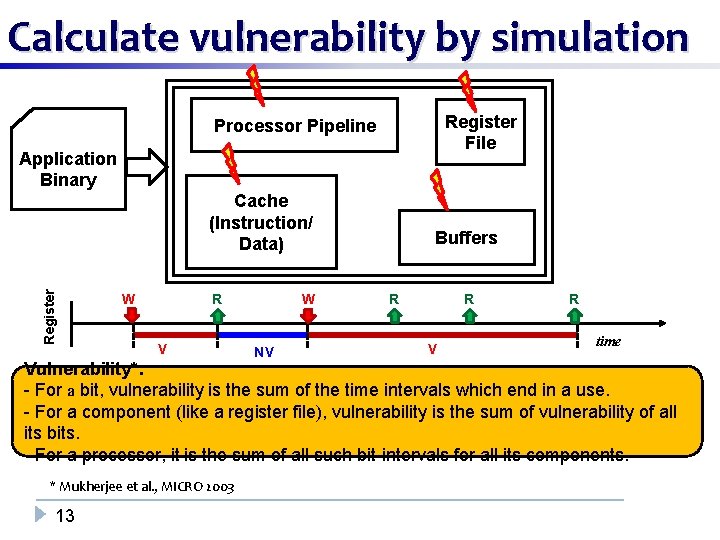
Need a metric of protection � Vulnerability* � A <bit, cycle> in execution is vulnerable, if a fault in it will result in Register erroneous execution. Otherwise, it is not-vulnerable. � Approximation: A <bit, cycle> is vulnerable, if it will be read/committed next. If it is overwritten, then it is not-vulnerable. W R R time V * Mukherjee et al. , MICRO 2003 12 W NV V
Calculate vulnerability by simulation Register File Processor Pipeline Application Binary Register Cache (Instruction/ Data) W R V W NV Buffers R R V R time Vulnerability*: - For a bit, vulnerability is the sum of the time intervals which end in a use. - For a component (like a register file), vulnerability is the sum of vulnerability of all its bits. - For a processor, it is the sum of all such bit-intervals for all its components. * Mukherjee et al. , MICRO 2003 13
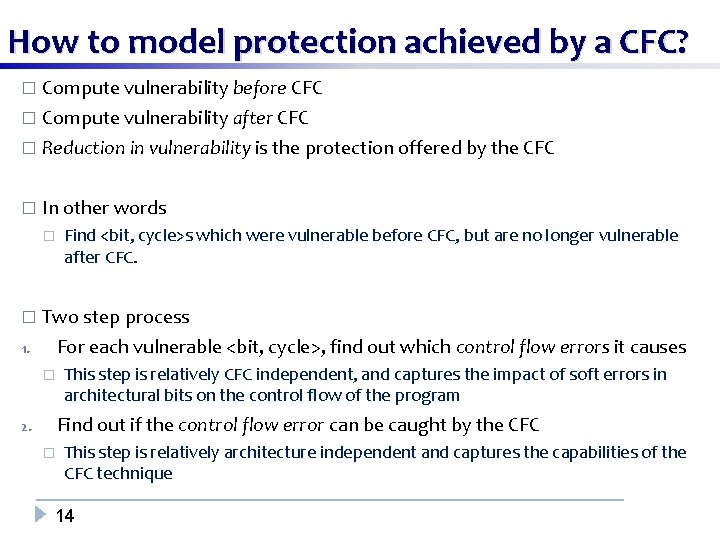
How to model protection achieved by a CFC? � Compute vulnerability before CFC Compute vulnerability after CFC � Reduction in vulnerability is the protection offered by the CFC � � In other words � � 1. Find <bit, cycle>s which were vulnerable before CFC, but are no longer vulnerable after CFC. Two step process For each vulnerable <bit, cycle>, find out which control flow errors it causes � This step is relatively CFC independent, and captures the impact of soft errors in architectural bits on the control flow of the program Find out if the control flow error can be caught by the CFC 2. � This step is relatively architecture independent and captures the capabilities of the CFC technique 14
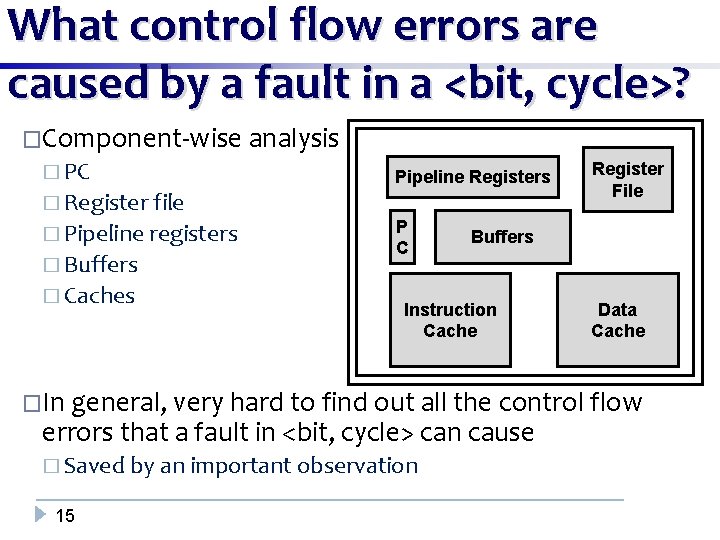
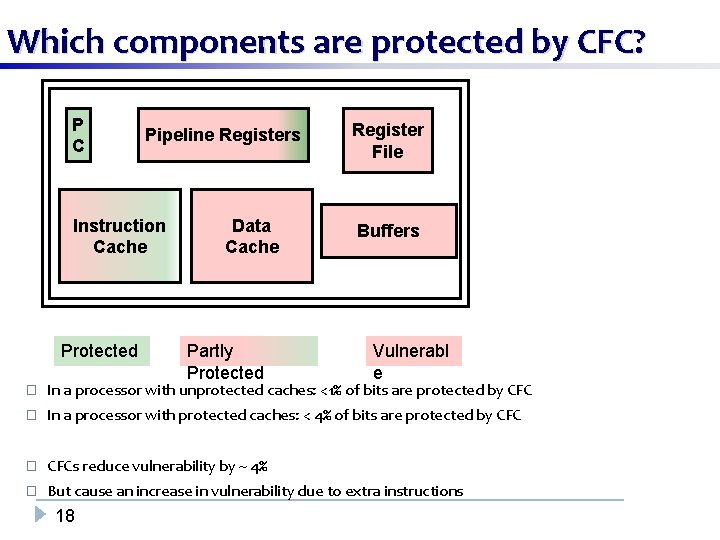
What control flow errors are caused by a fault in a <bit, cycle>? �Component-wise analysis � PC � Register file � Pipeline registers � Buffers � Caches Pipeline Registers P C Register File Buffers Instruction Cache Data Cache �In general, very hard to find out all the control flow errors that a fault in <bit, cycle> can cause � Saved by an important observation 15
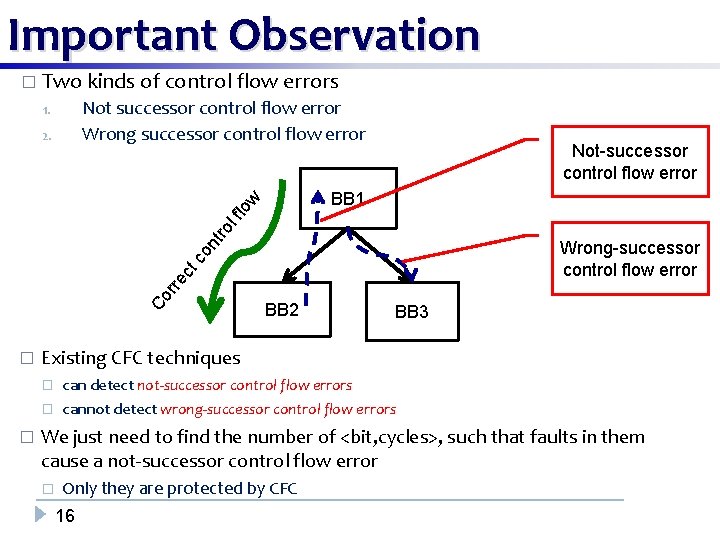
Important Observation � Two kinds of control flow errors Not successor control flow error Wrong successor control flow error 1. Not-successor control flow error BB 1 ro lf lo w 2. Co rre ct co nt Wrong-successor control flow error � � BB 2 BB 3 Existing CFC techniques � can detect not-successor control flow errors � cannot detect wrong-successor control flow errors We just need to find the number of <bit, cycles>, such that faults in them cause a not-successor control flow error � Only they are protected by CFC 16
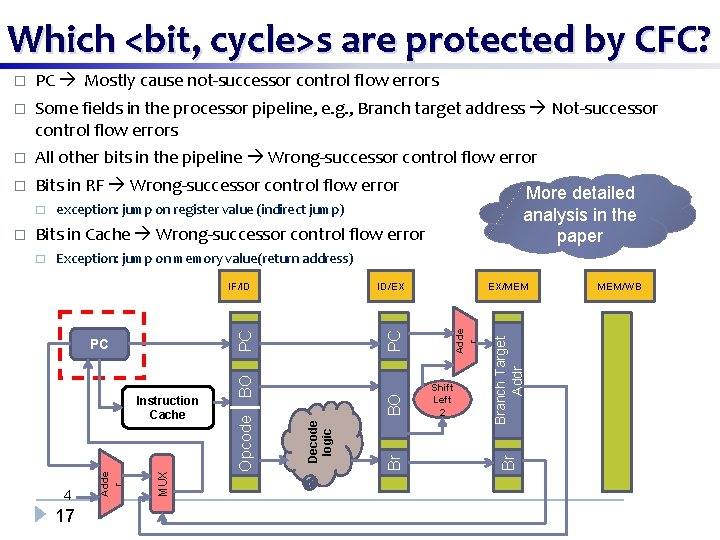
Which <bit, cycle>s are protected by CFC? � PC Mostly cause not-successor control flow errors � Some fields in the processor pipeline, e. g. , Branch target address Not-successor control flow errors � All other bits in the pipeline Wrong-successor control flow error � Bits in RF Wrong-successor control flow error � exception: jump on register value (indirect jump) Bits in Cache Wrong-successor control flow error Exception: jump on memory value(return address) 17 Br Shift Left 2 Branch Target Addr EX/MEM Adde r PC Br Decode logic BO BO Instruction Cache Opcode PC 4 ID/EX PC IF/ID MUX � Adde r � More detailed analysis in the paper MEM/WB
Which components are protected by CFC? P C Pipeline Registers Instruction Cache Protected Data Cache Partly Protected Register File Buffers Vulnerabl e � In a processor with unprotected caches: <1% of bits are protected by CFC � In a processor with protected caches: < 4% of bits are protected by CFC � CFCs reduce vulnerability by ~ 4% � But cause an increase in vulnerability due to extra instructions 18
Experimental setup � Setup � Compiler � LLVM [Lattner et al. , CGO 2004] ARM Cross-compiler � gcc, ARM � Benchmarks � Mi. Bench suite [Guthaus et al. , IEEE WWC 2001] � Cycle Accurate Simulator � Gem. V-CFC (based on gem 5 [Binkert et al. , Comput. Archit. News 2001]) � � ARM - Single core, Out of Order, 2 GHz, 5 -stage pipeline CFC techniques � CFCSS [Oh et al. , Transactions on Reliability 2002] � CFCSS+NA [Chao et al. , IEEE CIT 2010] � CEDA [Vemu et al. , IEEE Trans. Comput. 2011] � CFEDC [Farazmand et al. , ARES 2008] � CFCET [Rajabzadeh et al. , Microelectronic Reliability, 2006] 19
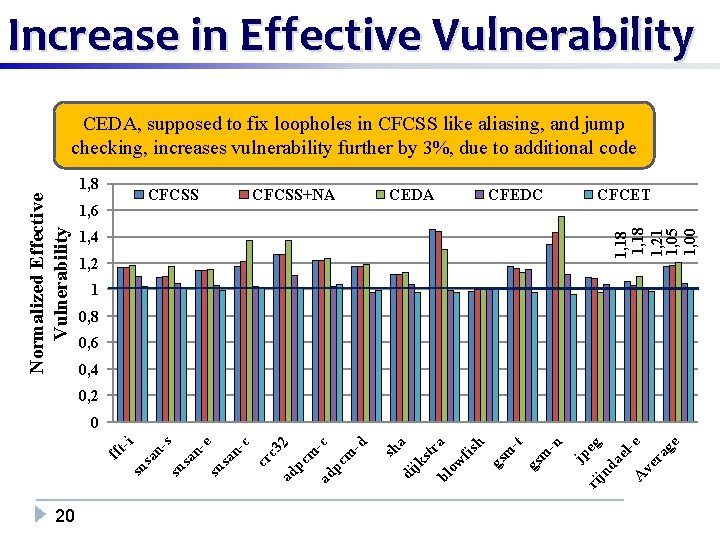
Increase in Effective Vulnerability CEDA, The effective supposedvulnerability to fix loopholes increase in CFCSS on applying like aliasing, CFCSSand : 18%, jump checking, CFCSS+NA increases : 18%, vulnerability CEDA : 21%, further CFEDC by 3%, : due 5%, to. CFCET additional : 0%code CFCSS 1, 6 CFCSS+NA CEDA CFEDC CFCET 1, 18 1, 21 1, 05 1, 00 Normalized Effective Vulnerability 1, 8 1, 4 1, 2 1 0, 8 0, 6 0, 4 0, 2 20 da el A -e ve ra ge eg jn jp ri sh di a jk st ra bl ow fis h gs m -t gs m -u ad 2 pc m ad -c pc m -d cr c 3 c nsa e su n- su sa ns sa su fft -i 0
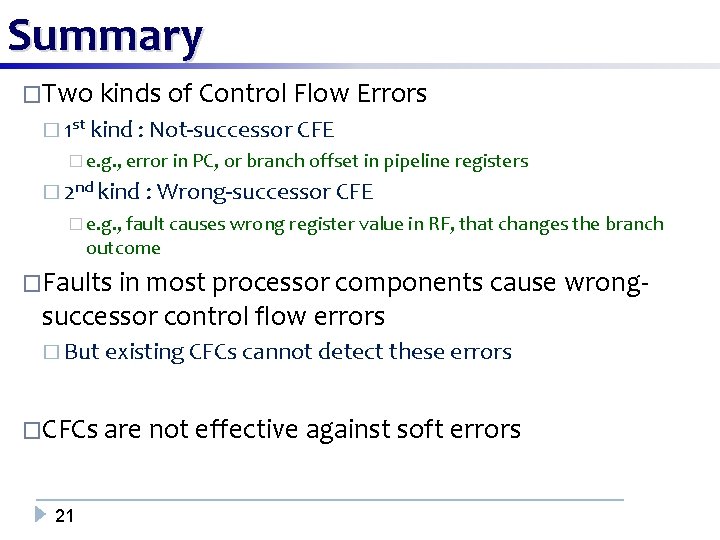
Summary �Two kinds of Control Flow Errors � 1 st kind : Not-successor CFE � e. g. , error in PC, or branch offset in pipeline registers � 2 nd kind : Wrong-successor CFE � e. g. , fault causes wrong register value in RF, that changes the branch outcome �Faults in most processor components cause wrong- successor control flow errors � But existing CFCs cannot detect these errors �CFCs are not effective against soft errors 21
Outlook � Redundancy still works � Component-based approaches � � � Power-efficient protection � � Pipeline registers can be protected � C-elements, Razor, [Gardiner et al. , IOLTS 2007] � Area overhead reported is 6. 4 to 15% ECC can protect RF � Selectively protect only the most vulnerable registers � Can reduce AVF of integer RF by up to 84% � Area overhead is 10% and power overhead is 45% for the protected registers Assertion-based fault testing, e. g. , ABFT [Abraham IEEE To. C 1984] CFC may be useful in other domains � Security, software integrity checks 22