
Quantitative Analysis Basics Sebastian M Rasinger Quantitative Research
Quantitative Analysis: Basics Sebastian M. Rasinger Quantitative Research in Linguistics. An Introduction 2 nd edition. 2013. London: Bloomsbury S. M. Rasinger. 2013. Quantitative Research in Linguistics. 2 e. Bloomsbury.
Agenda • Statistics – what for? • Quantitative data – what, how, why? • Descriptive statistics – frequencies – Measures of location – Measures of dispersion • Relationships between variables S. M. Rasinger. 2013. Quantitative Research in Linguistics. 2 e. Bloomsbury.

What is statistics? • Any orderly summary of numbers, e. g. results of an election, league table etc • Numerical measurement describing some characteristic of a sample • Collection of methodological tools which help to systematically and exemplarily collect, process and display information, e. g. inflation rate, unemployment rate S. M. Rasinger. 2013. Quantitative Research in Linguistics. 2 e. Bloomsbury.
Statistics as a basis for decisions • Numerous possibilities to process an issue statistically problem of measurement • Different interpretation of results: glass half empty or half full? • Manipulation of raw data S. M. Rasinger. 2013. Quantitative Research in Linguistics. 2 e. Bloomsbury.
Statistics: 3 purposes • Description: – Quantifying and summarising information in order to describe and display an issue in the most effective and optimal manner: tables, graphs, main statistical values – Aim: describing the reality S. M. Rasinger. 2013. Quantitative Research in Linguistics. 2 e. Bloomsbury.
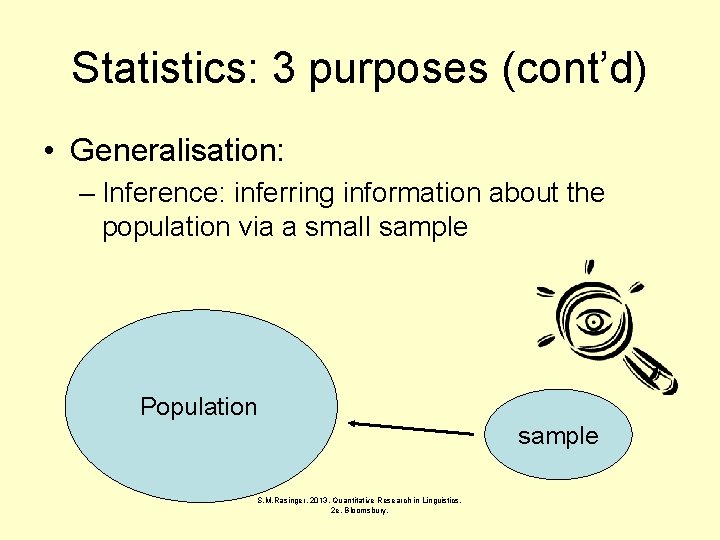
Statistics: 3 purposes (cont’d) • Generalisation: – Inference: inferring information about the population via a small sample Population sample S. M. Rasinger. 2013. Quantitative Research in Linguistics. 2 e. Bloomsbury.
Statistics: 3 purposes (cont’d) • • Identification of causal relationships, i. e. how two (or more) phenomena are related e. g. effect of learner’s age on language attainment S. M. Rasinger. 2013. Quantitative Research in Linguistics. 2 e. Bloomsbury.

Quant. Data: discrete or continuous • Discrete: finite or countable number of possible values – E. g. numbers of students in a class (there’re no half students…) • Continuous: infinitely many possible values on a continuous scale without gaps/interruptions – E. g. amount of coffee a university lecturer drinks a day: continuous (e. g. 1. 256 litres) S. M. Rasinger. 2013. Quantitative Research in Linguistics. 2 e. Bloomsbury.
Levels of measurement • Nominal data: – names, labels, categories. Cannot be arranged in high/low scheme, e. g. sex • Ordinal data: – Data may be arranged in some order, but differences between value cannot be determined or are meaningless, – e. g. ‘good’ – ‘average’ – ‘poor’ rankings S. M. Rasinger. 2013. Quantitative Research in Linguistics. 2 e. Bloomsbury.
Levels of measurement (2) • Interval data: – meaningful difference between data, but no natural zero starting point for when no quantity is present, e. g. Fahrenheit: 0° doesn’t mean no heat • Ratio data: – Natural zero point, e. g. length of lecture in minutes: 0 minutes = no lecture S. M. Rasinger. 2013. Quantitative Research in Linguistics. 2 e. Bloomsbury.
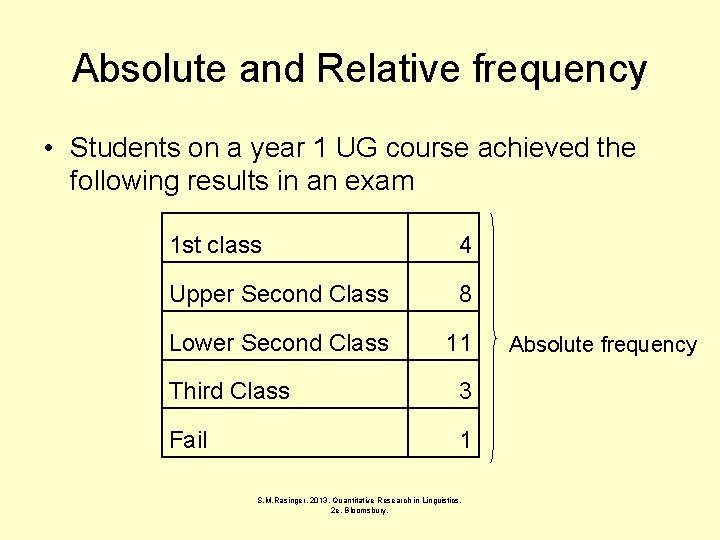
Absolute and Relative frequency • Students on a year 1 UG course achieved the following results in an exam 1 st class 4 Upper Second Class 8 Lower Second Class 11 Third Class 3 Fail 1 S. M. Rasinger. 2013. Quantitative Research in Linguistics. 2 e. Bloomsbury. Absolute frequency
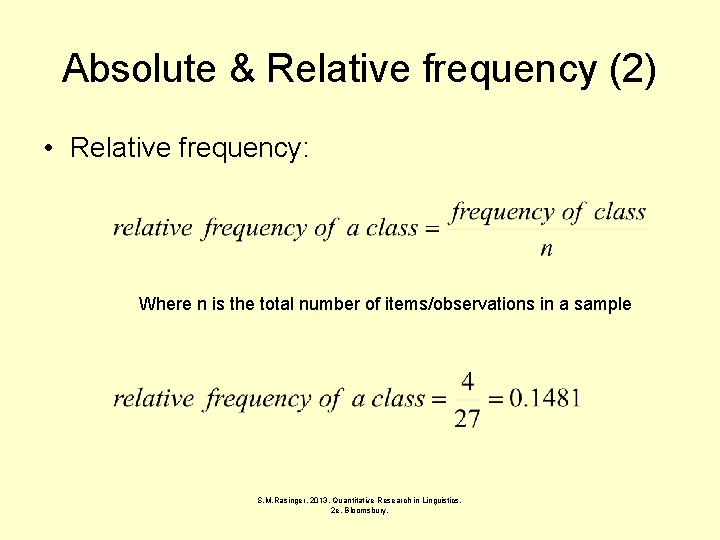
Absolute & Relative frequency (2) • Relative frequency: Where n is the total number of items/observations in a sample S. M. Rasinger. 2013. Quantitative Research in Linguistics. 2 e. Bloomsbury.
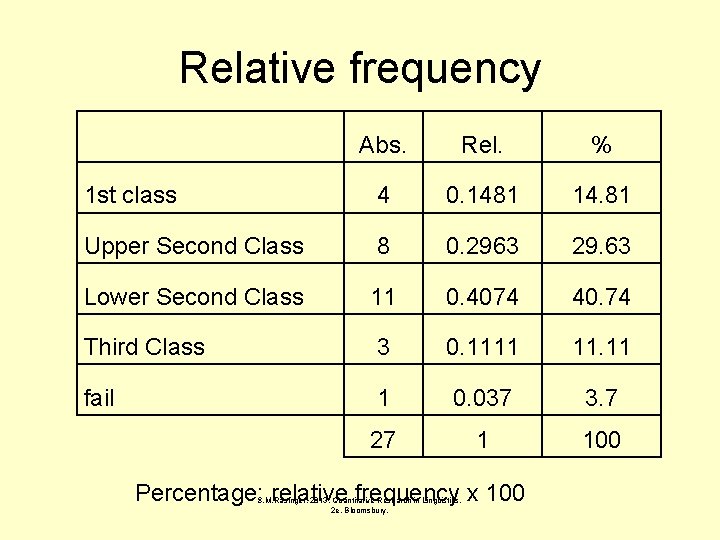
Relative frequency Abs. Rel. % 1 st class 4 0. 1481 14. 81 Upper Second Class 8 0. 2963 29. 63 Lower Second Class 11 0. 4074 40. 74 Third Class 3 0. 1111 11. 11 fail 1 0. 037 3. 7 27 1 100 Percentage: relative frequency x 100 S. M. Rasinger. 2013. Quantitative Research in Linguistics. 2 e. Bloomsbury.
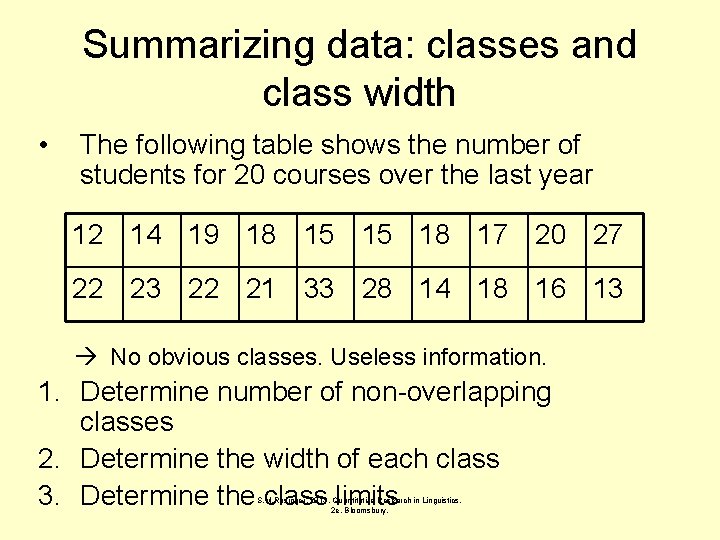
Summarizing data: classes and class width • The following table shows the number of students for 20 courses over the last year 12 14 19 18 15 15 18 17 20 27 22 23 22 21 33 28 14 18 16 13 No obvious classes. Useless information. 1. Determine number of non-overlapping classes 2. Determine the width of each class 3. Determine the class limits S. M. Rasinger. 2013. Quantitative Research in Linguistics. 2 e. Bloomsbury.
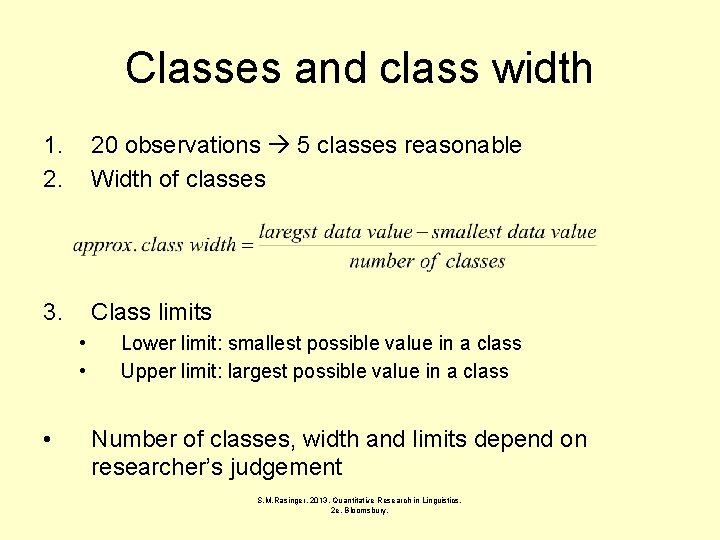
Classes and class width 1. 2. 20 observations 5 classes reasonable Width of classes 3. Class limits • • • Lower limit: smallest possible value in a class Upper limit: largest possible value in a class Number of classes, width and limits depend on researcher’s judgement S. M. Rasinger. 2013. Quantitative Research in Linguistics. 2 e. Bloomsbury.
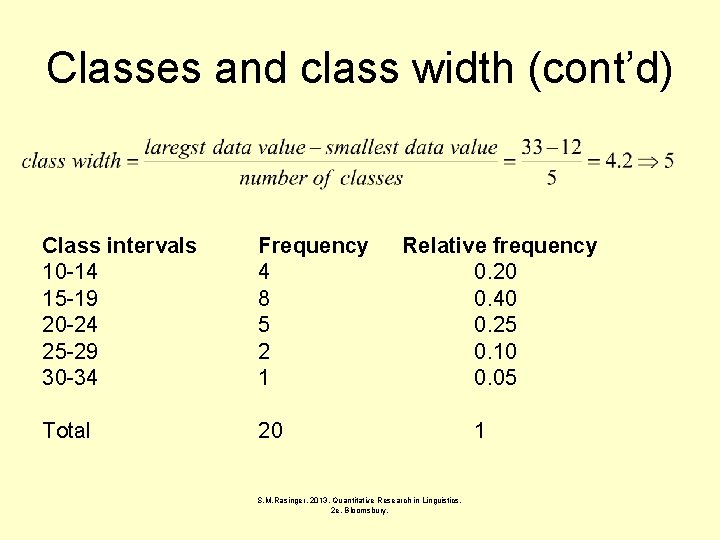
Classes and class width (cont’d) Class intervals 10 -14 15 -19 20 -24 25 -29 30 -34 Frequency 4 8 5 2 1 Total 20 Relative frequency 0. 20 0. 40 0. 25 0. 10 0. 05 S. M. Rasinger. 2013. Quantitative Research in Linguistics. 2 e. Bloomsbury. 1
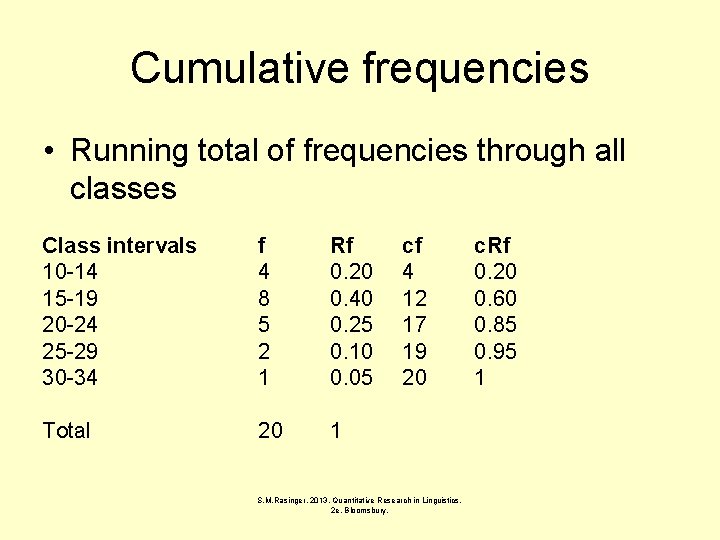
Cumulative frequencies • Running total of frequencies through all classes Class intervals 10 -14 15 -19 20 -24 25 -29 30 -34 f 4 8 5 2 1 Rf 0. 20 0. 40 0. 25 0. 10 0. 05 Total 20 1 cf 4 12 17 19 20 S. M. Rasinger. 2013. Quantitative Research in Linguistics. 2 e. Bloomsbury. c. Rf 0. 20 0. 60 0. 85 0. 95 1
- Slides: 17