
Quantifying tolerance indicator values for common stream fish


- Slides: 25
Quantifying tolerance indicator values for common stream fish species of the United States Michael R. Meador and Daren M. Carlisle U. S. Geological Survey, 12201 Sunrise Valley Drive, MS 413 Reston, VA 20192, USA U. S. Department of the Interior U. S. Geological Survey
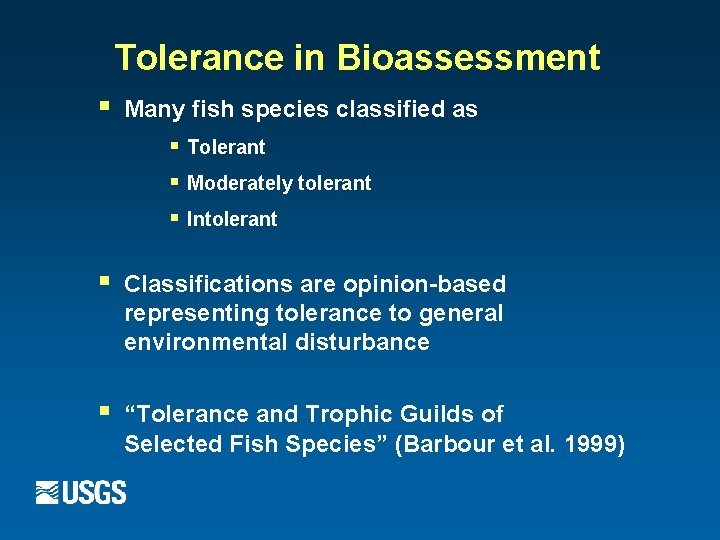
Tolerance in Bioassessment § Many fish species classified as § Tolerant § Moderately tolerant § Intolerant § Classifications are opinion-based representing tolerance to general environmental disturbance § “Tolerance and Trophic Guilds of Selected Fish Species” (Barbour et al. 1999)
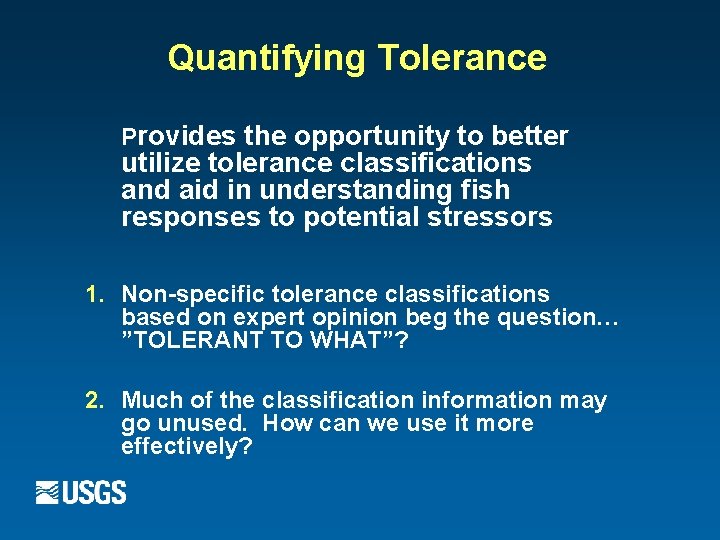
Quantifying Tolerance Provides the opportunity to better utilize tolerance classifications and aid in understanding fish responses to potential stressors 1. Non-specific tolerance classifications based on expert opinion beg the question… ”TOLERANT TO WHAT”? 2. Much of the classification information may go unused. How can we use it more effectively?
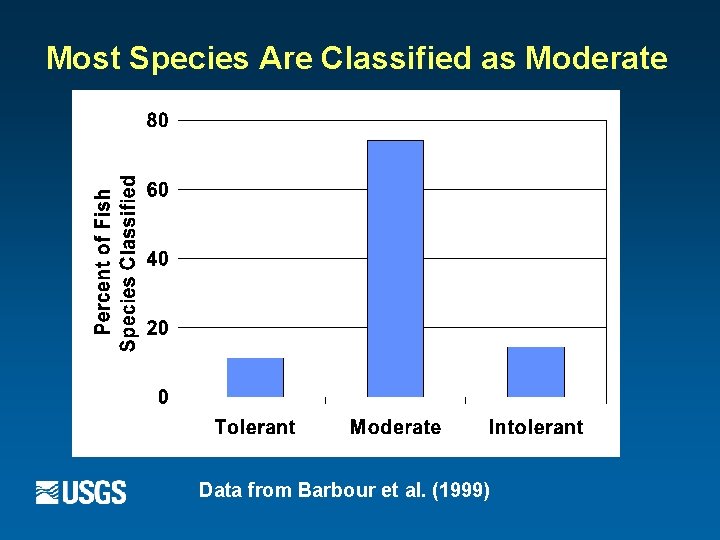
Most Species Are Classified as Moderate Data from Barbour et al. (1999)
Fish species abundance and waterquality data collected from 19932004 as part of the USGS National Water-Quality Assessment Program provided the opportunity to quantify fish species tolerances to selected water-quality variables
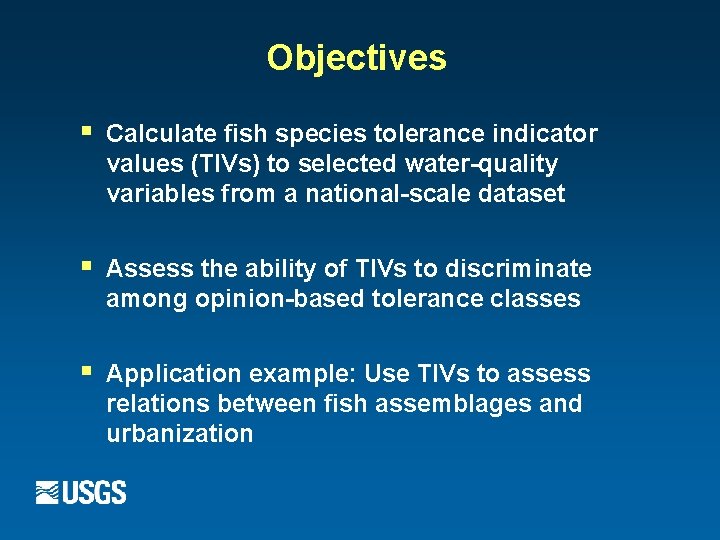
Objectives § Calculate fish species tolerance indicator values (TIVs) to selected water-quality variables from a national-scale dataset § Assess the ability of TIVs to discriminate among opinion-based tolerance classes § Application example: Use TIVs to assess relations between fish assemblages and urbanization
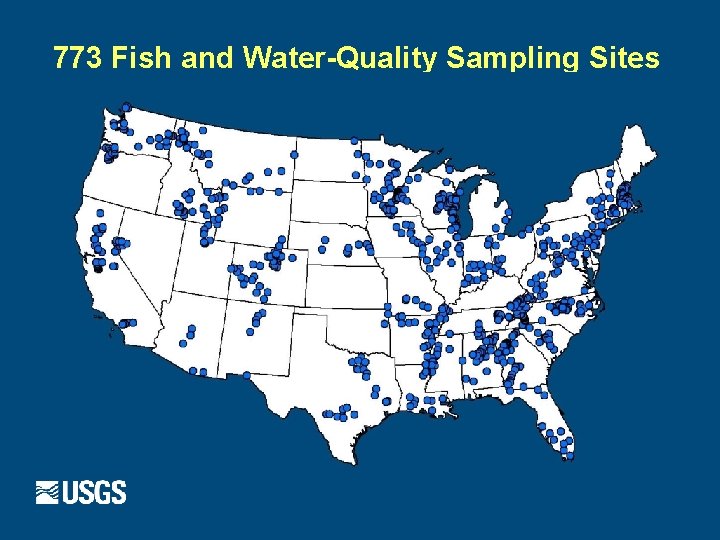
Study Area § Data were collected from 773 stream sites § Combined these sites are located downstream of basins that drain 43% of the total km of streams and rivers in the Nation
773 Fish and Water-Quality Sampling Sites
Methods § Fish collected during summer low-flow periods using a standard sampling protocol § Water-quality variables sampled during summer low-flow periods using standardized methods and collected within 14 days of fish sampling
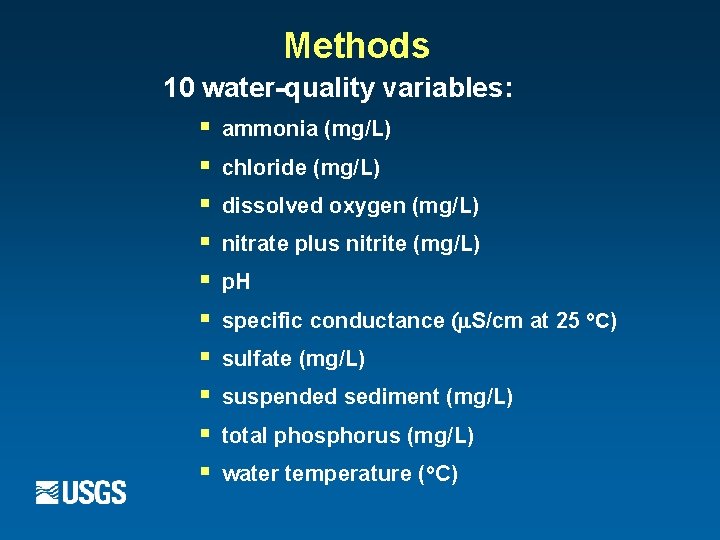
Methods 10 water-quality variables: § ammonia (mg/L) § chloride (mg/L) § dissolved oxygen (mg/L) § nitrate plus nitrite (mg/L) § p. H § specific conductance (m. S/cm at 25 o. C) § sulfate (mg/L) § suspended sediment (mg/L) § total phosphorus (mg/L) § water temperature (o. C)
Data Analysis § TIVs calculated as predictors of water-quality (WQ) variables using fish abundance weighted averaging (WA) § Included species collected from > 60 samples and >100 individuals total (all sites combined)
Creating TIVs § Transformed weighted averages to ordinal ranks (1 -10) § Ordinal rank of each species was assigned based on the percentiles of WAs across all species for each WQ variable § A rank of 1 reflected the lowest 10% of WAs whereas a rank of 10 reflected the highest 10% of WAs (except for dissolved oxygen)
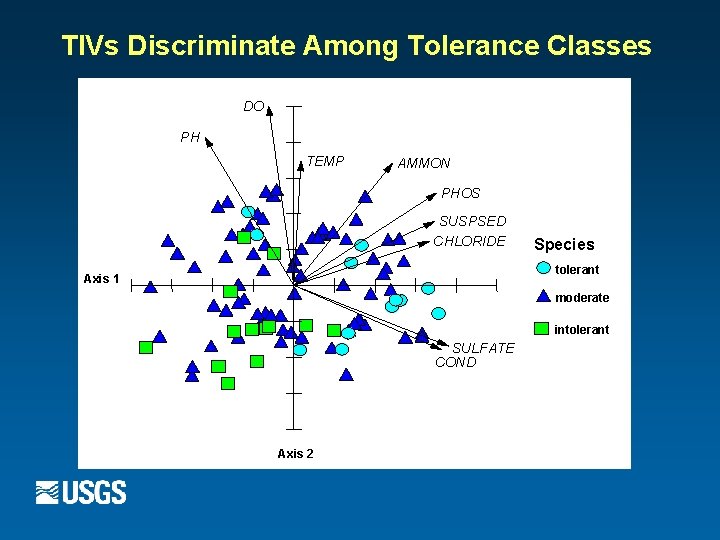
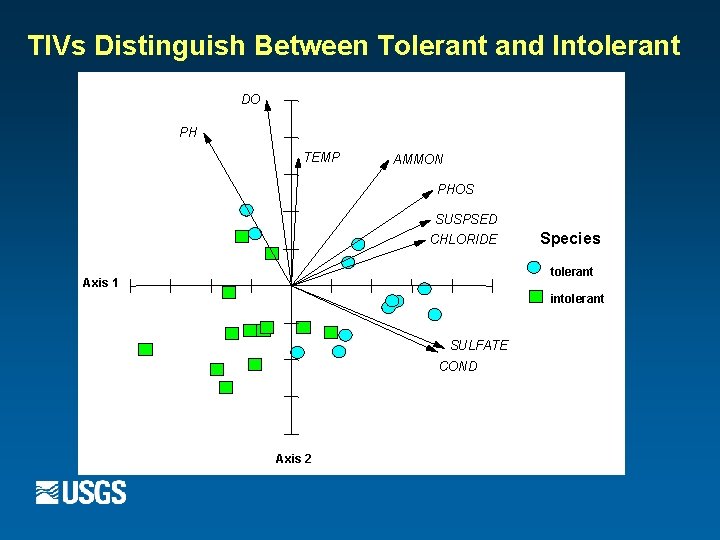
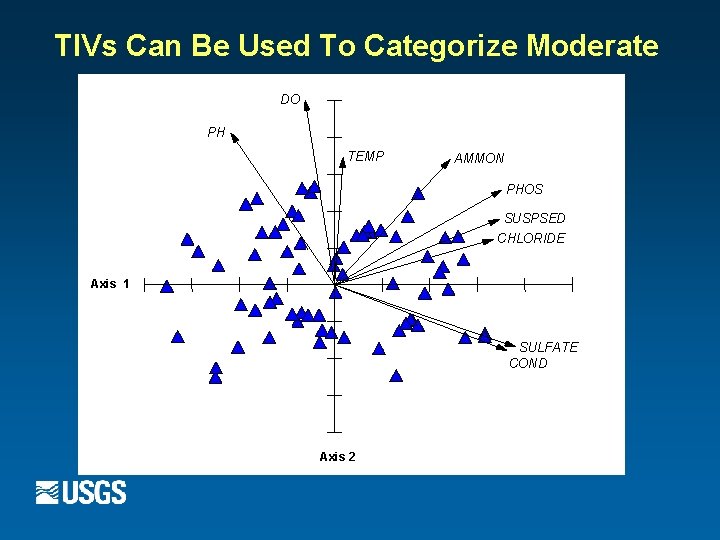
Data Analysis § Principal components analysis used to assess the ability of TIVs to discriminate among opinion-based tolerance classes § Provides a means to look at patterns in the data and identify factors that help explain those patterns
Results § 1, 734 fish assemblage samples § 583, 666 individuals § 485 fish species § TIVs were calculated for: § 105 fish species § 457, 882 individuals
TIVs Discriminate Among Tolerance Classes DO PH TEMP AMMON PHOS SUSPSED CHLORIDE Species tolerant Axis 1 moderate intolerant SULFATE COND Axis 2
TIVs Distinguish Between Tolerant and Intolerant DO PH TEMP AMMON PHOS SUSPSED CHLORIDE Species tolerant Axis 1 intolerant SULFATE COND Axis 2
TIVs Can Be Used To Categorize Moderate DO PH TEMP AMMON PHOS SUSPSED CHLORIDE Axis 1 SULFATE COND Axis 2
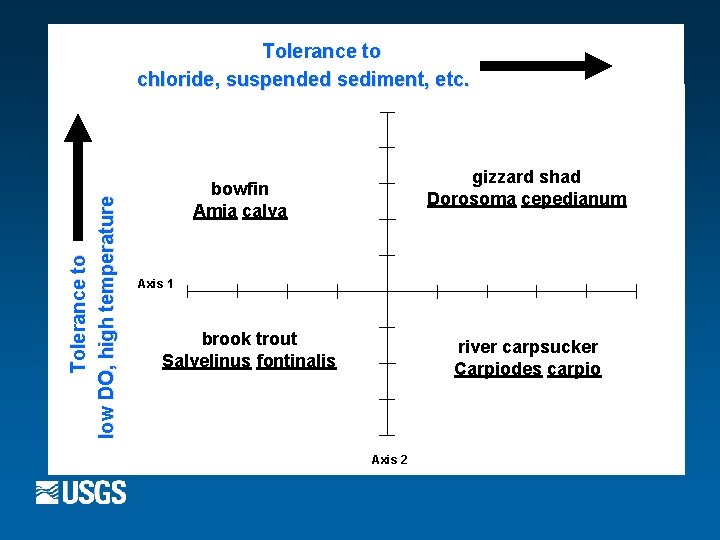
Tolerance to low DO, high temperature Tolerance to chloride, suspended sediment, etc. gizzard shad Dorosoma cepedianum bowfin Amia calva Axis 1 brook trout Salvelinus fontinalis river carpsucker Carpiodes carpio Axis 2
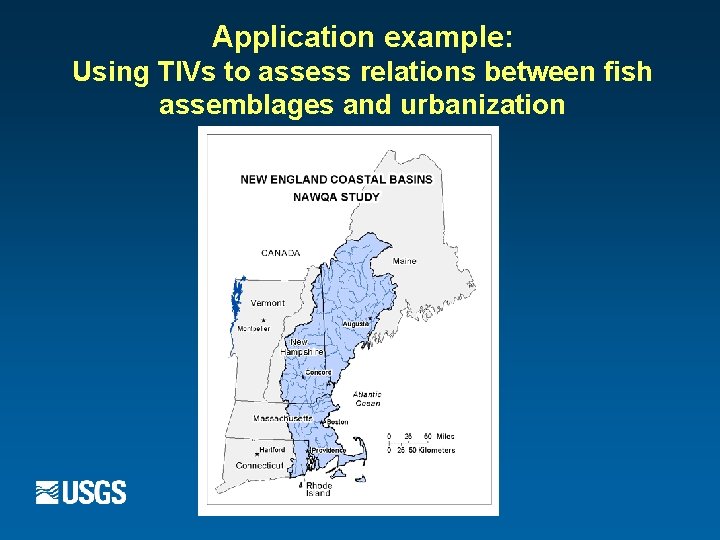
Application example: Using TIVs to assess relations between fish assemblages and urbanization
Application example: Data Analysis § Species TIVs were averaged for each of 30 sites to determine a mean TIV representing a fish assemblage for each WQ variable § Correlation analysis conducted to assess relations between mean TIVs and road density within a basin
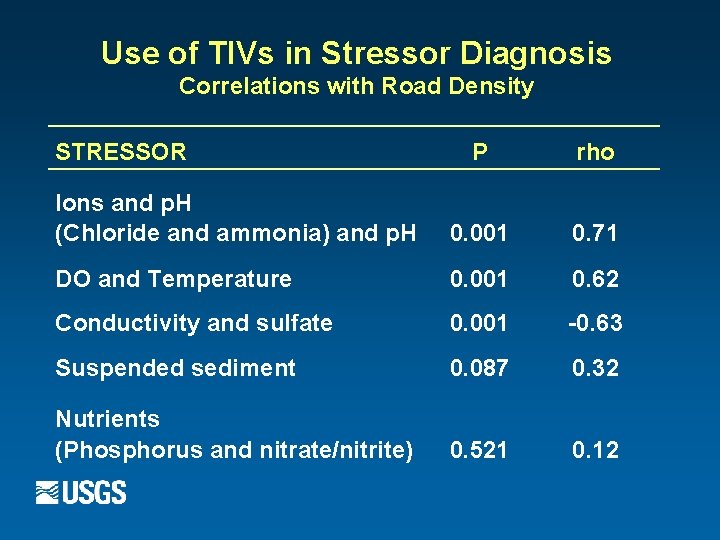
Use of TIVs in Stressor Diagnosis Correlations with Road Density STRESSOR P rho Ions and p. H (Chloride and ammonia) and p. H 0. 001 0. 71 DO and Temperature 0. 001 0. 62 Conductivity and sulfate 0. 001 -0. 63 Suspended sediment 0. 087 0. 32 Nutrients (Phosphorus and nitrate/nitrite) 0. 521 0. 12
Conclusions 1. Tolerant to what? – Tolerance variables identified 2. Can use classifications of moderate more effectively Fish species are tolerant to some stressors while less tolerant to others 3. TIVs have potential in stressor diagnosis
Cautions § Opinion-based classifications include habitat § Chemical stressors may co-vary § Wide range of environmental conditions sampled and the ordinal ranking approach robust to geographic variation
Acknowledgments We thank: - The NAWQA biologists, hydrologists, and technicians who collected data - James Falcone for GIS
http: //water. usgs. gov/nawqa/ecology