
Quantifying the influence of climate and land use
- Slides: 1
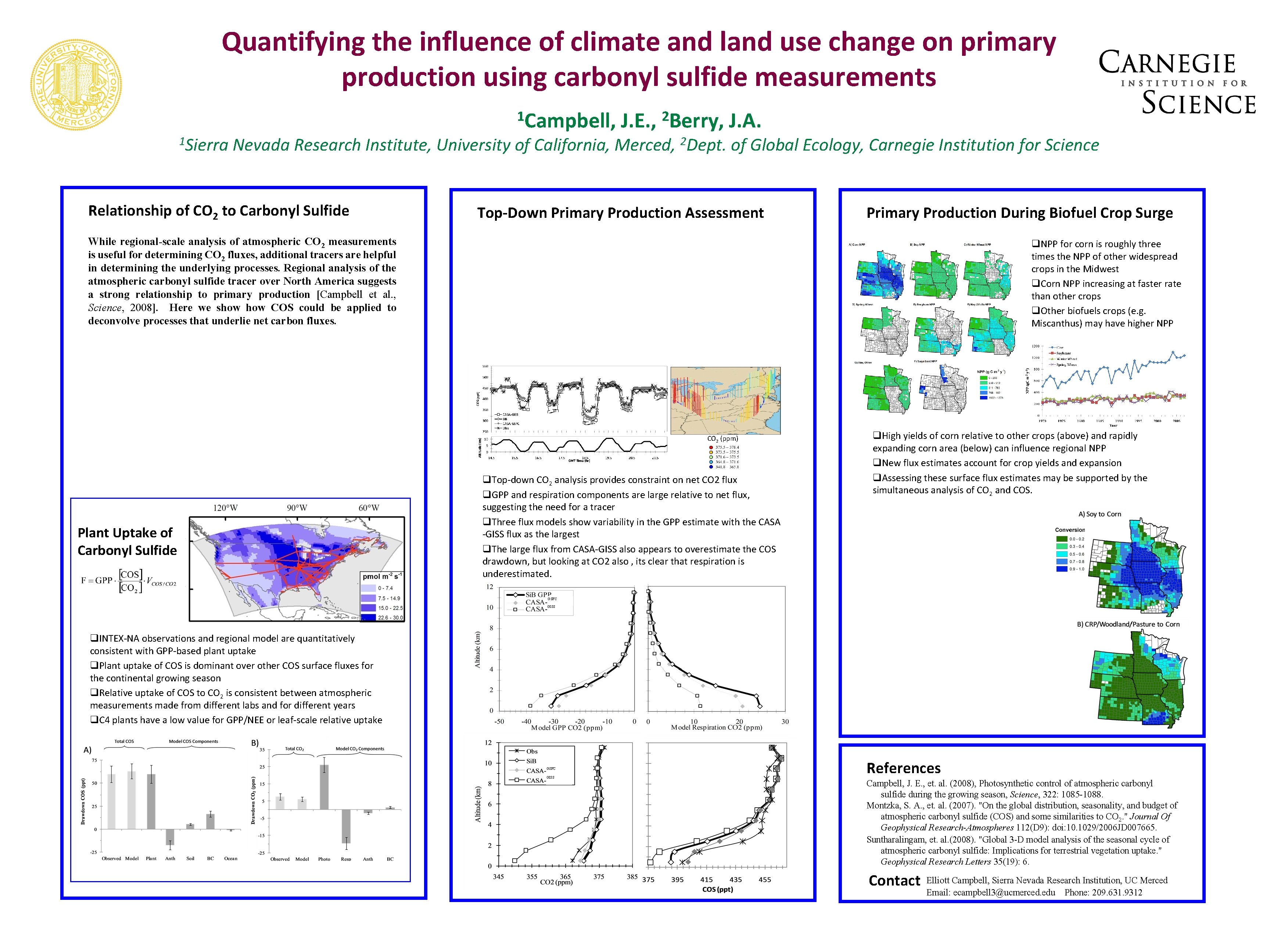
Quantifying the influence of climate and land use change on primary production using carbonyl sulfide measurements 1 Sierra 1 Campbell, J. E. , 2 Berry, Nevada Research Institute, University of California, Merced, Relationship of CO 2 to Carbonyl Sulfide 2 Dept. J. A. of Global Ecology, Carnegie Institution for Science Top-Down Primary Production Assessment Primary Production During Biofuel Crop Surge While regional-scale analysis of atmospheric CO 2 measurements is useful for determining CO 2 fluxes, additional tracers are helpful in determining the underlying processes. Regional analysis of the atmospheric carbonyl sulfide tracer over North America suggests a strong relationship to primary production [Campbell et al. , Science, 2008]. Here we show COS could be applied to deconvolve processes that underlie net carbon fluxes. q. NPP for corn is roughly three times the NPP of other widespread crops in the Midwest q. Corn NPP increasing at faster rate than other crops q. Other biofuels crops (e. g. Miscanthus) may have higher NPP CO 2 (ppm) Plant Uptake of Carbonyl Sulfide q. Top-down CO 2 analysis provides constraint on net CO 2 flux q. GPP and respiration components are large relative to net flux, suggesting the need for a tracer q. Three flux models show variability in the GPP estimate with the CASA -GISS flux as the largest q. The large flux from CASA-GISS also appears to overestimate the COS drawdown, but looking at CO 2 also , its clear that respiration is underestimated. GSFC GISS q. High yields of corn relative to other crops (above) and rapidly expanding corn area (below) can influence regional NPP q. New flux estimates account for crop yields and expansion q. Assessing these surface flux estimates may be supported by the simultaneous analysis of CO 2 and COS. GSFC Res GISS q. INTEX-NA observations and regional model are quantitatively consistent with GPP-based plant uptake q. Plant uptake of COS is dominant over other COS surface fluxes for the continental growing season q. Relative uptake of COS to CO 2 is consistent between atmospheric measurements made from different labs and for different years q. C 4 plants have a low value for GPP/NEE or leaf-scale relative uptake GSFC GISS References Campbell, J. E. , et. al. (2008), Photosynthetic control of atmospheric carbonyl sulfide during the growing season, Science, 322: 1085 -1088. Montzka, S. A. , et. al. (2007). "On the global distribution, seasonality, and budget of atmospheric carbonyl sulfide (COS) and some similarities to CO 2. " Journal Of Geophysical Research-Atmospheres 112(D 9): doi: 10. 1029/2006 JD 007665. Suntharalingam, et. al. (2008). "Global 3 -D model analysis of the seasonal cycle of atmospheric carbonyl sulfide: Implications for terrestrial vegetation uptake. " Geophysical Research Letters 35(19): 6. Contact Elliott Campbell, Sierra Nevada Research Institution, UC Merced Email: ecampbell 3@ucmerced. edu Phone: 209. 631. 9312