
Quantifying The Benefit Of Clustering And Shared Awareness
Quantifying The Benefit Of Clustering And Shared Awareness In An Information Network James Moffat, Dstl Note: This is joint work with Walter Perry, RAND.
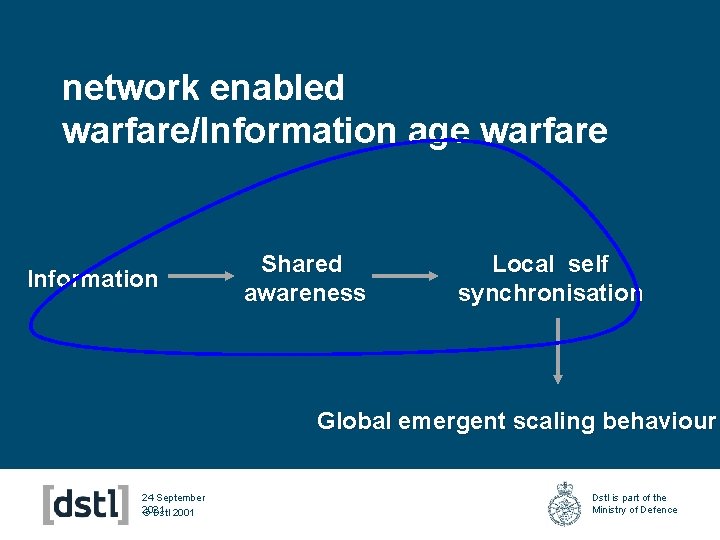
network enabled warfare/Information age warfare Information Shared awareness Local self synchronisation Global emergent scaling behaviour 24 September 2021 © Dstl 2001 Dstl is part of the Ministry of Defence
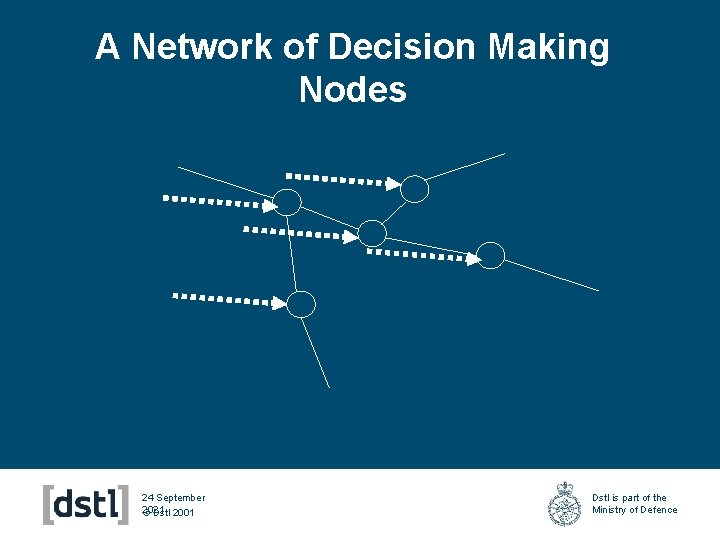
A Network of Decision Making Nodes 24 September 2021 © Dstl 2001 Dstl is part of the Ministry of Defence

Increased Network Knowledge improves rapid planning Network Knowledge With Information sharing and collaboration Without information sharing and collaboration Key Decision Point 24 September 2021 © Dstl 2001 Time Dstl is part of the Ministry of Defence

Information Superiority Reference Model Cognitive Domain Knowledge Information Domain Information Physical Domain 24 September 2021 © Dstl 2001 Dstl is part of the Ministry of Defence
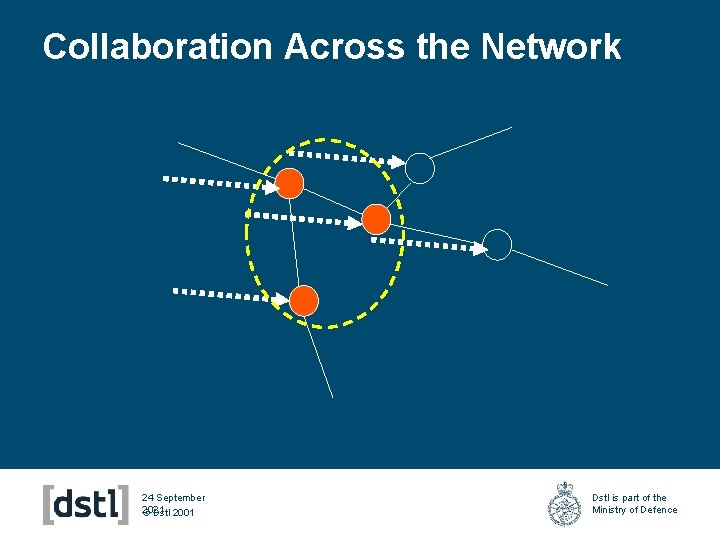
Collaboration Across the Network 24 September 2021 © Dstl 2001 Dstl is part of the Ministry of Defence
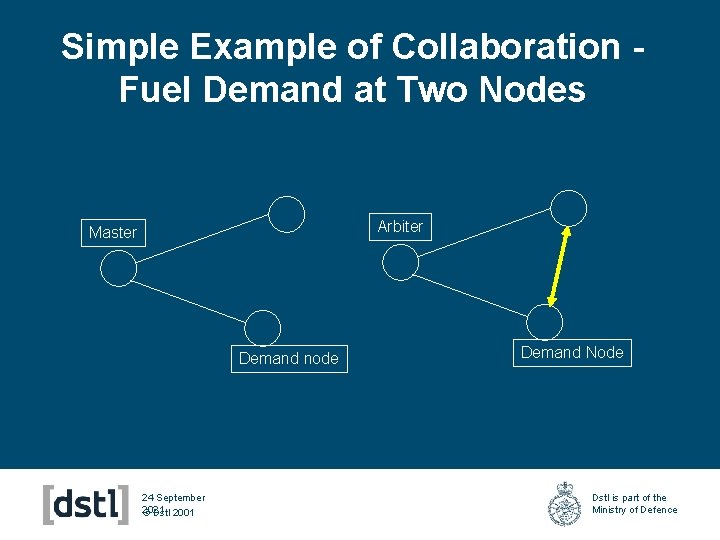
Simple Example of Collaboration Fuel Demand at Two Nodes Arbiter Master Demand node 24 September 2021 © Dstl 2001 Demand Node Dstl is part of the Ministry of Defence
The Benefit of Collaboration • Precision – The ability of a collaborating team to provide estimates that are very close together – It affects the estimate’s distribution variance • Accuracy – The ability of the collaborating team to provide estimates close to ground truth – It affects the estimate’s distribution mean • Correlation – The ability of the collaborating team to understand the way variables relate to each other – It affects the estimate’s joint probability distribution • All Contribute to Knowledge 24 September 2021 © Dstl 2001 Dstl is part of the Ministry of Defence
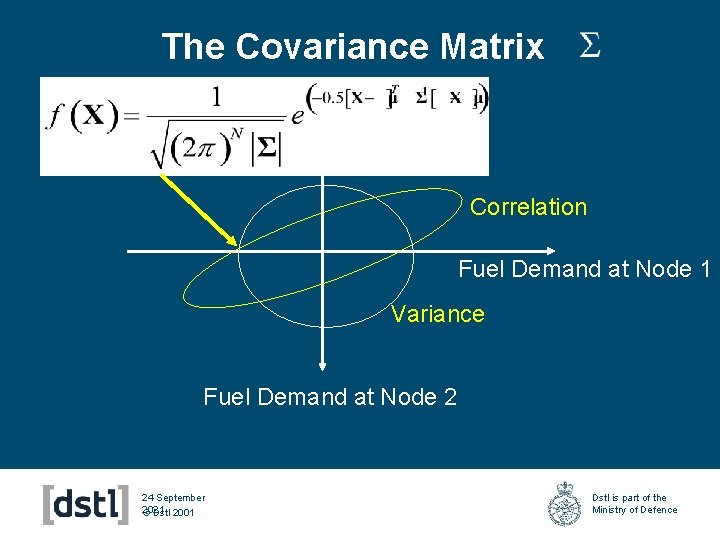
The Covariance Matrix Correlation Fuel Demand at Node 1 Variance Fuel Demand at Node 2 24 September 2021 © Dstl 2001 Dstl is part of the Ministry of Defence
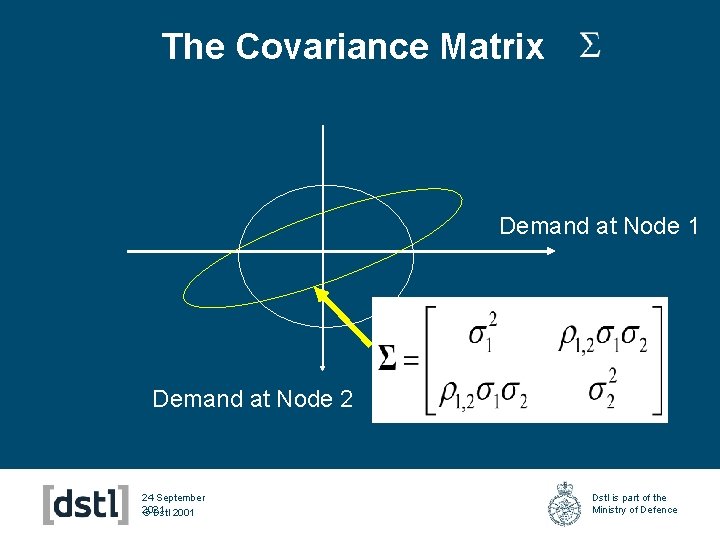
The Covariance Matrix Demand at Node 1 Demand at Node 2 24 September 2021 © Dstl 2001 Dstl is part of the Ministry of Defence
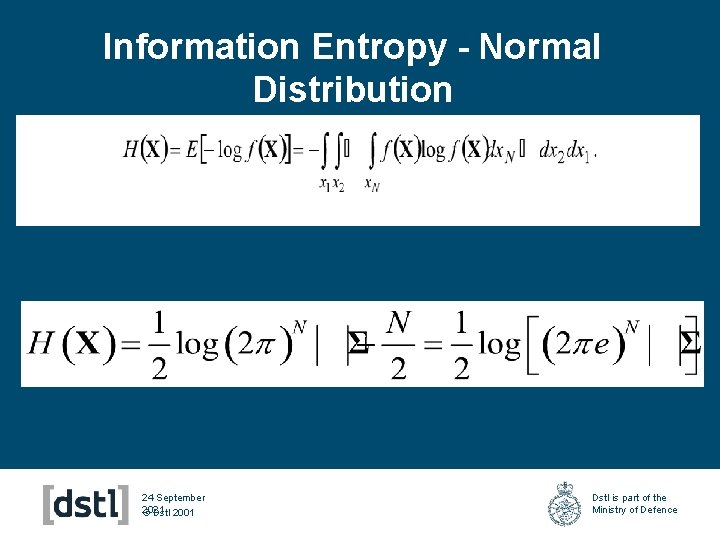
Information Entropy - Normal Distribution 24 September 2021 © Dstl 2001 Dstl is part of the Ministry of Defence
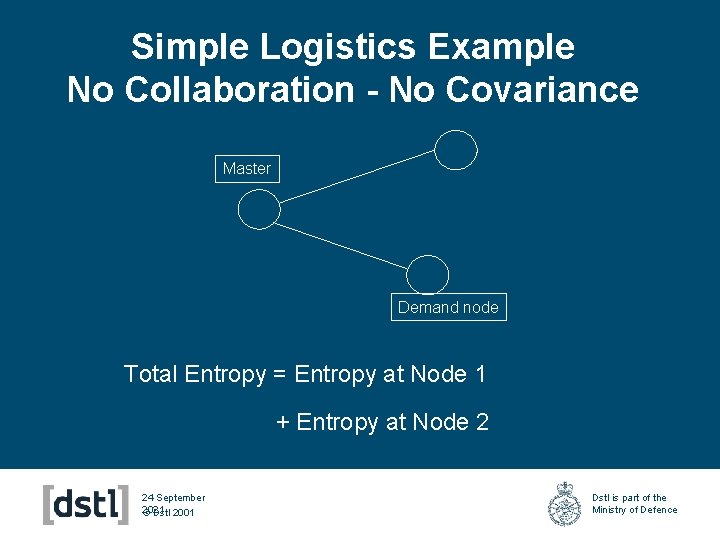
Simple Logistics Example No Collaboration - No Covariance Master Demand node Total Entropy = Entropy at Node 1 + Entropy at Node 2 24 September 2021 © Dstl 2001 Dstl is part of the Ministry of Defence
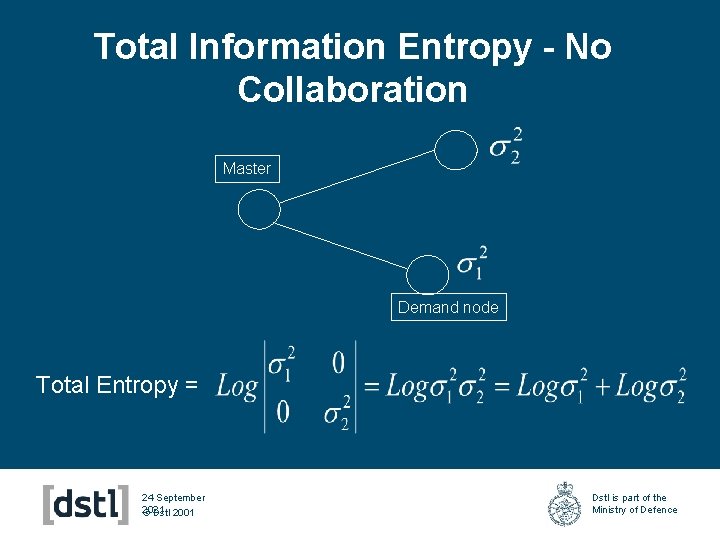
Total Information Entropy - No Collaboration Master Demand node Total Entropy = 24 September 2021 © Dstl 2001 Dstl is part of the Ministry of Defence
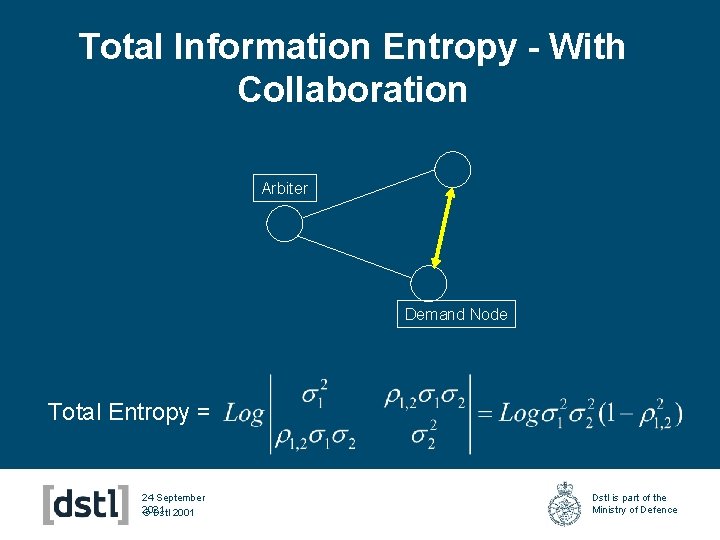
Total Information Entropy - With Collaboration Arbiter Demand Node Total Entropy = 24 September 2021 © Dstl 2001 Dstl is part of the Ministry of Defence
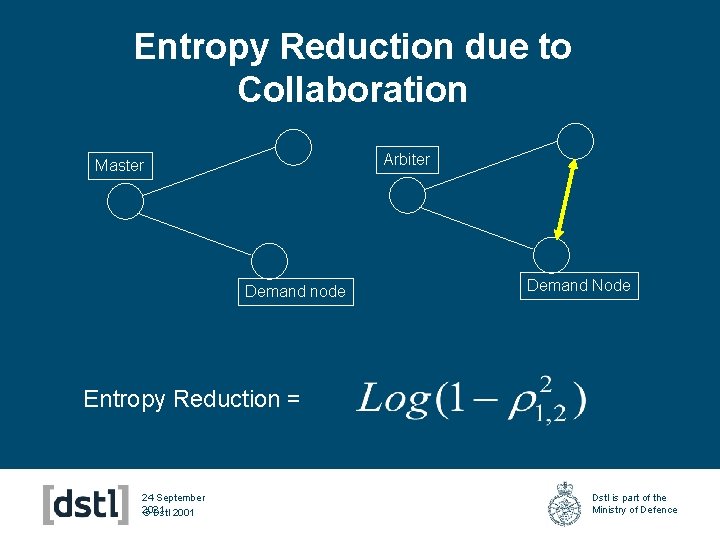
Entropy Reduction due to Collaboration Arbiter Master Demand node Demand Node Entropy Reduction = 24 September 2021 © Dstl 2001 Dstl is part of the Ministry of Defence
Source References • J Moffat ‘Command Control in the Information Age Representing its Impact’ The Stationery Office, London, UK, 2002. • J Moffat ‘Complexity Theory and Network Centric Warfare’ in press, CCRP, OSD, Do. D, USA, 2003. • W Perry, J Moffat ‘Information Sharing among Military Headquarters; The Impact on Decision Making’ in press, RAND Corporation DRR-2965 -UK, 2003. 24 September 2021 © Dstl 2001 Dstl is part of the Ministry of Defence
- Slides: 16