
Quantifying Predicting and Exploiting Uncertainty Glen Gawarkiewicz WHOI

- Slides: 41
Quantifying, Predicting, and Exploiting Uncertainty Glen Gawarkiewicz WHOI Taipei, Taiwan March 12 -14, 2008
Outline • • • QPE Workshop Goals and Schedule Working Definition of Uncertainty Review of Science Plan Major Issues in Integration Final Workshop Objectives
Workshop Goals • Present science plans for individual groups • Coordinate U. S-Taiwan Science plans • Integrate plans to create detailed science plan for pilot, preliminary science plan for main field effort • Action plan for preparations for pilot and main experiment • Report detailing results of workshop
Workshop Schedule • Wednesday Morning – Presentation of Individual Science Plans – Professor Shu-Kun Hsu- Bathymetry, Sediments, Tectonics of study region • Wednesday Afternoon – Discussion in Breakout Groups of Pilot Experiment – Physical Oceanography/Modeling and Acoustics/Geoacoustics working groups • Thursday Morning – Report of Group discussion on Pilot Experiment – Working Group discussions on Main Experiment
Workshop Schedule • Thursday Afternoon – Working group reports on Main Experiment to Entire Group – Revisit Pilot Plans for Additions or Changes – Logistics/Communications/Other Programs – Action Plan for Pilot Experiment – Assignments for Report, Next Meeting • Friday – Tour of Keelung Harbor and National Taiwan Ocean University
Working Definition of Uncertainty (Lermusiaux) • Error refers to the difference between the truth and the estimate. • Uncertainty is defined in terms of the PDF of the error. • Uncertainty representations are 4 -D fields in time and space. • For any estimate, the portion of variability that contains errors contributes to uncertainty. The variability that is unresolved is purely uncertainty.
QPE Goals and Objectives • New techniques in evaluating uncertainty in seabed, ocean, and acoustic propagation will be applied to observations in East China Sea • Focus will be on passive acoustics in frequency range of 1004000 Hz • Key goals will be to bound uncertainty and develop metrics that can quantify how well uncertainty can be exploited to improve Signal to Noise ratio for propagation • Basic research into Physical Oceanographic processes important to propagation including Kuroshio Intrusions, Cold Dome structure and variability, and non-linear internal waves and internal tides • Assessment of geoacoustic uncertainty over outer shelf in study region and assessment of contributions to uncertainty in transmission loss • Measurement of ambient noise and assessment of its contribution to uncertainty in transmission loss
Science Questions (1) • How large are uncertainties in transmission loss over the continental shelf and slope in the ECS? • What are the ambient noise levels and directionality in this region? • What are the dominant mechanisms and relative contributions of environmental uncertainty to transmission loss and ambient noise?
Science Questions (2) • What is the structure and variability of the Cold Dome over the outer continental shelf northeast of Taiwan? • How predictable are Kuroshio intrusions onto the outer shelf in this region? • How predictable are internal tides and internal waves in this region?
Science Questions (3) • What are the uncertainties in bottom geoacoustic properties over the outer shelf and continental slope? • How do uncertainties in bottom geoacoustic properties and morphology affect uncertainty in acoustic performance prediction?
Science Questions (4) • How do oceanographic processes over the outer shelf and upper slope in the ECS affect uncertainty in acoustic performance prediction? • How can knowledge of the spatial structure or temporal shifts in uncertainty of acoustic performance prediction be exploited to improve passive acoustics signal-to-noise ratios?
Science Plan (Lee and Lien) Intensive Study Area (ISA) OUT
Surface Thermal Structure Intensive Study Area is within Cold Dome and near Kuroshio Influenced by northward flow through Taiwan strait Strong barotropic and internal tides (M 2 dominant) SST October, 2006 (Caruso and Graber)
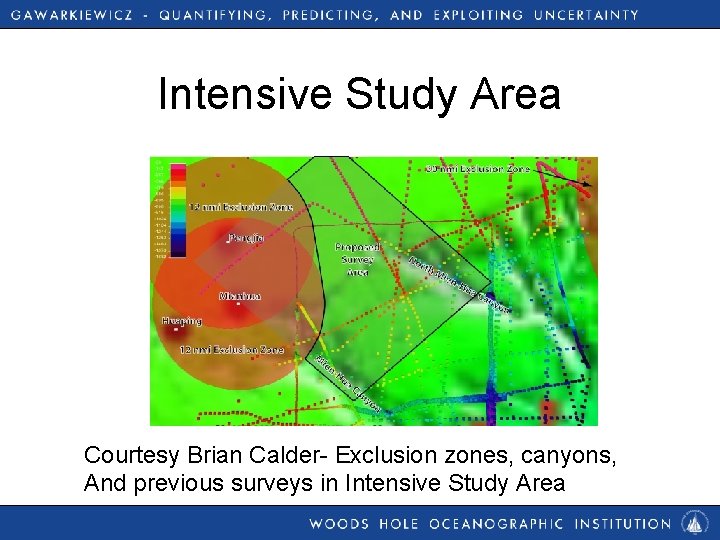
Intensive Study Area Courtesy Brian Calder- Exclusion zones, canyons, And previous surveys in Intensive Study Area
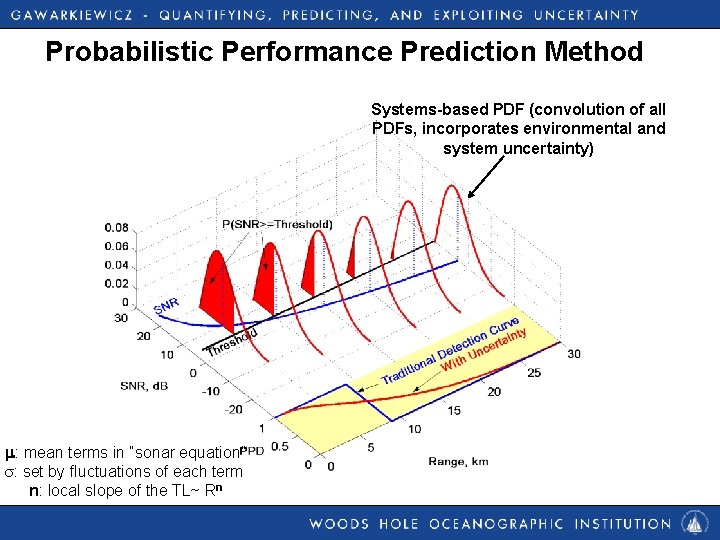
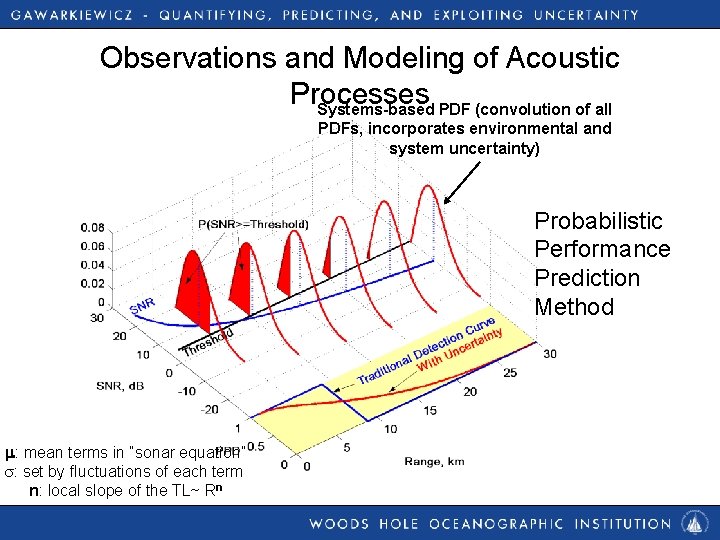
Probabilistic Performance Prediction Method Systems-based PDF (convolution of all PDFs, incorporates environmental and system uncertainty) : mean terms in “sonar equation” s: set by fluctuations of each term n: local slope of the TL~ Rn
Measurement and Modeling Tools
Timeline
Status for US QPE PI’s • Proposals were submitted mid-October 2007 • Funding decisions announced in December 2007 • Revised proposals with new work plans submitted in late January/February 2008 • Funding should arrive late March/April 2008 (hopefully)
First Task- Individual Goals and Plans • Present 3 -5 slides on science objectives and tools to achieve goals • Make sure to mention timing of observations and ship/logistics needs or model tools and data/communications needs • For US Investigators, highlight Taiwanese collaboration
Second Task- Coordination and Planning in Two Groups • Working group discussions- identify necessary model/data analysis tasks, develop timeline relative to field work, discuss observational plans, data needs for analysis • Identify shortcomings in science plan and suggest remedies (within program finances) • Suggest model sensitivity studies for improving environmental keys • Highlight logistics, communications, and remote sensing needs
Third Task- Overall Program Integration • Will pilot program meet needs of preparation for main field program? • How best do we use environmental uncertainty fields to drive sampling? What techniques? • Actions necessary to ensure logistical/communications/remote sensing needs are met • Timetables for model sensitivity studies and other analysis
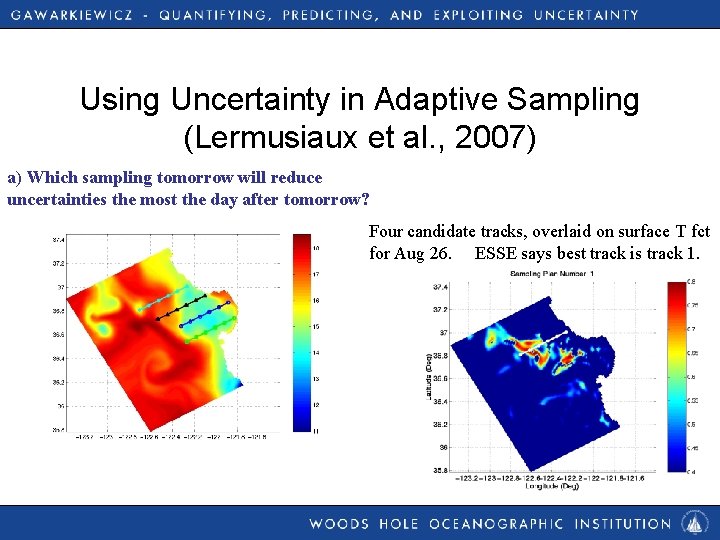
Using Uncertainty in Adaptive Sampling (Lermusiaux et al. , 2007) a) Which sampling tomorrow will reduce uncertainties the most the day after tomorrow? Four candidate tracks, overlaid on surface T fct for Aug 26. ESSE says best track is track 1.
Project Website • http: //www. whoi. edu/science/PO/qpe • Username- qpe • Password- uncertainty
Daily Hydrographic Mapping and Adaptive Sampling Towed Scanfish- 50 km by 30 km box daily Alongshelf scale= 10 km between sections Used to help decide mobile sound source tracks
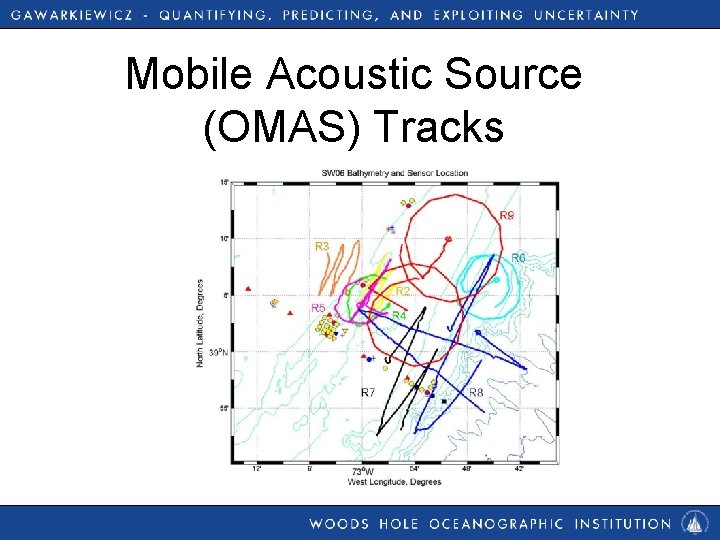
Mobile Acoustic Source (OMAS) Tracks
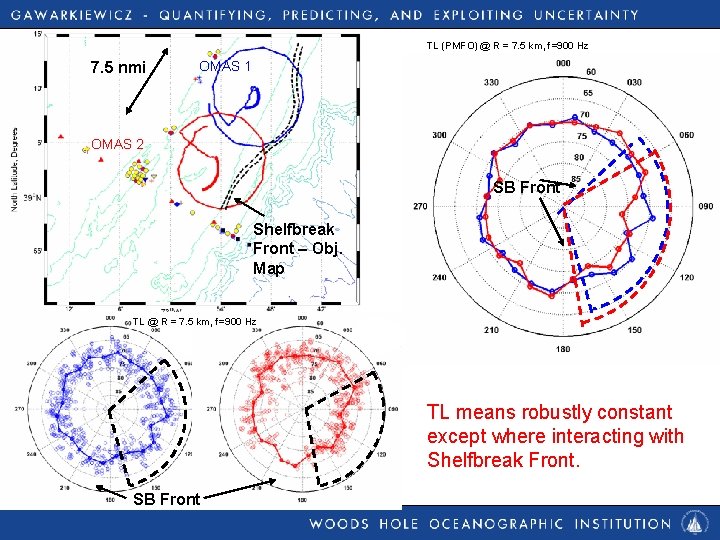
TL (PMFO) @ R = 7. 5 km, f=900 Hz 7. 5 nmi OMAS 1 OMAS 2 SB Front Shelfbreak Front – Obj. Map TL @ R = 7. 5 km, f=900 Hz TL means robustly constant except where interacting with Shelfbreak Front. SB Front
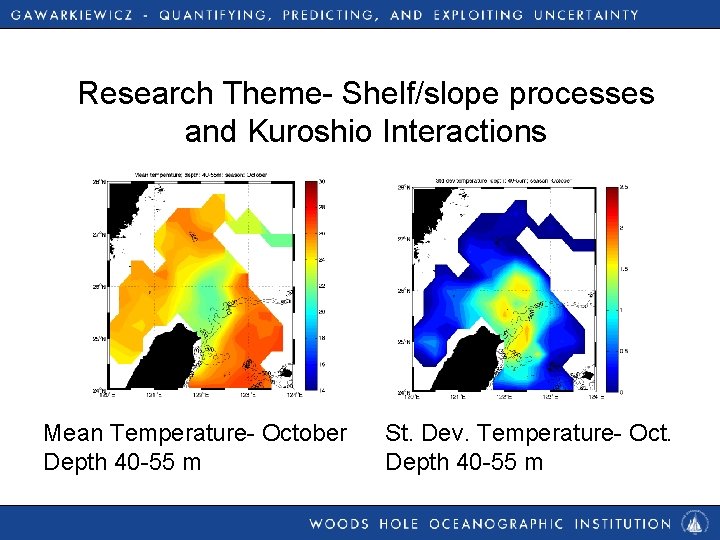
Research Theme- Shelf/slope processes and Kuroshio Interactions Mean Temperature- October Depth 40 -55 m St. Dev. Temperature- Oct. Depth 40 -55 m
Research Theme- Shelf/Slope Processes and Kuroshio Interactions • Predictability of Kuroshio Intrusions (correlations with SSH gradients) • Up-canyon flows and impact on Cold Dome • Internal tides and possible trapping over slope • Internal wave climate
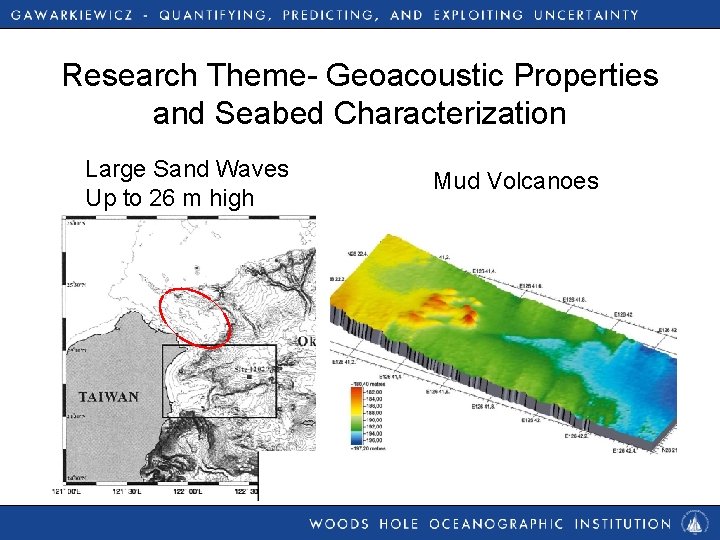
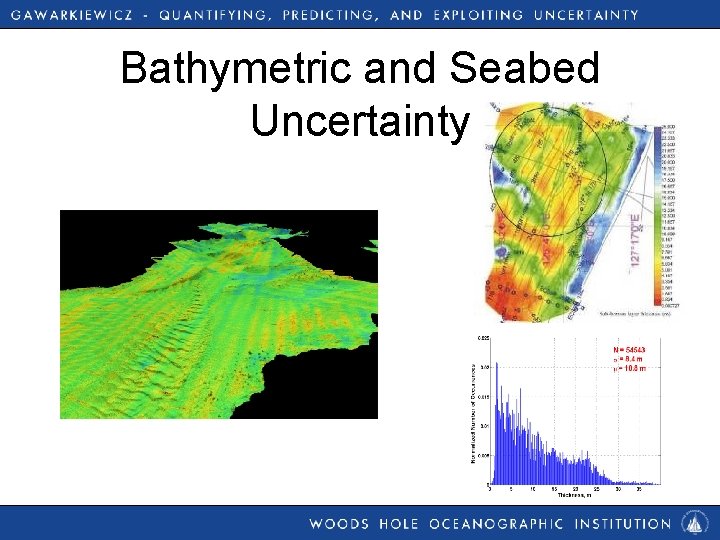
Research Theme- Geoacoustic Properties and Seabed Characterization Large Sand Waves Up to 26 m high Mud Volcanoes
Research Theme- Geoacoustic Properties and Seabed Characterization • Uncertainty in bathymetry near canyons and over continental slope • Spatial distribution of sand waves and mud volcanoes • Wide variety of soundspeeds with interstitial gases, clays and muds, sands, and carbonate pavements • Analysis of existing databases (NCOR) on bottom types and cores
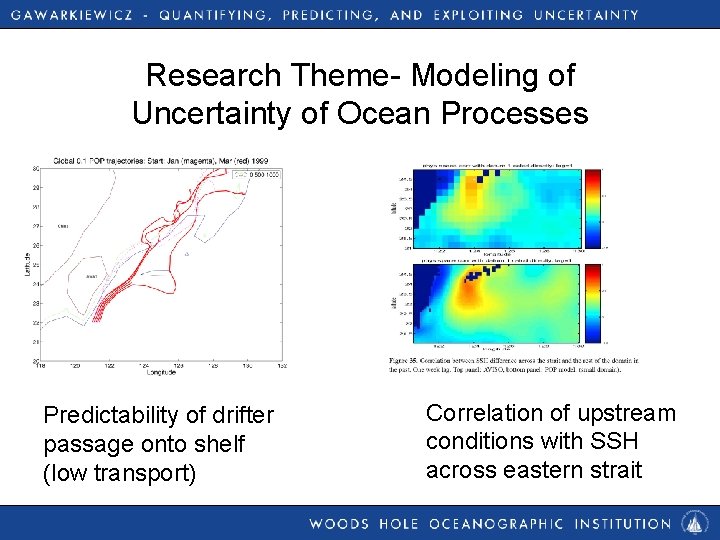
Research Theme- Modeling of Uncertainty of Ocean Processes Predictability of drifter passage onto shelf (low transport) Correlation of upstream conditions with SSH across eastern strait
Research Theme- Modeling of Uncertainty of Ocean Processes • Calculation of time-dependent uncertainty fields via adjoint models and ensemble methods (ESSE) • Use of models for adaptive sampling to reduce uncertainty to obtain optimum states • Particular focus on upstream boundary conditions necessary for prediction of ocean state and acoustic performance prediction
Observations and Modeling of Acoustic Processes Systems-based PDF (convolution of all PDFs, incorporates environmental and system uncertainty) Probabilistic Performance Prediction Method : mean terms in “sonar equation” s: set by fluctuations of each term n: local slope of the TL~ Rn
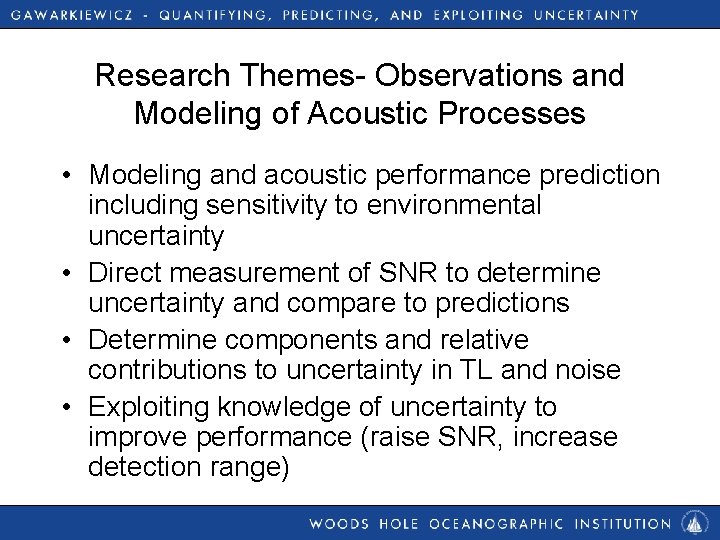
Research Themes- Observations and Modeling of Acoustic Processes • Modeling and acoustic performance prediction including sensitivity to environmental uncertainty • Direct measurement of SNR to determine uncertainty and compare to predictions • Determine components and relative contributions to uncertainty in TL and noise • Exploiting knowledge of uncertainty to improve performance (raise SNR, increase detection range)
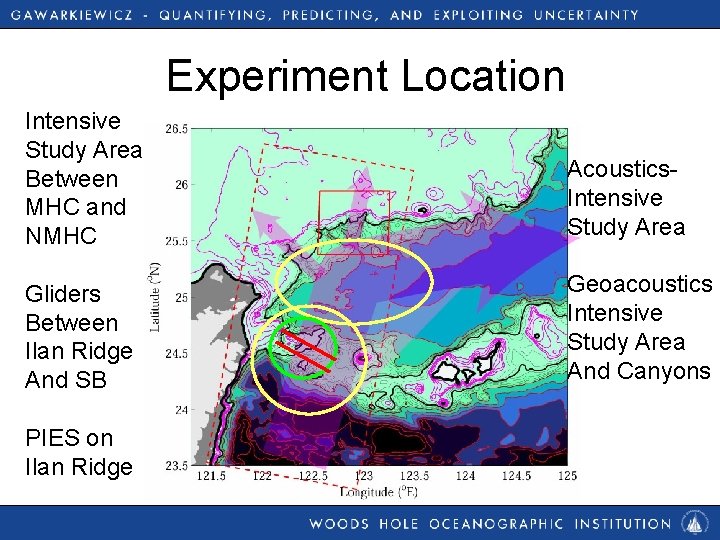
Experiment Location Intensive Study Area Between MHC and NMHC Acoustics. Intensive Study Area Gliders Between Ilan Ridge And SB Geoacoustics Intensive Study Area And Canyons PIES on Ilan Ridge
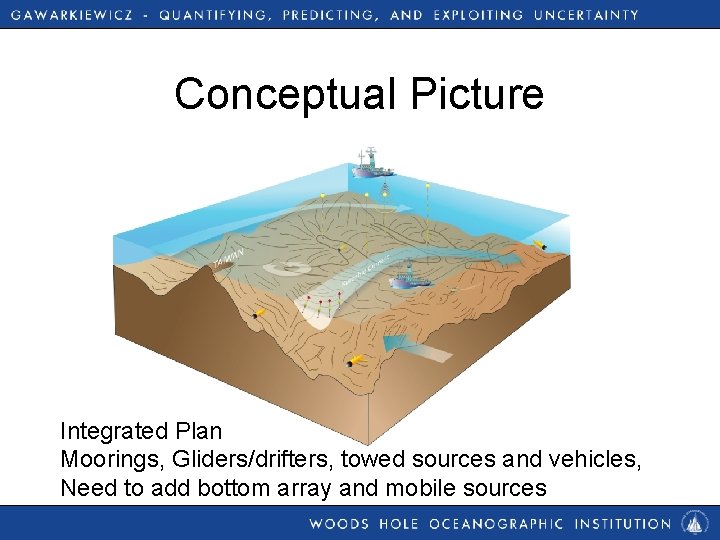
Conceptual Picture Integrated Plan Moorings, Gliders/drifters, towed sources and vehicles, Need to add bottom array and mobile sources
Which way to the Cold Dome?
Bathymetric and Seabed Uncertainty
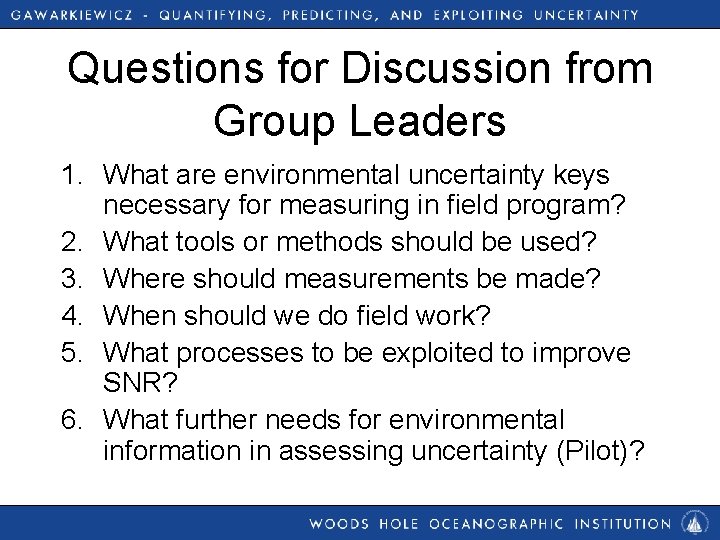
Questions for Discussion from Group Leaders 1. What are environmental uncertainty keys necessary for measuring in field program? 2. What tools or methods should be used? 3. Where should measurements be made? 4. When should we do field work? 5. What processes to be exploited to improve SNR? 6. What further needs for environmental information in assessing uncertainty (Pilot)?
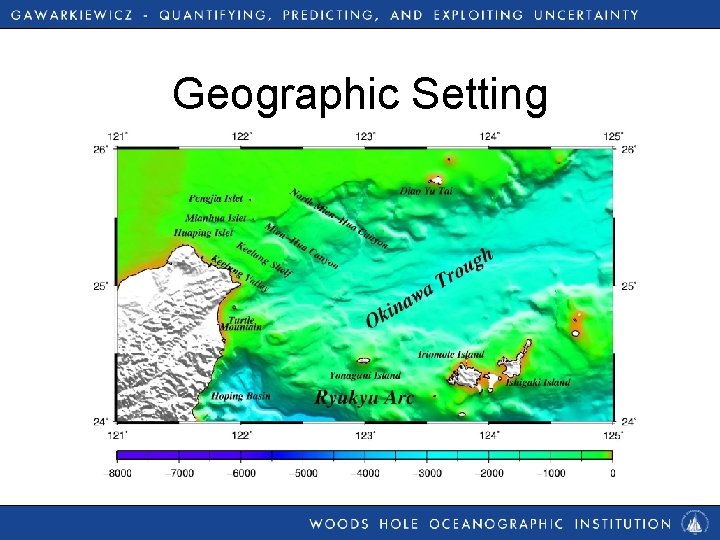
Geographic Setting
General Circulation