
Quantifying Economic Dependency Expert Group Meeting Measuring population
- Slides: 22
Quantifying Economic Dependency Expert Group Meeting: “Measuring population ageing: Bridging Research and Policy”, Bangkok, Thailand, 25 -26 February 2019 Session 6: Case studies: SDG 8 – Decent work and economic growth Alexia Fürnkranz-Prskawetz TU Wien, Institute of Statistics and Mathematical Methods in Economics Wittgenstein Centre for Demography and Global Human Capital (VID/IIASA/WU)
Economic Dependency Measures Characteristic feature of the economic life course: Ø Periods of economic dependency: childhood and old age Ø Differences in economic life course by socio-economic characteristics & institutional framework Economic Dependency Ratios (DR): Ø Measure the degree of economic dependency and their expected change due to population ageing. Ø Provide information about economic consequences of population ageing and are used to guide and legitimate policy. Ø Results depend strongly on the exact definition of dependency
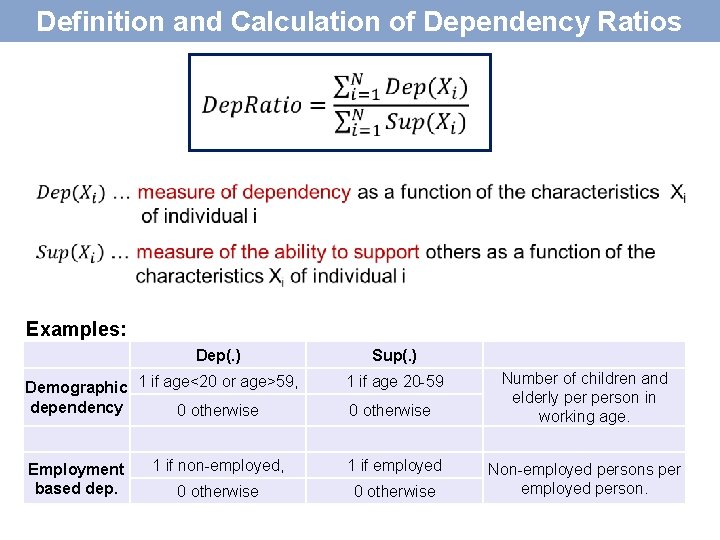
Definition and Calculation of Dependency Ratios Examples: Dep(. ) Demographic 1 if age<20 or age>59, dependency 0 otherwise Employment based dep. Sup(. ) 1 if age 20 -59 0 otherwise 1 if non-employed, 1 if employed 0 otherwise Number of children and elderly person in working age. Non-employed persons per employed person.
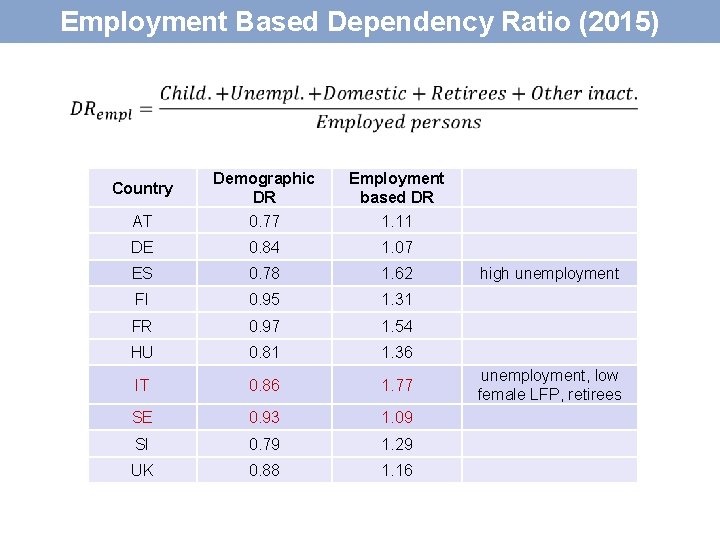
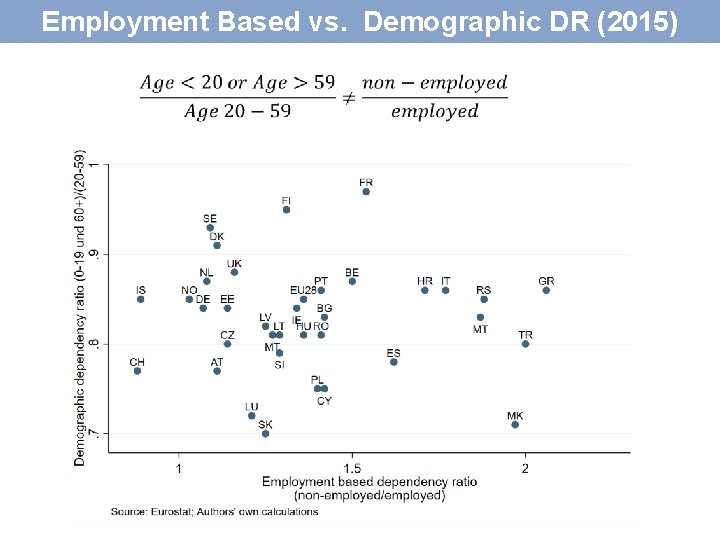
Employment Based Dependency Ratio (2015) AT Demographic DR 0. 77 Employment based DR 1. 11 DE 0. 84 1. 07 ES 0. 78 1. 62 FI 0. 95 1. 31 FR 0. 97 1. 54 HU 0. 81 1. 36 IT 0. 86 1. 77 SE 0. 93 1. 09 SI 0. 79 1. 29 UK 0. 88 1. 16 Country high unemployment, low female LFP, retirees
Employment Based vs. Demographic DR (2015)
National Transfer Accounts (NTA) NTA introduce demographic information into National Accounts National Transfer Accounts (NTA) measure by demographic groups: Ø Production and the generation of income Ø Distribution of income: public and private transfers Ø Use of income: consumption and saving The dataset contains per-capita averages of income, transfers contributions, transfer benefits, consumption and saving by demographic group => age-profiles of extent of economic activity
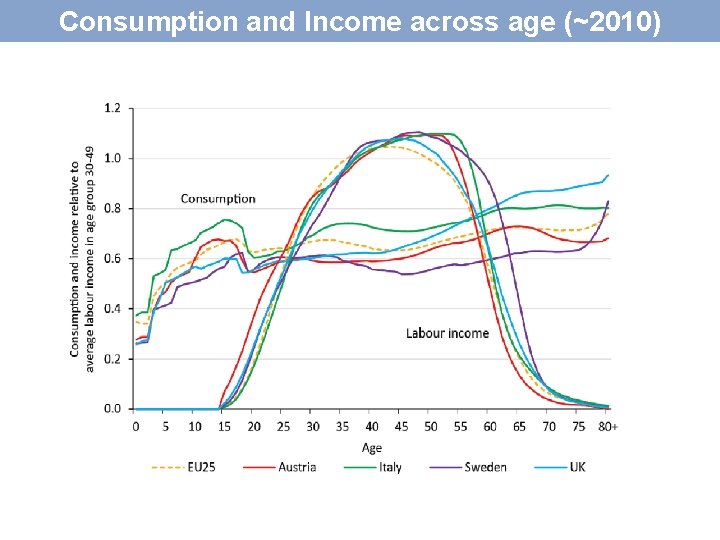
Consumption and Income across age (~2010)
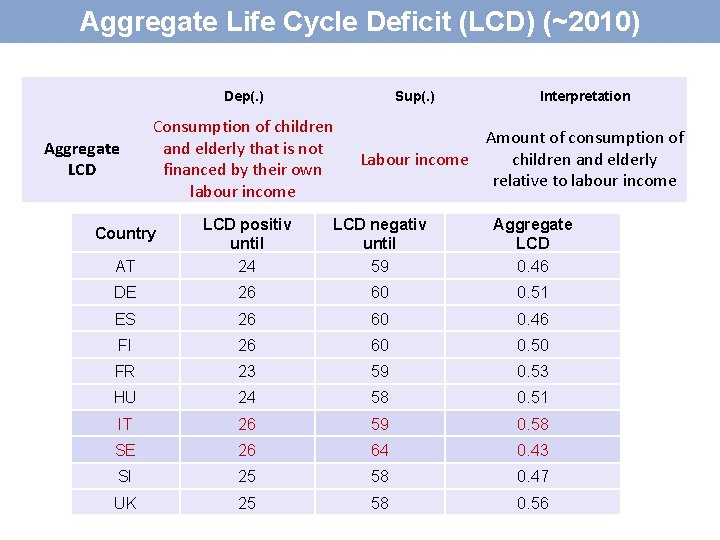
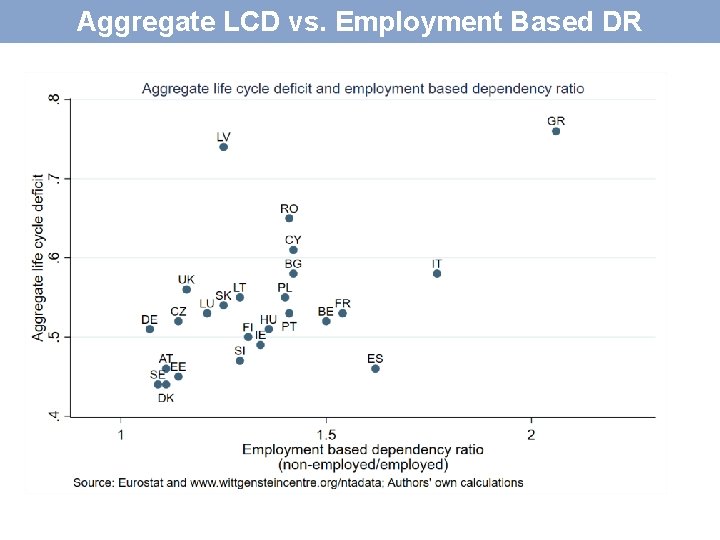
Aggregate Life Cycle Deficit (LCD) (~2010) Dep(. ) Aggregate LCD Sup(. ) Consumption of children and elderly that is not financed by their own labour income Interpretation Amount of consumption of Labour income children and elderly relative to labour income AT LCD positiv until 24 LCD negativ until 59 Aggregate LCD 0. 46 DE 26 60 0. 51 ES 26 60 0. 46 FI 26 60 0. 50 FR 23 59 0. 53 HU 24 58 0. 51 IT 26 59 0. 58 SE 26 64 0. 43 SI 25 58 0. 47 UK 25 58 0. 56 Country
Aggregate LCD vs. Employment Based DR
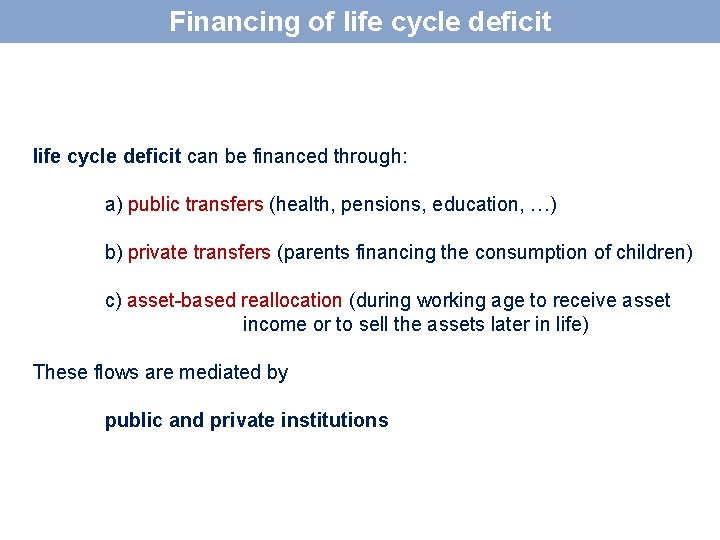
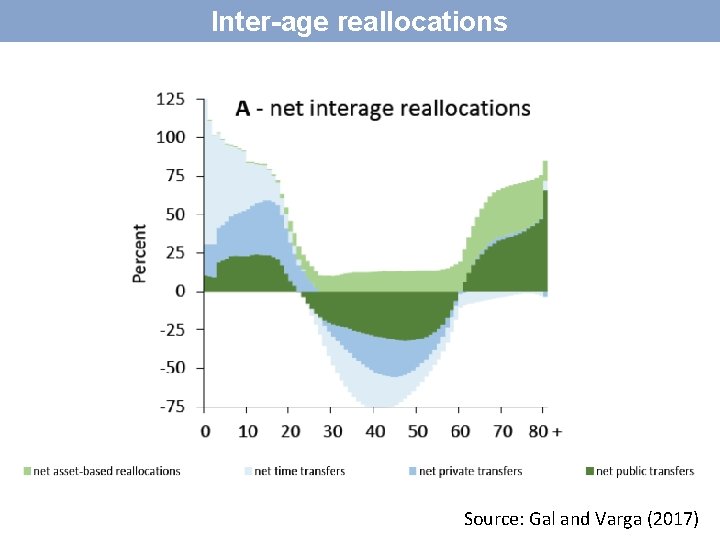
Financing of life cycle deficit can be financed through: a) public transfers (health, pensions, education, …) b) private transfers (parents financing the consumption of children) c) asset-based reallocation (during working age to receive asset income or to sell the assets later in life) These flows are mediated by public and private institutions
Inter-age reallocations Source: Gal and Varga (2017)
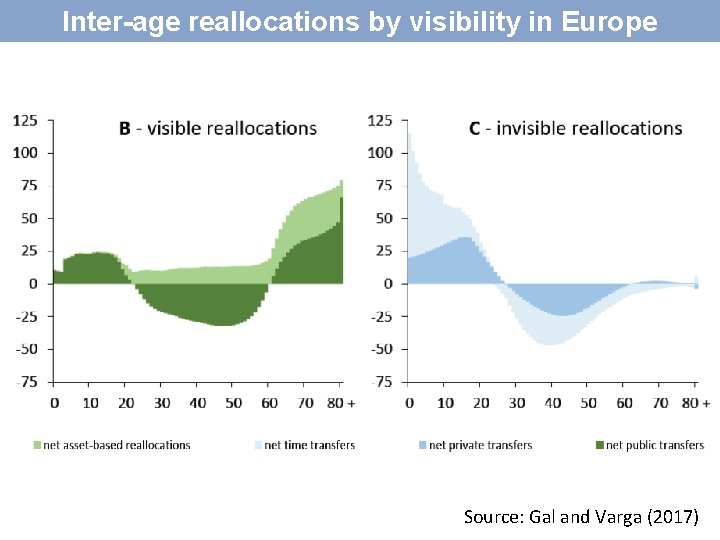
Inter-age reallocations by visibility in Europe Source: Gal and Varga (2017)
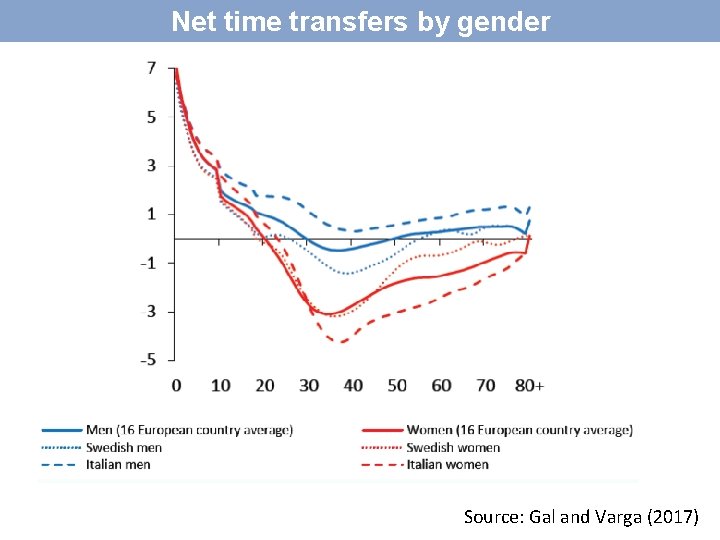
Net time transfers by gender Source: Gal and Varga (2017)
Conclusions Economic dependency determined by: Ø demography Ø age-specific type and intensity of economic activity Ø definition of dependency Effective ways to decrease economic dependency • use of labour force potential in working age (including increase in retirement age) • investment in human capital as the source of future benefits! • use of assets for old age provision How dependency rates are defined plays a crucial role in how we measure and think about the dependency.
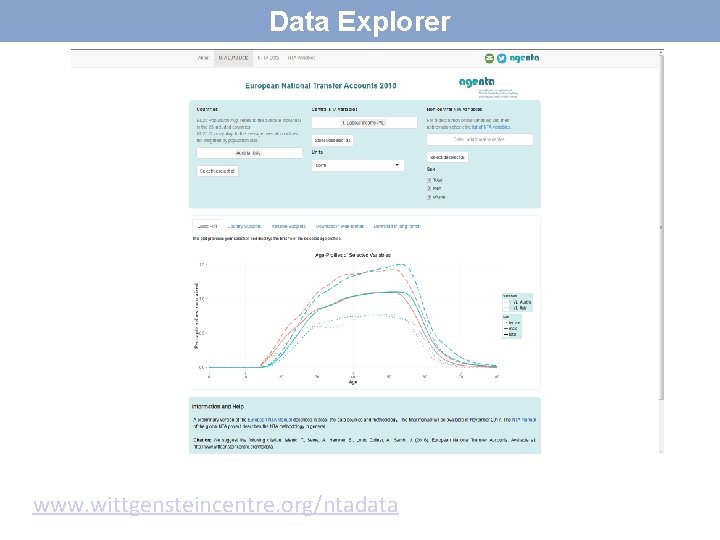
Data Explorer www. wittgensteincentre. org/ntadata
References Loichinger, E. , Hammer, B. , Prskawetz, A. , Freiberger, M. and J. Sambt (2017) Quantifying Economic Dependency, European Journal of Population 33, 351 -380. Prskawetz, A. , and B. Hammer (2018) Does education matter? – economic dependency ratios by education, Vienna Yearbook of Population Research 16 Zanella, M. , Hammer, B. , Prskawetz, A. and J. Sambt (2018) A Quantitative Assessment of the Rush Hour of Life in Austria, Italy and Slovenia, European Journal of Population 33, 351 -380. http: //agewell. eu/ AWA – Age Well Accounts http: //www. agenta-project. eu/en/index. htm AGENTA
Many thanks
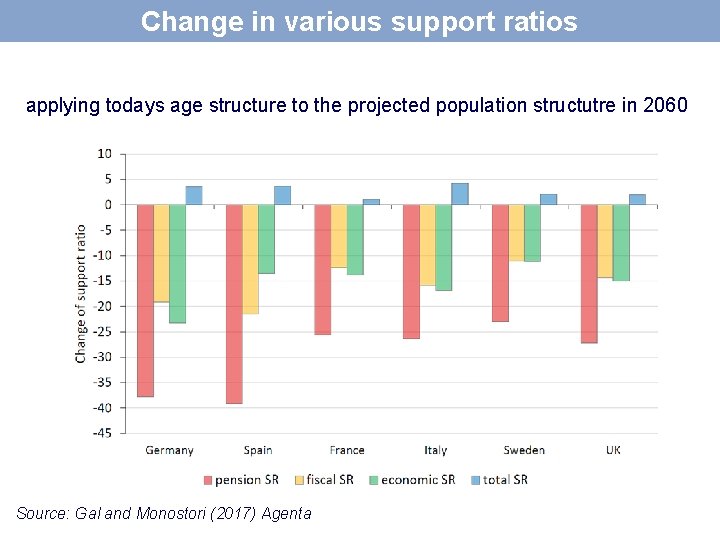
Change in various support ratios applying todays age structure to the projected population structutre in 2060 Source: Gal and Monostori (2017) Agenta
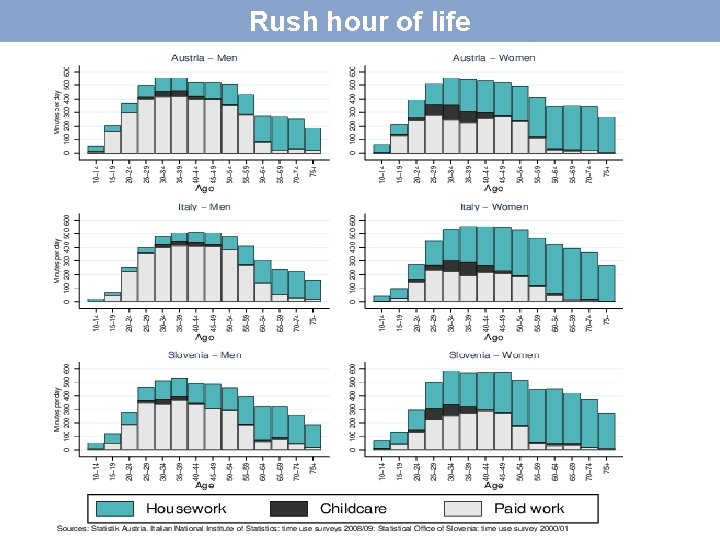
Rush hour of life
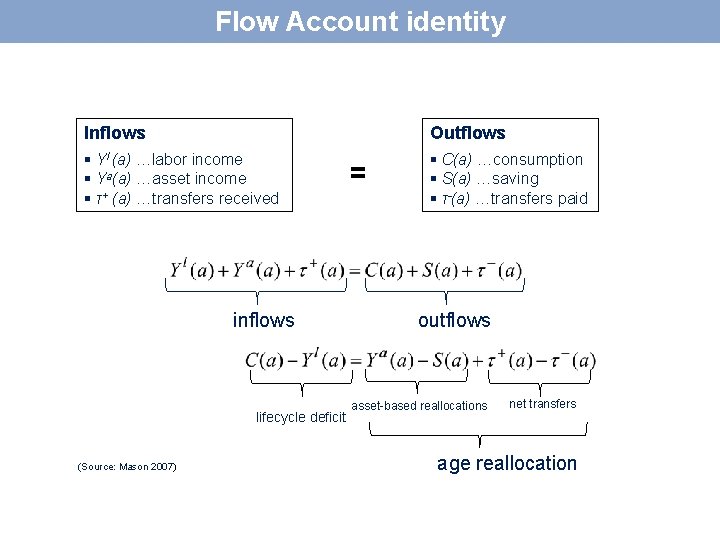
Flow Account identity Inflows Outflows § Yl (a) …labor income § Ya(a) …asset income § τ+ (a) …transfers received § C(a) …consumption § S(a) …saving § τ-(a) …transfers paid inflows lifecycle deficit (Source: Mason 2007) = outflows asset-based reallocations net transfers age reallocation
AGENTA Project AGENTA project: www. agenta-project. eu Ø Joint research project of 9 European partners funded by the European Union‘s FP 7 framework programme (grant agreement no 613247. ) 2014 -2017 Ø Explaining and forecasting public transfers in the light of demographic change Ø Important part of the project: gender-specific NTA and NTTA for European countries Ø Use of harmonized and publicly available data from Eurostat (ESA, EU-SILC, HBS…) Ø NTA for almost all EU countries Ø Using exactly the same methodology
NTA - Project NTA-Project: www. ntaccounts. org Ø Founders and coordinators: Ronald D. Lee (University of Berkley), Andrew Mason (East West Center Hawaii) Ø Teams from 50 countries Ø Development of methodology and collection of data Lee, R. and Mason, A. , editors (2011). Population Aging and the Generational Economy: A Global Perspective. UN (2013). National Transfer Accounts Manual: Measuring and Analysing the Generational Economy. United Nations